Act I
“Trash. Wipe it before I say cut.”
The words rang across the cardio floor of one of Miami’s most exclusive gyms, where mirrored walls reflected rows of expensive machines, LED lights glowed overhead, and a dozen members had stopped pretending not to watch.
Twenty-two-year-old Ethan Miller stood beside a treadmill with a cleaning towel draped over one shoulder. His black uniform was damp from a long shift, and he had been trying to wipe down the machine for less than a minute.
The man shouting at him was Blake Donovan, a thirty-three-year-old fitness influencer with a sculpted physique, a designer tank top, and a camera crew that followed him as if every movement deserved to become a viral moment.
Blake’s phone was still recording.
“Do you have any idea how long you’ve been standing there?” he demanded, gesturing toward the treadmill as though Ethan had deliberately sabotaged his workout.
Ethan glanced at the machine.
“I’m cleaning it now.”
Another member had just stepped off, leaving sweat across the handrails and console. Ethan had waited for the person to finish, then approached with disinfectant and a clean towel. It was an ordinary part of his job, the kind of task he performed dozens of times every shift.
But Blake had already begun filming his next workout clip, and the brief delay had interrupted the shot he wanted.
He turned toward his camera operator.
“Keep rolling. This is exactly what I’m talking about. Nobody takes pride in their work anymore.”
Ethan tried to remain professional.
“Sir, I just need a few seconds to finish.”
Blake stepped off the treadmill.
“You don’t tell me how long anything takes.”
“I wasn’t. I’m just cleaning the machine.”
That answer seemed to offend him more than an argument would have.
Blake moved closer, lowering his voice just enough to make the threat feel personal.
“You know who you’re talking to?”
Ethan shook his head.
“I know you’re a member.”
Blake laughed without humor.
“I’m the reason people like you have jobs in places like this.”
Several members exchanged uncomfortable glances.
Blake’s face appeared on fitness screens across social media. His training videos attracted millions of views, and his sponsored posts promoted supplements, athletic clothing, and luxury wellness products. He had built a personal brand around discipline, confidence, and the idea that successful people refused to tolerate mediocrity.
Off camera, he expected everyone around him to behave as though his time was more valuable than theirs.
Ethan reached for the disinfectant bottle.
“I’ll have it ready in a moment.”
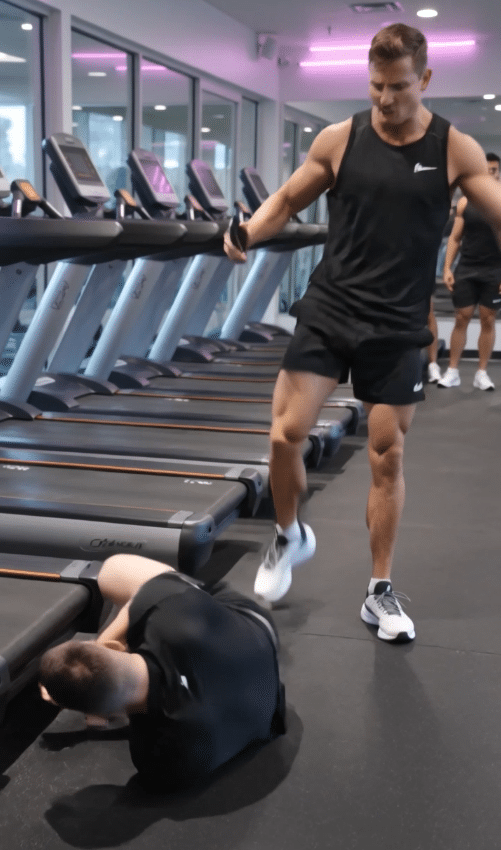
Blake shoved his phone toward the camera operator, stepped fully away from the treadmill, and kicked Ethan forcefully in the chest.
Ethan crashed onto the floor beside the machine. The cleaning bottle rattled against the treadmill base, and the towel slipped from his shoulder. When he tried to catch himself, his palm scraped against the floor, leaving a thin trace of blood.
A woman on a nearby elliptical covered her mouth.
A trainer stopped mid-sentence.
The camera operator kept filming, his expression caught between disbelief and fear.
Ethan struggled to sit up, breathing sharply as he tried to understand what had just happened.
“I’m cleaning it now,” he said again.
Blake looked down at him.
“Trash. Wipe it before I say cut.”
Then he delivered two more forceful kicks, one to Ethan’s back and another to his side.
Ethan winced and twisted away, keeping his head clear of the treadmill’s metal base. His hand reached instinctively for the machine, not to attack Blake, but to steady himself as pain spread through his chest.
The gym had gone quiet.
Nobody intervened.
Blake straightened his tank top and glanced toward the camera.
“Gym staff stay under the brand.”
He said it like a rule everyone should have understood from the beginning.
Then a glass office door swung open behind him.
The sharp impact echoed across the cardio floor.
A man in a premium black athletic jacket stepped out, moving so quickly that the employees near the office instinctively stepped aside. He was fifty-one-year-old Marcus Reed, founder and owner of the fitness chain.
Marcus crossed the floor, saw Ethan on the ground, and immediately placed himself between the injured employee and Blake.
Blake started to speak.
Marcus struck him once with a forceful punch.
The influencer stumbled backward, clutching his face as the camera continued recording. A thin trace of blood appeared at the corner of his mouth.
Marcus didn’t look at the camera.
He looked directly at Blake.
“That machine just ran your contract straight out of here.”
Blake’s expression changed.
The anger disappeared first.
Then the arrogance.
Finally, his eyes darted toward the camera operator, as though the person who had been documenting his power might somehow rescue him from the consequences.
“My contract?”
For the first time since he had entered the gym, Blake Donovan had no idea what to say.
And he was about to discover that the machine he had kicked Ethan beside was connected to a business deal worth far more than his next viral video.
Act II
Blake Donovan had spent nearly a decade turning his body into a business.
His earliest videos were simple workout clips filmed in a cramped apartment gym. He talked about consistency, early mornings, and the discipline required to change one’s life. His audience grew because he seemed approachable, a man who had built his success through hard work rather than inherited wealth.
As his following expanded, the message became more polished.
He began appearing in designer athletic clothing, traveling to exclusive resorts, and posting videos from luxury gyms around the country. His sponsorship deals grew larger, and his social media accounts became a carefully managed portfolio of aspirational images.
Blake stopped being merely a fitness creator.
He became a brand.
That distinction mattered because a brand could sell more than a workout plan. It could sell trust, discipline, ambition, and the belief that people who followed Blake were buying into a better version of themselves.
Companies paid him to embody those values.
He was particularly proud of his partnership with Apex Performance, a major athletic and wellness company preparing to launch a premium training campaign. The deal included a substantial signing payment, performance bonuses, and a long-term promotional agreement tied to the opening of several flagship fitness locations.
Blake had already told his followers that the partnership would be the biggest achievement of his career.
He had also made it clear to the people around him that the contract changed his status.
At the Miami gym, staff members had received repeated requests to accommodate his filming schedule. Machines were sometimes reserved for his workouts, trainers were asked to wait until he finished recording, and employees were expected to keep members out of the background whenever Blake wanted a clean shot.
Most staff members tolerated the inconvenience.
Blake brought publicity to the location, and the gym’s marketing team had encouraged collaboration with popular fitness creators.
But Ethan Miller had never been particularly impressed by fame.
He was twenty-two, lived in a small apartment several miles from the gym, and worked early and late shifts while taking online courses in physical therapy. He hoped to become a licensed rehabilitation specialist one day, helping people recover from injuries and regain confidence in their bodies.
For now, he cleaned equipment, restocked towels, checked supplies, and helped members navigate the facility.
It was not glamorous work.
Ethan took pride in doing it well.
His father had spent years working as a mechanic, and his mother had managed a small medical office. Neither had ever been able to give him much money, but both had taught him that a person’s job was not a measure of their worth.
When Ethan started at the gym, his supervisor praised him for noticing small problems before they became large ones. He regularly checked machines for loose attachments, reported damaged equipment, and made sure disinfectant stations remained stocked.
He also understood why the cleaning rules mattered.
A busy gym could not rely on appearances alone. Machines needed to be wiped down between users, spills had to be handled quickly, and employees had to balance speed with basic safety.
That afternoon, another member had finished using the treadmill just as Blake began setting up his camera.
Ethan waited until the machine was free, approached with his supplies, and began cleaning it.
Blake saw a delay.
Ethan saw a task that needed to be completed properly.
The difference became a confrontation because Blake believed the gym existed to support his image.
The staff existed to make his videos possible.
The members were an audience.
And any interruption was an insult.
The gym’s owner, Marcus Reed, had built the company around a different philosophy.
He had opened his first fitness center after working as a trainer and watching too many facilities treat employees as disposable while spending enormous sums on celebrity endorsements. He wanted a chain where the equipment was reliable, the staff were trained properly, and members felt welcome regardless of their income or social status.
As the business expanded, Marcus learned that a strong brand required more than attractive facilities.
It required people who could be trusted to protect the experience behind the scenes.
That was why he had recently approved a major campaign with Apex Performance.
The agreement would combine Apex’s product launch with the gym chain’s new premium training program. Blake Donovan was supposed to be the public face of the collaboration, appearing in promotional videos and demonstrating the company’s equipment in carefully designed workout sessions.
Marcus had personally approved the partnership after reviewing Blake’s public image.
The influencer’s message about discipline and respect aligned with the values the company wanted to promote.
But Marcus had also insisted on conduct requirements.
The contract contained provisions covering harassment, physical misconduct, unauthorized filming of employees, and behavior that could reasonably bring the campaign into disrepute. The company did not want to invest millions in a public partnership only to discover that its spokesperson treated ordinary workers with contempt.
Blake’s representatives had agreed to the terms.
They believed the clauses were standard legal language that would never become relevant.
Marcus, however, had begun hearing complaints from several gym locations. Employees described an influencer who demanded special treatment and berated staff when they failed to accommodate him. Members had also reported uncomfortable filming sessions that made them feel as though they were unwilling extras in someone else’s advertisement.
The complaints were not yet sufficient to end the partnership.
Marcus asked his operations director to document them and review the relevant footage. He wanted to distinguish legitimate concerns from ordinary disagreements over filming schedules.
Then Blake arrived in Miami to record a promotional workout.
Marcus happened to be working in the glass office overlooking the cardio floor.
He heard the shouting.
He watched Ethan fall.
And within seconds, the carefully constructed image of the campaign’s star no longer matched the man standing in front of him.
But Marcus’s decision was not based on a single punch or an angry exchange.
Before he left the office, his phone had already displayed a message from Apex’s campaign director.
The company was asking about a new video circulating internally.
It had been recorded at another gym.
And it showed Blake doing something that made the Miami incident look like part of a pattern.
Act III
The first warning had arrived three weeks earlier.
Apex Performance had been preparing to launch its most expensive fitness campaign in years. The company planned to introduce a new line of training equipment, expand its premium membership partnerships, and use Blake Donovan’s enormous online audience to reach customers who might never respond to traditional advertising.
The marketing team had invested months in the campaign.
Studio sessions had been booked. Promotional materials had been designed. Retail partners had been given launch dates, and the first advertising placements were already scheduled.
Blake’s contract was the centerpiece.
He was not simply being paid to wear a shirt with a logo. He was expected to represent the company’s philosophy of discipline, professionalism, and respect for the training community.
Then an employee at another gym submitted a complaint.
The report described Blake berating a cleaner who had asked him to move his equipment away from a walkway. The employee alleged that Blake had insulted him and demanded that the gym manager remove him from the shift.
There was no physical assault documented in that complaint, and the initial account contained conflicting details. Apex did not immediately terminate the partnership.
Instead, the company’s legal team asked for additional information.
A second report arrived soon afterward.
A trainer at a different location described being pressured to delay a class because Blake wanted an uninterrupted filming session. When the trainer objected, Blake reportedly threatened to complain to management and have him removed from the schedule.
Again, the details required verification.
But the complaints shared a troubling feature: Blake appeared to treat workers as obstacles to his content rather than people carrying out legitimate responsibilities.
Apex’s campaign director, Lauren Mitchell, asked Marcus whether the gym chain had experienced similar issues.
Marcus authorized an internal review.
The findings were uncomfortable. Staff members at several locations described demands for special access, hostile comments, and repeated attempts to make employees accommodate filming at the expense of ordinary operations.
Some complaints could be resolved through scheduling changes.
Others suggested a deeper problem.
Marcus did not want to destroy someone’s career over rumors, so he asked that the company preserve records and verify each incident. He also requested that Blake’s representatives remind him of the partnership’s conduct requirements.
Blake dismissed the warning.
He told his manager that companies became nervous whenever an influencer attracted attention. He described the complaints as jealousy from people who disliked successful creators.
His manager urged him to be careful.
Blake agreed in the way people agree when they have no intention of changing.
Then came the Miami recording session.
When the incident began, the camera operator was filming what Blake expected to be an ordinary workout sequence. The device captured the exchange with Ethan because Blake had deliberately kept the recording running while insulting him.
At first, the operator believed Blake was performing for the camera.
The influencer often exaggerated his personality to create entertaining clips, and the crew had learned to distinguish his on-camera theatrics from his behavior between takes.
But the attack was not a performance.
The camera recorded Blake stepping off the treadmill, kicking Ethan in the chest, and delivering two additional kicks after the younger man fell.
It also recorded Ethan’s repeated attempt to explain that he was cleaning the machine.
The footage was not edited.
There was no missing context that could turn the incident into a harmless joke.
When Marcus entered the cardio area, the operator instinctively lowered the camera, but he did not stop recording.
Marcus instructed him to preserve the original file and provide it to the appropriate investigators. He also asked the gym’s management team to secure any relevant security footage and document the names of witnesses.
Then he checked on Ethan.
The employee was shaken and in pain, but he was conscious. Marcus stayed beside him until medical assistance arrived, refusing to let Blake approach him.
Blake kept demanding to know why the owner had intervened.
“You can’t just throw away a partnership because of one argument,” he protested.
Marcus turned toward him.
“You attacked a member of my staff.”
“He was wasting my time.”
“He was doing his job.”
“I pay to use this facility.”
“And that doesn’t give you the right to hurt someone.”
Blake glanced at the camera.
He seemed to remember, too late, that his own crew had recorded everything.
Marcus’s phone rang again.
Lauren Mitchell was on the line.
She had already received the incident report from the gym’s operations director and wanted confirmation that the footage was authentic. Marcus told her the original recording was being preserved and that the company would cooperate with the investigation.
There was a pause.
Then Lauren asked whether Blake was still at the facility.
“Yes,” Marcus replied.
“Keep him away from your employees. Our legal team is reviewing the contract now.”
Marcus ended the call.
Blake’s face tightened.
“What contract?”
Marcus stepped closer, his voice low enough that the surrounding members had to lean in to hear him.
“The one that says Apex doesn’t have to pay you to represent values you refuse to practice.”
Blake attempted to laugh.
“You’re bluffing.”
Marcus did not answer immediately.
He looked toward the glass office, where his operations director was already gathering the partnership documents. Then he turned back to the influencer.
“That machine just ran your contract straight out of here.”
The words were not an impulsive threat.
Apex had spent weeks investigating complaints that Blake had dismissed as meaningless. The Miami footage had supplied clear evidence of physical misconduct, and the contract’s conduct provisions gave the company grounds to suspend promotional activity while the incident was reviewed.
The campaign director had made her position clear.
No new content would be released.
No additional promotional payment would be authorized while the legal team evaluated the breach.
And if the footage confirmed what everyone in the gym had witnessed, the partnership would be terminated.
Blake stared at Marcus.
For the first time, he understood that the person standing in front of him was not merely an owner protecting his employee.
Marcus controlled the venue, the partnership relationship, and the access Blake needed for the campaign.
But the final decision belonged to Apex.
And the company had already seen the video.
Act IV
By the next morning, Blake’s representatives were scrambling to contain the damage.
His manager contacted Apex’s legal department, arguing that the incident had occurred during a stressful filming session and should not determine the future of a multimillion-dollar partnership.
The argument failed to address the central problem.
Ethan had not threatened Blake.
He had not interrupted the workout deliberately.
He had been cleaning a treadmill.
The original footage showed Blake attacking him after a minor delay, then continuing the assault while the younger man tried to protect himself.
Apex suspended the campaign and froze the remaining promotional payments permitted under the agreement while the company reviewed the breach. Its legal team notified Blake’s representatives that the conduct provisions could justify termination.
The gym chain also suspended Blake’s membership privileges pending the outcome of its internal review and the relevant authorities’ assessment of the assault.
Marcus made no attempt to conceal what had happened.
He provided the original footage to investigators, preserved the gym’s security recordings, and instructed staff not to edit or circulate the material for entertainment. The incident was serious enough without turning Ethan’s pain into another piece of content.
The camera operator cooperated with the review.
So did several members who had witnessed the attack. Their statements confirmed the sequence recorded on video, including Blake’s insults and the three kicks.
Blake’s team attempted to argue that his comments had been exaggerated by the pressure of filming.
But the evidence did not depend on his tone.
It depended on what he had done.
The company also examined the earlier complaints. Some were substantiated by messages and scheduling records; others remained allegations that could not be fully verified. Together with the Miami footage, however, they raised legitimate concerns about whether Blake could continue representing a brand built around responsible fitness culture.
Apex’s executives faced a difficult commercial decision.
Blake’s audience was enormous, and canceling the campaign would mean losing a planned launch strategy that had cost the company substantial money. Retail partners had already prepared promotional displays, and marketing teams had scheduled advertisements around his participation.
Terminating the partnership would be expensive.
Keeping it would be worse.
If Apex continued paying Blake after receiving clear evidence of his behavior, it would be asking customers to believe in values its own spokesperson had publicly disregarded.
The company decided to end the partnership under the agreement’s applicable conduct provisions, subject to the contract’s formal termination process.
The announcement was brief.
Apex stated that Blake would no longer participate in the campaign and that the company expected all brand representatives to treat employees, customers, and members of the fitness community with respect.
It did not sensationalize the assault.
It did not declare him guilty of every allegation made against him.
It simply made clear that the partnership was over.
Blake learned the decision through his manager.
He called Marcus almost immediately.
“You can’t do this to me,” he said. “Do you understand what that contract was worth?”
Marcus stood in his office, looking through the glass toward the cardio floor.
“I understand exactly what it was worth.”
“Then you know you’re destroying my career over one bad moment.”
“No, Blake. I’m refusing to pretend that moment didn’t happen.”
“You hit me!”
Marcus did not deny it.
His own conduct was subject to scrutiny, and the gym would cooperate with any appropriate review of the confrontation. He understood that protecting an employee did not mean he was exempt from accountability for his own actions.
But Blake’s attempt to shift the conversation did not erase the assault that had started the incident.
“You’ll have to answer for what I did,” Marcus told him. “And you’ll have to answer for what you did to Ethan.”
Blake ended the call.
He had expected the owner to retreat, negotiate, or offer a private settlement that would keep the partnership alive. Instead, Marcus had preserved the evidence and allowed the contractual process to proceed.
Within days, the video began circulating beyond the original group of witnesses.
The gym did not release it for publicity. The footage spread after people who had seen the incident discussed it, and the original recording became part of the material being reviewed.
The response was immediate.
Followers who had admired Blake’s discipline questioned why he had attacked a worker over a few seconds of cleaning. Others began comparing the incident with earlier complaints about his treatment of gym employees.
Some of those stories could not be independently verified, and responsible coverage distinguished between the confirmed assault and unproven claims.
But the central facts were undeniable.
Blake had kicked a worker who was doing his job.
The partnership was canceled.
And the image he had spent years constructing could no longer be separated from the behavior recorded on camera.
Ethan, meanwhile, was recovering away from the gym.
Marcus arranged paid leave and made sure the company covered the support available under its employee policies. Ethan received medical attention and was given time to recover without pressure to return before he was ready.
When Marcus visited him, Ethan asked a question that surprised the owner.
“Am I going to lose my job because this became such a big problem?”
Marcus looked at him.
“You didn’t create this problem.”
“I don’t want everyone at work getting dragged into it.”
“They won’t be asked to protect someone who hurt you. And you won’t be punished for reporting what happened.”
Ethan lowered his eyes.
He had spent the previous night worrying about rent, missed shifts, and whether a confrontation with a famous influencer might make him unemployable. He had imagined a future in which he had to choose between speaking honestly and keeping the job that helped pay for his education.
Marcus’s answer did not erase those fears immediately.
But it gave Ethan something he had not expected to receive from the situation.
A clear assurance that his dignity was not a condition of his employment.
Blake, on the other hand, was discovering that losing a contract meant more than losing a payment.
The campaign had been expected to introduce him to a new audience and position him as a serious business partner rather than merely a popular creator. Its cancellation damaged the professional credibility he had been trying to build.
His management team could issue statements.
They could request meetings.
They could argue that one incident should not define an entire career.
But they could not make the footage disappear.
And every time Blake tried to explain why the incident should be forgotten, he had to confront the same humiliating question.
If his brand stood for discipline, why had he been unable to control himself when a worker asked for a few seconds to clean a machine?
Act V
Three weeks later, Ethan returned to the Miami gym.
The cardio floor looked almost exactly as it had before. Members moved between treadmills, trainers coached clients through their routines, and the mirrored walls reflected the familiar rhythm of an ordinary afternoon.
The machine beside which Ethan had fallen had been inspected and returned to service.
A fresh cleaning towel hung over his shoulder.
For a moment, he stood still beside the treadmill, remembering the sound of Blake’s voice and the sudden impact that had sent him to the floor.
He had replayed the incident in his mind more times than he wanted to admit.
The physical pain had begun to fade, but the memory of everyone watching without moving was harder to shake. He understood why people had frozen. The situation had unfolded quickly, and Blake’s aggression had made the room feel dangerous.
Still, the silence had stayed with him.
Marcus approached from the glass office.
“How are you feeling?”
“Better,” Ethan replied. “Not completely back to normal, but better.”
“Don’t rush it.”
Ethan nodded.
He had expected the owner to talk about the contract, the news coverage, or the damage to the gym’s reputation. Instead, Marcus asked whether the company had provided everything Ethan needed during his recovery.
The question made him realize how unusual the previous weeks had been.
For once, the person with the most authority in the building was asking what an employee needed rather than what the employee could do for him.
“I think I’m okay,” Ethan said. “I just want to get back to work.”
Marcus gave him a quiet nod.
“Then we’ll do that at your pace.”
The company had also changed its procedures for commercial filming. Influencers and other outside partners would be required to follow clear rules about equipment access, member privacy, staff interactions, and conduct on the premises.
No promotional arrangement would override an employee’s responsibility to maintain a safe facility.
The changes were not dramatic.
They were practical.
But they addressed the exact assumption that had allowed Blake to believe he could command the gym floor simply because his name attracted attention.
A business partnership was not a license to intimidate people.
And a person’s popularity did not make ordinary workplace rules optional.
Apex Performance moved ahead with a revised campaign that used trainers and fitness professionals rather than a single celebrity spokesperson. The company focused on the people who actually taught classes, maintained equipment, and helped customers use its products safely.
The new campaign was less glamorous than the one originally planned.
It was also more consistent with the company’s stated values.
Blake’s professional future remained uncertain. His representatives challenged aspects of the contract termination, and the legal issues were handled through the appropriate process. The assault itself was addressed separately from the commercial dispute, ensuring that neither the gym nor the sponsor treated the incident as merely a public relations problem.
The cancellation did not instantly erase Blake’s following.
Some people continued to support him, insisting that he deserved a second chance. Others stopped watching his videos altogether. Several former collaborators distanced themselves from his brand.
The consequences were not a single dramatic collapse.
They were the slow loss of trust.
And trust, once damaged, was much harder to rebuild than a social media audience.
Blake had believed that his contract proved how important he was.
Now the contract had become a reminder of what he had failed to understand.
The sponsor had not hired him simply because he looked successful on camera. It had hired him because it believed his public image reflected values that customers would respect.
The moment he attacked Ethan, he gave the company reason to question that belief.
The machine had not destroyed his career.
His own decision had placed it at risk.
Months later, Ethan completed another semester of his physical therapy coursework. He continued working at the gym, saving money, and learning more about rehabilitation from the trainers and specialists he met there.
He never became famous because of the incident.
He did not seek interviews or try to turn his experience into a personal brand. When people asked about the video, he answered briefly and returned to his work.
He wanted a future in which his identity was defined by what he built, not by what someone had done to him.
Marcus respected that.
One evening, as Ethan finished wiping down a treadmill, the owner stopped beside him.
“You know,” Marcus said, “I built this company because I wanted people to feel welcome here. Members, trainers, cleaners—everyone.”
Ethan looked up.
“I think most people do feel welcome.”
“Then we have to keep earning that.”
Marcus glanced toward the glass office.
He had replayed the moment he entered the cardio floor many times, too. He knew his decision to strike Blake had created its own questions, and he did not pretend that anger excused every action. The company would cooperate with any review, and he would accept the consequences of his own choices.
But he had also learned something about leadership that no contract could teach.
The true test of a business was not how it treated its most famous guest.
It was what it did when an ordinary employee was being hurt in plain sight.
Ethan picked up the cleaning bottle and moved to the next machine.
Another member had just stepped off.
The treadmill needed wiping.
And this time, nobody demanded that he hurry for the sake of a camera.
The gym returned to its familiar rhythm, but the lesson remained.
Blake had walked in believing that fame placed him above the people who kept the facility running. He had mistaken a sponsorship for ownership, attention for respect, and the ability to command a room for the right to control everyone inside it.
He had kicked a worker because a machine was not ready when he wanted it.
Then the owner walked out of the glass office and made clear that the partnership was finished.
“My contract?” Blake had asked, his face drained of confidence.
The question revealed the truth he had spent years avoiding.
He had been so focused on protecting the brand he built that he had forgotten what made anyone willing to pay for it in the first place.
Respect could be advertised.
It could be printed on a shirt, repeated in a motivational speech, and attached to a million-dollar agreement.
But the moment it mattered, respect was measured by how a person treated someone who could offer them nothing in return.
Ethan had been cleaning a treadmill.
Blake had seen a servant.
Marcus had seen an employee who deserved protection.
And when the camera captured all three perspectives, the most powerful man in the room was no longer the one demanding that everyone keep filming.
It was the man who understood that a successful business could survive losing a famous influencer.
What it could not afford was losing the trust of the people who made it work.