Act I
“Trash. Scholarship servants fix everything.”
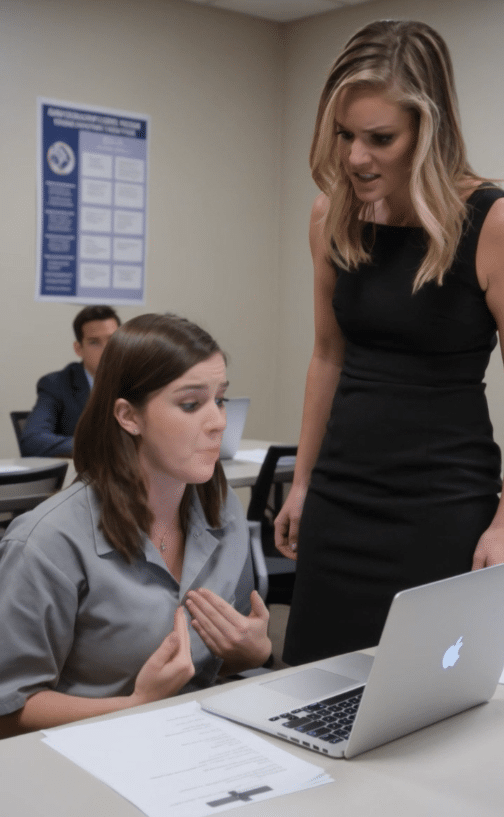
The words echoed through the university seminar room just as twenty-year-old Emily Parker struggled to push herself upright beside the presentation table. Her gray sweater was twisted at the shoulder, her elbow stung, and her laptop lay dangerously close to the edge of the desk.
Across from her stood Victoria Ashford, a twenty-one-year-old student whose designer handbag cost more than Emily spent on groceries in a month. Victoria’s father was one of the university’s largest donors, her name appeared on invitations to exclusive campus events, and professors often treated her complaints with the urgency reserved for important people.
She looked down at Emily as though the girl on the floor were an inconvenience that had somehow learned to speak.
“Present from the floor,” Victoria ordered.
Nobody laughed.
That seemed to irritate her more than anything else.
Five minutes earlier, the problem had been embarrassingly ordinary. The library printer had run out of paper just as Emily tried to print an extra copy of the group’s research handout. She had immediately emailed the final document to every student in the seminar, including the professor, and explained that the electronic version contained everything they needed.
The presentation was ready.
The missing paper copy changed nothing.
But Victoria had been waiting for an excuse to humiliate her.
“You were supposed to have printed copies,” Victoria said, stepping closer. “Do you have any idea how unprofessional this makes us look?”
Emily kept her voice steady.
“I emailed everyone the final copy.”
Victoria’s smile sharpened.
“You think sending an email makes you equal to the rest of us?”
Emily looked toward the professor, Dr. Michael Bennett, who stood near the projector with a folder pressed against his chest. Several students glanced at him, silently expecting him to intervene.
He hesitated.
That hesitation gave Victoria exactly the opening she wanted.
“Your scholarship pays for your education,” she continued. “It doesn’t mean the rest of us have to carry you.”
Emily’s cheeks flushed.
“My scholarship is based on my grades. I finished the research, checked the sources, and sent the handout to everyone.”
“Then why isn’t it printed?”
“Because the printer ran out of paper.”
Victoria stared at her as if Emily had deliberately insulted her.
“Take responsibility.”
“I have.”
“No. You’re going to stand there and apologize to everyone for making this group look pathetic.”
Emily placed her laptop on the seminar table and began to explain that she could display the complete document on the projector.
Victoria moved before she finished.
She stepped directly in front of Emily and kicked her forcefully in the chest.
Emily fell hard beside the table. Her elbow struck the floor, leaving a thin trace of blood on her skin, and the laptop slid toward the edge of the desk.
A student gasped.
Someone else covered her mouth.
Emily tried to pull herself upright, one hand reaching instinctively for the laptop.
“I emailed everyone the final copy,” she repeated, her voice strained with pain.
Victoria looked down at her.
“Trash. Scholarship servants fix everything.”
Then she delivered two more forceful kicks, one to Emily’s back and another to her side.
Emily winced and curled inward, struggling to keep the laptop from falling while trying to shield herself from another blow.
The seminar room had become unbearably quiet.
Dr. Bennett stood frozen near the projector. A student who had been sitting beside Emily’s research notes backed away from the table. Nobody touched Victoria. Nobody helped Emily.
They were all watching a rich girl attack a scholarship student over a handout that already existed in everyone’s inbox.
Victoria straightened her dress.
“Present from the floor.”
Emily stared at her, struggling to catch her breath.
For a moment, the only sound was the projector fan.
Then the seminar room door burst open and slammed against its doorstop.
Dean Robert Lawson entered in a brown suit, accompanied by Margaret Ellis, a fifty-year-old representative of the university’s scholarship board. Margaret carried a thick folder secured with a black clip.
Neither of them looked confused.
They looked furious.
Margaret crossed the room, stopped beside Emily, and positioned herself between the injured student and Victoria. Then she turned and delivered one decisive slap across Victoria’s face.
Victoria staggered half a step, one hand flying to her cheek.
The dean’s voice cut through the silence.
“That missing page just completed the report on you.”
Victoria stared at him.
Her confidence vanished so quickly that even the students who had feared her began to notice.
“Report on me?”
For the first time in her life, Victoria Ashford was standing in front of a room full of people who were no longer impressed by her name.
And the missing page she had mocked was about to expose a secret far more dangerous than a failed printer.
Act II
Victoria had grown up believing that consequences were negotiable.
Her father, Charles Ashford, was a successful real estate developer whose name appeared on university buildings, scholarship announcements, and gala invitations. He had funded laboratories, sponsored student programs, and donated enough money to ensure that his presence was felt even when he wasn’t in the room.
Victoria had learned early that people treated her differently because of him.
When she complained about a professor, the department chair usually called her back within a day. When she missed a deadline, an explanation was often accepted that would have been rejected from another student. When she offended someone, her father could arrange a private meeting in which the problem somehow became a misunderstanding.
Nobody had ever told Victoria that her behavior was acceptable in plain language.
They had simply allowed her to believe it.
By her second year, she had become one of the university’s most recognizable students. She organized charity events, appeared in campus promotional photographs, and attended dinners with alumni who enjoyed meeting the daughter of a major donor.
She knew how to smile for cameras.
She knew which professors preferred flattery and which administrators wanted to avoid difficult conversations.
Most importantly, she knew how to make people feel that opposing her would be more trouble than agreeing with her.
Emily Parker had never played that game.
She had grown up in a small Ohio town, where her mother worked as a nurse and her father repaired heating and cooling systems. Money was often tight, but Emily had learned that being unable to afford something was not the same as being less deserving of it.
She earned her university scholarship through exceptional grades, a rigorous application process, and a personal essay about her ambition to work in public policy.
She wanted to understand how institutions made decisions, how powerful people influenced those decisions, and why the consequences so often fell on people with the least influence.
The scholarship gave her the opportunity to study subjects her family could never have afforded otherwise.
Emily understood the responsibility that came with it.
She attended office hours, worked on research projects, and took a part-time job at the campus writing center to cover her living expenses. She rarely complained when assignments piled up because she knew what it meant to have a door open that had once seemed permanently closed.
Victoria interpreted that discipline as desperation.
They had first crossed paths during a group research project about university funding and financial accountability. Emily had spent weeks reviewing public reports, comparing scholarship distributions, and identifying inconsistencies in the way certain grants were described.
Victoria had volunteered to handle the presentation design.
At first, she seemed enthusiastic. She brought polished slides, suggested elegant graphics, and spoke confidently during meetings. But whenever Emily asked for the source behind a financial claim, Victoria brushed her off.
“It’s common knowledge,” she would say.
Emily would ask for documentation.
Victoria would roll her eyes.
The tension grew when Emily discovered that one of the figures in Victoria’s presentation did not match the university’s published records. The discrepancy was small enough to escape casual attention but significant enough to change the impression created by the slide.
Emily corrected it.
Victoria restored the original number.
Emily corrected it again.
Their disagreement became personal when Victoria accused Emily of trying to make her look foolish in front of the professor.
“I’m trying to make sure the report is accurate,” Emily replied.
“You’re a scholarship student. You should be grateful you’re even in this room.”
Emily had stared at her for a long moment.
“I am grateful to be here. That doesn’t mean I have to agree with you.”
Victoria never forgave her for that answer.
The group project became a quiet contest. Victoria controlled the presentation schedule and attempted to assign Emily the less visible tasks. Emily continued to check the figures, verify the sources, and maintain copies of every revision.
She was not trying to expose Victoria.
She was trying to protect the integrity of their work.
But the more Emily checked, the more she noticed that the discrepancy was not limited to a single slide.
Several scholarship totals had been presented without a clear explanation of how they were calculated. A funding category listed in one internal summary did not match the amount in a separate public report. Some grants were described as student assistance, although the documentation suggested they had been allocated through a different administrative process.
Emily did not have access to confidential financial records, and she refused to speculate beyond what she could verify.
She did, however, have a duty to make sure the presentation did not misrepresent the public information available to the group.
She emailed the professor with a question.
Dr. Bennett thanked her and asked her to preserve the source documents.
A few days later, Margaret Ellis from the scholarship board contacted him about an unrelated review of the university’s scholarship reporting practices.
The board had been examining inconsistencies between announced awards, actual disbursements, and the summaries provided to donors. Margaret asked whether any students had recently worked with public funding reports.
Dr. Bennett mentioned Emily’s project.
That was how the investigation began.
Neither Emily nor Victoria knew the full story.
Emily simply kept doing her research.
Victoria, meanwhile, was beginning to understand that the quiet scholarship student she had dismissed was no longer willing to accept her version of events.
So she decided to humiliate Emily in public.
She believed a few cruel words would put the girl back in her place.
She had no idea that Margaret Ellis had already begun asking questions about the Ashford family’s relationship with the university.
And those questions had led to a document Victoria had never expected anyone to read.
Act III
Margaret Ellis had spent twelve years serving on the university’s scholarship board.
She was not easily impressed by large donations or polished speeches. Her job was to ensure that the money entrusted to the board reached the students and programs it was intended to support.
Over the previous semester, she had noticed irregularities in several funding summaries.
The university publicly described a number of awards as need-based scholarships. Yet the internal allocation reports contained categories that were difficult to reconcile with those descriptions. Some figures had been revised after donor briefings, and the supporting explanations were incomplete.
At first, the discrepancies seemed like administrative problems.
Then the same names began appearing in different documents.
The Ashford family had supported a major scholarship initiative that was widely praised as a partnership between private philanthropy and the university. Charles Ashford had spoken at the launch, describing the program as a commitment to helping talented students succeed regardless of their financial circumstances.
The initiative had become one of the university’s most celebrated fundraising achievements.
But the board’s review raised a troubling question: were all the funds being reported in the way donors and students had been led to believe?
Margaret did not accuse anyone without evidence.
She requested reconciliations, compared official announcements with the records available to the board, and asked the university’s finance office to explain several unexplained adjustments. When the answers failed to resolve the discrepancies, she expanded the review.
A missing appendix became the focus of the next stage.
The appendix contained a reconciliation table connecting several scholarship allocations with the administrative categories used to report them. Without it, the summary looked straightforward. With it, the differences became impossible to ignore.
The document had been omitted from a packet prepared for an earlier board meeting.
Nobody could initially explain why.
When Margaret asked for the original file, the office produced several versions with different dates and incomplete supporting pages. The missing appendix was eventually located in an archived folder, but the sequence of revisions raised additional questions about who had approved the changes.
Margaret requested an independent examination.
Dean Lawson was informed because the matter involved academic oversight and the integrity of the university’s scholarship program. He had no interest in protecting a donor’s reputation at the expense of the students the program was supposed to serve.
He also knew that any investigation involving a major benefactor would create pressure.
Charles Ashford had helped fund the university’s expansion. His donations had supported new research facilities and several student initiatives. Administrators were accustomed to treating his family as partners whose concerns deserved immediate attention.
But financial support did not grant a family ownership of the institution.
The dean agreed to cooperate with the review and instructed the relevant offices to preserve the records.
Meanwhile, Emily’s project continued.
The presentation she prepared with her group included a careful comparison of published scholarship figures. She used only verifiable documents, marked areas where information was incomplete, and refused to claim that discrepancies proved misconduct.
That restraint impressed Margaret when she reviewed the materials.
Emily had not accused anyone.
She had simply identified questions that the existing records could not answer.
Then came the missing handout.
The additional printed copy had been intended for a visiting faculty member who wanted to review the source notes during the presentation. When the library printer ran out of paper, Emily emailed the complete document to the group and the professor.
The file included an appendix that Victoria had wanted removed from the presentation.
It was not a confidential financial record. It was a comparison of published figures and documented revisions, assembled from sources the students were permitted to consult.
But it drew attention to the same discrepancies the scholarship board had been investigating.
Victoria had noticed the appendix during an earlier draft review and demanded that Emily delete it.
“You’re making this unnecessarily complicated,” she had said. “The presentation is about scholarship access, not accounting.”
“The numbers are part of the argument,” Emily replied. “If they don’t match, we need to explain why.”
Victoria insisted that the figures had already been approved.
Emily asked to see the supporting documentation.
Victoria never provided it.
Instead, she told the group that Emily was undermining the project and threatened to remove her name from the presentation. Emily responded by emailing the professor the latest version, along with a short explanation of the unresolved discrepancies.
She believed the professor would decide what belonged in the final presentation.
She had no idea that the email would also help Margaret establish which version of the document the students had received and when.
When the printer ran out of paper, the missing physical copy became Victoria’s excuse to blame Emily for a problem that had already been solved electronically.
But the file had reached everyone who needed it.
And the appendix that Victoria wanted buried had become part of the evidence trail.
By the time Margaret and Dean Lawson entered the seminar room, they had enough information to know that the project had intersected with a much larger review.
They had not come to declare Victoria guilty.
They had come to protect the process, secure the relevant materials, and prevent anyone from intimidating students who might possess useful information.
Then they walked in and witnessed Victoria attacking Emily.
The assault changed the immediate priority.
Margaret moved to protect Emily, while Dean Lawson ordered the professor to call campus security and emergency medical services. The slap was a dramatic, impulsive reaction to what she had witnessed, but it did not replace the formal process that would follow.
Victoria held her cheek, too stunned to speak.
She had expected to be defended.
Instead, the dean looked at her as though the university itself had finally stopped looking away.
“That missing page just completed the report on you,” Margaret said.
Victoria’s voice trembled.
“Report on me?”
Margaret opened the folder.
“Not just about you,” she replied. “About the people who believed their name gave them permission to control this institution.”
For the first time, Victoria understood that the problem was no longer a disagreement between two students.
The university was asking questions about her family’s influence.
And the answers were already in writing.
Act IV
Campus security arrived within minutes.
Emily was helped away from the seminar table and assessed by medical personnel. Her injuries were painful, but the initial examination found no indication of a life-threatening condition. Dean Lawson remained nearby until she was safely in the care of the medical team.
Victoria, meanwhile, demanded to know why everyone was treating her as though she had committed some terrible crime.
“She provoked me,” she insisted. “She was trying to embarrass me in front of the professor.”
Dr. Bennett finally spoke.
“She explained that the handout had been emailed to everyone.”
Victoria turned toward him.
“You saw what she was doing.”
“I saw you kick her.”
The words landed harder than an argument.
For years, Victoria had depended on other people softening the truth for her. She expected explanations, qualifications, and private conversations in which her behavior could be reframed as a misunderstanding.
Dr. Bennett offered none.
Dean Lawson asked campus security to separate the students and preserve the room’s available evidence. He also instructed the department to ensure that Emily’s academic standing would not be affected by the incident.
Victoria’s father called before the end of the day.
Charles Ashford had already heard that something had happened in the seminar room. His first concern was the possibility that the incident would become public and damage his family’s reputation.
He demanded a private meeting with the dean.
Dean Lawson agreed to meet, but he made one thing clear before the conversation began.
“The university will not interfere with the investigation into the assault, and the scholarship review will continue independently.”
Charles leaned back in his chair.
“My family has supported this institution for years.”
“And the university appreciates legitimate support,” the dean replied. “That does not place any student above its rules.”
Charles’s expression hardened.
He had expected gratitude to function as leverage.
Instead, the dean placed a copy of the scholarship board’s preliminary findings on the table.
The report did not claim that the Ashford family had stolen scholarship money. The evidence was not sufficient to support that conclusion, and the investigators were careful not to confuse irregular reporting with proof of criminal conduct.
But the report documented discrepancies that required formal answers.
It showed that several funding summaries had been revised without complete supporting explanations. It identified inconsistencies between the stated purpose of certain allocations and the categories used in internal reporting. It also noted that a missing appendix had prevented board members from seeing the full comparison during an earlier review.
The university had referred the financial questions for an independent audit.
Charles scanned the first pages.
“This is an accounting issue,” he said.
“It may be,” the dean replied. “That is why we are auditing it.”
“And my daughter has nothing to do with the administration of these funds.”
“Then the evidence should establish that.”
Charles closed the folder.
He understood the distinction, but he also understood the danger. If the review found that his family had received preferential treatment, influenced scholarship decisions, or knowingly supported misleading reports, the consequences would reach far beyond the university.
He demanded that Victoria’s role in the student presentation be treated separately.
Dean Lawson agreed.
The assault would be investigated on its own facts. The scholarship review would proceed on its own evidence. Neither process would be manipulated to protect or punish someone because of their family name.
That decision frustrated Charles more than an outright accusation would have.
He was accustomed to negotiations in which every problem had a price, every disagreement had a private solution, and every public embarrassment could be managed before it became a scandal.
The university was no longer offering that kind of arrangement.
Over the following weeks, investigators interviewed students, reviewed the presentation drafts, and compared the documents submitted by Emily with the versions held in university records.
They confirmed that Emily had sent the final copy before the seminar and that the missing printed handout had not prevented anyone from accessing the material.
They also established that Victoria had repeatedly pressured Emily to remove the appendix documenting the unresolved discrepancies.
That behavior alone did not prove financial wrongdoing.
But it undermined Victoria’s claim that Emily had invented a problem to embarrass her.
The assault was more straightforward.
Multiple witnesses described the same sequence of events, and the room’s available footage corroborated their accounts. The university’s disciplinary panel found that Victoria had engaged in serious misconduct and imposed a suspension pending the completion of the relevant disciplinary process.
Her participation in campus leadership activities was suspended as well.
The decision stunned the students who had once treated her as untouchable.
Victoria appealed.
She argued that the university had responded too harshly because of her family’s connection to the scholarship review. Her representatives emphasized her academic record, her charitable work, and the stress she had experienced during the semester.
The panel reviewed the appeal.
It did not change the outcome.
The university made clear that the discipline concerned her actions in the seminar room, not the unresolved financial questions involving her family.
Meanwhile, the independent audit continued.
It found that several scholarship reports had been presented with incomplete reconciliations and that administrative controls had failed to ensure that the published figures were consistently supported by the underlying records. The findings required corrective action, and the university revised its reporting procedures and strengthened independent oversight.
The audit did not establish that every discrepancy was deliberate or that Charles Ashford had personally directed misconduct. Some issues resulted from poor documentation and weak controls; others required further review by the appropriate authorities.
But the university could no longer dismiss the concerns as a student’s misunderstanding.
The missing appendix had forced the institution to confront questions it should have addressed earlier.
And Emily’s careful documentation had helped investigators understand how the disputed figures had appeared in the students’ materials.
The greatest reversal came when the scholarship board issued a formal statement confirming that Emily had acted responsibly in raising questions about the published data.
She had not been disciplined for the appendix.
She had not violated academic rules by asking for sources.
And her scholarship would not be affected by the incident.
Victoria had tried to turn Emily’s financial circumstances into evidence that she did not belong in the room.
Instead, the university formally recognized the work that had made her one of the few people willing to ask whether the numbers were accurate.
The student Victoria had ordered to present from the floor was now being asked to help the scholarship board explain how future reports could become more transparent.
But for Emily, the most important part of the outcome was not the recognition.
It was that she no longer had to wonder whether telling the truth would cost her education.
Act V
The next semester began with a university-wide announcement about scholarship transparency and student safety.
The university introduced clearer procedures for reviewing funding reports, established an independent channel for students to raise concerns, and required additional oversight when donor relationships intersected with academic programs.
The changes did not erase the damage.
They did, however, make it harder for a powerful family or a popular student to turn institutional access into personal immunity.
Victoria did not return to campus leadership during her suspension.
Her friends gradually stopped defending her behavior in public. Some had once admired her confidence, mistaking her ability to command attention for strength. After the seminar incident, they began to recognize how often that confidence depended on the assumption that nobody would challenge her.
Her father continued cooperating with the independent review, though his relationship with the university became more formal. The family remained entitled to a fair process, but its donations no longer gave it informal influence over the scholarship board’s work.
For Victoria, the loss was more complicated than a suspension or a damaged reputation.
She had spent years believing that her family name was proof of her importance. Now she had to confront the possibility that people had tolerated her behavior because they feared the consequences of refusing her.
It was a difficult lesson, and she did not learn it all at once.
At first, she blamed Emily.
Then she blamed the professor.
Then she accused the university of using her as a scapegoat for a financial controversy that had nothing to do with her.
But the more she tried to separate herself from the events in the seminar room, the more she had to face the same question.
Why had she kicked another student over a printed handout that was already available online?
There was no convincing answer.
She had not been protecting the project. She had not been correcting a serious failure. She had wanted Emily to feel small, and she had believed she could make that happen without consequences.
The scholarship investigation exposed weaknesses in the institution.
The assault exposed weaknesses in Victoria herself.
Emily returned to her studies after recovering from her injuries. For a while, she avoided the seminar room where everything had happened. The memory of the students watching in silence remained with her longer than she expected.
She remembered the impact of the fall.
She remembered Victoria’s voice.
But she also remembered the moment Dr. Bennett finally spoke, the dean standing between them, and Margaret carrying the folder that contained the records nobody had been able to explain.
Those moments did not undo what had happened.
They reminded her that silence could end.
At the end of the semester, Emily was invited to present her research to a small committee reviewing the university’s scholarship reporting practices. She arrived with her laptop, carefully organized notes, and a printed copy of the appendix that had started the investigation.
This time, she brought several copies.
The printer had worked perfectly.
Before the meeting began, Margaret Ellis approached her.
“You should know that the board reviewed your documentation very carefully,” she said. “You were cautious about what the evidence did and didn’t show. That mattered.”
Emily nodded.
“I didn’t want to accuse anyone of something I couldn’t prove.”
“And you didn’t,” Margaret replied. “You asked questions that needed answers.”
Emily looked down at the appendix.
For months, she had thought of it as the page that had made Victoria hate her. It was the page Victoria wanted removed, the page that had turned a group project into a personal conflict, and the page that had become the center of an investigation much larger than Emily ever intended.
Now it represented something else.
It was proof that careful work mattered, even when the person doing it had no influence, no family fortune, and no guarantee that anyone would listen.
The committee meeting proceeded without drama.
Emily explained how she had compared the published figures, where the inconsistencies appeared, and which questions remained unanswered. She distinguished verified facts from possible explanations and recommended clearer documentation for future reports.
The board members listened.
They asked questions.
They took notes.
Nobody questioned whether Emily deserved to be there.
After the meeting, she stepped into the corridor and called her mother.
“It’s over,” she said.
Her mother was quiet for a moment.
“Are you sure?”
Emily considered the question.
The investigation was complete, but its effects would continue. The university would have to maintain its new procedures. The audit findings would remain part of the institution’s record. Victoria would have to live with the consequences of her actions, and Emily would still carry the memory of what happened.
“No,” Emily admitted. “Not everything. But the part where I was afraid nobody would believe me? That’s over.”
Her mother exhaled softly.
“I’m proud of you.”
Emily closed her eyes.
For the first time since the seminar room, she allowed herself to cry.
Not because she had defeated Victoria.
Not because a powerful family had lost its ability to control the conversation.
But because she had survived a moment when humiliation was meant to convince her that she did not belong, and she had returned to the same institution with her dignity intact.
The university did not become perfect overnight. No investigation could guarantee that power would never be abused again. But the records had been examined, the misconduct had been addressed, and the people responsible for correcting the reporting failures could no longer claim they had never been warned.
As for Victoria, the most damaging consequence was not the slap she had received when Margaret entered the room. That moment had been impulsive, and it was not what established the truth.
What mattered was what happened afterward: the witnesses spoke, the evidence was preserved, the disciplinary process continued, and the scholarship review proceeded without being buried beneath a donor’s influence.
The truth did not need another act of violence to make it powerful.
It needed a record that could not be erased.
And the missing page that Victoria had treated as worthless became the document that helped bring an entire system of unanswered questions into the light.
She had called Emily a scholarship servant because she believed money determined who deserved respect.
She had ordered her to present from the floor because she believed humiliation was a privilege reserved for people beneath her.
But when the dean entered with the scholarship board representative, the room finally saw the difference between someone who possessed influence and someone who deserved authority.
Victoria had asked, “Report on me?”
The answer was bigger than her.
It was a report about a university that had allowed unanswered questions to linger, about the danger of confusing generosity with ownership, and about the people who had been taught to remain silent because the powerful rarely liked being questioned.
And at the center of it was a young woman who had done nothing more outrageous than refuse to remove a page because someone important disliked what it revealed.
The printer had run out of paper.
Emily had sent the file anyway.
And the truth had reached everyone who needed to see it.