Act I
“Trash. Staff don’t correct executives.”
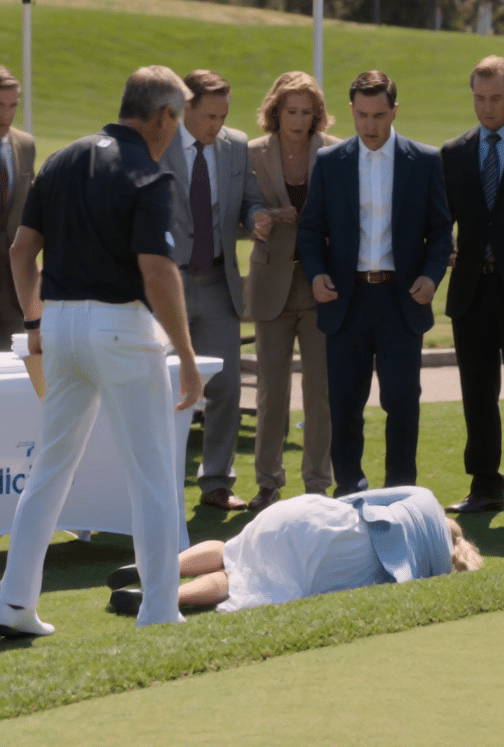
The vice president’s words sliced through the cheerful noise of the charity golf tournament. Guests in expensive polo shirts turned toward the donation table, where a pregnant woman in a white maternity dress stood with one hand resting beneath her belly and the other pointing toward an envelope in the man’s hand.
“That envelope must stay on the table,” she said.
The man in the black polo shirt lowered his dark sunglasses just enough to stare at her over the frames.
He was Richard Lawson, forty-three, vice president of corporate development at Whitmore Industries, and one of the most powerful executives in the company. His white golf trousers were spotless, his watch cost more than most people’s monthly salaries, and his smile carried the easy confidence of someone accustomed to getting whatever he wanted.
He looked at the woman as if she were an inconvenience.
“Did you just tell me what to do?”
She remained calm.
“I watched you take it from the donation table. It’s for the children’s hospital.”
Richard glanced at the envelope.
Inside was a cash contribution collected from guests during the morning’s charity fundraiser. The envelope had been placed beside a ledger so volunteers could record donations before transferring them to the event organizers.
Richard had picked it up moments earlier.
He hadn’t asked permission.
He hadn’t signed the ledger.
He had simply reached across the table and slipped the envelope toward himself, apparently assuming nobody would dare question him.
The pregnant woman had noticed.
“Please put it back,” she repeated. “The donations need to be accounted for.”
Richard gave a short laugh.
“Accounted for?”
“Yes.”
“Do you know who I am?”
She looked at him.
“No. And I don’t think that matters.”
His smile disappeared.
Around them, the fundraiser continued beneath the bright afternoon sun. Golf carts rolled across the green, water bottles sat in neat rows beside the refreshment station, and a banner near the clubhouse announced that the event would raise money for a regional children’s hospital.
The woman had been helping the volunteers straighten the water table when she noticed the envelope. Her blonde hair was tied low at the back of her neck, and her light blue jacket hung loosely over her white dress.
She wore flat shoes because standing for long periods had become uncomfortable.
At thirty, she was between six and seven months pregnant, and the warm weather had begun to tire her more quickly than she expected.
Still, she had volunteered that morning because the cause mattered to her.
Richard knew none of this.
He had already decided she was an ordinary event worker who had mistaken a routine instruction for a personal responsibility.
“Listen,” he said, leaning toward her. “I don’t have time to explain corporate business to the staff.”
“I’m not asking you to explain anything. I’m asking you to return the donation.”
His jaw tightened.
“Staff don’t correct executives.”
“Then executives should know better than to take money from a charity table.”
A few nearby guests went quiet.
One man holding a golf club turned toward them. A woman beside the water station stopped arranging bottles. The volunteer who had been recording donations glanced anxiously between Richard and the pregnant woman.
Richard noticed the attention.
His face darkened.
“You think you’re clever?”
“No.”
“Then stop embarrassing yourself.”
She glanced at the envelope again.
“Please put it back.”
Richard stepped closer, blocking her path.
“Who hired you?”
She didn’t answer immediately.
“That’s not important.”
“It’s very important if you’re going to stand here and question me.”
She took a small step backward.
“I don’t want an argument. I just want the donation returned.”
Richard looked toward the guests, as though expecting someone to laugh at his next remark.
“Serve drinks and stay quiet.”
The woman’s expression changed.
“I haven’t done anything to you.”
“You’ve been disrespectful since I arrived.”
“I was here before you took the envelope.”
Richard’s hand tightened around it.
For a second, she thought he might simply put it back and walk away.
Instead, he shoved the envelope into his pocket.
“I’m an executive at Whitmore Industries. I help run this company. You don’t get to lecture me about a charity event.”
She stared at him in disbelief.
“That’s exactly why you should put it back.”
His eyes narrowed.
Then he moved toward her.
The attack happened so quickly that the nearest guests barely understood what they were seeing.
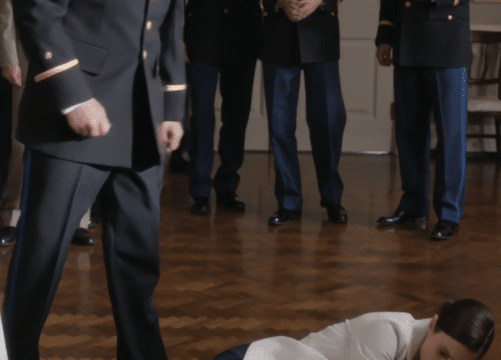
Richard surged forward and drove a forceful kick into her chest, knocking her down at the edge of the green.
She fell hard, her forearm scraping against the ground. A thin trace of blood appeared along the scrape as she curled inward, instinctively protecting her unborn child.
A golf club slipped from someone’s hand.
The woman gasped, struggling to catch her breath.
Richard stepped around her.
Then he delivered two more forceful kicks into her back.
A woman screamed.
Several guests covered their mouths and backed away from the donation table. One man reached for his phone but froze when Richard turned toward the crowd.
“Stay out of this!”
The pregnant woman remained on the ground, trembling as she held herself protectively.
Richard looked down at her.
“Serve drinks and stay quiet,” he repeated.
Then he adjusted his sunglasses and straightened his shirt, as if the entire incident had been nothing more than a disagreement about table arrangements.
The stolen envelope remained visible in the pocket of his white trousers.
A moment later, a golf cart came speeding along the path.
Its brakes squealed as it stopped beside the charity table.
A silver-haired man in a navy polo and an expensive golf jacket jumped out before the cart had fully settled. His expression changed the instant he saw the woman on the ground.
“Emily!”
He rushed toward her.
The man dropped beside her, shielding her with his body while checking that she was conscious.
Emily looked up through tears.
“Dad…”
The man’s face went pale.
Then he slowly turned toward Richard.
It was Thomas Whitmore, the fifty-eight-year-old chief executive officer of Whitmore Industries, the man whose signature appeared on every major acquisition Richard had spent his career trying to secure.
Thomas stared at the vice president.
His voice was almost frighteningly quiet.
“You attacked my daughter at my charity event?”
Richard froze.
The envelope was still in his pocket.
His mouth opened.
“Your daughter?”
For the first time in his life, Richard Lawson had no idea what to say.
And he had no idea how much more the envelope in his pocket was about to cost him.
Act II
Emily Whitmore had spent most of her life trying to escape one particular assumption.
That being Thomas Whitmore’s daughter meant she could never be ordinary.
Her father had built Whitmore Industries over three decades, turning a regional manufacturing business into a national company with thousands of employees and operations across several states. His name appeared in financial publications, industry conferences, and philanthropic announcements.
To outsiders, the Whitmores seemed to live in a world where every door opened before they reached it.
Emily knew better.
Her father worked long hours, missed birthdays, and carried the burden of decisions that affected entire communities. She had grown up watching him read reports at the dinner table, argue over budgets, and return home late with the exhausted expression of a man who knew that one careless decision could cost hundreds of people their jobs.
She loved him.
But she had also seen how quickly people changed when they discovered who he was.
A contractor who had ignored her email suddenly responded within minutes. A stranger who had spoken sharply to her at a restaurant became almost embarrassingly polite after recognizing her father. Business acquaintances who barely remembered her name began inviting her to events when they learned she belonged to the Whitmore family.
Emily hated the transformation.
She wanted people to speak to her honestly, not perform respect because they feared her father’s influence.
When she married Daniel Carter, an architect who had no interest in corporate politics, she made it clear that she wanted to build a life of her own. She continued volunteering with community organizations, helped coordinate educational programs, and stayed away from the executive spotlight whenever possible.
Her father never entirely understood why she avoided using his name.
But he respected her choice.
When Emily told him she was pregnant, Thomas had cried in the privacy of his study, then spent the next week pretending he was simply researching child safety seats.
He became protective in ways that amused her husband.
He checked the weather before every planned outing. He insisted that Emily take breaks during long events. He had even called her once to ask whether she had eaten lunch, only to discover that she was sitting in a restaurant with a plate of food directly in front of her.
“Dad, I’m pregnant, not made of glass,” she had told him.
“I know that.”
“Then stop calling every two hours.”
“I called once.”
“You called twice.”
He had paused.
“Fine. I’ll call less.”
Emily had laughed, and he had laughed with her.
The charity golf tournament had been Thomas’s idea.
For years, he had supported a children’s hospital that provided specialized care to families who could not afford certain treatments. The annual fundraiser brought together company executives, business partners, local donors, and community volunteers.
Thomas believed that a successful company had obligations beyond its shareholders.
Emily shared that belief.
She had volunteered at previous events, usually arriving early to help with the practical work nobody noticed once the guests began to arrive. She straightened tables, checked donation forms, carried water bottles, and helped elderly visitors find seats.
She could have assigned those tasks to someone else.
She preferred doing them herself.
That morning, she had told her father she would help at the donation table before joining him for lunch.
Thomas had objected to the idea of her standing in the sun for hours.
Emily promised she would take breaks.
He had accepted the promise reluctantly.
Neither of them expected the afternoon to become a public disaster.
Richard Lawson had arrived shortly before the incident.
He was a senior executive with a strong record of closing deals, negotiating contracts, and delivering results that impressed the board. He knew how to talk to investors and how to make himself seem indispensable.
He also had a talent for identifying people he considered beneath him.
At company events, he could be charming when speaking with board members and dismissive when addressing administrative staff. He treated assistants as if they existed to absorb his impatience and junior employees as if their primary purpose was to make him look efficient.
Complaints had occasionally reached human resources.
Richard dismissed them as personality conflicts.
His performance numbers made it easy for some executives to accept that explanation.
He had become convinced that his professional success entitled him to a different set of rules.
The charity event offered him another opportunity to display that attitude.
He had spent the morning discussing potential acquisitions with investors and had grown irritated when the schedule fell behind. When he approached the donation table, he noticed the envelope and decided he wanted to look at its contents.
The event coordinator was occupied with a group of donors.
Richard took the envelope without asking.
He told himself he was checking the donation amount for the company’s records.
But he hadn’t been assigned that responsibility, and he hadn’t intended to document what he took.
Emily saw him.
She didn’t know whether he intended to keep the money or simply believed he could do whatever he pleased. She knew only that the envelope belonged to the fundraiser and that it should not leave the table without being recorded.
She spoke up.
That was all.
Richard interpreted her request as an insult because he had already decided that someone dressed like a volunteer had no authority to question him.
He didn’t recognize her face.
He didn’t know her name.
And he had no idea that the company he claimed to help run had been built by the father of the woman he was attacking.
But Thomas knew exactly who Richard was.
He had hired him six years earlier, impressed by his energy and ability to negotiate complicated deals. Richard had helped expand the company’s commercial partnerships, and his results had earned him a place among the senior leadership team.
Thomas had praised him publicly.
He had also expected him to understand that the company’s reputation depended on more than financial performance.
Now, standing beside his injured daughter, Thomas was forced to confront the possibility that he had mistaken confidence for character.
The man he had trusted with major business responsibilities had just attacked a pregnant woman in front of dozens of witnesses.
And the reason had begun with a charity donation that Richard had no right to take.
Act III
“Emily, stay with me.”
Thomas kept his voice gentle as he knelt beside his daughter.
She was conscious, but shaken and in visible pain. He asked a nearby event worker to call emergency services and request immediate medical assistance, making sure the dispatcher understood that the injured woman was pregnant and had suffered a physical assault.
He did not try to pull her to her feet.
He stayed beside her while the first responders arrived, giving them room to assess her and arrange urgent medical evaluation.
Emily’s eyes searched his face.
“Dad, the baby…”
“I know, sweetheart. Help is coming.”
Thomas wanted to promise that everything would be fine.
He couldn’t.
Instead, he held her hand and waited with her until the medical team took over.
Only then did he stand and turn toward Richard.
The vice president had backed away from the table. His dark sunglasses concealed his eyes, but his posture had changed. He no longer looked like a man who owned the afternoon.
He looked like someone searching for an exit.
“Mr. Whitmore,” he began, “this is a terrible misunderstanding.”
Thomas stared at him.
“Is it?”
“Yes, sir. I was dealing with a difficult staff member.”
Thomas glanced at the donation table.
“Was she stealing from the charity?”
Richard hesitated.
“No.”
“Was she threatening you?”
“No, but—”
“Was she preventing you from performing your duties?”
Richard swallowed.
“I was trying to maintain order.”
Thomas’s eyes moved to the envelope bulging from Richard’s pocket.
“Then why is the donation in your pocket?”
The question cut through every excuse.
Richard instinctively touched the pocket, as though he had forgotten it was there.
“I was going to review it.”
“Were you?”
“Yes, sir.”
“Then you should have asked the event coordinator to record it. You should not have taken it without authorization.”
Richard nodded quickly.
“Of course. I understand.”
Thomas stepped closer.
“And you should never have laid a hand on my daughter.”
Richard’s face tightened.
“I didn’t know she was your daughter.”
Thomas looked at him for a long moment.
“Would that have made it acceptable if she were someone else’s daughter?”
“No, sir.”
“Someone else’s pregnant wife?”
“No.”
“An employee you didn’t recognize?”
Richard’s mouth opened, then closed.
Thomas pointed toward the green.
“She asked you to return a donation envelope. You insulted her, attacked her, and continued after she fell. What part of that do you believe was justified?”
“None of it, sir. I lost my temper.”
“You lost your temper because someone asked you to follow a basic rule.”
Richard glanced toward the surrounding guests.
Several were watching with their phones raised. Others had turned away, visibly shaken. The event coordinator stood near the table, staring at the envelope in Richard’s pocket.
Thomas followed Richard’s gaze.
“Everyone who witnessed this incident will be asked to provide an honest account. The original donation records must be preserved. Any available footage must be secured.”
“Mr. Whitmore, please,” Richard whispered. “We can discuss this privately.”
“No.”
Thomas’s answer was immediate.
“You attacked someone in public. The investigation will not be conducted in secret to protect your reputation.”
He turned toward the event coordinator.
“Please make sure the envelope is recovered and counted in the presence of the appropriate people. Record the amount, preserve the original donation log, and document the chain of custody.”
The coordinator nodded.
Richard reached into his pocket and pulled out the envelope.
He held it toward Thomas.
“Here. Nothing is missing.”
Thomas did not take it.
“Give it to the coordinator.”
Richard obeyed.
For the first time, the money he had casually taken seemed heavier than anything he had ever carried into a negotiation.
Thomas then turned back to him.
“You are not to contact my daughter, her husband, or any witness about this incident. You will be removed from your responsibilities while the company investigates your conduct. The appropriate authorities will determine any legal consequences.”
Richard looked stunned.
“You’re suspending me?”
“You have just committed a serious act of violence at an event hosted by this company. What did you expect?”
Richard’s voice rose with panic.
“I’m one of your senior vice presidents—”
“Vice president,” Thomas corrected quietly. “And your title does not place you above the law.”
The words settled over the crowd.
A man who had spent years using corporate hierarchy to silence people now found himself unable to hide behind the very hierarchy he had invoked.
Then a young event volunteer stepped forward.
“I saw everything,” she said.
Thomas turned toward her.
“Thank you. Please give your statement to the investigators. You will not be expected to defend anyone’s reputation. Just tell the truth.”
Another guest raised his hand.
“So did I.”
A third person offered to share a video recorded from beside the golf carts.
Richard looked from one witness to another.
He had assumed nobody would interfere because nobody had intervened when he attacked Emily.
He had mistaken shock for agreement.
The witnesses had frozen because they were horrified, uncertain, and afraid of making the situation worse. Their silence in the first seconds had not meant they approved.
Now they were speaking.
Thomas looked toward the medical team preparing to take Emily for further evaluation.
“I need to go with my daughter.”
He turned back to Richard one final time.
“You will answer for what you did through the proper process. My family’s name will not change the facts, and your title will not erase them.”
Then he walked away.
Richard remained beside the donation table, surrounded by guests who had watched him transform a minor disagreement into a public assault.
The envelope had been returned.
But its return could not undo what had happened.
And when the company began examining Richard’s records, it would discover that the incident was not the only thing he had hoped to keep out of sight.
Act IV
Emily was taken to the hospital for urgent assessment.
Thomas accompanied her, calling her husband, Daniel, on the way and explaining what had happened as clearly as he could. Daniel arrived soon afterward, frightened and pale, and stayed beside Emily while the medical team evaluated her condition.
The doctors monitored her closely and explained that the consequences of trauma during pregnancy could not be determined by appearances alone. Emily would need appropriate follow-up and time to recover.
Thomas listened to every instruction.
He asked questions when something was unclear and made sure Emily had the support she needed. For once, the man who normally controlled meetings, budgets, and negotiations could do nothing but wait.
When Emily finally had a quiet moment with him, she reached for his hand.
“Dad?”
“I’m here.”
“Did you get the envelope back?”
Thomas stared at her.
Of all the things she could have asked, that was the one she had chosen.
“Yes,” he said. “It was returned to the event coordinator and documented.”
She closed her eyes briefly.
“Good.”
He brushed a strand of blonde hair away from her face.
“Emily, you don’t need to worry about the donation right now.”
“I know. I just don’t want the hospital to lose the money because of what happened.”
Thomas felt a painful mixture of pride and anger.
Even after being assaulted, his daughter was thinking about the children the fundraiser had been organized to help.
“The donation will be accounted for,” he promised. “And the investigation will be handled properly.”
The company acted quickly to preserve the evidence.
Event staff secured the original donation ledger and documented the returned envelope. The organizers recorded the amount and compared it with the existing donation entries. Investigators collected statements from guests and employees who had witnessed the incident.
Several people had recorded portions of the confrontation.
The videos showed Richard taking the envelope, arguing with Emily, and attacking her after she asked him to return it. The footage also captured the moments when he continued the assault and ordered the crowd to stay out of it.
The evidence contradicted his first attempt to describe the incident as a defensive response to an aggressive staff member.
Emily had not threatened him.
She had not touched him.
She had not attempted to take anything from him.
She had asked him to return money that belonged to the charity.
Richard’s conduct was referred to the appropriate authorities, and Whitmore Industries placed him on leave while it conducted its own review. The company made clear that its internal process would not replace any criminal investigation or legal proceedings.
Then the financial review began.
The envelope incident had raised questions about Richard’s understanding of the company’s controls and his willingness to follow them. Investigators examined whether he had previously taken funds, bypassed approval procedures, or interfered with charitable contributions.
They did not assume that one incident proved a broader scheme.
They followed the records.
The initial review found no evidence that Richard had stolen the charity’s donation. The money in the envelope was accounted for and returned to the proper process.
But the investigation revealed other concerns about his management practices.
Several employees described situations in which Richard had pressured staff to make records fit his preferred narrative. Others reported that he had dismissed procedural questions as signs of disloyalty.
One finance employee recalled raising concerns about incomplete documentation for a business expense. Richard had responded by telling the employee to stop acting like a junior auditor and remember who approved promotions.
The employee had not filed a formal complaint.
They had believed it would damage their career.
Another staff member described being instructed to hurry an approval through before a quarterly review, despite missing supporting documents. That transaction required separate examination, and investigators made no assumption about wrongdoing until the underlying records had been checked.
The pattern was nevertheless disturbing.
Richard had cultivated an environment in which people feared questioning him, even when they had legitimate reasons to ask.
His senior title had made that fear harder to challenge.
The company began reviewing those concerns through its established compliance procedures, separating substantiated facts from allegations that required further verification.
Thomas was briefed on the findings.
He was furious—not because the company had discovered evidence of a secret criminal empire, but because employees had repeatedly felt too vulnerable to raise ordinary concerns.
“How many people believed they would be punished for asking a reasonable question?” he asked the review team.
No one could give him an immediate answer.
“Then find out,” he said. “Protect the people who cooperate, preserve the records, and do not promise outcomes before the facts are established.”
The board was informed of the assault and the related review. Richard’s employment was terminated after the company concluded that his conduct at the charity event constituted serious misconduct and violated its standards.
Any additional legal or financial consequences would be determined by the relevant authorities based on their findings.
Thomas did not make a speech announcing that he had destroyed Richard’s career.
He did not threaten him in private.
He allowed the evidence to do what his anger could not.
At a meeting with senior executives, Thomas placed a copy of the company’s conduct policy on the table.
“This document means nothing if employees believe they can be punished for enforcing it,” he said.
He looked around the room.
“We reward people for meeting targets. We promote people who deliver results. But if we reward results while ignoring the way those results are achieved, we are teaching the wrong lesson.”
One executive suggested that Richard’s performance had been too valuable to ignore.
Thomas’s expression hardened.
“His performance did not give him ownership of the company. It did not give him ownership of our employees. And it certainly did not give him the right to assault a pregnant woman.”
The room fell silent.
Thomas ordered a review of the company’s reporting channels, management oversight, and protection against retaliation. Senior leaders would be expected to document how they responded to complaints, and employees would receive clearer options for raising concerns outside their direct management chain.
The charity’s procedures were also strengthened. Donations would be recorded by designated staff, handled under documented controls, and reconciled before being transferred to the hospital.
The changes were practical rather than theatrical.
They were designed to make it harder for anyone to use a title as a substitute for authorization.
A few weeks later, Thomas visited Emily at home.
She was resting on the sofa, a blanket over her legs, while Daniel assembled a small shelf in the nursery. Sunlight fell across the room, and a stack of baby clothes sat beside a box of toys.
Thomas sat beside his daughter.
“How are you feeling?”
“Some days better than others.”
He nodded.
“The doctors are keeping an eye on everything?”
“Yes. We’re following their advice.”
He looked toward the nursery.
“Your husband has assembled that shelf three times.”
Emily laughed softly.
“He keeps deciding it’s crooked.”
“Is it?”
“No. But don’t tell him that.”
For the first time in weeks, Thomas smiled without forcing it.
Then Emily grew serious.
“Dad, I want to ask you something.”
“Anything.”
“Are you changing the company because of me?”
Thomas took a breath.
“I’m making changes because the company should have had stronger protections already.”
“But if I hadn’t been there—”
“Someone else might have been treated badly. We don’t know. What we do know is that people were afraid to challenge Richard, and that deserves attention.”
Emily looked down at her hands.
“I don’t want everyone to think the only reason this matters is because I’m your daughter.”
Thomas reached for her hand.
“Then we’ll make sure the response proves otherwise.”
He paused.
“You were right to ask him to return the donation. But even if you had said nothing, even if you had never met him before, even if you had been someone with no connection to this family, what he did would still have been wrong.”
Emily’s eyes filled with tears.
That was the answer she had needed.
Not revenge.
Not a promise that her father could make the world safe through sheer authority.
A commitment to ensure that the truth would not depend on the victim’s identity.
Act V
The children’s hospital received its donation after the event organizers completed the reconciliation and transfer process.
The fundraiser itself had been overshadowed by the assault, but the hospital did not lose the contribution. In the weeks that followed, several guests contacted the organizers to make additional donations, explaining that they wanted the evening to remain focused on the children the event had been intended to help.
Thomas declined to turn the incident into a publicity campaign.
He didn’t want Emily’s pain displayed beside a corporate slogan. He didn’t want the company’s response to be presented as proof of his personal virtue.
The company had responsibilities because of what happened.
Meeting them was not an act of generosity.
It was the minimum required.
Richard’s departure from Whitmore Industries became official after the internal review. The company documented its findings, cooperated with the appropriate authorities, and strengthened procedures intended to prevent similar failures.
The process was neither instant nor effortless.
Some employees worried that the new reporting requirements would create more paperwork. Others wondered whether senior management would truly protect people who spoke up once the attention faded.
Thomas knew those doubts could not be answered with a single announcement.
Trust had to be rebuilt through consistent action.
He asked leaders to follow through on the new procedures, investigate complaints fairly, and make sure that people who raised concerns were not punished for doing so. He also insisted that employees accused of misconduct receive a fair process rather than being judged by rumor.
Accountability, he told them, had to be more than a word used when the facts were convenient.
Meanwhile, Emily focused on her recovery and preparing for her child.
There were difficult moments.
A sudden movement behind her could make her tense. The memory of the golf course sometimes returned when she least expected it: the bright sun, the donation table, Richard’s voice, and the terrible confusion of finding herself on the ground.
Daniel stayed close without insisting that she talk about it.
Thomas visited often, bringing food Emily liked and pretending that he had not bought half the baby aisle at a local store.
One afternoon, Emily found him arranging tiny blankets in the nursery.
“Dad, why are there twelve blankets?”
He looked up.
“They were on sale.”
“You bought twelve blankets because they were on sale?”
“I thought it was a sensible investment.”
She laughed.
“You negotiate billion-dollar deals for a living.”
“Which is why I know a good deal when I see one.”
“Then you should know a baby doesn’t need twelve blankets.”
Thomas looked at the neatly folded stack.
“I’ll take some back.”
“You won’t.”
“No,” he admitted. “Probably not.”
They laughed together, and for a little while, the afternoon felt ordinary.
That ordinary feeling became precious.
Emily wanted to return to the life she had been building before the incident, without pretending that nothing had happened. She wanted to remain involved with the children’s hospital, raise her daughter, and continue volunteering when she was ready.
She did not want to become known only as the pregnant woman who had been assaulted by a corporate executive.
She wanted to be Emily again.
Her father understood.
When the baby arrived, Thomas waited outside the delivery room with Daniel, pacing so restlessly that a nurse finally suggested he sit down.
“I’ve sat through board meetings that lasted eight hours,” he muttered.
Daniel gave him a tired smile.
“Then this should be easy.”
Thomas looked at him.
“Don’t joke about this.”
“I’m not joking. I’m trying to keep you from wearing a hole in the floor.”
Thomas sat.
Minutes passed.
Then the door opened.
A nurse announced that Emily had delivered a baby girl, and Daniel covered his face with both hands.
Thomas stood so quickly that the chair scraped behind him.
“Is Emily all right?”
The nurse explained that the medical team would provide the details and that they could see the family shortly.
Thomas waited until he was invited inside.
When he finally saw his daughter holding the baby, every carefully controlled emotion broke at once.
Emily looked exhausted but peaceful.
“Dad,” she whispered.
He approached the bed.
“She’s beautiful.”
“She has Daniel’s nose.”
Daniel looked offended.
“That’s a perfectly good nose.”
Emily smiled.
Thomas bent to kiss his daughter’s forehead, then studied the tiny child wrapped in a pale blanket.
“What did you name her?”
“Grace,” Emily said.
Thomas’s eyes filled.
“Grace Whitmore Carter.”
He repeated the name softly, as if he wanted to remember the exact sound of it.
Then he touched the baby’s hand.
She closed her fingers around his thumb.
Thomas had spent years building a company, making decisions, and measuring progress through numbers that appeared on reports. He knew how to judge a quarterly result and how to evaluate a business strategy.
But there was no report that could capture what he felt holding his granddaughter for the first time.
He looked at Emily.
“You were right about something,” he said.
“What?”
“I spend too much time worrying about how to protect the people I love by solving everything.”
She smiled faintly.
“You do.”
“I can’t solve everything.”
“No.”
“But I can make sure I don’t look away when something is wrong.”
Emily squeezed his hand.
“That matters.”
Months later, when she was ready, Emily returned to the golf course.
She didn’t go to confront Richard or stand before a crowd to recount what had happened. She went because the hospital was holding a small follow-up event, and she wanted to see the people who had helped keep the fundraiser’s purpose alive.
Grace slept in her stroller beside her.
Thomas walked with Emily across the green, carrying a bag of supplies for the volunteers. The day was bright, and the water table had been set up beneath a canopy to keep the bottles cool.
At the donation table, a young volunteer was helping an older guest complete a contribution form.
The guest seemed confused about where to sign.
“No rush,” the volunteer said. “I’ll walk you through it.”
Emily stopped to watch.
There was no applause.
No executive had arrived to inspect the scene.
The volunteer didn’t know who Emily was, and she didn’t need to.
She was simply helping someone who needed help.
Emily felt something in her chest loosen.
Thomas followed her gaze.
“Everything all right?”
She nodded.
“Yes.”
She looked at the table where the envelope had once sat in Richard’s pocket.
For a moment, she remembered his sneer and the way he had spoken as though her clothes determined whether she was allowed to question him.
She remembered the impact, the fear, and the silence of the crowd.
Then she looked at the volunteer, who had stepped around the table to help the elderly guest find a seat.
“That,” Emily said quietly, “is how it should have been.”
Thomas nodded.
“Yes.”
They continued walking.
The company had changed some of its procedures. The hospital had received the donation. Employees had new ways to report concerns. Richard was no longer in a position to use his title at Whitmore Industries to intimidate the people around him.
None of those outcomes could erase what Emily had endured.
But they meant the incident had not been buried simply because the person responsible was powerful.
Thomas had learned that leadership was not measured by how quickly people obeyed when he entered a room. It was measured by what happened when someone with less power asked a reasonable question.
Richard had believed that his executive title made him untouchable.
He had mistaken deference for respect and silence for permission.
When Emily challenged him over the donation envelope, he could have returned it. He could have apologized. He could have acted like the professional he claimed to be.
Instead, he had chosen cruelty.
The arrival of her father had exposed the absurdity of his assumptions, but the truth had been clear long before Thomas stepped out of the golf cart.
Emily did not deserve protection because she was the CEO’s daughter.
The charity did not deserve honesty because its guests were wealthy.
And a person did not need an impressive title to recognize that taking money without authorization was wrong.
As they reached the clubhouse, Thomas paused beside his daughter.
“I wish I could have stopped it,” he said.
Emily looked at him.
“You couldn’t know what was going to happen.”
“I know.”
She glanced down at Grace, sleeping peacefully beneath her blanket.
“But you listened afterward. You made sure the evidence mattered. You didn’t try to hide it.”
Thomas nodded slowly.
“That’s what I should have done.”
“That’s what you did.”
He took her hand.
Together, they walked toward the clubhouse, where volunteers were preparing the next event and the donation table stood ready for another day.
The lesson would not be printed on a banner or delivered in a corporate speech.
It would live in the ordinary choices people made when nobody important was watching.
Return what does not belong to you.
Listen when someone raises a legitimate concern.
Never use authority to silence a person who has less of it.
And never confuse someone’s apparent status with their right to be treated with dignity.
Richard Lawson had thought the pregnant woman beside the donation table was powerless because she looked like staff.
Then he discovered she was the CEO’s daughter.
But the real measure of his failure was not the panic on his face when Thomas Whitmore stepped out of the VIP golf cart.
It was the choice he had made before he knew her name.
Emily Whitmore had been worthy of respect before her father arrived. The envelope belonged to the charity before anyone demanded its return. And the truth did not become important only when a powerful man finally witnessed it.