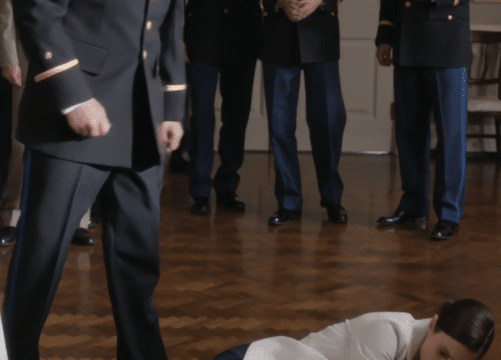
Act I
“Trash. You don’t belong in VIP.”
The insult rang through the conference center just as the young woman reached for the rope barrier to steady herself.
She stood in a gray maternity dress, a black coat draped over her shoulders, one hand resting beneath her seven-month-pregnant belly. Her brown hair was neatly tied back, and her flat shoes looked painfully ordinary against the polished floor and the expensive suits surrounding her.
In her other hand, she held a VIP access card.
“My grandfather is waiting inside,” she said calmly.
The event assistant glanced at the card, then at her face. His name badge read BRIAN MILLER — EVENT OPERATIONS. He wore a black suit and a staff lanyard, and he carried himself with the impatient arrogance of a man who had been given a little authority and mistaken it for importance.
“Your grandfather?” he repeated, laughing under his breath.
“Yes. He asked me to meet him in the VIP lounge.”
Brian reached for the card.
She pulled it back slightly. “Please, just scan it. If there’s a problem, you can call someone inside.”
That was the wrong answer.
Not because it was unreasonable, but because Brian had already decided that she was lying.
The policy conference had attracted senators, lobbyists, corporate donors, senior advisers, and journalists. Beyond the security scanners, a closed door led to a private reception where the most influential guests were gathering before the evening’s keynote address.
Brian had spent the entire afternoon watching people approach that door with credentials he was responsible for checking.
He liked the position more than he admitted.
People waited when he raised his hand. They showed him their badges. They explained themselves. For a few hours, he could make important people pause while he decided whether they were allowed to proceed.
And now a pregnant woman he had never seen before was telling him that her grandfather was waiting on the other side.
He wasn’t going to let her embarrass him.
“Let me see it,” he demanded.
“I’ve already shown you.”
“Then hand it over.”
She hesitated.
Something in his expression made her uneasy, but she didn’t want to create a scene. She held the card out, expecting him to scan it and return it.
Instead, Brian snatched it from her fingers.
He turned it over as if searching for proof that it was counterfeit.
“This doesn’t mean you can walk wherever you want,” he said.
“I understand. That’s why I’m asking you to check it.”
“Do you think I’m stupid?”
“No. I think there’s been a misunderstanding.”
He leaned closer.
“People like you always have a story.”
The woman blinked.
“People like me?”
“People who think they can get into places they don’t belong just because they know somebody.”
Her fingers curled around the edge of her coat.
“I’m not trying to get special treatment. My grandfather invited me.”
Brian glanced toward the closed VIP door.
“Then he can come out and get you.”
“He’s in a meeting. He doesn’t know you’re holding my card.”
“Sounds like your problem.”
She took a breath, fighting the discomfort in her lower back.
“Please. I’m seven months pregnant, and I’ve been standing here for several minutes. If you would just call the reception desk—”
“Don’t tell me what to do.”
“I wasn’t—”
“Shut up.”
The words stopped her.
Several guests near the security scanners turned to look. A woman in a cream-colored suit lowered her phone. Two men wearing conference badges exchanged an uneasy glance.
Brian noticed the attention and grew even more aggressive.
He didn’t want witnesses seeing him lose control. He wanted witnesses seeing him win.
“You don’t belong in VIP,” he said again, louder this time. “And you certainly don’t get to lecture staff about access.”
The woman looked down at the card in his hand.
“That’s my card. Please give it back.”
Brian smiled without warmth.
“Come and take it.”
She stared at him, unable to believe what she was hearing.
“Why are you doing this?”
“Because someone has to keep people like you in their place.”
She tried to move around him toward the security desk.
Brian stepped directly into her path.
“I’m asking you one last time to return my card.”
He looked at her belly, then back at her face.
“Or what?”
She said nothing.
For a brief moment, the only sound was the low murmur of the conference center and the faint electronic beep of a security scanner.
Then Brian moved.
He drove a forceful kick into her chest, knocking her onto the gray carpet beside the rope barrier.
Her elbow struck the hard edge where the carpet met the polished floor. A thin scrape appeared on her skin, and she folded inward with a sharp gasp, instinctively curling around her belly.
A guest cried out.
Before anyone could understand what had happened, Brian moved around her and delivered two more forceful kicks into her back.
The woman cried out and covered herself as best she could.
The conference center fell silent.
People stared. One man raised a hand to his mouth. A woman took a step forward, then stopped when Brian turned toward the crowd with a furious expression.
“Stay out of this!”
No one moved.
The pregnant woman struggled to catch her breath, one hand pressed protectively against her abdomen. Tears gathered in her eyes, but she couldn’t seem to make herself speak.
Brian stood over her, breathing hard.
Then he looked down at the VIP card still clutched in his hand.
“Try lying from the floor,” he said coldly.
He seemed satisfied with himself.
He had humiliated a stranger, defended his authority, and silenced the people watching.
At least, that was what he believed.
Then the closed VIP door swung open.
A gray-haired man in a dark gray suit stepped into the rope area, followed by two aides who stopped abruptly when they saw the scene.
The man’s blue tie was perfectly straight. His expression was not.
He spotted the woman on the floor.
“Claire?”
She lifted her head.
“Grandpa…”
The man moved so quickly that one of his aides barely had time to step aside.
He knelt beside her, took off his suit jacket, and carefully placed it around her shoulders while calling for immediate medical assistance. His eyes searched her face, then dropped to the card lying beside Brian’s polished shoes.
He picked it up.
For one second, he said nothing.
Then he rose and turned toward the event assistant.
“Who put hands on my granddaughter?”
Brian’s face drained of color.
He recognized the gray hair.
He recognized the blue tie.
And he recognized the man whose name had appeared on the conference program beneath the words UNITED STATES SENATOR.
“Senator…?”
The card trembled in Brian’s hand.
But the senator was no longer looking at the card.
He was looking at the man who had just attacked his family.
And the people standing behind Brian had begun to understand that they had witnessed something far worse than a security dispute.
Act II
Claire Bennett had learned early that being related to a powerful person could make ordinary life complicated.
Her grandfather, Senator Robert Hayes, had represented his state in Washington for more than two decades. He was known for his sharp questioning during committee hearings, his refusal to tolerate careless answers, and his ability to remain calm when everyone around him was losing patience.
To the public, he was a formidable politician.
To Claire, he was the man who had taught her to ride a bicycle in a quiet suburban driveway and then pretended not to notice when she fell into the grass.
He was the man who kept handwritten birthday cards in a drawer, even after his schedule became so crowded that he sometimes had to sign them at airports.
And he was the man who had held her mother’s hand through a long illness when Claire was still young enough to believe that adults could fix anything if they loved someone enough.
After her mother died, Robert became more than a grandfather.
He became the person Claire called when she couldn’t sleep, when she was unsure about a decision, or when she needed someone to tell her the truth without making her feel small.
He never promised that life would be easy.
He promised that she would never have to face it alone.
Claire had inherited his stubbornness, though not his appetite for public attention. She worked in nonprofit administration, helping organizations connect families with educational and community resources. She preferred quiet projects with measurable results to the endless performance of political life.
When people discovered her connection to Senator Hayes, she often watched their behavior change.
Some became excessively polite. Others suddenly wanted introductions, favors, or invitations. A few treated every conversation as if it were a negotiation.
Claire hated it.
She wanted to be judged by what she did, not by the man whose name she carried.
That was one reason she had kept her own surname after marrying Daniel Bennett, an emergency management consultant she had met through a community preparedness project. Daniel had never been interested in political influence, and Claire loved him for the uncomplicated way he treated people.
When they learned they were expecting their first child, Robert had been delighted.
He had also become insufferably cautious.
He sent Claire articles about prenatal care, called to ask whether she had packed enough water for a road trip, and once tried to convince her that she should avoid carrying a grocery bag because it looked heavy.
“Grandpa, it’s a bag of apples.”
“Apples can be heavy.”
“So can your opinions.”
He had stared at her for a second before laughing.
“Your grandmother used to say exactly that.”
Claire had treasured those moments.
She knew her grandfather could be intimidating in public. At home, he was simply Robert: sentimental, occasionally stubborn, and deeply protective of the people he loved.
The policy conference was important to him.
It brought together public officials, nonprofit leaders, and private organizations to discuss a proposed initiative supporting families facing housing and healthcare instability. Claire had helped one of the participating nonprofit groups prepare background materials, and Robert had invited her to attend the private reception before his keynote address.
He wanted her to meet several people working on the initiative.
More importantly, he wanted to hear what she thought of the proposal.
Claire had arrived at the conference center later than expected after stopping to help a woman whose car had stalled near the venue. By the time she reached the VIP area, Robert was already in a closed-door discussion with advisers.
She had texted him that she was there.
His reply had been simple: Come inside when you arrive. I’ll meet you by the lounge.
She had a valid access card.
She had been invited.
And she had no reason to believe the staff member at the rope barrier would turn her arrival into a confrontation.
Brian Miller had been hired by the event’s organizing contractor to assist with guest access and logistics. He wasn’t a security officer, though he sometimes behaved as if the lanyard around his neck gave him powers beyond checking credentials.
He had spent years working temporary event jobs, and he resented the fact that the people who passed through the doors often earned more in a month than he earned in a year.
That resentment had become a private grievance.
He told himself that the world was divided between people who deserved respect and people who expected it without earning it. He imagined that wealthy guests were all arrogant, that VIP invitations were often handed out through connections, and that his own frustration was proof he understood how unfair the world really was.
But instead of challenging unfairness, Brian had begun reproducing it.
He was polite to people he believed could help him and cruel to people he believed could not.
When a junior staff member asked him to correct a scheduling error earlier that afternoon, he had snapped at her in front of a guest. When an elderly attendee struggled to locate a conference room, Brian had pointed toward the corridor without looking up from his phone.
Neither incident had resulted in a formal complaint.
He had taken the absence of consequences as proof that his behavior was acceptable.
Then Claire arrived.
She wasn’t wearing a designer suit or carrying a luxury handbag. Her black coat was practical, her shoes were flat, and her pregnancy made her move carefully.
Brian saw what he expected to see: someone trying to get through a restricted entrance by claiming a connection she couldn’t prove.
When she offered the access card, he could have scanned it.
When she asked him to contact the reception desk, he could have done so.
When she told him her grandfather was waiting inside, he could have checked the guest list.
Instead, he chose to turn a routine procedure into a personal contest.
He did not know Claire was Senator Hayes’s granddaughter.
But even if he had known, the card should have been enough to trigger a straightforward verification process. Her family connection was not what made her entitled to fair treatment.
Her humanity did.
By the time Robert emerged from the VIP room, Claire was on the floor and Brian was still holding the access card he had snatched from her.
The senator had spent decades negotiating with people who hid their motives behind carefully chosen words. He knew how to recognize an excuse before it was fully spoken.
He also knew the difference between an honest mistake and an attempt to escape responsibility.
When Brian began talking, Robert heard no concern for the injured woman.
He heard only fear for himself.
And that told him almost everything he needed to know.
Act III
“Sir, I can explain.”
Brian’s voice sounded thinner than it had moments earlier.
Senator Hayes did not answer immediately. He remained beside Claire while the event staff contacted emergency medical services and followed instructions from the dispatcher.
He did not try to lift her himself.
He asked her to remain as still and comfortable as possible while the medical team was on its way. His jacket rested around her shoulders, and he kept one hand near hers without putting pressure on her body.
“Stay with me, sweetheart,” he said quietly.
Claire nodded, but her face had gone pale.
“I’m scared.”
“I know.”
“What about the baby?”
Robert felt his throat tighten.
“We’re getting medical help. Let them take care of you both.”
He wanted to promise that everything would be fine. He wanted to turn back time by five minutes and reach the rope barrier before Brian ever touched her.
Instead, he stayed where he was and waited for the professionals who could help.
When he finally stood, he turned toward the event assistant.
“Give me her card.”
Brian looked down at the card in his hand.
“Of course, Senator.”
He held it out.
Robert took it and glanced at Claire’s photograph and the access designation printed beneath it. He then passed the card to one of his aides, asking that it be retained as part of the incident record.
“You took this from her?”
“I was verifying her credentials.”
“Did you scan it?”
Brian hesitated.
“No, sir.”
“Did you call the reception desk?”
“No.”
“Did you check the guest list?”
Brian swallowed.
“No.”
Robert’s voice remained low.
“Then what exactly were you verifying?”
Brian looked toward the guests.
“I believed she was attempting to enter without authorization.”
“And you decided that gave you the right to assault her?”
“No, Senator. Absolutely not.”
“Then why did you do it?”
“I lost my temper.”
Robert stared at him.
“My granddaughter asked you to check a card. You could have called a supervisor. You could have asked her to wait. You could have followed any of the procedures available to you.”
He glanced toward the rope barrier.
“Instead, you chose violence.”
Brian shook his head quickly.
“I didn’t know who she was.”
Robert’s expression changed.
The words had revealed exactly what Brian thought might save him.
“You didn’t know who she was,” the senator repeated.
“No, sir.”
“Would you have treated her differently if you had known?”
Brian said nothing.
Robert took one step closer.
“Would you have kicked her if she had been the daughter of a governor? The wife of a judge? A wealthy donor whose name you recognized?”
“Of course not.”
“Then you understood that what you were doing was wrong. You simply believed she was someone you could get away with doing it to.”
Brian’s face reddened.
“That’s not what I meant.”
“Then tell me what you meant.”
There was no answer.
Behind them, guests who had watched the assault were beginning to speak. A woman in a cream-colored suit told an event supervisor that she had seen Brian strike Claire. A conference attendee offered a phone recording that captured the argument and part of the attack.
Another guest confirmed that Claire had presented a card before Brian took it from her.
Brian looked around, startled by the sudden willingness of witnesses to come forward.
He had ordered them to stay out of it.
Now they were speaking directly to the people responsible for investigating what had happened.
Robert turned toward the event supervisor.
“Secure the available footage. Record the names of the witnesses, and make sure nobody pressures them to change or soften their statements.”
“Yes, Senator.”
“I also want the access procedures preserved exactly as they were at the time of the incident. No revisions to the record, no deleted messages, no informal arrangements to make this disappear.”
The supervisor nodded, looking shaken.
Brian stepped forward.
“Senator, please. This is my job. I was trying to do what I was hired to do.”
“No,” Robert said. “You were hired to check credentials and help manage the event. You were not hired to decide who deserves dignity.”
“I know that now.”
“Do you?”
“Yes, sir.”
Robert looked at the card in his aide’s hand.
“She had authorization. You didn’t verify it. You didn’t ask for help. You took the card, insulted her, and attacked her when she tried to get past you.”
He paused.
“You don’t get to call that security.”
The medical team arrived, bringing the room’s attention back to Claire. They assessed her condition and prepared to transport her for urgent evaluation, given the assault and her stage of pregnancy.
Robert moved aside when they needed space.
Claire reached for his hand before they took her away.
“Grandpa?”
He leaned down.
“I’m here.”
“Don’t let them say I was trying to cause trouble.”
His expression softened.
“No one who matters is going to mistake asking for help with causing trouble.”
She squeezed his fingers.
Then the medical team took over, and Robert accompanied her.
As they moved toward the exit, he glanced back once.
Brian stood beneath the conference center’s bright lights, his staff lanyard hanging crookedly against his shirt. The VIP door remained open behind him, revealing the room he had been so determined to guard.
For the first time, he seemed to understand that the authority he had been pretending to possess could not protect him from the consequences of his own choices.
But the senator wasn’t finished.
Because the investigation would not stop at Brian’s version of events.
And once the organizers began asking why a temporary event assistant had been able to turn a routine credential check into a physical assault without anyone intervening, more uncomfortable questions would follow.
Act IV
At the hospital, Claire underwent urgent medical evaluation while Robert and Daniel waited nearby.
Daniel had arrived after receiving Robert’s call. He was frightened, angry, and struggling to process the idea that someone could attack his pregnant wife in a public conference center while dozens of people watched.
He wanted answers.
Robert wanted Claire to be safe.
For the moment, both men had to wait for the medical team to do its work.
The doctors monitored Claire carefully and explained that an assault during pregnancy required proper assessment, even when the visible injuries appeared limited. They would not make promises based on appearances alone, and they outlined the follow-up care she would need.
Robert listened to every word.
He had spent much of his professional life in rooms where people demanded immediate certainty. He knew how to press for answers when the stakes were high.
But this was different.
He could not vote his granddaughter out of danger. He could not summon a committee to force the world to make sense. He could only support Claire, trust the medical professionals, and wait.
While Claire was being cared for, the conference organizers began a formal investigation into the assault.
The available video was preserved. Witnesses gave statements. The access records were reviewed, and the contractor who had assigned Brian to the VIP entrance was asked to provide his training materials and supervisory procedures.
The evidence supported Claire’s account.
She had presented a valid access card.
Brian had taken it without completing the ordinary verification steps.
He had blocked her path, insulted her, and used physical violence against her. Several witnesses confirmed that she had not attacked or threatened him before the assault.
His claim that he had been trying to enforce access rules could not explain what the recordings showed.
The organizing committee removed him from the event immediately and terminated his assignment after reviewing the evidence. The matter was referred to the appropriate authorities for independent consideration of potential legal consequences.
Robert did not ask for a special charge or a guaranteed punishment.
He asked for the evidence to be preserved and the process to be followed.
“Do not treat this differently because she is my granddaughter,” he told the committee’s chair. “Treat it seriously because someone was assaulted.”
The chair assured him that the organization would cooperate fully.
But Robert also asked another question.
“Who was supposed to supervise that entrance?”
The answer was not simple.
Brian had received basic instructions about checking credentials and contacting a supervisor when a guest’s access was unclear. He had also been given discretion to manage the queue, but no authority to physically discipline guests or confiscate their belongings outside the event’s established procedures.
The contractor’s records showed that the company had not consistently documented how temporary staff handled difficult interactions. Some workers had received detailed briefings; others had been given a badge and a short verbal explanation before being sent to their posts.
That inconsistency did not excuse Brian’s actions.
It did, however, reveal a weakness in the system.
The committee ordered a broader review of staff training, supervision, incident reporting, and the procedure for handling disputed credentials. Temporary staff would receive clearer written instructions and direct access to a supervisor. Complaints involving intimidation or physical contact would have to be documented and escalated promptly.
The changes were not dramatic.
They were necessary.
Meanwhile, Claire’s condition remained the central concern.
When Robert was finally allowed to sit beside her, she looked exhausted. Daniel held her hand while she stared at the ceiling, trying to make sense of what had happened.
“Was everyone watching?” she asked.
Robert hesitated.
“Yes.”
She swallowed.
“And nobody came over.”
“Some people froze,” he said carefully. “Others were afraid of making things worse. That doesn’t make what happened acceptable.”
“I thought someone would help.”
“I know.”
Her eyes filled with tears.
“I kept thinking if I explained it better, he would stop.”
Robert lowered his head.
“You shouldn’t have had to find the perfect words to make someone treat you like a human being.”
Claire turned toward him.
“I wasn’t asking for anything special.”
“I know, sweetheart.”
“I just wanted him to check the card.”
Robert held her hand.
“And that was a reasonable request.”
For several minutes, neither of them spoke.
Then Claire asked, “Are you going to use your position to make sure he never works again?”
Robert looked at her carefully.
“No.”
She seemed surprised.
“Why not?”
“Because I won’t use public office to settle a personal score. The organizers have a responsibility to decide whether he should remain on their staff. The authorities have a responsibility to assess what happened under the law. I’ll make sure the evidence isn’t buried, but I won’t tell them what conclusion they must reach.”
Claire considered that.
“I don’t want him to hurt anyone else.”
“Neither do I.”
“Then what happens now?”
“We make sure the facts are clear. We make sure the process works. And we make sure that nobody can claim this was just a misunderstanding because it’s easier than confronting the truth.”
Robert paused.
“Accountability isn’t the same as revenge.”
Claire nodded slowly.
It was the answer she needed, even if it didn’t erase her fear.
In the weeks that followed, the incident drew attention within the conference organization. Several staff members acknowledged that they had previously seen Brian speak harshly to guests, though they had never witnessed violence. Those accounts were reviewed separately rather than treated as proof of every allegation.
The contractor revised its training requirements and clarified the limits of temporary staff authority.
The committee also created a direct reporting channel for attendees and workers who experienced intimidation or misconduct during events.
Robert did not give a triumphant press conference.
He did not release a statement describing how he would personally destroy the man who had hurt his granddaughter.
Instead, he issued a brief public message condemning the assault, thanking those who had preserved evidence, and asking the organizers to cooperate with the authorities.
His restraint frustrated some people who wanted a more dramatic response.
But Robert understood that the most important thing was not to prove how powerful he was.
It was to prevent power from replacing the truth.
Brian, meanwhile, found that his old excuses no longer worked.
He could not claim that Claire had refused to show identification. The video contradicted him.
He could not claim that he had been defending himself. The witnesses and recordings did not support that account.
And he could not explain away the attack by saying he had not known her identity.
That fact had never been a defense.
It had been the most revealing part of the entire incident.
Act V
Claire’s recovery took time.
For a while, she found herself watching every doorway when she entered a public building. The sight of a staff lanyard could make her remember Brian’s expression as he snatched her card. Even ordinary disagreements made her heart race, because she had learned how quickly a small moment could turn frightening.
Daniel stayed close without treating her as fragile.
Robert visited whenever his schedule allowed, though he made an effort not to turn every conversation into a medical check-in.
Some days they talked about the baby.
Other days, they discussed books, family memories, and the small frustrations of daily life. Robert brought groceries, then insisted he had bought too much because the store had been offering a discount. Claire told him that was the excuse he used for everything.
He denied it.
She laughed.
Those small moments mattered more than either of them said aloud.
Eventually, the medical team gave Claire a clearer picture of her recovery and the follow-up care she would need. The uncertainty did not disappear overnight, but she began to feel less trapped by the memory of the conference center.
She and Daniel prepared the nursery together.
Robert assembled a crib with the seriousness of a man reviewing a national security briefing. He read the instructions twice, checked every connection, and then asked Daniel to inspect his work.
Daniel looked at the completed crib.
“It seems fine.”
“Seems fine?” Robert repeated.
“Would you prefer I issue a formal certification?”
Robert glared at him.
Claire laughed from the doorway.
For the first time since the assault, the sound came easily.
When the baby arrived, Robert waited outside the delivery room beside Daniel, who had stopped pretending he wasn’t nervous.
The senator had faced hostile hearings, public accusations, and negotiations that lasted through entire nights. None of those experiences had prepared him for the helplessness of waiting to hear that his granddaughter and great-grandchild were safe.
He walked to the window.
Then back to the chairs.
Then to the window again.
Daniel watched him.
“You know pacing won’t make the door open faster.”
Robert turned.
“I’m aware.”
“You’ve walked past that same vending machine six times.”
“It’s a poorly designed hallway.”
Daniel smiled despite himself.
Then the door opened.
A nurse came out with news that Claire had delivered a baby girl. The medical team was caring for both mother and child, and the family would be able to see them shortly.
Robert closed his eyes for a moment.
Daniel sat down hard, covering his face with both hands.
When they were finally allowed into the room, Claire lay against the pillows, tired but smiling, with a tiny baby wrapped in a soft blanket beside her.
Robert approached slowly.
“Hello, sweetheart,” he whispered.
Claire looked at him.
“Grandpa, meet Eleanor.”
He stared at the baby.
“Eleanor.”
“After Grandma,” Claire said.
His face softened in a way Claire had rarely seen in public.
He bent to kiss her forehead, then looked down at the child who had arrived after a period of fear, uncertainty, and pain.
Eleanor opened her eyes briefly.
Robert offered one finger, and her tiny hand curled around it.
He laughed quietly, then wiped at his eyes as if he hoped nobody had noticed.
Claire noticed.
She always had.
Months later, when she felt ready, Claire returned to the conference center for a small community event hosted by one of the nonprofit groups involved in the policy initiative.
She didn’t go to confront Brian.
She didn’t go to deliver a speech about her grandfather or demand that the organizers praise her courage.
She went because she wanted to return to a place that had become associated with fear and discover whether it could hold a different memory.
Eleanor slept in her stroller while Daniel walked beside her. Robert joined them near the entrance, dressed in a simple dark suit without the entourage that usually accompanied him at public events.
The gray carpet had been replaced.
The rope barriers were different.
A staff member stood near the security scanners, checking badges and answering questions. When an older guest struggled to find the correct entrance, the staff member stepped around the desk and offered to walk him to the registration area.
No one made a performance of it.
No one applauded.
The staff member simply helped.
Claire watched for a moment.
Then she turned toward her grandfather.
“That’s all I wanted,” she said.
Robert followed her gaze.
“Someone doing their job properly?”
“Someone treating another person like they matter.”
He nodded.
“Yes.”
They continued inside.
The incident had not made Claire fearless. It had not erased the memory of the assault, and it had not transformed every bystander into someone who would always act bravely.
But it had taught her something she would carry into motherhood.
A person’s worth could not be measured by the badge they wore, the room they were permitted to enter, the family they belonged to, or the number of people who recognized their name.
Brian had looked at Claire and seen someone he believed he could humiliate without consequence.
He had mistaken an ordinary appearance for an absence of importance.
Then the VIP door opened, and he discovered that the woman on the floor was the granddaughter of a United States senator.
His panic became the moment everyone remembered.
But it was not the moment that made his behavior wrong.
He had been wrong when he snatched the card. Wrong when he refused to verify it. Wrong when he used humiliation to defend his pride. And most of all, wrong when he chose violence against a pregnant woman who had asked him to perform a simple task.
Robert Hayes could demand that the evidence be preserved. He could insist that the process be fair. He could use his influence to ensure that the incident was not quietly dismissed.
What he could not do—and what Claire had never asked him to do—was turn justice into a private weapon.
The appropriate authorities would assess the assault. The event organizers would answer for their procedures. Brian would face the consequences established through those processes.
And the conference center would have to become a place where a staff badge meant responsibility, not permission to intimidate.
On the day Claire returned, she paused briefly beside the entrance where the confrontation had begun.
She remembered Brian’s voice.
You don’t belong in VIP.
For months, those words had followed her into rooms where she had every right to stand.
Now she looked at the open doors, at the people entering and leaving, and at the ordinary staff member helping a stranger find his way.
Then she took Daniel’s hand and walked forward.
She had never needed her grandfather’s title to deserve respect.
She had never needed a VIP card to deserve safety.
And she had never needed a powerful man to emerge from behind a closed door for the truth to matter.
The senator’s arrival exposed Brian’s arrogance. But the real lesson had been there from the beginning: no one should have to prove they belong to a powerful family before another human being decides not to hurt them.