Act I
“Trash. Everyone claims they know someone important.”
The security manager’s voice echoed through the pristine hospital lobby as he blocked the pregnant woman’s path to the private elevator. She stood in front of the VIP reception counter wearing a simple white maternity dress beneath a wide beige coat, her brown hair tied neatly at the nape of her neck. One hand rested beneath her eight-month belly while the other held the strap of her handbag.
“My grandfather is waiting upstairs,” she said quietly.
The man in the black suit gave her a contemptuous look. His name badge identified him as Marcus Reed, the hospital’s security manager, and the black earpiece tucked behind his right ear made him look every inch the authority he believed himself to be.
“Your grandfather?”
“Yes. He asked me to come.”
Marcus glanced toward the private elevator, then back at her.
“Do you have any idea how many people come through here every day claiming they know a VIP patient?”
She swallowed and tried to remain patient.
“I understand that you have rules. I can show you my identification. Just call the reception upstairs and ask for him.”
Marcus didn’t reach for the phone.
Instead, he moved closer, forcing her to step back from the counter.
“You don’t get to tell me how to do my job.”
“I’m not trying to.”
“Then stop wasting my time.”
A nurse pushing an empty wheelchair slowed nearby. Two visitors sitting beside the lobby windows turned their heads. At the reception desk, a young employee glanced toward the security station, clearly uncomfortable with the confrontation.
The pregnant woman noticed them watching.
She lowered her voice.
“Please. I’ve been standing here for twenty minutes, and my back is hurting. My grandfather is expecting me.”
Marcus gave a short, mocking laugh.
“Everyone has an emergency when they want access to the VIP floor.”
“It’s not an emergency. I just need to see him.”
“Then make an appointment like everyone else.”
“He’s my grandfather.”
Marcus’s expression hardened.
“Do you think that makes you special?”
She stared at him, stunned.
“No. I just thought you would understand if I explained.”
That answer seemed to offend him even more.
Marcus had worked in hospital security for eleven years. He knew how to enforce visitor restrictions, how to handle aggressive patients’ relatives, and how to keep unauthorized people away from private treatment areas.
But over time, he had begun confusing authority with ownership.
He enjoyed making people wait. He enjoyed watching nervous visitors apologize for inconveniencing him. And he especially enjoyed deciding who was important enough to receive an exception.
The woman in front of him looked tired, vulnerable, and entirely unimpressive by his standards.
He assumed she was lying.
“I’m giving you one last chance,” he said. “Walk away from the elevator.”
She glanced at the reception desk.
“Could someone please call upstairs for me?”
Marcus stepped directly in front of her.
“Are you deaf? I said no.”
She tried to move around him, careful not to bump her belly against the counter.
Marcus blocked her again.
“Don’t test me.”
“I only want to see my grandfather.”
“And I only want you out of my lobby.”
The woman’s eyes glistened, but she kept her voice steady.
“Please don’t make this harder than it needs to be.”
Something in Marcus’s expression snapped.
He stepped back, raised his voice, and pointed toward the main entrance.
“Get out.”
She flinched.
“I haven’t done anything wrong.”
“People like you always say that.”
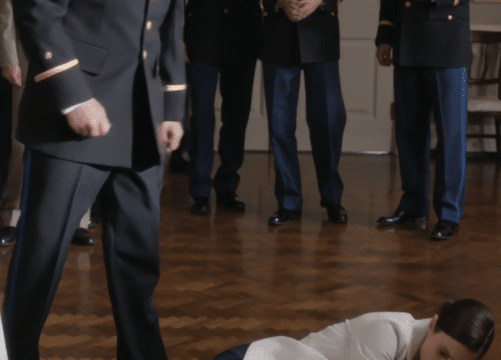
Then, before she could move away, Marcus drove a forceful kick into her chest.
The woman stumbled backward and fell beside the VIP counter, her forearm scraping across the polished stone floor. A thin trace of blood appeared along the scrape as she folded inward, gasping and instinctively protecting her unborn child.
A woman in the waiting area covered her mouth.
The nurse stopped moving.
For a moment, the lobby was filled with nothing but the sound of the pregnant woman’s frightened breathing.
Marcus looked down at her.
Instead of calling for medical assistance, he stepped around her and delivered two more forceful kicks into her back.
The sound of the impacts carried across the marble lobby.
Several visitors recoiled. The receptionist pressed a hand to her lips, while a man standing near the security desk took an instinctive step backward.
The pregnant woman curled around her belly, unable to understand how a simple request to visit her grandfather had become this.
Marcus adjusted his jacket.
“Cry outside the VIP floor.”
She looked up at him, tears gathering in her eyes.
“I told you who I was visiting.”
“And I told you to leave.”
He turned toward the reception desk as if the matter had been settled.
Then a soft chime sounded behind him.
The private elevator doors began to open.
A silver-haired man in a navy suit stepped into the lobby, accompanied by two aides who immediately stopped when they saw the scene. His face was rigid, his posture unmistakably authoritative.
He looked first at the woman on the floor.
Then at Marcus.
The color drained from his face.
He moved forward, his voice cold enough to silence the entire lobby.
“You just attacked my granddaughter.”
Marcus turned around.
For the first time in eleven years of security work, he seemed unable to remember what he was supposed to say.
Because the man standing before him wasn’t merely a powerful hospital visitor.
He was one of the most influential senior government officials in the country.
And the injured woman Marcus had just ordered to cry outside was the person he loved more than anyone in the world.
Act II
Her name was Olivia Bennett.
At twenty-seven, Olivia had grown accustomed to people reacting differently whenever they discovered who her grandfather was. Some became excessively polite. Others became nervous. A few tried to turn casual conversations into opportunities to gain influence.
She hated all of it.
Her grandfather, Thomas Bennett, had served in senior federal government positions for decades. He had advised presidents, testified before congressional committees, and negotiated through political crises that had dominated national headlines.
To the public, Thomas was a formidable man whose name could open doors across Washington.
To Olivia, he was the person who used to sit beside her bed when she had nightmares as a child.
Her parents had died in a car accident when she was twelve. Thomas had been the one who took her into his home, rearranged his schedule, and learned how to braid her hair from a series of increasingly frustrated online tutorials.
He attended her school performances whenever his duties allowed. He remembered her favorite birthday cake. When she struggled through her first year of college, he never told her to stop complaining or reminded her how much privilege she had.
He simply sat with her and asked what she needed.
Their bond had survived political pressure, family disagreements, and the constant demands of public life.
Olivia had never forgotten that her grandfather was a person before he was an official.
And she had spent her life trying to treat others the same way.
That philosophy had become especially important since she married Ethan Bennett, a civil engineer who worked on public infrastructure projects. Ethan had no interest in political influence and had never treated Olivia’s family connections as a shortcut to success.
Their marriage was quiet, affectionate, and deliberately private.
Now Olivia was eight months pregnant with their first child.
The pregnancy had been physically exhausting, and her doctor had recommended that she take extra care with long periods of standing. Thomas had worried constantly, although Olivia insisted that she was perfectly capable of looking after herself.
When she developed persistent discomfort one afternoon, Ethan encouraged her to get checked at a private hospital where her grandfather was receiving treatment for a minor medical issue.
Thomas had called her from his hospital suite that morning.
“Come upstairs when you arrive,” he had told her. “I want to see how you’re feeling, and I have something for the baby.”
“What is it?”
“That’s a surprise.”
“Grandpa, you’re terrible at keeping secrets.”
“I’ve kept secrets for the government for forty years. I can manage one more.”
She had laughed.
They agreed that she would visit him that afternoon.
Thomas had arranged for the hospital reception team to expect her, but the information had not been properly communicated to every member of the security staff. A temporary visitor restriction had also been placed on the private elevator while another patient was being transferred.
The confusion should have been easy to resolve.
Olivia had her identification. Thomas was expecting her. The reception desk could have called the upper floor and confirmed everything in less than a minute.
Instead, Marcus Reed had decided that his suspicion was more important than the truth.
Marcus had not always been cruel.
When he first joined the hospital, he took pride in protecting patients and helping frightened families navigate unfamiliar procedures. He knew that hospitals were places where people arrived at their most vulnerable, often exhausted, worried, and unsure of what to do next.
But after becoming security manager, his priorities shifted.
He began measuring success by how rarely anyone challenged him. He developed a reputation for being strict, and senior administrators praised him for maintaining order in the VIP wing.
Soon, he discovered that being feared could be easier than being respected.
He started humiliating visitors who asked too many questions. He threatened to remove staff members who disagreed with his decisions. When a junior guard complained that Marcus had unnecessarily frightened an elderly patient, Marcus accused him of being too weak for the job.
The guard withdrew the complaint.
Marcus interpreted the silence as permission.
By the time Olivia arrived, he had developed a habit of treating every unfamiliar visitor as a potential threat and every request for assistance as a challenge to his authority.
He had also learned something else.
People rarely complained when the person mistreating them controlled the doors.
A visitor who was denied access could be told to leave. A frightened family member could be accused of causing a disturbance. And anyone who insisted on being heard could be removed from the lobby before a supervisor had time to investigate.
Marcus believed the system protected him.
He never imagined that one day his own behavior would become impossible to hide.
When Olivia approached the private elevator, he saw a woman without a visible escort and assumed she was trying to gain unauthorized access. Her polite insistence irritated him because it challenged his first judgment.
Rather than reconsidering, he doubled down.
Every explanation became another reason to accuse her of lying.
Every attempt to remain calm became, in his mind, proof that she was manipulating him.
By the time he attacked her, he had convinced himself that he was defending the hospital.
He was actually defending his pride.
And when Thomas Bennett stepped out of the elevator, that distinction became painfully clear.
Act III
Thomas crossed the lobby so quickly that his aides struggled to keep pace.
“Olivia!”
She lifted her head at the sound of his voice.
“Grandpa…”
He dropped to one knee beside her, his carefully maintained composure breaking as he saw the pain in her face.
“Don’t try to get up. I’m right here.”
He reached for her hand, then looked toward the receptionist.
“Call the medical team immediately. Tell them we have a pregnant patient who has been assaulted.”
The receptionist hurried to make the call.
Thomas kept his eyes on Olivia.
“Can you hear me clearly?”
She nodded, though tears had begun to run down her cheeks.
“I’m sorry,” she whispered.
Thomas looked startled.
“What are you apologizing for?”
“I just wanted to come upstairs.”
His expression changed.
“You have nothing to apologize for.”
He turned toward the security staff gathering nearby.
“Give her room. Nobody moves her until medical personnel arrive.”
A nurse who had been waiting in the lobby approached cautiously, then knelt a short distance away to assess Olivia without moving her unnecessarily. Thomas stayed beside his granddaughter, holding her hand while the nurse asked a few initial questions.
Only when he was satisfied that help was on the way did he rise.
Marcus stood several feet away.
He had gone pale, but his expression still carried the strained look of someone trying to find an explanation that might save him.
“Sir,” he began, “there’s been a misunderstanding.”
Thomas turned toward him.
“A misunderstanding?”
“She was trying to access a restricted area.”
Thomas glanced at the private elevator.
“My granddaughter was expected upstairs.”
Marcus swallowed.
“I wasn’t informed.”
“Then you should have checked.”
“I was following security procedures.”
Thomas’s voice became sharper.
“Which procedure instructs you to kick a pregnant woman?”
Marcus opened his mouth, then closed it.
The lobby had fallen silent. Patients, visitors, and hospital staff watched the exchange with the stunned stillness of people who understood they were witnessing something that would not be easily forgotten.
Thomas took one step toward Marcus.
“You heard her explain who she was visiting. You had a reception desk, a telephone, and an entire security team available to you. You could have verified her identity in moments.”
Marcus’s jaw tightened.
“She refused to leave.”
“She asked you to call upstairs.”
“She was being difficult.”
Thomas stared at him.
“She was being polite.”
Marcus glanced toward the people watching.
“Sir, I had no idea who she was.”
Thomas’s expression hardened.
There it was.
The excuse he had expected.
“You had no idea who she was,” he repeated. “And that made it acceptable to attack her?”
“No, sir. That’s not what I meant.”
“Then what did you mean?”
Marcus shifted his weight.
“I was trying to protect the hospital.”
Thomas pointed toward Olivia.
“From her?”
Marcus said nothing.
Thomas lowered his voice, making every word unmistakable.
“You just attacked my granddaughter.”
He turned away from Marcus and returned to Olivia’s side as the medical team arrived. The clinicians began assessing her and arranging for her transfer to an appropriate treatment area.
Thomas followed their instructions, moving only when asked and refusing to leave Olivia alone.
Before the team wheeled her away, she caught his sleeve.
“Grandpa?”
“I’m here.”
“Please don’t let this become about my name.”
Thomas bent toward her.
She took a shaky breath.
“He shouldn’t have done that to anyone. Not just me.”
For a moment, Thomas could not answer.
He had spent his career watching powerful people demand exceptions, using their titles to escape the consequences that ordinary citizens faced. He had promised himself that he would never become one of them.
Now his own granddaughter was reminding him of the principle he had tried to live by.
He brushed a strand of hair away from her face.
“You’re right.”
Olivia’s eyes closed as the medical team began moving her toward the elevator.
Thomas watched until she was safely out of sight.
Then he turned back toward the security desk.
His expression was no longer simply that of a frightened grandfather.
It was the expression of a man determined to establish exactly what had happened and why.
“Who is responsible for this security team?” he asked.
The hospital’s director of operations, who had just arrived, stepped forward.
“I am, sir.”
“Then I want the original security footage preserved. Every camera covering this lobby, the elevator, and the reception counter. No edits, no deletions, and no exceptions.”
“Of course.”
“I want written statements from every employee who witnessed the incident. And I want the hospital’s legal and compliance teams involved immediately.”
The director nodded.
Thomas continued.
“Any criminal allegations must be handled by the appropriate authorities. The hospital must preserve the evidence and cooperate fully. No one is to pressure witnesses or attempt to rewrite what happened.”
Marcus’s eyes widened.
“Sir, you can’t possibly be suggesting that I—”
Thomas looked directly at him.
“I’m suggesting nothing. The evidence will speak for itself.”
He turned toward the director again.
“Until the investigation is complete, remove him from security duties. He is not to contact witnesses or interfere with the process.”
The director gave a quick nod to another security supervisor.
Marcus stepped forward.
“You can’t suspend me based on one person’s account!”
Thomas’s voice remained cold.
“There are witnesses standing in this room. There are cameras recording this lobby. And there is a woman upstairs receiving medical care after you attacked her.”
Marcus fell silent.
For the first time, the man who had controlled every conversation in the lobby had lost control of the room.
But Thomas was not finished asking questions.
Because while the hospital staff began securing the footage, one of the junior guards approached the director with a troubling admission.
Marcus had been reported before.
Not for an incident this severe, but for several confrontations with patients’ families that had raised concerns about unnecessary force, intimidation, and abuse of authority.
Those complaints had never been fully investigated.
And the man who had just attacked Olivia Bennett might have been protected by the very institution he claimed to serve.
Act IV
Thomas followed Olivia to the treatment area, where doctors began examining her and monitoring the baby.
Ethan arrived minutes later, his face tight with fear.
He had been on his way to meet Olivia when the hospital called. The moment he heard that she had been assaulted, he abandoned his plans and drove straight to the hospital.
When he saw her lying on the bed, he stopped at the doorway.
“Liv?”
She turned her head.
“I’m here.”
He crossed the room and took her hand.
“I’m here, too.”
For a moment, he could not say anything else.
The doctors explained that Olivia needed close observation after the assault. They were monitoring both mother and baby and would continue evaluating her condition before making any promises about the outcome.
Ethan listened to every instruction, asking questions when necessary and keeping his voice calm for Olivia’s sake.
Thomas stood near the window, his hands clasped behind his back.
He wanted to call every person he knew who could make Marcus’s life miserable. He wanted to demand immediate punishment, public accountability, and an explanation from every administrator who had allowed the security manager to remain in his position.
But Olivia’s words kept returning to him.
He shouldn’t have done that to anyone. Not just me.
Thomas had spent decades working inside institutions where power could quietly shape outcomes. He knew how easily an investigation could become a personal vendetta when the wrong people controlled it.
He would not allow that to happen.
The hospital’s legal team was instructed to preserve the evidence and cooperate with the authorities. The security manager’s duties were suspended while the internal investigation proceeded, and the hospital began a formal review of the earlier complaints against him.
The lobby footage was clear.
It showed Olivia approaching the reception counter and explaining that her grandfather was waiting upstairs. It showed Marcus blocking her path, refusing to verify her identity, and escalating the confrontation despite her calm behavior.
The recordings also captured the physical assault.
Several witnesses independently confirmed what the footage showed.
Marcus had not been defending himself. Olivia had not attacked him. There had been no emergency requiring physical force.
He had simply lost his temper when a visitor refused to accept his unsupported accusation.
When questioned, Marcus insisted that Olivia had been aggressive and that he had acted to maintain security.
The footage contradicted his account.
He then claimed that he had never received the correct visitor information and that the hospital’s procedures had placed him in an impossible position.
That explanation did not excuse his actions, but it prompted investigators to examine how the hospital communicated visitor restrictions and how security staff were trained to handle disputes.
The earlier complaints proved significant.
One family had reported that Marcus threatened to have them removed when they asked why a patient had been transferred to another unit. Another complaint described him shouting at an elderly man who could not locate the correct elevator.
In both cases, the initial reports had been classified as minor customer-service disputes.
No one had examined the pattern.
The hospital’s review found failures in its complaint-escalation process. Supervisors had relied too heavily on Marcus’s own accounts of confrontations, and employees had been reluctant to challenge a manager who controlled their assignments.
The institution had not instructed Marcus to abuse visitors.
But it had failed to recognize the warning signs before his behavior escalated.
The hospital’s director acknowledged the failures and ordered a broader review of security practices, including how force was authorized, how visitor concerns were escalated, and how employees could report misconduct without fear of retaliation.
Marcus was terminated after the internal investigation concluded that his actions constituted a serious violation of hospital policy. The assault was referred to the appropriate authorities, who would determine the legal consequences through the proper process.
Thomas did not demand that the hospital announce his granddaughter’s identity in its public statement.
He did not ask the director to release humiliating details about Marcus’s personal life.
He insisted only that the findings be accurate, the evidence remain intact, and the same standards apply to everyone involved.
When a reporter eventually asked whether his political influence had accelerated the response, Thomas gave a measured answer.
“The investigation should move as quickly as the evidence allows. But the standard should be the same for every patient, every visitor, and every employee. My granddaughter’s name should not be what makes this unacceptable.”
That statement spread widely.
Not because Thomas had threatened anyone, but because it exposed a contradiction the hospital could no longer ignore.
If a pregnant woman had to be the granddaughter of a senior government official before her complaint was taken seriously, then the institution had a problem far greater than one security manager.
Thomas understood that the public attention would fade eventually.
The more important question was whether the hospital would change after the cameras left.
He requested a meeting with the board and asked them to review the complaint process, the training standards, and the supervisory structure that had allowed earlier warnings to be dismissed.
The board agreed to implement the recommendations and establish an independent channel for reporting security misconduct.
Meanwhile, Olivia slowly began to recover.
Her doctors continued monitoring her condition, and Ethan remained beside her whenever he could. Thomas visited daily, often arriving with a book, a cup of tea, or some small gift he insisted was essential for the baby.
One evening, Olivia noticed him standing silently beside the window.
“You look like you’re planning to interrogate the entire hospital,” she said.
Thomas turned, surprised.
“I might be.”
She smiled faintly.
“Grandpa.”
He came to sit beside her bed.
“I keep thinking about what happened in the lobby.”
“So do I.”
“I should have done more to make sure people like Marcus couldn’t behave that way.”
Olivia looked at him.
“You didn’t know what he was going to do.”
“No. But the complaints were there.”
“And now you know.”
Thomas was quiet.
She squeezed his hand.
“Don’t spend all your energy being angry at one man. Make sure the next person who walks into that lobby doesn’t have to be related to you to get help.”
He nodded slowly.
That was the promise he would have to keep.
And it was a far more difficult task than making one security manager answer for his actions.
Act V
Several days later, Olivia was resting in a quieter room when Thomas arrived carrying a small gift bag.
“What’s that?” she asked.
“Something for the baby.”
“Another surprise?”
“I’m beginning to think I should stop telling you when I have surprises.”
She smiled as he placed the bag on the table.
Inside was a small knitted blanket, pale blue on one side and cream on the other. It had been made by Thomas’s late wife, Olivia’s grandmother, years before Olivia had even met Ethan.
Thomas had kept it carefully folded in a cedar chest for decades.
“I thought it belonged with the next generation,” he said.
Olivia ran her fingers over the soft fabric.
“Grandma made this?”
“She did. She said it was for the first grandchild who needed it.”
Olivia’s eyes filled with tears.
“She would have loved this baby.”
“She would have loved you holding it.”
Thomas sat beside her while she folded the blanket across her lap.
For a while, they talked about her grandmother, about the childhood summers Olivia had spent at her grandfather’s house, and about the small traditions they hoped to pass on to the baby.
Then Olivia became quiet.
“Did you hear what happened to Marcus?”
Thomas nodded.
“The hospital completed its investigation. He’s no longer employed there. The authorities are handling the assault separately.”
She looked down at the blanket.
“Do you think he understands what he did?”
“I don’t know.”
“Do you think he regrets it?”
Thomas considered the question.
“Regret and accountability aren’t always the same thing. He may regret the consequences. Whether he understands the harm he caused is something only his actions over time could demonstrate.”
Olivia nodded.
She wasn’t interested in pretending that what had happened could be undone. She remembered the fear, the pain, and the terrible moment when she had realized that the man blocking her path was willing to hurt her rather than listen.
But she also knew that her grandfather was right.
Justice was not the same as revenge.
She wanted the truth established, the failures corrected, and the next vulnerable visitor protected.
She did not need Marcus to suffer publicly in order for those things to matter.
“I just wish someone had helped sooner,” she whispered.
Thomas looked at her.
“So do I.”
That admission stayed with him long after he left the hospital.
The security footage had shown several people witnessing the attack. Most had frozen in shock, unsure how to react when a security manager became the source of danger rather than protection.
Some had feared interfering with an employee who appeared to control the lobby. Others had assumed someone else would call for help.
Their silence had not made them responsible for Marcus’s decision to use violence.
But it had revealed how easily fear could persuade ordinary people to wait.
The hospital introduced new procedures requiring staff to report serious misconduct immediately, even when the person involved held a supervisory position. Security employees received additional training in de-escalation and the proper use of force, while visitors gained a clearer way to request assistance when access disputes arose.
The board also required complaints involving security personnel to be reviewed independently rather than resolved solely by the manager accused of misconduct.
The changes did not erase what Olivia had experienced.
They did, however, make it harder for a similar pattern of behavior to remain hidden.
Months later, Olivia returned home with Ethan and their newborn daughter.
Thomas visited often, bringing meals, books, and far too many tiny outfits. He held the baby with extraordinary care, as though the smallest movement might disturb something precious.
One afternoon, Ethan found him standing beside the nursery window.
“You all right?” Ethan asked.
Thomas looked down at the sleeping child in his arms.
“I keep thinking about that elevator.”
Ethan knew exactly what he meant.
“If it hadn’t opened when it did,” Thomas continued, “I don’t know how long it would have taken before someone stepped forward.”
Ethan looked toward the crib.
“Maybe the answer is making sure people don’t have to wait for someone important to arrive.”
Thomas nodded.
“That is exactly the answer.”
When Olivia entered the nursery, she found the two men standing in silence.
“What are you discussing?”
“Your grandfather is trying to solve the world’s problems again,” Ethan said.
Thomas raised an eyebrow.
“Someone has to.”
Olivia laughed, and the sound filled the room with a warmth that had been missing since the hospital incident.
She took her daughter from Thomas and settled into the rocking chair. The baby stirred briefly, then fell asleep against her mother.
For a moment, Olivia thought about the lobby, the polished stone floor, the private elevator, and the man who had looked at her and decided she was not worth listening to.
She would always remember what happened.
But she refused to let that moment define the rest of her life.
She wanted her daughter to grow up understanding that authority was a responsibility, not a license to humiliate others. She wanted her to know that asking for help was not weakness, and that kindness mattered most when it was offered to someone who could give nothing in return.
Thomas sat beside her.
“I’ve spent most of my life in rooms where people wait for the most powerful person to speak,” he said quietly. “Sometimes I wonder whether that teaches everyone else to remain silent.”
Olivia looked at him.
“Then be the person who speaks up first.”
He smiled sadly.
“I’ll try.”
“No,” she said gently. “Do it.”
Thomas looked at his granddaughter and nodded.
He knew that his position could make people listen to him. It could secure meetings, compel institutions to examine their failures, and draw public attention to problems that might otherwise be ignored.
But it could not guarantee that every frightened visitor would be protected.
That responsibility belonged to the people who worked in those institutions every day.
The private elevator had opened at precisely the moment Thomas needed to see what was happening. His arrival had changed the room because everyone recognized him.
Yet the truth had been true before he stepped out.
Olivia had not deserved to be attacked when Marcus believed she was a stranger. She had not needed a powerful grandfather to make her suffering real. She had needed a security manager to do his job with restraint, and a hospital willing to hold its employees accountable when they failed.
Marcus had believed that the badge on his chest gave him the final word.
He had mistaken control for character and suspicion for proof.
In the end, the security footage, the witnesses, and the hospital’s own records revealed what his authority had concealed.
The woman he had tried to throw out was the granddaughter of a senior government official.
But that was not the reason his actions were wrong.
They were wrong because she was a human being who had asked for help.
And when Thomas Bennett stepped out of the private elevator and said, “You just attacked my granddaughter,” the entire lobby finally understood who she was.
The greater lesson, however, was one Marcus had failed to understand from the beginning.
You should never have to be somebody important to deserve to be treated like somebody who matters.