Act I
“Open the gate.”
The officer standing behind the closed checkpoint barrier did not move.
Instead, twenty-seven-year-old Sergeant First Class trainee Lauren Mitchell held out her hand and looked directly at the man in front of her.
“I need your access card first.”
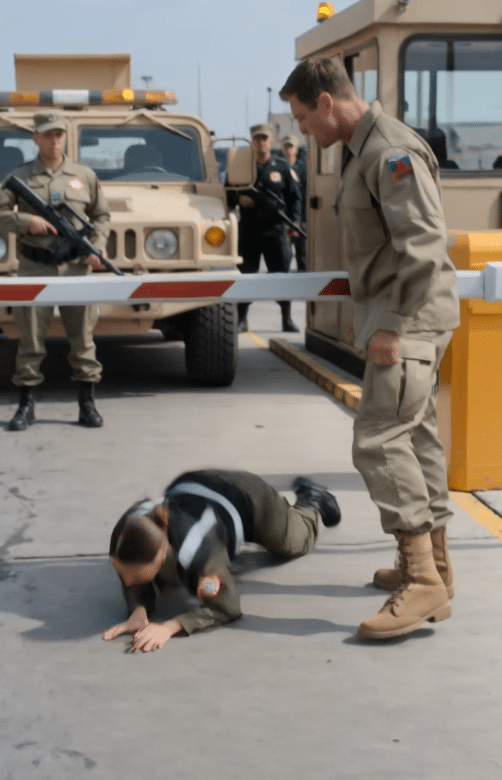
The red-and-white barrier remained lowered across the road. Yellow warning lights flashed against the military vehicles waiting behind it, and the guard cabin hummed beneath the noise of idling engines. Beyond the fence lay a restricted section of the American military base, sealed under a special security lockdown.
The man facing Lauren wore an olive-green uniform and the expression of someone who had never expected a woman at a checkpoint to tell him no.
His name was Captain Derek Walsh. At thirty-four, he had built his reputation on confidence, aggression, and an ability to make junior personnel nervous before he even spoke. He carried himself like a man who believed rank was not merely a responsibility, but a privilege that placed him beyond ordinary rules.
He stared at Lauren’s outstretched hand.
“Trash. Open the gate.”
Lauren kept her posture straight.
“Sir, the lockdown procedure requires identity verification before access can be granted.”
“I know what the procedure is.”
“Then you understand why I need your card.”
For a moment, Derek looked almost amused. He glanced toward the guards near the cabin, as if expecting one of them to step forward and correct the young officer for speaking to him that way.
Nobody moved.
The gate was closed because a security alert had triggered a temporary restriction on movement into the installation’s sensitive operations area. Until the alert was resolved, every person entering that section had to be verified, regardless of rank.
Lauren had been briefed on the order personally. She had checked the instructions twice and repeated them back to her supervisor before taking her position.
She had no authority to ignore the lockdown because someone disliked being inconvenienced.
And Derek had no authority to override it simply because he wore a captain’s insignia.
“Move,” he snapped.
Lauren did not lower her hand.
“Sir, I cannot open the gate without verifying your access.”
Something hardened in Derek’s face.
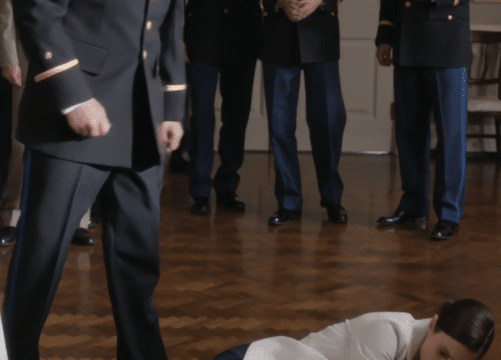
He took a forceful step toward her, then surged forward and drove a hard kick into her chest. Lauren was knocked backward beside the barrier, her boots slipping across the pavement as she fell.
Her forearm struck the ground. The impact scraped her skin, leaving a thin trace of blood, and her access-control equipment clattered beside her.
For one stunned second, the checkpoint seemed to lose all sound except the engines.
Lauren gasped and tried to draw a steady breath.
Derek stepped closer.
Then he kicked her again, twice, striking her back and side while she struggled to protect herself. She winced sharply, curling against the pain, but her eyes kept returning to the barrier.
It was still closed.
Even from the ground, she pointed weakly toward it.
“Sir…” she managed, fighting to catch her breath.
Derek looked down at her with open contempt.
“You don’t stop officers like me.”
Behind him, the gate guards froze. One covered his mouth. A military driver stepped away from his vehicle, then stopped when Derek turned his head.
Nobody intervened.
Derek had wanted to force the gate open through intimidation. Instead, he had turned a routine checkpoint into a scene of violence witnessed by multiple service members.
Then a command vehicle came to a sudden stop behind the barrier.
Its brakes cut through the rumble of the waiting engines.
The driver’s door opened, and a fifty-four-year-old man in a dark green command uniform stepped onto the pavement. His expression was severe, his stride deliberate, and the command badge on his chest caught the flashing yellow light.
Base Security Commander Colonel Thomas Reed had not come to the checkpoint to negotiate.
He walked directly toward Derek and stopped between him and the injured officer.
“You just attacked the officer enforcing my lockdown.”
Derek’s jaw tightened.
He looked at the closed barrier, then at the colonel.
For the first time, the captain seemed unable to decide what to say.
“Your lockdown?”
The question escaped his mouth as the color drained from his face.
He had thought Lauren was an obstacle he could remove.
He was only beginning to understand that she had been protecting an order issued by the very man now standing in front of him.
And the colonel had seen enough to know this was no longer just a question of access.
Act II
Lauren Mitchell had learned early that authority was easiest to recognize when it was inconvenient.
Her father had spent twenty-two years as a county emergency dispatcher. He was not a soldier, and he had never commanded anyone in uniform, but he had taught her a principle she carried into every job she held.
A rule mattered most when someone powerful wanted an exception.
When Lauren joined the military, she discovered that the principle applied everywhere. At a vehicle inspection, it meant refusing to wave through a truck with incomplete documentation. During a restricted-area check, it meant asking a decorated officer to verify his credentials even when everyone around her insisted they already knew who he was.
Some people appreciated her attention to detail.
Others called her rigid.
Derek Walsh belonged to the second group.
He had served long enough to know the procedures, but he had developed a habit of treating them as flexible guidelines for everyone except himself. If a junior soldier asked for a document, he demanded to know why. If a guard delayed his vehicle, he complained about incompetence. If someone challenged one of his decisions, he responded as though the disagreement itself were an act of disrespect.
He was not always openly hostile. In front of senior commanders, Derek could be polished and professional. He knew when to stand straight, when to salute, and how to describe a difficult situation in a way that made him sound decisive.
His problem emerged when authority did not arrive wearing a higher rank.
He could accept an order from a colonel.
He struggled to accept the same order from a young security officer whose job required her to enforce it.
The special lockdown had been issued after irregularities were detected in an access log connected to the restricted operations area. Investigators were reviewing whether an unauthorized credential had been used or whether a procedural failure had allowed an entry to go unrecorded.
There was no confirmed evidence that Derek was involved in the irregularities. At that stage, the purpose of the lockdown was to preserve security while the records were examined, not to accuse every person seeking entry of wrongdoing.
But the instruction was clear.
No one was to bypass identity verification. No exceptions were to be granted merely because a person claimed urgency, familiarity with the installation, or seniority.
Colonel Reed had personally emphasized that point during the morning briefing.
“The gate does not decide who deserves respect,” he had told the checkpoint team. “It verifies who is authorized to enter. Your responsibility is to apply the procedure consistently.”
Lauren had listened carefully.
She understood that the job was not glamorous. Most of the time, it involved checking credentials, monitoring vehicles, answering questions, and enduring complaints from people who believed their schedules mattered more than the security system.
But she also understood what a checkpoint protected.
Behind the barrier were personnel, equipment, sensitive information, and operations that could not be exposed to unnecessary risk. The gate was not simply a piece of metal across a road. It was the physical boundary between verified access and an assumption.
When Derek arrived, he was already irritated by the delay.
He had been trying to reach a meeting in the restricted operations area, and the lockdown had disrupted his schedule. He approached the checkpoint expecting to be recognized and waved through.
Lauren requested his access card.
He refused.
At first, she believed the disagreement would end with a supervisor being called. It was an ordinary solution to an ordinary problem: when a person disputes a security requirement, pause the process and request clarification through the proper chain of command.
But Derek did not want clarification.
He wanted obedience.
When Lauren repeated the instruction, he interpreted her calm refusal as a public challenge. The guards were watching. The drivers were watching. And in Derek’s mind, allowing a junior officer to delay him would make him look weak.
That fear mattered more to him than the reason the gate had been closed.
He attacked her because he believed violence would restore the authority he felt she had taken away.
What he failed to understand was that Lauren’s authority had never depended on winning an argument with him.
It came from the security order she was enforcing.
And that order had been issued by Colonel Thomas Reed, who was now walking toward him with the entire checkpoint watching.
Act III
Colonel Reed stopped close enough that Derek could no longer pretend the confrontation was between himself and a low-ranking gate officer.
The colonel’s gaze moved briefly to Lauren on the pavement. She was conscious, breathing hard, and trying to keep her injured arm steady. Her access card lay several feet away, near the base of the barrier.
Reed did not look away from Derek for long.
“Stand where you are,” he ordered.
Derek stiffened.
“Sir, she refused to follow a direct order to open the gate.”
“She followed my order to keep it closed.”
The response was immediate.
Derek blinked.
Reed continued, his voice cold and precise.
“The restriction was issued through base security command. Every person entering that section is subject to verification. Your rank does not suspend the procedure.”
“I was on my way to an authorized meeting, sir.”
“Then your authorization can be verified.”
“I was trying to get through.”
“And when she told you to present your access card?”
Derek hesitated.
Reed did not raise his voice.
“When she told you to present your access card, Captain, what did you do?”
The guards and drivers stood motionless. The yellow warning lights continued flashing above the closed barrier, casting brief bands of color across the colonel’s uniform.
Derek glanced at Lauren.
“She was being insubordinate.”
“That is not an answer.”
“She challenged my authority in front of my personnel.”
“You are not answering the question.”
Derek’s jaw flexed.
For years, he had been able to escape difficult conversations by speaking louder, shifting the subject, or making the person questioning him defend their own competence. It had worked often enough that he had begun to mistake the tactic for leadership.
Colonel Reed did not give him room to use it.
“You were denied immediate access pending verification. That was the procedure. You could have presented your card, requested a supervisor, or waited for clarification.”
Reed paused.
“Instead, you assaulted the officer enforcing the restriction.”
Derek looked toward the waiting vehicles as if the drivers might somehow offer him an alternative account of what had happened. Their faces gave him nothing. They had seen the attack. Some had heard every word.
He had no credible way to turn the incident into a misunderstanding.
“Sir, I did not intend to—”
“You kicked her.”
Derek stopped speaking.
The words were plain. They contained no speculation, no insult, and no room for the excuse he had been preparing.
Colonel Reed shifted slightly, maintaining his position between Derek and Lauren.
“You will not approach her. You will not interfere with the response to her injuries. You will remain here while the incident is secured and the appropriate authorities are notified.”
Derek’s face tightened at the word authorities.
He had expected an argument with a checkpoint officer. He had expected perhaps a reprimand, a delay, or an angry call to someone who would tell Lauren to stop making things difficult.
He had not expected the base security commander to treat his conduct as a serious incident requiring formal action.
“Sir, with respect, I am a commissioned officer.”
“And she is a security officer carrying out an authorized duty.”
Reed’s expression did not change.
“Your commission does not grant you permission to assault another service member.”
The sentence seemed to remove the last support beneath Derek’s confidence.
He looked down at the barrier again.
It had not moved.
The access procedure had not changed.
And the woman he had tried to silence had been enforcing the commander’s order exactly as written.
“Your lockdown?” he whispered, almost to himself.
Now the question meant something different.
He was no longer asking whether Reed had ordered the gate closed.
He was realizing that he had committed an act of violence while trying to force his way past an instruction issued by the officer responsible for the entire security operation.
But the revelation went deeper than the identity of the person who had given the order.
Colonel Reed had chosen Lauren for the checkpoint because he trusted her judgment.
And the way she had handled Derek’s arrival was about to matter as much as the way Derek had responded to it.
Act IV
The colonel did not turn the checkpoint into a stage for revenge.
He treated it as a security incident.
He directed the guards to preserve the scene, maintain the gate restriction, and record the names of the witnesses. Medical assistance was requested for Lauren, and Derek was kept away from her while the appropriate command and security personnel were notified.
The access card and checkpoint records were preserved as part of the review. Witness accounts would be collected separately, and the sequence of events would be established through the available evidence.
There would be no informal deal to make the incident disappear because the accused officer wore a captain’s insignia.
Nor would there be a final judgment delivered on the roadside before the facts had been formally examined.
Derek had the right to the procedures that governed his service. Lauren had the right to have the assault investigated without intimidation or interference. The witnesses had the responsibility to report what they had seen rather than what they thought their superiors wanted to hear.
Colonel Reed understood that discipline was not simply the ability to punish someone who had lost control.
It was the willingness to apply standards even when the person who violated them was powerful, well-connected, or otherwise considered valuable.
As Lauren was attended to by medical personnel, Reed remained focused on securing the checkpoint. The barrier stayed down. The lockdown remained in force. Derek’s attempt to force entry did not change a single requirement.
That fact seemed to trouble him more than anything else.
He had used violence because he expected the gate to open when he demanded it. Yet even after the assault, the system continued operating according to the same instructions.
The barrier had not yielded to his rank.
The guards had not suddenly decided that the rule no longer applied.
And Colonel Reed had not treated the attack as an unfortunate misunderstanding between two people who had failed to communicate.
The lockdown was about protecting a sensitive area, but it was also an examination of whether the base could apply its procedures under pressure. A restriction that disappeared whenever someone influential objected was not a restriction at all.
Lauren had understood that.
Derek had rejected it.
As the incident review began, investigators also examined the original access-control concern that had prompted the lockdown. The irregularities were still being assessed, and there was no basis to assume that Derek’s behavior proved he had anything to do with them.
But his assault presented a separate and immediate issue.
He had been asked to verify his access.
He had refused.
He had been told to wait.
He had attacked the person enforcing that instruction.
No theory about the underlying security alert could excuse those actions.
The command placed Derek’s access privileges and his eligibility for upcoming assignments under review in accordance with the applicable procedures. His conduct would be considered through the proper disciplinary channels, and his account would be weighed against the physical evidence and witness statements.
For an officer who had spent years building his career around the image of an unquestioned professional, the uncertainty was punishing.
He could no longer assume that his record would protect him from scrutiny. He could not count on the people watching to forget what they had seen. And he could not dismiss Lauren’s actions as a minor act of insubordination, because the very commander who had ordered the lockdown had confirmed that she was doing her job.
Colonel Reed eventually addressed the checkpoint team.
He did not lecture them about bravery or demand that they become heroes. He reminded them of their responsibilities, including the duty to report violence, preserve evidence, and seek help when an incident exceeded what they could safely handle.
He also made one point unmistakably clear.
A checkpoint officer’s authority was not a personal privilege that could be granted or withdrawn by the person waiting at the barrier. It was a responsibility delegated through the command structure, and it had to be respected if the security system was to function.
The silence among the witnesses changed.
They were still shaken by the assault, but now they understood what the colonel expected from them. Their job was not to decide whether Derek was important enough to receive special treatment.
Their job was to uphold the procedure and tell the truth about what had happened.
Derek stood apart from them, listening.
He had wanted the entire checkpoint to see a junior officer being put in her place.
Instead, every witness had seen a commissioned officer use his position as an excuse to attack someone performing an authorized duty.
The difference would follow him into the formal review.
And for the first time in his career, Derek had to face the possibility that the authority he had spent years demanding would not be enough to protect him from the consequences of his own choices.
Act V
The formal review did not end with a dramatic announcement at the gate.
It began with statements, records, medical documentation, and an examination of the applicable military rules. The command separated the facts of the assault from the still-unresolved access-control concern, ensuring that neither issue was used to prejudge the other.
The evidence of what had happened at the checkpoint was straightforward.
Lauren had requested Derek’s access card under the lockdown procedure. He had refused to comply. After she maintained the restriction, he had attacked her and continued the assault while the barrier remained closed.
Multiple witnesses had observed the confrontation.
The command review would determine the appropriate disciplinary response, and Derek would have to answer for his conduct through the established process. His access privileges and pending assignments remained subject to review while the matter proceeded.
There would be no instant restoration of his position simply because the confrontation had become embarrassing for the base.
Nor would the colonel promise an outcome before the process was complete.
That distinction mattered to Lauren.
She had never asked for Derek to be destroyed. She wanted the security rules respected, the assault taken seriously, and the checkpoint team to know that doing their jobs would not leave them alone when someone with more rank became angry.
When Colonel Reed visited her after she had received medical attention, she was seated with her injured arm supported. She looked exhausted, but her eyes were clear.
“Ma’am—” she began, then corrected herself with a faint, tired smile. “Sir, is the checkpoint still under lockdown?”
Reed studied her for a moment.
“Yes. The restriction remains in effect.”
“Good.”
He pulled a chair closer but remained standing beside it.
“You understand that the review may take time.”
“Yes, sir.”
“You also understand that you are not responsible for what Captain Walsh chose to do.”
Lauren looked down at the dressing on her forearm.
“I know, sir. I just wish the others hadn’t been afraid to move.”
Reed did not dismiss the concern.
“They will be given an opportunity to explain what they saw. We’ll review the response as well as the assault.”
Lauren nodded.
She did not pretend the fear at the checkpoint had been harmless. She had seen the guards step back, the drivers freeze, and the space around her grow empty while Derek stood over her. For a few painful seconds, she had understood how quickly a uniform could become a shield for the person wearing it, even when that person was abusing the authority it represented.
But she also knew that the incident had exposed a problem the base needed to address.
A security system could not rely entirely on the courage of one officer. It required clear procedures, reliable support, and a command willing to stand behind personnel who enforced legitimate orders.
Colonel Reed had given her that support when he arrived.
Now he had to ensure the institution did the same after he left.
In the weeks that followed, the incident became a reference point in the base’s security briefings—not as gossip about a captain who had lost his temper, but as a reminder that rank and authorization were not interchangeable. Personnel were reminded that access controls applied consistently, that objections had to be handled through proper channels, and that violence against a colleague would not be treated as a shortcut to compliance.
The lockdown itself was eventually resolved through the appropriate security review. The investigation into the access irregularities proceeded on its own evidence, separate from the disciplinary case arising from the assault.
Derek’s career did not receive a magical verdict in the space of a single afternoon. The consequences depended on the findings and the applicable procedures. But his actions had permanently changed the way his conduct would be examined, and the command no longer had reason to treat his confidence as proof of sound judgment.
The checkpoint guards remembered the moment he had demanded that Lauren move aside.
They remembered the kick, the closed barrier, and the command vehicle arriving behind it.
Most of all, they remembered Colonel Reed’s words.
You just attacked the officer enforcing my lockdown.
It was not a clever insult. It was not a threat designed to frighten Derek into obedience.
It was the truth, stated plainly by the person whose authority Derek had refused to recognize.
Lauren eventually returned to duty when she was cleared to do so. On her first shift back at the checkpoint, the red-and-white barrier lowered across the road as vehicles approached. The yellow warning lights flashed, and the familiar hum of the guard cabin surrounded her.
She checked the credentials presented to her one by one.
When another officer asked whether the verification process could be shortened because he was running late, Lauren remained polite and firm. She explained the requirement and waited for the necessary confirmation.
This time, nobody challenged her right to ask.
The barrier rose only when the required checks were complete.
There was no applause, no ceremony, and no commander standing beside her to make the moment feel important.
There was simply a security officer doing her job.
That was how it should have been from the beginning.
Derek Walsh had believed rank made him untouchable. He had mistaken compliance for respect and intimidation for leadership. When a young officer refused to bend a security rule, he had tried to prove that he was the more powerful person by force.
Instead, he had revealed the weakness beneath his authority.
Because real command is not measured by how quickly others step aside when you approach. It is measured by what you do when someone with less power tells you that you are wrong—and whether you can accept the answer without making everyone around you less safe.
At that checkpoint, Lauren Mitchell had held the barrier closed because the order required it.
Colonel Thomas Reed had backed her because the order was his.
And Derek had learned, too late, that no rank in the military could turn an unlawful demand into a legitimate command.
The gate had never been the thing standing between him and his destination.
His own conduct was.