Act I
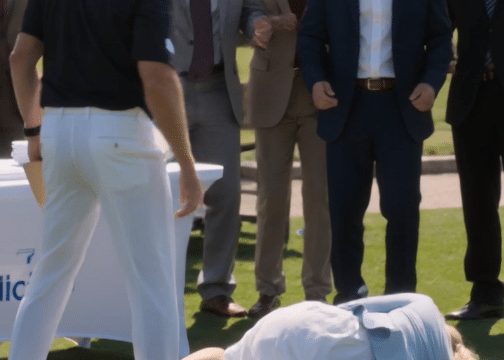
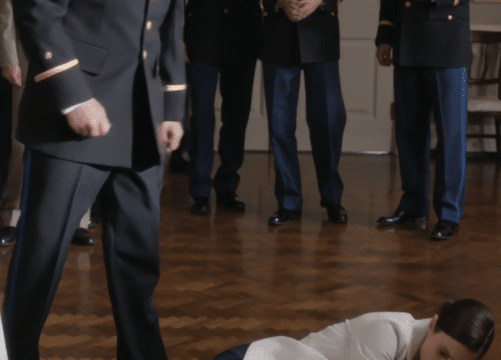
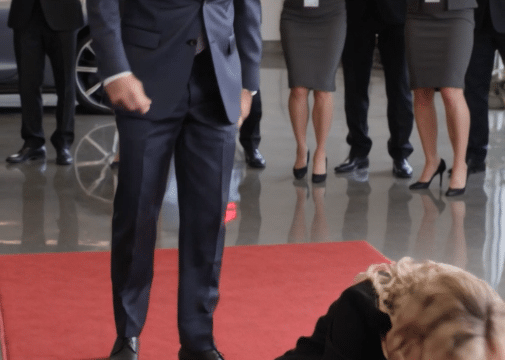
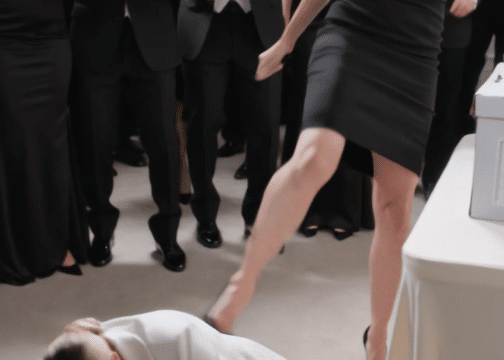
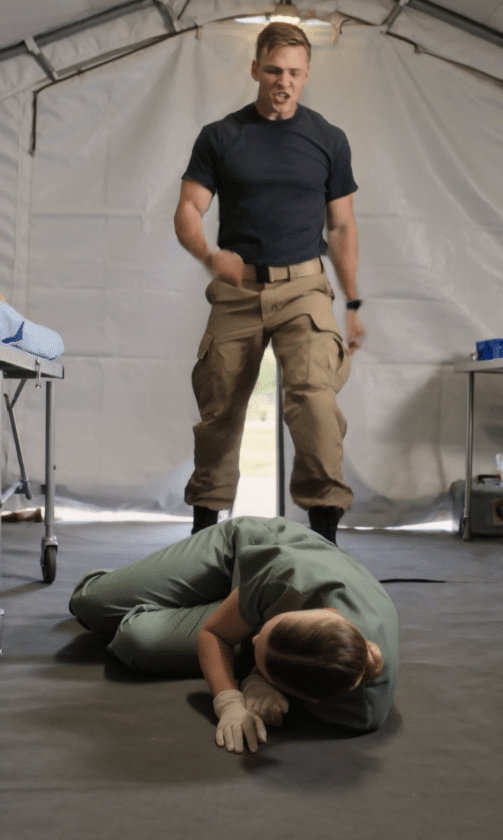
The kick sent her crashing to the ground beside the medical cot before anyone in the field tent could react.
The first-aid kit rattled violently against a metal support. A few instruments clattered onto the canvas-covered floor, and twenty-four-year-old Emily Brooks gasped as her forearm struck the ground. A thin trace of blood appeared where her skin had scraped against the rough surface.
But even as pain shot through her arm, Emily lifted one gloved hand toward the man standing over her.
“Do not move him yet.”
Sergeant-in-training Ryan Mitchell stared down at her as though she had just insulted him in front of an entire battalion. He was twenty-five, broad-shouldered, muscular, and accustomed to people moving out of his way whenever his voice grew loud enough.
To Ryan, the woman on the ground was not a medical professional. She was not a teammate. She was simply an obstacle between him and the opportunity to prove he was the toughest man in the tent.
“Trash. You’re just a trainee nurse.”
The words landed almost as hard as the kick.
Emily tried to push herself upright, keeping her eyes on the simulated casualty lying on the cot. The training mannequin had been designed to represent a soldier suffering from a suspected spinal injury after an explosion. According to the exercise instructions, moving him before completing the required assessment could turn a survivable injury into a catastrophic one.
Ryan had already reached for the mannequin’s shoulders.
Emily had stopped him because that was exactly what she was supposed to do.
And Ryan had answered by attacking her.
He stepped forward and delivered two more forceful kicks into her back and side as she struggled to protect herself. Emily recoiled with a sharp gasp, her body tightening against the pain, but her raised hand remained extended toward the cot.
Stop.
That was the signal she kept making.
Not because she believed Ryan would listen, but because the patient still mattered more to her than the humiliation unfolding around her.
Several trainees stood frozen along the tent walls. One covered his mouth. Another took an instinctive step backward, staring at Emily as if he could not understand how a training exercise had become an assault.
Nobody intervened.
Ryan straightened, breathing hard, and looked around at the silent witnesses.
“Move aside and let real soldiers work.”
He seemed to expect approval. At the very least, he expected fear.
What he did not notice was the sudden movement at the entrance.
The canvas flap snapped open.
A senior military doctor strode into the tent, her dark green uniform immaculate, her brown hair pulled tightly into a bun. At forty-eight, Colonel Catherine Hayes had spent enough years treating wounded service members to recognize the difference between confidence and recklessness.
She took in the fallen medic, the disturbed first-aid kit, the frightened trainees, and Ryan standing beside the cot.
Then she moved directly between him and Emily.
“Stand down. She was grading your medical response.”
Ryan’s expression changed.
For the first time since the confrontation began, he looked as though he had lost control of the situation.
His mouth opened slightly. His eyes shifted toward Emily, who was still on the floor, breathing through the pain.
“Grading me?”
The question came out smaller than he intended.
And Colonel Hayes had not yet told him what his actions had cost him.
Act II
Twenty minutes earlier, Emily Brooks had entered the medical training tent believing she was finally close to earning the recommendation she had worked toward for almost two years.
She had not grown up dreaming about military medals or command ceremonies. Her ambition had started with something much simpler: a night in a hospital emergency department when she was seventeen, watching a physician and two nurses fight to stabilize a stranger whose family had not even arrived yet.
Nobody in that room had asked whether the patient was wealthy, important, popular, or strong.
They had simply worked.
Emily remembered the quiet authority of the senior nurse who had directed everyone around her. The woman never shouted unless she needed to be heard over the noise. She never confused aggression with competence. When frightened people began moving too quickly, she slowed them down.
That was the kind of professional Emily wanted to become.
After joining the military medical training program, she discovered that medicine in uniform required more than memorizing anatomy and learning to apply dressings. It required making sound decisions while exhausted people panicked, while communications failed, and while someone with a higher rank demanded an answer before the evidence was clear.
The stakes were different from a civilian hospital, but the essential question remained the same.
Could you protect a patient when doing the right thing made someone angry?
Emily had answered that question in smaller ways throughout her training. She had challenged an instructor who had skipped a safety check. She had asked for clarification when a simulated casualty’s condition did not match the initial report. She had once refused to sign off on a procedure she had not personally observed, even after another trainee accused her of wasting everyone’s time.
Those decisions had not made her popular.
They had, however, earned her a reputation for being careful.
Ryan Mitchell had a very different reputation.
He was physically gifted, quick on obstacle courses, and capable of pushing himself through punishing drills. He could carry heavy equipment farther than most of his classmates and had a talent for making difficult tasks look easy.
In front of instructors, he often appeared disciplined and confident.
Away from them, his confidence became something else.
Ryan disliked being corrected, especially by women. He treated questions as challenges and safety instructions as obstacles designed by people who lacked the courage to act. When a teammate suggested a different approach, Ryan usually responded by reminding everyone how much harder he had trained than they had.
His performance records were good enough to keep him competitive for a coveted advanced field-operations qualification. Several instructors believed he had the physical ability to excel.
Others had quietly begun asking whether he could be trusted to make decisions when nobody was watching.
Ryan interpreted every warning as jealousy.
When Emily was assigned to the medical response assessment, he assumed she had been given a minor administrative task. She was a trainee, after all, and in his mind, a trainee’s job was to obey experienced soldiers rather than tell them what to do.
He never asked why she had been placed at the center of the exercise.
He never read the evaluation instructions carefully enough to understand that the medical response was not merely about moving a casualty from one location to another. It was designed to test judgment under pressure, communication, patient protection, and the ability to recognize when immediate action would cause additional harm.
Most importantly, Ryan did not understand that his response to correction was itself part of the assessment.
Colonel Hayes had helped design that portion of the training after witnessing too many promising service members confuse decisiveness with speed. She had seen what happened when a person became so invested in appearing strong that admitting uncertainty felt more frightening than making a dangerous mistake.
She wanted to identify that weakness before it reached a real battlefield.
Emily knew the rules.
Ryan believed the rules were beneath him.
And the exercise had barely begun when those two beliefs collided.
The mannequin on the cot represented a wounded soldier who might have suffered a spinal injury. The proper response required the trainees to stabilize the situation, communicate, and follow the assessment protocol before attempting movement.
Ryan wanted to get the casualty out immediately.
Emily stopped him.
It should have been an ordinary disagreement, resolved with a brief explanation and a corrected procedure.
Instead, Ryan decided that being told no was an insult he could not tolerate.
And within seconds, the training exercise became the kind of test nobody had intended to administer to Emily.
Act III
When Colonel Hayes entered the tent, she did not rush to Ryan, and she did not raise her voice.
She placed herself between him and Emily, forcing him to face someone he could not intimidate with a glare or a display of physical strength.
“Stand down,” she repeated, her voice controlled and unmistakably authoritative. “She was grading your medical response.”
Ryan stared at her.
Then he looked past her shoulder at Emily.
She was still beside the cot, one hand pressed against her side, her face pale from the pain. Her other hand had lowered to the ground, but her eyes remained fixed on the simulated casualty.
Even now, she seemed more concerned about the procedure than about the man who had kicked her.
Ryan’s confidence began to fracture.
“Grading me?”
He said it again, as though the words might change if he heard them in a different order.
Colonel Hayes did not answer immediately. She let the silence settle over the tent, allowing the significance of the moment to reach every trainee who had witnessed it.
Then she looked directly at him.
“You were being evaluated on your response to a suspected spinal injury. You were instructed to follow the protocol, communicate with the medical lead, and avoid unnecessary movement until the assessment was complete.”
Ryan swallowed.
“I was trying to get the casualty out of danger, ma’am.”
“You were told not to move him yet.”
“He was on the cot. I could have moved him.”
“That is not what you were being evaluated on.”
The colonel’s tone remained even, which somehow made the exchange more unsettling than a shout would have.
“You were being evaluated on whether you could recognize a risk, accept a safety instruction, and adjust your actions when a qualified team member identified a problem.”
Ryan’s jaw tightened.
He had expected an argument about technique. He had prepared himself to defend his physical instincts and insist that hesitation was dangerous. He had not expected the entire premise of his behavior to be questioned.
Colonel Hayes continued.
“Instead of explaining your reasoning, you insulted the person responsible for assessing the response. Then you used physical force against her.”
For the first time, Ryan glanced toward the other trainees.
They were still standing against the canvas walls. Nobody was looking at him with admiration now. The men who had once laughed at his jokes were watching him with the guarded expressions of people who had suddenly realized that they did not know someone as well as they thought.
Ryan shifted his weight.
“Ma’am, she was interfering with—”
“Stop.”
One word.
He fell silent.
Colonel Hayes turned her attention briefly toward Emily, checking that the injured trainee remained conscious and responsive. Her expression tightened when she saw the way Emily was holding her side.
“Medical support is being called,” she said. “You will not approach her.”
Ryan stayed beside the cot, rigid and uncertain, as the colonel reclaimed control of the space.
The revelation had changed everything, but it had not yet answered the question that mattered most.
What happened when a trainee entrusted with the safety of others proved that he could not control himself when his authority was challenged?
Colonel Hayes knew the answer would not fit neatly on a training scorecard.
Ryan was about to discover that it would follow him far beyond the tent.
Act IV
The next several minutes were the longest of Ryan Mitchell’s life.
Colonel Hayes kept him in place while medical personnel were summoned to assess Emily. She did not allow him to move toward the cot or offer an explanation to the witnesses. Whatever he wanted to say, he would have an opportunity to say it through the proper process.
For now, he was to remain silent and comply.
Emily was carefully assessed by the arriving medical team. Her injuries required attention, and the exercise was immediately suspended. The simulated casualty remained on the cot, untouched, a quiet reminder of the instruction Ryan had ignored.
The first reports gathered from the witnesses were consistent.
Emily had given a safety instruction.
Ryan had insulted her.
He had then kicked her, continued the assault after she fell, and ignored the fact that she was still trying to stop the premature movement of the casualty.
No one described an accidental collision. No one claimed that the violence had occurred while Ryan was attempting a legitimate medical maneuver.
The facts were difficult to disguise because so many people had seen them.
Yet Ryan continued searching for a version of events that would make him look less culpable.
He insisted that he had been focused on the casualty. He argued that Emily had undermined him in front of the group. He suggested that his reaction had been triggered by the pressure of the exercise.
Each explanation revealed the same underlying problem.
He was more concerned about why he had felt challenged than about what he had done to the person who challenged him.
Colonel Hayes listened without interrupting. When he finished, she asked a single question.
“Did she tell you to move the patient?”
Ryan hesitated.
“No, ma’am. She told me not to move him yet.”
“Did you understand the instruction?”
“I thought—”
“That wasn’t my question.”
He looked down.
“Yes, ma’am.”
“Did you follow it?”
“No, ma’am.”
“Did you assault her?”
Ryan’s face tightened.
The tent seemed to grow smaller around him. The canvas walls, the cot, the scattered equipment, and the silent trainees all became parts of a moment he could no longer control.
“Yes, ma’am,” he finally said.
Colonel Hayes nodded once.
“Then we will address what happened, not the version you wish had happened.”
She ordered the assessment records preserved and directed that the witnesses’ statements be collected independently. Ryan was removed from the exercise and placed under the appropriate command review while the incident was investigated.
His candidacy for the advanced field-operations qualification was immediately put on hold pending the outcome.
That was not a declaration of guilt beyond the evidence, nor was it a final disciplinary sentence. It was a necessary safeguard while the command determined what had occurred and what consequences were warranted.
Ryan had always imagined that the most important part of his record would be his physical performance.
Now his future depended on whether the military could trust him to follow instructions, respect his teammates, and exercise restraint when his pride was threatened.
Those were not secondary qualities in a field operation.
They were the foundation of leadership.
Later that afternoon, Colonel Hayes reviewed the exercise documentation with the training staff. The original assessment had been designed to measure a trainee’s response to an unstable casualty scenario. Emily’s job was to observe the process, identify deviations from protocol, and grade the response according to established criteria.
She had not been placed there to embarrass Ryan.
She had not provoked him.
She had simply done the work she had been assigned.
The irony was devastating: Ryan had treated the evaluator as an inferior because he believed the person giving him an instruction had less authority than he did. In doing so, he had demonstrated precisely the kind of judgment failure the assessment was designed to uncover.
Colonel Hayes had seen the warning signs before.
She had seen capable service members mistake confidence for competence and mistake obedience to a safe procedure for weakness. She had watched small lapses in discipline become larger failures when the pressure increased and nobody wanted to admit that the plan was wrong.
She had no intention of letting that pattern continue unchecked.
Still, she understood that the incident required more than a dramatic confrontation and a disappointed commander. Emily deserved proper medical care, a fair investigation, and protection from retaliation. The witnesses deserved a process that took their statements seriously. Ryan, too, would be subject to the military’s established procedures rather than an improvised punishment delivered in anger.
Justice would be stronger if it did not depend on anyone’s temper.
But the consequences were already becoming clear.
The qualification Ryan had treated as his next inevitable achievement was no longer within reach by default. His conduct would be examined alongside his performance, and no amount of physical strength could erase what had happened in the tent.
For the first time, he had to confront the possibility that the thing standing between him and the future he wanted was not another trainee, an unfair instructor, or a system that failed to recognize his potential.
It was Ryan Mitchell himself.
And the hardest part was still waiting for him.
Act V
By the following morning, Emily’s injuries had been assessed, and the incident was formally under review.
She returned to the medical training area only after receiving appropriate clearance and support. Her first question was not whether Ryan had been suspended from the program or whether his qualification had been withdrawn.
She asked whether the medical assessment records had been preserved.
The staff member answering her looked surprised.
“Emily, you were the one who was hurt.”
“I know,” she replied. “But the exercise needs to be documented correctly.”
It was such a simple answer that the staff member had no immediate response.
Emily was not pretending the assault had been insignificant. She remembered the impact, the pain in her side, and the fear that had flashed through her when she realized the other trainees were too frightened to intervene. She also understood that the investigation needed to establish exactly what had happened, without exaggeration or omission.
She wanted the truth recorded.
Nothing more. Nothing less.
Colonel Hayes met with her later that day.
The senior doctor did not offer an empty promise that everything would be easy from then on. She explained the review process, confirmed that the incident would be handled through the proper channels, and made clear that Emily would not be expected to confront Ryan or carry the burden of resolving his behavior.
Then she asked Emily a question.
“When you told him not to move the casualty, what were you thinking?”
Emily took a moment before answering.
“I was thinking that if he moved him before we completed the assessment, we could make the situation worse. I needed him to stop long enough for us to do it correctly.”
“And when he attacked you?”
Emily’s gaze dropped briefly to her hands.
“I was thinking that nobody was watching the patient anymore.”
Colonel Hayes leaned back slightly.
There it was: the distinction that had made the incident so revealing.
Ryan had interpreted the instruction as a challenge to his standing. Emily had interpreted the danger as a responsibility she could not abandon, even after she became the person in need of protection.
Neither response required extraordinary physical strength.
Only one reflected the purpose of the medical profession.
In the weeks that followed, the military review proceeded. The witnesses’ accounts, the training records, and the circumstances of the assault were examined. Ryan’s advanced qualification remained on hold while the command determined the appropriate administrative and disciplinary consequences.
There would be no instant, theatrical verdict delivered solely to satisfy the people who had watched him fall from grace. His future would be decided through the established process, based on the facts and the applicable standards.
But some consequences did not require a formal ruling to become real.
The trainees who had once admired Ryan’s confidence began to reconsider what they had seen. They remembered how quickly he had turned on someone who gave him a safety instruction. They remembered that Emily had been on the ground, hurt and frightened, while Ryan had continued to demand that everyone recognize him as the person in charge.
Most of all, they remembered the moment Colonel Hayes entered the tent.
She had not needed to threaten him.
She had not needed to humiliate him in return.
She had simply revealed what the exercise was actually measuring, and the truth had done the rest.
Ryan had thought he was proving that he could take command under pressure. Instead, he had shown that pressure made him dangerous when his pride was involved.
The lesson reached beyond his individual case.
A field medic must sometimes tell a stronger person to stop. A junior service member must sometimes challenge a mistaken decision. A soldier may have to accept that someone with less rank, less physical power, or less experience in another field has identified a risk that needs attention.
The ability to hear that warning is not weakness.
It can be the difference between a team that survives and a team that loses someone because nobody dared to speak up.
Emily understood that before she ever stepped into the tent.
Colonel Hayes had spent decades learning how easily people could confuse authority with control. And Ryan, despite his strength and ambition, had not yet learned that the most dangerous person in a crisis was sometimes the one who could not tolerate being corrected.
Months later, when Emily received her next evaluation assignment, she stood beside another training cot with her medical gloves on and her assessment sheet ready. There were new trainees in the room, new scenarios to work through, and another simulated casualty waiting for the team to make its decisions.
She did not enter looking for revenge.
She entered prepared to do her job.
Colonel Hayes watched from the edge of the training area, her expression unreadable. She had no need to announce Emily’s importance or turn her into a symbol. The young medic had already demonstrated the quality that mattered most: she had maintained her judgment when someone tried to frighten her out of using it.
Ryan’s case remained a reminder that physical ability alone could not make someone ready to lead. Whatever professional future he eventually earned would have to rest on something more reliable than the expectation that others would step aside whenever he demanded it.
The original exercise had been designed around a wounded soldier who could not speak for himself.
In the end, it exposed something far more consequential than a mistake in casualty handling.
It exposed the danger of a person who believed that being challenged was worse than being wrong.
And it proved why the quietest voice in a field tent might be the one everyone most needed to hear.