Act I
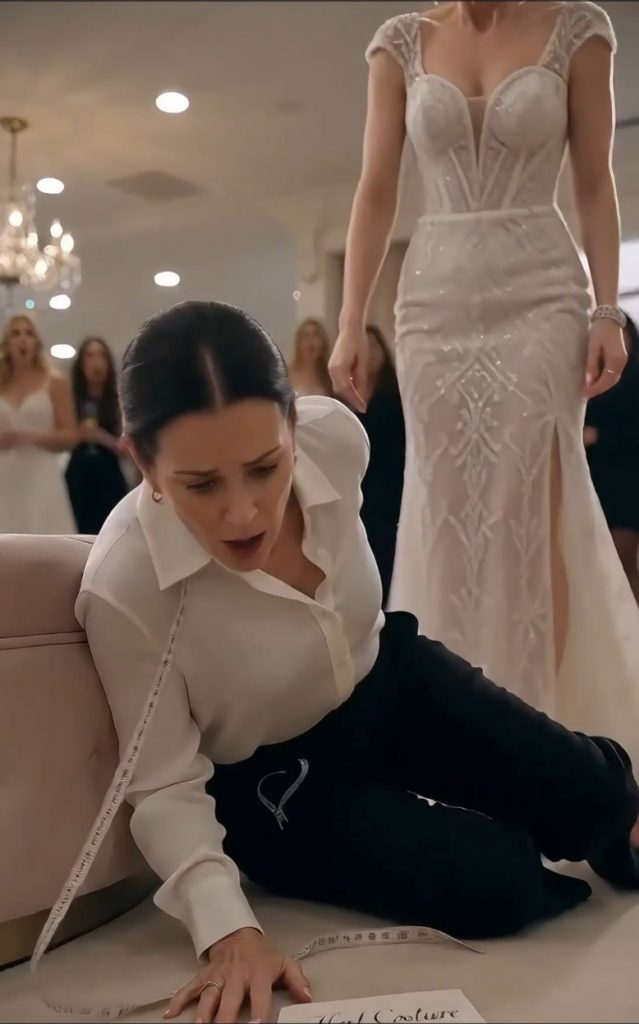
The measuring tape hit the floor before the room dared to gasp.
It slid across the pale rug beside the velvet fitting platform and stopped beneath a white couture gown, its silver tip resting inches from a cream tag stitched in elegant letters.
Hart Couture.
Then the woman beside the platform lost her balance.
Ms. Hart struck the edge of the fitting stand with one hand and dropped to one knee, her white button-up shirt pulling at the shoulder, her black hair loosening slightly from its low bun. The soft lights of the Beverly Hills bridal boutique caught the shock in her face before she lowered her eyes.
The slap had been loud enough to stop every mirror from feeling beautiful.
Champagne trays froze in the hands of assistants. Bridesmaids turned from pale pink sofas. Wealthy brides stood half-pinned in silk and lace, staring at the woman on the floor as if the entire room had just cracked through the center.
Above her stood Cassandra Whitmore.
The bride.
Blonde curls. Full bridal makeup. Diamond bracelet. A sparkling trial gown gathered in one hand like a crown she had decided she deserved before ever reaching the altar.
She looked down at Ms. Hart with a spoiled sneer.
“Women like you don’t touch dresses made for families like mine,” Cassandra said.
No one moved.
The boutique had been peaceful seconds earlier, filled with soft music, crystal reflections, and the quiet rustle of tulle. Now every gown hanging on the walls seemed to glow with accusation.
Ms. Hart stayed low, one hand braced against the floor.
She did not shout.
She did not cry.
She only reached for the measuring tape.
Cassandra stepped closer, her satin skirt whispering across the platform.
“Don’t,” she snapped. “You’ve done enough damage.”
The tag on the gown swung gently from the hanger.
Hart Couture.
Cassandra did not look at it.
She only saw the woman in flat shoes. The measuring tape. The simple shirt. The calm expression she mistook for obedience.
Then the private fitting room door opened.
The boutique owner, Isabella Reyes, rushed out in a cream suit, headset still clipped to her ear. Her pearl earrings flashed as she crossed the showroom, horror spreading across her face.
She stopped beside Ms. Hart.
Then she turned to the bride.
“Ms. Hart,” Isabella said, voice shaking with outrage and respect, “your bridal collection is ready for the runway.”
The room froze.
Cassandra’s hand tightened around the gown.
Isabella reached down and lifted the tag for everyone to see.
Hart Couture.
Cassandra’s face went pale.
“Hart?”
Act II
Clara Hart had never believed a wedding dress should make a woman disappear.
That was what first made her famous.
Not the fabrics. Not the silhouettes. Not the way her gowns moved like breath under soft light. Those things mattered, of course, and people with money praised them loudly.
But Clara cared about something quieter.
A dress should not swallow the bride.
It should reveal what she was trying to become brave enough to show.
She learned that from her mother, who had altered wedding dresses in the back room of a dry cleaner in Pasadena. Clara grew up under a table covered in pins and scraps of lace, listening to nervous women whisper truths they would never say in front of their families.
One bride wanted sleeves because her mother hated her arms.
Another wanted a fuller skirt because her fiancé’s mother kept calling her “plain.”
Another cried because the dress was beautiful, but everyone had chosen it except her.
Clara’s mother never judged them.
She pinned. She listened. She fixed what she could.
“Luxury is easy,” she used to tell Clara. “Tenderness is harder.”
Clara carried that sentence into every room she entered.
By twenty-six, she had built Hart Couture from a rented studio, three sewing machines, and a list of brides who wanted gowns made for bodies and stories rather than status. By thirty-five, her name was spoken carefully in bridal circles. By thirty-nine, celebrities waited months for fittings, and Beverly Hills boutiques fought for the right to carry her collection.
Clara hated most of that part.
Not success.
Performance.
She disliked champagne appointments where bridesmaids applauded dresses they had barely seen. She disliked mothers who treated daughters like mannequins. She disliked brides who wanted the most expensive gown because love, apparently, needed witnesses and a receipt.
Still, she agreed to partner with Isabella Reyes.
Isabella understood the difference between service and servitude. She had started as a fitting assistant herself, taking measurements for women who sometimes refused to learn her name. She built the boutique slowly, until the same people who had once ignored her asked for private appointments.
When Isabella called about a runway preview of the new Hart Couture bridal collection, Clara hesitated.
“I don’t want a circus,” Clara said.
“I want a room full of brides seeing dresses made with respect,” Isabella replied.
That convinced her.
Clara decided to attend quietly before the official reveal. No designer entrance. No black dress and dramatic applause. She wanted to watch fittings from the floor, listen to brides speak when they thought only staff could hear them, and make final adjustments with her own hands.
So she wore a white button-up shirt, black trousers, flat shoes, and tucked a measuring tape into her pocket.
She looked exactly like a fitting assistant.
That was the point.
The gown Cassandra Whitmore tried on that afternoon was called The Vale.
A structured bodice softened by hand-placed silk petals. A skirt light enough to move, but disciplined enough to hold shape under stage lights. It was one of Clara’s favorite pieces because it looked expensive only after you noticed how human it felt.
Cassandra noticed the price first.
Her mother cried over the label. Her bridesmaids gasped over the photos. Cassandra asked whether the designer could make the waist “more unforgiving” because she wanted her wedding pictures to “humble everyone.”
Clara heard that from across the room.
She said nothing.
She had already learned more than she wanted to know.
Cassandra Whitmore came from a family that treated weddings like corporate mergers with flowers. Her fiancé was heir to a hotel fortune. Her mother chaired two charity boards. Her father’s name appeared on museum walls. Every part of Cassandra’s wedding had become a performance of victory.
The dress was not meant to express love.
It was meant to announce rank.
And when Clara stepped forward to adjust a seam near the fitting platform, Cassandra looked down at her and saw only someone beneath the gown.
That mistake would cost her more than she understood.
Act III
The first insult came wrapped in a question.
“Are you the seamstress?” Cassandra asked.
Clara looked up from the hem.
“I’m assisting with the fit.”
Cassandra smiled at her reflection, not at Clara.
“Good. Then you should know this pulls strangely at the hip.”
Clara studied the line of the fabric.
“It’s not pulling. You’re standing with your weight locked on one side.”
The room went still in that tiny way rooms do when someone tells the truth to a person who expects decoration.
Cassandra’s eyes flicked down.
“Excuse me?”
Clara kept her voice calm.
“If you relax your knee, the skirt will fall correctly.”
One bridesmaid pressed her lips together.
Another looked away.
Cassandra’s face sharpened.
“I didn’t ask for posture lessons.”
“No,” Clara said. “You asked about the fit.”
That was enough.
Cassandra turned slightly on the platform, making the pins at the side of the gown tremble.
“I’m paying for perfection.”
Clara stepped back.
“Perfection usually requires cooperation.”
The words were not rude.
That made them worse.
Cassandra’s mother, seated beneath a crystal mirror, gave a small laugh meant to smooth the moment. But Cassandra heard challenge where there was only expertise.
She looked Clara over.
White shirt. Black trousers. Flat shoes. Measuring tape.
Then she looked at herself.
Gown. diamonds. audience.
The conclusion seemed obvious to her.
“You work in alterations,” Cassandra said. “I don’t.”
Clara’s face remained unreadable.
“I work with dresses.”
“And I wear them.”
Clara nodded.
“That is clear.”
A few people inhaled.
Cassandra stepped off the platform without permission, gripping the gown at the side.
“You think you’re clever?”
Clara reached forward carefully.
“Please don’t step down with the hem pinned.”
Cassandra jerked away.
“Don’t touch me.”
“I’m trying to protect the dress.”
“My dress.”
“Not yet.”
The silence turned sharp.
Cassandra’s eyes flashed.
The slap came fast.
It struck Clara across the face and sent her back against the platform edge. The measuring tape slipped from her pocket and fell beside the gown. The tag swung into view.
Hart Couture.
Gasps broke through the boutique.
Clara’s hand scraped lightly against the edge of the platform. She steadied herself on one knee, breathing through the pain and the public humiliation. Around her, mirrors caught the scene from every angle, multiplying it until Cassandra’s cruelty seemed to surround the room.
Cassandra stood over her, flushed and furious.
“Women like you don’t touch dresses made for families like mine.”
Clara looked down at the measuring tape.
For one second, she thought of her mother’s workroom.
The bent pins.
The tired brides.
The women trying to become beautiful under the weight of other people’s expectations.
Then she thought of every assistant who had ever been slapped by a voice even when no hand was raised.
She reached for the tape.
Cassandra’s shoe stopped beside it.
“Leave it,” she said.
Then Isabella entered.
She had heard the slap from the private fitting room and knew instantly it was not the sound of a tray falling or a mirror cracking. People who run luxury spaces learn the difference between accidents and entitlement.
When she saw Clara on the floor, the blood left her face.
Not because the designer had been disrespected.
Because the woman had.
Act IV
Isabella knelt beside Clara first.
“Clara,” she said softly. “Are you hurt?”
Cassandra blinked.
The first name unsettled her.
Then Isabella looked up, and every soft surface in the boutique seemed to harden.
“Ms. Whitmore,” she said, “step away from the gown.”
Cassandra gave a brittle laugh.
“Your assistant ruined my fitting.”
Clara slowly rose.
The showroom watched her. Brides in half-zipped dresses. Staff with pin cushions on their wrists. Mothers clutching champagne. Bridesmaids who suddenly looked less impressed by sparkle.
Isabella picked up the measuring tape and held it out to Clara with both hands.
That gesture changed the room before the words did.
It was too respectful.
Too formal.
Too frightened.
Cassandra noticed.
“What is going on?” she demanded.
Isabella turned toward the boutique.
“Ms. Hart,” she said clearly, “your bridal collection is ready for the runway.”
The gasp moved through the room like a gust of cold air.
Cassandra stared.
“No.”
Isabella lifted the gown tag.
Hart Couture.
“This is Clara Hart,” she said. “The designer of the gown you are wearing.”
Cassandra’s face drained of color beneath her bridal makeup.
A stylist near the mirrors whispered, “Oh my God.”
Clara touched the side of her face once, then lowered her hand.
She did not look victorious.
She looked disappointed.
That was worse.
Cassandra scrambled for control.
“No one told me.”
Clara’s eyes met hers.
“No one told you what?”
Cassandra swallowed.
“That you were the designer.”
The room waited.
Clara’s voice stayed quiet.
“You knew I was a person.”
Cassandra’s mouth opened, but nothing came.
Isabella stepped closer.
“You struck her.”
Cassandra turned defensive.
“She touched my gown.”
Clara looked at the dress.
“My gown.”
The words were soft enough to be almost gentle.
They still cut through the boutique.
Cassandra looked down at the silk petals, the perfect seamwork, the hem that had nearly torn when she stepped off the platform in anger. For the first time, the gown did not look like a trophy around her. It looked like borrowed grace.
And she had not deserved it.
“My family is spending a fortune here,” Cassandra said, voice trembling.
Clara nodded once.
“Your family was attempting to purchase a dress.”
“Attempting?”
Isabella’s expression hardened.
“Ms. Whitmore, this boutique will not complete the sale.”
Cassandra’s mother stood.
“Now, let’s not be dramatic.”
Clara finally turned toward her.
“Madam, your daughter slapped a woman in a room full of staff and brides because she believed a service uniform made that woman safe to humiliate.”
The mother’s face flushed.
No answer came.
Cassandra clutched the gown.
“You can’t take it from me. My wedding is in six weeks.”
Clara looked at the dress for a long moment.
Then at Cassandra.
“A wedding dress should not reward cruelty.”
Isabella nodded to the senior fitter.
“Please assist Ms. Whitmore out of the gown.”
Cassandra’s eyes widened.
“In front of everyone?”
Clara’s face did not change.
“In the fitting room. With dignity. More than you gave me.”
That mercy landed harder than punishment.
Cassandra’s lips trembled.
“Hart?” she whispered again.
Clara stepped aside.
“Yes,” she said. “And women like me made every beautiful thing in this room.”
Act V
Cassandra Whitmore left the boutique without a dress.
She exited through the side door in her own clothes, bridal makeup still perfect, diamond bracelet still shining, but with none of the triumph she had carried in. Her mother followed behind her, whispering into a phone, already trying to turn consequence into inconvenience.
The boutique did not resume immediately.
No one knew whether to speak.
A bride near the mirrors began crying quietly, though she was not the one hurt. Another slipped off the shoes she had been trying and sat down hard on the pale pink sofa. A young assistant gathered pins from the floor with shaking hands.
Clara noticed the assistant first.
She always noticed hands.
“Are you all right?” Clara asked.
The girl looked startled.
“Me?”
“Yes.”
The assistant nodded too quickly.
Clara stepped closer.
“What’s your name?”
“Annie.”
“Annie, has anyone here ever made you feel unsafe during a fitting?”
The girl’s eyes flicked toward Isabella.
Isabella’s face changed.
That was answer enough.
The runway preview was delayed by forty minutes.
In that time, Isabella closed the boutique doors, sent champagne away, and gathered every staff member in the back room. Clara sat with them in her white shirt and black trousers, the mark on her cheek visible, the measuring tape coiled on the table between them.
No speech.
Not at first.
Just space.
Then one fitter spoke.
A bride had grabbed her wrist last month.
Another said a mother of the bride had called her “the help” every time she entered the room.
A stylist admitted she had been told to laugh off insults because difficult clients spent more.
Isabella listened to all of it.
Her eyes filled with shame.
“I built this place because I hated being treated that way,” she said. “And somehow I let the room become too expensive to correct.”
Clara reached across the table.
“Then correct it now.”
The runway preview went on that evening.
But it was not the same show.
Before the first gown appeared, Clara walked onto the small platform at the center of the boutique. She had changed into a simple black dress, but refused makeup beyond what she had worn that morning. Her cheek still showed the truth.
She wanted it visible.
The guests stood around crystal mirrors and white gowns, subdued now, stripped of the easy chatter luxury usually provides.
Clara held the microphone lightly.
“My mother altered wedding dresses in the back of a dry cleaner,” she began. “She taught me that a gown is never just fabric. It carries fear, hope, family pressure, memory, and the strange courage it takes to stand in front of people and promise a life.”
The room was silent.
“She also taught me that no dress is beautiful enough to excuse cruelty.”
A few staff members lowered their eyes.
Not from shame now.
From relief.
“Tonight, Hart Couture and this boutique are adding a conduct clause to every appointment. Staff may stop any fitting if they are touched, insulted, threatened, or degraded. No purchase will be worth more than their dignity.”
The applause began with the employees.
Then the brides joined.
Then the mothers, quieter, perhaps learning something late.
The collection that followed became the most talked-about bridal presentation of the season. Not because of scandal, though gossip helped. Because the gowns looked different after Clara’s speech. People saw the stitching. The hands. The discipline beneath softness. The labor beneath fantasy.
Fashion magazines called the collection “quietly radical.”
Clara rolled her eyes at that.
Her mother would have called it good work.
Months later, Cassandra tried to apologize through a handwritten note. It arrived on thick cream stationery, careful and expensive. Clara read it once.
The apology was better than she expected.
Not perfect.
But less performative than most.
She did not write back.
Forgiveness was not a fitting someone else could schedule.
A year later, Hart Couture launched a small program in honor of Clara’s mother, offering free custom alterations for brides wearing inherited, thrifted, or low-cost dresses. The appointments took place once a month in the same Beverly Hills boutique.
No champagne trays.
No cameras.
No price minimum.
Just mirrors, pins, fabric, and listening.
One afternoon, a young bride arrived with a dress folded in a garment bag from a discount store. She apologized three times before unzipping it.
Clara stopped her gently.
“You don’t apologize for bringing a dress to someone who works with dresses.”
The bride laughed nervously.
“It’s not couture.”
Clara lifted the gown with care.
“It will be yours. That matters more.”
Annie, now promoted to lead fitter, smiled from across the room.
Together, they pinned the hem, softened the neckline, adjusted the waist, and watched the bride slowly recognize herself in the mirror.
That moment meant more to Clara than any celebrity wedding.
Later, after the bride left glowing, Isabella found Clara standing near the gown that Cassandra had once tried to claim. It had never been sold. Clara had renamed it Tenderness and included it in an archive show about labor behind bridal fashion.
The Hart Couture tag still hung from the seam.
Isabella stood beside her.
“Do you ever think about that day?”
Clara looked at the fitting platform.
The slap.
The measuring tape.
The sentence about women like her.
“Yes,” she said.
“Does it still hurt?”
Clara considered lying, then did not.
“Sometimes.”
Then she looked toward the workroom, where Annie was laughing with another assistant over a stubborn zipper.
“But not only.”
Because the memory no longer belonged to Cassandra.
It belonged to the policy that protected the staff.
The brides who came without shame.
The assistants who no longer had to swallow insults because someone rich was having an emotional day.
It belonged to every hand that measured, pinned, stitched, steamed, lifted, carried, and repaired beauty before anyone stepped onto a platform.
Cassandra Whitmore had been wrong.
Women like Clara did touch dresses made for families like hers.
They imagined them.
They cut them.
They built them by hand.
And when necessary, they took them back.