Act I
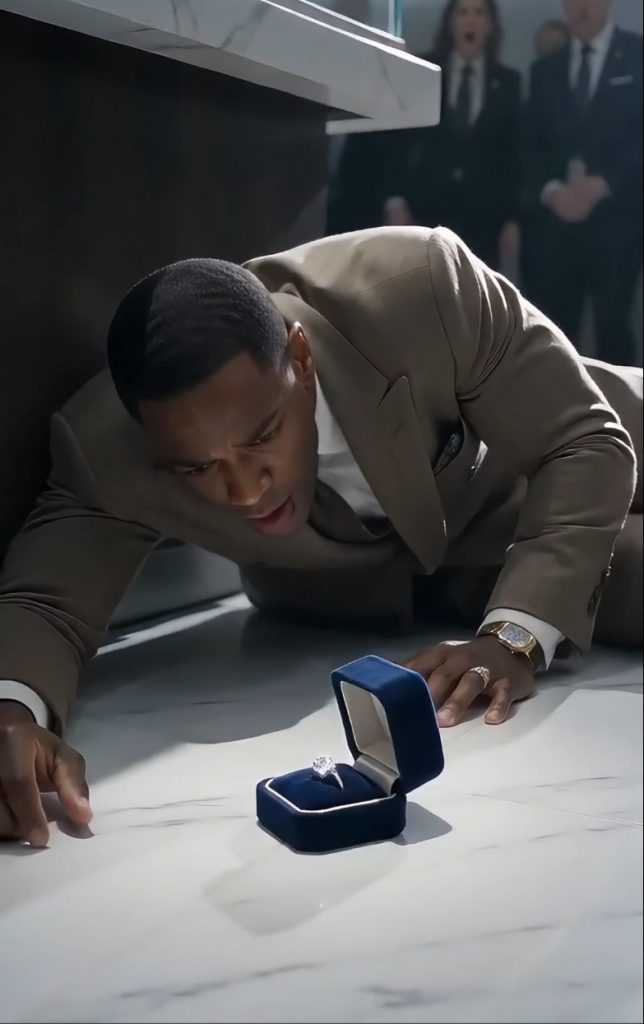
The velvet box opened when it hit the marble.
It landed on its side beside the diamond counter, snapped loose at the hinge, and revealed a single stone resting in navy silk under the white vault lights. For one second, nobody looked at the man on the floor.
They looked at the diamond.
It was not the largest stone in the room, but it had a strange gravity. Clear, old-cut, slightly warmer than modern perfection, with a small engraving along the platinum setting that caught the light when the box turned.
B.
Then Mr. Brooks hit the glass case with his shoulder.
He fell hard beside the counter, one hand bracing against the marble. His old brown suit pulled at the sleeve. A small mark showed near his lip, but he did not reach for it. His calm eyes went straight to the open box.
Not to the man who had punched him.
The man stood over him in a navy suit, silver hair slicked back, gold cufflinks flashing, a diamond pinky ring bright beside his clenched hand.
“Diamonds belong to families with money,” he said, crouching with a cold smirk. “Not men wearing last decade’s suit.”
The vault went silent.
Security guards froze near the steel doors. Jewelry consultants stopped beside velvet-lined trays. Appraisers looked up from tablets. VIP clients in formal suits stared from around the marble display table, suddenly trapped inside the ugliness they had paid to keep outside their lives.
Mr. Brooks stayed low, breathing slowly.
Controlled.
Dignified.
That only made the man above him look worse.
His name was Everett Sloan, a diamond client whose family money was old enough to have acquired polish and young enough to still need cruelty to prove itself. He had come to the private vault that morning to bid on a legendary collection rumored to be entering the market for the first time in decades.
The Brooks Collection.
Sloan had wanted it before he knew what it was.
He wanted it more when he saw Mr. Brooks holding the little velvet box.
To Sloan, the old suit said everything.
Poor.
Out of place.
Touching wealth that could not possibly be his.
Then the steel door opened.
The Vault Director rushed in, black suit sharp under the lights, pearl necklace still, security badge swinging at her chest. Her face changed when she saw the open box, the man on the floor, and Sloan standing over him.
She moved past the diamond client without hesitation.
Then she lowered herself beside Mr. Brooks.
“Mr. Brooks,” she said, voice formal and shaken, “your grandmother’s diamond collection has been secured.”
The room gasped.
The camera of every eye dropped to the open velvet box.
To the setting.
To the engraving.
BROOKS.
Everett Sloan’s lips parted.
“Brooks?”
Act II
Malcolm Brooks had grown up hearing that his grandmother once owned stars.
Not real stars, of course.
That was what she called diamonds when he was little.
He would sit on the floor of her apartment in Harlem while she opened an old blue tin and showed him folded sketches of necklaces, rings, brooches, and tiaras that looked too grand to belong to the quiet woman who made tea in chipped cups and wore house slippers with one split seam.
“These were ours?” Malcolm asked once.
His grandmother, Josephine Brooks, smiled.
“They are ours.”
But there was no diamond collection in the apartment.
No vault.
No velvet trays.
Only sketches, receipts, old photographs, and a navy velvet box she kept wrapped in cloth inside her dresser.
Inside that box was one ring.
A single diamond in platinum with the letter B engraved beneath the setting.
Josephine never wore it outside.
She said some things were safer when people forgot they existed.
Malcolm did not understand then.
He only knew his grandmother had beautiful hands. Strong hands. Hands that could repair a clasp, untangle a chain, polish a stone, and stroke his hair with the same gentle patience.
Josephine Brooks had been more than a collector.
She had been a designer.
In the 1960s and 70s, she worked behind the counters and workrooms of New York jewelry houses that never put her name in their windows. She sketched settings for society women who never knew a Black woman had designed the pieces they wore to charity dinners. She recognized stones by fire, weight, and flaw. She could tell when a diamond had been recut to hide a history.
But the world around her had rules.
Some written.
Most not.
Josephine could design brilliance, but she could not easily own credit. She could restore heirloom pieces, but not enter certain private rooms through the front door. She could be trusted with diamonds worth fortunes, but not with the story of having made them beautiful.
Then she married a quiet man named Arthur Brooks, who worked as a security supervisor for a private banking firm. Together, they saved, traded, bought damaged pieces no one wanted, and slowly built a collection not from vanity, but from memory.
Every stone carried a story.
A necklace redesigned after a widow refused to sell her mother’s ring.
A pair of earrings made from diamonds salvaged from a bankrupt estate.
A brooch Josephine purchased after recognizing her own design under someone else’s name.
She engraved each setting with a small B.
Not for pride.
For proof.
Then Arthur died.
And the collection disappeared.
Officially, it was placed in custodial storage after a dispute with a banking trustee. Unofficially, powerful clients circled it for years, trying to buy pieces through sealed channels before Josephine’s family could claim them.
Malcolm inherited only the velvet box when she died.
And a letter.
If they ever tell you the collection is gone, look for my mark. They can move diamonds through steel doors, but they cannot erase the hands that set them.
For fifteen years, Malcolm looked.
And that morning, he walked into the private jewelry vault wearing his best suit, holding his grandmother’s ring, ready to prove she had never been a myth.
Act III
Everett Sloan had been chasing the Brooks Collection for longer than he would ever admit.
His family office had bought art, wine, watches, rare cars, and diamonds with the same appetite: not to love them, but to make sure others could not. Sloan treated ownership like victory. He did not want beautiful things near him. He wanted beautiful things beneath his name.
The Brooks Collection irritated him because it resisted him.
For years, rumors followed it through private dealers and estate lawyers. A lost Black jewelry designer. A hidden Harlem collection. Diamonds engraved with a small B. Pieces that major houses quietly feared because their provenance might expose who had really designed settings they later sold under more famous names.
Sloan did not care about any of that.
He cared that the collection was rare.
He cared that other collectors wanted it.
He cared that buying it would make him appear tasteful, progressive, and powerful all at once.
When the vault announced a private verification event, Sloan secured a seat immediately. He assumed he would be bidding against other families like his. Old money. New money. People who spoke softly around wealth because they already believed it belonged to them.
Then Malcolm Brooks arrived.
Old brown suit.
White shirt.
No entourage.
No visible attorney.
A small velvet box in hand.
Sloan saw him standing near the diamond counter and assumed staff had made an error.
“What are you doing with that?” he asked.
Malcolm looked at him.
“Verifying ownership.”
Sloan laughed.
“Of what?”
Malcolm glanced toward the sealed trays under the white lights.
“My grandmother’s collection.”
The room heard it.
A few consultants stiffened.
One appraiser lowered his eyes too quickly.
Sloan noticed that too.
His smile sharpened.
“Your grandmother?”
“Yes.”
“And she kept diamonds in what? A shoebox under a radiator?”
The insult drew no laughter.
That made Sloan angrier.
Malcolm opened the velvet box.
Inside, Josephine’s ring caught the vault light.
Sloan leaned in, saw the stone, saw the old setting, and for the first time that morning felt something other than contempt.
Fear.
Because the ring looked real.
Not valuable enough to compete with the trays perhaps, but old enough. Correct enough. Marked.
He reached for it.
Malcolm closed the box.
“Don’t touch it.”
Sloan’s face changed.
A man like him could tolerate being ignored by wealth.
He could not tolerate being refused by someone he had already decided was poor.
He struck Malcolm in front of the vault.
The box opened.
The diamond showed its mark.
And the room finally saw what greed had tried to knock away.
Act IV
Vault Director Caroline Mercer had built her career on discretion.
In the world of private jewelry, discretion was treated as a virtue, but she knew it could also become a curtain. Behind that curtain, fortunes moved quietly. Provenance softened. Uncomfortable names disappeared. Families with lawyers outlasted families with memories.
Caroline had spent six months studying the Brooks file.
At first, it looked like an estate verification matter. Then a historical ownership dispute. Then something uglier. Josephine Brooks’s designs appeared in archives under other people’s names. Her collection had been held for “custodial review” far longer than any reasonable process required. Private purchase requests had come repeatedly from the same client network.
One of them was Sloan.
Caroline had delayed the sale.
That made enemies.
But she had found the engraving.
Not on one piece.
On all of them.
A tiny Brooks mark, sometimes hidden beneath a hinge, sometimes inside a clasp, sometimes along the lower rim of a setting where only a jeweler would know to look.
When Malcolm arrived with the ring, Caroline knew the last key had entered the vault.
She had gone to retrieve the final ownership file when she heard the impact.
Now she stood between Malcolm and Everett Sloan with the open velvet box on the marble.
“Security,” she said, voice hard, “preserve all vault footage.”
Sloan blinked.
“There’s no need for theatrics.”
Caroline looked at him.
“You punched a lawful claimant beside a secured diamond case.”
“I thought he was attempting theft.”
Malcolm slowly stood.
His voice was quiet.
“You thought I could not own what you wanted.”
The sentence touched something raw in the room.
Sloan’s jaw tightened.
“Look at him.”
The words came out before he could make them elegant.
Caroline’s eyes went cold.
“We are.”
The answer humiliated him more than shouting would have.
An appraiser near the display table cleared his throat.
“The engraving matches the authenticated Brooks settings,” he said.
Sloan turned.
“Quiet.”
The appraiser did not obey.
“The ring completes the provenance chain.”
Caroline opened the leather file she had carried in.
“Josephine Brooks’s collection has been verified as family property. Mr. Malcolm Brooks is the named heir under the restored estate documents and supporting design records.”
She placed the file on the marble counter.
The sound was soft.
Final.
Sloan stared at it.
“That collection was open to acquisition.”
“Not by you,” Caroline said.
His face flushed.
“I made a standing offer.”
“You made several aggressive inquiries into property under disputed custody.”
He swallowed.
“You can’t prove—”
Caroline tapped the file.
“We can.”
The steel room seemed to shrink around him.
A security guard stepped closer.
Sloan’s diamond pinky ring flashed near his hand, suddenly small compared to the history in the velvet box.
Malcolm looked down at Josephine’s ring.
Then at Sloan.
“My grandmother spent her life watching other people wear her work without knowing her name,” he said. “You were not going to be one more.”
Sloan’s mouth trembled once.
“Brooks?”
Malcolm did not answer.
The engraving already had.
Act V
Everett Sloan was removed from the vault before the trays were opened.
Security escorted him past the steel doors, past the marble counters, past the diamond cases he had expected to dominate. His navy suit remained perfect. His gold cufflinks remained bright. His face did not.
He looked smaller with every step.
Not poorer.
Just smaller.
There is a difference.
Malcolm Brooks stayed near the counter, one hand resting lightly on the velvet box. For a long moment, no one spoke to him. That was the first kindness the room offered him: space.
Then Caroline Mercer asked softly, “Would you like to see them?”
Malcolm nodded.
The vault staff moved with a quiet care that felt almost ceremonial.
One by one, the velvet trays were unlocked and brought beneath the white spotlights.
A necklace with pear-shaped diamonds set like falling rain.
A pair of earrings built around two old stones with faint warmth in their centers.
A bracelet with hidden hinges so delicate the mechanism looked impossible.
A brooch shaped like a branch in winter, each diamond placed not for size but for rhythm.
Malcolm did not cry when he saw the first tray.
He cried when Caroline turned over the brooch and showed him the engraving beneath the clasp.
B.
Small.
Exact.
Stubborn.
His grandmother’s voice seemed to rise from memory.
Look for my mark.
He touched the edge of the tray, not the diamonds.
“She said they were ours,” he whispered.
Caroline lowered her head.
“She was right.”
The legal confirmation took weeks, though the moral truth had already arrived in the vault that morning.
The Brooks Collection was removed from private sale and restored to Malcolm under the estate settlement. Several jewelry houses received formal requests for archival review. Designs long attributed to unnamed workshops were reopened. Josephine Brooks’s sketches were authenticated, scanned, and placed into a permanent research archive under her full name.
The industry reacted the way old industries often do when truth knocks on a steel door.
First denial.
Then careful language.
Then selective praise.
A major auction house called Josephine “previously overlooked.”
Malcolm hated that phrase.
Overlooked sounded accidental.
His grandmother had not fallen behind a cabinet.
She had been used, minimized, delayed, and nearly erased because the people around diamonds often preferred brilliance without memory.
So Malcolm refused the private collector circuit.
He refused sealed bids.
He refused to let wealthy clients sit in rooms whispering numbers over trays of his grandmother’s life.
Instead, he created the Josephine Brooks Foundation for Jewelry Arts and Provenance Justice. The collection would travel through museums, historically Black colleges, design schools, and public exhibitions. Young jewelers would study her settings. Researchers would trace erased craftspeople. Families fighting ownership disputes over inherited pieces would receive legal support.
Caroline left the vault company six months later and became the foundation’s first director of provenance.
When asked why, she gave a simple answer.
“I was tired of locking history in rooms where only buyers could see it.”
Malcolm kept only one piece for himself.
The ring.
The small navy velvet box remained on his desk, the hinge repaired but the corner still marked from the day it hit the marble. He did not polish the box smooth. He wanted the scar visible.
Objects remember what people try to deny.
A year after the vault incident, the Brooks Collection opened in New York.
Not in a private sale room.
In a public museum.
The first gallery wall held a photograph of Josephine Brooks at her workbench, hair pinned back, loupe in one eye, one hand holding a setting under a lamp. She looked focused, tired, and entirely uninterested in disappearing.
Beside the photograph was her sentence from Malcolm’s letter.
They can move diamonds through steel doors, but they cannot erase the hands that set them.
Visitors stood before it longer than expected.
Some came for the diamonds.
Many stayed for the story.
One afternoon, a young Black girl in a school uniform stood in front of the winter-branch brooch and asked Malcolm, “She made that?”
Malcolm smiled.
“Yes.”
The girl leaned closer.
“And they didn’t put her name?”
“No.”
“Why?”
He looked at Josephine’s photograph.
“Because some people wanted the beauty without the truth.”
The girl frowned.
“That’s stupid.”
Malcolm laughed softly.
“It is.”
She looked back at the diamonds.
“But now everybody knows.”
His throat tightened.
“Yes,” he said. “Now everybody knows.”
People would still tell the vault story, of course.
The rich diamond client punched a man in an old suit.
The velvet box opened.
The director arrived.
The collection belonged to his grandmother.
Brooks?
It was satisfying because arrogance panicked under vault lights.
But Malcolm never liked that version best.
It made inheritance the lesson.
The punch had been wrong before the engraving showed.
The insult had been ugly before Caroline read the file.
The man on the marble floor had deserved respect before anyone knew his grandmother’s diamonds were real.
That was why, at every foundation event, Malcolm placed the old brown suit on display beside the ring.
Not because the suit was valuable.
It was not.
Not because it was stylish.
It never had been.
He displayed it because that suit was what Sloan had used as evidence against him.
Evidence of poverty.
Evidence of unbelonging.
Evidence, in Sloan’s mind, that Malcolm could not possibly be the heir to brilliance.
Below the suit, a small plaque read:
Never mistake worn fabric for an empty history.
The first time Malcolm saw the plaque installed, he stood silently for nearly a minute.
Then he opened the velvet box.
The diamond inside caught the light, small and steady, marked by a single hidden letter that had survived greed, silence, steel doors, and time.
B.
Brooks.
Belonging.
Brilliance.
Not the kind money buys.
The kind someone protects until the world finally learns where it came from.