Act I
The books hit the carpet like a small collapse of history.
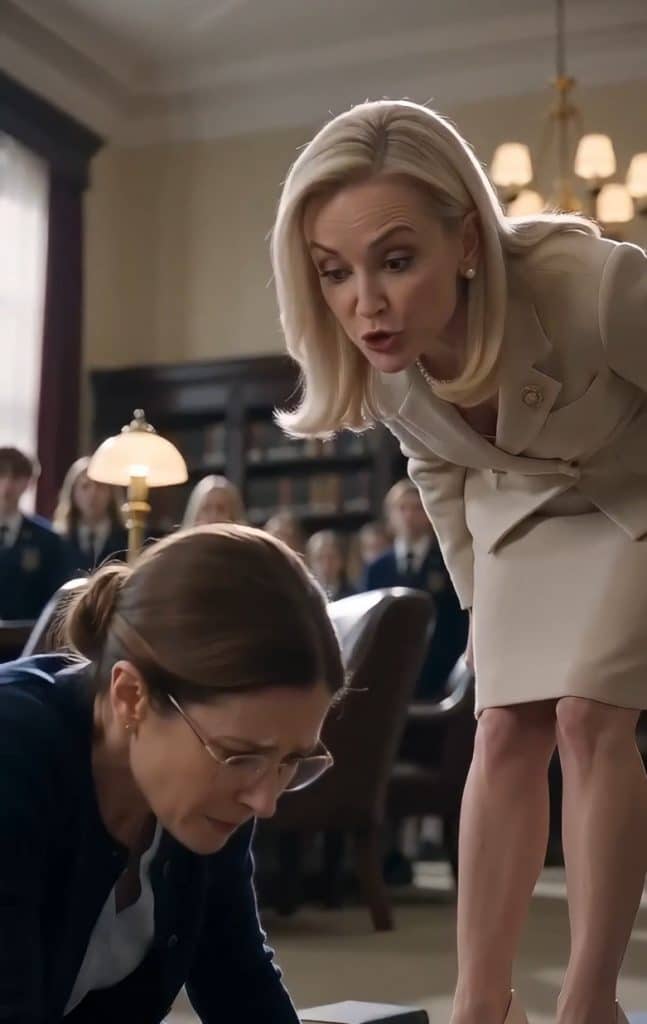
One hardcover slid beneath the brass lamp. Another opened facedown beside the librarian’s desk, its old spine cracking softly in the sudden silence. A third landed near Professor Lane’s glasses, which had slipped crooked across her face when she fell.
The slap still seemed to echo between the dark wooden shelves.
Students in navy uniforms froze with their mouths open. Visiting parents turned from the display model of the new scholarship library. Teachers stood still between leather chairs and tall windows, caught in that terrible second when everyone knew something wrong had happened and no one had decided who was brave enough to name it.
Professor Lane stayed low on the carpet, one hand braced against the floor.
Her navy cardigan had pulled at the shoulder. A faint red mark warmed across her cheek. Her thin glasses sat unevenly, but her eyes remained calm behind them, hurt but not broken.
Above her stood Meredith Whitcomb.
Blonde hair straight as a blade. Beige designer blazer. Pearl studs. Luxury handbag hanging from one arm like proof of rank.
She looked down at the woman she had struck with the cold satisfaction of someone who believed the room would agree with her.
“This library is for children with futures,” Meredith said, voice sharp enough to stop every whisper. “Not women paid to dust shelves.”
A few students flinched.
One boy near the reference table lowered his eyes in shame.
Professor Lane reached for a fallen book.
Meredith stepped closer, her polished shoe stopping beside the cover.
“Don’t touch that,” she snapped. “You’ve done enough damage.”
The book was a first edition of an essay collection on public education.
Professor Lane had brought it herself.
She said nothing.
That restraint seemed to irritate Meredith more than protest would have. She leaned down with a polished smile that felt crueler than shouting.
“People like you should be grateful this school hires help at all.”
Then the library doors opened.
Headmaster Charles Pembroke entered with three board members behind him, his navy blazer neat, striped tie centered, round glasses low on his nose. He stopped when he saw the scattered books.
Then he saw Professor Lane on the floor.
The color left his face.
He crossed the library with sudden urgency, passing Meredith as if she were furniture.
“Professor Lane,” he said, lowering himself beside her, “the new scholarship library will carry your name.”
The room stopped breathing.
Behind them, the display model glowed under a brass lamp.
Lane Scholarship Library.
Meredith’s face emptied.
“Lane?”
Act II
Eleanor Lane had never trusted schools that looked too much like museums.
She loved books. She loved quiet. She loved the smell of old paper and polished wood. But she had spent enough of her life around elite education to know that beauty could become a gate if the wrong people held the key.
As a child, she had grown up twelve miles from Kingsford Academy and a world away from it.
Her mother cleaned offices at night. Her father drove a city bus before dawn. Their apartment was small, loud, and always full of secondhand books stacked under windows, beside the heater, and once, memorably, inside the kitchen cabinet where her mother had meant to store pans.
Eleanor read everywhere.
On buses. In laundromats. In waiting rooms. On the floor outside her parents’ bedroom when the light was better in the hall.
Books gave her rooms she had not been invited into yet.
At fourteen, she won a citywide essay contest. The prize was a summer program at Kingsford Academy, the most prestigious private school in the state. She arrived in borrowed shoes and a blouse her mother ironed three times. The library took her breath away.
Dark wood shelves.
Brass lamps.
Leather chairs.
A ceiling high enough to make thought feel sacred.
Then a girl from a legacy family asked if Eleanor was there with the cleaning staff.
Eleanor remembered that more clearly than the prize ceremony.
She also remembered the librarian, Mrs. Abel, who had overheard it and quietly placed a book in Eleanor’s hands.
The Souls of Black Folk.
“Some rooms don’t know they’re waiting for you,” Mrs. Abel said. “Enter anyway.”
Eleanor did.
She entered every room after that.
Scholarship high school. State university. Doctoral program. Oxford fellowship. Professorship. Essays that changed how educators talked about access, literacy, and class. A landmark study proving that school libraries were often the difference between talent discovered and talent abandoned.
She became Professor Lane to everyone except her mother, who still called her Ellie when she was proud and Eleanor when she was worried.
Years later, Kingsford Academy invited her back.
Not as a scholarship student.
As the mind behind its most ambitious new project: a library and access program for students who could not afford the hidden costs of elite education. Books, tutoring, travel stipends, application support, family resources, digital access, and weekend reading programs for students from public schools across the city.
The board wanted her name on it.
Lane Scholarship Library.
Eleanor resisted at first.
“I don’t need a building,” she told Headmaster Pembroke.
“It is not for you,” he said. “It is for every student who has been made to feel like a visitor in a room built from knowledge.”
That answer stayed with her.
She agreed, but on one condition.
Before the announcement ceremony, she wanted to visit the old library quietly.
No press.
No faculty reception.
No donors asking for photographs.
She wanted to carry in the books she had chosen for the opening collection herself. Some were rare. Some were worn. One had belonged to Mrs. Abel, who had died five years earlier and left Eleanor a box of annotated volumes.
That was why Eleanor arrived in a navy cardigan, dark skirt, low bun, and flat shoes, with a stack of old hardcovers in her arms.
To students, she looked like a librarian.
To teachers, perhaps a visiting scholar.
To Meredith Whitcomb, she looked like someone who worked beneath her.
Meredith had spent ten years treating Kingsford Academy like a family investment.
Her husband sat on a donor committee. Her son, Preston, was in eighth grade and already had a college counselor, a lacrosse coach, and a mother who spoke of his future as if it had been engraved before he was born.
Meredith hated the scholarship library.
Not publicly.
Publicly, she praised opportunity.
Privately, she called it “mission drift.”
She feared anything that widened the room, because her entire identity depended on believing her child stood higher because others stood outside.
Then she saw Eleanor Lane near the librarian’s desk with old books in her arms.
And she decided to remind her where she belonged.
Act III
It began with a book Meredith did not recognize.
Eleanor had placed the stack gently on the librarian’s desk, checking the handwritten list tucked between the covers. The library bustled with visiting parents touring the new display model. Uniformed students whispered near the shelves. Board members were expected any minute.
Eleanor lifted Mrs. Abel’s old copy from the top of the pile.
Its cover was worn at the corners.
Meredith appeared beside her.
“Excuse me,” she said.
Eleanor looked up.
“Yes?”
“Are those approved for the display?”
Eleanor glanced at the books.
“They’re for the scholarship collection.”
Meredith’s smile tightened.
“And who authorized you to bring outside materials into the Kingsford library?”
Eleanor studied her for a moment.
“I did.”
The answer was not arrogant.
That was what made Meredith hate it.
“You did?” Meredith repeated, looking Eleanor over from cardigan to flat shoes. “And what exactly is your position here?”
Eleanor adjusted the book in her hand.
“I’m connected to the new library.”
Meredith laughed softly.
Several parents nearby looked over.
“Oh, I’m sure you are,” Meredith said. “Everyone is connected to something these days.”
A student near the desk froze.
Eleanor noticed him.
He was a scholarship student. She could tell from the way he watched the exchange, not with curiosity, but recognition.
He had heard this tone before.
So had she.
Meredith reached for the old book.
Eleanor moved it back.
“Please don’t handle that. It’s fragile.”
Meredith’s eyes sharpened.
“Do not correct me in my child’s school.”
“This book belonged to someone important.”
“So do half the families in this room.”
Eleanor’s expression changed then.
Only slightly.
But Meredith saw it and mistook sadness for weakness.
“I am so tired of people treating this place like a public experiment,” she said, voice rising. “Kingsford is supposed to prepare exceptional children for exceptional futures.”
Eleanor kept her voice low.
“Exceptional futures should not require inherited permission.”
The library heard that.
A hush spread between the shelves.
Meredith’s face hardened.
The slap came fast.
The books scattered from Eleanor’s arms. Her glasses shifted. She fell beside the desk as the old hardcovers opened across the carpet.
Gasps broke from the students.
The scholarship boy stepped forward, then stopped when his teacher touched his shoulder, afraid.
Meredith stood over Eleanor, breathing through her nose, her polished cruelty now fully exposed.
“This library is for children with futures,” she said. “Not women paid to dust shelves.”
Eleanor reached for Mrs. Abel’s book.
Her hand shook once.
Only once.
She thought of being fourteen, standing in this same room while another girl assumed she belonged to the cleaning staff. She thought of Mrs. Abel’s voice.
Enter anyway.
Then the library doors opened.
Headmaster Pembroke stepped inside with the board.
He saw the books first.
Then Eleanor.
Then Meredith.
And the ceremony meant to honor the new library began on the floor.
Act IV
Headmaster Pembroke helped Eleanor stand with reverence.
Not politeness.
Reverence.
That was what broke Meredith’s confidence first.
He did not look at Eleanor like staff. He did not look at her like a guest. He looked at her like someone whose presence had made the room more important.
“Professor Lane,” he said again, louder this time, “are you hurt?”
The title moved through the library.
Professor.
A parent near the display model whispered, “That’s her?”
A board member bent quickly to gather the fallen books. Another picked up the copy with Mrs. Abel’s notes and held it as carefully as if it were evidence.
Meredith’s face lost color.
“Professor Lane?” she said. “This is Eleanor Lane?”
Eleanor straightened her glasses.
“Yes.”
The scholarship boy near the desk looked at the display model.
Lane Scholarship Library.
His eyes widened.
Meredith tried to recover.
She gave a brittle laugh.
“No one told me.”
Eleanor turned toward her.
“No one told you what?”
Meredith’s mouth opened.
“That you were… that you are the professor.”
Pembroke’s voice became cold.
“You did not need a résumé to refrain from striking her.”
The library went silent.
Students heard it.
Parents heard it.
Teachers heard it.
And every adult in the room understood that the headmaster was not speaking only to Meredith. He was speaking to the pause that had followed the slap. The waiting. The calculation. The terrible habit of deciding whether someone deserved protection after learning who they were.
Meredith tightened her grip on her handbag.
“I believed she was mishandling library property.”
Eleanor looked down at the scattered books.
“They are mine.”
“I thought she was interfering with the display.”
“I designed the program behind it.”
Meredith flushed.
“This is being twisted.”
A teacher near the shelves spoke quietly.
“No. We saw it.”
Another parent, who had said nothing before, added, “You hit her.”
Meredith turned sharply.
“I was defending standards.”
Eleanor looked at the scholarship boy again.
He was watching her as if the next words might decide something in him.
So she chose carefully.
“Standards that require cruelty are not standards,” she said. “They are excuses.”
Meredith’s face tightened.
“My family has supported this school for years.”
“And yet,” Pembroke said, “you have misunderstood its purpose.”
He nodded toward the model.
The tiny building under glass seemed suddenly less decorative and more alive.
“The Lane Scholarship Library exists because excellence is not the property of wealth,” he said. “Professor Lane’s work helped prove what schools like this should have known all along: ability is everywhere. Access is not.”
A murmur moved through the room.
Meredith looked around for allies.
She found parents staring at the carpet, teachers staring at her, students staring with the unforgiving clarity of the young.
“I apologize,” she said abruptly.
Eleanor waited.
Meredith swallowed.
“For the misunderstanding.”
Eleanor’s eyes stayed steady.
“That is not an apology.”
Meredith’s polished mask cracked.
“What do you want me to say?”
“The truth.”
The library held its breath.
Meredith’s voice dropped.
“I thought you were a librarian.”
The actual librarian, a quiet woman near the circulation desk, lifted her chin.
Eleanor did not look away.
“And that made me acceptable to humiliate?”
Meredith said nothing.
The silence answered.
Headmaster Pembroke turned to the security officer near the door.
“Mrs. Whitcomb will leave campus immediately. Her board privileges are suspended pending review.”
Meredith’s eyes widened.
“You cannot do that. My son goes here.”
“Your son will not be punished for your conduct,” Pembroke said. “But he will not be taught that money excuses it.”
That sentence landed harder than any shout.
Meredith looked once more at Eleanor.
“Lane?” she whispered.
Eleanor picked up Mrs. Abel’s old book from the carpet.
“Yes,” she said. “And this room was never yours to guard.”
Act V
The ceremony did not proceed as planned.
That was the best thing that could have happened.
The polished speeches were set aside. The donor remarks were shortened. The photographer was told to stop asking people to stand near the model. For once, Kingsford Academy allowed an uncomfortable truth to remain visible rather than hiding it under flowers and applause.
Professor Lane asked to speak from the librarian’s desk.
Not the podium.
Not the stage.
The desk.
The place Meredith had assumed belonged to someone small.
Students gathered between the shelves. Parents stood behind them. Teachers lined the walls. Headmaster Pembroke remained near the display model, quiet and pale with shame.
Eleanor placed Mrs. Abel’s book on the desk.
“When I was fourteen,” she began, “I stood in this library and was mistaken for someone who did not belong.”
The scholarship boy stopped fidgeting.
Several adults lowered their eyes.
“A librarian corrected that moment by handing me a book. She did not make a speech. She did not embarrass anyone. She simply gave me access to a room I had already earned by wanting to learn.”
Eleanor touched the worn cover.
“This new library should not carry my name because I became impressive enough to return. It should carry a promise. No student should have to become famous, wealthy, or useful to be treated as worthy of knowledge.”
The room was still.
She looked at the students.
“Libraries are not trophies. They are doors.”
That line stayed.
It appeared later in the dedication program, then on the first page of the Lane Scholarship Library charter.
Meredith Whitcomb resigned from the parent advancement council within a week. The school board opened a conduct review that exposed years of quiet gatekeeping disguised as concern for tradition. Scholarship families had been excluded from certain donor events. Financial aid students had been discouraged from applying for legacy mentorship programs. Parent committees had used words like “fit” and “culture” to protect comfort from challenge.
Professor Lane read the report twice.
Then she returned it with notes.
The final policy changes were not symbolic.
Scholarship students received equal access to college counseling, travel grants, academic enrichment, and alumni networks. Parent councils lost influence over student programming. Staff and faculty were given authority to report harassment from parents without fear. The library’s opening collection included books chosen by students from every income level.
The old library changed too.
Not completely.
Dark wood shelves still lined the walls. Brass lamps still glowed on long tables. Leather chairs still creaked beneath students who pretended to study while whispering. The tall windows still filled the room with afternoon light.
But something had shifted.
The room no longer felt like it was waiting to judge who entered.
On the first day the Lane Scholarship Library opened, Eleanor arrived without ceremony.
She wore the same navy cardigan.
Her glasses were repaired.
In her hands was a single book.
The scholarship boy from the day of the slap stood near the entrance, holding his backpack with both straps.
“Professor Lane?” he asked.
She smiled.
“Yes?”
“I wanted to say thank you.”
“For what?”
He looked around the new library.
“For saying it wasn’t theirs to guard.”
Eleanor felt the words settle somewhere deep.
“What’s your name?”
“Malik.”
“Do you like to read, Malik?”
He hesitated.
“I think so. I just never know where to start.”
Eleanor held out the book in her hands.
It was Mrs. Abel’s copy.
Not the fragile original. That stayed in the archive now. This was a new edition, wrapped with a small note inside.
Start anywhere. Enter anyway.
Malik took it carefully.
“Do I have to return it?”
Eleanor’s eyes softened.
“Eventually. But not before it becomes yours for a while.”
He smiled then.
Small.
Real.
Later that afternoon, Eleanor stood alone in the doorway of the new library and watched students fill the tables. Some wore blazers that had been tailored in expensive shops. Some wore uniforms bought secondhand. Some spoke with the ease of children who had never doubted their place. Others entered carefully, as if still waiting for someone to correct them.
No one did.
A girl sat cross-legged near the poetry shelf.
A boy helped another student find a history book.
Malik read under a brass lamp, head bent, one finger moving slowly down the page.
Eleanor thought of Meredith’s slap.
The books scattering.
The insult about children with futures.
But the memory no longer ended on the carpet.
It ended here.
With students turning pages in a room built to widen instead of exclude.
With old books made new by new hands.
With a library named not for status, but for the promise that no child’s future belonged to a parent’s bank account.
Meredith Whitcomb had been wrong.
The library was not for children with futures.
It was for children who deserved the chance to discover them.