Act I
The paintbrush hit the black marble before the champagne glass stopped ringing.
It skidded across the penthouse floor, thin and stained with blue paint, then came to rest beside Mr. Reed’s hand under the glare of the gallery lights. Behind him, the central painting towered on a white wall, enormous and quiet, its colors catching the Manhattan skyline through the floor-to-ceiling windows.
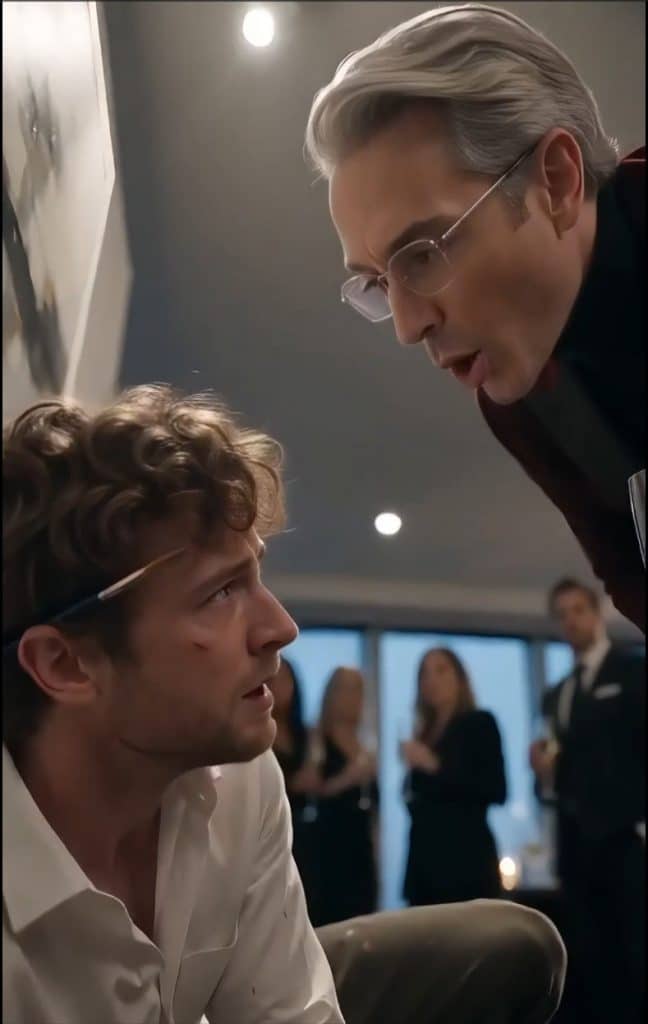
Mr. Reed had been knocked against the wall.
His paint-marked white shirt twisted at the shoulder. His curly brown hair fell over one eye. A tiny mark showed near his lip, but he did not reach for it.
He looked at the brush.
Then at the painting.
The man who had punched him stood above him in a velvet blazer, black turtleneck, thin glasses, and the bored disgust of someone who believed cruelty could be elegant.
Julian Voss, one of New York’s most feared art brokers, lifted his crystal champagne coupe and smiled like he had just corrected a stain.
“Paint walls,” he said, voice low and venomous. “Not masterpieces. Know your place.”
The room fell silent.
Collectors froze with champagne trays between them. Socialites turned from the windows. Gallery assistants stopped beside the white walls. Photographers lowered their cameras, then lifted them again, realizing scandal had stepped into the light.
The central artwork glowed behind them.
A storm of gray, gold, and deep blue. A city painted like it was trying not to collapse. A thin line of red crossing the bottom corner, almost invisible unless someone knew where to look.
Mr. Reed stayed on the floor.
Quiet.
Breathing carefully.
That calm seemed to irritate Voss even more.
“You almost touched a six-million-dollar painting,” Voss snapped. “Do you have any idea what your hands are worth in this room?”
Mr. Reed glanced at his own paint-marked fingers.
“Yes,” he said softly.
That single word unsettled the broker.
Before Voss could answer, the penthouse host lifted her microphone.
Clara Whitmore moved quickly from beside the champagne table, black evening dress sweeping over the marble, diamond earrings flashing beneath the lights. Her expression had gone pale with alarm, then hard with recognition.
She stepped beside Mr. Reed.
Then she turned to the guests.
“Everyone,” she said into the microphone, her voice shaking with controlled fury, “the artist behind tonight’s million-dollar collection has arrived — Mr. Reed.”
A gasp moved through the penthouse.
The camera of every eye shifted to the central painting.
There, in the lower corner, written in the same red line Voss had never bothered to explain, was the signature.
Reed.
Julian Voss stared at it.
His champagne coupe trembled in his hand.
“Reed?”
Act II
Matthew Reed did not learn art in galleries.
He learned it in apartments with bad heating and cracked windows, in laundromats where fluorescent lights made every color look tired, in subway stations where people became shadows before trains carried them away.
His mother was a public school art teacher in Queens. She believed children drew the truth before adults taught them how to hide it. She kept broken crayons in coffee tins, saved cardboard from grocery boxes, and once told Matthew that beauty was not something rich people owned.
“It is something people notice before the world convinces them to look away,” she said.
Matthew never forgot that.
His father painted houses.
Real houses.
Walls, ceilings, trim, stairwells, kitchens after divorces, nurseries before babies, apartments before tenants moved in. He came home with paint under his nails and exhaustion in his shoulders. Sometimes he let Matthew help tape edges or clean brushes.
“You want a clean line?” his father would say. “Respect the wall before you touch it.”
Those words shaped Matthew more than any museum lecture ever did.
He became a painter because he could not explain himself any other way. His early work was rough, emotional, almost too quiet to sell. People told him his cityscapes looked lonely. He told them cities were lonely when painted honestly.
For years, he worked at night and painted by day, taking mural jobs, restaurant commissions, restoration work, anything that paid rent without requiring him to flatter people who liked the idea of artists more than artists themselves.
Then his mother got sick.
Medical bills came first. Pride came second. Paint came whenever he could steal an hour.
During that time, he created the series that would change everything.
He called it The Rooms We Leave Behind.
It was not a collection about luxury. Not really. It was about the spaces people passed through while becoming invisible: empty kitchens after eviction, train platforms at dawn, office towers after cleaning crews had gone, hospital waiting rooms, city windows lit by people who could not sleep.
He painted absence as if it had weight.
He painted work as if it had memory.
He painted New York not as a skyline, but as a witness.
A small gallery in Brooklyn showed three pieces. They sold quietly. Then one collector brought a friend. Then a critic posted a paragraph online. Then Julian Voss appeared.
Voss did not arrive like a thief.
He arrived like salvation.
He praised Matthew’s restraint, his “market discipline,” his refusal to perform celebrity. He promised privacy, protection, and access to collectors who would understand the work.
Matthew was exhausted enough to believe him.
The first contracts were simple.
Then they became complicated.
Voss handled sales, press language, collector relationships, and “strategic anonymity.” He told Matthew mystery increased value. He told him artists who talked too much ruined their own market. He told him to keep painting and let professionals manage the room.
Matthew did.
Until he stopped seeing his own name.
Act III
Julian Voss had made a career out of standing between artists and people who wanted to own them.
He called it representation.
Often, it was control.
He knew how to speak collector language. He knew how to make insecurity sound like taste. He knew that rich people bought stories as much as paintings, and he was very good at deciding which stories made them feel intelligent.
Matthew Reed became his greatest invention.
Not because he created Reed.
Because he concealed him.
Voss built a myth around the work: a reclusive American painter, impossible to reach, uninterested in public life, almost monastic in his refusal of fame. Collectors loved it. Magazines loved it more. Prices rose with every absence.
The less Matthew appeared, the more valuable he became.
At first, Matthew accepted that. His mother’s bills were paid. His father’s old debts cleared. He had a studio with windows. He could paint without wondering whether the electricity would hold.
Then he discovered what Voss had hidden.
A secondary sale where Matthew received nothing.
A licensing agreement he had never approved.
A collector letter describing the artist as “difficult, unstable, and best approached only through Voss.”
Then the worst one.
The central painting for the Manhattan penthouse party, titled Window With No Witness, had been sold as the crown of the collection for six million dollars.
Matthew had not signed off on the sale.
He had not been invited to the event.
Voss told the host that Reed refused public appearances.
That was a lie.
Clara Whitmore, the host, sensed it before she had proof. She was a collector, yes, but not the kind Voss preferred. Clara liked meeting the people behind objects. She liked provenance documents. She liked uncomfortable questions.
When she asked to send Reed a personal invitation, Voss said, “He does not do rooms.”
Clara replied, “Then why does he paint them?”
That was the beginning.
She found Matthew through an old gallery assistant who had left Voss’s office after being asked to alter shipping records. Clara called him directly. Matthew almost hung up twice, thinking it was a trap.
Then Clara said, “I have your painting in my penthouse, and I am beginning to think you were not invited to your own life.”
Matthew came that night in the only shirt he had been painting in when the call came.
White, marked with dried color.
A small brush tucked behind his ear.
He entered the penthouse quietly, through the guest door, not the service entrance. No one recognized him. Several people assumed he was there to touch up a wall near the central piece.
Matthew did not correct them.
He moved toward Window With No Witness and saw immediately what had been done.
The painting had been revarnished without permission.
A bad decision.
Not disastrous, but wrong.
The surface caught too much light now. The shadowed figures near the bottom had been softened. The room looked more beautiful and less honest.
Matthew reached up, not to damage it, but to examine the corner near his signature.
That was when Voss saw him.
And Voss understood, in one violent flash, that the invisible man had walked into the room.
Act IV
Clara Whitmore did not lower the microphone after the reveal.
She kept it raised because rooms like that respected amplified truth more quickly than whispered decency.
“Mr. Voss,” she said, “step away from him.”
Voss blinked, still trapped between the man on the floor and the signature on the painting.
“There has been a misunderstanding,” he said.
Matthew slowly stood.
His hand closed around the paintbrush. He brushed dust from his shirt, not because it mattered, but because dignity sometimes begins with small movements no one can take from you.
“A misunderstanding?” Clara repeated.
Voss forced a laugh.
“I thought he was staff.”
Matthew looked at him.
“I am staff.”
The room stilled.
“I am the staff of every painting you sold.”
The sentence struck with surgical force.
A photographer lowered his camera.
A collector near the window whispered, “My God.”
Voss’s mouth tightened.
“This is absurd. Matthew, you know how these events work.”
Clara turned to him sharply.
“So you do know him.”
Voss froze.
It was the smallest mistake.
The fatal kind.
Clara lifted a folder from the table beside the central artwork.
“Before tonight, Mr. Voss informed me that the artist refused attendance, refused communication, and approved all sales through his office. Mr. Reed has since provided correspondence suggesting otherwise.”
Voss’s face paled.
“Private business should not be aired at a social event.”
“You punched him at one,” Clara said.
The room absorbed that.
Matthew spoke quietly.
“You sold Window With No Witness without my final approval.”
Voss scoffed.
“I built your market.”
“You built a locked door.”
“And you walked through it because I made people care what was behind it.”
Matthew’s eyes moved to the painting.
The city inside it looked like it was holding its breath.
“My mother died before she saw this finished,” he said.
Voss rolled his eyes, just slightly.
Several guests saw it.
The room turned colder.
Matthew continued.
“She told me beauty was not something rich people owned. You made me forget that for a while.”
Clara looked toward the gallery assistants.
“Secure the sales documents. No work leaves this penthouse tonight. All provenance files will be reviewed.”
A young assistant near the far wall stepped forward.
“I have emails,” she said.
Voss turned sharply.
She swallowed but did not retreat.
“He told us not to copy Mr. Reed on collector negotiations. He said artists get emotional when they know prices.”
Another assistant added, “He changed the bio.”
Voss’s voice cracked.
“You people work for me.”
Clara’s eyes flashed.
“No. Tonight, you worked a room that no longer believes you.”
Security moved toward him.
Voss looked at Matthew one last time, panic finally breaking through the velvet performance.
“Reed?”
Matthew did not answer.
His signature already had.
Act V
Julian Voss left the penthouse without the central painting, without his client list, and without the careful myth he had built around another man’s silence.
Security escorted him past the champagne trays and the floor-to-ceiling windows where Manhattan glittered like nothing ugly had happened above it. His crystal coupe remained on a side table, half full, the rim stained with the arrogance he had carried into the room.
No one reached for it.
Matthew stayed beside Window With No Witness.
For several minutes, no one approached him. Not because they had forgotten him. Because for once, the room seemed to understand that attention could be another kind of taking.
Clara finally stepped beside him.
“I am sorry,” she said.
Matthew looked at the painting.
“For the punch?”
“For believing the story that kept you out of the room.”
He nodded once.
That apology mattered more.
The party changed after that.
It did not end.
It became something more honest.
The champagne still moved. The collectors still whispered. The city still glowed beyond the glass. But the center of gravity had shifted away from price and toward provenance, away from possession and toward the person who had made the work.
Clara asked Matthew if he wanted to speak.
He said no.
Then changed his mind.
He stood before the central painting with the paintbrush in one hand.
Not like a prop.
Like a small tool that had survived a larger lie.
“I painted this after my mother died,” he said.
The room went completely still.
“She spent her life teaching children to make things without asking whether anyone important would approve. My father painted walls. He used to tell me that a clean line depends on respecting what is already there.”
He looked at the black marble beneath his shoes.
“I forgot that in rooms like this. I let someone tell me invisibility was strategy.”
His voice tightened, then steadied.
“It wasn’t. It was control.”
A collector near the front lowered her eyes.
Matthew turned to the painting.
“This work was never about wealth. It was about the people inside buildings after the beautiful rooms empty out. The cleaners. The assistants. The drivers downstairs. The parents waiting. The artists outside their own openings.”
He paused.
“And if you bought it because someone told you mystery made it valuable, then you bought the wrong thing.”
No one clapped.
Not at first.
Good.
It was not a performance.
Then Clara stepped forward and placed the microphone on the table, ending the theater of the room.
The legal consequences unfolded over months.
Voss’s contracts were reviewed. Several sales were frozen. Works were traced, commissions recalculated, rights restored. The gallery assistant who had saved the emails became a key witness in arbitration. Other artists came forward, some quietly, some shaking with anger, all carrying versions of the same story.
Voss had not only sold paintings.
He had sold access to people while convincing them they were safer unseen.
Matthew did not become a celebrity after that night.
At least not in the way the market wanted.
He refused the dramatic magazine spread titled The Artist Who Returned. He refused the documentary crew that wanted him walking alone through Brooklyn at dawn. He refused to let pain become branding.
But he did change the way his work entered rooms.
Every future exhibition contract required direct artist communication. Every sale included a clear rights statement. Every catalogue named the studio assistants, framers, restorers, and handlers involved in the work’s journey. If a collector wanted the painting, they had to accept the truth around it.
Some didn’t.
That was fine.
Matthew had learned the cost of being purchased incorrectly.
Clara purchased Window With No Witness again.
Properly this time.
The first sale was unwound. The second was signed in Matthew’s studio, at a wooden table stained with paint and coffee rings. No champagne. No velvet blazer. No broker speaking over him.
Clara asked one question before signing.
“Do you want it in the penthouse?”
Matthew thought about it.
Then nodded.
“Yes. But not above the bar.”
“Where?”
“Near the window, where people have to stand still.”
She did exactly that.
A year later, Clara hosted another gathering.
Smaller.
Quieter.
No broker controlled the guest list.
The central painting remained under gallery lights, but beside it hung a small framed object: the thin paintbrush from the night Voss punched him. Its blue-stained bristles were slightly bent from the fall.
Below it was a plaque Matthew had written himself.
The hand that makes the work belongs in the room.
Guests read it and shifted in the way people do when a sentence catches something they were hoping to keep hidden.
Matthew stood nearby in a clean shirt this time.
Still not expensive.
Still himself.
A young painter approached him near the window. She looked nervous, holding a portfolio against her chest as if it might protect her.
“Mr. Reed,” she said, “how do you know when someone is helping your career and when they’re controlling it?”
Matthew looked at the paintbrush in the frame.
“When help requires your silence,” he said, “it is not help.”
She nodded slowly.
He added, “And never trust anyone who speaks about your work more loudly than they listen to you.”
Across the room, Clara smiled faintly.
The story of Julian Voss spread, of course.
People loved the neat version.
The art broker punched a man he thought was a hired painter.
The host lifted the microphone.
The man was Reed.
Reed?
It was satisfying because arrogance collapsed in front of the very collectors it had manipulated.
But Matthew never liked that version best.
It made fame the point.
The punch had been wrong before anyone saw the signature.
The insult had been ugly before Clara spoke into the microphone.
The man on the marble floor had deserved respect before the room learned his paintings were worth millions.
That was why Matthew kept painting rooms.
Not perfect rooms.
Not empty luxury spaces scrubbed of fingerprints.
Rooms after people left.
Rooms before people arrived.
Rooms with scuffed floors, crooked light, half-open doors, and small tools forgotten near the edges.
He painted the places where dignity had to survive without applause.
And in the corner of every canvas, he signed his name clearly.
Reed.
Not hidden.
Not whispered through a broker.
Not turned into a myth someone else could sell.
Just there.
A line of proof.
A refusal to disappear.