Act I
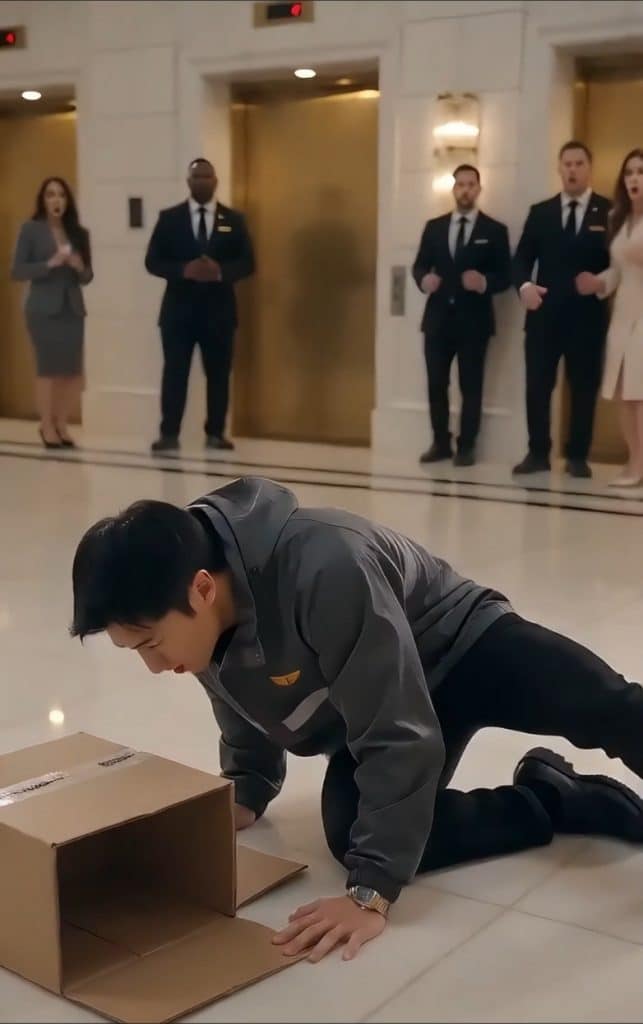
The delivery box split open when it hit the floor.
A damp cardboard corner tore against the polished lobby stone, spilling a stack of papers just far enough for the gold lobby lights to catch their edges. Mr. Chen landed beside it, one hand braced against the floor, his rain-damp jacket twisted at the collar where the resident had grabbed him.
A small mark showed near his lip.
The package lay open between the private elevators and the concierge desk.
For one frozen second, the entire penthouse lobby looked at the wrong thing.
Not the man on the floor.
The box.
As if property damage were easier to understand than human cruelty.
The man who had punched him stood over him in a beige designer coat, loafers planted wide, luxury watch flashing under the warm light. His face held the kind of anger that came from believing a room belonged to him simply because he paid to stand inside it.
“Use the service entrance,” he snapped. “People like you don’t walk through my lobby.”
The words struck harder than the punch.
Residents stopped near the private elevators. A woman holding a small dog stared from beside an abstract painting. A doorman froze with one hand on the brass door. Behind the concierge desk, two assistants stood pale and silent.
Mr. Chen stayed low, breathing carefully.
He did not rise quickly.
He did not shout.
That seemed to irritate the resident even more.
“Did you hear me?” the man barked. “You don’t belong here.”
Then the head concierge came from behind the desk.
His name was Marcus Ellery, and he moved with the controlled speed of a man who understood, too late, that disaster had unfolded in the one place he was responsible for protecting. His charcoal suit was flawless. His white gloves held a leather folder embossed with the building’s ownership seal.
He did not look at the resident first.
He went straight to the man on the floor.
“Mr. Chen,” Marcus said, voice clear and shaken, “your penthouse closing papers are ready. The building is now yours.”
The lobby went silent.
The resident’s face emptied.
His mouth opened, but only one broken sound came out.
“Mr… Chen?”
The delivery box lay open between them, damp and torn, suddenly more honest than every polished wall in the room.
Act II
Daniel Chen had learned the language of luxury from the service entrance.
Not as an owner.
Not at first.
His mother, Lian Chen, cleaned apartments in Manhattan towers where the elevators were divided by who was allowed to be seen. Residents entered through marble lobbies with orchids, brass, and art no one touched. Workers entered through side doors that smelled of bleach, cardboard, and rain.
When Daniel was young, he waited for her after school near those side doors.
He remembered the way doormen changed their voices depending on which entrance opened. He remembered rich children in clean coats passing through front lobbies while he sat beside mop buckets doing math homework on his knees. He remembered one building manager telling his mother not to bring “family problems” into a luxury property because Daniel had fallen asleep in a folding chair near the service hallway.
His mother did not complain.
She worked.
She cleaned kitchens that cost more than her yearly salary. She polished glass tables where people left unpaid invoices beneath designer catalogs. She memorized which residents were kind, which were careless, and which ones became cruel the moment they thought no one important was watching.
Daniel grew up watching her disappear into buildings that depended on her and denied her dignity.
So he built a life around doors.
First software.
Then logistics.
Then real estate technology that helped small property owners manage buildings without selling to predatory funds. By his early thirties, Daniel Chen was the kind of investor magazines called “quietly dangerous.” He bought neglected properties, cleaned up debt structures, replaced abusive management, and made luxury boards nervous because he liked reading staff complaints more than marble renovation plans.
The Manhattan tower at 88 Waverly Place had been on his list for six months.
On paper, it was flawless.
White stone walls. Private elevators. Abstract art. Gold lighting. A concierge desk praised in lifestyle magazines. Penthouse rentals that cost more each month than most people earned in a year.
Behind the paper, it was rotting.
Doormen reported being screamed at for letting delivery workers wait in the lobby during storms. Housekeepers were told to keep carts out of sight when residents had guests. Contractors were fined for using the wrong elevator even when the service lift failed. One courier had been shoved near the mailroom and fired by his app after the resident complained first.
Daniel read every report.
Then he bought the building.
The closing was scheduled for four o’clock.
His lawyers expected him to arrive in a black car.
Daniel arrived in a rain-damp delivery jacket with a cardboard box under one arm.
He wanted to see whether the front door opened differently for someone who looked like labor.
It did.
But not in the way he hoped.
Act III
The resident’s name was Preston Vale.
He leased the top penthouse and behaved as if that made him sovereign.
He served on the resident advisory committee, hosted fundraisers on the terrace, and once filed a complaint because a nurse visiting the family on the thirty-second floor had used the main elevator while wearing scrubs.
Preston called it maintaining standards.
Everyone else learned to call it Tuesday.
That afternoon, he entered the lobby angry before he saw Daniel. His driver was late. Rain had spotted his coat. The lobby smelled faintly of wet cardboard because three deliveries had arrived at once, and Preston believed inconvenience became offensive when witnessed by people he considered beneath him.
Daniel stood near the private elevator with the box tucked under his arm.
He had already checked in at the desk.
Marcus had seen his name on the closing schedule but not his face. The ownership transfer had been handled through lawyers, holding companies, and sealed instructions. All Marcus knew was that a Mr. Chen was expected with final documents.
The rain-damp man in the delivery jacket did not match the image in his mind.
That mistake would haunt him.
Preston saw Daniel first.
“You,” he said. “Service entrance.”
Daniel turned.
“I’m here for the penthouse office.”
“No, you’re not.”
“I checked in.”
Preston laughed, short and sharp.
“With who?”
Daniel looked toward the concierge desk.
Marcus was on a call, half-turned away. A junior assistant looked down at her screen, visibly uncomfortable.
Daniel understood then.
The building had rules on paper.
Preston had rules in practice.
“I have business here,” Daniel said calmly.
Preston stepped closer.
“Your business is not in this lobby.”
Daniel did not move.
“My name is Chen.”
Preston’s eyes flicked to the damp jacket, the black pants, the cardboard box.
“Your name could be Rockefeller. You still use the side door if you’re delivering packages.”
Daniel held his gaze.
“That is not building policy.”
Preston’s face hardened.
He was not used to being corrected by someone holding cardboard.
He grabbed Daniel by the collar.
The punch came before anyone crossed the floor.
The box broke open.
The lobby gasped.
And the building revealed itself perfectly.
Act IV
Marcus Ellery stood beside Daniel with the leather folder in both white-gloved hands.
For the first time in years, the lobby’s silence did not belong to wealth.
It belonged to consequence.
Preston blinked at the folder.
“The building is what?”
“Owned by Mr. Chen,” Marcus said.
His voice was professional, but the shame beneath it was unmistakable.
Daniel slowly rose. He wiped one hand against his jacket, then bent to gather the papers that had spilled from the box. A junior concierge rushed forward to help, but Daniel lifted one hand gently.
“I have it.”
He picked up the torn cardboard flap first.
Then the papers.
Then the small framed photograph that had slipped from inside.
It showed a young woman in a cleaning uniform standing beside a boy outside a Manhattan service entrance. The boy was holding a backpack. The woman’s hand rested on his shoulder. Both of them were smiling, but the door behind them looked heavy.
Daniel looked at the photograph for one second too long.
Preston saw it and seemed to realize, dimly, that the box had not been random.
Daniel placed the photograph back inside.
Then he turned to him.
“You called this your lobby.”
Preston swallowed.
“I didn’t know who you were.”
“No,” Daniel said. “You didn’t.”
Preston’s face brightened with desperate relief.
Then Daniel continued.
“But you knew I was standing in it.”
The lobby held still.
A resident near the elevators lowered her eyes.
Daniel looked around at the staff.
“At any point, did anyone believe he had the right to touch me?”
No one answered.
That was answer enough.
Marcus closed his eyes briefly.
“I failed to intervene, sir.”
Daniel looked at him.
“Yes.”
The word was not cruel.
That made it worse.
Preston tried again.
“This is absurd. I pay an enormous amount to live here.”
Daniel nodded.
“You pay rent.”
Preston stiffened.
Daniel’s voice remained quiet.
“You do not buy the right to assault people in the lobby.”
The doorman finally stepped forward.
“He’s done this before,” he said.
Preston turned sharply.
The doorman did not stop.
“Not a punch. But he grabs packages. Yells at couriers. Threatens staff. We were told to keep him happy.”
Marcus looked at the floor.
The junior assistant whispered, “Because he was penthouse.”
Daniel turned toward her.
“And now?”
Her voice shook.
“Now he’s a tenant.”
A faint shift moved through the lobby.
Not laughter.
Not triumph.
The first breath after fear loosens.
Daniel faced Marcus.
“Preserve all security footage. Call building counsel. Notify NYPD that an assault occurred in the lobby. And suspend Mr. Vale’s amenity access pending legal review.”
Preston went pale.
“You can’t do that.”
Daniel looked at the torn box by his feet.
“I just bought the doors you thought made you powerful.”
Act V
Preston Vale was escorted upstairs by security to wait for counsel.
Not dragged.
Not shouted at.
Just removed from the center of the lobby he had mistaken for a stage.
His face had gone rigid with humiliation, but Daniel did not watch him long. Public panic was not the point. If anything, it was too small a consequence for something the building had permitted long before the punch.
The real work began after the elevator doors closed.
Daniel asked every staff member on duty to stay.
Then he asked every resident who had witnessed the assault to leave written statements with building counsel before returning upstairs. Some looked offended. Some embarrassed. Some relieved to have a formal way to do what they should have done immediately.
The lobby slowly emptied.
Only staff remained.
Doormen. Concierge assistants. Security. A porter with wet sleeves. A building engineer who had come in from the service corridor after hearing the commotion.
Daniel stood before them with the broken cardboard box on the concierge desk.
“This building changed ownership today,” he said. “But ownership is not the same as repair.”
No one moved.
“My mother cleaned buildings like this. She was told which doors to use, which elevators to avoid, which residents were allowed to insult her because they were important.”
His voice stayed even, but something in it made Marcus look up.
Daniel touched the torn edge of the box.
“I came through the front door today because I wanted to know whether this building treated people with dignity before it knew their title.”
The truth settled heavily.
“It did not.”
Marcus removed his white gloves.
It was a small gesture.
A confession without words.
“I am sorry,” he said.
Daniel looked at him.
“I believe you. Now make the apology useful.”
By morning, 88 Waverly Place was operating under new rules.
The service entrance remained for freight, safety, and logistics, but no worker, visitor, courier, nurse, aide, contractor, or staff member could be barred from the main lobby simply because a resident disliked seeing them. The private elevators remained private, but not sacred. Residents who harassed staff faced written penalties, amenity suspension, and possible lease action. Staff could report misconduct directly to ownership without passing through building management.
Preston fought everything.
His attorneys sent letters.
Daniel’s attorneys sent footage.
That quieted the room.
Within weeks, Preston’s lease violation process began. More importantly, past complaints were reopened. The courier who had been shoved near the mailroom received a formal statement and compensation. Two staff members who had left after repeated abuse were invited back with raises. One declined, but thanked Daniel for admitting what had happened.
The lobby changed slowly.
That was the only honest kind of change.
The abstract art remained. The white stone still gleamed. The brass doors still caught afternoon light. Wealthy residents still crossed the polished floors with quiet shoes and expensive coats.
But the front desk no longer lowered its eyes for cruelty.
One evening, a resident complained that a home health aide was waiting near the seating area.
Marcus looked at her calmly.
“She is a guest of a resident.”
“She’s making the lobby look like a clinic.”
Marcus’s voice did not change.
“This lobby is an entrance. Not a mirror for your comfort.”
The woman stared, stunned.
Then she walked away.
The junior concierge smiled so slightly that only Daniel, watching from near the elevators, noticed.
Months later, the building held a tenants’ meeting in the lobby. Not in the penthouse lounge. Daniel insisted on that. Staff attended too, seated in the same rows as residents. For some, that alone felt revolutionary.
Daniel placed the repaired cardboard box on a small table near the front.
It had been taped carefully along one torn edge. Inside was the photograph of his mother and him outside the service entrance.
He did not display it for pity.
He displayed it for memory.
“My mother used to tell me,” he said, “that buildings have manners. You can tell what a place believes by watching who it makes wait in the rain.”
No one spoke.
“88 Waverly made too many people wait in the rain.”
He looked toward the brass doors.
“That ends while I own it.”
After the meeting, Marcus approached him.
“I should have recognized you.”
Daniel shook his head.
“That was never the problem.”
Marcus understood.
The problem was not that he failed to recognize the new owner.
The problem was that recognition had been required.
A year later, Daniel moved his office into the small unused room beside the lobby, the one once reserved for luxury package overflow. Residents found that strange. Investors found it stranger.
Daniel liked being near the front door.
He liked watching who entered and how they were greeted.
One rainy afternoon, a delivery worker came in carrying three soaked boxes and looking nervous.
The doorman opened the brass door wider.
“Take your time,” he said. “Floor’s wet.”
The courier blinked, surprised by kindness without warning.
“Thanks.”
Daniel looked up from his desk.
Marcus saw him watching and gave the smallest nod.
No announcement.
No drama.
No dramatic folder reveal.
Just a door held open for someone carrying weight.
That was the victory.
People would still tell the story of the punch, of course.
The resident grabbed the delivery man.
The box broke open.
The concierge arrived.
The delivery man had bought the building.
Mr… Chen?
It was a satisfying story because arrogance collapsed in the same lobby where it had performed.
But Daniel knew the better lesson was not about ownership.
The punch had been wrong before the closing papers.
The insult had been ugly before the leather folder appeared.
The man on the floor had deserved help before anyone knew he could sign the building deed.
That was why he kept the cardboard box in his office, taped but still visibly damaged.
Not as a trophy.
As evidence.
Every time someone asked about it, Daniel gave the same answer.
“It reminds me what a building is.”
Then he would look through the glass wall toward the lobby, where residents, workers, nurses, couriers, children, assistants, and guests passed beneath the same gold lighting.
“A building is not luxury because it keeps certain people out,” he would say. “It becomes worth owning only when everyone who enters through its doors is allowed to keep their dignity.”