Act I
The dog kept searching after the battlefield had gone quiet.
Dust moved across the mountain pass in thin pale sheets. The armored vehicle sat crooked against the rocks, smoke drifting from its engine like the last breath of a broken machine. Scattered gear lay across the gravel. The sun was harsh and white, exposing everything and comforting nothing.
The Belgian Malinois moved through it all with his nose low.
His name was Atlas.
He had no vest now. No handler at his side. No command in his ear. Only a simple collar, dust on his tan-and-black coat, and a desperation that made him check every shape on the ground as if sheer loyalty could wake the silent.
He sniffed one motionless soldier, paused, then moved on.
Another.
Then another.
His paws clicked against loose stone. His breathing came fast, rough, and hot. Every few steps he lifted his head and searched the wind for the one scent that mattered.
Owens.
Specialist Benjamin Owens.
His handler.
His person.
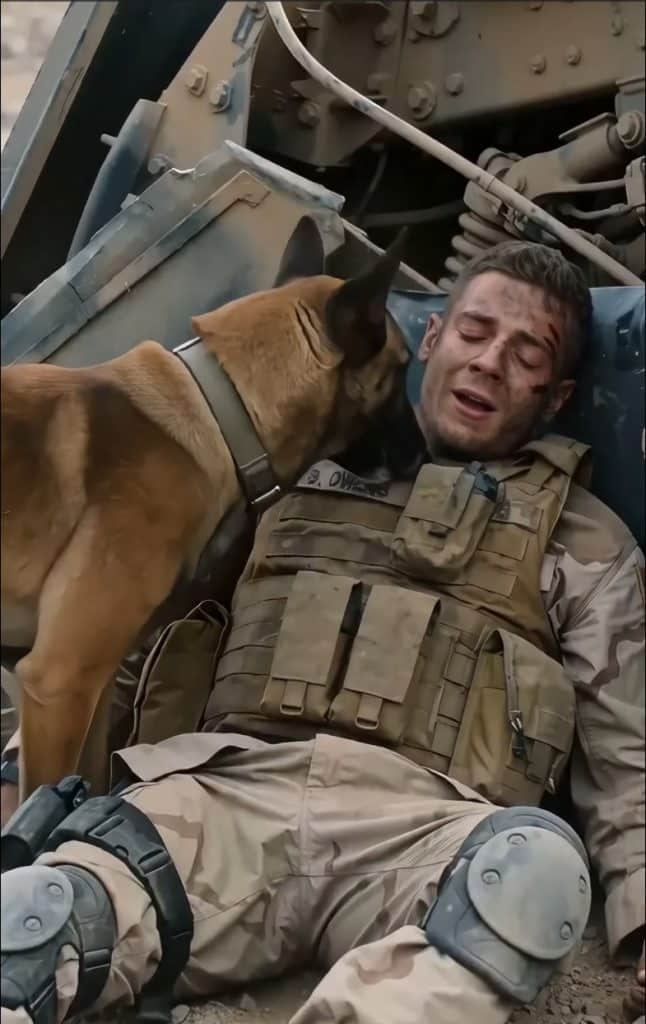
Atlas found him half-hidden beside a piece of twisted metal near the damaged vehicle. Ben was leaning against the wreckage, his tan-and-olive uniform coated in dust, his name patch barely visible beneath the dirt.
B. OWENS.
His eyes were closed.
Atlas stopped so suddenly gravel sprayed from beneath his paws.
Then he rushed forward with a sharp whine, pressing his muzzle against Ben’s chest, his neck, his cheek. He sniffed frantically, then whined again, lower this time, frightened by how still Ben felt.
Ben’s eyelids fluttered.
His hand twitched.
Atlas froze.
The soldier opened his eyes just enough to see him.
For one brief second, the battlefield disappeared from Ben’s face. Pain gave way to something softer, something almost impossible in that ruined pass.
“Buddy,” he rasped. “You’re alive.”
Atlas pushed closer, licking dust from his cheek, pressing his body against him as if he could hold him in the world by weight alone.
Ben lifted a trembling hand and rested it against the dog’s chest.
The effort cost him. His breathing changed. His eyes moved past Atlas to the empty road, the rocks, the smoke, the far ridgeline where no help had appeared.
Atlas whined and tried to lie beside him.
Ben knew that look.
Stay.
Guard.
Never leave.
But this time, staying would not save him.
Ben swallowed hard, gathered what strength he had left, and pushed weakly against Atlas’s chest.
The dog resisted.
“Atlas,” Ben whispered.
The Malinois lifted his ears.
Ben’s voice broke, but the command came through.
“Go get help.”
Atlas stared at him.
The soldier’s hand fell back against his vest.
“Go,” Ben said again, softer now. “Find them.”
The dog backed up one step.
Then another.
He looked at Ben as if leaving him was the most impossible order he had ever been given.
But Atlas had been trained to obey.
And Ben had never given him a command that mattered more.
So the dog turned toward the empty pass and ran.
And the last thing Ben saw before the dust swallowed him was Atlas disappearing into the glare, carrying his only chance of survival.
Act II
Ben Owens had not wanted a dog.
That was the joke everyone in his unit told later.
He had grown up in a small Ohio town where dogs were either farm dogs, porch dogs, or the neighbor’s loud problem. He liked animals well enough, but he preferred quiet things. Books. Old radios. Early morning coffee before anyone spoke.
Then Atlas arrived.
The Malinois was two years old, lean and restless, with sharp ears and eyes that seemed to judge every human in the room. The first time Ben met him, Atlas refused to sit. Refused to heel. Refused to look impressed.
The trainer handed Ben the leash and said, “Good luck.”
Atlas dragged him ten feet before breakfast.
By noon, Ben had a bruised shoulder and no dignity.
By sunset, Atlas had stolen half his sandwich.
“I don’t think he likes me,” Ben told the kennel sergeant.
The sergeant laughed. “He likes you fine. He just doesn’t respect you yet.”
Respect took time.
It came in long training days under heat that made the ground shimmer. It came in repeated commands, failed drills, corrected mistakes, and evenings when Ben sat outside the kennels talking to Atlas like the dog understood every word.
Maybe he did.
Ben told him about home. About his younger sister, Maddie, who sent him ridiculous care packages full of socks and candy he pretended not to like. About his mother’s Sunday calls. About his father, a quiet mechanic who had never once said he was proud until the day Ben left for basic training.
Atlas listened.
Or at least he stayed.
That was enough.
Then came the day on a training range when Ben slipped on loose rock and hit the ground hard enough to knock the breath out of him. The instructor shouted for Atlas to continue the drill.
Atlas did not move.
He planted himself beside Ben and barked until someone checked him.
After that, no one joked about whether the dog respected him.
Atlas had chosen.
From then on, they became something more than handler and dog. They became a rhythm. Ben learned the tilt of Atlas’s head when he caught a scent. Atlas learned the difference between Ben’s command voice and Ben’s tired voice. They moved through dangerous places with a trust that was not dramatic because it did not need to be.
Trust showed itself in smaller things.
Atlas waking Ben before a patrol because he sensed the shift in his breathing.
Ben saving the last bite of every field ration that was safe for him.
Atlas leaning against his leg during long waits.
Ben checking the dog’s paws before his own gear.
The morning of the mountain pass mission, Ben had clipped Atlas’s collar and scratched the fur beneath his jaw.
“Easy day,” he said.
Atlas stared at him.
Ben smiled faintly. “Fine. Not easy. But we’ll get through it.”
They were part of a convoy moving through a remote rocky route, delivering supplies and checking a stalled communication outpost beyond the pass. The air was dry. The road narrow. The mountains around them looked ancient and indifferent.
Then the world changed.
It happened fast.
Too fast for memory to arrange cleanly.
A flash. A pressure wave. Shouts. Dust so thick that sky and ground became the same color. The armored vehicle lurched and stopped. Metal groaned. Radios cracked with broken voices.
Ben remembered Atlas barking.
Then Ben remembered nothing.
When he woke, he was alone in pieces of silence.
He called for Atlas.
No answer.
He tried again.
Nothing.
For the first time since they had been paired, Ben imagined the one thing he had never let himself imagine.
That Atlas was gone.
So when the dog found him beside the wreckage, Ben did not feel relief first.
He felt gratitude so sharp it hurt.
But love, in that moment, meant asking Atlas to do what both of them hated most.
Leave.
Somewhere beyond the pass, help still existed.
And Atlas was the only one who could reach it.
Act III
Atlas ran until the rocks cut at the rhythm of his paws.
The pass stretched ahead in harsh sunlight, every rise looking like the last, every breath full of dust and smoke. He stopped once on a ridge, turned back, and stared toward the place where Ben lay.
Every instinct pulled him backward.
Stay with him.
Guard him.
Keep him warm.
But the last command was stronger.
Go get help.
Atlas pushed forward.
He followed scent, sound, memory. The convoy route. The wind carrying traces of fuel, rubber, fabric, humans. His ears snapped at every distant echo. His body knew the training even while his heart fought it.
A torn strip of canvas flapped against a rock.
He ignored it.
A loose metal panel shifted in the wind.
He veered around it.
A dry ravine cut across the path, forcing him down and up again through gravel that slid beneath his paws. He stumbled once, caught himself, and kept moving.
Then he heard voices.
Faint.
Human.
Atlas froze at the top of a rise.
Below, near a bend in the road, a small support team had stopped beside two vehicles. They were far from the blast site, blocked by terrain and interference, unaware that anyone was still alive beyond the ridge.
Atlas barked.
One soldier turned.
At first, the men did not understand what they were seeing.
A dust-covered Malinois without a handler.
No vest.
No leash.
No human beside him.
Atlas barked again, sharper, frantic.
“Is that Owens’s dog?” someone shouted.
Atlas ran toward them, then stopped and looked back.
The soldiers exchanged one stunned glance.
He barked again.
Then he turned, took three steps up the ridge, and looked back once more.
This time, they understood.
“He’s leading us.”
The support team moved fast.
Medics grabbed packs. A radio operator sent the alert. Two soldiers climbed into a vehicle while another followed Atlas on foot up the first stretch of rocks, not waiting for the engine to turn.
Atlas did not slow enough for them.
He ran ahead, then circled back when they fell behind. Barked once. Pushed forward again. His whole body became one message.
Hurry.
Hurry.
Hurry.
The rescue team followed him into the pass.
The route that had seemed empty minutes earlier now felt alive with urgency. The damaged vehicle came into view through drifting smoke. The soldiers saw the aftermath and went quiet, but Atlas did not let them freeze.
He ran straight to Ben.
The medic reached him seconds later.
“Alive!” he shouted.
Ben’s eyes opened halfway.
He did not look at the medic first.
He looked for Atlas.
The dog forced his head under Ben’s weak hand, pressing into his palm.
Ben’s lips moved.
No sound came.
Atlas stayed there while the medics worked, whining whenever they shifted Ben too far away, calming only when one of them said, “He’s right here, Owens. Your dog’s right here.”
Ben’s fingers curled weakly in Atlas’s fur.
The rescue team prepared him for transport.
Atlas tried to climb in after him.
A soldier blocked him gently. “Not yet, boy.”
Atlas barked, offended by the stupidity of that answer.
The medic looked at Ben, then at the dog.
“Let him ride.”
No one argued.
So Atlas climbed into the vehicle and lay pressed against Ben’s side as they moved out of the pass.
Ben drifted in and out of awareness.
Each time he surfaced, he felt the same thing.
Warm fur.
Steady breathing.
A living promise beside him.
But the hardest part was waiting on the other side.
Act IV
Ben woke in a field hospital to fluorescent lights and the sound of someone adjusting a curtain.
For one terrible second, he did not know where he was.
Then he tried to sit up.
A nurse stopped him with one firm hand.
“Easy, Specialist. You’re safe.”
Ben’s voice came out raw.
“My dog.”
The nurse’s face softened.
“He’s outside.”
“Outside where?”
“Just beyond the door. He refused to leave the hallway, so they gave up trying.”
Ben closed his eyes.
A laugh broke through him, weak and painful and full of relief.
“Sounds like him.”
They let Atlas in an hour later.
The dog entered carefully, as if he knew the room was not a battlefield but still contained something fragile. His ears were high. His eyes locked on Ben. Then he crossed the room and placed his head gently on the edge of the bed.
Ben laid his hand over Atlas’s muzzle.
“You did it,” he whispered. “Good boy.”
Atlas exhaled, long and heavy, and closed his eyes.
The official report came later.
The support team confirmed that Atlas reached them before the damaged convoy’s emergency beacon fully connected. Terrain interference had delayed the signal. Without the dog, the response would have taken longer.
No one needed to finish that sentence.
Ben understood.
So did everyone else.
But there was one part of the story Ben did not learn until three days later, when Sergeant Vale came to visit with a folded envelope in his hand.
He stood at the foot of Ben’s bed, looking less like a soldier and more like a man carrying someone else’s unfinished sentence.
“This was found in your pack,” Vale said.
Ben frowned.
The envelope was dusty but sealed.
Maddie was written across the front in Ben’s handwriting.
His little sister.
He remembered it then.
The letter he had written the night before the mission. Not because he expected anything to happen. Just because the pass had made him think of home, and Maddie had sent him a photo of her new baby boy, who had Ben’s crooked smile.
He had written that if anything ever happened, she should know he was not alone.
He had written about Atlas.
How the dog had become family in a place where family was mostly a voice on a phone.
Ben stared at the envelope until the letters blurred.
“I didn’t send it,” he said.
“No,” Vale replied. “But you can still send a better one.”
Ben looked at Atlas.
The dog was asleep beside the bed, one paw twitching as if still running through the pass.
A better one.
For weeks, Ben healed slowly.
He hated it. Hated needing help to stand. Hated the weakness in his limbs. Hated the quiet hours when memory returned in fragments and he could not place all the faces where they belonged.
Atlas helped without knowing he was helping.
Or maybe he knew exactly.
When Ben woke from bad dreams, Atlas was already standing beside him. When Ben refused to eat, Atlas rested his chin on the tray until Ben gave in. When Ben struggled through his first steps, Atlas walked beside him, slow and steady, not pulling ahead.
The doctors called it recovery.
Ben called it being led home.
Eventually, the military made the decision official.
Atlas would be retired from active duty.
The reason was written in formal language. Stress response. Handler bond. Operational considerations.
Ben read the papers and knew what they really meant.
Atlas had done his job.
He had earned peace.
But peace had one condition.
Ben had to be there too.
Act V
The ceremony took place three months later under a pale morning sky.
Not on a grand parade field. Not with cameras crowding the moment. Just a small formation, a few officers, the support team who had followed Atlas into the pass, and Ben Owens standing with a cane in one hand and a leash in the other.
Atlas sat at his left side.
Older somehow.
Not in years, but in gravity.
His ears were alert. His coat had been brushed until it shone. Around his collar hung a small medal that kept catching the light whenever he moved.
Ben looked down at him.
“Don’t get full of yourself,” he murmured.
Atlas glanced up, unimpressed.
Maddie stood in the front row holding her baby, who stared at Atlas with enormous eyes. Ben’s father stood beside her, cap in both hands. His mother cried quietly from the moment the ceremony began and did not bother pretending otherwise.
When Ben’s commanding officer spoke, he kept it simple.
He said Atlas had located his handler under extreme conditions.
He said Atlas had led rescuers through hazardous terrain.
He said loyalty was often spoken of as an idea, but occasionally it arrived on four paws and refused to quit.
Ben stared straight ahead until that last line.
Then he had to blink hard.
When they handed him Atlas’s retirement papers, the officer asked if he accepted permanent custody.
Ben looked down at the dog who had found him in smoke, left him only because he was ordered, and returned with help because love had learned the route.
“Yes, sir,” Ben said. “I accept.”
Atlas barked once.
The formation laughed.
Ben did not.
He crouched slowly, ignoring the ache that shot through him, and put both hands on Atlas’s face.
“You’re coming home,” he whispered.
Atlas leaned forward and pressed his forehead against Ben’s chest.
For once, the dog obeyed no command.
He simply stayed.
Months later, Ben took Atlas to Ohio.
The town was smaller than he remembered. The streets seemed quieter. His father’s garage still smelled like oil and coffee. His mother’s porch still had the wind chime that never sounded in tune.
Atlas adapted immediately.
He inspected the yard, approved the fence, distrusted the mailman on principle, and slept outside Ben’s bedroom door the first night as if enemy ridgelines might appear in the hallway.
Ben tried to make him sleep on a dog bed.
Atlas ignored it.
Some habits did not retire easily.
On Sundays, Ben walked him to the edge of town where the fields opened wide and the sky seemed mercifully empty. At first, Ben moved slowly with the cane. Atlas matched him step for step.
Not ahead.
Never behind.
Beside him.
One afternoon, Maddie came over with her son, now old enough to wobble on unsteady legs. The baby reached for Atlas’s ears before anyone could stop him.
Ben froze.
Atlas remained perfectly still.
Then he gently licked the child’s hand.
Maddie laughed through tears.
“He knows,” she said.
Ben nodded.
“Yeah. He always knows.”
That night, after everyone left, Ben finally opened the letter he had once written to Maddie. The old one. The one found in his pack.
He read it at the kitchen table while Atlas slept at his feet.
The words belonged to another version of him. A man trying to sound brave. A man preparing comfort he hoped no one would ever need.
He folded it carefully.
Then he took out a new sheet of paper.
Maddie,
I was wrong about one thing. I told you once that Atlas was just my working dog. He isn’t. He’s the reason I’m writing this myself.
He stopped there and looked down.
Atlas opened one eye.
Ben smiled.
Outside, the Ohio night was quiet. No smoke. No gravel. No broken metal under the sun. Just crickets, porch light, and the soft breathing of the dog who had crossed a battlefield to bring him back.
Ben finished the letter.
Then he placed it in an envelope, sealed it, and wrote his sister’s name across the front.
This time, he mailed it.
The next morning, he woke before sunrise.
Atlas was already at the door, leash in his mouth.
Ben laughed.
“You planning the day now?”
Atlas wagged once.
Ben took the leash and stepped onto the porch.
The sky was turning pale gold.
For a moment, the light reminded him of the mountain pass, and his chest tightened. Then Atlas leaned against his leg, solid and warm, anchoring him to the place they were now.
Home.
Ben rested a hand on the dog’s head.
“You got help,” he said softly. “Now let’s go live.”
Atlas looked up at him, ears high, eyes bright.
Then they walked down the steps together, into a morning that did not need rescuing.