Act I
The scream tore through Room Four before anyone in the hallway understood what was happening.
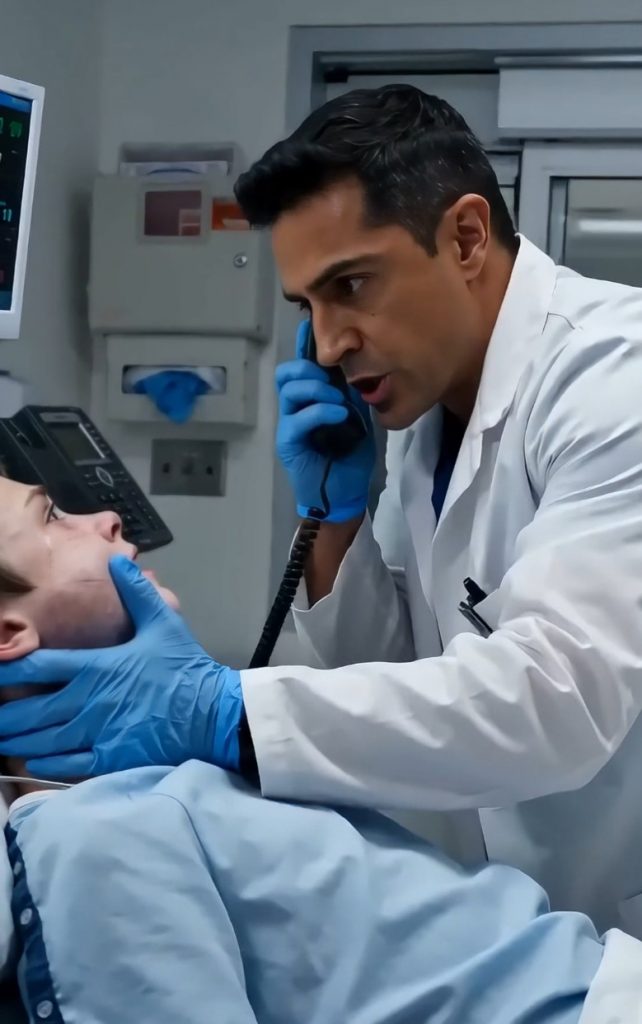
Evan Torres lay on the hospital bed in a pale blue gown, his small body trembling beneath the fluorescent lights. His face was wet with tears. His right cheek, swollen near the jawline, had turned angry and tight around a narrow dark opening that seemed too small to be causing so much pain.
Dr. Aaron Hale held the boy’s head steady with one blue-gloved hand.
“Evan, listen to me,” he said, keeping his voice calm even as the monitors behind him beeped faster. “I need you to stay still.”
“I can’t,” Evan cried. “It hurts.”
Outside the glass observation window, his mother slammed both palms against the pane.
Mara Torres had been forced into the hallway when the emergency team rushed in. Now she stood there with her dark hair falling loose around her face, crying so hard she could barely breathe.
“What’s inside my baby?” she screamed.
Her voice came through the glass muffled and broken.
Dr. Hale looked once toward her, then back at the wound.
He had seen infections before. Swelling. Abscesses. Allergic reactions. He had seen frightened parents and children in pain.
But this was different.
The opening in Evan’s cheek shifted.
Not from breathing.
Not from crying.
From something beneath the skin.
A nurse beside the bed went very still.
Dr. Hale’s expression changed.
He reached for the black intercom phone mounted on the wall and yanked it from the receiver.
“Get the surgical team down to Room Four,” he said. “Now.”
The room seemed to sharpen around the command.
Monitor beeps. Rubber gloves. Moving feet. Stainless steel trays. Evan’s breathless crying. Mara’s hands striking the glass again and again as if love could break through it.
Dr. Hale returned to the bed.
“Evan,” he said, leaning close. “Look at me. You’re not alone. We’re going to help you.”
Evan’s eyes were wide and terrified.
“My mom,” he whimpered.
“She’s right outside.”
“I want her.”
“I know.”
The doctor steadied him carefully, watching the cheek wound as the opening widened just slightly.
Something moved again.
This time, everyone in the room saw it.
The nurse covered her mouth but did not step back.
Dr. Hale did not move roughly. He did not panic. He only held Evan still and turned his head toward the door, waiting for the surgical team that suddenly felt too far away.
Behind the glass, Mara stopped screaming.
For one silent second, she saw the doctor’s face.
And she understood that every person who had dismissed her for the last three weeks had been wrong.
Act II
Three weeks earlier, Mara had been told to stop overreacting.
The first doctor said it with a smile.
The second said it with a sigh.
The school nurse said it with the careful politeness people use when they believe a mother is becoming a problem.
“It’s probably an insect bite,” they told her.
Then, “Children scratch. It gets irritated.”
Then, “Try not to frighten him.”
But Mara knew her son.
Evan was not dramatic. He was the child who apologized to chairs after bumping into them. He was the boy who cried quietly during sad movies and pretended he had allergies. If he said something felt wrong, something felt wrong.
The mark had appeared after a school-sponsored wilderness retreat at Silver Ridge Camp.
It was supposed to be a gift.
Evan’s public middle school had partnered with the camp for a science weekend funded by donors. The brochure promised nature hikes, team-building games, astronomy lessons, and “hands-on ecology experiences” led by certified guides.
Mara almost said no.
She worked double shifts at a laundry service and did not like sending Evan anywhere overnight. But he had held the brochure like it was a passport to another world.
“Mom,” he said, trying to sound casual and failing completely, “they have telescopes.”
So she signed the permission form.
When Evan came home, he was sunburned, exhausted, and happier than she had seen him in months. He told her about the stars. The campfire. The creek where they were not supposed to get their shoes wet but everyone did anyway.
Then he rubbed his cheek.
“Something bit me,” he said.
At first, the mark was tiny.
Mara cleaned it. Put ointment on it. Told him not to touch it.
By the fourth day, it had changed.
By the seventh, Evan said he could feel pressure under the skin.
At urgent care, the doctor barely looked up from the tablet.
“Localized irritation,” he said.
Mara asked if it could be from the camp.
The doctor smiled thinly.
“Kids get bites. It doesn’t mean there’s a mystery.”
She wanted to believe him.
She tried.
But the swelling grew.
Evan stopped sleeping on his right side. He stopped eating anything that required much chewing. He stopped smiling in photos because it hurt to move his face.
Mara took him back.
This time, the clinic receptionist mentioned an unpaid balance before anyone mentioned Evan’s cheek.
The second doctor examined him for less than two minutes.
“Some parents become very anxious when children have visible symptoms,” he said.
Mara stared at him.
“My child is in pain.”
“I’m not saying he isn’t.”
But he wrote the note anyway.
Mother highly distressed. Patient anxious.
That note followed them.
At school, a counselor asked whether Evan had been picking at the wound because of stress at home. A nurse asked whether their apartment was clean. Someone used the phrase “environmental factors,” and Mara knew exactly what they meant.
Poor.
They meant poor.
They meant her clothes smelled like detergent from work and her shoes were worn down at the heel. They meant she had no husband sitting beside her in the waiting room wearing a button-down shirt and asking questions in a calm voice.
They meant she looked like someone easy to doubt.
So Mara began documenting everything.
Photos.
Dates.
Temperature readings.
Medication times.
The names of doctors who told her to wait.
The night before the emergency room, Evan woke her at 2:13 a.m. whispering, “Mom, something’s moving.”
Mara did not wait for morning.
She wrapped him in a jacket, called a rideshare she could not afford, and brought him to St. Brendan’s Hospital.
At intake, she tried to explain.
The triage nurse took one look at Evan’s face and stopped typing.
Within minutes, Dr. Hale was at the bed.
Within ten, the room was full.
Within fifteen, Mara was behind glass, watching the nightmare she had been warning people about become visible.
But the wound was only the beginning.
Act III
The surgical team arrived like a storm in blue scrubs.
Dr. Hale met them at the door, speaking quickly but clearly. Evan was conscious. The wound was active. The source appeared embedded near the right cheek and jawline. His vital signs were elevated but holding.
Mara heard none of the medical language.
She heard only her son.
“Mom,” Evan cried.
A nurse stepped out into the hallway and approached her gently.
“Mrs. Torres?”
“Mara,” she said automatically.
“Mara. We’re going to take care of him.”
“What is it?”
The nurse hesitated.
That hesitation nearly destroyed her.
“Tell me,” Mara begged.
“We don’t know everything yet. But Dr. Hale believes there may be a parasitic infection.”
Mara’s face went blank.
The word did not fit her son. It sounded impossible, like something from another country, another life, another mother’s nightmare.
“No,” she whispered. “No, they said it was a rash.”
“I know.”
“I told them. I told everyone.”
The nurse’s eyes softened.
“I believe you.”
Those three words hit Mara harder than any diagnosis.
I believe you.
She folded forward, one hand against the wall, sobbing not only from fear, but from the sudden agony of being heard too late.
Inside Room Four, Evan was given medication to calm him and control the pain. The team worked carefully, shielding his face from the harshest lights, speaking to him even when he was too frightened to answer.
Dr. Hale stayed near his head.
“You’re doing great,” he told him. “I need you to keep breathing for me.”
Evan’s lashes fluttered.
“My mom mad?”
The question nearly broke the doctor’s composure.
“No,” he said softly. “Your mom fought for you.”
The procedure was delicate and tense, but controlled. The team removed the source of the infection without rough movement, then cleaned and protected the wound. There was no shouting after that. No movie-style chaos. Just trained hands, measured voices, and the heavy relief that comes when a child’s breathing begins to steady.
When Dr. Hale finally stepped into the hallway, Mara almost could not stand.
“Is he alive?”
“Yes.”
The word left his mouth before anything else.
Mara covered her face and cried.
“He’s stable,” Dr. Hale continued. “He’s sedated now. We’ll monitor him closely, and infectious disease is coming in. We need to run tests, but we were able to remove the immediate threat.”
Mara nodded, trying to absorb each word.
Then her face changed.
“Silver Ridge,” she said.
Dr. Hale paused.
“The camp?”
“He got the bite there. I told the clinic. I told the school. I wrote it down.”
She began searching through her bag with shaking hands. Receipts, tissues, medication packets, folded discharge papers, a pen, a small notebook with a cracked cover.
She shoved the notebook toward him.
“I’m not crazy,” she said. “I wrote everything.”
Dr. Hale took it.
The pages were filled edge to edge.
Day one: Returned from camp. Small red mark near right cheek.
Day four: Swelling. Pain. Clinic said bite.
Day seven: Pressure. Warmth. No improvement.
Day eleven: Evan says he feels movement. Doctor says anxiety.
Day sixteen: School nurse asks about home hygiene.
Day twenty-one: Severe pain. ER.
Dr. Hale read silently.
Then he turned the page.
Mara had taped in a copy of the camp schedule.
Hands-On Ecology: Soil, Streams, and Insects.
Beside it was a handwritten note.
Evan said counselor told them not to mention the “bug box” because parents might complain.
Dr. Hale looked up.
“What bug box?”
Mara’s eyes filled again.
“I don’t know.”
At that moment, an infectious disease specialist stepped into the hall, holding preliminary lab notes and looking grim.
“You need to see this,” she told Dr. Hale.
And the story shifted from one emergency room to something much larger.
Act IV
By morning, St. Brendan’s Hospital had contacted the county health department.
By noon, three other children from Silver Ridge Camp were being evaluated.
By evening, the camp director was no longer answering calls.
Mara sat beside Evan’s bed while the world beyond the room began to move around them.
He looked small under the blanket. Too small for words like investigation, exposure, negligence, and outbreak. His cheek was bandaged now, his breathing softer, his pain finally controlled.
When he woke, the first thing he asked was whether he looked scary.
Mara leaned over him and kissed his forehead.
“You look like my brave boy.”
“Did they get it out?”
“Yes.”
He closed his eyes.
“Good.”
Then, after a moment, he whispered, “I told them at camp something bit me.”
Mara went still.
“Who did you tell?”
“Mr. Lyle.”
The camp director.
“He said don’t make a big thing. He said city kids always freak out about nature.”
Mara’s hand tightened around the bedsheet.
Evan opened his eyes.
“Did I get in trouble?”
“No,” Mara said, voice shaking. “No, baby. You didn’t do anything wrong.”
That afternoon, Dr. Hale came into the room with two visitors: a hospital patient advocate and a woman from the health department named Denise Calder.
Denise spoke gently to Evan first, asking simple questions without pressure. Where did the bite happen? What activity were they doing? Was anyone else bitten? Did any adult clean the wound?
Evan answered slowly.
The “bug box” had been part of an ecology demonstration. A counselor had brought out sealed containers with soil, leaves, and insects. The children were allowed to touch some of the materials while wearing gloves, but the gloves ran out.
One boy had dared Evan to hold a clump of damp soil near his face because “it smelled like a cave.”
Evan did.
Something brushed his cheek.
He told the counselor.
The counselor told him to wash it and stop worrying.
Mara looked at Denise.
“You believe him?”
Denise did not hesitate.
“Yes.”
Mara shut her eyes.
Again, those words.
Again, too late and still necessary.
The investigation uncovered what Mara had felt in her bones from the start.
Silver Ridge had cut safety corners. Supplies were reused. Outdoor materials were brought in without proper screening. Minor injuries were underreported to avoid alarming parents and donors.
Then came the part that made Mara cold.
Two children had reported unusual skin irritation before Evan.
Their parents had been told it was nothing.
One had been advised to “avoid dramatizing normal outdoor exposure.”
Mara stared at the report when Dr. Hale showed her.
The phrase looked familiar.
Too familiar.
Normal outdoor exposure.
It was the same phrase used in Evan’s urgent care discharge summary.
Dr. Hale’s face was tight.
“The clinic had access to the camp’s incident note,” he said. “They should have escalated this.”
Mara did not speak.
She thought of the receptionist mentioning money. The doctor smiling at her like she was foolish. The school counselor asking about her apartment instead of the camp.
All those adults.
All that certainty.
And her son had been suffering the whole time.
Dr. Hale placed the notebook on the table beside Evan’s bed.
“Your records helped connect the cases,” he said.
Mara looked at the cracked cover.
She had carried it like evidence of sanity.
Now it was evidence of truth.
“What happens now?” she asked.
Denise answered.
“The camp is suspended pending review. The clinic will be investigated. Families are being notified. And your son’s treatment costs related to this exposure will not be placed on you.”
Mara’s shoulders shook.
She had been so focused on keeping Evan alive that she had not let herself think about the bills.
Evan stirred on the bed.
“Mom?”
She immediately turned to him.
“I’m here.”
“Can we go home?”
Mara brushed his hair back gently.
“Soon.”
He looked toward Dr. Hale.
“Am I gross?”
The doctor’s expression softened.
“No, Evan. You were sick. That is not the same thing.”
The boy seemed to think about that.
Then he looked at his mother.
“You knew.”
Mara nodded, crying quietly now.
“I knew something was wrong.”
Evan’s voice became sleepy.
“You always know.”
Mara held his hand and lowered her forehead to it.
The monitors beeped steadily beside them.
For the first time since entering Room Four, the sound did not feel like an alarm.
It felt like time being given back.
But Mara still had one more room to walk into.
Act V
The hearing took place six weeks later.
Mara almost did not go.
Evan was home by then, recovering well, with a faint healing mark near his jaw and a new habit of checking mirrors when he thought no one noticed. His hair had grown a little shaggy. His appetite had returned. He had started laughing again, cautiously at first, then fully.
That should have been enough.
Mara told herself she did not need to stand in front of officials, doctors, school administrators, and lawyers. She did not need to relive the glass window, the screaming, the way her son had asked if she was mad while lying in a hospital bed.
Then Evan found her blouse ironed over the back of a chair.
“Is that for the meeting?” he asked.
She nodded.
“You should go.”
Mara looked at him.
“Yeah?”
He touched the side of his face, then dropped his hand quickly.
“What if another mom knows and nobody listens?”
So Mara went.
The room was crowded.
Silver Ridge representatives sat at one table with attorneys. The urgent care clinic sent an administrator who spoke in careful phrases. The school district sent someone who looked deeply uncomfortable every time Mara glanced in her direction.
Dr. Hale was there too.
So was Denise Calder from the health department.
Mara sat alone until Dr. Hale quietly took the seat behind her.
When her name was called, she walked to the microphone.
Her hands shook.
For a moment, all she could see was the emergency room glass.
Her palms against it.
Her son inside.
The doctor’s blue gloves.
The intercom.
The opening in Evan’s cheek that proved she had not imagined the danger.
Then she took a breath.
“My son told me something was wrong,” she said. “I believed him.”
The room went silent.
“I brought him to doctors. I brought notes. I asked about the camp. I asked if it could be more than a bite. And over and over, people looked at me and saw an anxious mother instead of a witness.”
She looked at the clinic administrator.
“You wrote that I was distressed.”
Her voice tightened.
“I was. My child was in pain.”
Someone in the back shifted.
Mara kept going.
“You wrote that Evan was anxious. He was. Something was happening inside his body and nobody would explain it. You wrote about my emotions because it was easier than questioning your own certainty.”
Dr. Hale lowered his eyes.
The school district representative swallowed hard.
Mara turned toward the Silver Ridge table.
“And you,” she said. “You told children not to make a big thing out of being hurt because it would inconvenience adults. You taught my son that his pain was embarrassing.”
The camp director stared at the table.
Mara’s voice broke, but it did not weaken.
“He asked me if he was gross. He asked if he was in trouble. That is what your negligence did. It made a sick child ashamed of being sick.”
No one interrupted.
No one dared.
By the end of the hearing, Silver Ridge lost its youth program license pending major review. The clinic entered a formal corrective process. The school district adopted new rules requiring parent concerns after off-site trips to be documented and escalated, not dismissed as anxiety.
Mara did not feel victorious.
Victory was too clean a word.
She felt exhausted.
But outside the building, Dr. Hale approached her with a folded paper in his hand.
“I wanted you to have this,” he said.
Mara opened it.
It was a copy of Evan’s corrected medical summary.
Near the top, under history, Dr. Hale had written:
Mother repeatedly reported progressive symptoms following camp exposure. Her concerns were medically relevant and accurate.
Mara read it twice.
Then a third time.
Her eyes filled.
“Thank you,” she whispered.
Dr. Hale nodded.
“I should be thanking you. You kept records when no one kept faith.”
Months later, Evan returned to school.
Not all at once. Half days at first. Then full days. He wore his backpack on both shoulders and kept his head slightly lowered when he passed groups of kids, but each week his confidence came back in small pieces.
One afternoon, during science class, a teacher began a lesson on ecosystems.
Evan went quiet.
The teacher noticed and gently changed the activity.
After class, she asked if he wanted to help design a safety checklist for future outdoor trips.
Evan thought about it.
Then he nodded.
His checklist was simple.
Wear gloves.
Tell an adult immediately.
Write down what happened.
Listen when someone says something feels wrong.
The last line was underlined twice.
At home, Mara taped a copy to the refrigerator.
Evan pretended to be embarrassed.
He was not.
On the first anniversary of the emergency room visit, Mara and Evan walked past St. Brendan’s Hospital after a follow-up appointment. The glass doors opened and closed as families came and went, carrying flowers, paperwork, coffee cups, fear.
Evan stopped near the entrance.
“Do you think Dr. Hale remembers me?”
Mara smiled.
“Baby, I think everyone in Room Four remembers you.”
He touched his cheek lightly.
The mark was faint now.
Not gone.
But no longer frightening.
“Mom?”
“Yeah?”
“I’m glad you didn’t stop asking.”
Mara looked down at him.
There were many things she wanted to say.
That she had been terrified.
That she had almost believed them.
That every time someone called her anxious, she wondered if loving a child too fiercely made adults stop hearing the truth inside the fear.
Instead, she took his hand.
“I’ll always ask,” she said.
Evan leaned against her side.
They stood there for a moment in the late afternoon light, mother and son reflected in the hospital glass.
Not trapped on opposite sides anymore.
Together.
And when they finally walked away, Mara did not look like the hysterical mother from the hallway.
She looked like what she had been all along.
The first person who knew something was wrong.
And the last person willing to give up.