Act I
The first thing everyone heard was the growl.
Deep. Low. Warning.
It rolled across the dry grass behind the gym and stopped every adult cold.
Timmy Volkov lay on the ground near the chain-link fence, one cheek pressed against the dust, his gray T-shirt smeared with dirt. His crayons were scattered around him like bright little pieces of a normal afternoon that had been shattered. An open sketchbook lay beside his knee, one page bending in the wind.
Above him stood a massive brown dog.
Its front legs were planted wide. Its white chest patch rose and fell with heavy breaths. A thick black collar cut across its neck, and its teeth were bared toward the fence.
From a distance, it looked like every parent’s nightmare.
A child on the ground.
A powerful dog standing over him.
A growl sharp enough to make the air feel dangerous.
“Get it off him!” someone screamed.
Footsteps pounded across the parking lot. A gate rattled open. People ran toward the grassy corner behind the building, shouting over one another.
“The dog’s killing Timmy!”
“Behind the gym!”
“Hurry!”
But Timmy was not screaming.
He was shaking, yes. His face was pale, and his breath came in small, frightened bursts. But his eyes were not fixed on the dog’s teeth.
They were fixed on the fence.
The dog’s were too.
Behind the chain-link, half-hidden in the hedge, something dark shifted.
A hooded figure.
Black sweatshirt. Dark face covering. One gloved hand curled through the fence before vanishing back into the leaves.
The dog lunged half a step toward it, barking once with such force that Timmy flinched beneath him. But the animal did not leave the boy. It braced itself over him again, a living shield between Timmy and whatever waited in the bushes.
Then Aleksandr Volkov came running.
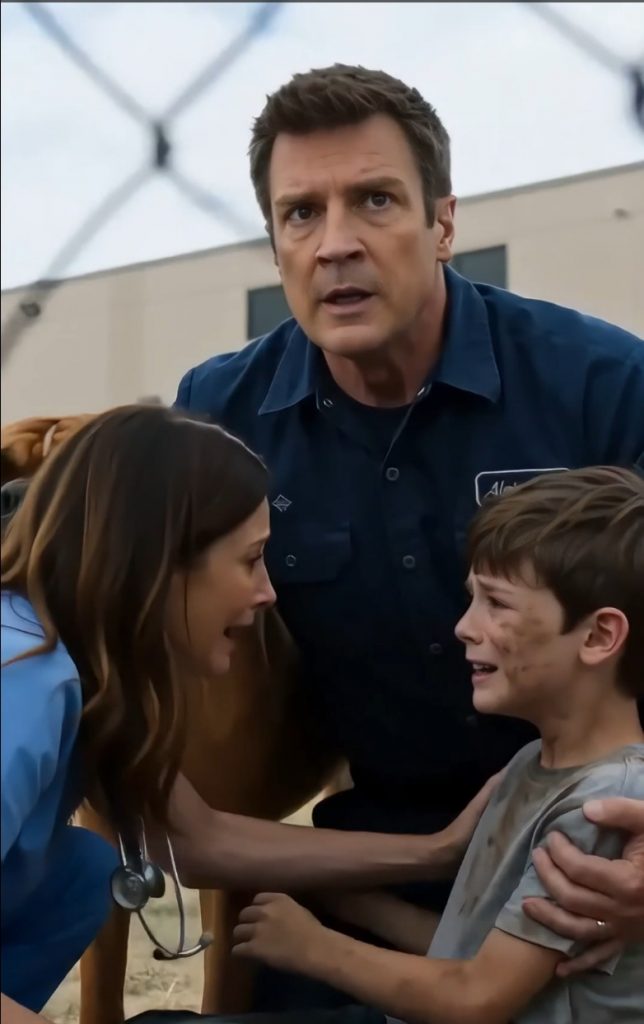
He had been fixing a jammed door near the school gym when the screaming started. He was still in his navy work shirt, the name patch on his chest stitched with ALEKSANDR in white thread. His boots tore through the dry grass as he pushed past bystanders, face drained of color.
“Timmy!”
The dog turned its head for one split second.
Aleksandr froze.
He knew that dog.
“Buddy?” he whispered.
The dog’s ears flicked, but its body stayed locked toward the fence.
Timmy lifted one trembling hand and touched the dog’s side.
“Buddy,” he said, voice small but urgent. “Good boy.”
Aleksandr dropped to his knees.
Behind him, people kept shouting.
“Don’t touch it!”
“Get the kid away!”
“Call animal control!”
But Timmy looked straight at his father through tears.
“He saved me,” the boy said. “Daddy, grab my arm!”
Aleksandr reached beneath the dog’s chest and took Timmy carefully by the wrist. Buddy did not snap. Did not turn. Did not move except to shift his weight, giving Aleksandr just enough space to pull his son back.
The hooded figure rustled behind the hedge.
Buddy barked again, fierce and furious.
And that was when Aleksandr realized the dog everyone feared was the only reason his son was still there.
Act II
Buddy had not always belonged to them.
In fact, for the first three months, Aleksandr refused to let him near the house.
The dog had appeared behind the apartment building in late winter, ribs showing, collar broken, one ear nicked from some old fight with the world. He slept under the stairs and watched everyone with amber eyes that seemed too tired for an animal.
People complained.
Too big.
Too dangerous.
Bad breed.
Call the city.
Timmy saw something else.
“He’s lonely,” he told his father.
Aleksandr did not want a dog. He worked maintenance at the school district by day and took night repair jobs when the rent got tight. His wife, Elena, worked twelve-hour nursing shifts at the hospital. They had schedules pinned to the fridge, bills stacked in drawers, and barely enough quiet in the house to sleep.
A giant stray dog was not part of the plan.
But Timmy kept leaving water near the back steps.
Then half a sandwich.
Then the crust from his toast.
The dog never rushed him. Never lunged. Never even barked. He waited until Timmy went inside before eating, as if he understood shame.
One rainy evening, Timmy sat at the window watching the dog shiver under the stairs.
“Dad,” he said softly, “if we don’t help him, who will?”
Aleksandr had no answer.
That was how Buddy came inside.
Not all the way at first. Just the laundry room. Then the kitchen mat. Then, after one thunderstorm when Timmy crawled beside him with a blanket, the foot of the boy’s bed.
Elena was the first to trust him fully.
She saw how he followed Timmy from room to room, never crowding him, always watching doors and windows. She said some animals knew what fear felt like because they had lived with it.
Aleksandr remained careful.
He trained Buddy every morning before work. Sit. stay. leave it. heel. He took him to a local trainer who worked with rescued guardian dogs and came home with pages of rules. Buddy learned them all.
But the neighborhood did not.
Mothers crossed the sidewalk when they saw him. A man in the building called him a lawsuit with legs. Someone left an anonymous note under their door.
Keep that beast away from children.
Timmy found it first.
Aleksandr wished he had not.
The boy read it in silence, folded it carefully, and put it in the trash.
“He’s not a beast,” Timmy said.
“No,” Aleksandr replied. “He’s not.”
Still, they stopped bringing Buddy to school pickup. They avoided crowded parks. They kept him leashed even in empty fields. Aleksandr understood the world did not judge calmly when it was afraid.
Then came the art club picnic behind the school gym.
Elena had signed Timmy up because he loved drawing buildings and dogs and superheroes with oversized hands. Aleksandr was there doing maintenance work near the side entrance. Buddy was supposed to be at home.
But that morning, the back gate at their apartment complex had been left open.
Buddy got out.
He tracked the scent he knew best.
Timmy.
By the time the dog reached the school grounds, Timmy was sitting near the fence with his sketchbook open, drawing Buddy from memory with a green crayon. The other children had gone toward the picnic tables with the art teacher. Timmy stayed behind for one more minute to finish the collar.
That one minute became everything.
A man in a black hoodie appeared behind the chain-link fence.
At first, Timmy thought he was a worker.
Then the man crouched near the hedge and whispered his name.
Timmy froze.
He did not know the voice.
The man told him his father had been hurt. Told him to come closer. Told him not to call out because everyone would panic.
Timmy stood.
His sketchbook slid off his lap.
The man pushed something small through the fence.
“Come here,” he said.
Then Buddy came out of nowhere.
He slammed between Timmy and the fence so fast Timmy fell backward into the grass. The dog’s growl began low and terrible. The man jerked back into the hedge.
Timmy understood before the adults did.
Buddy was not attacking.
Buddy was saying no.
Then the screams started.
And the whole world came running toward the wrong danger.
Act III
Elena heard her son’s name before she saw him.
She had been crossing the parking lot in blue scrubs, stethoscope still around her neck, coming straight from a hospital shift to pick Timmy up. She heard “dog” and “attacking” and “Timmy” in the same breath, and the ground seemed to tilt beneath her.
She ran.
By the time she reached the grass, Aleksandr had pulled Timmy into his arms. Buddy stood beside them, chest heaving, eyes still locked on the fence.
Elena fell to her knees.
“Timmy! Baby!”
She ran her hands over his face, his arms, his hair. Searching. Checking. Needing proof with every frantic touch.
“I’m okay,” Timmy sobbed. “Mom, I’m okay.”
But she did not stop shaking.
A crowd gathered fast. Parents. school staff. a hiking group that had been passing near the lot. Two officers arrived through the side gate, followed by a school security guard holding a radio.
“Move away from the dog,” one officer ordered.
Aleksandr did not.
He kept one arm around Timmy and placed his other hand on Buddy’s head.
The dog’s growl faded under the touch, but his body remained tense.
“He’s with me,” Aleksandr said.
The officer’s eyes narrowed. “Sir, step away from the animal.”
“No.”
“A child was on the ground under that dog.”
“And that dog kept him there for a reason.”
The crowd murmured.
Someone said, “He’s making excuses.”
Someone else said, “That thing should be taken.”
Elena looked up, still crying. “Aleksandr.”
He heard the fear in her voice. She was not afraid of Buddy. She was afraid of what frightened people might do when they thought they were protecting a child.
Timmy pulled away from his mother just enough to speak.
“He wasn’t hurting me,” he said. “Buddy was watching the man.”
The officer paused.
“What man?”
Timmy pointed toward the chain-link fence.
“There.”
Everyone turned.
At first, the hedge looked empty.
Then the security guard stepped closer and lifted his radio.
“There’s movement behind the bushes.”
The second officer moved along the fence line. “Stay back.”
Buddy barked once.
A dark shape bolted.
The hooded figure ran from the hedge toward a gap near a wooden storage structure beyond the fence. For one stunned second, nobody moved. Then both officers took off around the gate, shouting for the person to stop.
The crowd went silent.
That silence was heavier than the screaming.
Aleksandr felt Timmy’s fingers dig into his shirt.
Elena covered her mouth.
Buddy stood in front of the family, tail stiff, shoulders squared, breathing hard.
Minutes passed.
Then a radio crackled.
“We’ve got him.”
A murmur moved through the bystanders like wind through dry grass.
The first officer returned with a grim expression. In his hand was Timmy’s backpack.
Elena gasped.
The officer held it up carefully. “Was this your son’s?”
Timmy nodded.
“It was found behind the hedge,” the officer said.
Aleksandr’s stomach turned cold.
Timmy’s backpack had been on his shoulders when he sat down to draw.
The officer looked at the boy, then at the dog.
“Son,” he asked gently, “did that man touch your backpack?”
Timmy’s lip trembled.
“He grabbed it,” he whispered. “Buddy pulled me down before he could pull me.”
Elena made a broken sound and gathered Timmy against her.
Aleksandr’s hand tightened on Buddy’s collar.
The officer looked back toward the fence, then at the crowd.
Nobody was calling Buddy a beast now.
But the worst part was still coming.
Because the woman who had filmed the first seconds had already posted the video.
Act IV
By evening, the clip was everywhere.
Dog attacks child behind school.
Dangerous animal pins boy to ground.
Parents demand action after terrifying incident.
The first version did not show the hooded figure. It did not show the backpack behind the hedge. It did not show Timmy touching Buddy’s side or saying, “He saved me.”
It showed only the moment fear wanted to see.
A large brown dog over a small boy.
That was enough.
The school district issued a statement before the police report was finished. Buddy was labeled an “uncontrolled animal on school property.” Animal control opened a review. Comment sections filled with people who had never met Timmy, never met Buddy, never stood behind that gym in the dry grass with a hidden stranger behind the fence.
Aleksandr sat at the kitchen table that night with his hands folded so tightly his knuckles ached.
Buddy lay by Timmy’s bedroom door.
He had not moved from that spot in hours.
Timmy was asleep only because Elena had stayed beside him until his breathing finally slowed. Even then, he twitched whenever a truck passed outside.
Elena came into the kitchen, still in the same scrubs, her hair loose now, her face pale with exhaustion.
“They’re saying they might take him during the review,” she said.
Aleksandr did not answer.
He had spent his whole life believing control mattered. Fix the pipe. tighten the hinge. patch the wall. Fill the form. Do the training. Keep the leash short. Keep your voice calm. Prove you are responsible until the world runs out of reasons to doubt you.
But the world had not run out.
It had found a fifteen-second video.
“He saved our son,” Elena said, voice breaking.
“I know.”
“No, Sasha.” She leaned forward. “He saved our son.”
Aleksandr looked toward the hallway.
Buddy lifted his head as if he heard his name inside their silence.
The next morning, Aleksandr went to the police station with Timmy’s sketchbook in one hand and Buddy’s training folder in the other.
The sketchbook page was still smudged with dirt.
It showed Buddy in green crayon with a lopsided head, a black collar, and a white patch on his chest. Underneath, Timmy had written in uneven letters:
Buddy is my brave dog.
The detective handling the case was named Ruiz. She watched the full school security footage with them in a small room that smelled like coffee and old paper.
This version showed the truth.
Timmy alone by the fence.
The figure approaching.
The backpack grabbed.
Buddy racing in.
Timmy falling backward as the dog threw himself between the boy and the fence.
Buddy never bit Timmy.
Never turned on him.
Never even looked at the crowd until Aleksandr arrived.
Detective Ruiz played the footage twice.
Then she sat back.
“That dog may have prevented an abduction,” she said.
Elena closed her eyes.
Aleksandr stared at the screen, jaw clenched so hard it hurt.
Timmy looked down at his shoes.
“Is Buddy in trouble?” he asked.
Detective Ruiz’s expression softened.
“Not with me.”
But the public hearing still happened.
It was held in a school board room three nights later because enough parents had demanded answers. Folding chairs filled quickly. Reporters stood near the back. The woman who had filmed the first video sat in the second row, not smiling now.
Buddy was not allowed inside.
That nearly broke Timmy.
“He came because I was scared,” the boy whispered outside the building. “Now he’s scared and he can’t come.”
Aleksandr crouched in front of him.
“Then we speak for him.”
Inside, the room buzzed with fear disguised as concern.
One parent stood and said she was glad Timmy was safe but did not want “that kind of animal” near children.
Another said intentions did not matter when a dog was that powerful.
A third said if Buddy had really been trained, he would not have scared everyone.
Aleksandr listened until his name was called.
Then he stood.
He placed Timmy’s sketchbook on the table.
He placed the training records beside it.
Then he looked at the crowd.
“My son is alive because that dog scared everyone,” he said.
The room went quiet.
Aleksandr’s voice was controlled, but his eyes were bright with anger.
“You saw a dog over a child and decided the dog was the danger. I understand why. I’m a father. I would have panicked too.”
He turned toward the board members.
“But panic is not proof.”
Detective Ruiz played the security footage.
This time, everyone saw it.
The hidden figure.
The hand through the fence.
The backpack pulled away.
Buddy’s body cutting between the stranger and the boy.
Timmy falling safely behind the dog instead of toward the fence.
When the clip ended, no one spoke.
Then Timmy stood up.
He was shaking, but he stood.
And what he said changed the room more than any footage could.
Act V
“Buddy didn’t scare me,” Timmy said.
His voice was small, but the microphone caught it.
“He scared the bad man.”
Elena covered her mouth.
Aleksandr reached for his son’s hand, but Timmy kept speaking.
“I thought the man knew my dad. He said my dad was hurt. I was going to go closer. Then Buddy came and knocked me down.”
He looked toward the adults in the room, confused by how hard truth seemed to be for them.
“He stayed on me so the man couldn’t get me. I told him good boy because he was being good.”
The woman from the second row began to cry.
She raised her hand, though no one had called on her.
“I’m the one who posted the video,” she said.
Every head turned.
Her face was red with shame.
“I thought I was helping. I thought people needed to see it. I didn’t know.”
Aleksandr looked at her.
For a moment, anger rose so sharp in him he could almost taste it.
The video had turned their dog into a monster before the facts had a chance to breathe. It had made strangers call for Buddy to be taken. It had made Timmy ask if saving him was going to get his best friend punished.
But the woman’s hands were trembling.
And Aleksandr thought of the crowd behind the gym, all those eyes fixed on the wrong threat.
Fear made people fast.
Truth made them slower.
“Take it down,” Aleksandr said.
“I did,” she whispered. “And I posted the full footage from the police statement. I’m sorry.”
It was not enough.
But it was a beginning.
The board chair cleared his throat.
“Based on the police findings, the district will withdraw its complaint regarding the dog as an attacking animal. We will review fencing and supervision protocols behind the gym immediately.”
Someone in the back started clapping.
Then another person.
Then more.
Timmy did not smile until Aleksandr leaned down and whispered, “Buddy’s coming home.”
Outside the building, Buddy waited in the back of the family’s old SUV with the windows cracked and Elena sitting beside him. The second Timmy stepped into view, the dog stood, tail thumping hard against the seat.
Timmy ran.
Aleksandr almost told him not to.
Then he stopped himself.
Buddy lowered his head as Timmy wrapped both arms around his neck.
“Good boy,” Timmy whispered. “I told them.”
Buddy pressed his head against the boy’s chest.
Elena turned away, wiping her face.
Aleksandr stood beside them in the parking lot, one hand resting on the open car door. For the first time since the incident, his breathing eased.
The hooded man was later charged after police found evidence that he had been watching the school grounds before that day. The details stayed mostly out of Timmy’s hearing, as they should have. He was a child. He did not need the full shape of every danger to know he had been saved from one.
The fence behind the gym was repaired.
The hedge was cut back.
The school added cameras and changed pickup procedures.
Parents who had once crossed the street when they saw Buddy began stopping Aleksandr outside the apartment building.
Some apologized.
Some only nodded.
One little girl asked if she could pet the brave dog.
Aleksandr looked at Timmy first.
Timmy looked at Buddy.
Buddy sat calmly, tongue out, tail sweeping the sidewalk.
“Ask him nicely,” Timmy said.
The little girl did.
Buddy leaned forward and let her touch the white patch on his chest.
Weeks later, Timmy drew another picture.
This one showed the grassy field, the fence, himself, his parents, and Buddy standing tall in front of them. In the corner, he drew a dark scribble behind the fence, then crossed it out with a red crayon.
At the top of the page, he wrote:
Buddy said no.
Aleksandr framed it.
He hung it near the front door, right above Buddy’s leash.
Not as a decoration.
As a reminder.
That sometimes protection does not look gentle at first. Sometimes it growls. Sometimes it plants its paws in the dirt and frightens everyone who does not yet understand where the real danger is hiding.
On quiet evenings, Buddy slept outside Timmy’s bedroom with his head on his paws, one ear always tilted toward the hall.
And every time Aleksandr passed him, he remembered the moment in the grass when the world had shouted monster and his son had whispered good boy.
The crowd had seen teeth.
Timmy had seen a shield.
And when everyone else tried to pull the dog away, one father finally placed his hand on Buddy’s head and told the truth loud enough for them all to hear.
“He’s with me.”