Act I
The road looked endless at dawn.
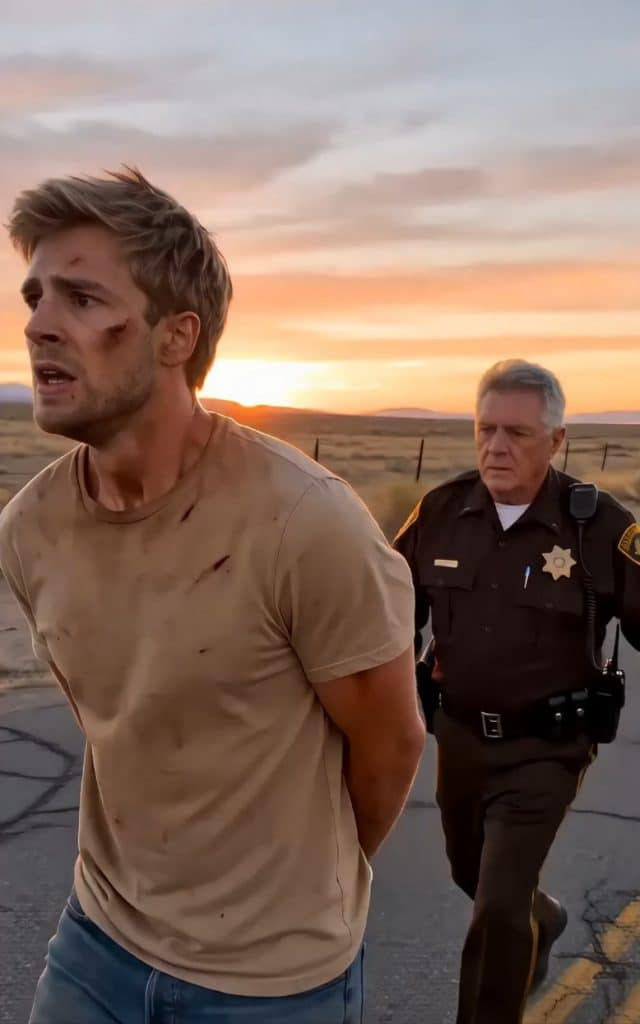
A cracked two-lane strip of asphalt cut through the flat desert, its faded yellow line disappearing into gold and pink light. Dry shrubs trembled in the wind. A low fence leaned along the shoulder. There were no houses, no cars, no witnesses.
Only two men.
One wore a police uniform.
The other had his hands cuffed behind his back.
Luke Mercer walked ahead with his shoulders tight, dirt on his tan shirt, dust on his face, and fear sitting heavy in his chest. The cuffs clicked softly with every step. Behind him, Officer Daniel Hayes followed in silence, boots scraping the asphalt, radio crackling faintly on his shoulder.
The patrol car was almost a mile behind them, dead on the shoulder after hitting debris in the road. No cell signal. Weak radio. A transport gone wrong in the kind of empty place where help felt less like a promise and more like a rumor.
Luke kept glancing at the horizon.
No one.
Not one car.
Not one farmhouse light.
Nothing but open road and morning sky.
He should have been thinking about jail. About the warrant. About the judge who would look at his file and see missed hearings, unpaid fines, and one desperate man who ran when the police came for him.
But all Luke could think was this:
If I get a chance, I’m gone.
Then the footsteps behind him stopped.
Luke heard a strained breath.
He turned just enough to look over his shoulder.
Officer Hayes had one hand pressed against his chest.
At first, Luke thought it was a trick. Some test. Some way to make him turn around so the older man could shove him forward and tell him to stop dragging his feet.
But Hayes’s face had gone pale.
His knees buckled.
He hit the asphalt hard.
The sound cut through the dawn like a snapped branch.
Luke froze.
The officer lay on the road, one hand near his chest, his radio crackling uselessly against his shoulder. His eyes were partly open, but unfocused. His breathing came shallow and uneven.
For three seconds, Luke could not move.
Then instinct took over.
He ran.
The cuffs rattled behind his back as he stumbled down the center line, awkward and off-balance. His boots slapped the asphalt. His lungs burned. The empty road opened in front of him like a door.
Freedom.
For the first time in months, it was not a dream.
It was ten yards away.
Twenty.
Thirty.
He looked back.
Officer Hayes had not moved.
Luke kept running.
Then his steps slowed.
The wind dragged across his face. The cuffs bit into his wrists. His breath came in hard bursts, but something heavier than fear rose inside him.
A memory.
His mother’s voice.
You can hate what a man stands for and still not leave him dying in the dirt.
Luke stopped.
He bent forward, gasping.
Ahead was open road.
Behind him was the man taking him to jail.
“I can finally leave,” he whispered.
His eyes locked on the motionless officer in the distance.
“But how can I let him die?”
Luke closed his eyes once.
Then he turned around.
And ran back toward the man who had arrested him.
Act II
Luke Mercer had not always been the kind of man people expected to run.
There had been a time when he was known for showing up early. For fixing engines other mechanics gave up on. For buying coffee for the old men who sat outside Jensen’s Auto because they had nowhere else to go.
He was twenty-nine, but life had weathered him early.
His father died when Luke was sixteen. His mother got sick not long after. By twenty, Luke was paying rent, medical bills, and whatever it cost to keep his younger brother, Tommy, in school and out of trouble.
Tommy did not make that easy.
He was charming in the dangerous way. Always smiling. Always borrowing. Always promising he had a plan.
Luke loved him anyway.
That was the curse of being the older brother. You remembered the kid someone used to be, even when everyone else only saw the mess he had become.
The trouble started with a stolen truck.
Tommy swore he had only borrowed it. Luke knew better. By the time the owner called the police, Tommy was crying in the garage, saying he could not go back to juvenile court, saying one more charge would ruin him.
So Luke lied.
He said he had taken it.
He thought he could handle one charge better than Tommy could handle another. He thought being older meant being stronger. He thought sacrifice was simple if you loved someone enough.
It was not simple.
The court gave him probation. The garage fired him. His mother cried in the kitchen and told him he had mistaken love for rescue.
Then she died before Luke could fix any of it.
After that, everything slid.
Luke missed one probation meeting because he was burying his mother. He missed another because Tommy disappeared for three days and Luke was out looking for him. The fines stacked up. The letters came. The warnings grew sharper.
Then Tommy stole again.
This time, he left town.
And Luke, who had already burned his own life trying to save him, was the one the sheriff’s department found first.
Officer Daniel Hayes arrested him outside an abandoned service station just before dawn. Luke had been sleeping in the back room, waiting for a ride that never came. When Hayes found him, Luke ran.
Not far.
Not well.
Just enough to make himself look guilty all over again.
By the time Hayes cuffed him, Luke was shaking with rage and exhaustion.
“You don’t know anything about me,” Luke snapped.
Hayes, gray-haired and broad-shouldered, looked at him with tired eyes.
“I know you ran.”
“That’s all anyone ever knows.”
Hayes said nothing for a long moment.
Then he guided Luke toward the patrol car and placed a hand on the roof so Luke would not hit his head getting in.
That small courtesy made Luke angrier than cruelty would have.
He did not want the man to be decent.
Decent made things complicated.
The transport was supposed to be quick. Valley Road to the county station. Paperwork by noon. A cell by evening. Another hearing where no one asked the right questions.
Then the patrol car hit something sharp in the road.
The tire blew. The car swerved onto the shoulder. Hayes kept control, but the wheel rim bent badly, and the radio inside the vehicle sputtered in and out. The older officer checked the horizon, checked Luke, checked his own breathing.
“We walk to the ridge,” Hayes said. “Signal’s better there.”
Luke laughed bitterly.
“With my hands behind my back?”
“You planning to behave?”
Luke looked at the empty road.
Hayes saw the answer on his face.
So they walked.
For half a mile, neither man spoke.
The dawn brightened. The road stretched on. Luke kept thinking of Tommy, of his mother’s funeral, of the stupid lie that had turned into a criminal record he could not outrun.
Then Hayes collapsed.
And suddenly the whole world narrowed to one impossible choice.
Run and live free for a little while.
Or turn back and save the man who would put him in a cell.
The road did not care which one he chose.
That was what made the decision his.
Act III
Luke dropped to his knees beside Officer Hayes so hard pain shot up through his legs.
“Hey,” he shouted. “Officer. Hey, can you hear me?”
Hayes did not answer.
His breathing was faint. His face was gray beneath the desert light. The radio on his shoulder hissed with static, just inches from Luke’s cuffed hands.
Luke twisted awkwardly, trying to reach it.
The cuffs made every movement clumsy. He leaned sideways, shoulder nearly against the asphalt, fingers stretching behind him until they caught the edge of the radio cord.
“Come on,” he muttered. “Come on.”
The radio slipped.
Luke swore under his breath, then tried again.
This time, he managed to drag the microphone close enough to press the button with his knuckle.
Static burst through the speaker.
Luke bent his face toward it.
“Officer down!” he shouted. “Valley Road! Medical emergency! Get here fast!”
The radio crackled.
No answer.
Luke’s heart slammed.
He pressed again.
“This is Luke Mercer,” he yelled. “I’m with Officer Hayes. He collapsed. He’s breathing, but barely. We’re on Valley Road, east of mile marker twelve. Send help!”
Static.
Then a voice broke through.
“Unit calling, repeat your location.”
Luke almost sobbed from relief.
“Valley Road. East of mile marker twelve. Patrol car down the road. Officer Hayes is on the asphalt. He needs an ambulance now.”
A pause.
“Identify yourself again.”
Luke stared at the empty highway.
He understood the pause.
He understood what his name meant on their end.
Handcuffed prisoner.
Transport subject.
Flight risk.
“Luke Mercer,” he said. “I’m the one he arrested.”
Silence.
Then the dispatcher’s voice returned, sharper now.
“Luke, are you still on scene?”
Luke looked down at Hayes.
The officer’s fingers moved slightly, then went still again.
“Yes,” Luke said. “I’m still here.”
“Are you armed?”
“No. My hands are cuffed behind me.”
“Stay where you are. Help is on the way.”
Luke almost laughed.
Where was he supposed to go now?
He shifted closer to Hayes, using his shoulder to block the wind from the older man’s face. He could not do much. He could not unlock the cuffs. He could not lift him. He could not become a doctor by wanting it hard enough.
So he stayed.
That was all.
He stayed while the sun climbed higher.
He stayed while his knees ached.
He stayed while the radio voice kept asking questions.
“Is his breathing steady?”
“I don’t know,” Luke said, panic rising again. “It’s there. It’s weak, but it’s there.”
“Keep talking to him.”
Luke looked at Hayes.
For a second, he could not think of anything to say to the man who had arrested him.
Then he swallowed.
“Officer Hayes,” he said, voice shaking. “You better not die out here, all right? I came back. Don’t make that a waste.”
Hayes did not respond.
Luke leaned closer.
“My mom would’ve liked you,” he said, surprising himself. “She liked stubborn old men who thought rules could fix people.”
The radio hissed.
The wind moved over the road.
Luke’s eyes burned, but he blinked hard.
“She would’ve told me to help you,” he whispered. “So I’m helping.”
In the distance, faint at first, sirens began to rise.
Luke lifted his head.
Red and blue lights shimmered on the horizon.
For one brief second, fear returned.
He had done the right thing.
And now the law was coming back for him.
Act IV
The first deputy arrived with his hand near his weapon.
Luke did not blame him.
From a distance, the scene looked dangerous. A collapsed officer. A handcuffed prisoner kneeling beside him. No one else on the road.
“Don’t move!” the deputy shouted.
Luke raised his shoulders as much as he could with his hands cuffed behind him.
“I’m not moving!”
Another cruiser pulled up. Then an ambulance. Boots hit the asphalt. Radios crackled. Paramedics rushed past Luke and dropped beside Hayes.
Luke backed away on his knees.
A deputy grabbed him by the arm and hauled him upright.
“He’s the prisoner,” someone said.
“He called it in,” the dispatcher’s voice snapped through a radio. “He stayed on scene.”
That changed the air.
Not enough to make anyone uncuff him.
Enough to make them look at him differently.
Luke stood beside the cruiser, chest heaving, dust on his knees, cuffs still cutting into his wrists. He watched the paramedics work around Hayes. He tried to read their faces. He could not.
A younger deputy stepped in front of him.
“You ran?”
Luke looked down the road.
“Yeah.”
“Then came back?”
Luke nodded.
The deputy frowned as if the two facts did not fit in the same report.
“Why?”
Luke looked past him at Hayes.
“Because he was dying.”
The deputy had no answer for that.
They put Luke in the back of a cruiser, but they did not slam the door.
Through the window, he watched the ambulance doors close around Officer Hayes. The siren started, then faded west toward town.
Only then did Luke let his head fall back against the seat.
He should have felt proud.
He did not.
He felt empty.
Doing one decent thing did not erase the mistakes. It did not bring back his mother. It did not make Tommy answer his phone. It did not turn the stolen truck into a misunderstanding or the missed hearings into paperwork dust.
But it did something.
It forced one small truth into the record.
When Luke Mercer had the empty road in front of him, he came back.
By afternoon, the story had spread through the county station.
Not kindly at first.
Stories like that never begin kindly.
The prisoner ran.
The officer dropped.
The prisoner came back.
No, really.
He used the radio.
Saved his life, maybe.
Luke heard pieces through the holding cell bars. Deputies lowering their voices when they walked past. A clerk looking at him too long. Someone saying Hayes was in surgery, then someone else saying he was stable.
Stable.
Luke held that word like water.
Near sunset, Sheriff Nolan came to the cell.
He was a heavyset man with a white mustache and eyes that made people stand straighter.
“Mercer.”
Luke rose.
“How is he?”
The sheriff studied him.
“Alive.”
Luke closed his eyes.
His knees nearly gave.
The sheriff unlocked the outer door but did not open it all the way.
“He regained consciousness for a minute.”
Luke looked up.
“Did he say anything?”
“Asked if you ran.”
Luke gave a bitter half-smile. “That sounds about right.”
“I told him you did.”
The smile vanished.
“Then I told him you came back.”
The sheriff held Luke’s gaze.
“He said, ‘Good. Then write both down.’”
Luke looked away fast.
He did not want the sheriff to see what that did to him.
But the older man saw anyway.
“Hayes also told me something else,” the sheriff said. “He said your original theft case never sat right with him.”
Luke froze.
The sheriff continued.
“He was the arresting officer on your brother’s case too. He always thought you took the weight for someone else.”
Luke’s throat tightened.
“I signed the statement.”
“People sign lies for family every day.”
Luke looked at the floor.
The sheriff’s voice softened, just barely.
“Your brother was picked up this morning two counties over.”
Luke’s head snapped up.
“With the truck owner’s missing tools in his possession,” the sheriff said. “And before you ask, he’s alive. He’s talking.”
Luke gripped the bars.
“What did he say?”
The sheriff looked toward the hallway, then back at Luke.
“He said you didn’t steal the truck.”
For a moment, Luke did not understand the words.
He had carried the lie for so long that truth sounded foreign.
The sheriff stepped closer.
“That doesn’t wipe away everything. You ran from Officer Hayes. You missed hearings. You made a mess of your own life trying to protect someone who kept making messes.”
Luke nodded, tears burning his eyes.
“I know.”
“But tonight,” the sheriff said, “there is a man alive because you turned around.”
Luke could not speak.
The sheriff opened the cell door.
“Tomorrow, the judge will hear all of it.”
Luke looked at him carefully.
“All of it?”
“All of it.”
For the first time in years, Luke felt something more frightening than despair.
Hope.
Act V
Officer Hayes came to court in a wheelchair three days later.
The room went silent when he entered.
Luke stood beside a public defender who had barely slept, wearing borrowed clothes that did not fit right and the same haunted expression he had carried since Valley Road. His wrists were no longer cuffed behind his back, but he still held his hands carefully, as if the metal memory remained.
The prosecutor spoke first.
She described the warrant. The missed hearings. The attempt to flee. The risks. The pattern.
She was not wrong.
That was what made it hard.
Then Sheriff Nolan submitted the radio transcript.
The courtroom heard Luke’s voice through the speakers.
Officer down! Valley Road! Medical emergency! Get here fast!
His voice sounded raw. Panicked. Honest.
Then came the dispatcher.
Luke, are you still on scene?
And Luke’s answer.
Yes. I’m still here.
No one spoke after that.
The judge looked down at the transcript for a long time.
Then Officer Hayes asked to speak.
The bailiff brought him forward.
Hayes looked older than he had on the road. Tired. Pale. But his voice held steady.
“Your Honor,” he said, “Luke Mercer had a clear chance to escape. No vehicles. No witnesses. Open country. I was unconscious or close to it. He could have left me there and bought himself hours, maybe more.”
Luke lowered his eyes.
Hayes continued.
“He ran.”
The prosecutor nodded slightly, as if that proved her point.
Then Hayes said the rest.
“And then he came back.”
The room changed.
“People like clean stories,” Hayes said. “Good men. Bad men. Victims. Criminals. Heroes. Cowards. But I have worn a badge long enough to know most people are a fight between the worst thing they’ve done and the best thing they still might do.”
He turned his head toward Luke.
“This man made bad choices. But when my life depended on his character, his character won.”
Luke pressed his lips together.
His public defender put a hand lightly on the table, close but not touching him.
Hayes looked back at the judge.
“I am not asking the court to ignore the law. I am asking the court to see the whole man.”
Then Tommy Mercer was brought in.
He looked thinner than Luke remembered. Younger too, somehow, though trouble had aged them both in different ways. Tommy would not meet Luke’s eyes at first.
When he finally did, his face crumpled.
“I’m sorry,” Tommy said.
Luke shook his head once, warning him not to fall apart there.
But Tommy kept going.
“He didn’t steal that truck,” he told the court. “I did. He lied because I begged him to. Everything after that, all of it, started with me.”
The confession did not fix the past.
Nothing could.
Luke’s record did not vanish like smoke. The missed hearings still mattered. Running still mattered. The court still had procedures, filings, consequences.
But truth had entered the room.
And truth, once spoken where it belonged, is difficult to bury again.
The judge ordered Luke released under supervision while the old conviction was reviewed. He would have to report regularly. He would have to appear at every hearing. He would have to rebuild trust one hard appointment at a time.
Luke nodded to every condition.
This time, he did not look for the door.
Outside the courthouse, the afternoon sun was too bright.
Luke stood on the steps for a moment, breathing like a man who had forgotten air could feel clean. Tommy waited several feet away, ashamed and uncertain.
Officer Hayes came out last, moving slowly.
Luke turned to him.
“I didn’t do it for court,” Luke said.
Hayes nodded.
“I know.”
“I almost left.”
“I know that too.”
Luke gave a humorless laugh. “You know everything, huh?”
“No,” Hayes said. “Just enough.”
For a moment, the two men stood in silence.
Then Hayes held out his hand.
Luke stared at it.
Three days earlier, that hand had belonged to the man escorting him to jail. Three days earlier, Luke had wished for nothing more than to escape him.
Now Luke took it.
Hayes’s grip was weak but firm.
“My mother would’ve told me to help you,” Luke said quietly.
Hayes looked at him.
“Sounds like she raised you better than you think.”
Luke had to look away.
Across the courthouse lawn, Tommy wiped his face and waited. Luke knew there would be anger later. Hard talks. Maybe forgiveness. Maybe not. Loving someone did not mean carrying their crimes forever.
He was finally beginning to understand that.
Hayes followed his gaze.
“You going to be all right?”
Luke exhaled.
“I don’t know.”
It was the first honest answer he had given in years.
Hayes nodded as if honesty was a decent place to start.
“Then don’t run from the next right thing.”
Luke looked back at him.
The words settled deep.
That night, when Luke returned to the halfway house assigned by the court, he could still hear the road.
The wind. The cuffs. The sirens in the distance. The terrible silence after the officer fell.
He remembered the open horizon in front of him.
He remembered turning back.
People would tell the story later in simpler ways.
A handcuffed man saved a cop.
A prisoner chose mercy.
A criminal got a second chance.
But Luke knew the truth was heavier than that.
He had not become good in one moment. He had not erased every wrong turn with one radio call. He had simply reached the edge of who he thought he was and found one decent piece still alive inside him.
That piece had turned him around.
On Valley Road, under a pink and gold sky, freedom had been waiting in one direction.
A dying man had been lying in the other.
Luke chose the man.
And somehow, by giving up his chance to run, he found the first road that might actually lead him home.