Act I
The old man did not look up when the laughter started.
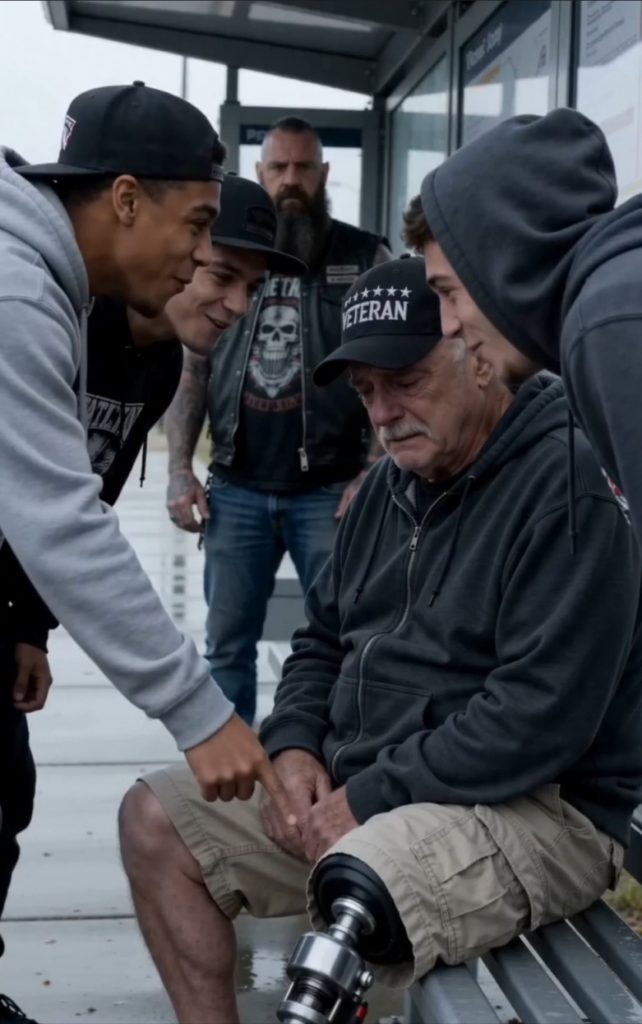
He sat beneath the glass bus shelter on a damp grey afternoon, both hands folded over the handle of his cane, his black cap pulled low enough to hide his eyes.
White letters across the front read VETERAN.
His left pant leg ended at the knee, where a metallic prosthetic limb continued down to a black athletic shoe planted carefully on the wet concrete.
Three teenage boys stood a few feet away, close enough to be cruel and young enough to think cruelty was entertainment.
One of them leaned forward, pointed at the prosthetic, and laughed.
“He’s a robot!”
The others burst out laughing.
The veteran’s jaw tightened.
He did not answer.
He did not tell them his name was Walter Mercer. He did not tell them he had once stood taller than any of them, or that he had learned to walk three different times in one lifetime: once as a baby, once after war, and once after grief.
He just stared down at the damp pavement.
Rainwater dripped from the edge of the shelter roof in slow, uneven taps.
A bus route sign behind him listed places he could no longer drive to himself.
VA Clinic.
County Courthouse.
Community Center.
The boys kept going.
“Better stay home!” one shouted.
Another bent at the waist, laughing so hard his backward cap nearly slipped off.
Walter blinked slowly.
Then he raised his right hand and wiped a tear from the corner of his eye before it reached his mustache.
That only made them laugh harder.
Behind Walter, near the edge of the shelter, a broad man in a black leather vest stood perfectly still.
He had a thick dark beard, tattooed arms, and the kind of presence that usually made people lower their voices. But the boys had not noticed him yet. They were too busy performing for each other.
The biker watched the veteran’s hand tremble against his cane.
He watched the boys point.
He watched one of them, the tallest in a grey hoodie, glance back as if expecting approval from the world.
The biker’s face hardened.
Because he knew that boy.
The boy was his son.
And the old man they were laughing at was the reason his son had ever been born.
Act II
Walter Mercer had not meant to cry at the bus stop.
That embarrassed him more than the mockery.
He had survived louder men than teenage boys. He had survived commanders, doctors, insurance offices, staircases without railings, and strangers who looked away from his prosthetic with pity in their eyes.
But some insults find the youngest part of a person.
Robot.
As if the metal below his knee made him less human.
As if the pain that woke him before sunrise was imaginary because the part hurting was no longer there.
Walter had left his apartment that afternoon carrying a manila envelope under his hoodie. Inside were medical forms, a utility bill he could not fully pay, and a photograph folded so often the edges had gone soft.
The photograph showed four soldiers standing in desert sunlight, all of them too young, all of them smiling like the future was something guaranteed.
Walter was in the middle.
Beside him stood Marcus Reed.
Back then, Marcus had been twenty-two years old, skinny, loud, newly married, and terrified of admitting he missed home. He carried a photo of his newborn son tucked inside his helmet liner. Every night, before lights out, he would take it out and show anyone unlucky enough to sit near him.
“That’s Caleb,” he would say. “Look at him. That’s my boy.”
Walter used to tease him.
“Kid looks like a potato.”
Marcus would grin and say, “Best-looking potato in America.”
The memory almost made Walter smile.
Almost.
Then came the night everything changed.
Walter did not think of it in pictures anymore. He had trained himself not to. He remembered sound, dust, confusion, a radio cutting in and out, men calling for one another in the dark.
He remembered finding Marcus.
He remembered Marcus whispering, “Tell my wife I tried.”
Walter had grabbed him by the vest and said, “You can tell her yourself.”
He remembered the photograph of baby Caleb slipping from Marcus’s pocket.
He remembered picking it up.
He remembered making a promise to a baby who could not hear him.
Your father is coming home.
Walter kept that promise.
The price of it was the leg those boys were laughing at now.
After the hospital, after the ceremonies he refused to attend, after the long white rooms where doctors taught him how to stand again, Walter disappeared into ordinary life. He did not want speeches. He did not want medals in shadow boxes. He wanted quiet.
Marcus tried to find him for years.
Letters came back undelivered. Phone numbers changed. Old records vanished into government offices and privacy rules.
Walter assumed Marcus moved on.
He hoped so.
That was the point of saving someone, wasn’t it?
Not to be thanked forever.
Just to let them live.
What Walter did not know was that Marcus Reed had spent seventeen years telling his son about a man named Sergeant Mercer.
Not as a war story.
As a debt.
Caleb heard the name so often when he was little that he once asked if Sergeant Mercer was a superhero.
Marcus had said no.
“He was a man who got scared and did the right thing anyway.”
But children grow.
They stop listening.
They become teenagers at bus stops, laughing at pain because they have not yet learned that every body is carrying history.
And now Marcus Reed stood behind his son, watching him mock the man who had carried him home.
Act III
“Caleb.”
The biker’s voice was not loud.
It did not need to be.
The boy in the grey hoodie stopped laughing.
His friends turned first, then Caleb did.
His face changed the instant he saw his father.
“Dad?”
Marcus stepped forward slowly.
The leather of his vest creaked in the damp air. His boots stopped beside Walter’s bench, close enough that the old veteran finally looked up.
For a second, Marcus forgot the boys.
He saw the white mustache.
The tired eyes.
The cap.
The cane.
The man he had been searching for across half his adult life.
His voice lowered.
“Sergeant Mercer?”
Walter stared at him.
He did not recognize him at first. The beard was new. The tattoos. The years. The weight of fatherhood around the eyes.
Then Marcus removed a chain from around his neck.
A small metal tag hung beside a worn baby photograph sealed in plastic.
Walter’s breath caught.
The photograph was of Caleb as an infant.
The same photo from the desert.
Walter whispered, “Reed?”
Marcus swallowed hard.
“Yes, sir.”
The bus stop went silent.
Caleb looked from his father to the veteran, confusion moving across his face.
Marcus did not take his eyes off Walter.
“I looked for you,” he said. “For years.”
Walter’s mouth tightened.
“I didn’t need looking after.”
“No,” Marcus said. “But I needed to thank you.”
Walter glanced away.
The old instinct rose in him, the one that rejected gratitude before it could become too heavy.
“You got home. That was enough.”
Marcus turned then.
Not to Walter.
To his son.
Caleb’s hands had fallen to his sides. His friends no longer laughed. Rainwater dripped from the shelter roof between them, each drop suddenly too loud.
Marcus pointed at Walter’s prosthetic leg.
“You called him a robot.”
Caleb’s face flushed.
“I didn’t know—”
“No,” Marcus cut in. “You didn’t care.”
The words landed cleanly.
Marcus took one step closer.
“That leg is the reason you know my voice. It’s the reason I got to hold you. It’s the reason I taught you to ride a bike, showed up at your school plays, fixed your first flat tire, and stood in your doorway every night when you were little to make sure you were breathing.”
Caleb stared at the ground.
Marcus’s voice shook now, but he did not soften it.
“That man lost part of himself bringing me home to you.”
Walter shifted uncomfortably.
“Marcus—”
“No, sir,” Marcus said, still looking at Caleb. “He needs to hear it.”
The other two boys backed away slightly.
Caleb’s eyes filled, though he fought it with everything a teenage boy uses to avoid being seen.
Marcus lowered his voice.
“You laughed at a wound you didn’t understand. Worse than that, you laughed after you saw it hurt him.”
Caleb looked at Walter.
For the first time, he really looked.
Not at the metal.
At the man.
The old veteran sat hunched beneath the bus shelter, rain tapping the glass behind him, one hand resting protectively over the manila envelope in his lap.
Caleb’s mouth opened, but no apology came out.
Not yet.
Shame had reached him faster than language.
Then Walter spoke.
“Don’t crush him for ignorance,” he said quietly.
Marcus turned.
Walter’s eyes were tired, but steady.
“Correct it.”
Act IV
The bus arrived with a hiss of brakes.
No one moved toward it.
The driver opened the door, waited, then looked at the scene through the windshield and decided not to rush anybody.
Walter pushed his cane against the pavement and began to stand.
His prosthetic clicked softly as he shifted his weight.
Caleb stepped forward instinctively, then stopped, unsure if help would insult him.
Walter noticed.
For the first time all afternoon, the old man almost smiled.
“You can offer,” he said. “Don’t grab.”
Caleb swallowed.
“Do you… do you need a hand, sir?”
Walter studied him.
Then he nodded once.
Caleb helped him rise.
It was awkward. Careful. Human.
The boy who had pointed at the prosthetic now steadied the arm attached to the man who wore it.
Walter stood fully and adjusted his cap.
Marcus watched with wet eyes.
Caleb’s voice came out rough.
“I’m sorry.”
Walter did not answer quickly.
The silence made the apology work harder.
Finally, he said, “For what?”
Caleb looked confused.
Walter waited.
Caleb understood.
“For calling you that,” he said. “For laughing. For telling you to stay home. For acting like…” He struggled. “Like you weren’t a person.”
Walter nodded.
“That’s better.”
Caleb wiped his nose with his sleeve.
“I didn’t know who you were.”
Walter looked at him for a long moment.
“Most people won’t be someone your father owes his life to,” he said. “They still deserve respect.”
Caleb bowed his head.
“Yes, sir.”
The other two boys muttered apologies too, but theirs came out thin and frightened. Walter accepted them with a nod, not because they deserved comfort, but because dignity was not something he borrowed from their behavior.
Marcus looked at the bus.
“Where are you headed, Sergeant?”
“Community Center,” Walter said. “Veterans’ support office. If the bus still takes me after all this theater.”
The driver called from the open door, “I’m waiting, aren’t I?”
A small laugh moved through the shelter.
Not cruel this time.
Gentle.
Marcus glanced at Caleb.
“We’ll drive him.”
Walter shook his head.
“No need.”
“I know,” Marcus said. “I’m asking anyway.”
Walter looked at him, and something old passed between them. A desert road. A promise. A photograph kept against the heart.
At last, Walter nodded.
Marcus picked up the manila envelope from the bench and handed it to him.
A corner slipped open.
Caleb saw the old photograph inside.
Four soldiers in sunlight.
His father young and grinning.
Walter standing beside him.
And tucked behind it, a newer document with the words Housing Assistance Review printed at the top.
Marcus saw it too.
His expression darkened.
“Sergeant,” he said carefully, “are you in trouble?”
Walter’s jaw tightened.
“Just paperwork.”
Marcus knew that tone.
Men used it when the problem was bigger than pride allowed them to admit.
Caleb looked at his father, then at Walter, then down at the prosthetic leg he had mocked minutes earlier.
Something changed in him then.
Not completely. People do not become better in one clean flash.
But a door opened.
“Dad,” he said softly, “can we help?”
Marcus looked at Walter.
Walter looked away.
“I didn’t save your father to become your charity project.”
Caleb’s face reddened.
“No, sir. I mean…” He searched for the right words. “Can we show up?”
Walter stared at him.
That was different.
Help can feel like pity.
Showing up can feel like respect.
Finally, Walter gave a tired sigh.
“Your father can drive me to the community center,” he said. “You can carry the envelope. And your friends can stop pretending they have somewhere better to be.”
The two boys nodded quickly.
Marcus smiled for the first time.
Caleb took the envelope like it mattered.
Because now it did.
Act V
The story did not end at the bus stop.
Cruelty rarely ends at the exact place it is exposed. It echoes. It asks to be answered again the next day, and the next, when no one is watching.
Marcus drove Walter to the community center in his old pickup, with Caleb in the back seat holding the manila envelope on his lap like it was fragile. The other boys followed on foot for three blocks, soaked by drizzle and silence.
At the veterans’ support office, Marcus learned what Walter had called paperwork.
A rent increase.
A delayed benefits adjustment.
A broken elevator in his building that made the third floor feel like a mountain.
Walter had been coming to ask for help, but the mockery at the bus stop had nearly sent him home.
“Better stay home,” Caleb had said.
Now he understood what those words could have cost.
Marcus did not take over. He did not embarrass Walter with grand promises. He sat beside him, read forms when asked, made calls when permitted, and kept his voice level.
Caleb watched.
That was the first lesson.
Respect did not always look like cheering or saluting.
Sometimes it looked like sitting in a plastic chair for two hours while an old man explained his life to a tired caseworker.
In the weeks that followed, Caleb started showing up at the community center on Saturdays.
At first, Walter ignored him.
Then he gave him small jobs.
Stack chairs.
Refill coffee.
Hold the door.
Do not hover.
Do not call everyone a hero.
Learn names.
Caleb learned.
He learned that one veteran hated being thanked but loved crossword puzzles. Another had lost two marriages and still mailed birthday cards to every grandchild. A quiet woman who used a walker had once been a helicopter mechanic. A man with no visible injuries flinched at dropped trays but could make everyone laugh during bingo.
Pain, Caleb discovered, did not always announce itself with metal.
Sometimes it sat under a cap and looked at the ground.
Sometimes it wore a leather vest and raised a son badly for a moment, then tried to raise him better.
One month after the bus stop, Caleb asked Walter if he could interview him for a school project.
Walter said no.
Caleb came back the next week and asked if he could interview Marcus instead about being saved.
Walter said, “That’s manipulative.”
Caleb said, “Yes, sir.”
Walter said, “Fine. Ten minutes.”
The interview lasted an hour.
Walter did not talk much about war. He talked about coming home. About learning how to put on a prosthetic before sunrise. About people staring. About the strange loneliness of being praised in public and forgotten in paperwork.
Caleb recorded none of it until Walter gave permission.
Another lesson.
People are not stories you own because they moved you.
By spring, the bus shelter looked different.
Not because the city fixed it. The glass was still scratched, the pavement still cracked, the route sign still faded.
It looked different because Caleb could no longer pass it without seeing the old version of himself standing there, laughing.
He hated that boy.
Walter told him not to.
“Shame is useful only if it teaches you where not to live,” he said. “Don’t build a house in it.”
On Memorial Day weekend, Marcus organized a ride through town with his motorcycle club. Not a loud spectacle. No speeches from politicians. Just veterans, families, neighbors, and a stop at the community center for lunch.
Walter refused to be honored.
So they honored the center instead.
The teenagers served food.
Caleb’s friends came too. They were quieter now. Still awkward. Still boys. But when an elderly man with a cane dropped his napkin, one of them picked it up without making a joke.
Walter noticed.
He said nothing.
That was his way of approving.
Near the end of the day, Marcus found Walter sitting outside beneath a maple tree.
“You ever get tired of correcting people?” Marcus asked.
Walter looked across the lawn at Caleb carrying a tray of sandwiches.
“Yes.”
Marcus smiled. “And?”
Walter adjusted his cap.
“And then one of them learns.”
For a while, neither man spoke.
Then Marcus reached into his vest and pulled out the old baby photograph.
Caleb as an infant.
The picture Walter had picked up in the dark all those years ago.
“I kept it,” Marcus said.
Walter looked at it and nodded.
“So did I.”
He removed the folded photograph from his own pocket, the old one with four soldiers in desert sunlight.
Marcus laughed softly.
“You sentimental old liar.”
Walter’s mustache twitched.
“Don’t spread that around.”
Across the lawn, Caleb looked over at them.
This time, he did not see a robot.
He saw his father’s past.
He saw a man’s sacrifice.
He saw the terrible weight of words thrown carelessly at someone already carrying enough.
Later that afternoon, Caleb walked Walter to Marcus’s truck.
He did not reach for him.
He waited.
Walter offered his arm.
Caleb took it.
At the curb, the old veteran paused and looked back toward the street where the bus shelter stood in the distance.
The grey day, the laughter, the tear wiped away beneath the brim of his cap — none of it had vanished.
But it had changed shape.
It was no longer only a memory of humiliation.
It had become the place where a boy learned to see.
Walter climbed into the truck slowly, metal and flesh moving together with practiced patience.
Caleb closed the door.
Before Marcus started the engine, Walter lowered the window.
“Caleb.”
The boy leaned in.
“Yes, sir?”
Walter’s eyes were stern, but not unkind.
“Next time you see someone sitting alone, don’t wait until you know their story to act decent.”
Caleb nodded.
“I won’t.”
Walter looked at him for another second.
Then he said, “Good.”
The truck pulled away.
Caleb stood on the curb until it turned the corner.
Only then did he notice his friends waiting behind him, quiet and uncomfortable.
The old Caleb would have made a joke.
The new one did not.
He looked at the bus shelter, then at the wet pavement where Walter had sat with his head down while they laughed.
“We were wrong,” he said.
No one argued.
And somewhere down the road, in the passenger seat of an old pickup, Walter Mercer rested one hand on his cane and watched the town pass by.
The world had not become kinder overnight.
But one boy had.
Sometimes, for a man who had given so much, that was enough to keep going.