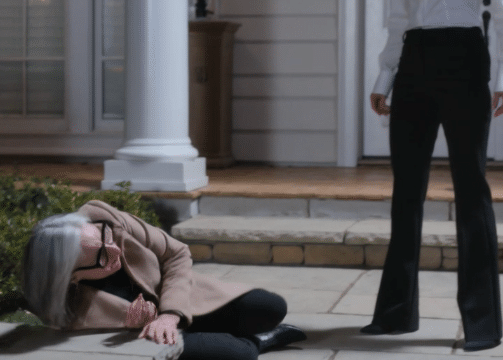
Act I
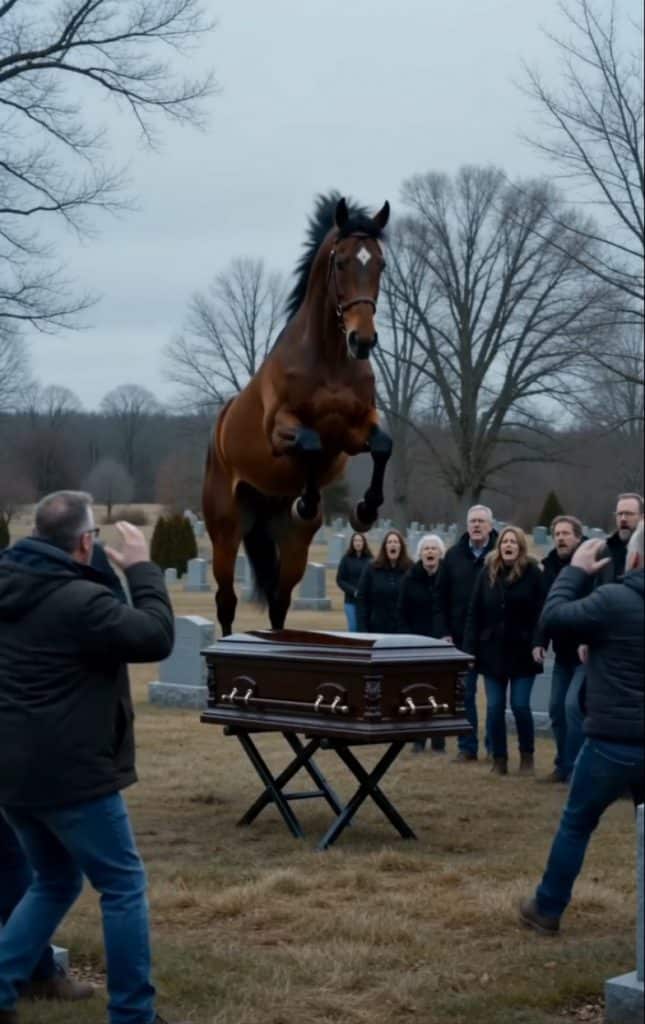
The horse reared before anyone understood what was happening.
One moment, the mourners were standing in a crooked half-circle around the coffin, their coats buttoned against the bitter winter wind. The next, a massive bay horse rose above them like something torn out of a nightmare, its front hooves cutting the gray air over the polished dark wood.
Women screamed.
Men stumbled backward over the dead brown grass.
The coffin sat in the center of the cemetery on a black metal stand, too elegant for the bleak morning, too still for the panic erupting around it. The sky above was thick and colorless. Bare trees clawed at the horizon. Every gravestone seemed to watch.
“Get back!” someone shouted.
But the horse was not looking at the crowd.
It was staring at the coffin.
Its nostrils flared. Its eyes were wide, bright, almost furious. A small white diamond marked its forehead, the only soft thing about it. The bridle on its head looked absurdly thin against the force of its body.
Then its hooves came down.
The sound cracked across the cemetery like a gunshot.
The lid splintered beneath the impact.
People scattered. A woman dropped a black umbrella and ran without looking back. A young man fell to one knee, hands over his head, frozen between grief and terror. Someone sobbed the name of the dead woman as if saying it could stop the animal.
But nothing stopped him.
The horse struck the coffin again.
Wood jumped. The metal stand shuddered. The old minister standing near the grave lost his grip on the prayer book, and the pages scattered across the grass like pale birds.
A silver-haired man in a navy winter coat pushed forward, his face twisted with horror.
“Get the horse away from the coffin!” he screamed.
His name was Arthur Bell, and until that moment, most people in town had believed he was the most composed man in Millhaven. He had buried his wife with dry eyes. He had shaken hands at his son’s memorial. He had stood through bankruptcy hearings, hospital corridors, and courtroom verdicts without ever raising his voice.
But now he was shouting like a man watching his whole life come apart.
Two men lunged toward the horse. The animal bolted sideways, bucking with terrifying power. One of them, a broad-shouldered cousin in a black jacket, was knocked into the grass near a gravestone. He rolled away groaning, shaken but conscious.
The horse circled back.
That was when the crowd understood something worse than fear.
This was not random.
The horse was not fleeing.
It was returning.
It trotted toward the coffin again, head low, ears pinned, eyes fixed on that one polished box as if it had recognized an enemy. The mourners stood frozen now, too stunned to run, too frightened to intervene.
The dead woman inside was supposed to be Eleanor Bell.
Eleanor, the quiet widow who had owned Ashford Stables for forty-two years.
Eleanor, who had trained half the town’s children to ride.
Eleanor, who had loved that horse more than she had loved most people.
And now, at her funeral, the animal she had rescued from slaughter was trying to break open her coffin.
When the horse reared a second time, no one screamed.
They only watched.
The hooves slammed down again and again, rhythmic, furious, unstoppable. The coffin lid cracked down the center. The polished surface caved inward. Splinters scattered across the grass. The stand wobbled but held.
Arthur Bell staggered forward, pale as paper.
“Stop him,” he whispered.
But there was something inside the coffin the horse would not let stay buried.
Act II
Three days earlier, the town had come to Eleanor Bell’s farmhouse with casseroles, flowers, and careful voices.
They spoke of her kindness.
They spoke of her patience.
They spoke of the way she could calm a frightened animal with nothing more than a hand on its neck and a quiet word.
No one spoke loudly of the argument.
But everyone knew about it.
Eleanor had died in her kitchen on a Wednesday night, just after the first hard frost of December. The official explanation was simple: heart failure. She was seventy-one. She had been tired. She had been grieving for years. People accepted it because accepting it was easier than questioning it.
Her only surviving son, Gregory Bell, arrived from Boston before dawn in a black SUV with tinted windows and a wife who wore pearls to breakfast.
Gregory had not visited his mother in nearly two years.
By noon, he was inside her office.
By sunset, the office was locked.
By the next morning, he had announced that Ashford Stables would be sold.
That was when the whispers began.
Eleanor had never been rich in the way Gregory wanted her to be, but she owned sixty acres of land on the edge of town. Developers had been circling for years. They wanted the pasture flattened, the barns demolished, the riding trails carved into luxury lots with names like Willow Ridge and Heritage Oaks.
Eleanor refused every offer.
“This land has already saved too many lives,” she once told her neighbor. “People only see dirt. I see every child who came here broken and left standing taller.”
No one understood what she meant more than Leah Mercer.
Leah was twenty-eight, a stable hand with a guarded face and work-roughened hands. Eleanor had found her years earlier sleeping in the hayloft after running away from a home no one in town liked to discuss. Instead of calling the police, Eleanor gave her soup, a blanket, and a job mucking stalls.
Later, she gave Leah something more dangerous.
A place to belong.
Leah was the one who found Eleanor on the kitchen floor.
She was also the one who noticed the broken teacup, the open back door, and the missing leather journal Eleanor kept in the drawer beside the stove.
But when Leah told Gregory, he looked at her as though she had tracked mud across a church floor.
“My mother was old,” he said. “Do not turn her death into a performance.”
At the funeral home, Gregory refused to let Leah sit with the family.
“She was staff,” he told the director.
Arthur Bell, Eleanor’s younger brother, said nothing.
That silence hurt Leah more than Gregory’s insult. Arthur had eaten at Eleanor’s table every Sunday. He had known Leah since she was sixteen. He had watched Eleanor place a hand on Leah’s shoulder and say, “This girl has more courage than anyone in our bloodline.”
But Arthur was frightened.
Not of grief.
Of Gregory.
Years before, Arthur had borrowed money against Eleanor’s trust without her knowledge. Gregory had found out. Since then, Gregory kept him close with one hand and controlled him with the other. Arthur told himself silence was survival. He told himself Eleanor would forgive him.
On the morning of the funeral, Leah arrived at the cemetery in her old green coat, standing far from the family tent.
She had not been invited.
She came anyway.
And she brought the horse.
His name was Valor.
Eleanor had bought him from an auction nine years earlier, when he was underfed, wild-eyed, and scarred by fear. Everyone said he was ruined. Eleanor walked into the pen, waited until the animal stopped trembling, and whispered something no one else heard.
From that day on, Valor followed her voice.
No one else could manage him when storms came. No one else could touch the white diamond on his forehead without him flinching. No one else could lead him past the creek where he once broke a fence in panic.
Except Leah.
Because Eleanor had taught her.
When Gregory saw the horse at the cemetery, his face hardened.
“Get that animal out of here,” he said.
Leah held the reins with both hands. “He deserves to say goodbye.”
Gregory stepped close enough that only she could hear him.
“You are not family,” he said. “After today, you are not even employed.”
Leah stared at him, cold wind pulling loose strands of hair across her face.
“Eleanor changed her will,” she said quietly.
For one second, Gregory’s expression slipped.
Then he smiled.
“My mother was confused near the end.”
“She wasn’t confused.”
“No,” Gregory said softly. “She was lonely. And lonely old women can be manipulated.”
Arthur heard it. He looked away.
The minister began the service before Leah could answer. People bowed their heads. Gregory stood in the front row, dry-eyed and perfect in his tailored coat. His wife dabbed at tears that never fell.
Leah stood behind the last row with Valor.
The horse was restless from the start.
At first, people blamed the wind. Then the coffin. Then the smell of cut flowers and damp earth. Valor pawed the grass. He tossed his head. His muscles quivered beneath his sleek brown coat.
Leah leaned close.
“Easy,” she whispered. “Easy, boy.”
But Valor was not listening.
His ears were locked on the coffin.
Halfway through the prayer, he pulled against the reins so hard Leah nearly fell. His breath burst in white clouds. His body trembled, not with fear, but with recognition.
Then the coffin shifted slightly on its stand.
A faint smell rose from the cracked seam.
Valor screamed.
And Eleanor’s funeral became a battlefield.
Act III
By the time the coffin lid broke open, three men had managed to drag Valor back by the bridle.
Leah reached him first.
“Stop pulling his mouth!” she shouted.
Her voice cut through the chaos with such force that even Gregory turned.
Valor was shaking. Not bucking now. Not fighting. Shaking.
Leah pressed her forehead briefly against the white diamond mark between his eyes and felt his whole body tremble beneath her hands.
“It’s not her,” she said.
No one heard her over the sobs and shouting.
Then she said it louder.
“It’s not her.”
The cemetery fell into a strange, broken quiet.
Gregory moved first. “Get her away from there.”
But Leah was already walking toward the coffin.
The lid was shattered inward. The satin lining had torn. The mourners stayed back, horrified, unwilling to look too closely. Death was supposed to be hidden behind polished wood and ritual words. This was not grief anymore. This was exposure.
Leah looked inside.
Her face changed.
Not into fear.
Into certainty.
Arthur came beside her and looked down. His knees almost gave out.
The coffin did not hold Eleanor Bell.
Inside lay a weighted burial mannequin wrapped in Eleanor’s funeral dress, arranged beneath layers of lining and flowers to deceive anyone who did not look closely. At the broken center, beneath the crushed satin, was a dark leather satchel.
Leah knew it instantly.
Eleanor’s journal bag.
Gregory’s wife made a small sound, almost a gasp.
Gregory did not move.
That was how Leah knew.
A guilty man often shouts too soon.
Gregory only stared at the satchel as if it were a snake.
Arthur reached into the coffin with trembling hands and pulled it free. Mud stained the leather. The brass clasp was bent. A folded envelope had been tucked beneath the strap.
On the front, in Eleanor’s handwriting, were three words.
For Leah Mercer.
Leah did not take it.
She looked at Arthur. “Where is she?”
The question passed through the cemetery like a cold draft.
The minister crossed himself. Someone whispered, “Dear God.” A woman in the back began crying again, but differently now, not from grief. From dread.
Gregory stepped forward.
“This is outrageous,” he said. “My mother’s remains were handled by a licensed funeral home. Whatever this is, she put it there herself during one of her episodes.”
Leah turned on him.
“She didn’t have episodes.”
“She forgot things.”
“She forgot where she put her glasses. She did not fake her own funeral.”
Gregory’s jaw tightened.
Arthur opened the envelope.
Inside was a single page, folded twice, and a small silver key taped to the bottom.
His hands shook so badly that Leah had to steady the paper.
Arthur read the first line aloud.
“If this letter is found at my funeral, it means Gregory has done exactly what I feared he would do.”
No one breathed.
Arthur looked as if the words had aged him ten years in a second.
He kept reading.
“I am not afraid of dying. I am afraid of being erased. For months, my son has pressured me to sign over Ashford Stables. When I refused, he told people I was confused. When I changed my will, he told me no court would believe an old woman over her own son.”
Gregory laughed once, sharply. “That is not my mother’s signature.”
Leah’s eyes stayed on the page.
Arthur continued.
“I have left copies of my medical records, my new will, and the recording of our last conversation in the north tack room, behind Valor’s old stall. Leah knows where the loose board is. Valor knows the scent of the bag because I trained him to find it.”
The crowd looked at the horse.
Valor stood several yards away, sides heaving, eyes still fixed on the coffin. He had not destroyed it out of rage.
He had done exactly what Eleanor had taught him to do.
Find the hidden bag.
Expose it.
Bring it into the open.
Arthur’s voice cracked on the final lines.
“If I vanish before I can file the papers, do not believe the first story you are told. And do not let Gregory bury me before someone opens the blue freezer in the foaling barn.”
The cemetery erupted.
Gregory lunged for the letter.
Leah pulled it back.
Arthur stepped between them at last.
“No,” he said.
One small word.
But it changed everything.
Act IV
The police arrived twenty minutes later.
By then, Gregory had stopped pretending to grieve.
He stood near the family tent with his phone pressed to his ear, speaking in a low, furious voice. His wife would not look at him. The mourners had split into clusters, whispering behind gloved hands, glancing from the broken coffin to the horse to Leah.
The man Valor had knocked down sat on a folding chair with a blanket over his shoulders, insisting he was fine.
The funeral director paced near the hearse, pale and sweating.
“This is impossible,” he kept saying. “This is absolutely impossible.”
But impossible things had a way of becoming simple when money was involved.
Within an hour, officers opened the foaling barn at Ashford Stables.
Leah led them there.
The barn smelled of hay, dust, and winter. Eleanor’s old jacket still hung by the door. Her boots were beneath the bench, toes pointed neatly outward, as if she might return from the fields at any moment.
Leah nearly broke when she saw them.
But Valor nudged her shoulder from behind, gentle now, and she kept walking.
At the back of the barn, beneath a tarp and two sacks of feed, stood the blue freezer.
It was unplugged.
Inside were no remains, no horror, no nightmare image the town had silently feared.
Instead, there were documents sealed in waterproof bags. Bank records. Copies of deeds. A revised will. Medical evaluations proving Eleanor was mentally competent. Photographs of bruises on her wrists where someone had grabbed her too hard. A flash drive labeled in black marker.
And at the very bottom was Eleanor’s missing leather journal.
Leah recognized the handwriting before she touched it.
The final entries told the story Gregory had tried to bury.
He had come home six months earlier with a plan already in motion. He had forged preliminary sale documents. He had persuaded Arthur to witness papers Arthur had not fully read. He had told developers the land would be free of “sentimental complications” by winter.
But Eleanor had discovered everything.
Worse for Gregory, she had changed her will.
Ashford Stables would not go to him.
It would become a trust.
Its purpose was simple: to shelter at-risk children, rescue neglected horses, and preserve the land permanently. Leah Mercer would serve as director. Arthur would serve as trustee only if he confessed to his role in the earlier financial fraud and repaid every dollar.
And Gregory would receive one dollar.
Not out of hate.
Out of record.
Eleanor had written that line in her journal.
“I want the court to know I did not forget my son. I remembered him clearly.”
That sentence ended him.
The flash drive did the rest.
On it was a recording from Eleanor’s kitchen, dated two nights before her death. Gregory’s voice was unmistakable. Smooth at first. Then impatient. Then cruel.
He told his mother she had no idea what she was doing.
He told her Leah was using her.
He told her he would make sure no one believed a woman her age.
Then Eleanor’s voice came through, faint but steady.
“I raised you, Gregory. Do not mistake my love for blindness.”
There was a pause.
Then a sound of a chair scraping.
Gregory said, “Sign it.”
Eleanor said, “No.”
The recording ended there.
It did not prove everything.
But it proved enough.
The officers searched the farmhouse next. In Gregory’s briefcase, they found Eleanor’s original death documents, unsigned forms from a private transport company, and a burner phone with messages to the funeral director.
The truth came out in pieces over the next forty-eight hours.
Eleanor had not died in her kitchen the way Gregory claimed.
She had collapsed after their argument, but she was alive when he found her. Instead of calling for help immediately, Gregory called a private doctor he knew from Boston, a man already under investigation for falsifying elder competency reports.
By the time emergency services were contacted, Eleanor was gone.
Gregory had not killed her with his hands.
But he had abandoned her when saving her would have cost him the land.
Then he tried to control the story.
He arranged a fast burial. He pressured the funeral director. He replaced the coffin’s contents before the public service so there would be no final viewing, no questions, no delay. Eleanor’s body had been quietly stored for transport under false paperwork, meant to be cremated out of state before anyone could request an independent review.
But Eleanor had prepared for betrayal.
She knew Gregory would avoid anything that required public attention.
So she used the one witness he would never consider.
Valor.
For weeks before her death, Eleanor had hidden the leather satchel in different places around the stable. Each time, she led the horse to it. Each time, she rewarded him when he pawed, stamped, or struck the surface covering it.
To anyone else, it was strange training from an eccentric old woman.
To Eleanor, it was a final alarm bell.
She had taught her horse to find the truth.
And at her funeral, he had.
Act V
The second funeral was held two weeks later.
There was no grand coffin this time.
No polished display.
No Gregory in the front row.
He was in custody, facing charges that would follow him for the rest of his life. The doctor lost his license before the case even went to trial. The funeral director, who first claimed ignorance, later admitted Gregory had paid him to move quickly and ask no questions.
Arthur Bell stood before the town with no coat despite the cold.
He looked smaller than before.
When he spoke, his voice shook, but he did not hide.
“My sister deserved my courage long before today,” he said. “I gave her silence instead. I cannot undo that. But I can spend whatever years I have left protecting what she loved.”
Leah stood near the grave with Valor’s reins in her hand.
This time, the horse was calm.
He lowered his head as the minister spoke. The wind moved gently through his mane. The white diamond on his forehead seemed bright against the gray day, a small mark of impossible loyalty.
People came who had not come the first time.
Children Eleanor had taught to ride, now grown with children of their own.
Women who remembered her leaving groceries on porches.
Men who remembered her refusing to sell sick horses to cruel owners.
A retired judge who said Eleanor once wrote him a letter every week until he agreed to reconsider a boy’s placement in a foster home.
That boy was now a firefighter.
He cried openly beside the fence.
Leah did not cry until the very end.
The minister closed his book. The mourners placed white winter roses on the grave. One by one, they touched Valor’s neck as they passed, as if thanking him felt almost like thanking Eleanor herself.
Arthur approached Leah last.
For a long moment, neither spoke.
Then he held out a small envelope.
“I found this in her sewing box,” he said. “It was dated the morning she changed the will.”
Leah took it carefully.
Her name was written on the front in Eleanor’s neat hand.
Inside was a photograph.
Leah as a teenager, standing awkwardly beside Valor on the first day she had ever brushed him. She looked thin, wary, ready to run. Eleanor stood behind her, smiling with one hand on the horse and the other hovering near Leah’s shoulder, not touching without permission.
On the back, Eleanor had written:
Some children are not born into your family. Some arrive carrying all the proof you need.
Leah pressed the photo to her chest.
The tears came then, hot and silent.
Arthur looked at the grave.
“She wanted to adopt you,” he said.
Leah froze.
Arthur swallowed hard. “Gregory found the papers years ago. He convinced her it would complicate things. He said you might feel obligated. He said people would talk. She listened because she was afraid of hurting you.”
Leah shook her head, overwhelmed. “She never told me.”
“She told me once,” Arthur said. “She said you were the only daughter her heart ever chose.”
The words broke something open in Leah, but not the way grief had.
This pain had warmth inside it.
All those years she had called Eleanor her employer because she was afraid to call her anything more. All those dinners at the kitchen table. All those birthdays Eleanor pretended were casual. All those mornings when Leah found coffee waiting and a note beside it telling her which horse needed patience that day.
It had been family.
Not by law.
By love.
The court would later uphold Eleanor’s final will.
Ashford Stables became the Bell-Mercer Trust, though Leah fought the name at first. She said Eleanor should have been first. Arthur said Eleanor would haunt them both if Leah tried to make herself small.
So the name stayed.
By spring, the developers’ signs were gone from the roadside. The barns were repaired. The old indoor arena was converted into a therapy riding center. Children came in groups on Saturday mornings, some loud and laughing, others silent and watchful.
Leah recognized the silent ones.
She had been one.
Valor lived in the front pasture, retired from work but not from purpose. He became something like a legend in Millhaven. Parents pointed him out from the road. Children whispered that he had broken open a coffin because a dead woman asked him to.
Leah never corrected them entirely.
The truth was stranger and more beautiful.
Eleanor had known that people lie.
Documents disappear.
Power protects itself.
Families can become prisons when love is twisted into ownership.
But animals remember what the heart teaches them.
One evening in late April, Leah walked to the pasture as the sun dropped behind the bare trees, now tipped with the first green haze of spring. Valor came to the fence, slower than before but still proud, still watchful.
Leah touched the white diamond on his forehead.
“You found her,” she whispered.
The horse breathed warm air against her sleeve.
Behind them, the stable lights glowed gold. Children’s laughter drifted from the arena. Arthur was inside teaching a nervous boy how to hold a curry comb. Eleanor’s boots still sat beneath the bench by the barn door, not as a shrine, but as a promise.
Nothing she loved had been sold.
Nothing she built had been erased.
And the grave in the cemetery no longer felt like the place where Eleanor Bell disappeared.
It felt like the place where she won.