Act I
The little girl stopped in front of the woman because everyone else had walked past.
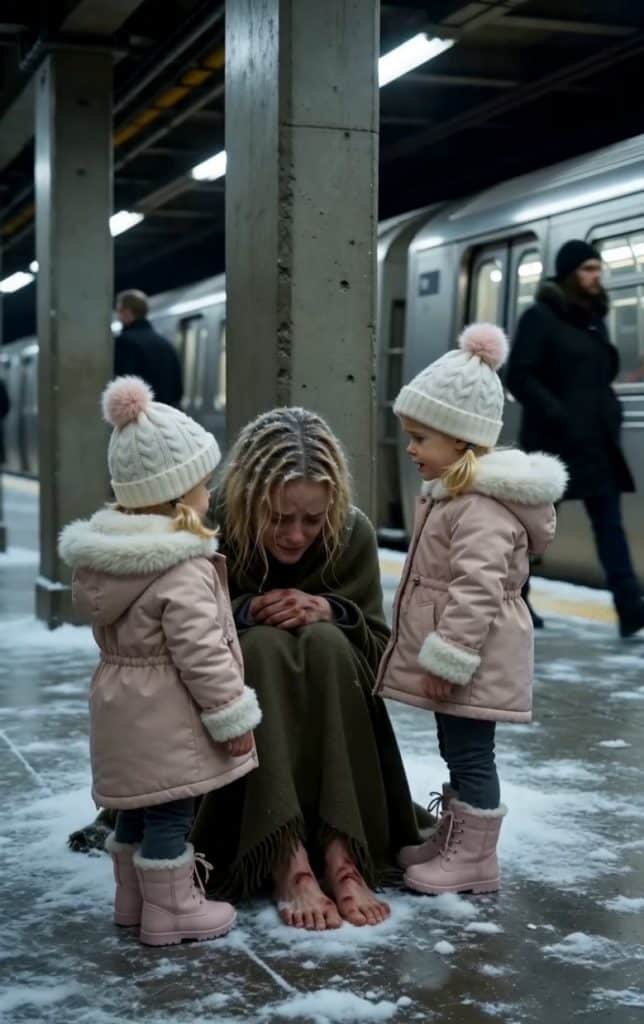
The subway platform was freezing, the kind of cold that slipped through coats and settled into bone. Frost dusted the concrete floor. The train sat beside the platform with its windows glowing yellow, warm faces blurred behind the glass.
Against a concrete pillar, a woman huddled in an oversized moss-green coat.
Her blonde hair hung in tangled strands around her pale face. A darker green shawl covered her lap and legs, pulled carefully down to her ankles. Beneath it, her bare feet were red from the cold, dusted with snow that had blown down from the street stairs above.
People noticed her only long enough to avoid her.
They stepped around her coat.
They looked at their phones.
They held their children closer and kept moving.
But Lily stopped.
Then Emma stopped beside her.
The twins were three years old, identical down to their blonde pigtails and matching pink winter coats. Their white knit hats had pink pom-poms that bounced when they tilted their heads. They looked too soft for that station, too bright for all that gray.
The woman stared at the ground, shivering.
Lily leaned closer, her little brow folding with concern.
“You’re freezing,” she whispered. “Why is nobody helping you?”
The woman’s hands tightened over the shawl.
They were battered, raw with scratches, shaking so hard she could barely lace her fingers together. She tried to hide them, but Emma saw and took a small step forward.
“Did you fall?” Emma asked.
The woman lifted her face.
For one second, something warm moved through her expression. Not happiness. That was too far away. But recognition of kindness, sudden and painful, like sunlight touching a room that had been locked for years.
A tear slid down her cheek.
“I’m okay, sweetheart,” she whispered.
Her voice cracked on the word sweetheart.
Lily did not believe her.
With the solemn determination only a child could have, she reached into her pink coat pocket and pulled out a chocolate chip cookie wrapped in silver foil. It was slightly crushed from the ride, saved from breakfast, treasured until that moment.
She held it out with both hands.
“You can have mine.”
The woman stared at the cookie as if it were something holy.
Then footsteps thundered across the platform.
“Lily! Emma!”
A man rushed through the crowd, his dark navy pea coat open over a white dress shirt, his brown leather briefcase swinging from one hand. His face was sharp with panic.
He dropped the briefcase so hard it snapped open on the floor.
Then he grabbed both girls by the shoulders and pulled them back.
“Step away from her,” he barked. “Now. I told you not to talk to strangers.”
The twins flinched.
The woman did too.
The train began to move behind them, windows sliding past in streaks of gold and black. Wind surged across the platform, lifting loose snow from the ground and scattering it around their feet.
The man opened his mouth to say more.
Then he looked down at the woman’s face.
Everything in him stopped.
His hands fell from his daughters’ shoulders.
The anger drained out of him so quickly it left something worse behind. Shock. Grief. A kind of terror no stranger could create.
His lips parted.
His eyes filled.
“Emily,” he whispered.
The twins looked up at him, confused.
“Daddy,” Emma asked softly, “why are you crying?”
The woman stared back at him through the tears running down her face.
She did not reach for him.
She did not smile.
Her voice came out hoarse and broken, but every word landed like a stone.
“You told them I was dead.”
And in that freezing underground station, Daniel Whitmore finally understood that the ghost he had mourned was still alive.
Act II
Five years earlier, Emily Whitmore had not been a woman people stepped around.
She had been the woman people turned to.
At charity galas, she was the one crouching down to talk to the catering staff’s children while wealthy donors pretended not to see them. At Daniel’s company events, she remembered the names of interns, drivers, assistants, and janitors. She had a way of making strangers feel less like background.
Daniel loved that about her before he feared it.
He came from a family where reputation mattered more than truth. The Whitmores owned half the city skyline and believed kindness was useful only when photographed. His mother, Vivian, had raised him to speak calmly, dress perfectly, and never give anyone enough information to use against him.
Then he met Emily Mercer.
She was a legal aid volunteer with scuffed boots, quick hands, and a laugh that made him forget the rules of every room. She had grown up without much money, and she never learned to be impressed by it. When Daniel offered to send a car after their second date, she told him she had legs and a subway card.
He married her within a year.
Vivian called it impulsive.
Daniel called it breathing.
For a while, they were happy in the reckless way people are happy before family pressure learns where to press. Emily moved into Daniel’s brownstone and filled it with plants, books, and secondhand furniture Vivian hated. She left charity invitations unanswered and spent Saturdays helping at a women’s shelter instead.
Then the twins were born.
Lily and Emma arrived six weeks early on a night of hard rain. Daniel stood beside Emily’s hospital bed, trembling more than she was, while two tiny girls screamed their way into the world.
Emily cried when she held them.
Daniel cried too.
Vivian did not.
She looked at the babies through the nursery glass and said, “At least they have the Whitmore eyes.”
From the beginning, Vivian treated motherhood like a title Emily had accidentally stolen.
She corrected how Emily held the babies. She sent nannies Emily never asked for. She scheduled photographers when Emily was exhausted. She told Daniel his wife was becoming “emotional,” then told Emily that Daniel was worried about her.
Little cracks opened.
Tiny ones.
The kind no one sees until the wall gives way.
Emily noticed Daniel working later. Daniel noticed Emily looking tired. Vivian noticed everything and fed each misunderstanding like a flame under glass.
When Emily said she wanted to return to legal aid part-time, Vivian told Daniel she was abandoning the children.
When Daniel suggested hiring more help, Vivian told Emily he did not trust her.
When Emily cried from exhaustion, Vivian called the family doctor.
The doctor wrote words into a file that would later become weapons.
Anxious.
Overwhelmed.
Unstable under stress.
Emily never saw the notes.
Daniel never questioned them.
He was not cruel then. That was the part Emily would later hate most. Cruel men were easier to mourn. Daniel had simply been weak in the polished, respectable way powerful families often trained their sons to be.
He believed the person who spoke with certainty.
Vivian always did.
The night everything changed, Emily had packed two small bags.
Not to leave forever.
To breathe.
She planned to take the girls to her friend Anna’s apartment for the weekend. Daniel had missed dinner again. Vivian had spent the afternoon telling Emily that the twins needed “structure Emily could not provide.” Emily was tired of being observed in her own home.
She strapped Lily and Emma into their car seats and drove through falling snow.
She never reached Anna’s apartment.
At an intersection near the river, a delivery truck slid on black ice. Emily swerved. The car spun into a guardrail, hard enough to crush the front end and shatter the windows.
Emily remembered the sound of the twins crying.
She remembered snow blowing into the car.
She remembered unbuckling one seat belt with hands that would not stop shaking.
Then there were strangers, sirens, lights, and Vivian’s voice somewhere above her.
Not Daniel’s.
Vivian’s.
When Emily woke in the hospital two days later, her daughters were gone.
So was her wedding ring.
A nurse told her she was lucky to be alive. A doctor told her the children had been discharged to family. A lawyer Emily had never met told her Daniel had filed an emergency custody motion.
Emily laughed because it sounded impossible.
Then the lawyer handed her the papers.
The accusations were cleanly typed, politely worded, and devastating.
Emotional instability.
Reckless endangerment.
Possible impairment.
A mother unfit to be alone with her children.
Emily tore the papers in half.
That was the first time hospital security removed her from the pediatric floor.
The second time, they called the police.
By the end of the week, Vivian had built a story so complete that even Daniel could not see the seams. Emily had crashed the car. Emily had been overwhelmed. Emily had frightened the nurses. Emily needed treatment before she could see the girls.
And Daniel, terrified of losing his daughters after almost losing them once, signed whatever his mother placed in front of him.
Emily was transferred to a private recovery facility outside the city.
She was told Daniel had requested distance.
Daniel was told Emily had agreed to treatment.
Neither was true.
The letters Emily wrote never reached him.
The calls Daniel made were routed through Vivian’s office.
By the time Emily walked out of that facility against medical advice, three months had passed, and the Whitmore house had become a fortress.
Daniel would not see her.
At least, that was what the guard at the gate told her.
The next week, Emily found the obituary.
Not a full obituary.
A quiet legal notice connected to a sealed family petition. The wording was careful, but the meaning was clear enough to destroy her.
Emily Mercer Whitmore was presumed dead after a winter disappearance connected to the river accident.
Daniel had buried an empty coffin.
The twins had been told their mother was in heaven.
And Emily, still breathing, had become a woman with no home, no children, no money, and no name anyone powerful was willing to recognize.
Act III
Daniel did not touch Emily on the subway platform.
He wanted to.
Every part of him moved toward her at once. Husband. Father. Widower. Coward. All the versions of himself he had buried under expensive suits and quiet grief.
But Emily’s eyes stopped him.
They were not the eyes from the wedding photograph in his bedroom drawer. They were not the eyes from the hospital bed, tired and laughing as she held two newborn girls against her chest.
These eyes had lived through doors being closed.
“Emily,” he said again, softer this time.
She almost smiled.
Not from tenderness.
From disbelief that he still thought her name belonged in his mouth so easily.
Lily stepped around his coat, still clutching the cookie.
“You know her?” she asked.
Daniel could not answer.
Emily looked at the girls for one trembling second. She saw the curve of Lily’s cheek. The small crease above Emma’s nose when she worried. She saw herself in them, and the seeing hurt so much she had to grip the concrete pillar to stay upright.
“How old are they?” she whispered.
Daniel swallowed. “Three.”
“I know.”
His face crumpled.
Of course she knew.
A mother did not stop counting birthdays because men with signatures said she no longer existed.
Emma leaned closer to her father’s leg. “Daddy?”
Daniel crouched slowly, his eyes never leaving Emily.
“Girls,” he said, voice breaking, “this is…”
Emily shook her head once.
A warning.
Not here.
Not while commuters watched from the edges of the platform, pretending not to stare. Not while the cold made her teeth chatter. Not while she sat barefoot on concrete, reduced to an explanation in front of her own children.
Daniel stood.
He took off his coat and held it out.
Emily did not accept it.
That refusal wounded him more than any accusation.
“Please,” he said.
“You don’t get to look kind now.”
The words were quiet.
The twins did not understand them, but Daniel did.
He bent, picked up his briefcase with shaking hands, and pulled out his phone. Within minutes, he had called his driver, his assistant, and then the one person he had avoided calling for years.
His mother.
Vivian answered on the second ring.
Daniel put the phone on speaker.
“Mother,” he said, his voice strangely calm, “where is Emily?”
There was a pause.
A tiny pause.
Emily heard it.
Daniel heard it too.
Vivian’s voice came through smooth as polished stone. “Daniel, what kind of question is that?”
“Where is my wife?”
“Your wife is dead.”
Emily looked away.
The words still had teeth.
Daniel stared at the phone. “I’m standing in front of her.”
This time, the silence was not tiny.
It was enormous.
Then Vivian said, “Do not move. Do not speak to anyone. I’m sending people.”
Emily gave a bitter laugh.
“There she is.”
Daniel ended the call.
For the first time in his life, he did not wait for his mother to tell him what to do next.
He brought Emily to the nearest hospital, not the private one his family used. A public one. A crowded one. A place Vivian could not quietly control with a donation and a board seat.
Emily allowed it only because Lily began to cry when she saw her feet.
“I don’t want her toes to be cold,” the child sobbed.
That broke what pride could not.
Emily let Daniel carry her.
She weighed almost nothing.
He remembered carrying her over the threshold of their first apartment while she laughed and kicked at him to put her down. Now she was silent in his arms, stiff with the effort of not leaning into him.
At the hospital, nurses wrapped her in heated blankets. A doctor cleaned the scratches on her hands and asked careful questions. Daniel stood in the corner with the twins, watching Emily wince without making a sound.
The doctor asked how long she had been outside.
Emily said, “Long enough.”
The doctor asked if she had family.
Emily’s eyes moved to Daniel.
Then away.
“No,” she said.
Lily heard and looked confused.
“But Daddy knows you.”
Emily closed her eyes.
Daniel sat down like his legs had failed.
That was when the second twist arrived.
Not from Vivian.
Not from a lawyer.
From Lily.
She reached into Daniel’s briefcase, where his dropped papers had spilled loose, and pulled out a folded photograph she had seen many times before. It was creased from being carried too long.
“Daddy keeps this,” she said, holding it toward Emily.
Emily took it.
Her own face stared back.
It was a picture from the summer before the twins were born. She was standing in a field, hair blown wild by wind, laughing at something outside the frame.
On the back, in Daniel’s handwriting, were four words.
I failed you. Stay.
Emily’s hand began to shake.
Daniel looked up.
“I wrote that every year,” he said. “On your birthday. On theirs. I kept thinking if grief was punishment, maybe one day it would be enough.”
Emily stared at him.
“You believed I was dead.”
“I was told they found your coat by the river. Your phone. Your ring.”
“My ring was taken at the hospital.”
“I didn’t know.”
“You didn’t ask me.”
That was the sentence that split him open.
Not because it was loud.
Because it was true.
Act IV
Vivian Whitmore arrived at the hospital in a black cashmere coat and pearls.
She brought two lawyers, a family doctor, and the old authority of a woman who had spent her life confusing money with law.
She stopped in the doorway when she saw Emily sitting upright in the bed.
For one brief moment, Vivian looked afraid.
Then she became herself again.
“Daniel,” she said, “take the children outside.”
“No.”
Vivian blinked.
It was a small word, but it entered the room like a slammed door.
The twins sat on the window bench with a nurse, eating crackers and watching the grown-ups with wide eyes. Emily had insisted they stay only if no one shouted. She had lost years. She would not lose this first hour to another closed door.
Vivian looked at Emily with controlled pity.
“My dear, you need help.”
Emily’s voice was rough from cold. “I needed help five years ago.”
“And you received it.”
“I was hidden.”
“You were treated.”
“You stole my children.”
Daniel stepped forward. “Mother.”
Vivian turned to him, wounded now, elegant in her offense. “I protected your daughters when you could not. I protected you from a woman who nearly killed them.”
Emily flinched.
Daniel saw it.
For years, that sentence had lived inside him like scripture. Emily crashed the car. Emily endangered the girls. Emily ran. Emily died.
But now he had seen her hands.
He had seen her bare feet in the snow.
He had heard his mother’s pause.
“Where are the letters?” he asked.
Vivian’s expression did not change, but her right hand tightened on her purse.
“What letters?”
“The letters Emily says she wrote me.”
“Daniel, listen to yourself. She has been living on the street. She is confused.”
Emily laughed softly. “Still using that word.”
Then the hospital room door opened again.
An older woman stepped inside wearing a nurse’s coat under a winter jacket. Her name badge read Marisol Vega.
Emily sat forward.
“Marisol?”
The nurse looked at Vivian first, then Daniel.
“I saw the news alert from your assistant,” she said. “They said Emily Whitmore had been found.”
Vivian went still.
Marisol had worked at the private recovery facility five years earlier. Back then, she had been new, underpaid, and frightened of losing her job. She had seen Emily writing letters every night. She had watched staff place them in a locked outgoing tray that never went to the mailroom.
“I kept copies,” Marisol said.
Vivian’s lawyer spoke sharply. “Do not say another word.”
But Marisol was already crying.
“I should have said something then.”
From her bag, she removed a folder thick with paper.
Photocopies of letters.
Visitor logs.
Medication records altered after Emily refused certain treatments.
A discharge note Emily had never signed.
And one internal memo with Vivian Whitmore’s name printed at the top.
No direct visitation without family counsel approval.
No outgoing correspondence without review.
Patient believes husband is withholding children. Do not validate.
Daniel took the folder like it might burn him.
His eyes moved over Emily’s handwriting.
Daniel, please. I know you’re angry. Just let me see them for ten minutes.
Daniel, I didn’t run the light. The truck slid. Ask the police for the intersection camera.
Daniel, your mother said you want me gone. Tell me yourself and I’ll stop fighting you, but don’t let them erase me.
Daniel, Lily has a tiny birthmark behind her left knee. Emma hates being rocked too fast. Please don’t let them forget I know them.
He pressed his hand over his mouth.
The room blurred.
Vivian said his name once, warning him not to collapse in front of strangers.
He ignored her.
For the next hour, everything Vivian had built began to fall.
The police report from the accident showed no impairment. The traffic camera had confirmed the truck slid first. Emily’s hospital bracelet records showed her wedding ring had been removed by “family request.” Daniel’s call logs from that week showed every call to Emily routed through Vivian’s office line.
And the legal notice declaring Emily presumed dead had been filed with an affidavit.
Signed by Vivian.
Supported by the same private doctor standing beside her in the hospital room.
The doctor tried to leave.
Daniel blocked the door.
Not with violence.
With something colder.
Power finally pointed in the right direction.
“You are going to sit down,” Daniel said, “and you are going to wait for the police.”
Vivian’s face hardened.
“You would destroy this family for her?”
Daniel looked at Emily.
Then at Lily and Emma.
Then back at his mother.
“No,” he said. “You did that.”
The twins did not understand the legal words that followed.
They did not understand fraud, custodial interference, medical coercion, or sealed petitions.
They understood only that their grandmother was taken into the hallway by officers.
They understood that their father cried without hiding it.
And they understood that the woman in the bed looked at them the way people look at something they thought they would never be allowed to hold again.
Lily climbed down from the window bench.
She walked to Emily and held up the cookie, now broken in half inside its foil.
“You still can have mine,” she said.
Emily covered her mouth with both hands.
Then she nodded.
This time, when Lily placed the cookie in her palm, Emily accepted it.
Act V
The court hearing happened six weeks later.
Emily wore a borrowed navy dress and flat shoes because her feet still hurt in the cold. Her hair had been trimmed, but not styled. She refused to look polished for people who had mistaken polish for truth.
Daniel sat across the aisle with the twins.
Not beside her.
He had asked once, quietly, if she wanted him there.
She had said, “Yes. But not next to me.”
He accepted that.
It was the first right thing he had done without asking how it made him look.
Vivian’s lawyers argued carefully. They spoke of concern. Of confusion. Of a tragic misunderstanding during a family crisis. They painted Vivian as a protective grandmother who had made imperfect decisions under fear.
Then the judge read Emily’s letters.
Not all of them.
Only enough.
The courtroom changed by the third one.
By the fifth, even Vivian stopped looking at the gallery.
Marisol testified.
The former driver testified.
A retired clerk from the courthouse testified that Vivian’s attorney had requested an emergency seal on the petition because “publicity would harm the children.”
Then Daniel stood.
He did not defend himself.
That surprised everyone except Emily.
He told the court he had failed to verify the truth. He told the court grief had made him obedient. He told the court his mother had controlled access, information, and fear, but that none of it excused him from the simplest duty of a husband.
“I should have looked for her,” he said.
His voice broke.
Emily stared at the table.
“I should have looked until I found her.”
The judge restored Emily’s legal identity that day.
Those words sounded strange to the people in the gallery, almost bureaucratic.
To Emily, they felt like oxygen.
Her name returned first.
Then her rights.
Custody would not be solved in one dramatic afternoon, because real healing did not move at the speed of a movie. The judge ordered supervised reunification, emergency housing, trauma counseling, and an investigation into every person who had helped erase her.
Vivian was removed from all contact with the twins pending criminal proceedings.
Daniel did not object.
After the hearing, Emily stood on the courthouse steps with snow falling lightly around her. She had hated snow for five years. It had become the weather of loss, the color of hospital walls, the cold on subway concrete.
Lily and Emma stood at the bottom of the steps, each holding one of Daniel’s hands.
They looked up at Emily shyly.
Not like daughters running to a mother.
Not yet.
Like children approaching a story they had been told was impossible.
Emily crouched.
Her knees trembled, but she stayed steady.
Lily spoke first. “Are you our mommy?”
Daniel closed his eyes.
Emily did not look at him.
She looked only at the girls.
“Yes,” she said softly. “But you don’t have to know what that means today.”
Emma frowned. “Daddy said our mommy was in heaven.”
“I know.”
“Were you?”
Emily’s throat tightened.
Then she smiled through tears.
“No, sweetheart. I was lost.”
Lily stepped closer. “Did we find you?”
Emily looked at the little pink boots planted in the snow.
Then at the child’s open face.
“Yes,” she whispered. “You did.”
Emma reached out first.
Her mitten touched Emily’s sleeve.
It was not an embrace. Not exactly.
It was permission.
Emily took it like a miracle.
Months passed.
The reunions began in a bright room with toys on low shelves and a counselor sitting nearby. At first, the girls called her Emily. She told them that was okay. They showed her drawings. She learned their favorite cereal, their bedtime songs, the way Emma needed three questions answered before she could sleep and Lily pretended to be brave when she was scared.
Daniel drove them to every visit.
He waited outside.
Sometimes Emily saw him through the glass, sitting alone with his hands folded, carrying the weight of what he had not done. She did not comfort him. That was not her job anymore.
But one day, months later, she opened the door after the session.
“Daniel.”
He stood quickly.
She held out a small envelope.
Inside was a copy of the first letter she had written him from the facility.
“I don’t want you to forget,” she said.
He nodded, eyes wet. “I won’t.”
“And I don’t want to live inside it forever.”
He looked at her then, not with hope, but with humility.
That was better.
By the next winter, Emily had an apartment four blocks from the twins’ school. Not a mansion. Not a brownstone. A small second-floor place with yellow curtains, mismatched mugs, and two little pink toothbrushes in the bathroom for overnight visits.
The first night the girls slept there, Lily woke from a bad dream.
Emily found her standing in the hallway, clutching a stuffed rabbit.
“I forgot where I was,” Lily whispered.
Emily knelt in front of her.
“You’re safe.”
“With you?”
Emily’s face softened.
“With me.”
Lily thought about that.
Then she wrapped both arms around Emily’s neck.
The force of it almost knocked Emily backward.
She held her daughter carefully at first, afraid of wanting too much. Then Emma appeared in the doorway, sleepy and jealous, and climbed into the embrace too.
Emily closed her eyes.
For years, she had imagined this moment so many times it had become dangerous to touch. She had pictured grand music, apologies, justice, a perfect return.
But the real thing was smaller.
Warmer.
Two children in pajamas.
One hallway light.
Three heartbeats slowly learning the same rhythm.
The next morning, Daniel arrived to pick them up for school. He stood at the door while the girls raced around looking for mittens.
Emily handed him a lunchbox.
“Emma won’t eat the apple slices if they have skin.”
“I know,” Daniel said, then corrected himself. “I mean, thank you.”
Their eyes met.
There was no easy forgiveness waiting there.
No sudden romance.
No erasing what had happened because the ending looked pretty from a distance.
But there was truth now.
There was the beginning of repair.
Downstairs, snow covered the sidewalk in a clean white sheet. Lily and Emma ran ahead, pink coats bright against the morning. Halfway to the car, Lily turned back.
“Mommy, hurry!”
The word struck Emily so deeply she had to stop.
Daniel heard it too.
He did not speak.
He simply looked at Emily with tears in his eyes, and this time, he did not make the moment about his guilt.
Emily stepped into the snow.
Her hands were healed now, though faint marks remained. She did not hide them. They were proof that she had climbed through the worst of her life and still reached for the door.
Lily grabbed one hand.
Emma grabbed the other.
Together, they walked toward the car under a pale winter sky.
Years earlier, Emily had vanished from the world because powerful people decided a mother could be edited out of her own story.
But on that morning, with her daughters pulling her forward and her name restored in every way that mattered, Emily understood something they had never been able to take.
She had not been dead.
She had been waiting to be found.