Act I: The Veil on the Floor
The ballroom at the Grand Orsini always felt designed for other people.
Not because it wasn’t beautiful. It was painfully beautiful. Gold chandeliers. Cream marble. Walls so polished they reflected candlelight in soft, expensive waves. The kind of room built for families who had never once worried about the cost of flowers, lawyers, or silence.
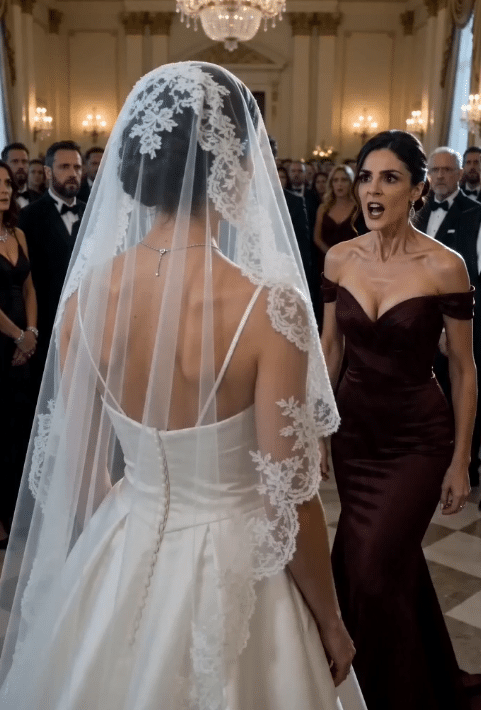
Three hundred guests stood beneath that light watching me smile in a white satin gown that fit so perfectly it almost made me forget why I was really there.
Almost.
The quartet was still finishing the last notes of the processional when Vivienne Vale stepped toward me.
She wore black.
Of course she wore black.
Strapless silk. Diamonds at her throat. Red lipstick sharp enough to draw blood without touching skin. She had spent the last six months pretending to welcome me into the family while looking at me the way women like her look at anything that arrives without pedigree and refuses to bow.
I saw the moment she decided to do it.
Her mouth tightened.
Her shoulders lifted slightly.
Then her hand shot out and caught the edge of my veil.
“A girl like you,” she said, loud enough for half the ballroom to hear, “doesn’t deserve to look beautiful here.”
The lace tore against my hair.
There is a very specific sound silk makes when it is ripped from a body in public. It is too soft for the damage it causes. The veil jerked hard, pins tearing loose, and then it was gone—thrown carelessly to the marble like something cheap and disposable.
A few people gasped.
Someone near the back laughed.
A man’s voice—male, smug, distant—cut through the room. “She should have known her place!”
That was the moment the wedding stopped being a wedding.
Across from me, Adrian’s smile vanished.
My groom.
My almost-husband.
His hand twitched as though he meant to step between us, but shock held him where he stood. Behind him, his father Charles Vale went rigid in his tuxedo, white rose boutonniere motionless against black silk. He looked less angry than irritated, as if a private family embarrassment had chosen a very inconvenient audience.
I did not bend to pick up the veil.
I did not cry.
I did not even touch my hair.
Instead, I slipped my hand into the hidden pocket sewn into the side of my dress and pulled out my white phone.
That changed the room faster than Vivienne’s cruelty had.
Mockery expects collapse.
It does not know what to do with composure.
I lifted the phone to my ear and spoke into the silence.
“Yes,” I said. “Do it now.”
No one moved.
No one breathed.
I lowered the phone and watched the confusion spread from face to face like spilled champagne. Vivienne’s expression cracked first. Charles took one step toward me, not yet panicked but suddenly very alert. Adrian looked at me as if I had become someone else in the span of a single heartbeat.
Charles’s voice came out harder than he intended.
“What did you just do?”
I smiled then.
Not because I was happy.
Because at last, after two years of pretending, waiting, memorizing, listening, and standing still while powerful people measured my worth like fabric, I had reached the one moment my mother used to tell me would matter more than rage.
The moment when they finally understood they had touched the wrong thing.
I held up the phone so Charles could see the screen.
A secure transfer.
Twelve folders.
Seventy-eight files.
Outgoing.
Fast.
His face changed before anyone else understood why.
I took one step toward him, close enough to watch the blood leave his skin.
“You should have asked that,” I said softly, “before you touched my mother’s veil.”
His lips parted.
The room seemed to lean in.
And in a voice I will hear for the rest of my life, Charles Vale whispered the question my mother had waited eighteen years to force out of him.
“Who are you?”
Act II: The Woman They Called a Thief
My mother was never supposed to matter to men like Charles Vale.
That was the first mistake they made.
Margaret Hart came from the sort of family moneyed people refer to as “good, practical stock,” which is a polished way of saying useful but invisible. Her father repaired clocks. Her mother taught piano to children who did not practice enough. She grew up learning that precision was a form of dignity.
By thirty-one, she was Charles Vale’s senior financial controller.
This was before the foundation, before the magazine covers, before the family turned philanthropy into theater. Back then, the Vales were still building the empire that would eventually let them walk into hospitals, museums, and senate fundraisers as if generosity were their native language.
My mother built the numbers underneath that language.
She saw every trust, every transfer, every endowment allocation that moved through Vale Holdings and the charitable arm they used to wash their public image. She was not glamorous. She was not invited to the right dinners. She was not photographed beside crystal centerpieces.
She was smarter than all of them.
That came later, in the files she left for me and in the quiet stories she only told when pain loosened the edges of restraint. But even as a child, I understood one thing: whenever my mother said Charles’s name, she used the tone people reserve for venomous snakes and polished cutlery.
He ruined her carefully.
That is what powerful men do when a woman knows where the numbers are buried.
She discovered the first irregularities in the Vale Foundation’s widow-benefit accounts. Small diversions at first. Harmless enough to dismiss as accounting drift if you did not understand how drift becomes theft. Then the patterns widened. Emergency care funds routed through shell vendors. Estate assistance grants redirected into acquisition vehicles. Vulnerable women signing documents they did not understand. Their property ending up under entities tied back, through layers of paper, to Charles’s private network.
When she confronted him, he smiled.
When she documented it, he moved.
Within three weeks, she was under internal review.
Within two months, anonymous allegations surfaced accusing her of manipulating donor accounts.
Within three, her name was in the local paper beside the words investigation and misappropriation.
No charges were ever filed.
That was the brilliance of it.
No formal case meant no formal exoneration either.
She simply became what they wanted her to be: suspect, unemployable, quietly ruined.
I was fourteen when she told me the truth.
Not all at once.
In pieces.
The way women hand down dangerous knowledge when they are not sure whether giving it to you is love or a burden.
She kept boxes in the back of our hall closet labeled winter coats and old tax records. Inside were copied ledgers, emails, trust amendments, property transfer chains, and handwritten notes about donor accounts that no longer matched the lives they were supposed to protect.
She had not just survived Charles Vale.
She had been building a case against him for years.
“Why not go to the police?” I asked once.
She laughed.
It was not a happy sound.
“Because men like Charles don’t fear accusations,” she said. “They fear timing.”
That line stayed with me longer than anything else she ever said.
After her diagnosis, when the doctors began speaking in those soft, organized voices that make death sound like a scheduling issue, she brought me one last box.
On top of the files was a folded length of lace wrapped in tissue paper.
Her veil.
Not expensive. Not cathedral-length. Just simple French lace with a hand-finished edge and a tiny row of seed pearls she had sewn herself the week before she married my father.
“I want you to wear it once,” she told me.
I thought she meant on my wedding day.
I didn’t understand until much later that she meant something far more dangerous.
Wear it when you make them look at you.
By the time she died, I had already met Adrian Vale.
And that, perhaps, was the second mistake his family made.
Because Charles taught his son how to inherit a name.
He never taught him how to recognize a woman who entered the room with a purpose sharper than love.
By the time Adrian proposed, I had already decided exactly where I wanted the veil to appear.
And exactly what would happen when his family touched it.
Act III: How I Entered the House
I did not meet Adrian by accident.
That is the part people always judge first, and perhaps they should.
He was speaking at a museum fundraiser on estate preservation and “ethical legacy stewardship,” which would have been funny if it had not been so obscene. I attended under my legal middle name, Elena Rowan, wearing a navy dress I bought on sale and the sort of polite expression my mother used to call camouflage.
Adrian looked nothing like Charles when he smiled.
That made him dangerous in a different way.
He had his father’s confidence without the cruelty written openly into it. He asked questions and waited for answers. He remembered details. He sent flowers after our third date because I mentioned once, casually, that my mother liked white lilies before hospitals ruined them for us.
I should have hated him on sight.
Instead, I made the mistake of liking him.
Then trusting him just enough to become conflicted.
For six months, I told myself I was still in control. I was collecting details. Mapping routines. Learning who handled what inside the Vale structure. Vivienne, I discovered, was not simply Charles’s companion. She managed guest lists, social networks, charity boards, and the private social architecture of the family. She weaponized embarrassment the way some people use law degrees.
Charles, meanwhile, kept his real affairs in rooms no guest ever saw.
But Adrian talked.
Not recklessly.
Tenderly.
That was worse.
He told me about the burden of carrying the family name. About his father’s expectations. About the way public generosity became private coercion in wealthy families long before anyone called it abuse. He never once described Charles as kind.
Only effective.
I almost told him who I was twice.
The first time was after we drove back from Nantucket in silence because he had spent the weekend apologizing for Vivienne without quite meaning to. The second was the night he proposed in the winter garden at the Vale estate, his hand shaking slightly as he opened his mother’s diamond ring box and asked me to build a life with him far away from his father’s machinery.
I said yes.
Not because the plan was working.
Because in that moment, I believed there might be a version of the future that did not require detonation.
Then I saw the prenup file.
It came to me by accident, which is another way of saying Charles underestimated the women who filed his papers. Buried in the legal packet were trust protections that activated differently if Adrian married without family approval. More importantly, there was an internal note referencing legacy containment exposure and a list of archival matters requiring suppression before ceremony.
One item was labeled simply: Hart materials.
My mother’s name.
Still active.
Still feared.
That was when affection ended and strategy resumed.
I copied everything.
I contacted the journalist my mother had trusted but never used. I sent a timed bundle to a forensic accountant in Boston. I arranged a deadman release with a litigation team that specialized in elder estate fraud. And I created one final trigger: if I gave a voice command at the wedding, everything moved at once.
Charles thought he was hosting a society marriage.
I was setting a clock.
Which is why, when Vivienne tore the veil from my head in front of donors, judges, trustees, and three separate local news photographers, I did not feel humiliated.
I felt grateful.
Because public cruelty has a wonderful habit of clarifying moral angles for everyone in the room.
By the time Charles asked who I was, the answer was already leaving his control in twelve separate directions.
And the first phones were beginning to vibrate among the guests.
Act IV: What the Ballroom Learned
It happened quickly after that.
Too quickly for containment.
A woman near the second floral arch glanced down at her screen and gasped. One of Charles’s board members did the same. Then another. A low murmur moved through the ballroom, the sound of elite composure fracturing under synchronized information.
Phones lit the room like a second constellation.
On mine, the transfer bars turned green one by one.
Archive A: donor diversions.
Archive B: widow trust acquisitions.
Archive C: internal approvals.
Archive D: Hart correspondence.
Archive E: audio.
That last one made Charles lunge.
Not violently. Desperately.
His hand came up as if to snatch the phone from mine, but I stepped back, and for one brief second the entire ballroom saw what fear looked like in a man who had spent thirty years confusing fear with power.
“Stop this,” he hissed.
Vivienne stared between us, suddenly stripped of all elegance. “Charles,” she said, too loudly, “what is she talking about?”
Adrian moved then at last, stepping between his father and me.
“Elena,” he said, voice tight with disbelief. “What is happening?”
I looked at him, and that was the hardest part.
Not Charles.
Not Vivienne.
Adrian.
The man I might have loved in a cleaner world.
“Your father destroyed my mother,” I said. “And spent eighteen years making sure the women she tried to protect stayed quiet, poor, or legally erased.”
The room went still again.
Charles let out a short, disbelieving laugh, that final reflex of powerful men who assume denial still works after evidence begins speaking for itself.
“This is absurd.”
“No,” I said. “Absurd was accusing Margaret Hart of theft after she found your diversion accounts. Absurd was using widow relief trusts to acquire property through shell entities. Absurd was keeping her name in your suppression notes eighteen years after you ruined her.”
I lifted the phone so Adrian could see the first incoming confirmation.
Received. Chain preserved. Press hold active.
His face changed when he read the sender line.
Hart Archive Litigation Team.
He looked at me then not as his fiancée, not even as a stranger, but as someone standing inside the blast radius of two incompatible truths.
“My God,” he whispered.
Vivienne took a step back in her heels. “Margaret Hart?”
She knew the name.
Of course she knew it.
Every woman who survives high society learns which ghosts are never mentioned at luncheons.
Behind Charles, one of the family attorneys was already moving toward an exit with his phone pressed to his ear. Two trustees from the foundation whispered fiercely beside the champagne wall. At the back of the room, a reporter lowered her program and simply watched, suddenly far more interested in the wedding than she had been five minutes earlier.
Then Charles made the mistake that truly finished him.
He said my mother’s name like an insult.
“That woman was unstable.”
It came out sharp.
Automatic.
Practiced.
And from somewhere inside the crowd, an older female voice answered before I could.
“No,” she said. “She was right.”
Heads turned.
A silver-haired woman in emerald silk stepped forward from table nine.
Judge Helena Mercer. Retired appellate bench. Widow. Former foundation donor.
I recognized her from my mother’s files before Charles did. One of the earliest women whose trust disbursements had been altered under emergency care authorizations.
Charles looked stricken.
Helena lifted her own phone.
“I just received forty-seven pages of internal correspondence,” she said, “including one where your office discusses my confusion level like an asset class.”
The ballroom rippled.
Another woman stood.
Then a man.
Then one of the junior trustees.
Public power is a fragile architecture. It survives on the belief that everybody else still believes.
The moment that fails, collapse becomes social.
Adrian turned slowly toward his father.
“Is any of this false?”
Charles did not answer.
He glanced instead toward the side entrance, calculating distance, witnesses, perhaps escape. He looked older suddenly. Smaller. Not because exposure changes the body, but because it reveals how much posture was doing.
“You should have come to me privately,” he said.
I almost laughed.
“That was your last language,” I told him. “Private. Quiet. Contained. My mother died waiting for men like you to behave decently when nobody was watching.”
A sharp tone sounded from the ballroom doors.
Then another.
Security earpieces. New arrivals. Movement spreading from the corridor like weather.
The hotel manager entered first, pale and stiff. Behind him were two state investigators and a woman from the Attorney General’s financial crimes office I had met only once, six weeks earlier, in a borrowed conference room with no windows.
Charles saw them and stopped breathing.
Vivienne took one involuntary step away from him.
And Adrian, poor Adrian, finally understood that he had never been standing at an altar.
He had been standing at the mouth of a grave his father dug years before either of us met.
Act V: The Name I Finally Gave Him
The investigators crossed the ballroom with the solemn efficiency of people who know spectacle only helps the guilty if you let it.
Nobody tried to stop them.
Nobody dared.
One of them asked Charles Vale to step aside for questioning regarding financial misrepresentation, trust diversion, and evidence suppression tied to an active elder fraud inquiry. The phrasing was clinical. The effect was not. All around us, guests pretended not to stare while staring harder than ever.
Vivienne did what women like Vivienne always do when power leaves the room.
She recalculated.
“Charles,” she said softly, suddenly fragile, suddenly wounded, as if she had not been the one with her hand in my hair two minutes earlier. “Tell them this is a mistake.”
He didn’t look at her.
He was looking at me.
“Who are you?” he asked again.
This time, the question sounded less shocked than haunted.
So I answered him properly.
“My name is Elena Hart,” I said. “Margaret Hart’s daughter. The woman you framed. The woman whose donors you robbed. The woman you kept trying to bury under paperwork because you were terrified she had copied more than you could find.”
His jaw clenched.
“She destroyed herself.”
“No,” I said. “You just made sure the public never saw your fingerprints.”
Adrian closed his eyes briefly.
When he opened them again, something in him had hardened—not against me, not yet, but against the man who raised him. There is a special kind of grief reserved for children who discover they inherited elegance from a monster.
“You knew,” he said to Charles.
It was not a question.
Charles said nothing.
Adrian took off his boutonniere and let it fall onto the marble floor beside the ruined veil.
Then he stepped away from his father.
I wish I could tell you that was the moment my heart became simple. It wasn’t. I had cared for him. Perhaps some part of me always will. But there are truths too expensive to reveal gently, and by then we were standing inside one.
The investigators asked Charles to come with them.
He resisted only with dignity, which is another way of saying he did not fight because there were too many witnesses with too much money and too much self-interest to publicly defend him anymore. Men like Charles never understand that the rich will tolerate theft more easily than embarrassment.
As they led him past me, he looked once at the veil on the floor.
For the first time all evening, his face showed something like comprehension.
Not remorse.
Recognition.
He finally understood what my mother had known from the beginning.
Timing.
That was all.
Not innocence.
Not truth by itself.
Timing.
I bent, picked up the veil, and shook out the lace as carefully as if my mother were watching from one of the mirrored walls. One edge had torn near the pearls. It would need repair.
So had everything else.
Helena Mercer approached me then and touched my wrist lightly.
“Your mother tried to warn us,” she said.
“I know.”
“I’m sorry it took this.”
I looked around the ballroom.
At the guests still holding phones.
At the flowers beginning to wilt under hot lights.
At Adrian standing alone near the altar with the expression of a man measuring the cost of his surname in real time.
At Vivienne, already invisible to herself.
And then I looked down at the veil.
My mother sewed every pearl on this with her own hands, years before Charles Vale ever learned how dangerous she could become. She wore it once in a church basement with no chandeliers, no string quartet, and no family office to impress. Just hope, lace, and a belief that love would make a decent structure out of the world.
She was wrong about some things.
Not all.
I folded the veil over my arm and walked past the altar toward the ballroom doors, the train of my dress whispering over marble.
Behind me, reporters were already gathering names.
Inboxes were already opening.
Board members were already deciding how quickly they had stopped supporting Charles Vale in principle.
And somewhere, in six different offices, my mother’s files were being read by people who could no longer pretend they had never seen them.
Adrian said my name once as I reached the doorway.
“Elena.”
I turned.
He looked destroyed.
Honest, finally, and destroyed.
“Was any of it real?” he asked.
That answer deserved more than cruelty.
“Yes,” I said. “That was the hardest part.”
Then I left.
Outside, the night air was cool against my scalp where the veil pins had torn free. Sirens glowed faintly at the end of the drive, muffled by hedges and distance. The sky above the city was the color of old silver.
I stood there alone for a moment and thought of my mother at the kitchen table, sliding boxes toward me one by one. Keep copies. Don’t warn them. Make them look.
So I did.
Vivienne thought she was humiliating a girl beneath chandeliers.
Charles thought he was attending his son’s wedding.
The guests thought they were there to witness the joining of two powerful families.
None of them understood what the evening really was.
It was a delivery.
A summons.
A reckoning wrapped in satin and lace.
And when they tore my mother’s veil from my head, all they really did was ring the bell that told the truth it was finally time to enter the room.