Act I: The Tear in the Side
The mattress was the last thing I planned to touch.
It lay on the floor in the far corner of the cabin’s upper room, low and misshapen, the fabric yellowed with age and damp in the places where the roof had once leaked. Every time I walked past it, I caught the smell of mildew and old dust and something sour underneath, as if the years had soaked all the way through.
The cabin itself sat deep beyond Black Alder Road, where the trees grew so close together they made daylight feel temporary. My father had bought it before I was born, though “bought” was never the word my mother used. She always said he “took it off someone’s hands,” which could have meant anything with him.
I had not set foot there in eleven years.
Not since the week after his funeral.
Back then, I was too angry to grieve properly. Too numb to ask the right questions. Too young to understand why everyone in our town looked relieved when they said they were sorry for my loss.
My father, Daniel Mercer, had officially died in a boating accident on Lake Wren in early November. His body was never recovered. The sheriff called it tragic. The local paper called him a “private but respected businessman.” My mother called it the end of a long bad chapter and locked herself in the bathroom for nearly an hour after the deputies left.
What nobody called it was believable.
My father did not fish in November.
He hated the lake after dark.
And he never went anywhere without telling at least one lie in advance to cover whatever he was really doing.
For years, I tried to accept the version of events printed in the obituary. Maybe because the alternative felt exhausting. Maybe because my mother made it clear, in the gentle way people do when they are barely holding themselves together, that some doors were better left closed.
Then she died last winter.
Heart failure, sudden and brutally ordinary.
I sold her car, donated her coats, boxed up her dishes, and found the cabin key in the back of a kitchen drawer taped to an index card with four words written in her thin, slanted handwriting:
If you’re ready, go.
That was how I ended up kneeling on a splintered floor three states of grief too late, cleaning out a room that had once belonged more to my father’s secrets than to him.
I had already filled three contractor bags with moldy blankets, foxed magazines, broken fishing gear, and damp cardboard when I noticed the mattress.
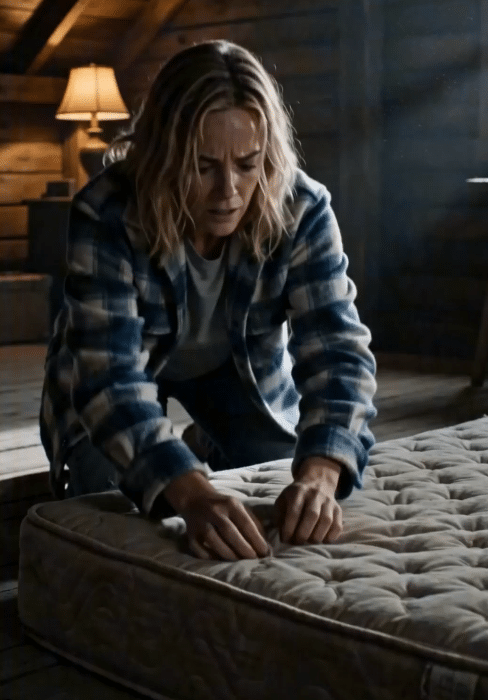
It had a long rip along one side, maybe six inches wide, half-hidden against the wall. Through the tear, I could see the old padding inside, grey and lumpy and compressed into strange shapes.
At first I thought it was just ruined stuffing.
Then I looked closer.
There was something too smooth beneath it.
Too dark.
Too deliberate.
I set down the trash bag and pulled the mattress farther into the light. Dust lifted around it in a dry cloud, making me cough. The bedside lamp on the crate behind me threw a warm cone across the floorboards, enough to show there was definitely something buried inside the torn side.
I grabbed the fabric with both hands and pulled.
The seam resisted once, then gave way with a ragged sound that seemed far too loud for a place that isolated. More dust flew into the air. Old batting spilled out across my knees.
And then I saw them.
Long, heavy cylinders wrapped in dark plastic and tape, packed lengthwise inside the mattress cavity like someone had designed the entire thing around hiding them. There were at least eight. Maybe more.
For a second, I just stared.
My hands had gone cold.
I reached in and dragged one out. It was heavier than it looked, dense and solid, about the length of my forearm. The wrapping had yellowed slightly with age, but the tape was still tight.
“Oh my God,” I whispered.
The words disappeared into the wood around me.
I looked back into the torn opening and realized the package in my hands was not the discovery.
It was a sample.
Because inside that mattress, buried beneath the padding and stitched into the oldest object in the room, there was an entire hidden inventory my father had never meant anyone to find.
And the moment I started peeling back the plastic, I understood why my mother had waited until after she was gone to send me there.
Act II: What Was Wrapped in the Dark
I expected money.
That was my first thought.
Old cash. Bundled bills. Maybe something stolen. Maybe something my father had hidden from taxes, creditors, girlfriends, or whichever version of accountability he happened to be avoiding that year. That would have fit the man I knew.
Instead, when I peeled back the tape and pulled away the outer plastic, I found a roll of oilcloth wrapped tightly around a metal tube.
Inside the tube were documents.
Not one or two.
Dozens.
Some were folded land maps so old the paper had gone soft at the edges. Some were photocopies of county records with handwritten annotations in my father’s blocky capital letters. There were property deeds, mineral rights agreements, handwritten names, dates, and parcel numbers I did not recognize. Tucked into the center was a spiral notebook with a black cover warped by time.
I opened it carefully.
The first page held only three lines.
North tract, false transfers begin in 1998.
Sheriff knew. Keller knew.
If anything happens to me, it wasn’t the lake.
I stopped breathing for a moment.
I read the lines again, slower this time, as if different pacing would somehow make them less clear.
The room had gone very quiet around me. Even the trees outside seemed to have stilled.
My father had written that.
Not typed. Not copied. Written.
I knew his handwriting too well not to. Years earlier, I had forged his signature on a school field trip form because he was out gambling for two nights and my mother didn’t want the embarrassment of explaining it. I had studied the hard, angular shape of every letter until I could fake it in seconds.
This was him.
I set the notebook down and reached into the mattress for another cylinder.
Then another.
Then another.
Every one of them contained more records.
Property maps.
Copies of bank transfers.
Receipts from shell companies.
A list of names with arrows linking some of them together.
And hidden inside the sixth package, wrapped separately in plastic as if it mattered more than the rest, was a stack of cassette tapes labeled in silver marker with dates spanning nearly seven years.
I sat back on my heels and looked around the cabin as if I expected someone to emerge from the walls and explain it all.
My father had not been hiding cash.
He had been archiving evidence.
Not casually. Not half-heartedly. Systematically.
The sort of evidence a paranoid man gathers when he knows no one will believe him without paperwork. Or when he has already tried once and learned what truth costs.
I thought of my mother then.
Of the card in the kitchen drawer.
If you’re ready, go.
She had known.
Maybe not everything, but enough.
Enough to keep the key. Enough to send me there only after she could no longer be dragged into whatever remained of it.
I opened the black notebook again and kept reading.
Most of it was fragmented, written in bursts, as if my father had recorded things quickly before they vanished from him. There were notes on land parcels surrounding Black Alder, Wren County, and two neighboring townships. Several deeds had changed hands multiple times within short periods, sold between limited liability companies whose names sounded interchangeable and false.
There were repeated references to “north tract access” and “unregistered drilling,” though no company names appeared in full. A sheriff’s deputy named Owen Price was mentioned in connection with cash drops and sealed reports. A county commissioner named Harold Keller appeared on nearly every other page.
And once, halfway through the notebook, my father had written a single sentence so hard the pen had nearly torn the paper:
They buried more than records up there.
I closed the notebook immediately.
Not because I didn’t want to know.
Because I did.
Too much.
The mattress sat open beside me like a wound. I could see more packages inside, still untouched. The lamp cast a trembling light across them, and for the first time since arriving at the cabin, I felt watched.
Not by a person.
By a history.
I stood, crossed the room, and locked the cabin door even though I had not heard a car or another human sound in hours.
When I turned back, the notebook lay where I had left it, pages slightly curled, as if it had been waiting all these years for someone to continue.
I told myself I would sort it in the morning.
Catalog the documents.
Take photos.
Drive straight to a lawyer or a newspaper or maybe the state police if I could figure out whom not to trust.
But before I could make myself close the notebook, one folded sheet slid free from the back cover and landed face down on the floor.
I picked it up.
It was a photograph.
A grainy one, taken at night from a distance. Three men stood beside an excavator near a fenced clearing in the woods. One of them was holding a flashlight. Another had one hand lifted to shield his face.
The third man was turned toward the camera just enough for me to recognize him.
Harold Keller.
Still serving county office.
Still smiling on campaign flyers and shaking hands at pancake breakfasts and telling local reporters how deeply he cared about preserving Wren County’s heritage.
I stared at the photograph until my arm started to shake.
Then I turned it over.
On the back, in my father’s handwriting, were six words.
This is why they killed Nora.
I read the name twice.
Then a third time.
Because Nora was not a stranger.
Nora Mercer was my aunt.
My father’s younger sister.
And according to every version of my family history I had ever been told, she died in a highway crash when I was seven.
Act III: The Dead Woman in the Wrong Story
The first lie a family tells is rarely the last.
I learned that at twelve, when I overheard my parents arguing in the kitchen and realized adults did not keep secrets because children could not understand them. They kept secrets because truth rearranged everything around it.
Nora had always been one of those sealed subjects.
I remembered her only in flashes. A perfume with a sharp orange scent. A silver ring she spun constantly on her thumb. The way she used to crouch to my height instead of calling me over. She was the only one in my father’s family who ever made him seem smaller when she entered a room.
Then she was dead.
Car crash, I had been told.
Rain, a curve in the road, no suffering.
It had the neat, closed shape of something adults wanted a child to accept without questions.
Years later, once or twice, I tried asking my mother for more. She would go very still and say only that Nora had been “trying to expose dangerous people.” My father, if he was drunk enough, would mutter that Nora had “never known when to stop digging.”
Now I was holding a photograph that said they killed Nora.
Not she died.
Not she got caught up in something.
They killed her.
I dropped into the chair by the lamp and felt the room tilt around me.
Outside, the wind had started to move through the pines. The cabin walls creaked softly, settling or warning—I could not tell which. The old mattress lay split open at my feet, its hidden contents no longer concealed, and suddenly the whole place looked less like a forgotten family property and more like a storage vault abandoned in panic.
I went through the remaining packages faster after that.
Inside one, I found notarized copies of old county easement maps with areas circled in red. Inside another, photographs of tanker trucks on logging roads that did not officially exist. There were invoices issued to companies with mailing addresses that traced back to empty storefronts. There were typed environmental complaints stamped received and never followed up on.
And then I found Nora.
Not in person.
In paper.
A full file bound with string.
Her name appeared on the front page in my father’s handwriting, underlined twice. Beneath it was a copy of an article from a regional newspaper dated sixteen years earlier. The headline described her as a local activist killed in an apparent weather-related collision while returning from a meeting in the capital.
The article was short. Too short.
No mention of what she had been investigating. No mention of the public records requests she had filed. No mention of threats. Only condolences, a statement from Keller’s office, and one clean quote from the sheriff calling it “a heartbreaking accident.”
My father had marked up the margins so heavily some sentences were almost obscured.
Wrong time stamp.
Witness disappeared.
Brake line report never filed.
Nora called me at 10:14. Said she finally had proof.
The file also contained copies of letters Nora had written to two state agencies about contamination concerns near Black Alder. She believed illegal waste dumping was taking place under the cover of land transfers and undeclared extraction permits. Her last letter included a list of parcel numbers.
The same parcel numbers were now showing up in my father’s notebook.
My father had not started this investigation.
He had inherited it.
From Nora.
I leaned back and pressed a hand to my mouth.
For most of my life, I had treated my father as the unreliable center of every family disaster. He lied, borrowed, drank, vanished, returned, and made promises that dissolved in the air behind him. Loving him had always felt like defending a crumbling structure with my bare hands.
But here, in the cabin no one talked about, was a different version of him.
Still flawed. Still frightened. Still secretive.
But not useless.
Not crazy.
And not dead by accident.
I looked again at the line from his notebook.
If anything happens to me, it wasn’t the lake.
My pulse started hammering.
I checked my phone. No service, which I had expected. The cabin never had any. I had driven out there prepared to be unreachable for a few hours, maybe a full day.
Now that silence felt dangerous.
The nearest place with a signal was the gas station off Route 11, about twenty minutes back toward town if the dirt road wasn’t washed out. I started packing the documents into plastic totes I had brought for old clothes and junk, working fast and without much order. My hands moved before my mind caught up.
Deeds in one.
Notebooks and tapes in another.
Photographs wrapped in a flannel shirt and tucked between folders.
I had just lifted the last package from the mattress when I heard it.
A car.
Far at first.
Then closer.
Gravel under tires.
I froze.
Almost no one drove out to that cabin by accident. You had to know where it was. Know which narrow road to take after the second bridge and how to ignore the weathered No Trespassing sign half-swallowed by brush.
The engine cut.
Silence came down so fast it made my ears ring.
Someone was outside.
And whoever it was had arrived at the exact moment my father’s evidence was no longer hidden.
Act IV: The Knock at the Door
The first knock was polite.
That was the worst part.
Three calm taps against old wood, as if whoever stood outside expected me to open the door with a smile and offer coffee. For one absurd second, my brain reached for harmless explanations. A neighbor. A hunter. A county worker lost on the wrong road.
Then the second knock came.
Harder.
“Hello?” a man’s voice called. “Anybody in there?”
I did not answer.
I moved quickly instead, crouching beside the totes and sliding the cassette tapes into my backpack. The notebook went next, then the photograph of Keller near the excavator, then Nora’s file. If I had to leave everything else, those were not staying behind.
The voice outside came again, closer now, as if he had stepped off the porch and was listening at the side window.
“I saw a car. Just wanted to make sure everything’s alright.”
That settled it.
No local out there would say it like that. Not unless he already knew who I was and wanted me to believe I did not matter.
I switched off the lamp.
The room dropped into a blue-grey dusk lit only by what little evening leaked through the cracks around the curtains. My eyes adjusted slowly. Below, I heard a board creak on the front porch.
Then another.
I scanned the room and saw the back hatch in the floor—a narrow trap-style storage opening my father once used to lower firewood and supplies from the upper room to the mudroom below. I had nearly forgotten it existed.
The handle was stuck at first. I pulled harder, and it lifted with a dry groan.
On the porch, the knob turned.
Locked.
A pause.
Then the man outside exhaled once, a sound almost amused.
I lowered the backpack through the hatch first, then climbed down after it, one careful step at a time. The mudroom below smelled of wet canvas and mouse droppings. I crouched in darkness, reaching up to pull the hatch nearly closed above me, leaving only the thinnest slit.
From the room overhead came a sharp crash.
The front door.
Forced open.
Bootsteps moved through the cabin, slow and unhurried. Not the rush of someone uncertain. The confidence of someone who believed the place already belonged to him.
Another voice now. Lower.
“She’s here.”
My pulse slammed in my throat.
The first man answered from farther inside. “Find it.”
Not her.
It.
That told me everything.
They did not know how much I had seen. Only that I had probably found something.
I pressed one hand flat against the dirt-cold wall and forced myself not to move. Above me, floorboards complained under shifting weight. A drawer opened. Something was overturned. One of the men walked into the upper room.
Then I heard him stop.
The mattress.
A long silence followed.
Then, very softly, “Damn.”
The other man came up the stairs fast enough to shake dust loose through the gaps in the boards. “What?”
“She opened it.”
“How much is gone?”
No answer.
A few seconds later, something heavy hit the wall hard enough to make the mudroom latch rattle.
“She can’t have gone far,” the first man snapped.
Footsteps thundered back down. A cabinet door downstairs banged open. The kitchen chairs scraped across the floor. One of them came so close to the mudroom I could hear the dry rasp in his breathing.
My hand found the old back door latch in the dark.
It still worked.
Barely.
I waited until the sounds inside shifted toward the front room again, then eased the door open inch by inch. Night air spilled in, cold and damp and carrying the smell of pine and lake water from somewhere deeper in the woods.
I slipped outside and closed the door without letting it click.
The ground behind the cabin sloped sharply toward a stand of trees and, beyond that, the overgrown path leading to the abandoned pump road. I had used it as a child once, following Nora while she warned me not to tell my father. I had forgotten about it until that second.
Inside the cabin, one of the men shouted something I could not make out.
Then came the slam of the upper hatch being kicked open.
They had found the mudroom.
I ran.
Branches tore at my sleeves. The backpack bounced against my spine. My boots slipped twice in the leaf rot, but I did not fall. Behind me I heard the back door burst outward and a voice cut through the dark.
“There!”
A flashlight beam sliced through the trees.
I veered left off the path, then right, using the old washout ditch for cover until the woods thickened around me. The pump road emerged thirty yards later, little more than a muddy strip between scrub and stone, but it led toward Route 11 if memory had not fully betrayed me.
I kept moving until my lungs burned.
Only when I saw the distant red glow of the gas station sign through the trees did I finally slow enough to reach for my phone.
One bar.
Then two.
My hands shook so badly I missed the first call.
When the second attempt connected, I did not call the sheriff.
I called the number clipped inside Nora’s file—handwritten beneath an old letter and labeled only with two words.
If urgent.
A woman answered on the second ring.
I told her my name.
There was a silence on the line so complete I thought the call had dropped.
Then she said, very quietly, “Leave town now. They killed your aunt for less.”
Act V: The Version That Survived
Her name was Evelyn Shaw.
She met me forty minutes later in the parking lot behind a closed farm supply store two counties over, driving a rusted Subaru that looked too ordinary for a woman who had spent sixteen years waiting for someone to find a dead man’s evidence. She was in her sixties, with steel-grey hair cut to her jaw and the sort of face that had long ago stopped expecting to be believed.
She had worked with Nora.
Not as a journalist, though that was what she had pretended publicly. Evelyn had been part of a regional watchdog group tracking illegal dumping and undeclared extraction on protected land. Nora, furious and fearless in ways my family later edited into “reckless,” had brought them the first real lead: shell companies buying land around Black Alder, then sealing access roads and falsifying environmental reviews.
My father had joined after Nora died.
Not out of courage at first, Evelyn said.
Out of guilt.
“He should have gone with her that night,” she told me, both hands around a paper cup of gas-station coffee she never drank. “He knew she was close to proving Keller and the others were moving industrial waste through those parcels. He was supposed to meet her with copies of the transfer records. He got scared.”
I looked away when she said it because that sounded like my father. Painfully, exactly like my father.
“What happened after?” I asked.
“He spent years trying to make up for ten bad minutes.”
Evelyn had warned him repeatedly to take the material to federal investigators. He never fully trusted anyone with a badge after Nora’s death. A witness had changed his statement. A brake line report disappeared. The sheriff closed ranks with Keller before the week was over. My father became convinced the only safe strategy was duplication and delay—copy everything, hide it in pieces, never keep the whole story in one place.
“He told me if anything happened to him, your mother would know where the last archive was,” Evelyn said.
The last archive.
The mattress.
My chest tightened.
“So my mother knew all these years?”
“She knew enough,” Evelyn said. “Enough to stay alive. Enough to keep you out of it.”
That landed harder than I expected.
All those years I had mistaken her silence for fear. Maybe part of it had been. But another part had been protection. She had lived beside a truth sharp enough to get people killed and still managed to give me a childhood that contained birthday cakes, school lunches, and enough ordinary love to keep the world from collapsing too soon.
Evelyn took the notebook from my bag with the kind of reverence some people reserve for religious objects. She read the first few pages under the parking lot light, jaw tightening as she went.
“This is more than we had,” she said at last. “A lot more.”
“Enough?”
She looked up at me.
“Enough to make them panic. Which is why they sent men to that cabin before you even got off the mountain.”
That meant I had been watched earlier than I thought. Maybe from town. Maybe from the road. Maybe from the moment I used my card at the hardware store for contractor bags and work gloves before driving out there.
It was not an old conspiracy sitting quietly in the past.
It was alive.
And it had seen me.
Evelyn had one clean contact left inside a federal environmental crimes unit—someone Nora had tried to reach before she died. He had retired and come back on contract years later, which sounded impossible until you remembered how long truth sometimes takes to circle back.
We drove through the night to meet him at a field office outside Harrisburg.
I expected fluorescent lights, forms, skepticism.
I got all three.
But I also got something else.
Recognition.
Not of me.
Of the names.
Keller. Price. North tract. The parcel numbers. The shell company chain.
The investigator, a careful man named Ruiz with silver-rimmed glasses and the exhausted patience of someone who has spent a career watching corruption pretend to be bureaucracy, took one look at the notebook and went still.
“We’ve seen fragments of this before,” he said. “Never enough to tie it together.”
My father, for all his flaws, had tied it.
Not beautifully.
Not legally.
But thoroughly.
The documents in the mattress linked the county land transfers to contaminated fill contracts and off-book payments. Nora’s letters established prior warnings. The photographs placed Keller at illegal nighttime operations. The tapes—once digitized—proved even more explosive.
My father had recorded meetings.
Not many. Just enough.
Muffled voices. Dates. One exchange in which a man Ruiz later identified as Owen Price explicitly discussed “moving the drum loads before state eyes get curious.” Another in which Keller himself laughed off “the Mercer girl” and said dead activists made for shorter paperwork.
I listened to that one only once.
That was enough.
The arrests began six weeks later.
Not all at once. Not cleanly. Men like Keller do not go quietly because they have spent their whole lives mistaking delay for victory. First came sealed warrants. Then search teams. Then state-level resignations dressed up as health leaves and family emergencies. Price disappeared for three days before they found him in Tennessee trying to cross into private contractor work under a false middle name.
The local paper did not call any of it heartbreaking.
This time, they called it what it was.
Conspiracy. Illegal dumping. Fraud. Obstruction. Possible homicide review.
Nora’s case was reopened.
So was my father’s.
The boating accident fell apart almost immediately under fresh scrutiny. Fuel records did not match. His truck had been moved after the fact. A witness who originally placed him alone at the lake recanted under federal questioning and admitted he had been threatened with old drug charges if he refused to sign the earlier statement.
My father had been killed.
Not on the water.
Before it.
And his body had been used to finish the lie.
There are no words for finding out your father died because, for once in his life, he chose not to walk away. It does not erase the damage he did. It does not make him easy to love in retrospect. It does not turn him into a saint.
It turns him into something more difficult.
A flawed man who failed early, failed often, and still spent his last years trying to hand the truth forward to someone who might survive it.
Months later, when I returned to the cabin with federal permission and an escort I had never imagined needing in my own family history, the upper room looked smaller than I remembered. The mattress was gone, tagged and stored as evidence. The crate with the lamp remained in the corner, and the floor still bore faint marks from my knees where I had torn the seam wider with both hands.
I stood there a long time.
The room no longer felt like a trap.
Just a place where a story had waited too long to be told.
On the way out, I found one thing the agents had missed: a folded slip of paper wedged beneath the loose board beside the bed frame. My father’s handwriting again. Only one sentence.
Your mother was braver than me.
I sat on the cabin steps after that and cried harder than I had at either funeral.
Not because the sentence fixed anything.
Because it didn’t.
Because it was true.
And because for the first time in my life, the dead in my family had stopped speaking through lies.
The mattress had looked like trash.
That was the genius of it, I think. The hiding place was so ugly, so ordinary, so easy to dismiss that nobody bothered to imagine it might be carrying the weight of a county’s buried crimes. But rot is deceptive. Sometimes it hides what corruption wanted forgotten. Sometimes it preserves the one version of the story that survives everybody who tried to kill it.
I went to the cabin that day expecting to clear out junk.
Instead, I tore open the one thing everyone had agreed was worthless and found the truth my family had been forced to live around for half my life.
And once the dark wrapping came off, nothing stayed buried for very long.