Act I: The Sound of the Tray
The cafeteria at Redwood Academy was never quiet.
There was always the scrape of chairs, the sharp pop of juice cartons opening, the noise of a hundred conversations stacking on top of each other until the whole room sounded like it was vibrating. If you stood near the serving line long enough, you learned how to separate it all—the laughter, the whispers, the fake confidence, the real fear.
And underneath all of it, there was one rule everyone understood without ever saying it out loud.
If Alex Kane was in the room, stay out of his way.
I had only been at Redwood for nine days when I learned that rule for myself. That was apparently all the time Alex needed to decide what kind of person I was.
The new kid.
The scholarship case.
The boy with no father.
The one whose mother worked a cash register.
People at schools like Redwood never said those things to your face at first. They let the rumors soften you up before the cruelty arrived in public.
By the second week, the rumors had already done their work.
I knew when people looked at me, they weren’t really seeing me. They were seeing the story they had built from scraps—my plain clothes, my silence, the fact that my mother drove an old car that rattled at stoplights, the way I never joined conversations about ski trips or second homes or whose father knew which senator.
I wasn’t mysterious.
I was just tired.
My mother and I had moved three times in fourteen months. We had left behind an apartment, then a town, then most of the life we used to call ours. By the time I got to Redwood, I had already learned that silence was often cheaper than explanation.
Alex Kane interpreted silence as weakness.
Most people did.
He was the kind of person who had been rewarded for taking up space his whole life. Tall, broad-shouldered, loud in the deliberate way that rich boys often are, he moved through the school like he had inherited it along with his last name.
In a way, maybe he had.
His father’s name was on the science wing.
His father’s name was on the gym renovation plaque.
His father’s name showed up at galas, scholarship breakfasts, district fundraisers, and every conversation teachers had in lowered voices when they thought students couldn’t hear.
At Redwood, Alex didn’t need to be smart. He didn’t need to be kind. He didn’t even need to be careful.
He only needed to be a Kane.
The first time he spoke to me, he shoulder-checked me in the hallway and smiled when my books slipped.
The second time, he asked if my shoes came from a donation bin.
The third time, he asked whether my mother scanned groceries or just stacked them.
His friends laughed every time.
Not because he was funny.
Because no one wanted him turning on them.
I ignored him for eight days. On the ninth, our chemistry teacher asked him a question he should have known. He leaned back, confident as ever, then stalled long enough for the room to realize he didn’t have the answer.
The teacher looked at me next.
I gave the correct one without even thinking.
It wasn’t dramatic. It was barely a moment.
But I saw something dark flash across Alex’s face before he smiled again.
That was the moment I knew lunch was going to be a problem.
By the time I reached the cafeteria, the long break crowd had already thickened into the usual moving wall of students and trays. I picked up the cheapest lunch on the line—apple slices, bread, overcooked vegetables, something pretending to be chicken—and started toward an open table near the far windows.
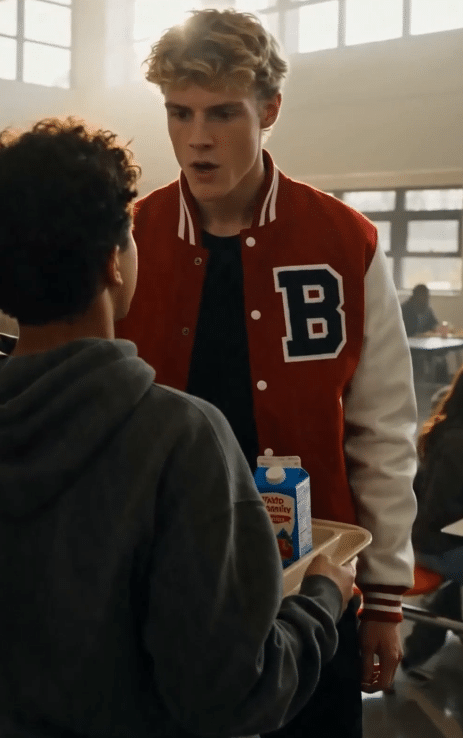
I was halfway there when Alex stepped in front of me.
He didn’t look at me at first. That was part of his act. He angled his body just enough to block my path, then drove his elbow into my arm as if I had walked into him.
My tray shook hard.
Milk jumped in the carton.
The apple slices slid.
“Watch where you’re going,” he said, loud enough to pull heads in our direction.
The room shifted immediately.
Conversations lowered.
Bodies slowed.
That strange cafeteria radar kicked in—the one that tells everybody there’s about to be a scene.
I looked at him and kept my voice even.
“You stepped in front of me.”
That got a few reactions. Small ones.
A turned head.
A sucked-in breath.
A nervous laugh that died almost as soon as it started.
Alex smiled the way people do when they’ve just been handed a reason to escalate.
“Oh, so you talk,” he said. “You got comfortable fast.”
His two friends took up positions behind him like they’d rehearsed it. One leaned against a table. The other folded his arms and grinned. Neither of them had to say anything. Their job was to make the moment feel official.
Alex glanced at my tray, then at my clothes, then back at me.
“Is that your lunch,” he asked, “or did someone hand it to you because they felt sorry for you?”
A few students at the nearest table dropped their eyes.
Nobody moved.
Nobody ever moved.
He stepped closer.
“I heard your mom works as a cashier now,” he said. “That true?”
I didn’t answer.
He took my silence as permission.
“That means people like you should learn how this place works. You keep your head down. You don’t get smart in class. And you definitely don’t act like you belong here.”
I tightened my grip on the tray.
I could feel every eye in the room without looking up. That was the worst part of public humiliation. Not the insult.
The audience.
Alex leaned in so close I could smell mint gum on his breath.
“You and your mother should be grateful this school even lets you in the building.”
Then he smiled.
Cold. Careless. Confident.
“You don’t belong here.”
And before anyone could react, he slapped the tray out of my hands.
The sound cut through the cafeteria like metal striking concrete.
Food exploded across the floor.
Bread skidded under a chair.
Apple slices bounced and spun.
The tray landed flat, then rocked once before going still.
For a second, the entire room went silent.
I looked down at the mess.
Then I crouched.
Not because I was ashamed.
Because I knew exactly what was coming next.
And because by then, I had already seen the time.
11:43.
My mother had told me not to say a word about what happened that morning.
But as I reached for the dented tray, I realized Alex Kane had chosen the worst possible ten minutes of his life to make me kneel.
Act II: The Name That Opened Doors
People at Redwood thought Alex’s power started with money.
It didn’t.
Money was just the decoration.
The real power came from the way adults bent around it.
You could see it in tiny things if you paid attention. Teachers didn’t call on him when he hadn’t done the reading. Coaches overlooked the fights he started in practice. Administrators reworded reports until consequences became “misunderstandings.”
By the time I arrived, Alex wasn’t just a bully. He was an institution.
Students had stories about him the way older towns have stories about storms. He had shoved a sophomore into a locker and gotten a warning. He had mocked a girl until she cried in front of half the class and later claimed he was joking. He had been caught copying homework twice and somehow turned it into a tutoring arrangement.
Every version of the story ended the same way.
Alex walked away.
The part nobody at school knew was that my mother knew the Kane name better than almost anyone in that building.
Not from news articles.
Not from plaques.
From conference tables.
Three years earlier, before everything fell apart, my mother had been a senior financial administrator for the Kane Educational Foundation. She wore pressed blouses, carried leather folders, and spoke in the kind of calm voice people mistake for certainty. We lived in a good neighborhood then. My father was still alive. Our kitchen still smelled like coffee in the mornings instead of anxiety.
Then my mother found numbers that didn’t make sense.
Scholarship funds routed through empty vendor accounts. Building improvement budgets that kept swelling without visible work. Grants awarded on paper and missing in reality. Donations praised publicly and split privately in ways no auditor was supposed to notice.
She noticed.
That was her first mistake.
The second was believing truth would protect her.
She raised concerns quietly at first. Internal memos. Private meetings. Follow-up emails that were polite enough to be ignored and precise enough to become dangerous. She thought the irregularities would be corrected.
Instead, she became the irregularity.
Within four months, she was suspended pending review.
Within six, she was named in whispers she never got to answer.
By the end of the year, she had lost her job, her reputation, and most of the professional network she had spent a decade building. No one charged her with a crime. They didn’t need to. They left her with something almost worse.
Doubt.
Employers stopped calling back.
Friends got careful.
Bills became immediate.
When my father died of a stroke the following winter, there was no savings left strong enough to absorb it. The career my mother had built was gone. The life we had known went with it.
So yes.
By the time I came to Redwood, my mother did work as a cashier.
She stood under fluorescent lights for eight-hour shifts and scanned cartons of milk for customers who barely looked at her face. The people at school reduced her whole life to that single detail because it was easier for them than imagining what had been taken from her.
They had no idea that on the morning Alex humiliated me in the cafeteria, she had spent three hours downtown giving a formal statement to state investigators.
They had no idea that after nearly three years of silence, someone had finally reopened the case.
And they definitely had no idea that Alex’s father had spent the entire week trying to keep that from happening.
At 7:10 that morning, before she dropped me off, my mother sat in the car with both hands on the steering wheel and stared through the windshield for so long I thought the engine had died.
“They may move quickly today,” she said.
I looked at her.
“What does that mean?”
“It means the truth doesn’t always arrive politely.”
Her voice was steady, but I could hear what it cost her to keep it there.
I asked whether I should stay home.
She shook her head.
“No. You go to school. You do what you always do.”
“And if somebody says something?”
Her eyes finally met mine.
“Then you remember that noise and power are not the same thing.”
She almost said something else after that. I saw it in the way her mouth moved and stopped. But instead, she handed me my backpack and told me to be careful.
So when Alex stood over me in the cafeteria and told me my mother didn’t belong in the building, something in me almost laughed.
Not because it was funny.
Because he had no idea who had started pulling apart his life just a few hours earlier.
I picked up the tray.
He loomed over me, enjoying the silence.
“Well?” he said. “You got nothing to say?”
I stood slowly.
The room was still watching.
I kept my voice low enough that only he and his friends could hear.
“You should answer when the office calls.”
His smile twitched.
“What?”
I held his stare.
“You’ll want to answer.”
He frowned then, just slightly, like he couldn’t decide whether I was bluffing or broken.
And right then, before he could speak again, the cafeteria intercom crackled to life.
Act III: The Call From the Front Office
Everybody in that room heard the static before the voice.
It was one of those old school speakers that always made announcements sound smaller than they were. Most students barely noticed them unless a club meeting or a lost ID was involved.
This time, the voice belonged to the principal.
And it was tight.
“Alex Kane,” he said. “Report to the main office immediately. Alex Kane, come to the main office now.”
No one moved at first.
Not Alex.
Not me.
Not anyone.
He gave a short laugh and looked around as if the timing itself had decided to flatter him.
“Probably my dad,” he said loudly. “He’s meeting with the board today.”
One of his friends smirked in relief. The other gave a little shrug, like the universe had stepped in to save the scene.
Alex leaned closer to me one last time.
“You’re still cleaning that up before you leave.”
Then he turned and started walking toward the cafeteria doors.
He made it maybe six steps.
That was when the first phone buzzed.
Then another.
Then three more.
In under ten seconds, the silence in the room changed shape. It stopped being fear and turned into confusion.
Students were pulling their phones from hoodie pockets and jacket sleeves. Heads dropped. Faces shifted. Whispers started in quick, disconnected bursts.
“Oh my God.”
“No way.”
“Is that real?”
“Wait—Alex.”
He turned back.
“What?”
No one answered him directly.
They were all looking at their screens.
So was I.
The local news alert filled mine in one block of cold text.
State investigators and federal financial crime units had executed search warrants connected to the Kane Educational Foundation. Public records tied the inquiry to scholarship fraud, embezzlement, and witness intimidation involving several district-linked accounts.
For a second, I couldn’t breathe.
Not because I was surprised.
Because the truth looked different once it finally stopped hiding.
Alex’s face changed when he saw the first screen turned toward him.
Then the second.
Then the third.
He grabbed the nearest phone from one of his friends and stared at it like language itself had betrayed him.
“That’s fake,” he said.
No one said anything.
He looked up too fast, too angry.
“That’s fake.”
But even as he said it, the cafeteria doors opened.
The assistant principal stepped inside first. Behind him were two men in dark suits I had never seen at school before and the head of campus security, who normally moved through the building with the emotional range of a hallway plant.
Now he looked alert.
Very alert.
The assistant principal scanned the room, found Alex, and crossed the cafeteria floor without hurry. That was what made it worse. Fast meant uncertainty. Calm meant the decision had already been made.
“Alex,” he said. “Bring your bag. You need to come with us.”
Alex laughed again, but the sound was wrong now.
“What is this?”
The assistant principal’s jaw tightened.
“Now.”
Every table in the cafeteria had gone still. Students weren’t pretending not to stare anymore. They were openly watching the first crack appear in something they had assumed was unbreakable.
Alex looked around as if he expected an adult somewhere to smile and explain the misunderstanding.
No one did.
He glanced at me then.
Just once.
And for the first time since I had met him, there was no mockery in his face.
There was only uncertainty.
He opened his mouth, probably to threaten me one more time, maybe to restore the script he trusted. But before the words came out, one of the boys near the window whispered something that turned half the room.
“Look outside.”
We all did.
Across the courtyard, near the administration building, a black SUV sat angled by the curb. Another one was parked behind it. Two more men in jackets were speaking to a staff member by the front entrance.
And just inside the glass doors, I saw a man I recognized from photographs.
Victor Kane.
Alex’s father.
He was not walking the way powerful men usually walk in schools they believe they own.
He was not smiling.
He was not being greeted.
Two investigators were escorting him through the lobby while the headmaster stood off to one side with his face drained nearly white.
Alex stopped breathing for a second.
I knew because everyone around him did.
“No,” he said.
It came out small.
Smaller than I had imagined his voice could sound.
The assistant principal touched his shoulder. Not rough. Not gentle. Just final.
“Come with me.”
Alex jerked away from the hand as if he had just remembered how many people were watching.
“This is insane. My dad didn’t do anything.”
But the words were already losing structure.
The room had shifted out from under him. He knew it. We all knew it.
His friends took half a step back without meaning to.
That was the moment everything truly changed.
Not when the intercom called his name.
Not when the alerts hit.
When the boys who laughed for him moved away to protect themselves.
The assistant principal said my name next.
“Leo. The principal would like to see you as well.”
And just like that, every eye in the cafeteria moved from Alex Kane to me.
I didn’t know yet whether that was going to feel like justice or something far more complicated.
Act IV: The Office Behind the Glass
The walk from the cafeteria to the main office was only two corridors and one stairwell, but it felt like crossing a border.
Alex walked ahead of me with security at his side. He wasn’t swaggering anymore. He wasn’t joking. He wasn’t performing for anyone.
He kept checking his phone.
Call after call.
No answer.
When we reached the office, the waiting area looked nothing like a school on a normal Tuesday. The receptionist had been moved from her desk. The door to the conference room was shut. Staff members stood in clusters, pretending to sort paperwork while their eyes flicked toward everything that mattered.
Alex was taken into the headmaster’s office.
I was asked to wait outside the principal’s door.
For the first time since lunch, my hands started shaking.
Adrenaline is strange that way. It lets you survive the public moment, then asks for payment in private.
A few minutes later, the principal opened the door and told me to come in. My mother was already there.
She stood when she saw me.
For one terrible second, I thought something had gone wrong.
Then I realized she was crying.
Not the helpless kind. Not the humiliated kind. Not the exhausted crying I had seen in apartment kitchens after bills arrived.
This was different.
This was release.
She came toward me fast and held both sides of my face in her hands like she needed proof I was real.
“You’re okay,” she said.
“I’m okay.”
The principal closed the door and sat down slowly, as if the room itself required more care than usual. He was a careful man, polished in the way administrators learn to be, but even he looked shaken.
“Leo,” he said, “your mother has given us permission to explain what’s happening.”
I sat down without taking my eyes off her.
He folded his hands.
“The district received confirmed findings this morning tied to an active investigation into the Kane Educational Foundation and several related accounts connected to Redwood’s scholarship administration.”
He paused, maybe expecting the language to soften the reality.
It didn’t.
“Your mother was wrongfully implicated in financial misconduct three years ago. Evidence obtained this month, including internal correspondence and off-book transfers, strongly suggests she attempted to report the fraud and was retaliated against.”
My mother looked at the floor then. Just for a second. Long enough for me to understand what it meant to hear the truth out loud from someone with power.
The principal cleared his throat.
“The board has placed all Kane-funded administrative partnerships under immediate review. Victor Kane has been removed from district advisory roles pending formal charges. There will also be an independent inquiry into past complaints involving student misconduct that may have been suppressed.”
Student misconduct.
A clean phrase for a dirty history.
I thought about the girl Alex had mocked in history class. The freshman he shoved near the lockers. The dozens of students who had learned to shrink because the adults around them had decided his behavior was manageable.
My mother sat very still.
Then she reached into her purse and pulled out a folded grocery receipt. It took me a second to realize why.
On the back of it, in her neat handwriting, was the same thing she used to write on sticky notes when I was younger and scared before exams.
Breathe first. Then think.
“I kept this,” she said quietly. “From my shift last night.”
The principal looked confused.
She gave a tired smile.
“I wanted something ordinary in my hand when they told me whether I had my name back.”
That almost broke me.
Not the investigation.
Not Alex.
That.
The fact that after everything she had lost, she still didn’t expect dignity to arrive dressed like dignity. She expected it to come folded inside a grocery receipt.
A knock sounded at the office door.
The principal looked toward it, then at us.
“I need to step out for a moment.”
When the door closed, I turned to my mother.
“Did you know it would happen today?”
She nodded once.
“I knew it might.”
“And you still sent me to school.”
Her face tightened.
“I wasn’t going to let them take one more normal day from you.”
That answer sat between us for a moment.
Then I asked the thing that had been growing like a bruise in the back of my mind.
“Why didn’t you ever tell me how much of this was because of them?”
Her eyes met mine.
“Because I needed you to grow up knowing who you were,” she said, “not only who hurt us.”
I looked down then because I didn’t trust myself not to cry if I kept looking at her.
Outside the office, I could hear doors opening and closing. Low voices. Fast footsteps. The machinery of an institution rearranging itself once its favorite lie had stopped being useful.
My mother leaned back in the chair.
“It won’t all be fixed today,” she said.
I knew that.
Reputations don’t return as quickly as headlines. Lost years don’t come with receipts.
But when the principal stepped back inside and told us that the district had already issued a formal written correction clearing her name, I saw something in her shoulders change.
Not everything.
Just enough.
Enough to understand that sometimes justice doesn’t arrive as triumph.
Sometimes it arrives as the first full breath after years of breathing shallow.
Outside, in another office, Alex Kane was learning what power felt like when it stopped answering to his last name.
And for the first time since I had walked into Redwood, I wondered what the school would sound like once people stopped being afraid of him.
Act V: What Remains After the Noise
By the next morning, Redwood felt like a house after a storm.
The building was still standing, but everyone moved through it differently. Conversations started too quickly and stopped too late. Teachers were suddenly serious in a new way, like people who had discovered they were visible after all.
Alex didn’t come to school.
Neither did his two closest friends.
An email went out before first period about conduct, safety, review procedures, and support resources. It used the kind of polished language institutions use when they are trying to sound morally awake after years of sleeping through the obvious.
But the students understood the real message anyway.
The shield was gone.
I carried my lunch tray through the cafeteria at noon and realized the room was loud again. Not performative loud. Not nervous loud.
Normal loud.
There is a difference.
A sophomore I barely knew moved his backpack so I could sit if I wanted. A girl from my English class asked whether I had the homework assignment. Someone two tables over mentioned Alex’s name, then lowered it, not out of fear this time, but discomfort.
No one laughed.
I sat by the window and opened my carton of milk.
For a while, I just listened.
I had spent so many days at Redwood cataloging the tone of fear that I almost didn’t know what to do without it. The room sounded unfinished, like a play after the lead actor walks out mid-scene and everybody else discovers they were carrying more of the story than they thought.
My phone buzzed.
It was my mother.
Name cleared officially, the message read. Lawyer says more coming. Proud of you. Pick up bread on your way home?
I stared at the last sentence and smiled.
That was my mother.
A life-changing morning, a legal correction, the first crack of justice after years of humiliation—and she still needed bread.
The ordinariness of it was beautiful.
I typed back, I will.
A shadow fell across my table.
I looked up.
It was Mr. Harlan, my chemistry teacher.
He held his coffee like he had forgotten why he’d poured it.
“I owe you an apology,” he said.
I waited.
“There were things many of us should have addressed much earlier.”
He didn’t say Alex’s name.
He didn’t have to.
“I’m sorry,” he said again.
It wasn’t enough to fix anything.
But it mattered that he said it.
That afternoon, when the final bell rang, I walked past the main office and saw maintenance staff removing one of the framed donor boards from the wall. Victor Kane’s name had been unscrewed from its brass brackets and left leaning against a chair.
Just a piece of metal.
That was all.
Funny, after years of adults treating it like a law of nature.
A week later, rumors started that Alex would not be returning to Redwood. Some said he had been expelled. Others said his family had pulled him out before the district could act. A few students claimed they saw him getting into a car outside a private counseling center across town.
I never checked whether any of it was true.
I had spent enough of my life orbiting the damage done by powerful people. I wasn’t interested in building a new life around their collapse.
That Friday, my mother came home in her work uniform, set her keys on the counter, and looked at me with a kind of quiet disbelief.
“They asked if I would consult on the independent audit,” she said.
I stared at her.
“Seriously?”
She nodded.
“It’s temporary. But it’s real.”
Something in my chest eased when she said that. Not because everything was fixed.
Because something had finally started.
Later that night, I found the old photo album we had packed three moves ago and never reopened. There was my father in the backyard, smiling with grill smoke behind him. There was my mother in one of her old office dresses, hair pinned back, holding a mug and laughing at something outside the frame. There was me, smaller, sunburned, certain the world made sense.
I looked at the photos for a long time.
Then I closed the album and put it back on the shelf.
Not hidden.
Not displayed.
Just kept.
That Monday, I walked into the cafeteria with another plain lunch on a dented plastic tray. The room was crowded. Chairs scraped. Juice cartons opened. Someone across the room laughed too loudly at something not that funny.
Life, continuing.
I passed the exact spot where Alex had knocked my food onto the floor.
For a second, I remembered the sound.
The tray striking tile.
The silence after.
The way an entire room had waited to see whether I would break.
I didn’t.
That was the part none of them understood.
Alex had believed humiliation was power because he had only ever seen people confuse the two. But power that depends on witnesses is fragile. Power that depends on fear is already dying.
I set my tray down by the window and sat in the noon light.
Outside, students crossed the courtyard without looking over their shoulders. Inside, the noise of lunch rose and fell in ordinary waves.
And for the first time since arriving at Redwood, I finally understood what my mother had meant in the car.
Noise and power were never the same thing.
One disappears the moment people stop feeding it.
The other survives long enough to tell the truth.