Act I: The Bucket in My Hands
The mud was colder than I expected.
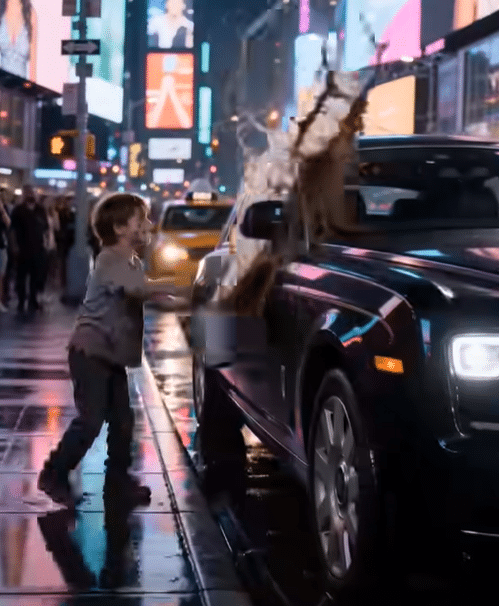
It soaked through the rim of the cheap plastic bucket and dripped over my fingers as I stood on the wet sidewalk in Times Square, staring at the black Rolls-Royce idling at the curb like it had every right to be there. Neon billboards flashed across the polished paint in violent color—red, blue, gold, white—so bright it made the mud look almost theatrical.
That was fitting.
Everything about Times Square is theatrical.
The lights are too loud. The faces are too many. Even the pity feels performative if it comes at all.
I was eight years old, standing in ripped jeans and an oversized gray hoodie that still smelled faintly like the laundromat bathroom where I’d slept the night before. My sneakers were wet through. My stomach had been empty since morning. My hands were shaking, but not from the cold.
I had been waiting for that car for three days.
I knew it would come.
My mother’s old friend at the shelter said women like her always come back to the same places when they want to be seen. The expensive hotels. The charity galas. The fashion dinners where photographers crowd the entrance and rich people pretend not to enjoy being watched.
The woman in that car liked attention.
That was why I chose Times Square.
I wanted witnesses.
The rear door opened.
A woman stepped out in a champagne-colored silk dress, her hair pinned into a sleek dark knot, diamond earrings catching billboard light every time she moved. She had one hand on a silver glitter clutch and one heel still inside the car when I threw the bucket.
Mud hit the Rolls-Royce in a thick, ugly wave.
It splashed across the passenger door, ran down the chrome trim, and dripped onto the curb in slow brown streaks. For one second, the whole block seemed to pause around the sound of it.
Then the crowd reacted.
Phones went up first.
That’s always how it happens now.
Before outrage.
Before questions.
Before help.
A ring of strangers lifted glowing screens and turned my anger into content before they understood a single word of it.
The woman looked at the car.
Then at me.
Then back at the mud.
When she spoke, her voice came out sharp enough to cut through traffic and music and the giant digital ads exploding overhead.
“Are you insane, you little idiot?”
She stepped toward me fast.
Not afraid.
Disgusted.
People with money are rarely afraid of poor children in public. They assume the city will eventually separate the inconvenience from the pavement and hand the clean version of reality back to them.
I held my ground.
My chest was tight enough to hurt. I could feel tears coming and hated them already, because tears make adults kinder in the wrong way. They start seeing emotion instead of truth.
“You did this to me!” I shouted. “This is your fault!”
The words cracked in the middle.
A man in a Yankees cap laughed softly somewhere behind the phones. A woman in a red wool coat covered her mouth and whispered, “Oh my God,” but didn’t step in.
The elegant woman stared at me as if trying to decide whether I was dangerous, crazy, or merely filthy enough to be ignored after security arrived.
Then she took another step closer.
Her perfume reached me before her hand did.
Expensive.
Floral.
Clean.
So clean it made me hate her more.
“You vandalize my car,” she said, each word clipped and cold, “and then scream at me in the middle of the street?”
I almost backed up then.
Almost.
But I had not spent eleven months carrying that photograph in my pocket through cold nights, shelter lines, and the long mechanical indifference of New York just to lose my courage in front of her face.
So I looked up at the woman my mother had named in tears and fever and half-finished stories.
And I said the one sentence I had practiced so many times it no longer sounded real in my own mouth.
“You left us,” I told her. “You drove away. You didn’t even look back.”
That was when her expression changed.
Only slightly.
But enough for me to see that whatever she had expected from this night, it was not me.
And when I reached into my hoodie pocket for the crumpled photograph, I knew the woman standing over me was about to remember a life she had spent years paying to forget.
Act II: The Name My Mother Wouldn’t Let Die
My mother used to say her name like it was both a prayer and a curse.
Celeste Warren.
Sometimes she said it with anger so sharp it scared me. Sometimes with a strange softness that made me think grief and hope must live much closer together than people admit. Most of the time, she said it when she was tired enough not to censor herself and frightened enough not to stop.
“She was supposed to come back,” my mother whispered the first time I ever heard the name clearly.
I was six.
We were sleeping in the back room of a church pantry in Queens because a volunteer knew the pastor and thought mothers with children should at least be kept away from the men who shouted in their sleep. My mother had a fever that night and kept slipping in and out of dreams, speaking to the dark as though someone were listening just beyond it.
“She promised,” she said.
When I asked who, she turned her head toward me and stared for so long I thought she hadn’t heard. Then she touched my cheek and said, “The woman who should have known better.”
My mother’s name was Elena Cruz.
She had once been beautiful in the kind of careless way beauty can be when life has not yet started collecting payment. Even on the worst days, with her coat too thin and her face worn hollow by stress, you could still see traces of the woman she must have been. High cheekbones. Soft dark eyes. A smile that arrived rarely but transformed her whole face when it did.
She met Celeste Warren twelve years earlier in Miami, when they were both young enough to believe rich men were the only dangerous thing a woman needed to watch for.
Celeste was the daughter of a hotel developer and a former pageant winner, raised inside bright rooms and private schools and summer houses where people spoke about ordinary life as if it were weather in another country. My mother worked the bar at a beach club Celeste frequented with friends who liked white linen, expensive champagne, and gossip delivered with manicured cruelty.
For reasons my mother never fully explained, the two women became close.
At first, I think, because my mother did not flatter her.
Rich girls raised around performance often mistake honesty for intimacy. My mother gave Celeste what money around her never did: someone who laughed at her without wanting anything, someone who knew how to say no, someone who had survived enough of the world not to be impressed by cosmetic power.
They shared apartments for a while.
Then secrets.
Then, according to my mother, one unbearable summer night, something worse.
I was not old enough when she first began telling it for the details to settle properly. Later, when I was seven and smarter about the shapes adults avoid, I gathered the fragments.
Celeste got pregnant.
Or thought she might.
There was a man involved at first, maybe more than one. That part never stayed consistent, which told me it hurt too much or mattered less than the thing after. What mattered was this: Celeste had been terrified. Her father monitored everything. Her mother cared more about scandal than suffering. There were pills, appointments, disappearing weekends, and one period of silence so complete my mother thought Celeste had run to Europe.
Then, months later, there was a baby.
Me.
When I asked my mother directly if Celeste was my mother, Elena always answered the same way.
“She said she was.”
Not yes.
Not no.
Just that.
“She said she’d fix everything,” my mother told me once while washing her face in a bus station restroom mirror with brown paper towels and hand soap. “She said she needed time. She said no one could know yet. She said I should keep you safe and she would come back with money, lawyers, all of it.”
“Did she?”
My mother looked at me through the mirror.
“No.”
That was the part of the story I understood before anything else.
No.
No money.
No letters.
No lawyer.
No explanation.
Just absence.
For years my mother kept one photograph wrapped in wax paper inside a zippered makeup pouch. It showed a younger Celeste holding a baby swaddled in pale blue. My mother had written on the back in ballpoint pen:
She held you for six minutes. She cried the whole time.
I found that photo by accident the first time, and after that I stole moments with it whenever I could. The woman in it looked softer than the one who stepped from the Rolls-Royce in Times Square. Less carved. Less controlled. But the eyes were the same.
My mother made me promise never to lose it.
When she got sick last winter, she made me promise something else.
“If you ever find her,” she said, coughing so hard afterward I thought the sentence had broken her, “make her look at you before she lies.”
That was why the photograph was in my pocket that night.
Not to prove the truth to myself.
To force it onto her face.
Act III: The Photo in My Hand
By the time I pulled the photograph out, the crowd had tightened into a rough circle around us.
Times Square is a machine built to turn private pain into public spectacle. Tourists slowed but didn’t leave. A man dressed as Spider-Man hovered near the edge of the scene as if deciding whether grief was still marketable if the mood turned too real. Billboard light flickered over the wet pavement, turning every expression around me strange and artificial.
The woman in the silk dress—Celeste, if my mother had ever told me the truth—stood completely still.
“You left us,” I said again, quieter this time. “You didn’t even look back.”
She opened her mouth to answer.
Then I unfolded the photograph.
It was soft at the corners from being touched too often and protected too poorly. The image had faded enough that the hospital blanket looked gray instead of blue, but her face was unmistakable. Mine wasn’t, of course. Babies belong to blur more than identity.
Still, the picture did what I needed it to do.
It stopped her.
Her hand flew to her chest.
Not dramatically.
Instinctively.
That mattered more.
I held the photograph up between us with both hands because my fingers were shaking too much to trust one.
“My mom said you were my mother,” I told her. “I waited.”
The last word came out in a sob.
I hated that.
I had promised myself I would say everything cleanly, with all the fury I’d rehearsed under bridges and in shelter bunks and behind the storage shed where the mission kitchen volunteers smoked after service. I had imagined her face hardening, imagined myself strong enough to keep speaking over whatever dismissive lie she produced.
Instead, I sounded like what I was.
A child.
A tired, angry child asking the worst question in the middle of the brightest street in the city.
Celeste stared at the photograph as if it might physically strike her.
Her lips parted.
The hand at her chest tightened.
“That’s not possible,” she whispered.
The sentence might have meant many things.
That it wasn’t her.
That the baby wasn’t me.
That the life in front of her could not possibly be connected to the one she had curated so carefully around magazine profiles, philanthropic galas, and luxury car doors opening for cameras.
Or perhaps it meant only this: that she had spent so long insisting some part of the past was buried that the sight of it alive on a wet sidewalk felt obscene.
A woman in the crowd murmured, “Jesus.”
Another said, “Is this real?”
Phones stayed up, of course.
But fewer people were filming now because the scene had moved beyond entertainment. Shame has a way of sobering spectators when it turns specific enough. A child with mud on his sleeves and a photograph in his hands is harder to enjoy than a random street confrontation.
Celeste reached toward the picture.
I flinched back.
Something crossed her face then.
Pain.
Real pain.
Not the social kind.
Not embarrassment.
Not the cold fury of being challenged by someone poor and inconvenient.
The pain of recognition colliding with a history she had no longer expected to carry in her body.
“Where did you get that?” she asked.
“My mother kept it.”
“What’s her name?”
I almost laughed then because the question was so terrible.
Not because it was cruel.
Because it was late.
So late.
“Elena Cruz,” I said.
That did it.
She staggered once, just half a step, enough for one of the men near the car to move instinctively as if to steady her. She shook him off without looking. Her eyes were filling now, dark and wide and horrified.
“Elena,” she said, and for the first time her voice sounded like it belonged to the woman in the photograph instead of the one in the silk dress. “No. Elena wouldn’t—”
“She did,” I snapped. “Because you never came back.”
The crowd blurred at the edges for me then. Not because I was faint, but because rage and grief had started pulling in opposite directions so violently I could barely stay still. I wanted to throw the photo at her face. I wanted to demand everything all at once. Why? Where were you? Did you know? Did you look for me even once? Did you know she died?
Instead I just stood there crying in front of a hundred strangers and the woman my mother had named from sickness and memory and regret.
Then Celeste said something so quietly I almost missed it.
“When did Elena die?”
My whole body went cold.
Because only a guilty person asks that first.
Act IV: The Story She Thought Was Finished
My mother died in March under the FDR overpass during the coldest week of the year.
That is not the sort of sentence elegant people know what to do with. Death, in their world, arrives in private rooms, under clean sheets, with soft lamps and carefully controlled phone trees. My mother died wrapped in two blankets from a shelter donation bin while I tried to keep her awake by telling her things I thought might matter if she could just hold on long enough to hear them.
The city came after.
A medic with tired eyes.
A clipboard.
Questions I did not answer because I had already learned that the right answer sometimes gets you separated from the wrong things too quickly to stop it.
By the time anyone official tried to place me, I was gone.
That was the beginning of the waiting.
Not for rescue.
For recognition.
I did not know how to find Celeste at first. My mother had kept old names, a few addresses, and exactly one magazine clipping with a photograph of Celeste at a charity auction in Manhattan, arm looped through some finance man whose name changed every few years in the press. “Hospitality philanthropist and arts benefactor,” the caption called her.
I hated that phrase for months.
It sounded too clean for a woman my mother remembered in tears.
I learned the rest from piecing together what homeless people, doormen, gossip pages, and volunteers know when no one wealthy bothers to imagine they are listening. Celeste Warren had married briefly, divorced quietly, inherited aggressively, and become the sort of woman who arrived in black SUVs, donated enough to be praised, and never stayed anywhere long enough for the wrong people to claim her.
But she had patterns.
A winter gala here.
A donor dinner there.
A hotel entrance on certain Thursdays.
Times Square before an event because she liked making entrances where the city could reflect her back to herself in glass and screens.
I watched for three days.
Then I waited with the bucket.
Now, standing in front of her with the photograph between us, I saw the exact second she realized my mother had not merely spoken her name in anger.
She had preserved proof.
“Elena told you I was your mother,” Celeste said.
It wasn’t really a question.
I nodded.
She looked down at the mud streaking her Rolls-Royce, then at the phones around us, then back at me. The old social instinct was still there, I could see it fighting to the surface. Damage control. Optics. Containment. Find the nearest private room. Get the story quiet before it becomes unmanageable.
But private was no longer available to her.
Not after the car.
Not after the shouting.
Not after the photograph.
“She shouldn’t have done this in the street,” Celeste said, and even as the words left her mouth, I think she knew how monstrous they sounded.
My laugh came out broken.
“She didn’t,” I said. “You did.”
That landed.
Good.
Because I was tired of adults speaking as if truth were indecent but abandonment wasn’t.
A man in a dark coat edged closer and murmured, “Miss Warren, maybe we should leave.” He sounded like an assistant or driver or lawyer, one of those men whose careers are built on making other people’s scandals arrive at the right hotel entrance.
Celeste ignored him.
“What did Elena tell you?” she asked me.
I wanted to say everything.
That my mother loved me enough to tell the story even when it humiliated her.
That she hated Celeste some nights and defended her others.
That fever made her confess things hunger would normally bury.
That she once said the worst part wasn’t the abandonment. It was that Celeste had looked so horrified holding me, as if love and panic had arrived at her body together and she chose the wrong one.
Instead, what I said was simpler.
“She told me you promised.”
The crowd went quiet again.
Truly quiet this time.
No mutters.
No laughter.
No phone commentary.
Just the terrible stillness of people realizing they are no longer consuming a scene. They are watching the center of someone’s life split open.
Celeste closed her eyes.
Only for a second.
When she opened them again, tears had gathered but not fallen.
“She took you,” she said.
I stared at her.
“What?”
“Elena took you and disappeared.”
I felt the city tilt.
All at once, two impossible versions of the story were standing in front of me, both wearing my mother’s face in pieces I could not reconcile. In one, Celeste fled and my mother waited. In the other, my mother ran with me and Celeste was left behind.
It should have sounded absurd.
It didn’t.
Because grief teaches you one brutal lesson before all others: the dead do not answer clarifying questions.
Celeste took one careful step forward, palms open now, not touching me, but no longer towering either.
“I came back,” she whispered. “The apartment was empty.”
I thought of my mother’s stories.
The church room.
The bus station sink.
The envelope of names.
The way she always said Celeste should have known better.
Not she was evil.
Not she lied from the start.
Should have known better.
As if the real wound had always been cowardice, not malice.
And suddenly, for the first time, I understood that my mother’s grief had always contained something more dangerous than blame.
Doubt.
Before I could decide whether that made anything better or worse, a black town car pulled up hard behind the Rolls-Royce, and the woman stepping out of it took one look at me, the photograph, and Celeste’s face—and went dead white.
Celeste saw her too.
And the sound that came out of her was not anger.
It was fear.
“Marianne,” she said.
The woman stopped moving.
I didn’t know who she was yet.
But the way Celeste looked at her told me the truth about my life had never belonged to only one liar.
Act V: The Woman Who Knew Where I Came From
Marianne Holt had my mother’s ring.
I saw it before anything else because grief sharpens the eye for tiny violences. Thin silver band. Oval green stone. Worn setting on the left side where Elena used to rub it with her thumb when she was trying not to cry.
Marianne wore it on a chain around her neck.
For one wild second, I thought I might actually hit her.
Not because I knew what she had done. Because some part of me understood instantly that she belonged to the missing middle of the story—the part between promise and disappearance where adults arrange a child’s fate while calling it necessity.
Celeste’s driver said something low and urgent I didn’t catch.
Marianne ignored him.
Her face was that peculiar color people turn when they realize a secret has not died on schedule.
She looked at me.
Then at the photograph in my hand.
Then at Celeste.
“Oh God,” she whispered.
Celeste stepped toward her like she meant to tear the truth out by force.
“Tell me I’m wrong,” she said.
Marianne’s eyes filled immediately.
That told me enough before she even spoke.
They had all been carrying some version of me for years.
Not in their homes.
Not in their love.
In their silence.
The story came apart fast after that, in half-sentences and broken admissions under the neon glare while Times Square kept roaring around us like the city refused to care how many lives were being rearranged on one wet patch of sidewalk.
Marianne had been Celeste’s mother’s personal assistant eighteen years earlier.
When Celeste got pregnant, there was panic. Family panic. Reputation panic. Inherited wealth panic. The kind of panic that looks at a baby and sees newspaper risk. Celeste wanted to keep me at first, Marianne said. Then didn’t. Then did. Then couldn’t decide fast enough for the adults around her.
Elena, my mother, was there because Celeste trusted her.
Or maybe because Elena was the only one who saw me as a child before I became a problem.
According to Marianne, Celeste’s father arranged everything.
A private birth.
Cash.
Documents.
A “temporary placement” until choices became cleaner.
Elena was told to take me for a week.
Then a month.
Then until Celeste stabilized.
Then lawyers got involved.
Then Celeste was told Elena had run off with me for money.
Elena, meanwhile, was told Celeste had signed everything away and wanted the situation erased.
Each woman spent years believing the other had chosen the crueler version.
And Marianne—who knew enough to stop it—did nothing but keep the ring, keep the memory, and keep working for the same people who had decided my life was a stain to be managed.
“Why?” I asked her.
It came out smaller than I meant it to.
Marianne started crying then. Real crying. Old guilt breaking open.
“Because I was a coward,” she said.
There it was.
The simplest answer in the whole city.
Not strategy.
Not confusion.
Cowardice.
The thing my mother hated most because it always arrives disguised as practicality.
Celeste looked like someone had reached into her body and pulled out the architecture holding her upright. The polished woman in silk and diamonds was gone. In her place was someone older than her face, someone carrying years of wrong grief and late horror all at once.
She took one step toward me.
Then stopped.
Permission, finally.
“I looked for you,” she said.
Maybe she had.
Maybe she had only looked until the search became professionally inconvenient.
Maybe both were true.
That is the ugly thing about adults. They are rarely monsters in a clean direction. More often, they are weak at exactly the moments strength was required, then spend years building pretty lives around the damage.
I believed her just enough for it to hurt.
More black cars arrived after that.
Not police.
Not yet.
Lawyers, I think.
Or handlers.
People who move toward disaster when money inside it still belongs to someone important.
But by then the crowd had become too big, too knowing, too full of faces that would remember. Someone had already sent the video somewhere. I could feel the scene slipping out of private control with every passing second.
Celeste took off one diamond earring, then the other, like the weight of them had suddenly become obscene.
“I don’t know what to say to you first,” she whispered.
I thought about the shelters.
The church pantry.
My mother dying under concrete.
The magazine clipping.
The photograph.
The bucket in my hands.
Then I told her the only thing that still felt true.
“You should’ve looked back.”
That broke her more than the mud ever could have.
For a long moment, no one moved.
Then Celeste did something I didn’t expect. She sank slowly to the wet pavement in front of me, silk dress pooling against the dirty sidewalk, knees pressed into Times Square rainwater and city grime. A millionaire in couture kneeling in the exact place where she had expected me to stand small before her.
Not performance.
There were too many phones for performance now.
Just collapse.
I looked at her there and understood something all at once: the woman my mother cursed and the woman my mother once loved had always been the same person. Weak. Frightened. Capable of feeling deeply and choosing badly. Rich enough to let other people weaponize her fear. Human enough to suffer for it too late.
None of that gave me back the years.
None of it brought Elena back.
But it did something almost as dangerous.
It gave shape to the truth.
Not the clean truth of heroes and villains.
The harder one.
That my life had been built in the space between two women who were both lied to, one woman who was not brave enough to fight through the lie, and one woman who was brave enough to carry me but too wounded to ever fully trust what had happened.
The city rushed around us.
Screens flashed.
Traffic pushed on.
And in the middle of all that noise, holding a photograph that had once belonged to my mother, I realized the worst thing about abandonment is not always that someone left.
Sometimes it’s that everyone stayed silent long enough for a child to mistake that silence for being unwanted.
Celeste lifted her face to me, ruined now, and asked the question I think she had been carrying in pieces for almost a decade.
“What do you want me to do?”
I looked down at her.
Then at Marianne.
Then at the ring on her chain.
And for the first time that night, I knew exactly what the answer was.
“Tell the truth,” I said. “Where everyone can hear it.”
Because mud washes off a car.
A lie like mine does not.
And after years of being carried through the city as if I were no one’s responsibility, I finally understood this much: if they wanted me back in their world, it would not begin with a private car door, a quiet hotel suite, or another adult promising to fix things later.
It would begin the only way the damage began.
In public.
With witnesses.
And this time, nobody would get to look away.