Act I
“You’re in the wrong line.”
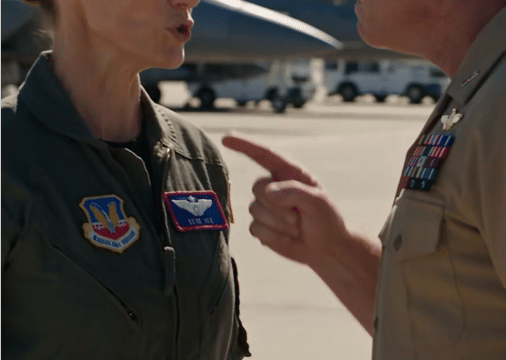
Brigadier General Robert Hayes stood beside the command reviewing area, his polished black shoes planted firmly on the parade ground. His one-star insignia gleamed on his Army service uniform, and his ribbon rack reflected the afternoon sunlight.
Standing directly in front of him was a woman in an ordinary-looking Army OCP combat uniform.
Her black hair was secured in a low bun. Her tan boots were dusty, and her field uniform carried none of the decorations normally associated with senior command.
She looked toward the hundreds of soldiers preparing for parade rehearsal.
“No. I’m exactly where I should be.”
Hayes narrowed his eyes.
He had spent years building his reputation around discipline, authority, and absolute control of his command space. He didn’t appreciate anyone questioning his instructions, especially someone he believed was a relatively junior officer.
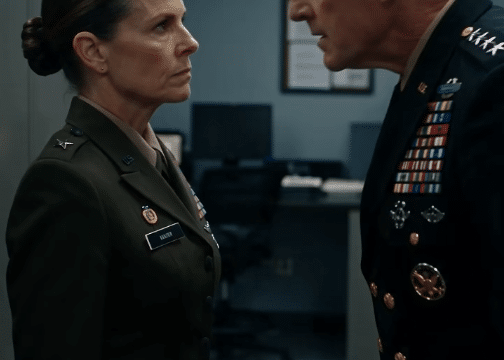
“Stay out of command space.”
The woman didn’t move.
That was enough to push him over the edge.
Hayes stepped forward and struck her hard across the face.
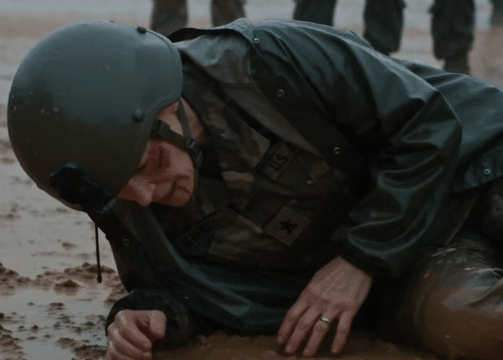
Her head snapped sideways. Her cheek immediately reddened, and a faint trace of blood appeared at the corner of her mouth.
Before she could recover, he drove a forceful kick into her abdomen.
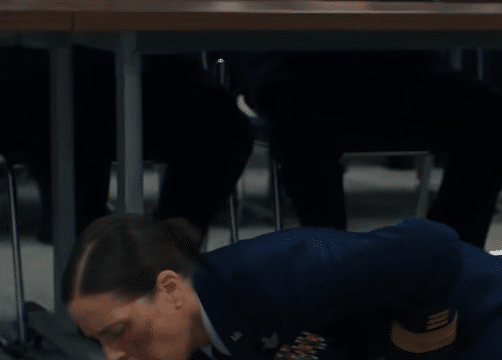
She stumbled backward and dropped to one knee on the parade ground, struggling to regain her breath.
But Hayes wasn’t finished.
He grabbed her field shoulder strap and violently jerked her upper body sideways, forcing her off balance.
The drum cadence continued in the background.
Hundreds of soldiers were watching.
The woman slowly raised her head, one hand guarding her abdomen.
Hayes stood over her.
“Stay out of command space.”
He believed he had just put an insignificant subordinate in her place.
He had no idea that the next command shouted across the parade ground would expose exactly how wrong he was.
Act II
The woman’s name was General Catherine Mitchell.
At forty-nine, she had spent more than two decades serving in the United States Army, building a career that had taken her through demanding field assignments, major operational commands, and some of the highest levels of military leadership.
She was a four-star general.
But she had deliberately avoided making her identity the center of attention during her inspection of the installation.
She wanted to see the soldiers as they actually operated.
Not how they behaved when surrounded by senior officers.
Not how they performed when cameras were present.
She wanted to understand the command culture beneath the formal ceremonies and polished uniforms.
That morning, she had arrived at the parade ground wearing her OCP uniform, carrying a small inspection folder and observing the rehearsal from different positions.
She had watched junior soldiers correct their formations under the afternoon sun.
She had noticed the Command Sergeant Major coordinating the drum cadence.
And she had noticed something else.
General Hayes treated the reviewing area as though it belonged exclusively to him.
Junior officers moved out of his way.
Enlisted soldiers avoided approaching him.
Even members of the command staff appeared uncomfortable whenever he entered the field.
Mitchell had been watching quietly.
When Hayes ordered her away from the command area, she could have identified herself immediately.
She could have displayed her authority and ended the confrontation before it escalated.
Instead, she calmly told him she belonged where she was.
She wanted to see whether he understood that leadership did not depend on intimidating everyone around him.
His response answered that question.
Now she was on one knee, trying to control her breathing.
The cheek that Hayes had struck was visibly swollen. Her uniform had shifted at the shoulder where he had grabbed the strap.
Around them, soldiers had begun to notice that something was terribly wrong.
A few trainees exchanged stunned glances.
The command staff near the reviewing stand had stopped moving.
But nobody had yet understood who the woman on the ground really was.
And then the drums stopped.
Not gradually.
Not at the end of a scheduled sequence.
They stopped abruptly.
The sudden silence rolled across the parade ground.
The Command Sergeant Major had just seen her.
And his reaction would change the entire formation.
Act III
The Command Sergeant Major stood near the front of the reviewing area, watching the soldiers prepare for their next rehearsal sequence.
Then his eyes moved toward the woman kneeling on the ground.
He froze.
For a brief moment, his expression changed from routine concentration to unmistakable recognition.
He looked at her uniform.
Then at her face.
Then at the officer standing over her.
His posture immediately became rigid.
He stepped forward, drew himself to attention, and raised his voice with the authority of a senior enlisted leader.
“Command on the field!”
The words cut through the silence.
Every soldier in the nearest formation reacted.
The first rank pivoted.
Then the second.
Then the next.
In a perfectly disciplined sequence, hundreds of soldiers turned toward Catherine Mitchell.
Arms moved upward.
Hands reached the salute position.
The entire formation stood facing the woman Hayes had just knocked to the ground.
It was a breathtaking sight.
A parade ground filled with soldiers, all directing their attention toward one person.
The Command Sergeant Major held his salute.
The command staff followed.
The soldiers in the rear formations followed.
Within seconds, the entire field had transformed into a massive display of military recognition.
Mitchell remained on one knee.
She didn’t announce her rank.
She didn’t demand attention.
She simply looked toward the formation, her expression controlled despite the pain in her face and abdomen.
Hayes slowly turned around.
At first, he looked irritated.
He seemed ready to question why the rehearsal had been interrupted.
Then he saw the soldiers.
Every formation was facing the woman.
Every salute was directed toward her.
Nobody was looking at him.
His eyes moved toward the Command Sergeant Major.
The senior enlisted leader remained perfectly still.
Hayes looked back at the woman.
Something wasn’t right.
This wasn’t a routine salute for a visiting colonel or a ceremonial courtesy extended to an ordinary guest.
The entire command had recognized someone.
Someone whose authority was far greater than his own.
And the realization was beginning to settle in.
Act IV
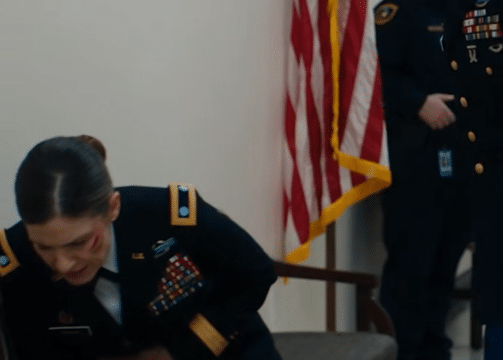
Catherine Mitchell slowly pushed herself upright.
Her breathing remained strained, and she briefly steadied herself against her own knee before standing fully.
Her swollen cheek was visible.
The faint trace of blood remained at the corner of her mouth.
But her expression had changed.
The woman who had quietly observed the rehearsal was now looking across the parade ground with the calm authority of someone accustomed to commanding entire formations.
Hayes stared at her.
He looked at the Command Sergeant Major again.
Then at the hundreds of soldiers still saluting.
The one-star insignia on his own uniform suddenly seemed painfully insignificant.
He knew what the command meant.
He knew the significance of a senior leader being recognized by an entire formation.
And he knew that nobody on that field would have responded that way to an ordinary officer.
Mitchell adjusted her field jacket.
She didn’t need to reveal anything.
The formation had already done it for her.
Four stars.
The highest general officer rank in the United States Army.
General Catherine Mitchell had been observing the installation without announcing her identity.
And Brigadier General Hayes had just assaulted her in front of hundreds of witnesses.
His face began to lose color.
He looked toward the reviewing stand, hoping someone might intervene or somehow explain what was happening.
Nobody moved.
The Command Sergeant Major remained at attention.
The command staff remained silent.
The soldiers continued holding their salute.
Hayes swallowed.
He had spent years demanding that junior personnel respect the chain of command.
Now he was standing before the very embodiment of that chain.
And he had physically attacked her.
For the first time, he seemed to understand the seriousness of what he had done.
This wasn’t a disagreement over parade-ground procedures.
It wasn’t an argument between two officers.
It was an assault witnessed by an entire military formation.
And there would be no way to pretend it hadn’t happened.
Act V
The parade ground remained silent.
Catherine Mitchell stood upright, her injured face turned toward the soldiers.
The Command Sergeant Major maintained his position.
Hundreds of soldiers continued saluting.
Hayes looked from the formation to the general.
His jaw loosened.
Sweat began forming across his forehead.
The same man who had ordered her out of command space was now struggling to understand why the entire command was standing in recognition of her.
He had mistaken a plain combat uniform for insignificance.
He had mistaken restraint for weakness.
And he had mistaken the absence of visible decorations for an absence of authority.
But the greatest humiliation wasn’t that Mitchell outranked him.
It was that the soldiers had shown their respect for her before she ever needed to identify herself.
They recognized the authority he had failed to recognize.
They understood the significance of her presence.
And they had witnessed what happened when someone wearing one star believed that gave him permission to mistreat another human being.
Mitchell looked briefly across the formation.
She saw the young soldiers standing beneath the afternoon sun, their hands raised in perfect unison.
She saw the Command Sergeant Major, still holding his salute.
Then she looked at Hayes.
There was no triumph in her expression.
Only a quiet, unmistakable authority.
The colonel’s eyes widened.
His breathing became uneven.
He glanced once more at the four-star general, then at the hundreds of soldiers who had turned toward her.
His voice finally broke the silence.
“Command… her?”
Nobody answered.
The formation remained motionless.
And Brigadier General Hayes was left standing on the parade ground, realizing that the woman he had ordered out of command space was the very person the entire command had been waiting to recognize.
Fix the final rank inconsistencyReduce repetitive realization passages