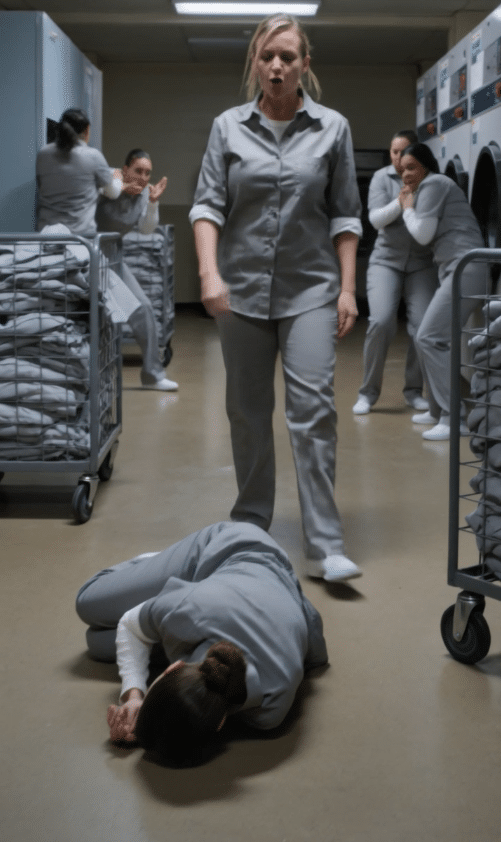
Act I
“I can move it back right now.”
Claire Bennett’s voice was barely audible above the industrial washers roaring around her. She stood beside a rolling laundry cart, one hand gripping its metal handle, the other holding a gray prison uniform she had accidentally placed in the wrong pile. The mistake was small. She had noticed it immediately and was already correcting it.
But Brenda Walsh had no intention of letting her.
“Trash. You work for my whole row now.”
Brenda was forty, broad-shouldered, and feared by the women assigned to the prison laundry workroom. Her sleeves were rolled to her elbows, her blonde hair pulled into a tight knot, and her expression carried the smug certainty of someone who had mistaken a little influence for absolute power.
She had been in prison long enough to understand how unofficial hierarchies worked. Some inmates controlled the best work assignments. Others traded favors, spread rumors, or made sure newcomers understood exactly where they stood. Brenda had established herself as the woman who decided which mistakes mattered and which people would be punished for making them.
Claire had been inside for less than two months.
At twenty-eight, she was smaller than Brenda and still carried herself with the cautious politeness of someone who had not yet learned which ordinary gestures could be interpreted as weakness. She worked carefully, kept her head down, and tried to avoid the arguments that seemed to erupt whenever Brenda was bored.
That morning, Claire had folded a uniform into the wrong cart.
She apologized immediately.
Brenda treated the apology like an insult.
“You heard me,” she said, stepping into the narrow aisle. “You’re doing the whole row’s laundry now.”
Claire glanced at the carts lined up beside the industrial washers. The work had already been divided among several inmates, each responsible for sorting, folding, and delivering a designated load. Reassigning an entire row to one person would mean hours of additional labor, but Claire was less concerned about the workload than about what Brenda might do if she refused.
“I made one mistake,” Claire said carefully. “I’ll fix it and finish my own cart.”
Brenda smiled without warmth.
“You think you get to decide what happens here?”
“No. I’m just trying to correct it.”
“Then stop talking.”
Around them, the washers churned and the laundry carts rattled across the floor. Several women continued folding, but their movements had slowed. They knew Brenda’s temper, and they recognized the dangerous moment when a minor disagreement became an excuse for public humiliation.
Claire pulled the cart backward toward the correct row.
It should have ended there.
Instead, Brenda stepped directly into the aisle.
Claire tried to maneuver around her, careful not to knock into the other carts. Before she could move past, Brenda drove one hard kick into her chest.
Claire stumbled backward and fell beside the rolling cart. Her hand struck its metal frame, leaving a thin trace of blood along the skin. The cart rattled violently, and a stack of folded uniforms slid onto the floor.
For a second, Claire could only stare at the fluorescent lights overhead.
She drew a breath, winced, and tried to pull herself away from the cart wheel.
Brenda stepped closer.
Then she delivered exactly two more kicks, one into Claire’s back and another into her side.
Claire curled in pain, instinctively drawing her arms toward herself. Her injured hand scraped across the concrete as she tried to move away.
Several inmates covered their mouths.
One woman took a step forward, then stopped when Brenda turned her head.
Nobody wanted to become the next target.
Brenda looked down at Claire, whose eyes were wet with pain and disbelief.
“New girls fold from the floor.”
She said it as if she had delivered a clever joke.
Claire struggled to sit up. She was embarrassed by the attention, frightened by the pain, and horrified that the mistake of placing one uniform in the wrong cart had somehow become a reason for another person to treat her like she had no rights at all.
Then the laundry-room door burst open.
The metallic crash cut through the noise of the machines.
A woman in a navy management jacket entered beside the cellblock supervisor. She was fifty, composed, and unmistakably in charge. Her white shirt was immaculate, and a labor-program identification badge hung prominently from her jacket.
Her name was Patricia Monroe, the prison’s labor program manager.
She took in the fallen uniforms, the overturned cart, and Claire on the floor.
Then she raised one hand.
“Shut everything down.”
The supervisor moved immediately. The industrial machines powered off one after another until the room fell into an unnatural silence.
Brenda’s smile disappeared.
Monroe walked toward her, stopping several feet away. She did not touch Brenda. She did not raise her voice or threaten physical retaliation.
She simply looked at her with an expression so cold that even the women who had been afraid to speak began watching openly.
“You just folded your own sentence tighter.”
Brenda stared at her.
“My sentence?”
For the first time, the woman who had controlled the laundry room looked as though she desperately wanted someone else to explain what was happening.
She had assumed that Claire’s inexperience made her powerless.
She had not realized that the workroom was part of a monitored rehabilitation program—and that the manager standing in front of her had been reviewing reports about its unofficial pecking order.
The misplaced uniform had not destroyed Brenda’s future.
Her decision to turn it into an assault might.
And Patricia Monroe had arrived with more than a warning.
Act II
Claire Bennett had never imagined that a prison laundry room would become the place where she learned how much a person’s dignity could depend on the willingness of others to defend it.
Before prison, she had worked as a receptionist at a small medical office in western Pennsylvania. She answered phones, scheduled appointments, helped patients navigate insurance forms, and stayed late whenever the office fell behind. Her life had been ordinary in the way she once took for granted: rent due at the end of the month, groceries to buy, a younger brother who called whenever his car broke down.
Then she made a decision that changed everything.
Claire had been struggling financially after her mother became seriously ill. Medical bills accumulated, her savings disappeared, and she began relying on credit cards to cover expenses she could no longer manage. When a supervisor at the office offered to show her how to alter a few billing entries to conceal an accounting discrepancy, Claire knew she should refuse.
Instead, she agreed.
At first, she told herself the changes were temporary. She believed the money would be replaced before anyone noticed, and she convinced herself that she was helping protect the office from a larger financial crisis.
The arrangement grew.
When investigators eventually examined the records, Claire’s involvement could not be dismissed as a simple clerical error. She had knowingly participated in falsifying documents, and the evidence showed that her actions had helped conceal financial misconduct.
She was convicted.
The judge acknowledged the pressure Claire had been under but made it clear that desperation did not excuse deliberate fraud. Claire understood the verdict, even as she struggled to accept the life that followed it.
She had lost her job, damaged her professional reputation, and disappointed the people who had believed she would always make the responsible choice.
Her younger brother, Michael, stopped visiting for several months. He still answered her letters, but his messages were careful and restrained. Their mother, whose health had improved, continued to write with a tenderness that sometimes hurt more than anger would have.
Claire never blamed them for their distance.
She had made a choice, and she was trying to learn how to live honestly with its consequences.
The prison labor program had become one of the few places where she felt she could rebuild something useful. The work was repetitive, but she liked the order of it. Every uniform had a place. Every cart had a label. If she made a mistake, she could identify it, correct it, and move forward.
It was a comfort she had not expected.
The laundry program also offered inmates the opportunity to earn small work credits and develop practical skills. Claire hoped that completing it successfully would help her prepare for a job after release.
She took the responsibility seriously.
Brenda Walsh had a different relationship with the program.
She had been incarcerated for several years after a violent dispute connected to a failed business arrangement. Before prison, she had worked in a warehouse and supervised a small team. She was accustomed to giving orders, and she had always preferred environments where people followed them without asking questions.
Inside, she had discovered that a person did not need an official title to make others obey.
Brenda had become a de facto leader among several laundry workers. She decided who received easier assignments, who had to handle the heaviest carts, and who could take a brief break when the workload allowed it. She offered favors to inmates who supported her and made life unpleasant for those who did not.
She had no formal authority to impose these punishments.
That distinction rarely mattered to the women who feared her.
The official program had rules for assigning work, addressing errors, and reporting conflicts. Brenda’s unofficial system operated alongside those rules, relying on intimidation to discourage complaints.
A newcomer who challenged her could expect to be mocked, excluded from conversations, or pressured into taking on extra work. Brenda rarely needed to make an explicit threat. Her reputation did the work for her.
Claire had witnessed several such incidents before becoming a target herself.
One inmate had been ordered to refold an entire cart because Brenda disliked the way she had stacked the uniforms. Another had been accused of hiding a missing towel, even though the towel was later found in a different bin. Each time, the other women had kept their heads down.
Claire had told herself that staying out of trouble was the safest option.
She was not proud of the decision, but she understood the fear behind it.
Then came the misplaced uniform.
The mistake gave Brenda an excuse to make an example of her. The assault transformed that excuse into something far more serious.
As Patricia Monroe stood in the silent laundry room, Claire was being helped into a seated position by the cellblock supervisor. Medical staff had been called, and an officer was documenting the scene.
Monroe turned to the supervisor.
“Secure the work area. Preserve the camera footage and identify everyone who witnessed this.”
Brenda immediately tried to regain control.
“She was refusing instructions,” she said. “I was keeping the room organized.”
Monroe looked at the uniform lying beside the cart.
“By kicking her?”
Brenda’s mouth tightened.
“She needs to learn how things work here.”
Monroe’s expression hardened.
“This is a labor program, Ms. Walsh. Not your personal kingdom.”
She instructed the supervisor to separate Brenda from the other workers while the incident was documented. Brenda would not be permitted to approach Claire or communicate with potential witnesses during the initial review.
Brenda stared at the supervisor as though she expected him to hesitate.
He did not.
For the first time, the unofficial rules she had imposed on the laundry room were no longer being enforced.
And Monroe was about to discover that Claire’s assault was not the first warning the program had received.
Act III
The investigation began with the simplest question: What had happened?
The answer was visible on the laundry room’s security recording.
Claire placed a uniform in the wrong cart. She noticed the error and attempted to correct it. Brenda ordered her to perform additional work, then blocked her path when she tried to move the cart back to its proper location.
The footage showed no physical threat from Claire.
It showed Brenda delivering one kick to her chest, followed by exactly two more kicks after she fell.
It also captured the reactions of the women who witnessed the assault. Their fear was visible in the way they stepped backward, avoided Brenda’s eyes, and remained frozen beside the washers.
Monroe watched the recording with the cellblock supervisor and the staff member responsible for reviewing labor-program incidents.
She asked for the complete footage, including the minutes before the confrontation and the period immediately afterward. She did not want a short clip that might remove context or leave room for competing interpretations.
The original recording was preserved.
Claire’s medical assessment was documented, and the staff began collecting individual witness statements. The investigation would follow the prison’s disciplinary procedures, but Monroe made one point clear from the beginning: the fact that the incident had happened between inmates did not make it a private matter beyond the program’s responsibility.
Then the earlier records arrived.
Three weeks before the assault, another inmate had submitted a complaint about being repeatedly assigned extra laundry work by Brenda. The complaint had been classified as a disagreement over workload and resolved informally.
A second report described Brenda humiliating a newcomer after a folding error. That inmate had withdrawn her complaint before the review was completed.
A third record mentioned pressure to surrender preferred work assignments in exchange for being left alone.
None of these reports, taken separately, proved every allegation against Brenda. Some lacked witness statements, and one contained conflicting accounts. But the similarities were difficult to ignore.
The same name appeared repeatedly.
So did the same pattern: a minor mistake, a disproportionate punishment, and a victim who eventually stopped complaining.
Monroe leaned back in her chair.
“Why were these treated as separate disputes?”
The program administrator studied the records.
“They were reviewed as they came in. No single report established a serious pattern at the time.”
“Then why didn’t anyone check whether there was a pattern?”
The administrator had no immediate answer.
The program had focused heavily on completing laundry quotas and maintaining schedules. Staff members had become accustomed to resolving small conflicts quickly so the work could continue. In doing so, they had failed to recognize that some of the conflicts were not ordinary disagreements at all.
Brenda had learned to exploit that weakness.
She kept each act of intimidation small enough to appear manageable until the consequences accumulated. An extra cart here. A humiliating remark there. A threat disguised as a joke. When someone complained, she insisted that she was merely enforcing standards.
The system’s reluctance to escalate minor incidents had given her room to build a private hierarchy inside an official program.
Claire’s assault had made that hierarchy visible.
Monroe ordered a review of the previous complaints and requested additional interviews with inmates who had worked under Brenda. She also instructed the staff to examine whether work assignments had been manipulated to reward cooperation or punish people who refused to obey her.
Brenda, meanwhile, was struggling to understand why her usual explanations were no longer working.
During her initial interview, she insisted that she had been trying to maintain discipline.
“I didn’t like the way she was handling the uniforms,” she said. “I told her to fix it.”
“You could have instructed her to correct the cart,” the investigator replied.
“She should have listened the first time.”
“She was correcting it.”
Brenda shifted in her chair.
“She needs to learn respect.”
The investigator placed a still image from the footage on the table.
It showed Claire reaching for the cart handle just before Brenda stepped into the aisle.
“Where in this image is she attacking you?”
Brenda said nothing.
The investigator continued.
“Where is she threatening you? Where is she refusing to work?”
Brenda looked at the image, then away.
For the first time, she was being asked to defend her conduct against evidence rather than against another inmate’s willingness to contradict her.
She tried a different argument.
“Everyone makes mistakes. If I don’t make people take responsibility, the whole room falls apart.”
“Responsibility is not the same as punishment you invent yourself.”
Brenda’s expression tightened.
She had always believed that the laundry room needed someone willing to be harsh. She considered herself the person who kept the others from becoming lazy, disorganized, and disrespectful.
What she could not explain was why her discipline had required humiliation—or why a misplaced uniform had led her to assault someone who was trying to fix it.
The investigator ended the interview without arguing further.
The evidence would speak for itself.
When Monroe reviewed the growing file, she discovered another problem: some inmates had been reluctant to report Brenda because they believed she would learn who had complained. The records did not establish that every fear was justified, but the perception alone had been enough to keep several women silent.
Monroe directed staff to explain the reporting process clearly, protect witnesses from unnecessary contact with Brenda, and ensure that future complaints could be reviewed without relying solely on face-to-face confrontations.
She also ordered that laundry assignments be returned to the official system rather than informally controlled by inmate leaders.
Brenda’s small empire was beginning to collapse.
But Monroe was not finished.
The program had a responsibility to address the assault, and it also had a responsibility to repair the conditions that had allowed intimidation to become routine.
That meant the next decision would affect more than Brenda’s place in the laundry room.
It could determine whether the women who had watched Claire fall would ever feel safe enough to tell the truth.
Act IV
By the following morning, Brenda Walsh had been removed from the laundry work assignment pending the disciplinary process.
The decision meant she could no longer direct the other workers, allocate their tasks, or use the room’s routines to exert pressure on anyone who had challenged her. She was prohibited from approaching Claire while the initial safety restrictions remained in place.
Brenda reacted as though the prison had taken something that belonged to her.
She demanded to know who had complained. She insisted that the other inmates were exaggerating because they disliked her. She told staff that the laundry program would fall behind without her experience.
No one promised that the program would be unaffected.
The staff simply reminded her that completing the work was not more important than the safety of the people doing it.
The disciplinary review considered the video, Claire’s medical documentation, the witness statements, and Brenda’s own account. Investigators also examined the previous complaints, distinguishing what had been substantiated from what remained uncertain.
The assault itself was not ambiguous.
Brenda had attacked Claire after a minor work error, then kicked her twice more after she fell. Claire had not posed a physical threat, and Brenda had not been acting to protect herself.
The hearing officer found Brenda responsible for the assault under the facility’s disciplinary rules. Sanctions were imposed through the established process, and her removal from the labor program was made permanent.
The related allegations of intimidation were reviewed separately. Where the evidence supported findings, those incidents were included in the disciplinary record. Where the evidence was incomplete, investigators documented the limitations rather than treating every accusation as proven.
Brenda had lost her position in the laundry program.
She had also lost the informal authority she had used to control the other women.
For several days, she kept insisting that the decision was unfair.
Then she began to notice how people responded when she entered a room.
Some looked away. Others continued their conversations. A few who had once hurried to agree with her now kept their distance.
It was not a dramatic confrontation. No one surrounded her or delivered a speech about justice.
They simply stopped acting as though her approval was necessary for them to get through the day.
That loss unsettled Brenda more than she wanted to admit.
Her influence had depended on constant confirmation. People moved when she told them to move, apologized when she demanded it, and accepted extra work because they feared what might happen if they refused.
She had mistaken that behavior for respect.
Now, without the laundry assignment to reinforce her status, she had to confront the possibility that people had never respected her at all.
They had been afraid of her.
The program changed as well.
Work assignments were reorganized under staff supervision. Inmates were given a clearer way to report intimidation, and supervisors were required to document how complaints were reviewed and resolved. Staff members received additional guidance on recognizing when repeated minor incidents might indicate a larger pattern of coercion.
The changes were not presented as a miracle solution. No procedure could guarantee that every inmate would feel safe immediately, and no new form could repair trust overnight.
But the program was no longer relying on the assumption that people who worked together would naturally resolve every conflict themselves.
Monroe also arranged for Claire to receive follow-up medical attention and temporary adjustments to her workload while she recovered. The laundry program could accommodate those adjustments without making her responsible for proving that her pain was serious enough to deserve consideration.
Claire found the change difficult to accept at first.
She was accustomed to apologizing whenever her needs affected someone else’s schedule. Even when staff explained that her recovery was part of the plan, she worried that other inmates would resent her.
One afternoon, Monroe visited the workroom while Claire was sorting a small stack of uniforms at a table away from the heavy carts.
“How are you doing?” the manager asked.
“I’m okay.”
Monroe waited.
Claire looked down at the fabric in her hands.
“I don’t want everyone thinking I’m the reason the program changed.”
“You didn’t create the problem,” Monroe replied. “You were harmed by it.”
Claire swallowed.
“But I did make the mistake with the uniform.”
“Yes. And you corrected it. Those are two separate facts.”
Claire looked up.
Monroe continued in a measured voice.
“You can be responsible for a mistake without becoming responsible for someone else’s decision to hurt you.”
The words struck deeper than Claire expected.
For months, she had been trying to accept responsibility for her own past. She knew that she could not erase the fraudulent records she had helped create, and she did not want to pretend that financial pressure made her choices harmless.
But she had begun to confuse accountability with the idea that she must quietly accept whatever happened to her.
Monroe’s words offered a distinction she had needed to hear.
Claire could admit she had made a mistake with the laundry. She could correct it, learn from it, and continue working.
She did not have to accept violence as the price of getting something wrong.
Across the facility, Brenda was beginning to face a different kind of reckoning.
She had spent years telling herself that the prison was a place where people respected strength. If someone appeared vulnerable, she believed it was natural for others to push them around. If someone complained, she considered it proof that they could not handle the environment.
But the investigation had exposed the flaw in that logic.
Claire’s vulnerability had not made the assault inevitable. Brenda had chosen to turn a harmless error into an opportunity for domination.
No one had forced her to do it.
No one had ordered her to kick Claire.
And no explanation about work quotas or discipline could transform the assault into a reasonable response.
When Brenda eventually crossed paths with Monroe during a supervised administrative meeting, she tried one final time to defend herself.
“You made an example of me,” she said.
Monroe looked at her steadily.
“No. Your actions became an example of what happens when someone mistakes control for authority.”
Brenda’s face tightened.
“You think I’m the only person in this place who’s ever done something wrong?”
“No,” Monroe answered. “But we’re discussing what you did.”
There was nothing dramatic in the reply.
No insult. No threat. No victory speech.
That made it harder for Brenda to dismiss.
She had wanted the investigation to become a debate about whether other people were equally bad, because that would allow her to avoid the question of what she herself had done.
Monroe refused to let her change the subject.
The file remained open where additional review was required, the disciplinary decision stood, and the labor program continued without Brenda directing the women who worked there.
Her sentence had not changed in some magical way.
But the consequences of her conduct had become more serious, more visible, and impossible to shift onto the woman she had hurt.
For the first time, Brenda had to live with a consequence she could not impose on someone else.
Act V
The next time Claire entered the laundry room, the machines were already running.
The familiar roar filled the space. Steam rose faintly from the industrial washers, and rows of gray uniforms waited to be sorted and folded. The rolling carts stood beneath their labels, each assigned to a specific part of the process.
Everything looked almost exactly as it had before.
Claire paused at the doorway.
For a moment, she could see the scene again: the misplaced uniform, Brenda blocking the aisle, the sudden impact, and the awful silence that followed. She remembered the embarrassment of lying on the floor while people watched, and the fear that the same thing could happen again if she made another mistake.
Her hand tightened around the strap of the small laundry bag she carried.
Then a staff member approached and reviewed her assignment.
“You’re on folding today. Take the time you need to do it correctly.”
Claire nodded.
She walked to her station and began working.
The first few minutes were difficult. Every time a cart rattled nearby, she found herself glancing toward the aisle. When another inmate accidentally placed a shirt in the wrong stack, Claire’s shoulders tensed before she could stop herself.
The woman noticed the mistake and moved to correct it.
Nobody shouted.
Nobody stepped in front of her.
The work continued.
It was such an ordinary moment that Claire almost missed its importance.
Before the assault, she had believed safety meant making herself impossible to criticize. If she worked carefully enough, apologized quickly enough, and avoided drawing attention, perhaps no one would choose her as a target.
Now she understood that no amount of perfection could guarantee another person’s good behavior.
The responsibility for violence belonged to the person who chose it.
She could be careful without living in fear of every mistake.
Over the following weeks, Claire gradually returned to more of her regular duties. She was still cautious, and the memory of the assault did not vanish simply because Brenda had been removed from the program. But the room no longer revolved around one inmate’s moods.
The women began speaking more openly about how work was assigned. When a disagreement arose, they were more willing to ask a staff member for clarification rather than allowing it to become a private contest for dominance.
Not everyone trusted the new procedures immediately.
Some had learned through experience that reporting a problem could carry risks. Others worried that speaking up would make them look weak or difficult. Staff members continued to explain the process, review complaints, and make sure that concerns were not dismissed simply because they involved small incidents.
The improvement was gradual.
But it was real.
Claire also began writing to her brother again.
In one letter, she told Michael about the laundry program and the changes that had followed the assault. She did not ask him to forgive her for the fraud conviction or pretend that their family had returned to the way it had been before.
Instead, she wrote honestly about what she was learning.
I used to think taking responsibility meant accepting every bad thing that happened after I made a mistake. I’m beginning to understand that it means owning my choices—not pretending other people have the right to make theirs for me.
She read the paragraph twice before folding the letter.
It was the clearest way she had found to explain the difference.
She still regretted the decision that had brought her to prison. She still carried the knowledge that her actions had damaged trust and caused consequences she could not undo.
But she was learning that regret could be useful without becoming a life sentence of self-hatred.
She could take responsibility for her past and still work toward a better future.
Michael’s reply arrived several weeks later.
It was brief, but it contained something Claire had been afraid she might never hear again.
He wrote that he was glad she was trying to change, and that he hoped they could rebuild their relationship one honest conversation at a time.
Claire held the letter for a long moment.
It was not forgiveness in full. It was not a promise that everything would be repaired.
It was a beginning.
Patricia Monroe continued overseeing the labor program’s corrective measures. She made sure the changes were documented and that supervisors reviewed how assignments were being managed. The program’s purpose, she reminded staff, was to provide structured work and practical experience—not to create a space where inmates could invent their own punishments.
For Monroe, the assault had revealed a danger that could hide inside almost any institution.
When people became accustomed to small acts of intimidation, they could begin treating them as normal. A humiliating comment became a joke. An unfair assignment became a personality conflict. A frightened witness became someone who simply did not want to get involved.
Eventually, the person doing the harm could begin to believe that no one would ever challenge the behavior.
That belief was what Monroe had wanted to break.
She had not entered the laundry room to strike Brenda or humiliate her in return. She had entered to stop the violence, preserve the evidence, and make sure the conduct was addressed through a process that could withstand scrutiny.
The consequences were significant because the evidence was significant.
Brenda had lost her place in the labor program because she had abused the influence she possessed. The investigation had uncovered enough concern to justify reviewing how complaints were handled, and the facility had been required to confront the weakness of a system that allowed informal power to operate without proper oversight.
The lesson was not that a person could never make a mistake.
Claire had made one.
The lesson was that a mistake did not grant someone else the right to inflict punishment outside the rules.
One afternoon, Claire finished folding a stack of gray uniforms and placed them neatly in the correct cart. She checked the label, checked it again, and then stepped back.
Everything was in order.
A younger inmate working beside her accidentally dropped a folded shirt onto the floor. She froze, her face tightening with the expectation of a reprimand.
Claire picked up the shirt and handed it back.
“It’s okay,” she said. “Just put it in the right stack.”
The woman looked at her as though she had expected something much worse.
“That’s it?”
Claire nodded.
“That’s it.”
The woman returned to work.
For a moment, Claire watched her, thinking about how easily fear could teach people to pass cruelty from one person to another. Brenda had treated humiliation as a lesson. She had believed that making someone suffer would prove she was in control.
Claire wanted to learn a different lesson.
A person could correct a mistake without destroying someone’s dignity. A person could demand accountability without inventing punishment. And strength did not require finding someone weaker to carry the weight of one’s anger.
The machines continued turning.
The carts rolled across the floor.
The women kept working.
Nothing about the room looked extraordinary, but Claire no longer saw it as a place where the loudest person automatically decided what everyone else deserved.
Brenda had once believed that the laundry room belonged to her because other inmates were afraid to challenge her. She had treated a misplaced uniform as an opportunity to demonstrate power, never imagining that the same act would expose how fragile her position really was.
When Patricia Monroe told her, “You just folded your own sentence tighter,” Brenda had heard a threat.
What the manager had actually delivered was a warning: every decision leaves a record, and every position of authority comes with limits.
Brenda’s badge had not been taken away because someone stronger had beaten her at her own game.
Her influence had collapsed because the evidence showed what she had done, and the people responsible for the program had finally acted on it.
Claire did not need to see Brenda suffer to know that something had changed.
She only needed to be able to return to work, correct an ordinary mistake, and continue her day without fearing that another person would turn it into an excuse for violence.
The prison doors remained locked. The past remained part of both women’s lives. And neither disciplinary action nor a new set of procedures could instantly erase the harm that had already been done.
But in that laundry room, the rules had begun to mean something more than the demands of whoever shouted the loudest.
Claire placed the last uniform into its proper cart.
Then she pushed it forward.
This time, nobody stood in her way.
And Brenda Walsh, who had once believed that every new inmate had to be taught her place, was left with a question she could no longer force someone else to answer for her.
If power means being able to punish someone for the smallest mistake, what happens when the truth finally gives that person the power to hold you accountable?