Act I
The zipper snapped halfway up the red dress, and the actress reacted as if someone had just insulted her in front of a million people.
“Are you kidding me?” Vanessa Cole shouted, twisting toward the woman behind her. “What is wrong with you?”
The costume assistant stood beside the mirror with a sewing kit in one hand and a handful of dress clips in the other. At twenty-six, Emily Carter had learned that a film set could be more intimidating than any classroom, especially when a single person’s temper had the power to ruin everyone’s day.
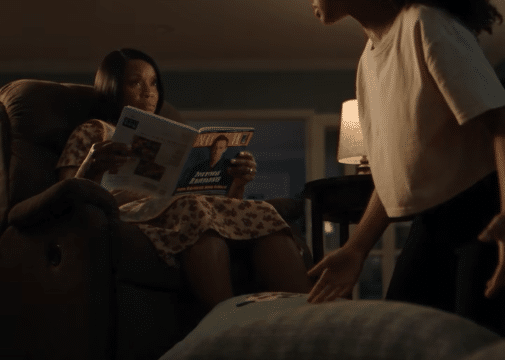
Vanessa was thirty-seven, famous, wealthy, and accustomed to getting whatever she wanted before she finished asking for it. Her face appeared on magazine covers, her name dominated entertainment headlines, and the streaming drama she starred in had turned her into one of the most recognizable actresses in the country.
But inside the crowded costume room of an Atlanta production studio, the zipper of her red dress had become a problem she couldn’t solve by issuing orders.
Emily leaned closer, careful not to tug the delicate fabric.
“I can fix the zipper carefully.”
Vanessa turned her head slowly. Her reflection stared back from three enormous mirrors, surrounded by racks of costumes and the blurred movement of assistants rushing to meet the next shooting deadline.
“Trash. Bow before you touch my costume.”
For a moment, Emily thought she had misheard.
She had worked fourteen-hour days without complaint. She had repaired torn seams minutes before cameras rolled, stayed late to save costumes other people had damaged, and taken responsibility for mistakes she hadn’t made because she knew how quickly a temporary worker could be replaced.
But she had never been ordered to bow.
“Ms. Cole, I’m just trying to—”
Emily reached carefully toward the zipper.
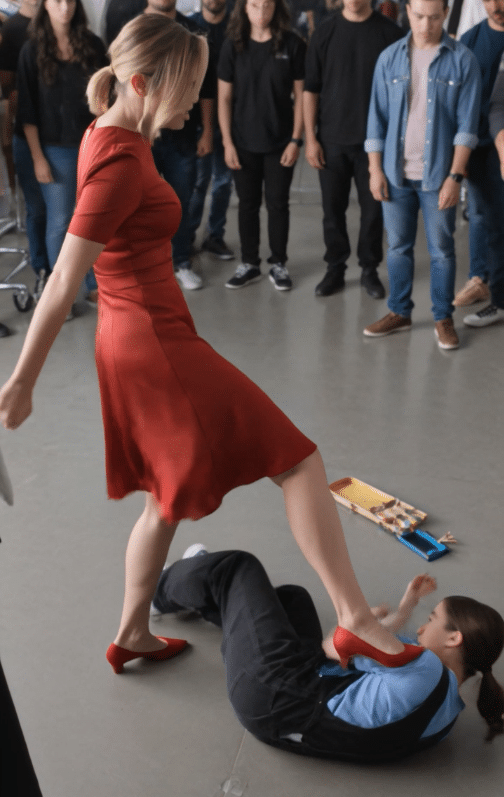
Vanessa stepped back and drove her foot forcefully into Emily’s chest.
The impact sent Emily crashing sideways beside a costume rack. Hangers rattled violently, a few garments slipped from their hooks, and her sewing kit scattered across the floor. She landed hard, one hand scraping against the edge of a metal equipment case.
A thin trace of blood appeared across her palm.
The room froze.
A makeup artist covered her mouth. Two production assistants exchanged horrified looks. An extra standing near the doorway took a step backward, as though witnessing the attack had somehow made her a target too.
Emily struggled to draw a steady breath.
She was hurt, confused, and desperately trying to understand how a broken zipper had become this.
“I can fix the zipper carefully,” she repeated, her voice quieter now.
Vanessa looked down at her with open contempt.
“Trash. Bow before you touch my costume.”
Then she delivered exactly two more forceful kicks, striking Emily in the back and side.
Emily winced and curled instinctively, trying to protect herself without knocking the already unstable costume rack onto the floor. Her fingers gripped the edge of the carpet as she fought to keep herself from crying in front of the people who had just watched her being treated like she wasn’t human.
Vanessa straightened her dress.
“Costume girls stay behind stars.”
No one moved.
The woman who had just been assaulted was surrounded by coworkers, yet the room offered her no protection. Everyone understood what Vanessa could do with a phone call, a complaint to a producer, or a single carefully worded accusation that someone had made her feel unsafe.
Emily understood it too.
She had spent two years building a reputation for being reliable. One angry celebrity could destroy that reputation before lunch.
Vanessa turned toward the mirror, checking her makeup as if nothing important had happened.
Then the set door burst open.
Bright production lights spilled into the costume room, and a woman with short silver hair and a long black coat strode inside, her production headset still resting against her ear.
She took in the scattered sewing tools, the frightened crew, and Emily lying beside the rack.
Then she looked directly at Vanessa.
What she did next would make the entire room understand that the actress had finally chosen the wrong person to humiliate.
Act II
The woman in the black coat was Eleanor Shaw, the showrunner responsible for the series Vanessa had spent the past three years calling her greatest achievement.
At fifty-five, Eleanor had built her career on a reputation that made even powerful executives choose their words carefully. She had started as an assistant on small television productions, worked her way through script revisions and impossible shooting schedules, and eventually become the creative force behind one of the most successful dramas on streaming television.
She was not the loudest person on a set.
She was the person whose silence made everyone else nervous.
Eleanor had no inherited studio connections, no famous relatives, and no patience for people who confused professional authority with personal ownership of everyone around them.
Vanessa, unfortunately, had never learned that distinction.
For years, she had been the unquestioned center of the production. Her contract guaranteed approval over certain wardrobe decisions, promotional appearances, and aspects of her character’s development. Executives tolerated her demands because her name attracted viewers and her image sold subscriptions.
She had mistaken that tolerance for immunity.
If a junior assistant made a mistake, Vanessa could demand a replacement. If a makeup artist disagreed with her, she could request a different one. If a director challenged her interpretation of a scene, she could threaten to leave the production until someone persuaded her to return.
And usually, someone did.
Behind the scenes, her behavior had become an open secret.
A lighting technician had once been forced to apologize because Vanessa didn’t like the way a shadow fell across her face. A wardrobe intern had been blamed for a missing accessory that Vanessa herself had misplaced. Another assistant had quietly resigned after being berated in front of an entire department for failing to predict a last-minute costume change.
Every incident had been treated as an isolated problem.
Every apology had been accompanied by the same explanation.
Vanessa was under pressure. Vanessa was exhausted. Vanessa was essential to the show.
Emily knew nothing about the larger pattern when she accepted the job.
She had grown up in a working-class family outside Savannah, where her mother altered wedding dresses at the kitchen table and taught her that a well-made garment could give someone the confidence to face the world. Emily had learned to sew before she could drive, and she had dreamed of working in film since watching the credits roll on a movie her mother had taken her to see.
The Atlanta production was supposed to be her breakthrough.
She had saved money for months to move closer to the studio. She had borrowed against her savings to buy professional tools and accepted the least glamorous assignments because she believed talent and patience would eventually earn her a place among the costume designers whose names appeared in the credits.
She didn’t need Vanessa to like her.
She only needed the chance to do her job.
That morning, the red dress had arrived with a zipper that already resisted movement. Emily had noticed the problem during an earlier fitting and warned the wardrobe supervisor that the fastening needed reinforcement before the next scene.
The warning had been logged.
But Vanessa had insisted on wearing the dress immediately for a promotional shoot, despite the costume department’s recommendation to make the adjustment first.
Then she had yanked the zipper too hard.
And when it stuck, she had blamed the person standing closest to her.
Eleanor knew none of those details when she entered the room. What she knew was that one of her employees was injured, a famous actress was standing over her, and every witness seemed too frightened to speak.
She crossed the room without looking away from Vanessa.
The actress began to smile, expecting the familiar ritual: a concerned executive, an apology for the inconvenience, and a private conversation about keeping things professional.
Instead, Eleanor stepped between Vanessa and Emily.
She struck Vanessa once, a single forceful slap across the face.
Vanessa staggered half a step, her hand flying to her cheek. A thin trace of blood appeared at the corner of her mouth, and the confidence drained from her expression.
Eleanor didn’t strike her again.
She turned immediately toward Emily, shielding the injured assistant with her own body.
Then she looked back at the actress.
“That zipper just closed the door on your next episode.”
Vanessa stared at her.
The costume room had become so quiet that the faint hum of the overhead lights seemed suddenly deafening.
“My next episode?”
For the first time in years, Vanessa Cole had no idea what would happen next.
And Eleanor Shaw had no intention of explaining everything while Emily was still lying on the floor.
Act III
“Get medical assistance,” Eleanor ordered.
Her voice wasn’t loud, but it moved the room.
A production assistant hurried to call the on-set medic. Another finally stepped forward to retrieve Emily’s scattered sewing tools, while a wardrobe supervisor moved the unstable costume rack away from her.
Eleanor remained beside Emily until the medic arrived.
“Don’t try to stand yet,” she said gently. “Let them check you first.”
Emily nodded, embarrassed by the attention and fighting the urge to apologize for disrupting the schedule.
“I’m sorry about the dress,” she whispered.
Eleanor looked at her as if the words had hurt more than the injury itself.
“You have nothing to apologize for.”
Across the room, Vanessa kept her hand against her cheek.
“This is insane,” she said. “She damaged my costume, I reacted, and suddenly you’re treating me like a criminal?”
Eleanor turned toward her.
“You kicked an employee who was trying to repair a problem you created.”
“You don’t know what happened.”
“I know what I saw when I walked through that door.”
“You saw one second!”
“No,” Eleanor replied. “I saw enough.”
Vanessa glanced toward the other crew members, searching for someone willing to support her version of events. The makeup artist looked down. A production assistant stared at the floor. The wardrobe supervisor stood rigidly beside the rack, her face pale.
Their silence was no longer the silence Vanessa had commanded.
It was the silence of people who had finally realized that someone with authority was willing to listen.
Eleanor removed her headset and handed it to her assistant.
“Secure the footage from the hallway and the costume department entrance. Preserve the production logs from this morning. Nobody deletes anything, and nobody rewrites an incident report to make this easier for anyone.”
Vanessa’s expression changed.
“What footage?”
“The security cameras. The access records. The fitting notes.”
“Those cameras aren’t even pointed at the mirrors.”
“I didn’t say they were.”
Eleanor paused.
“I’m interested in what they can establish.”
The showrunner had been reviewing a separate issue before entering the room. During the previous week, the production office had received complaints about missing costume records, unexplained schedule changes, and repeated attempts to charge expensive wardrobe alterations to the wrong departmental budget.
At first, the problems had appeared to be ordinary production chaos.
But Eleanor had begun noticing a pattern.
Each time Vanessa demanded a last-minute change, someone else seemed to become responsible for the cost. When a fitting ran late, the assistant who had raised the original concern was blamed. When a costume arrived damaged, the paperwork somehow indicated that a junior employee had mishandled it.
The red dress was not the first warning.
It was simply the first incident Eleanor had witnessed with her own eyes.
Vanessa folded her arms.
“You’re going to destroy an entire production over a wardrobe disagreement?”
“Is that what you think happened?”
“That’s what happened.”
“Then you should have no problem with a proper investigation.”
Vanessa’s eyes narrowed.
She was accustomed to arguments that ended when someone calculated how much money she might cost the company. Eleanor was talking about records, procedure, and evidence—things that couldn’t be silenced by threatening to walk off a set.
Still, Vanessa believed she understood the situation.
Eleanor needed her.
The series was expensive. The cast was under contract. International distributors were waiting for the next installment, and the studio had already invested millions in the upcoming season.
Vanessa had been told repeatedly that the show could not survive without her.
She lifted her chin.
“You can’t fire me. I’m the face of this series.”
Eleanor looked at the red dress.
“No,” she said. “You’re one of the people paid to help make it.”
Then she walked with Emily toward the door as the medic prepared to examine her.
Vanessa remained beside the mirror, surrounded by the costumes she had treated as proof of her importance.
She thought Eleanor was bluffing.
But in the production office upstairs, a file was already being opened—and it contained something far more dangerous than a complaint about workplace violence.
Act IV
By midafternoon, the production had been placed on a temporary hold.
The official explanation was that an incident involving a cast member and a crew employee required an internal review. Nobody mentioned Vanessa’s name in the announcement, but the rumor had already begun spreading through the studio.
Some people claimed she had attacked an assistant over a zipper.
Others insisted that the showrunner had personally intervened.
By the time Vanessa reached her trailer, three members of her management team were calling her phone.
She ignored the first two calls.
The third came from her agent, Richard Hale, who had represented her since the early years of her career.
“What happened?” he demanded.
“Eleanor has lost her mind.”
“That’s not an answer.”
“She assaulted me in front of the crew, and now she’s threatening my job because I disciplined an assistant who couldn’t do hers.”
There was a long silence.
Then Richard asked, “Did you touch the assistant?”
Vanessa looked at herself in the mirror.
“She was on the floor.”
“Vanessa.”
“She made me angry.”
“Did you kick her?”
Vanessa’s jaw tightened.
“She was being disrespectful.”
Richard exhaled sharply.
“Tell me you didn’t do what I’m hearing you did.”
She ended the call.
For the next hour, Vanessa tried to regain control of the story. She drafted a statement about an unfortunate misunderstanding, then deleted it. She considered posting a photograph of her cheek, but the image looked too much like evidence of a confrontation she couldn’t explain.
Finally, she called the studio’s head of talent relations and demanded an immediate meeting.
Instead, she was instructed to remain available while the incident was reviewed.
That was when she began to understand that something had changed.
Meanwhile, Emily sat in a quiet medical room with an ice pack resting against her side. The medic had examined her injuries and recommended further evaluation because of the force of the assault. Her palm had been cleaned and bandaged, and every movement reminded her of what had happened.
Eleanor visited her personally.
“I’m sorry,” the showrunner said.
Emily blinked in surprise.
“For what?”
“For allowing an environment to develop where people thought keeping their jobs required them to endure this.”
Emily looked down at her bandaged hand.
“I just wanted to work.”
“I know.”
“I didn’t even pull the zipper. She did.”
“I know that too.”
For a moment, Emily’s composure slipped.
She had been trying not to cry since the costume room, partly because she was hurt and partly because she feared that showing emotion would somehow make her look unprofessional. Now that someone had finally acknowledged the truth, she couldn’t stop the tears.
Eleanor waited without interrupting.
When Emily had calmed down, the showrunner explained that the studio would document the incident, preserve the relevant records, and make sure Emily could speak with the appropriate representatives without pressure from the production team.
“No one is going to ask you to pretend this didn’t happen,” Eleanor promised.
Emily nodded, but her expression remained troubled.
“What happens to the show?”
Eleanor gave her a tired smile.
“The show will survive.”
Then she added, “Whether Vanessa is part of it is another question.”
The investigation moved quickly because the evidence did not depend on anyone’s memory alone. The production had access records, fitting logs, departmental messages, and security footage from the corridor outside the costume room. Several crew members also agreed to provide formal statements about what they had witnessed.
The records revealed that Emily had flagged the zipper problem before the fitting. They showed that Vanessa had insisted on wearing the dress without waiting for the recommended adjustment.
More troubling were the earlier complaints.
A pattern of last-minute demands, retaliatory accusations, and questionable wardrobe charges had been documented over several months. Some reports had been dismissed as personality conflicts. Others had been quietly resolved without reaching the executives responsible for overseeing the production.
Eleanor had already been reviewing those failures before the attack.
Now she had a reason to demand answers.
By the following morning, the studio’s executive committee had convened an emergency meeting. Eleanor presented the documented incident, the witness statements, and the records that connected the costume-room confrontation to a larger pattern of misconduct.
Vanessa attended with her attorney and agent.
She arrived wearing sunglasses and a carefully chosen expression of wounded dignity. She expected a negotiation, perhaps a temporary suspension designed to calm the crew before she returned to work.
Instead, the studio’s chief operating officer placed a document in front of her.
It was a formal notice suspending her from production while the investigation continued, together with a demand that she cease contacting crew members about their statements.
Vanessa stared at the pages.
“You’re suspending me?”
“Pending the outcome of the investigation,” the executive replied.
“This show is built around me.”
Eleanor sat at the far end of the table.
“No. It’s built around the story.”
Vanessa turned toward her.
“You can’t replace me halfway through a season.”
“Scripts can be rewritten. Contracts can be reviewed. Productions can change direction.”
“You would lose millions.”
“Possibly.”
Eleanor’s answer unsettled the room more than an angry speech would have.
She leaned forward.
“But money isn’t a permission slip.”
For the first time, Vanessa had no immediate response.
The committee did not terminate her contract that day. It didn’t need to. The suspension was only the beginning, and the legal review would determine the precise consequences under the terms she had signed.
But Eleanor had already made one decision.
Vanessa would not return to the set while Emily’s assault remained unresolved.
And when the next episode was discussed, the actress who had once treated the production as her personal kingdom would discover that her name was no longer the only one on the agenda.
Act V
Three weeks later, the studio announced that Vanessa Cole would not be returning for the remainder of the season.
The statement was brief. It cited a production review and a decision to move forward in a different creative direction. There were no dramatic accusations in the announcement, no public argument between executives, and no attempt to turn Emily’s suffering into a promotional spectacle.
The consequences were nevertheless unmistakable.
Vanessa’s scheduled appearances were canceled. Promotional commitments were reassigned, and the writing team began restructuring the remaining episodes around a different direction for her character. Her representatives entered negotiations with the studio over the contractual implications of her departure.
The actress who had once believed the entire production depended on her was suddenly forced to explain why she had lost her place in it.
She blamed the showrunner.
She blamed the studio.
She blamed the pressure of an impossible schedule and the people who, she claimed, had failed to support her.
But she could not blame the zipper.
The zipper had been a minor problem. Emily had offered to fix it. The costume notes documented the warning, and the people who witnessed the attack had given their statements.
No matter how Vanessa rearranged the story, the essential truth remained the same.
She had been offered help.
She had answered with cruelty.
And the person she believed powerless had become the center of an investigation she could no longer control.
Emily returned to the studio after receiving medical clearance and taking time away from the production. She was nervous walking through the costume department door for the first time, her sewing kit tucked beneath one arm and her bandaged hand still tender.
The mirrors were in the same place.
The racks stood along the same walls.
But the room felt different.
A few crew members greeted her quietly. The wardrobe supervisor approached and apologized for not intervening sooner. Emily accepted the apology without pretending that the memory had disappeared.
She understood why people had frozen.
She also understood that fear could explain silence without making the silence harmless.
Eleanor had arranged for the studio to review its reporting procedures and establish clearer protections for crew members who raised concerns about cast behavior. The changes did not make the industry perfect overnight, but they gave employees a way to report misconduct without relying on the goodwill of the very people they might be reporting.
Emily wasn’t asked to become the face of that effort.
She didn’t have to give an interview or deliver a speech about resilience.
She was allowed to return to the work she loved.
Several months later, a new costume designer noticed the care Emily took with an elaborate period dress. The garment required delicate handwork, careful measurements, and the kind of patience that rarely attracted attention until something went wrong.
Emily explained the construction, demonstrated a repair technique, and showed how a small reinforcement could prevent a fastening from failing during a long day of filming.
The designer listened closely.
Then she asked Emily to help oversee the wardrobe preparation for the next production.
It was a modest promotion by Hollywood standards.
To Emily, it meant something far greater.
For the first time, someone had recognized her skill without first asking whose approval she carried.
On the first day of the new production, Emily stood in front of a mirror, checking a costume before it went to set. She smoothed the fabric, tested the fastening, and carefully closed the zipper.
It worked perfectly.
She smiled, almost despite herself.
Then she heard Eleanor’s voice behind her.
“Everything holding together?”
Emily turned.
“Everything that matters.”
Eleanor laughed softly.
For a moment, neither woman mentioned Vanessa. They didn’t need to. The story had already traveled through the studio, changing slightly with every retelling, but its central lesson had remained intact.
A famous actress had believed a costume assistant existed beneath her.
A showrunner had reminded her that a person’s worth was never measured by the title on a call sheet.
And a broken zipper had exposed something that years of expensive publicity had managed to hide.
Vanessa had once commanded a room simply by entering it.
Now, whenever someone mentioned the production, people remembered the moment the door flew open, the silver-haired showrunner stepped between an injured worker and a powerful star, and one sentence changed the direction of an entire season.
“That zipper just closed the door on your next episode.”
Vanessa’s final question had been almost childlike in its disbelief.
“My next episode?”
She had asked because, until that moment, she had never seriously considered the possibility that the world could continue without giving her another scene.
But the cameras kept rolling.
The crew returned to work.
The story moved forward.
And the woman who had been told to bow before touching a dress learned that she could stand upright without anyone’s permission.