Act I
“I’m moving as fast as I can.”
Thomas Walker’s voice trembled as he tried to steady himself on the narrow stone path, his cane tapping against the pavement while a wealthy jogger charged toward him from behind.
The morning sun had barely risen above the manicured lawns of the neighborhood. Luxury homes stood behind tall hedges, sprinklers whispered across perfectly trimmed grass, and runners in expensive athletic clothes moved through the park as if the entire world had been arranged for their convenience.
Thomas was not running.
At sixty-six, the former soldier was relearning how to trust his body after losing a leg. His prosthesis had been giving him trouble that morning, and every step required concentration. He wore an old navy athletic jacket and gray workout pants, his tired face set with the stubborn determination of someone who had already survived far worse than an uncomfortable walk.
He had chosen the quietest part of the path for his rehabilitation.
Unfortunately, Blake Morgan believed the path belonged to him.
Blake was forty, dressed in a sleek black running outfit that probably cost more than Thomas’s entire wardrobe. Wireless earbuds sat in his ears, and an expensive sports watch glowed on his wrist as he checked his pace.
When he saw Thomas moving slowly ahead, his expression twisted with irritation.
“Move!”
Thomas turned his head.
“I’m trying to step aside.”
“Then do it faster!”
Thomas shifted his weight, attempting to move toward the grass without losing his balance. His prosthetic foot caught slightly against the uneven edge of the stone path, and he tightened his grip on his cane.
“I’m moving as fast as I can,” he repeated.
Blake stopped behind him.
For a moment, the only sounds were the birds in the trees and the faint rhythm of runners approaching from another bend.
Then Blake stepped forward.
“Trash. You’re blocking the whole path.”
Thomas looked up at him, stunned by the insult.
“There’s room to go around me, son.”
That calm answer seemed to make Blake angrier.
He had spent his morning tracking his pace, measuring his distance, and making sure nothing interrupted his carefully controlled routine. Now, in his mind, this elderly man had become an obstacle that had no right to exist in his way.
Blake’s eyes flicked toward the prosthetic leg.
“You people always expect everyone else to wait.”
Thomas’s face tightened.
“You people?”
“You heard me.”
Thomas tried to move farther toward the grass.
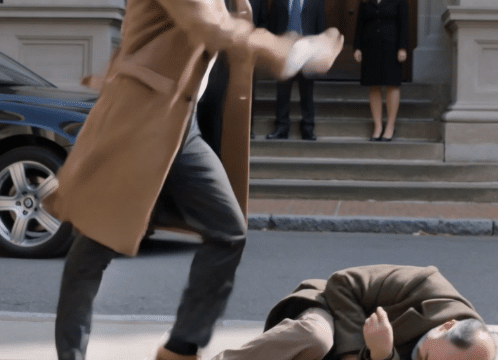
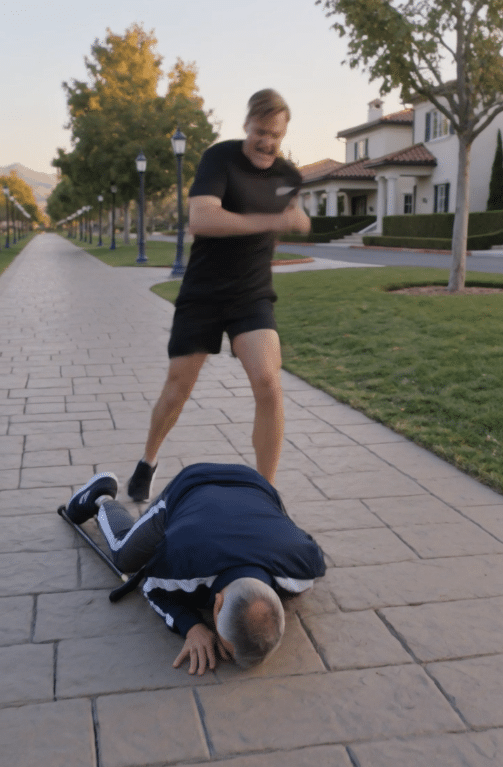
But before he could regain his balance, Blake accelerated from behind and drove a brutal kick into his back.
Thomas lurched forward and crashed onto the stone path.
His cane spun away, clattering across the pavement. His elbow and knee scraped against the rough stones, leaving thin traces of blood, while the impact sent a sharp wave of pain through his back and side.
He tried to push himself up.
His arm trembled.
His prosthetic leg was awkwardly positioned beneath him, and without his cane, he could not regain his balance. He drew a painful breath, his expression caught between disbelief and the instinctive fear of someone suddenly helpless on the ground.
Blake stepped closer.
Thomas reached toward the cane.
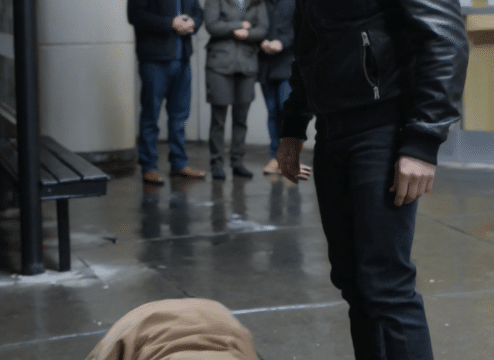
Blake kicked him twice more, striking his back and side as he struggled to move away.
Several nearby runners stopped. A woman covered her mouth. A man standing beside a park bench took a step backward, his eyes fixed on the scene.
Nobody moved toward Thomas.
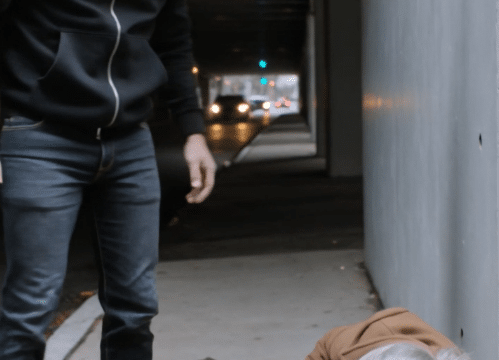
Blake looked down at the injured veteran.
“Stay off the trail if you can’t keep up.”
Thomas curled slightly around his pain, struggling to breathe normally.
He had worn a uniform when he was young. He had followed orders, carried burdens, and learned what it meant to keep moving when his body begged him to stop.
But nothing in those memories prepared him for the humiliation of being kicked across a public path while strangers watched.
Then, from a luxury house beside the park, a door flew open.
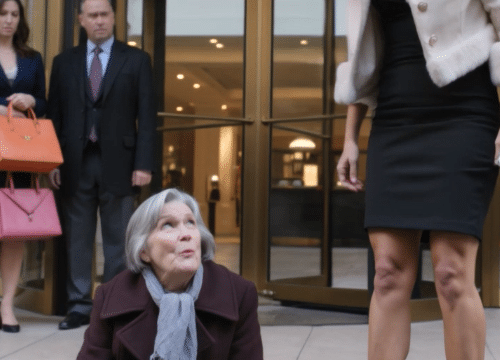
A woman in a white coat rushed down the front steps and ran straight toward the fallen man.
She did not look at the joggers.
She did not look at the expensive houses.
She saw Thomas.
“Dad!”
Natalie Walker dropped beside him, placing one arm protectively across his body. She retrieved his cane and carefully set it near his hand before turning toward Blake.
The expression on her face was no longer that of a wealthy businesswoman beginning her day.
It was the expression of a daughter who had just found someone attacking the man she loved most.
“That is my father,” she said, her voice shaking with fury. “And this park exists because of him.”
Blake froze.
Natalie kept her eyes on him.
“You kicked an injured veteran because he couldn’t move fast enough for you.”
The jogger’s mouth opened, but his confidence had disappeared.
He looked at Thomas.
Then at Natalie.
Finally, his eyes widened as the meaning of her words reached him.
“He built this park?”
For the first time that morning, Blake Morgan had nothing to say.
And for the first time since the attack began, everyone watching understood that the man on the ground was not going to be left alone.
But what Blake did not yet understand was that the park’s history was only the beginning of what he had just destroyed.
Act II
Thomas Walker had never believed a person needed wealth to make a difference.
He had spent most of his life believing the opposite.
When he returned home after military service, he brought back memories he rarely discussed, a deep appreciation for ordinary mornings, and a determination to build a life that was useful to other people.
He married his childhood sweetheart, Margaret, and raised their daughter Natalie in a modest home where money was sometimes tight but dinner was always shared whenever possible.
Thomas worked in construction management, eventually establishing a small company that specialized in repairing public spaces, restoring neglected properties, and making older buildings safer for the people who used them.
He was not a glamorous businessman.
He did not appear on magazine covers or spend his evenings attending charity galas. He preferred early starts, practical solutions, and the quiet satisfaction of seeing something broken become useful again.
Natalie inherited his determination, though she approached the world differently.
She studied finance, learned how to navigate corporate negotiations, and eventually built a successful investment firm. Her career brought her into rooms Thomas would never have sought out, but she had never forgotten who taught her to recognize the difference between owning something and taking responsibility for it.
When Thomas lost his leg after a serious accident years later, his life changed in ways he struggled to explain.
The physical recovery was difficult, but the loss of independence hurt in quieter ways. He hated having to ask for help with ordinary tasks. He became frustrated when people spoke to Natalie instead of him, as if the prosthesis had somehow taken away his ability to make decisions.
He refused to let that frustration define the rest of his life.
His rehabilitation began with short walks.
First, he crossed the living room. Then the driveway. Later, he made it to the end of the street, resting against a fence when his balance failed.
Every improvement came with a new problem.
Some mornings, the prosthesis fit comfortably. On others, pressure and fatigue made every step a negotiation. He learned to pay attention to his posture, adjust his pace, and stop before exhaustion turned a careful movement into a fall.
The park became part of that recovery.
It was quiet at sunrise, with broad stretches of grass, mature trees, and a stone path that wound past a small pond. Thomas had walked there long before his injury, back when he could cover several miles without thinking about his feet.
Returning to it felt like reclaiming a small piece of his old life.
The park also held a personal history that few visitors knew.
Years earlier, the land had been threatened by a commercial development that would have replaced its trees and walking paths with private buildings and parking spaces. Thomas had been involved in a community effort to preserve it, contributing money, construction expertise, and years of work to turn a neglected public area into a safe, accessible green space.
He helped redesign the paths, worked with landscape crews, and insisted that the project include routes suitable for people with mobility limitations.
He wanted children to have somewhere to run.
He wanted older residents to have somewhere to walk.
He wanted veterans returning from service, including people whose injuries changed how they moved through the world, to have a place where they did not feel like intruders.
When funding fell short, Thomas helped organize private donations and convinced local businesses to contribute materials and labor.
Natalie, already building her own financial career, eventually provided a major portion of the remaining funding through a foundation she established with her father.
The park became a shared family project.
Thomas supplied the vision and practical experience. Natalie helped secure the resources to complete it. Together, they ensured that the land remained open to the public.
The finished park carried no grand monument to their family.
There was no enormous statue of Thomas, no golden plaque announcing his generosity. The only permanent recognition was a modest dedication near the main entrance, naming the people and community groups who had helped preserve the land.
Thomas had preferred it that way.
“A park isn’t supposed to make the people who paid for it feel important,” he had once told Natalie. “It’s supposed to make the people who use it feel welcome.”
Natalie had remembered those words for years.
She had also remembered how her father reacted when people tried to treat him differently because of his injury.
He would accept assistance when he needed it, but he would not accept pity as a substitute for respect.
That morning, he had left the house before breakfast to continue his rehabilitation walk. Natalie had been reviewing documents at home when she noticed him moving along the path through a window overlooking the park.
She was preparing to join him when she saw a man approach from behind.
At first, she thought the jogger might simply ask to pass.
Then she saw the kick.
She watched her father fall.
For one terrible second, her mind refused to process what her eyes had seen. Then she was out the door, running toward him with no thought for her coat or the neighbors watching from their windows.
Now, kneeling beside Thomas, Natalie could see the pain in his face.
“Dad, don’t try to stand yet.”
“I’m all right,” Thomas managed.
“No, you’re hurt.”
“I’ve been hurt before.”
“That doesn’t mean you have to pretend this doesn’t hurt.”
He looked at her, and some of the tension left his face.
“I don’t want you to worry.”
Natalie swallowed hard.
“I’m your daughter. Worrying about you is part of the job.”
She made sure his cane was within reach, then checked that he could answer her questions clearly. She called for medical assistance and asked the nearby witnesses to remain available.
Only after she was satisfied that her father was not being left alone did she stand and face Blake again.
The jogger had removed one earbud.
His eyes darted between Natalie and Thomas, as though he was still searching for an explanation that would make the scene less serious.
“Look,” he began, “he was blocking the path.”
Natalie stared at him.
“You kicked a man from behind.”
“He wouldn’t move.”
“He was trying to maintain his balance.”
“I didn’t know he was your father.”
The words landed like a second insult.
Natalie’s expression hardened.
“And if he weren’t?”
Blake had no answer.
She glanced toward the stone path, where her father’s cane lay beside the place he had fallen. A small mark of blood remained on the pavement.
Then she looked back at the man who had caused it.
“You seem to think you only did something wrong because you picked the wrong person.”
Blake shifted uncomfortably.
Natalie stepped between him and her father.
“You are going to stay here while this is reported. And you are not going anywhere near him.”
The jogger glanced at the witnesses, hoping someone might help him turn the situation into a dispute over trail etiquette.
Nobody did.
But Natalie had no intention of letting the incident become a story about a wealthy daughter protecting her injured father.
What mattered was that the park had been built for people like Thomas to use safely.
And Blake had treated that very purpose as a personal inconvenience.
Act III
The first responders arrived as the morning light spread across the park.
They examined Thomas, asked about his pain, and helped him remain in a stable position while they assessed his injuries. Natalie stayed beside him, answering questions when necessary but allowing her father to speak for himself.
Thomas disliked being the center of attention.
He disliked even more the thought that his daughter might turn the incident into a personal crusade because she had the money and influence to do so.
“Let the people who saw it tell them what happened,” he said quietly.
Natalie nodded.
“They will.”
Several witnesses had already begun speaking with the responding officers. Their accounts were consistent: Thomas had been walking slowly, Blake had approached from behind, and the attack had begun without any physical threat from the veteran.
A runner who had stopped near the pond explained that she had heard Blake shouting before she saw Thomas fall. Another witness confirmed that the jogger had delivered additional kicks after Thomas was already on the ground.
A man who had initially stepped away returned to offer his account.
“I should have moved sooner,” he admitted to Natalie.
She looked at him, anger still burning behind her eyes, but she answered carefully.
“You saw something frightening. I’m glad you’re willing to tell the truth now.”
It was important that the witnesses understood the difference between responsibility and fear. Blake had chosen to attack Thomas. The people who watched had been startled by an act of sudden violence, but their statements could help ensure that it was not minimized or misrepresented.
Blake, meanwhile, had begun trying to explain himself.
“He was in the way,” he told one of the officers. “I was running. I didn’t expect him to take up the entire path.”
The officer asked him to describe what he meant by that.
Blake gestured impatiently toward the narrow stretch of stone.
“He was moving too slowly.”
Natalie heard him from where she stood beside her father.
She turned.
“That path belongs to everyone.”
Blake looked at her.
“I didn’t know who he was.”
“You keep saying that as if it changes what you did.”
“I didn’t know he was the person who helped build this place.”
Natalie took a slow breath.
“My father helped preserve this land when people wanted to replace it with private development. He worked to make the paths accessible. He wanted people with injuries, older residents, parents with children, and people who simply needed a quiet place to walk to be able to use it.”
She glanced toward Thomas.
“He didn’t do that so someone could look at a man with a prosthetic leg and decide he was a nuisance.”
Blake’s face reddened.
“I wasn’t thinking about his leg.”
“Then what were you thinking about when you kicked him from behind?”
Silence.
Natalie continued.
“You had room to slow down. You had room to ask him to move. You had room to go around him. Instead, you chose to hurt him.”
Blake looked away.
The words seemed to strip away the excuses he had been building since she arrived. He had expected the conversation to focus on whether Thomas was important, whether Natalie owned property nearby, or whether Blake had unknowingly offended someone powerful.
But none of those questions explained the attack.
The park’s dedication records could establish Thomas’s role in preserving the land. The foundation documents could show Natalie’s contributions. Witnesses could confirm what Blake had done.
Yet the central truth required no paperwork at all.
An elderly man had been walking along a public path, trying to maintain his balance.
A jogger had decided that the man’s pace was an insult.
And violence had followed.
Natalie knew the neighborhood would soon be full of rumors. Some residents would describe Blake as an otherwise respectable man who had made a terrible mistake. Others would focus on Thomas’s connection to the park, treating the incident as if its significance came from the victim’s identity.
She refused to let either interpretation erase what mattered.
Later that morning, after Thomas had been taken for medical evaluation, Natalie met with the park’s management representatives. The property was maintained through a public-private arrangement supported by local funding and her family’s foundation, with rules designed to keep the grounds open and accessible.
She requested that any available security footage be preserved and that the incident be formally documented. The park’s staff agreed to cooperate with the authorities and provide relevant records.
She also asked for the park’s existing accessibility and incident-reporting procedures to be reviewed.
Not because the path had caused the assault.
Because the place had been created to welcome people, and the community needed to know that violent behavior would not be dismissed as a private disagreement.
Before the meeting ended, one of the representatives mentioned the dedication near the entrance.
“People should understand why this park exists,” he said.
Natalie considered that.
“Yes,” she replied. “But not because my father was attacked.”
She looked out toward the trees.
“They should understand because it’s the right way to build a public space.”
By the afternoon, Blake had learned enough about Thomas’s role to understand that the quiet man he had kicked was part of the park’s history.
But the discovery did not make him regret the attack for the reason Natalie hoped.
He was frightened of the consequences.
And the distinction between fear and remorse was about to become impossible to ignore.
Act IV
By the following morning, the incident had spread through the neighborhood.
People who regularly walked the park had heard that an elderly veteran had been assaulted on the stone path. Some recognized Thomas from his daily rehabilitation walks. Others knew him as one of the people who had helped save the land years earlier.
The story traveled from the walking groups to the neighborhood association, then to residents who had never spoken to Thomas but had used the park for years.
Blake Morgan had believed the trail was a private extension of his morning routine.
Now he discovered that the people who used it had their own memories, relationships, and reasons for being there.
A mother who pushed a stroller along the path remembered how Thomas had insisted that the route remain wide enough for wheelchairs and mobility aids. An older resident recalled attending a community meeting where Thomas had argued that a public park should not be designed only for the young and physically fit.
One veteran remembered Thomas volunteering at a local rehabilitation event, encouraging people to set manageable goals instead of comparing their progress with anyone else’s.
These were not stories about a wealthy benefactor demanding gratitude.
They were stories about a man who had quietly invested in the lives of people he might never meet.
Natalie did not organize a public campaign against Blake. She did not use her business connections to pressure the authorities or ask the neighborhood to harass him.
She cooperated with the investigation and allowed the evidence to speak.
The witness statements, the physical evidence, and any available recordings were reviewed through the appropriate process. The central details remained consistent: Blake had approached Thomas from behind, kicked him to the ground, and delivered two additional kicks while he struggled to reach his cane.
There was no credible evidence that Thomas had threatened him.
There was no justification for the assault.
Blake attempted to explain that he had been frustrated by the slow pace of the walk and had lost control of his temper. He also pointed to his clean record and his long-standing reputation in the neighborhood.
But neither his reputation nor his impatience changed what the witnesses had seen.
The matter proceeded through the appropriate legal channels, with decisions left to the authorities responsible for determining the consequences of the assault.
The park’s management also reviewed how staff should respond to violent incidents and how witnesses could report concerns. The review was not an admission that the park’s design had caused the attack. It was a recognition that a public space must be prepared to respond when someone attempts to make it unsafe for others.
For Natalie, the hardest part was not the paperwork.
It was seeing her father return home with the same careful movements he had spent months trying to improve.
The assault had interrupted his rehabilitation and shaken his confidence. Even after medical staff cleared him to resume gentle activity, he hesitated when he approached the front door.
His cane rested against the wall.
He looked at it for several seconds before picking it up.
Natalie stood nearby, resisting the urge to take it from him or insist that he rest.
“Do you want me to come with you?” she asked.
Thomas considered the question.
“Not today.”
“All right.”
“I need to see if I can do this myself.”
She nodded, though the answer hurt.
Her instinct was to protect him from anything that might cause more pain. But she understood that helping him recover meant respecting his independence, even when doing so frightened her.
Thomas took a few careful steps across the driveway.
His prosthetic leg moved forward. His cane touched the ground. He paused, adjusted his balance, and continued.
It was slower than before.
But it was movement.
Natalie watched until he reached the sidewalk, then joined him at his side without taking his arm.
They did not discuss Blake.
They did not discuss the park’s dedication or the neighborhood’s reaction.
They talked about the weather, the small garden outside the house, and the fact that Margaret wanted them to pick up fresh bread on the way home.
Ordinary things.
The kinds of things Thomas had been trying to reclaim all along.
When they reached the entrance to the park, he stopped beside the modest dedication marker. His name appeared among those who had helped preserve the land, but he barely glanced at it.
Instead, he watched a young father guide a child along the path. Farther ahead, an older woman walked slowly with a cane of her own. A runner approached from the opposite direction and moved aside to give her room.
Thomas’s shoulders eased.
“That,” he said quietly, “is how it’s supposed to work.”
Natalie followed his gaze.
Nobody had announced who the woman was. Nobody needed to know how much money she had, where she lived, or what she had contributed to the community.
She was simply using the park.
And someone had made room for her.
Thomas turned toward the path.
He was not ready to walk far, and Natalie did not push him. They stood together for a moment longer before he took his first careful step forward.
This time, there was no shouting behind him.
But the real test of what the neighborhood had learned would come when the story was no longer fresh, when the witnesses had returned to their routines, and when Thomas was once again just an older man moving slowly along a public path.
Act V
Several weeks later, Thomas returned to the park at sunrise.
The sky was pale gold above the trees, and the air carried the cool stillness that came just before the neighborhood fully awakened. Sprinklers clicked across the lawns, birds moved between the branches, and the stone path glowed softly beneath the morning light.
Thomas stood at the entrance with his cane in one hand.
His recovery was not complete.
Some mornings, his prosthesis still caused discomfort. His balance remained less reliable when he was tired, and the memory of the attack occasionally returned without warning.
But he had decided that Blake Morgan would not determine whether he continued walking.
He adjusted the strap on his old navy jacket and began moving along the path.
One step.
Then another.
He was slower than the runners passing farther ahead, but he was moving at the pace his recovery required.
At the first bend, a jogger approached from behind. Thomas heard the rhythmic footfalls and instinctively shifted toward the edge, preparing to make room.
The runner slowed.
“Take your time,” the man said. “I’ll go around.”
Thomas looked up.
“Thank you.”
The exchange lasted only a second.
No dramatic announcement followed. No one recognized him as the man from the incident. The runner continued on his way, and Thomas continued walking.
Yet that small moment meant more to him than the public attention that had followed the assault.
He did not want every person in the park to know his name.
He wanted people to understand that a narrow path was not a racecourse reserved for whoever could move fastest. It was shared space, and the people using it had different bodies, different needs, and different reasons for being there.
Natalie joined him a little later.
She had left the house wearing her white coat over black trousers, her pace brisk until she reached her father. Then she slowed to match him.
“How are you feeling?” she asked.
“Better.”
“Any pain?”
“Some.”
“Should we turn back?”
Thomas gave her a sideways look.
“Are you asking because you’re worried, or because you think I can’t decide for myself?”
Natalie smiled faintly.
“Both can be true.”
He chuckled.
“Let’s go to the next bench. Then we’ll see.”
They continued together.
As they passed the pond, Natalie told him that the park’s management had completed its review of incident procedures and that staff now had clearer guidance for reporting violent behavior. The authorities had continued handling the assault through the proper channels, and the case was being addressed on the basis of the evidence.
Thomas listened without asking for details.
“I hope they take it seriously,” he said.
“They are.”
“Good.”
He did not ask whether Blake had lost friends or whether the neighborhood had turned against him. He did not want revenge to become another burden he carried through his recovery.
He wanted accountability.
He wanted people to recognize the harm that had been done and understand that impatience did not excuse violence.
Most of all, he wanted to continue living without feeling that every slow step required an explanation.
When they reached the bench, Thomas sat carefully and rested his cane beside him. Natalie took the place next to him, looking across the grass toward the houses.
From there, the park seemed almost exactly as it had before the assault.
Children would arrive later in the morning. Dog walkers would follow the paths. Older residents would sit beneath the trees, and runners would measure their distances along the stone walkway.
The attack had not changed what the park was meant to be.
But it had revealed how easily one person’s arrogance could threaten the sense of safety that everyone else took for granted.
Natalie rested her hand over her father’s.
“I was so scared when I saw you on the ground.”
Thomas looked at her.
“I know.”
“I keep thinking about what might have happened if I hadn’t seen it.”
He squeezed her hand gently.
“But you did.”
“That doesn’t make me feel better.”
“No,” he admitted. “It probably doesn’t.”
They sat in silence for a while.
Then Thomas glanced toward the dedication marker near the entrance.
“You know, when we started this project, people kept asking why we needed to make the path wider. They said most people could already walk through just fine.”
Natalie remembered.
She had been younger then, sitting beside her father at community meetings while residents argued about budgets and construction plans.
“What did you tell them?” she asked.
Thomas smiled slightly.
“I told them that a path isn’t accessible because the fastest person can get through it. It’s accessible when the people who need it most can use it, too.”
Natalie looked out across the park.
The sentence stayed with her.
Thomas had never built the park so people would know who he was. He had helped preserve it because he understood that a public space should not demand that people prove their worth before allowing them to belong.
Blake had failed to understand that principle in the cruelest possible way.
He had seen a man with a prosthetic leg and a cane and concluded that the man was an inconvenience. He had mistaken physical vulnerability for permission to dominate.
And when he discovered that Thomas had helped build the park, his shock had exposed the assumption beneath his behavior.
He had believed the attack was unforgivable because the victim was important.
But Thomas’s importance had never depended on his role in preserving the land, his daughter’s wealth, or the names engraved on a dedication marker.
He was a human being trying to recover.
That was enough.
After a few minutes, Thomas pushed himself carefully to his feet. Natalie rose beside him but waited for him to settle his balance before they started walking again.
He moved toward the next bend, his cane tapping against the stone.
The morning sun climbed higher.
Behind them, the bench remained empty, waiting for the next person who needed to rest. Ahead, the path curved between green trees and open grass, wide enough for people to pass one another without a struggle.
Thomas kept walking.
He would not pretend the assault had never happened. He would not forget the pain or the fear of lying helpless on the stones while strangers watched.
But he refused to let that moment become the final word on his life.
He had spent years helping build a place where people could walk freely.
Now, one careful step at a time, he was claiming that freedom for himself.
And if Blake Morgan ever returned to the park, he would find the same stone path, the same trees, and the same quiet morning air.
He might also find Thomas Walker moving slowly ahead of him.
This time, the only question that mattered would be whether he had learned to see the person in front of him before deciding that the world belonged to him alone.
Because Thomas had helped build the park.
But he had never built it for people like himself alone.
He had built it for everyone.