Act I
“I want this chair for my wife.”
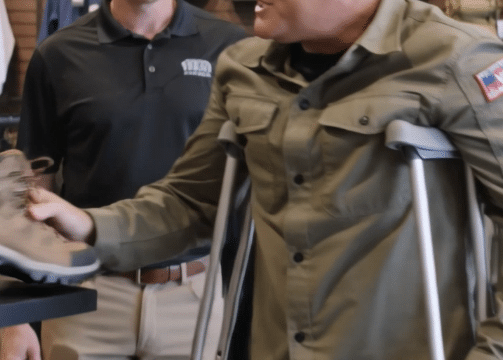
Arthur Collins stood beside an adjustable leather recliner in the middle of an expensive furniture showroom, one weathered hand resting on the chair’s arm. His old wooden crutches supported his weight, and his faded Army jacket looked painfully out of place among the polished wood tables, designer lamps, and well-dressed shoppers wandering beneath the warm display lights.
He had not come to argue.
He had come to find a chair.
At seventy, Arthur had learned to measure comfort differently from the people who designed luxury furniture. A soft seat mattered. A reliable footrest mattered. So did a control panel his wife could operate without twisting her aching wrists.
For weeks, she had complained that their old recliner made it difficult to stand. She tried to hide the discomfort, always insisting she was fine, but Arthur had watched her grip the armrests and struggle to rise.
He had promised her he would find something better.
Now, as he studied the adjustable model in front of him, he looked toward the showroom manager.
“How much is this one?”
Preston Vale glanced at Arthur’s jacket, then at his crutches.
The manager was thirty-eight, impeccably dressed in a light gray suit, with polished shoes and an expensive watch that caught the overhead light whenever he moved his hand. His name badge identified him as the showroom manager, a position he wore with the confidence of a man accustomed to having the final word.
He barely looked at the recliner.
“You need to leave.”
Arthur blinked.
“I’m sorry?”
“You heard me. This isn’t a place to wander around all afternoon.”
“I’m shopping,” Arthur replied. “I’d just like to know the price.”
Preston let out a short, contemptuous laugh.
“Shopping?”
Arthur’s fingers tightened around his crutches.
“Yes, sir.”
“I don’t think you understand what we sell here.”
Arthur looked around at the furniture, then back at the manager.
“I understand enough to ask how much a chair costs.”
For a moment, Preston’s expression hardened. The old man had not shouted, threatened him, or even raised his voice. Somehow, that calm refusal to be embarrassed seemed to irritate the manager more than an argument would have.
Preston stepped directly into Arthur’s path.
“Trash. You can’t afford this room.”
A woman examining a dining table turned around. A couple standing beside a display sofa fell silent.
Arthur’s cheeks flushed, but he did not lower his eyes.
“You don’t know anything about what I can afford.”
Preston smiled coldly.
“I know what I see.”
Arthur glanced back at the recliner.
“My wife needs a comfortable chair. That’s all I’m here for.”
“Then shop somewhere that matches you.”
Arthur tried to move past him.
Preston’s patience snapped.
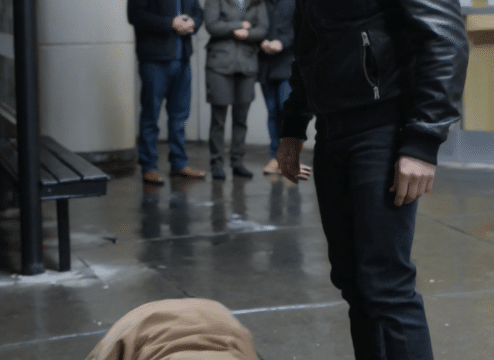
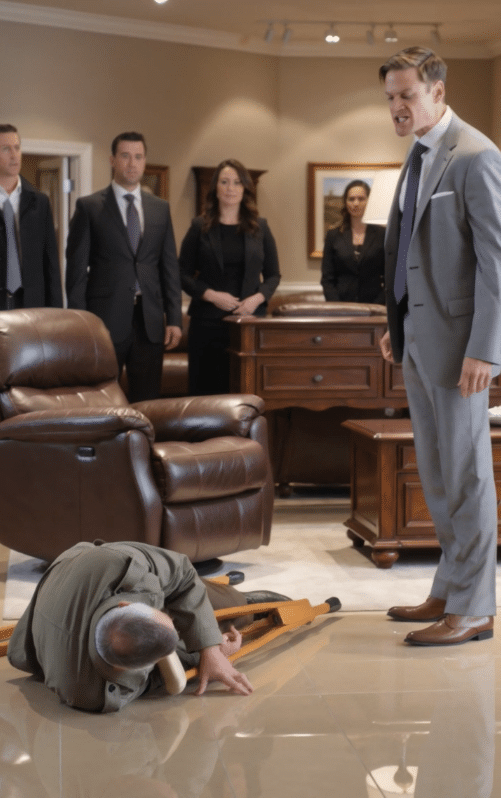
He stepped forward and drove a forceful kick into Arthur’s chest.
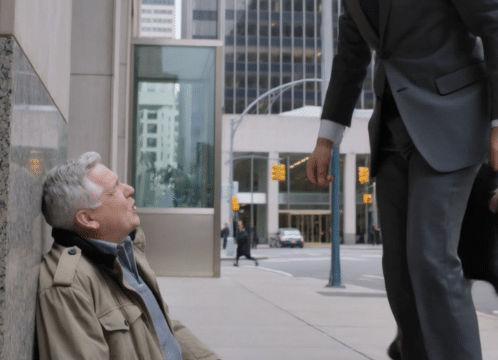
The older man was knocked backward beside the recliner display. His crutches shot away across the polished floor, one sliding beneath the edge of the leather chair. Arthur hit the ground hard, catching himself with his hand as the impact stole the breath from his lungs.
A thin trace of blood appeared where his palm scraped the floor.
For several seconds, he could do nothing but grimace and struggle to breathe.
His missing leg made it impossible to push himself upright in the way he instinctively tried. He shifted his weight, wincing, and reached toward the crutch trapped beneath the recliner.
“I want this chair for my wife,” he gasped.
Preston looked down at him.
“Trash. You can’t afford this room.”
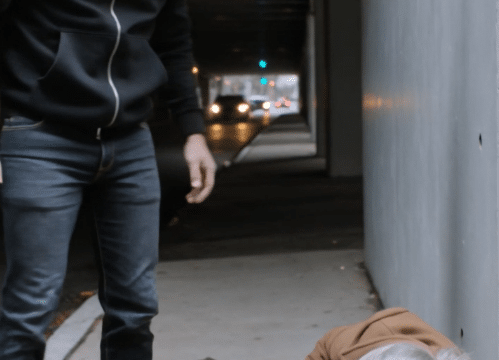
Then the manager stepped closer and kicked him twice more, striking his back and side as Arthur curled defensively against the pain.
Shoppers recoiled.
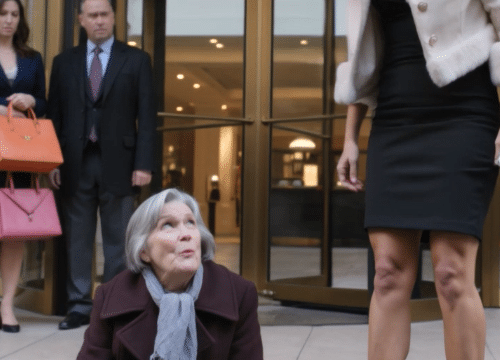
A woman covered her mouth. A man beside the entrance took a frightened step backward. Nobody rushed forward, even as Arthur struggled to reach the crutch that might help him sit up.
Preston straightened his jacket.
“Shop somewhere that matches you.”
Outside the glass entrance, a black car braked sharply at the curb.
The driver barely had time to stop before the rear door opened. A tall man in a black coat hurried toward the entrance, his expression changing as he looked through the glass.
He saw the scattered crutches.
He saw the elderly man on the floor.
And he recognized the faded Army jacket before he recognized anything else.
“Dad!”
Marcus Collins rushed into the showroom.
He dropped beside Arthur, placing himself between his father and the manager. He retrieved the crutch from beneath the recliner and laid it carefully within Arthur’s reach before checking his father’s face and the scraped hand.
Then Marcus looked up.
His eyes settled on Preston with a fury that made the manager take an involuntary step backward.
“Who touched my father?”
Preston’s mouth opened.
Nothing came out.
He looked at the man in the black coat, then at the old veteran on the floor.
And suddenly, the showroom manager seemed to understand that the person he had decided was too poor to belong in his store was connected to someone who could change his entire future.
But Marcus Collins was not interested in the price of the recliner anymore.
He wanted to know exactly what had happened while his father was lying helpless on the floor.
And everyone in that showroom was about to find out what happened when the truth could no longer be hidden behind a manager’s badge.
Act II
Marcus Collins had built his life around furniture.
Not the kind of furniture people bought to impress their neighbors, but the kind they depended on every day: beds that supported tired bodies, tables around which families gathered, and chairs that allowed someone in pain to sit comfortably without dreading the moment they had to stand.
His company had started with a single struggling store and a warehouse full of discounted inventory. He had spent years working alongside delivery crews, negotiating with manufacturers, and visiting stores to understand why some customers returned while others never came back.
Eventually, he transformed the business into a nationwide furniture chain.
The expansion brought money, influence, and the kind of executive life his younger self had once imagined as impossible. But Marcus never forgot the two people who had taught him what furniture was supposed to mean.
His parents.
His mother had worked long hours before her health began to decline. His father had spent much of Marcus’s childhood repairing whatever the family could not afford to replace. When a table wobbled, Arthur fixed it. When a chair broke, Arthur found a way to make it useful again.
They had not been wealthy.
They had been resourceful.
Arthur taught Marcus that a home did not become valuable because its furniture cost a fortune. It became valuable because people could live comfortably in it, because children felt safe there, and because someone always had a place to sit when the day became too difficult.
Those lessons remained with Marcus even after the company grew beyond anything his parents could have imagined.
Arthur, meanwhile, had never become comfortable with his son’s wealth.
He was proud of Marcus, but he disliked being treated as though the relationship entitled him to special favors. He preferred to visit stores without announcing himself. He wanted to ask ordinary questions, make ordinary decisions, and be treated like a customer rather than the father of an executive.
Marcus respected that independence.
So when Arthur mentioned that he wanted to find a new recliner for his wife, Marcus offered to help him compare models. Arthur declined the offer to arrange a private appointment.
“I can look at a chair without an escort,” he had told his son.
Marcus had laughed.
“All right. Just don’t buy something uncomfortable because the salesperson tells you it’s popular.”
“I’ve survived worse advice than that.”
Arthur’s wife, Eleanor, had laughed from her place on the old recliner in their living room.
That chair had served them for years. Its upholstery had faded, its footrest sometimes jammed, and one armrest had begun to loosen. Eleanor insisted she could manage, but Arthur had seen the strain on her face when she tried to rise.
He wanted to surprise her with something better.
That was why he had gone to the showroom alone.
He had not planned to mention his son’s name unless it became necessary. He had not expected a discount. He had not expected anyone to recognize him.
He simply wanted to find a chair his wife could use without pain.
Preston Vale had interpreted every detail differently.
The old jacket meant poverty.
The wooden crutches meant inconvenience.
Arthur’s quiet manner meant weakness.
And his refusal to leave immediately meant disrespect.
Preston had spent years in retail management convincing himself that customers should be judged quickly. He believed a showroom had an image to maintain, and he saw people who did not match that image as potential problems.
The best customers, in his mind, were those who arrived in expensive cars, spoke confidently, and looked as if they already understood the products.
Everyone else had to prove they deserved attention.
The problem was not that Preston enforced store policies. A manager had every right to explain prices, answer questions, and maintain reasonable standards of conduct.
The problem was that Arthur had done nothing to justify the contempt Preston showed him.
He had asked a question.
Preston had turned that question into a judgment about the man’s worth.
Then he had turned that judgment into violence.
Now Marcus was kneeling beside his father, asking the medical questions that mattered while the rest of the showroom watched.
“Dad, can you take a slow breath for me?”
Arthur tried, his face tightening.
“I’m all right.”
“Don’t tell me that just because you don’t want me to worry.”
“I’ve had worse mornings.”
“That isn’t helping your argument.”
Arthur gave a brief, pained exhale that might have been a laugh under different circumstances.
Marcus checked that the crutch was within reach but did not force his father to stand. He asked a nearby employee to call for medical assistance and requested that the showroom’s security staff preserve the camera footage.
Only then did he rise.
Preston immediately began talking.
“Mr. Collins, thank goodness you’re here. This situation has gotten completely out of hand.”
Marcus stared at him.
“My father is on the floor.”
“I understand that, but he was being disruptive.”
Marcus glanced at the scattered display cushions and the recliner beside Arthur.
“What exactly was he doing?”
“He refused to leave when I asked him to.”
“What did he do before you asked him to leave?”
Preston hesitated.
“He was questioning our prices.”
Marcus held his gaze.
“He asked how much a chair cost?”
“That isn’t the whole story.”
“Then tell me the rest.”
Preston looked around the showroom, searching for someone who might support his version. The shoppers who had witnessed the assault avoided his eyes, but none of them volunteered to defend him.
Marcus turned toward his father.
Arthur was still breathing carefully, his hand resting near the crutch. His expression was drawn with pain, but he had not asked anyone to punish Preston. He had not even demanded an apology.
He was still thinking about Eleanor.
“Marcus,” he said quietly, “the chair has a good footrest.”
His son stared at him for a moment.
Then the anger in Marcus’s face gave way to something more painful.
Even after being kicked to the floor, Arthur had been thinking about whether the chair would help his wife.
Marcus looked back at Preston.
“You had a customer who wanted to buy a chair for his wife. You could have helped him.”
Preston swallowed.
“And instead, you attacked him.”
The showroom seemed to shrink around those words.
Because the incident was no longer something Preston could describe as a disagreement over store policy.
It was a violent assault witnessed by customers and recorded by cameras.
And Marcus was determined to make sure the evidence spoke for itself.
Act III
The medical team arrived within minutes.
They examined Arthur, assessed his pain, and treated the scrape on his hand. Marcus stayed nearby, following their instructions and resisting the urge to rush his father to his feet before they were ready.
When Arthur was finally comfortable enough to sit upright, Marcus retrieved the document envelope his father had brought with him.
It contained a folded shopping list, a few measurements Arthur had taken of the old recliner at home, and a note Eleanor had written about the features she hoped the new chair would have.
There was no secret contract.
No hidden fortune.
No demand for special treatment.
Just a list written by a husband who wanted his wife to hurt less when she stood up.
Marcus read the note, then carefully placed it back in the envelope.
He felt a sharp ache behind his ribs.
His father had crossed the showroom to make Eleanor’s life a little easier. Preston had seen a man he believed was beneath the store’s customers and decided to humiliate him.
Marcus turned toward the manager.
“Tell me exactly what happened.”
Preston straightened.
“As I explained, he refused to follow my instructions. I was trying to protect the showroom and keep the sales floor orderly.”
“Did you kick him?”
The question was so direct that Preston seemed to lose his prepared answer.
“I was trying to get him to move.”
“Did you kick him?”
Preston glanced at the employees standing near the reception counter.
“Yes, but—”
“And after he fell?”
“I was frustrated.”
“You kicked him twice more.”
Preston’s face tightened.
“I don’t think you understand the pressure I deal with every day.”
Marcus looked at him in disbelief.
“My father is seventy years old. He has one leg. He came into your store to ask about a recliner, and you kicked him while he was on the floor.”
“I didn’t know who he was.”
For a moment, Marcus said nothing.
Then he took one slow step forward.
“That is your defense?”
Preston’s confidence faltered.
“I mean, I didn’t know he was your father.”
“Would you have treated him differently if you had?”
The manager did not answer.
Marcus glanced toward the shoppers.
“Did anyone here see what happened?”
A woman near the dining tables raised her hand hesitantly.
“I did.”
“Would you be willing to provide an account to the people reviewing the incident?”
She nodded.
Another customer stepped forward.
“So did I.”
Then an employee near the recliners spoke.
“I was working on the other side of the display. I saw Mr. Collins ask about the chair. He wasn’t causing trouble.”
Preston spun toward him.
“You don’t need to get involved.”
Marcus immediately intervened.
“Do not pressure him.”
The employee fell silent, but he stayed where he was.
Marcus turned toward the store’s assistant manager and asked that the camera footage be preserved in its original form. The security system covered the central showroom, the entrance, and the main display aisles. The recordings could establish what happened before the assault, not merely the moments afterward.
He also requested that witness statements be collected independently and that no one who reported the incident be subjected to retaliation.
The assistant manager agreed.
Preston looked increasingly unsettled.
“Marcus, I have worked hard for this company. I know how to run a showroom. You can’t throw away years of service because of one bad moment.”
“One bad moment?” Marcus repeated.
“I lost my temper.”
“You made a choice.”
“I was under pressure.”
“So was my father. He was on the ground trying to reach a crutch while you stood over him.”
Preston’s eyes shifted toward Arthur.
The old man had managed to sit more comfortably, though pain remained visible in his expression. He was listening without interrupting.
For the first time, Preston seemed to understand that the victim’s silence was not an admission of guilt or weakness. Arthur had simply refused to turn the showroom into a shouting match.
Marcus continued.
“You told him he couldn’t afford this room. You told him to shop somewhere that matched him. Then you assaulted him.”
“I was wrong to say those things.”
“You were wrong to do much more than that.”
Preston looked toward the glass entrance.
Outside, the black car remained parked at the curb. Its presence had first seemed unremarkable. Now, to Preston, it was a reminder of the distance between his assumptions and reality.
He had judged Arthur by his clothes and disability.
He had never considered that the elderly man might be the father of the person whose name appeared on the company’s executive documents, whose signature authorized major decisions, and whose values were supposed to shape every store in the chain.
But Marcus was not interested in using that connection to humiliate Preston in return.
He wanted accountability.
“If my father had been a stranger,” Marcus said, “the assault would still have happened. The cameras would still have recorded it. Those customers would still have seen it.”
He paused.
“His relationship to me doesn’t change what you did.”
That statement unsettled Preston more than an angry threat would have.
He had expected Marcus to be furious because his family had been insulted. He had expected a private argument, a demand for an apology, perhaps a sudden dismissal announced in front of the witnesses.
Instead, Marcus was treating the incident as a serious breach that required evidence, documented findings, and formal consequences.
There would be no quiet arrangement that allowed Preston to keep his job simply because the owner was embarrassed.
There would be no edited account that transformed an assault into a misunderstanding.
And there would be no pressure on Arthur to accept an apology in exchange for silence.
Marcus looked toward the assistant manager.
“Secure the footage and start the formal review. I want the facts established, every witness heard, and the appropriate actions taken according to company policy and the law.”
Then he returned to his father’s side.
Arthur reached for his crutch.
Marcus placed it carefully in his hand.
As he did, he noticed that his father was looking not at Preston, but at the adjustable recliner.
“Do you think Eleanor would like the dark brown one?” Arthur asked.
Marcus stared at him.
After everything that had happened, his father was still trying to choose the right chair.
“Yes, Dad,” he said quietly. “I think she would.”
But before either of them could leave, Marcus had one more thing to do.
He needed to make sure Preston understood that no amount of money, status, or family connection could erase what the cameras had captured.
Act IV
The showroom remained closed to new customers while Arthur received further care and the immediate incident was documented.
Marcus did not turn the store into a stage for public revenge. He instructed the appropriate management personnel to secure the records, gather witness accounts, and review Preston’s conduct according to the company’s procedures.
The investigation began with the simplest question: what had happened?
The answer was clear.
Arthur had approached the recliner and asked about its price. Preston had ordered him to leave, insulted him, and attacked him. After Arthur fell and lost access to his crutches, Preston had kicked him twice more while shoppers watched.
The camera footage supported the witness accounts.
There was no evidence that Arthur had threatened anyone or behaved violently. There was no indication that the manager had needed to defend himself. The explanation Preston had offered about maintaining order could not account for the force of the attack or the insults he had directed at a man lying on the floor.
The company removed Preston from his supervisory duties while the formal process continued.
His access to store systems and authority over staff were restricted to protect the review. He was required to provide his account, but he could not control the evidence or instruct employees on what to say.
For years, Preston had used his title as a shield.
People had obeyed him because he was the manager. Employees had hesitated to contradict him because he could influence their schedules, evaluations, and opportunities. Customers who felt insulted often left rather than risk a public confrontation.
He had mistaken that silence for respect.
Now, for the first time, he was not the person deciding how the story would be told.
The investigation also examined earlier complaints about Preston’s behavior. Some involved impatient remarks toward customers; others described staff members being discouraged from escalating concerns.
Those reports were evaluated on their own merits rather than automatically treated as proof of the assault. Still, they helped the company examine whether the showroom’s culture had allowed disrespect to become routine.
Marcus wanted the review to establish both individual responsibility and any procedural failures that might have made it easier for complaints to go unanswered.
He also made a point of speaking with the employees who had witnessed the incident.
Several admitted they had been frightened to intervene. One said he had never seen a manager attack a customer before and had frozen, unsure what to do.
Marcus listened.
“I understand that people can freeze when something unexpected happens,” he told them. “But our procedures must give you a safe way to call for help and report what you see.”
He made clear that the responsibility for the assault belonged to Preston, not to the people who had been too afraid to confront him. At the same time, the company needed to ensure that staff members could respond to emergencies without believing their jobs were at risk.
The review led to clearer incident-reporting procedures, additional guidance for handling aggressive conduct, and renewed expectations that customers be treated professionally regardless of their appearance or circumstances.
The goal was not to excuse misconduct or make employees afraid to enforce legitimate rules.
It was to prevent a manager’s personal prejudice from becoming company policy.
When the findings were finalized, Preston’s conduct was determined to be incompatible with his role. He was dismissed from the showroom management position, with the decision documented through the company’s formal process.
Any further legal questions arising from the assault were left to the appropriate authorities.
There was no triumphant announcement over the store’s speakers.
No public spectacle.
Just a documented decision based on what had happened.
For Marcus, that was enough.
He did not need Preston to suffer humiliation identical to Arthur’s. He needed the man to face the consequences of his choices, and he needed the showroom to become a place where no customer would be treated as less worthy because of disability, age, clothing, or perceived wealth.
A few days later, Marcus visited his father at home.
Arthur was seated in the old recliner, one hand resting on the armrest as he shifted carefully to ease the discomfort in his back. Eleanor sat nearby, watching him with worried eyes.
Marcus pulled a chair close.
“How are you feeling?”
“Sore, but improving.”
“Did the doctor say you should be resting more?”
“The doctor said several things. Your mother remembers all of them.”
Eleanor gave him a look.
“Because someone in this house has to.”
Arthur smiled faintly.
Marcus looked from one parent to the other.
“I should have gone with you.”
Arthur’s expression changed.
“No.”
“Dad—”
“You offered. I said I could manage.”
“I know. I just keep thinking about what happened.”
“So do I.”
Arthur looked down at his hands.
For a moment, the room was quiet.
“I keep thinking about how he looked at me,” he said. “As if asking about a chair was something I had no right to do.”
Marcus felt his jaw tighten again.
“You had every right.”
“I know that now. I knew it then, too.” Arthur paused. “But knowing you’re right doesn’t stop it from hurting when someone treats you like you’re nothing.”
Marcus looked at his father, understanding that the physical pain was only part of what he had carried away from the showroom.
“I wish I could undo it.”
“You can’t.”
“I know.”
“But you can decide what happens next.”
Marcus nodded.
His father had spent his life refusing to let hardship turn him cruel. Now he was asking his son to do the same.
Not to forgive the assault before the consequences had been established.
Not to minimize what had happened.
Simply to make sure the response was guided by principle rather than revenge.
Marcus promised that the company would continue reviewing its practices and that his father’s complaint would not be dismissed once the immediate attention faded.
Then Eleanor looked toward the old recliner.
“Since we’re discussing chairs,” she said, “I would still like one that doesn’t make me feel as if I’m climbing out of a hole every time I stand up.”
Arthur chuckled.
Marcus finally smiled.
“Then we’re going to find you one.”
And this time, he would make sure his father could finish shopping in peace.
Act V
The following week, Arthur returned to the furniture showroom.
He wore the same faded Army jacket, the same pale blue shirt, and the same brown trousers. His old wooden crutches still supported him, and he still moved carefully across the polished floor.
But he was not alone.
Marcus walked beside him, not as an executive arriving to inspect his business, but as a son accompanying his father on an errand that mattered to their family.
The showroom looked much as it had before. Leather recliners stood beneath warm display lights. Large wooden tables filled the central floor, and carefully arranged sofas created quiet corners where customers could test the furniture.
The chair Arthur had first noticed was still there.
A member of the sales team approached them with a professional smile.
“Good afternoon. Welcome back. Are you looking for anything in particular?”
Arthur glanced at Marcus, then toward the recliner.
“We’d like to try that one again.”
“Of course. Let me show you how the controls work.”
The employee demonstrated the adjustable footrest, explained the reclining positions, and showed them how to return the chair to its upright position. He did not rush Arthur when he needed extra time to sit down. He did not speak over him to Marcus or assume that the older man could not make his own decision.
He simply answered the questions Arthur asked.
Eleanor had written down several features she wanted, and Arthur compared them carefully against the model. He tested the armrests, checked how easily the footrest moved, and considered whether his wife would be able to rise without straining her wrists.
Marcus watched with a quiet smile.
His father was doing exactly what he had come to do the first time.
Shopping for his wife.
Nothing more.
Nothing less.
After a few minutes, Arthur looked up at the salesperson.
“How much is it?”
The employee gave him the price without hesitation.
Arthur nodded.
“That’s within our budget.”
“Would you like me to arrange delivery?”
“Yes, please. My wife has been waiting for a better chair for a long time.”
The employee began the paperwork.
Marcus stood back, allowing his father to make the decisions. He did not announce his ownership of the company or ask for special treatment. The purchase was handled like any other, with the same terms and ordinary procedures.
That was important to him.
The showroom did not need to prove that it could be kind to the owner’s family.
It needed to prove that it could treat a customer with dignity.
Before leaving, Arthur paused beside the recliner and ran his hand over the leather armrest.
“I think Eleanor will like this.”
“I think so, too,” Marcus said.
Arthur glanced at him.
“You know, she may complain about the color.”
“She complains about every color.”
“Then you know her well.”
They laughed softly.
For the first time since the assault, Marcus felt the tension in his chest ease. His father was still recovering, and the memory of the showroom floor had not vanished. But the day was no longer defined entirely by what Preston had done.
It was also defined by what Arthur had refused to surrender.
His independence.
His love for his wife.
His belief that a person should be judged by how they treat others, not by the clothes they wear or the money someone assumes they have.
As they approached the glass entrance, Marcus slowed to match his father’s pace.
“Are you sure you don’t want me to carry the envelope?”
Arthur held it a little higher.
“I can carry a piece of paper.”
“I know.”
“Then stop asking.”
Marcus smiled.
They stepped outside into the afternoon light.
The black car waited near the curb, but Arthur took his time reaching it. Marcus stayed beside him, ready to help if needed without turning assistance into an insult.
Before getting into the car, Arthur looked back through the showroom windows.
The furniture inside gleamed beneath the warm lights. Customers moved between the displays, trying chairs and comparing tables, unaware of the story that had unfolded there days earlier.
Arthur hoped they would never have a reason to learn it.
He had not wanted to become the center of a confrontation. He had not wanted his son to have to rush through the doors and find him injured. He had simply wanted to buy his wife a chair that made her life easier.
Preston Vale had looked at that ordinary desire and decided it was beneath him.
He had judged a man by the signs of hardship visible on his body and clothing, then used his position to turn that judgment into public cruelty.
Only when Marcus arrived did Preston realize the person he had attacked was connected to the owner of the entire chain.
That discovery had changed the manager’s expression in an instant.
But it had not changed the facts.
Arthur had deserved respect before Marcus arrived.
He had deserved help before anyone knew his name.
And he would have deserved justice even if his son had been a stranger walking past the entrance.
Marcus opened the car door and offered his father a hand. Arthur accepted it, settled into the seat, and carefully arranged his crutches beside him.
“Let’s get this chair home,” Arthur said.
Marcus closed the door and walked around to the driver’s side.
As the car pulled away, he thought about the lesson his father had taught him years ago: the worth of a person was never measured by the price of the things they could buy.
A luxury showroom could fill itself with the most expensive furniture in the country and still be a poor reflection of the people running it.
A manager could wear a tailored suit, carry an impressive title, and command a room—and still reveal his true character in a single moment.
And an elderly veteran in a faded jacket could possess more dignity than the person who believed he had the right to throw him out.
Preston had asked Arthur to shop somewhere that matched him.
In the end, it was Preston who proved he did not belong in a place built to serve people.
Because the most revealing question was never whether Arthur Collins could afford the recliner.
It was why anyone had believed he needed to prove his worth before being treated like a human being.