Act I
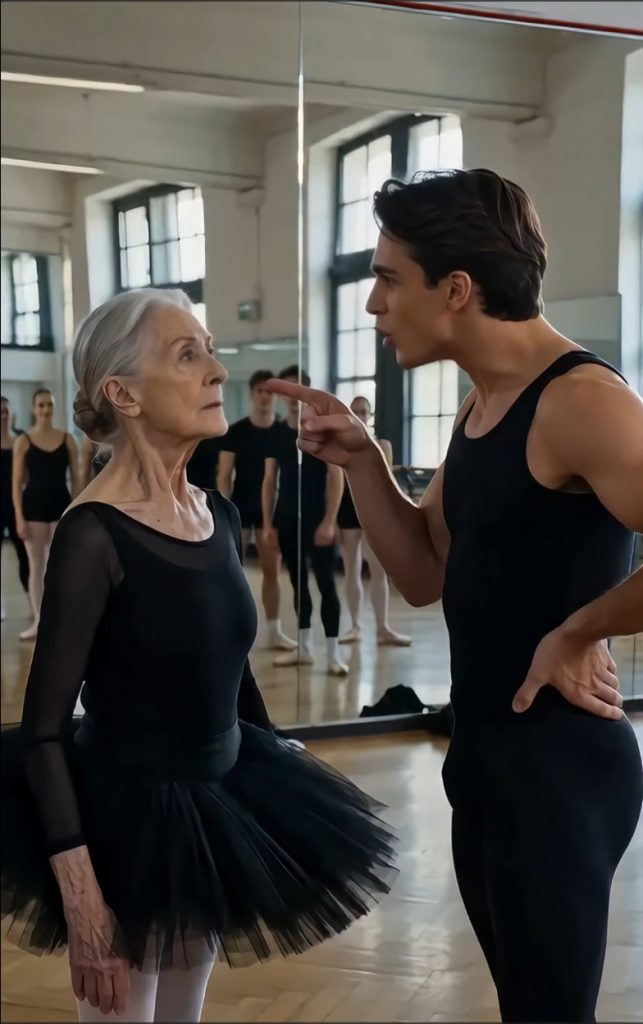
The young dancer pointed at her like she had wandered into the wrong life.
“Listen,” he said, voice cutting across the studio. “You’re too old. Leave this place.”
The room went still, but not with sympathy.
Around them, twenty young dancers stood near the mirrored wall in black practice clothes, their arms crossed, their bodies loose with the effortless confidence of youth. A few exchanged glances. One girl covered her mouth, not to hide shock, but laughter.
In the center of the polished wooden floor stood an elderly woman in a black long-sleeved ballet dress.
Her silver-white hair was pinned neatly at the back of her head. White tights covered her thin legs. Her ballet slippers looked worn, not decorative, the ribbons tied with the care of someone who had done it thousands of times.
She did not step back.
She did not apologize.
She only looked up at the young man with steady eyes.
His name was Adrian Vale, and everyone in the studio knew he was talented. He had the clean lines, the explosive jumps, the sharp turns, the kind of body directors loved to cast before they knew whether the soul had learned how to follow.
He also knew he was watched.
That made him cruel.
Behind him, the mirrors multiplied every smirk in the room. The old woman could see them all without turning her head.
Adrian leaned closer.
“This is not a community hobby class,” he said. “This is a professional studio. People come here to train. Not to babysit nostalgia.”
A whisper ran through the dancers.
The woman lifted her chin.
“I want to dance,” she said.
Her voice was not loud.
It did not need to be.
For one second, the laughter faltered.
Then Adrian smiled.
Not kindly.
He turned away from her and moved toward the center of the room, rolling his shoulders as if preparing for battle. The others backed up to give him space.
The music from the corner speaker changed into something sharper, quicker, more competitive.
Adrian launched into a rapid series of pirouettes.
His body spun with clean force. His head snapped around. His arms held tight, then opened. One turn became two, then three, then more, his black shoes scuffing rhythmically against the polished floor.
He finished in a deep forward lunge, one arm extended toward her as if he were offering not grace, but humiliation.
The younger dancers murmured approval.
Adrian rose, breathing lightly, eyes bright with victory.
He walked back to the elderly woman and stopped inches in front of her.
“Can you do this?”
The question hung in the air.
The woman looked at him.
Then she looked past him, into the mirror, where her own reflection stood small and silver among a room full of youth.
For the first time, something flickered across her face.
Not fear.
Memory.
And the studio had no idea it was about to watch history walk back onto the floor.
Act II
Her name was Evelyn Hart.
But in that room, no one knew it.
To the young dancers, she was just an old woman who had appeared during morning company class with a small cloth bag and a pair of white slippers. She had signed in at the front desk quietly, ignored the receptionist’s confusion, and walked into Studio A as though the building remembered her.
It did.
The floors remembered.
The barres remembered.
Even the tall windows, throwing clear daylight across the boards, seemed to know the shape of her shadow.
Forty-seven years earlier, Evelyn Hart had danced there before the studio had its polished donor plaques and glossy brochures. Back then, the mirrors were cracked near the corners. The roof leaked during winter storms. The dancers rehearsed in sweaters because the heat failed more often than it worked.
But they danced as if the building were sacred.
Evelyn had been seventeen when she first stepped inside. Poor, stubborn, and hungry for beauty in a way that made ordinary life feel too small. Her mother cleaned offices at night. Her father drove buses until his knees gave out. Ballet was not supposed to belong to girls like her.
So she took it.
Not with entitlement.
With discipline.
She cleaned studios for lessons. Sewed torn costumes. Massaged bleeding toes. Took buses before sunrise. Ate apples for dinner. Stayed after everyone left and practiced in the dark with only the streetlight through the windows to guide her.
Then the world noticed.
Evelyn became the kind of dancer people leaned forward to watch. Not because she was the flashiest. Because she seemed to make silence move. Her arms carried grief. Her feet held fire. Her stillness could break a heart before the orchestra began.
Critics called her luminous.
Directors called her rare.
Audiences called her unforgettable.
But fame is a room with many doors, and not all of them open kindly.
At thirty-two, during the final rehearsal of Giselle, Evelyn fell from a lift after a partner mistimed his grip. The injury did not end her life, but it ended the version of her career the world wanted to applaud. The company offered sympathy. Then distance. Then younger replacements.
She taught for a while.
Then cared for her husband through a long illness.
Then disappeared from the stage entirely.
What no one in Studio A knew that morning was that Evelyn had not come to compete with youth.
She had come because of a letter.
Two weeks earlier, she received a cream envelope from the studio’s board of directors. The old founder, Madame Celia Renard, had died, and the academy was preparing a memorial performance. They wanted former dancers to attend.
At the bottom of the letter, in handwriting Evelyn recognized from half a lifetime ago, was a private note.
Come back once. Dance if you can. The floor still knows you.
Evelyn had sat at her kitchen table for a long time, the letter trembling in her hand.
She had not danced in a studio for years.
Not truly.
She stretched in her living room. Practiced gentle barre beside the sink. Marked old combinations when her knees allowed. But a real studio was different. A real studio asked the body what time had taken and what love had kept.
That morning, she almost turned around outside the building.
Then she remembered Madame Renard’s voice.
The body ages. The dancer does not disappear. She changes rooms.
So Evelyn entered.
And Adrian Vale, who had never known a room he did not think existed for him, decided she did not belong.
But he had mistaken age for absence.
Act III
Evelyn did not answer Adrian immediately.
Instead, she walked to the old upright piano in the corner.
The accompanist, a thin man with glasses and nervous hands, looked at her uncertainly.
“Do you know Winter Prayer?” she asked.
His expression changed.
Every old ballet studio has certain pieces hidden in its bones. Music used in auditions, farewells, funerals, debuts. Winter Prayer was one of them. Rarely played now. Too slow for competitions. Too exposed for dancers who depended on speed to hide emptiness.
The accompanist nodded.
“Yes,” he said softly.
Adrian laughed under his breath.
“Oh, come on.”
Evelyn turned toward him.
“You asked if I could dance,” she said. “Not if I could imitate you.”
That quiet correction moved through the room like a blade wrapped in silk.
Adrian’s smile thinned.
The first notes of Winter Prayer rose from the piano.
Slow.
Bare.
Almost fragile.
Evelyn stepped to the center of the floor.
The young dancers shifted, ready to be embarrassed for her. Ready to see shaking knees, forgotten technique, the sad spectacle of someone trying to reclaim a body that had moved on without her.
Then she took first position.
The room changed.
Not loudly.
Not all at once.
But every dancer there felt it.
Her feet settled into the floor with perfect knowledge. Her spine lengthened. Her shoulders dropped. Her arms lifted, not high, not dramatic, but with such clean intention that the air around her seemed to gather.
She began.
A simple tendu.
A slow développé.
A turn of the head.
Nothing Adrian had shown.
Nothing that begged.
And yet, the studio stopped breathing.
Evelyn moved as though every gesture had been earned by loss. Her leg did not fly as high as a twenty-year-old’s. Her turns were not rapid weapons. But her control was merciless. She did not waste one inch of movement. Her balance held in silence until the watchers felt their own bodies ache.
Then came the first turn.
One clean pirouette.
Then another.
Not fast.
Perfect.
She came out of it with no wobble, one arm opening like a door to a room everyone had forgotten existed.
The mocking dancers no longer smiled.
A girl near the mirror lowered her arms.
A young man who had laughed earlier stared at Evelyn’s feet with open disbelief.
Adrian’s jaw tightened.
Evelyn continued.
The music deepened, and with it, her dancing. She crossed the floor in a diagonal of soft, gliding steps, then stopped in arabesque, her raised leg modest but her line so alive it seemed to stretch beyond the mirror.
The studio saw it then.
Technique was not youth.
Beauty was not height.
Power was not speed.
Adrian had danced to conquer the room.
Evelyn danced as if she had survived it.
At the end of the phrase, she sank slowly to one knee, one hand reaching toward an invisible figure she had lost long ago. The movement was so intimate that several dancers looked away, suddenly ashamed to have witnessed it after mocking her.
The final note faded.
No one clapped.
Not because it was unworthy.
Because applause would have been too crude for the silence she left behind.
Then the studio door opened.
An older woman in a navy suit stepped inside, followed by the academy director and two board members.
The woman in the navy suit looked at Evelyn with wet eyes.
“Miss Hart,” she said. “You came.”
Adrian’s face changed.
Miss Hart.
The name moved through the young dancers slowly.
Then all at once.
One of the women near the mirror whispered, “Evelyn Hart?”
The accompanist closed the piano lid halfway, his hands shaking.
The director stepped forward.
“Everyone,” he said quietly, “you have just watched the woman whose portrait hangs in the west hall.”
Adrian turned toward the hall outside.
Toward the framed black-and-white photo he had walked past every day without reading the plaque.
A young ballerina frozen mid-leap, face lifted, arms open, body suspended in impossible grace.
EVELYN HART
Principal Dancer. Teacher. Founding Artist of the Renard Academy.
The room had mocked its own legend.
Act IV
Adrian did not apologize at first.
Pride made him stupid for another few seconds.
He looked from Evelyn to the director, then back to the dancers, as if searching for some version of the room where he still had power.
“There was no announcement,” he said.
It was the kind of sentence arrogant people use when shame needs somewhere else to stand.
The director’s expression hardened.
“There should not need to be an announcement for basic respect.”
The words struck cleanly.
Adrian looked down.
The woman in the navy suit approached Evelyn.
Her name was Claire Renard, Madame Renard’s daughter. She carried a small velvet case in one hand.
“My mother asked me to give this to you if you came,” she said.
Evelyn’s composure faltered for the first time.
Claire opened the case.
Inside lay an old pair of satin ribbons, faded nearly ivory with age. Pinned beside them was a small handwritten note.
Evelyn recognized the ribbons immediately.
They were from her first principal performance, the night she danced Aurora and cried backstage because she thought she had ruined the Rose Adagio. Madame Renard had taken her hands and said, “You did not fall. That is enough for tonight. Tomorrow, become unforgettable.”
Evelyn touched the ribbons with trembling fingers.
Claire read the note aloud.
For Evelyn, who taught this floor what devotion looks like.
The studio went utterly still.
Evelyn closed her eyes.
For a moment, she was no longer standing before a room of young dancers. She was twenty again, breathless backstage, Madame Renard tightening the ribbons around her ankles with stern tenderness.
Adrian watched.
Something in his face finally broke.
Not dramatically. Not enough to redeem him.
But enough to show that humiliation had reached him in reverse.
The director turned to the class.
“You will all remove your shoes.”
The dancers looked confused.
He continued, “You will sit on the floor.”
No one argued.
Even Adrian obeyed.
The young dancers lowered themselves to the polished boards in a semicircle. Without the height of their standing bodies, they looked younger. Less certain. More human.
The director looked at Evelyn.
“Miss Hart, would you speak to them?”
Evelyn almost refused.
She had not come to lecture. She had not come to punish. She had come to answer a letter from a dead friend and to see whether her body still knew how to pray in motion.
But the dancers were watching her now.
Not with mockery.
With hunger.
The kind she remembered.
So she spoke.
“When I was your age,” Evelyn said, “I thought ballet belonged to the strongest body in the room.”
Her voice was calm, but every word held.
“I was wrong. Strength leaves. Speed changes. Beauty changes. Applause changes. If that is all you build your art on, time will take your whole identity with it.”
Adrian stared at the floor.
Evelyn looked at him, but not cruelly.
“What remains is attention. Discipline. Reverence. The ability to see another dancer as more than a body competing against yours.”
She turned toward the mirrors.
“These mirrors are dangerous if you use them only to admire yourself. They should also teach you what you refuse to see.”
The room absorbed that.
Then Evelyn did something Adrian least expected.
She walked to him.
He looked up, face tight with shame.
“Stand,” she said.
He stood.
She held out one hand.
“Again.”
He blinked.
“What?”
“Your pirouette. Again.”
His eyes flicked toward the others.
This was punishment, he thought.
A public correction.
But Evelyn’s expression held no malice.
So he moved to the center and prepared.
The pianist began a simple rhythm.
Adrian turned.
Technically, it was beautiful.
But everyone saw what Evelyn saw now.
He attacked the turn. Forced it. Finished with his chin high, waiting to be admired.
Evelyn approached.
“You are talented,” she said.
He swallowed.
“But you dance like someone afraid that if you stop impressing people, you will disappear.”
The words hit harder than any insult he had thrown at her.
Adrian’s face flushed.
Evelyn softened.
“Now try again. Not for them.”
She nodded toward the mirror.
“Not for yourself.”
A long silence followed.
Then Adrian turned again.
This time, there were fewer rotations.
But the landing was different.
Quieter.
Truer.
For the first time all morning, he looked like a dancer instead of a weapon.
Act V
The memorial performance took place one month later.
The Renard Academy theater filled before the doors officially opened. Former dancers came with canes, silver hair, old programs, and memories folded carefully inside evening coats. Young students lined the balcony. Critics arrived, whispering that Evelyn Hart had been seen at the studio again.
Adrian stood backstage in black costume, pale with nerves.
He had been cast in the memorial piece, but not as the lead.
That honor had gone to no one.
Evelyn had refused the language of lead and supporting roles.
“This is a remembrance,” she told the director. “Not a hierarchy.”
Instead, the piece was built around generations.
Young dancers, current professionals, retired artists, teachers, and children from the academy’s scholarship program. Bodies at different ages. Different speeds. Different histories. All moving through the same music.
Winter Prayer.
Adrian had rehearsed under Evelyn’s guidance for four weeks.
She was not gentle in class.
Not cruel.
Precise.
She corrected lazy arms, arrogant finishes, empty expressions, and the habit young dancers had of thinking a high leg could replace a truthful one.
But she never humiliated.
That was what Adrian noticed most.
She had every reason to make him feel small.
She did not.
The night of the performance, he found her near the wings, tying her ribbons slowly. She wore the same black dress from the studio and the old faded ribbons from Madame Renard tucked around her wrist.
“Miss Hart,” he said.
She looked up.
His throat tightened.
“I’m sorry.”
She waited.
Not coldly.
Honestly.
“I wanted everyone to see I was better than you,” he said. “Because I was terrified you might still matter in a way I didn’t understand.”
Evelyn studied him.
Then she nodded.
“That is a better apology than most people manage.”
He almost smiled.
“Do you forgive me?”
“No.”
His face fell.
“Not yet,” she said. “Forgiveness is not a curtain call. It is rehearsal.”
He absorbed that.
Then she added, “But you may begin.”
The stage manager called places.
The performance began in darkness.
One by one, dancers entered through narrow light. A child crossed first, uncertain but brave. Then a young student. Then Adrian, no longer performing conquest, but carrying restraint. Then older dancers, some turning fully, some marking movement with hands, some standing still with such presence that the audience leaned forward.
Finally, Evelyn entered.
No spotlight announced her.
She walked into the light as if returning to a room she had never truly left.
The audience recognized her slowly.
A ripple moved through the theater.
Evelyn lifted one arm.
Silence fell.
She did not dance long.
She did not need to.
Her solo lasted less than two minutes, but in it lived a whole life: ambition, injury, love, grief, discipline, disappearance, return. When she turned, it was only once, but the landing held more command than Adrian’s ten turns ever had.
At the end, the entire cast gathered around her.
Not bowing to her.
Breathing with her.
The final image was simple.
Evelyn standing center stage, surrounded by dancers young and old, one hand resting over her heart.
The curtain fell into thunder.
The audience stood.
Backstage, dancers cried openly. Claire Renard embraced Evelyn. The director wiped his glasses with shaking hands.
Adrian stayed back until the crowd thinned.
Then he approached Evelyn and held something out.
His own practice shoes.
The black ones he had worn the day he mocked her.
“I was going to throw them away,” he said. “Then I thought maybe I should keep them. To remember the day I started learning.”
Evelyn looked at the shoes.
Then at him.
“Good,” she said. “A dancer should always remember the floor that corrected him.”
Years later, Adrian would become a respected principal dancer.
Not the flashiest of his generation.
The deepest.
When critics praised the emotional maturity of his work, he never told them it began with humiliation in a mirrored room and an old woman who refused to leave.
But every season, on the first day of company class, he told new dancers the same thing.
“Respect the person beside you. You do not know what stage they have already survived.”
In the west hall of the Renard Academy, Evelyn Hart’s portrait remained.
But beside it, years later, another photograph was added.
Not a young ballerina in flight.
An older woman in a black dress, standing in Studio A beneath bright windows, surrounded by dancers half her age, her chin lifted, her eyes steady.
The plaque beneath it read:
EVELYN HART
The dancer does not disappear. She changes rooms.
And every young dancer who passed it on the way to class learned to read the name.
Not because they were afraid of being corrected.
Because somewhere inside that studio, beneath the polished floor and mirrored light, they understood what Adrian had learned too late.
Youth can fill a room.
Talent can command one.
But grace, real grace, can outlive them both.