Act I
The courtroom had been silent for ten minutes when the dog appeared.
Not restless. Not lost. Not wandering in by accident.
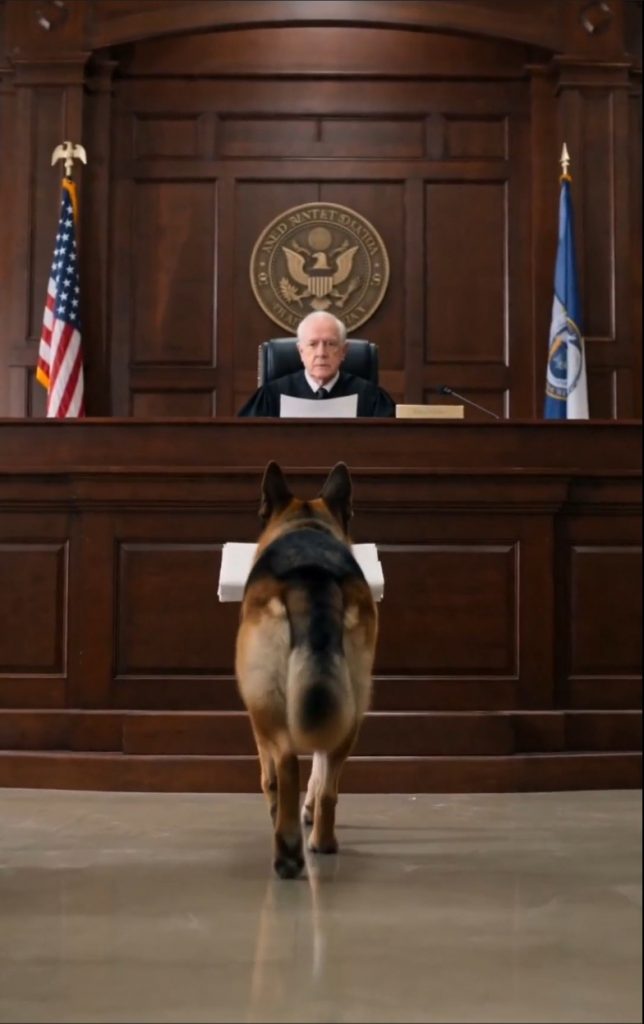
The German Shepherd came through the open double doors and walked straight down the center aisle with a thick white legal packet clenched carefully in his jaws.
Every head turned.
The gallery froze on the wooden benches. A woman in the second row lifted one hand to her mouth. A court officer reached for his radio, then stopped, unsure whether protocol had anything to say about a dog delivering paperwork to a judge.
At the defense table, Nathan Cole rose halfway from his chair.
“Oh my God,” he whispered. “What is it doing?”
The dog did not look left or right.
He trotted over the polished aisle floor with steady, deliberate steps, ears high, eyes fixed on the bench.
At the front of the room, Judge Harold Mercer slowly lowered his glasses.
He was seventy-two, stern, scholarly, and so difficult to surprise that lawyers considered it a professional achievement when one eyebrow moved.
Now both did.
The German Shepherd reached the bench, shifted his weight, and rose onto his hind legs. His front paws landed firmly on the edge of the judge’s desk.
No growl.
No bark.
Just purpose.
Then he opened his mouth.
The white packet dropped flat onto the polished wood.
The courtroom did not breathe.
The dog remained there, tall and still, staring directly up at the judge as if waiting for the next command.
Judge Mercer looked at the packet.
Then at the dog.
Then at the case number typed across the front in black ink.
STATE v. REED.
The same case being tried in front of him.
At the defendant’s table, Jonah Reed went pale.
He was a former paramedic, thirty-eight years old, accused of killing his wife, Elise, a courthouse records clerk who had died eight months earlier in what prosecutors called a domestic tragedy.
Jonah had denied it from the beginning.
No one believed him.
Not the police.
Not the newspapers.
Not even half the gallery watching his trial.
But the dog had once belonged to Elise.
His name was Scout.
And Scout had been missing since the night Elise died.
The prosecutor stood quickly.
“Your Honor, this is highly irregular.”
Judge Mercer did not answer.
Nathan Cole, the defense attorney, stepped into the aisle, eyes locked on the dog and the packet.
His surprise had changed into something sharper.
Recognition.
“Your Honor,” he said, voice ringing through the room, “I believe I can explain what the dog is trying to say.”
The judge looked at him over the rim of his glasses.
“Then I suggest you do so very carefully, Mr. Cole.”
Nathan pointed toward the packet.
“That dog was trained by Elise Reed to carry emergency filings between the records office and the bench when the elevators failed during the renovation.”
The gallery stirred.
Nathan’s voice dropped.
“If Scout brought that packet here today, he didn’t find it randomly.”
Jonah’s hands began to shake.
Nathan turned toward the judge.
“He brought it to the only place Elise taught him evidence was safe.”
Judge Mercer reached for the packet.
The dog finally lowered himself from the bench.
And when the judge opened the first page, every bit of color drained from his face.
Because the document began with six words that changed the trial before anyone had finished reading them.
If I am dead, Jonah is innocent.
Act II
Eight months earlier, Elise Reed had stopped trusting locked doors.
That was what Jonah remembered most.
Not the arguments. Not the late nights. Not even the fear in her eyes when she came home from the courthouse with her hands trembling around a paper grocery bag.
The locks.
She checked them once when she came in.
Again after dinner.
Again before bed.
Then she trained Scout to sit facing the back door.
“He’s not a guard dog,” Jonah had said gently one night.
Elise looked at the German Shepherd, who was watching the hallway with solemn attention.
“No,” she said. “He’s smarter than that.”
Elise worked in the courthouse records office, a place most people forgot existed until they needed a file no one could find. She knew which judges kept handwritten notes. Which prosecutors filed late. Which police reports arrived too clean. Which old cases had pages missing from the middle.
She had a memory like a steel trap and a habit of noticing what powerful people hoped clerks would ignore.
That habit got her killed.
For weeks before her death, Elise had been reviewing archived conviction files after a defense nonprofit requested records connected to a retired prosecutor named Malcolm Crane.
Crane was a legend in the county.
Hard on crime. Beloved by donors. Feared by defendants. Praised by judges. His portrait hung in the bar association hall beside men who had spent their careers making sure the public confused convictions with justice.
Elise found a pattern.
Missing witness statements.
Evidence logs altered years later.
Jailhouse informants appearing in case after case.
Men and women convicted on testimony that seemed to change shape depending on what Crane needed it to become.
She told Jonah one night while he washed dishes and Scout slept under the table.
“If I’m right,” she whispered, “people are in prison because someone built lies into the files.”
Jonah turned off the sink.
“Who knows you’re looking?”
She did not answer fast enough.
“Elise.”
She looked toward the hallway.
“Too many.”
Three days later, her office was searched after hours.
Nothing was taken that anyone admitted to.
But Scout growled at the records room door the next morning and refused to leave Elise’s side for the rest of the day.
Then came the accusation.
Elise was reported for mishandling sealed files. Anonymous complaint. Internal review. Suspension pending investigation.
Jonah begged her to stop.
She refused.
“I can’t,” she said. “If I stop, they win twice. Once against the people they buried. Once against me.”
On the last night Jonah saw her alive, Elise placed Scout’s head in her lap and cried into his fur.
Not loudly.
Elise never cried loudly.
She said only, “I hid it where the truth is supposed to go.”
Jonah asked what she meant.
She kissed his forehead and said, “You’ll know if you need to.”
By morning, Elise was dead.
The police found Jonah’s fingerprints everywhere because it was his house. They found traces of sedatives in a glass he had touched while cleaning the kitchen. They found his text messages begging Elise to “let it go” and turned them into proof of anger.
Scout vanished before animal control arrived.
The papers made Jonah into a monster by noon.
Former paramedic snaps after wife’s legal troubles.
Husband questioned in courthouse clerk’s death.
Domestic dispute suspected.
No one printed the fact that Jonah had tried to perform CPR until first responders pulled him away.
No one printed that he was the one who called 911.
No one printed that Scout had been barking at the basement door when Jonah found her.
Because by then, the story had already been chosen.
And stories, once chosen by the powerful, are very hard to survive.
Act III
Judge Mercer read the first page twice.
Then he removed his glasses and looked at the prosecutor.
“Ms. Halden,” he said, “did the state know this document existed?”
The prosecutor stood stiffly.
“No, Your Honor.”
Nathan Cole did not sit down.
“May I approach?”
“You may.”
The packet contained a sworn statement from Elise Reed, dated three days before her death. Behind it were copies of court logs, file-access records, and a sealed letter addressed to Judge Mercer personally.
The judge opened the letter with a paper knife.
His hands were steady.
His eyes were not.
Your Honor,
I am writing this because I believe records under this court’s authority have been altered to conceal misconduct in multiple prosecutions handled by Malcolm Crane and later protected by members of the district attorney’s office.
If anything happens to me, do not trust the first story they tell you.
Do not trust my suspension.
Do not trust the evidence they place in my home.
And please, do not trust any accusation against my husband until Scout brings you the rest.
A low murmur passed through the gallery.
The judge lifted one hand.
Silence returned.
Scout sat at Nathan’s feet now, eyes fixed on the bench, as if he had completed one task and was waiting for another.
Jonah stared at the dog through tears he was trying not to shed.
“Scout,” he whispered.
The dog’s ears flicked, but he did not move.
Not yet.
Nathan looked at the packet again.
“There’s a storage key attached.”
Taped to the inside flap was a small brass key.
Beside it, Elise had written:
Basement evidence overflow. Cabinet C-17. Scout knows.
Judge Mercer’s gaze shifted to the bailiff.
“Secure this courtroom.”
The prosecutor objected immediately.
“Your Honor, this is not authenticated. We cannot allow a dog’s behavior to derail a murder trial.”
The judge’s voice turned cold.
“This court has allowed far weaker evidence to send men to prison.”
No one spoke after that.
The words landed too close to the thing Elise had died trying to prove.
Within minutes, the jury was removed. The gallery was held in place. A court officer was sent with Nathan, the bailiff, and Scout to the basement evidence overflow room.
Jonah remained at the defense table, guarded and trembling.
The prosecutor kept her face neutral, but her fingers gripped her pen so tightly it bent.
Downstairs, the courthouse basement smelled of dust, metal shelves, and old paper. Rows of cabinets stood beneath humming fluorescent lights. Most were labeled. Some were not. The kind of place where forgotten evidence could sit for decades, waiting for someone honest or desperate enough to look.
Scout led them straight to Cabinet C-17.
He did not sniff around.
He did not hesitate.
He stopped, sat, and stared at the lock.
The brass key turned.
Inside was a black fireproof case.
Nathan opened it.
For a moment, no one moved.
The case held audio recordings, original evidence logs, witness affidavits, and a small hard drive wrapped in Elise’s scarf.
On top was one photograph.
Elise Reed in the records room, kneeling beside Scout, smiling tiredly at the camera.
On the back, in her handwriting, were three words.
He remembers truth.
Nathan had built a career out of not crying in courtrooms.
In that basement, he almost failed.
Because Elise Reed had not trusted lawyers, police, prosecutors, or locks.
She had trusted the dog who would never lie about where she had hidden the truth.
Act IV
The trial stopped being a murder trial by sunset.
It became an earthquake.
The hard drive contained security footage from the courthouse records office. Not the clean version turned over during discovery. The original.
It showed Malcolm Crane entering the records archive at 11:48 p.m., two nights before Elise died.
Crane had been retired for six years.
He had no reason to be there.
He was not alone.
A deputy prosecutor was with him.
So was an evidence technician who had testified earlier that week that Jonah Reed’s home had been processed “without irregularity.”
The footage showed them opening sealed boxes, removing documents, and replacing file sleeves.
Then came the audio recordings.
Elise had confronted Crane in the records office.
His voice filled Judge Mercer’s private chambers while Nathan, the prosecutor, two investigators, and Jonah listened in silence.
“You are a clerk,” Crane said. “You move paper. You do not decide what justice is.”
Elise’s voice answered, shaking but clear.
“No. But I know when paper has been changed.”
“You have no idea what you’re touching.”
“I know exactly what I’m touching.”
Crane laughed softly.
“Then you know your husband has a history with controlled medications from his paramedic work. You know grief makes men unstable. You know the public loves a simple story.”
Jonah closed his eyes.
The recording continued.
Elise said, “If you hurt me, Scout will find what I hid.”
Crane replied, “Then I’ll make sure the dog disappears too.”
Scout growled from beneath the table.
Everyone looked at him.
Jonah whispered, “He remembers his voice.”
The dog’s body was rigid, eyes fixed on the speaker as Crane’s recorded threats continued.
By morning, warrants were issued.
The evidence technician was arrested first. He confessed before lunch, not because he was noble, but because men like him always assume someone above them will sacrifice them first.
He admitted evidence had been planted in Jonah’s home.
He admitted Elise’s glass had been altered after her death.
He admitted Scout had been taken and dumped miles outside the city with his collar removed.
“But he kept coming back,” the technician said. “We couldn’t catch him again.”
Scout had spent eight months surviving alley scraps, rainstorms, and traffic, returning again and again to the courthouse because Elise had trained him to finish the task.
The packet he delivered had been hidden behind a loose panel near the old employee entrance, wrapped in plastic, scented with Elise’s scarf.
He had waited until the doors opened.
Then he carried it to the bench.
Malcolm Crane was arrested in his driveway while reporters shouted questions he had once trained prosecutors to ignore.
The deputy prosecutor resigned before he was charged.
The district attorney held a press conference using words like disappointment, ongoing review, and isolated misconduct.
Judge Mercer watched from his chambers, expression hard.
Then he turned off the television.
“This was not isolated,” he said.
Nathan looked at Jonah.
Jonah had not spoken for nearly an hour.
His eyes were on Scout.
Finally, the judge faced him.
“Mr. Reed, based on the evidence now before this court, the state’s case against you appears to have been built on fraud.”
Jonah’s face crumpled.
The judge’s voice softened, but only slightly.
“I am ordering your release pending formal dismissal.”
For one second, Jonah did not understand.
Then Nathan put a hand on his shoulder.
“You’re going home.”
Jonah shook his head.
“I don’t have one.”
Scout rose from the floor and crossed the room.
This time, no one stopped him.
The German Shepherd placed his head in Jonah’s lap.
Jonah folded over him and wept with both hands in the dog’s fur.
The court had finally believed him.
But the first one who came back for him had four legs and no collar.
Act V
The courthouse changed after that.
Not quickly enough.
Not completely.
But enough that the old men who had treated justice like a private club began to look over their shoulders when clerks carried files.
The Reed case reopened dozens of convictions. Some led to new trials. Some led to releases. Some led only to grief sharpened by proof that the system had known where to look and chosen not to.
Elise Reed’s name became unavoidable.
The courthouse records office was renamed after her despite objections from people who said it was “too soon” or “politically sensitive.” Judge Mercer overruled them with one sentence.
“Truth is not a political inconvenience.”
Jonah attended the dedication in a borrowed suit.
Scout sat beside him wearing a new collar, black leather with a small brass plate.
SCOUT REED.
Jonah had hesitated before putting his last name on it.
“He was hers,” he told Nathan.
Nathan looked at the dog, who was leaning against Jonah’s leg as if the matter had been settled long ago.
“He’s yours too.”
During the ceremony, Judge Mercer spoke of duty. Nathan spoke of courage. A former prisoner, released after Elise’s files exposed false testimony in his case, spoke of years no apology could return.
Jonah did not speak.
He stood in the back with Scout, one hand resting between the dog’s ears, and listened as other people finally said Elise’s name without pity.
Afterward, he went alone to the records room.
Not fully alone.
Scout followed.
The room had been cleaned, repainted, reorganized. The old cabinets were replaced. New security cameras watched every aisle. A framed photograph of Elise stood near the entrance, the same one from the fireproof case: tired smile, hand on Scout’s shoulder, eyes full of a woman who knew fear and worked anyway.
Jonah touched the frame.
“I’m sorry,” he whispered.
Scout sat at his feet.
Jonah had said those words a thousand times in jail.
Sorry he had not protected her.
Sorry he had begged her to stop.
Sorry he had survived the story they built around her death.
This time, the apology felt different.
Less like a chain.
More like a thread still connecting him to the woman who had loved him enough to plan for the day no one else would believe him.
Nathan found him there near dusk.
“Crane’s plea fell apart,” he said.
Jonah turned.
“He’s going to trial?”
Nathan nodded.
“And he’s afraid.”
Jonah looked back at Elise’s photo.
“Good.”
There was no shame in the word.
Some fear was earned.
Months later, Jonah returned to the courtroom where Scout had delivered the packet.
It was empty then, sunlight falling across the mahogany walls and the gold seal behind the bench. No gallery. No jury. No prosecutor calling him a killer.
Just quiet.
Scout walked down the aisle ahead of him, nails clicking softly on the floor.
At the front, the dog stopped and looked up at the judge’s bench.
Jonah smiled through the ache in his chest.
“You remember.”
Scout wagged his tail once.
Jonah sat in the front row.
For a long time, he did nothing.
Healing did not arrive with the judge’s order. Freedom was not the same as peace. Some nights he still woke hearing the cell door. Some mornings he still reached for Elise before memory returned.
But Scout was there.
Always there.
At the door.
Beside the bed.
On the passenger seat during drives to the cemetery.
In the courtroom now, the dog rested his head on Jonah’s knee.
Jonah looked toward the bench where the packet had landed and thought about the strange shape of justice.
Sometimes it came late.
Sometimes it came damaged.
Sometimes it came carried in the mouth of a dog who had crossed half a city with no collar, no voice, and no reason to keep trying except love.
Elise had once told him that paper remembered what people tried to forget.
She was right.
But Scout had remembered too.
He remembered the route.
The command.
The woman who trusted him.
The man who had been left behind.
Jonah scratched behind the dog’s ear.
“You brought her back,” he said softly.
Scout closed his eyes.
Outside the courtroom, life moved on in murmurs and footsteps. Cases began. Doors opened. Clerks carried files. Somewhere down the hall, someone laughed, and for the first time, the sound did not feel cruel.
Jonah stood.
Scout rose with him.
Together, they walked back down the aisle, past the benches where people had once stared at Jonah like he was already guilty.
This time, no one blocked the door.
This time, no one called him a murderer.
And this time, when Scout looked back toward the judge’s bench, Jonah understood.
The dog had not been trying to speak for himself.
He had been carrying Elise’s final command.
Tell the truth.