Act I
The old man fell in the aisle somewhere above Nebraska.
At first, everyone thought he had only stumbled.
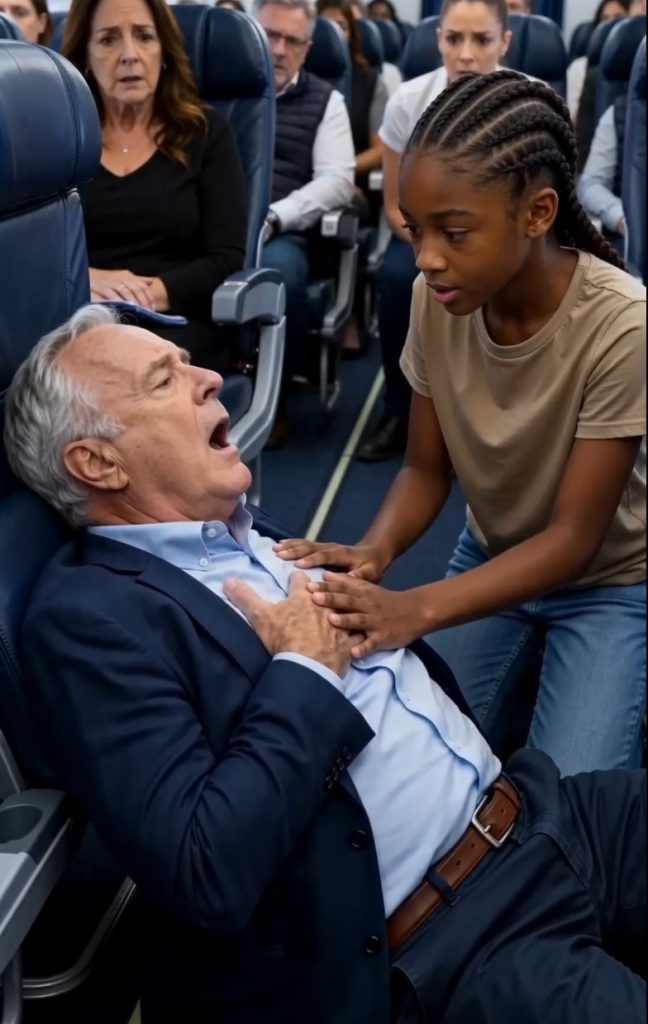
A plastic cup rolled beneath a row of dark blue leather seats. A woman gasped. Someone shouted for a flight attendant. Then the man’s knees buckled, and he slid down hard against the base of an aisle seat, one hand clawing at the front of his navy blazer.
His mouth opened wide as he fought for air.
The cabin changed instantly.
A minute before, people had been watching movies, reading paperbacks, sipping ginger ale under dim cabin lights. Now every face turned toward the narrow aisle where the man sat on the floor, gray-haired and terrified, his light blue shirt wrinkled under his fist.
“Sir?” the male flight attendant called, leaning over the seats. “Can you hear me?”
The man could not answer.
He only gasped.
Passengers began standing despite the seat belt sign being off. Bodies crowded the aisle. A woman in black covered her mouth. A man in a vest stared forward, frozen. The female flight attendant pushed through with a medical kit, her neat bun beginning to loosen from the rush.
Then a small voice cut through the panic.
“Move back. He needs air.”
Everyone turned.
A girl with neat braids was kneeling beside the man.
She could not have been older than twelve.
She wore a beige T-shirt, blue jeans, and sneakers with one lace untied. Her face was young, but her eyes were not frightened. They were focused.
The male attendant blinked at her.
“Sweetheart, you need to get back to your seat.”
“No,” she said, placing both hands carefully against the man’s lower chest and abdomen, guiding him to stop fighting the air. “He’s panicking because he can’t control his breathing. But his chest pain means you need the medical kit open now. And ask if there’s a doctor.”
A few passengers stared.
One man muttered, “She’s a kid.”
The girl did not look up.
“Sir,” she said to the patient, leaning close enough for him to see her. “Listen to me. Slow breaths. In and out.”
His wild eyes found hers.
“That’s it,” she said. “Look at me. Don’t look at them. Just me.”
The old man tried.
His shoulders jerked. His breath caught. His hand tightened over his chest.
The girl’s voice stayed calm.
“Breathe with me… hold… now out slowly. That’s it. You’re okay. Keep breathing.”
The flight attendant looked stunned.
“Is everything okay?”
“No,” the girl said. “But it can be if everyone stops crowding him.”
The authority in her voice silenced adults twice her size.
Then the man on the floor grabbed her wrist.
Not hard.
Desperate.
His lips moved around a word no one else could hear.
The girl heard it.
Her expression changed.
She looked down at his face more carefully.
Then at the gold ring on his right hand, engraved with a crest she had seen once before on a letter that made her mother cry.
Her voice dropped to a whisper.
“Mr. Whitmore?”
The man’s eyes widened.
And suddenly the girl understood that the stranger she was trying to save was not a stranger at all.
Act II
Amara Davis had learned how to stay calm in emergencies from a woman who never got to receive a medal.
Her mother, Dr. Naomi Davis, had been an emergency physician in Baltimore. Not the polished television kind. The real kind. Tired eyes, coffee gone cold, sneakers worn at the heels, hands steady when everybody else’s shook.
When Amara was little, Naomi used to bring home medical flashcards and let her quiz herself at the kitchen table.
“What’s the first thing you do when people panic?” Naomi would ask.
“Make the room smaller,” Amara answered.
“What does that mean?”
“Give one person one thing to do.”
Naomi would smile.
“That’s my girl.”
Amara grew up around hospitals the way other kids grew up around soccer fields. She knew the smell of antiseptic, the rhythm of monitors, the strange silence in waiting rooms where families were trying not to hear bad news before it arrived.
Then her mother reported a mistake.
Not a small mistake.
A private medical company had sold defective portable monitors to several airlines and rural clinics. Naomi noticed the pattern after three emergency transfers came through her hospital with incorrect readings from the same device. She wrote reports. She made calls. She refused to let it go.
The company denied everything.
Its chairman was a man named Raymond Whitmore.
Old money. Clean suit. Donor wings named after him. A face that appeared in business magazines beside words like innovation and leadership.
His lawyers said Naomi was confused.
Then reckless.
Then bitter.
Within months, Naomi lost her hospital privileges. Not officially because of the report. Powerful people rarely leave fingerprints that clean. But everyone understood.
She kept fighting anyway.
She gathered records. She contacted journalists. She kept a file in a blue binder under the kitchen sink because she said no one ever looked for truth next to dish soap.
Then she died in a car crash on a rain-slick road after a late shift.
Amara was ten.
The case against Whitmore Medical vanished into settlement rumors and sealed statements. The blue binder disappeared from their apartment before Amara’s aunt could collect Naomi’s things.
Only one letter remained, folded inside Naomi’s copy of Gray’s Anatomy.
It was from Raymond Whitmore’s office.
Dr. Davis, your allegations are baseless and damaging. Further action will be treated accordingly.
At the bottom was the same crest Amara now saw engraved on the old man’s ring.
For two years, Amara carried a quiet anger she had nowhere to put.
Her aunt Tessa tried to protect her from it. She moved them to Atlanta, enrolled Amara in a new school, signed her up for debate club, and told her that being her mother’s daughter did not mean carrying her mother’s fight alone.
But Amara kept studying.
Not because she thought she was a doctor.
Because it made her feel close to Naomi.
This flight was supposed to be simple. Atlanta to Seattle, where Tessa had a nursing conference and Amara would spend three days in a hotel pool pretending she did not care about the scholarship interviews she had coming up.
Then Raymond Whitmore collapsed six rows ahead of her.
And when adults froze, Amara heard her mother’s voice.
Make the room smaller.
Give one person one thing to do.
So she moved.
She did not know yet whether she was saving a man who ruined her mother.
She only knew he was a person on the floor who needed help.
And that was exactly the kind of choice Naomi Davis had raised her to make.
Act III
A doctor finally stood from row 22.
“I’m a cardiologist,” she said, pushing through the aisle.
Amara moved back immediately, but she did not leave.
The cardiologist took over assessment while Amara stayed near Raymond’s face, keeping him focused, speaking gently each time panic began to pull him under.
“Stay with us,” she said. “You’re doing good.”
Raymond’s eyes flicked to her again and again.
Recognition had not fully reached him, but something had.
The female flight attendant opened the medical kit. The male attendant called the cockpit. A request for priority landing moved forward through the crew.
The cardiologist glanced at Amara.
“You did exactly the right thing getting him calm.”
Someone behind them whispered, “That little girl saved him.”
Amara hated how those words made her chest tighten.
She did not want to save Raymond Whitmore.
She wanted her mother back.
But bodies do not wait for justice. A failing heart does not pause while history gets sorted.
The plane diverted to Denver.
For twenty-seven minutes, the cabin remained suspended between sky and consequence. Raymond stabilized enough to speak in broken phrases. His hand stayed locked around Amara’s wrist until the cardiologist gently loosened it.
“You know me?” he rasped.
Amara stared at him.
“No,” she said.
Then, after a beat, “But I know what you did to my mother.”
Raymond’s face shifted.
Not confusion.
Pain.
“Your mother?”
“Dr. Naomi Davis.”
The name traveled through him like a shock more powerful than the illness itself.
His eyes filled with something Amara did not trust.
Regret was easy when a man was weak.
Truth was harder.
Before he could answer, the plane began descending. Flight attendants secured the cabin. Passengers craned their necks as paramedics waited below.
When the door opened, Raymond was taken first.
Amara thought that would be the end.
Then, as paramedics lifted him onto a stretcher, he grabbed the sleeve of the cardiologist.
“The girl,” he whispered. “Bring the girl.”
Aunt Tessa, who had been forced to remain two rows back during the emergency, stepped forward immediately.
“No,” she said. “She’s done enough.”
Raymond’s eyes moved to her.
“You’re Tessa Davis.”
Tessa froze.
Amara looked between them.
“Aunt Tess?”
Tessa’s face had gone hard.
“How do you know my name?”
Raymond closed his eyes, exhausted.
“Because Naomi sent me something before she died.”
Tessa’s lips parted.
“You said she was lying.”
“No,” Raymond whispered. “My company did.”
The paramedics started moving him.
His voice grew weaker.
“I kept the binder.”
Amara stopped breathing.
The blue binder.
Her mother’s missing evidence.
Raymond looked at her one last time before they rolled him away.
“I was coming to return it.”
Then he disappeared through the aircraft door.
And Amara realized the man she had saved might be the last person alive who knew why her mother was destroyed.
Act IV
The hospital smelled like everything Amara remembered.
Antiseptic. Coffee. Rain on jackets. Fear pretending to be patience.
Raymond Whitmore survived the first night.
That was what the doctor told them after Aunt Tessa spent six hours arguing with airline representatives, hospital staff, and one lawyer who appeared in the waiting room far too quickly for anyone’s comfort.
“He’s asking for the girl,” the doctor said.
Tessa crossed her arms.
“She’s twelve.”
“I know. He says it’s important.”
Amara looked up from the vending machine crackers she had not eaten.
“I want to hear him.”
Tessa’s face softened.
“Mar, you don’t owe him anything.”
“I know.”
That was why she needed to go in.
Raymond looked smaller in the hospital bed. Without his blazer and ring, without the business-magazine posture, he was just an old man under white blankets, lines running from machines to skin.
But his eyes were clear.
On the table beside him sat a worn blue binder.
Amara stopped in the doorway.
Tessa made a sound behind her.
Raymond touched the binder with trembling fingers.
“Your mother sent this to me two days before the accident,” he said. “Not to my office. To my home.”
Amara’s voice was flat.
“And you hid it.”
“Yes.”
The honesty was so quick it disarmed her.
Raymond swallowed.
“I told myself I was protecting the company until I could verify everything. Then the crash happened. My legal team said returning the documents would expose us. They said Naomi’s family would sue. They said people would panic.”
Tessa’s eyes burned.
“So you let my sister’s name rot.”
Raymond closed his eyes.
“Yes.”
No excuse followed.
That made it worse somehow.
Amara stepped closer to the binder.
“Why bring it back now?”
Raymond looked at her.
“Because I read it.”
Silence filled the room.
“All of it,” he continued. “Your mother was right. The devices were faulty. The failures were hidden. People were harmed. My signature is on approvals I barely read because I trusted men who understood profit better than patients.”
Tessa shook her head.
“You expect us to feel sorry for you?”
“No,” he said. “I expect you to hate me. But I’m tired of cowardice being the last thing I do.”
He pushed the binder toward Amara.
Inside were Naomi’s reports, witness statements, emails, device failure logs, and handwritten notes in the margins.
Amara knew her mother’s handwriting instantly.
Her throat closed.
On the first page, Naomi had written:
If they bury this, someone else will pay for our silence.
Raymond’s hand trembled.
“There’s more,” he said.
He nodded toward the drawer beside the bed. Tessa opened it and found a small recorder and a sealed envelope.
“The company board meets tomorrow,” Raymond said. “My statement is on that device. Names. Dates. Who ordered the cover-up after Naomi’s report. Who removed the binder from her apartment after she died.”
Tessa’s face changed.
“You know who took it?”
Raymond nodded.
“My chief counsel.”
Amara gripped the binder.
“Why should we believe you?”
He looked at her for a long time.
“Because you saved me when you had every reason not to,” he said. “And I have no right to waste the life your mother’s daughter gave back to me.”
Amara hated that the words made her cry.
She hated that he saw.
She hated that her mother’s truth had been sitting in a rich man’s drawer while she learned to live without her.
But she took the binder.
Not for Raymond.
For Naomi.
By morning, the first copies were in the hands of federal investigators.
By afternoon, Whitmore Medical’s stock was falling.
By evening, the men who had buried Dr. Naomi Davis’s report were calling lawyers, resigning from boards, and discovering that sealed silence burns quickly when the right page catches fire.
Act V
The world called Amara a hero.
She hated that too.
Reporters wanted the story simple. Brilliant child saves billionaire. Heartwarming midair miracle. Unlikely bond. Redemption at thirty thousand feet.
Amara refused every interview that tried to make Raymond Whitmore the center.
“My mother is the story,” she said the one time she agreed to speak. “She told the truth before anyone clapped for it.”
That line played everywhere.
Whitmore Medical reopened all device safety cases tied to Naomi’s report. Federal hearings followed. Families who had been told their loved ones’ emergencies were “unpredictable outcomes” learned there had been warnings years earlier.
There were lawsuits.
Resignations.
Arrests.
A hospital wing quietly removed Raymond’s name.
He did not fight it.
Months later, Raymond testified from a wheelchair before a congressional committee, thinner but alive. Amara sat behind him with Aunt Tessa, wearing one of Naomi’s old scarves around her shoulders.
Raymond named everyone.
Including himself.
“I allowed reputation to outweigh truth,” he said. “Dr. Naomi Davis tried to prevent harm. We harmed her instead.”
Tessa cried silently.
Amara did not.
Not then.
She waited until they returned to the hotel. Then she locked herself in the bathroom, sat on the floor, and sobbed into the scarf until Tessa knocked softly and asked permission to come in.
Healing, Amara learned, did not arrive with justice.
It arrived in pieces afterward.
The first piece came when Naomi’s medical license record was formally restored and corrected.
The second came when the hospital where she had worked created a patient safety fellowship in her name.
The third came when Amara opened the blue binder weeks later and found a note tucked into the back pocket.
For Amara, when you’re old enough to understand why I couldn’t look away.
Baby, courage is not the absence of fear. It is deciding love matters more than comfort.
Amara read the note once.
Then again.
Then she placed it beside her bed.
A year after the flight, Amara boarded another plane.
This time, she was not traveling because of scandal or emergency. She was flying to Boston to speak at a youth medical leadership program named after her mother.
Tessa sat beside her, pretending not to cry into a napkin.
The flight attendant recognized Amara and smiled, but did not make a scene.
That was good.
Amara looked down the aisle.
For a moment, she saw it again: Raymond on the floor, passengers frozen, her own knees against the carpet, her mother’s voice telling her to make the room smaller.
She had been scared.
People always forgot that part.
She had been a child in a narrow airplane aisle, surrounded by adults waiting for someone else to know what to do.
So she had done what Naomi taught her.
Not perfectly.
Not magically.
But enough.
As the plane lifted through the clouds, Amara opened her notebook and began drafting her speech.
She did not start with Raymond.
She started with the kitchen table, the flashcards, the woman who believed truth was a form of care.
She wrote:
My mother taught me that saving a life is not always dramatic. Sometimes it is a hand on someone’s shoulder. Sometimes it is telling the truth when powerful people would rather you stay quiet. Sometimes it is helping a person breathe, even before you know whether they deserve your kindness.
Amara paused.
Then she added one more line.
Because the help we give should say who we are, not who they have been.
Outside the window, sunlight spread over the wing.
Inside the cabin, passengers settled into their ordinary worries.
And Amara Davis, daughter of Dr. Naomi Davis, looked down at her mother’s scarf in her lap and finally understood something.
Her mother’s fight had not ended in silence.
It had ended with a girl kneeling in an airplane aisle, steady hands against fear, carrying the truth forward one breath at a time.