Act I
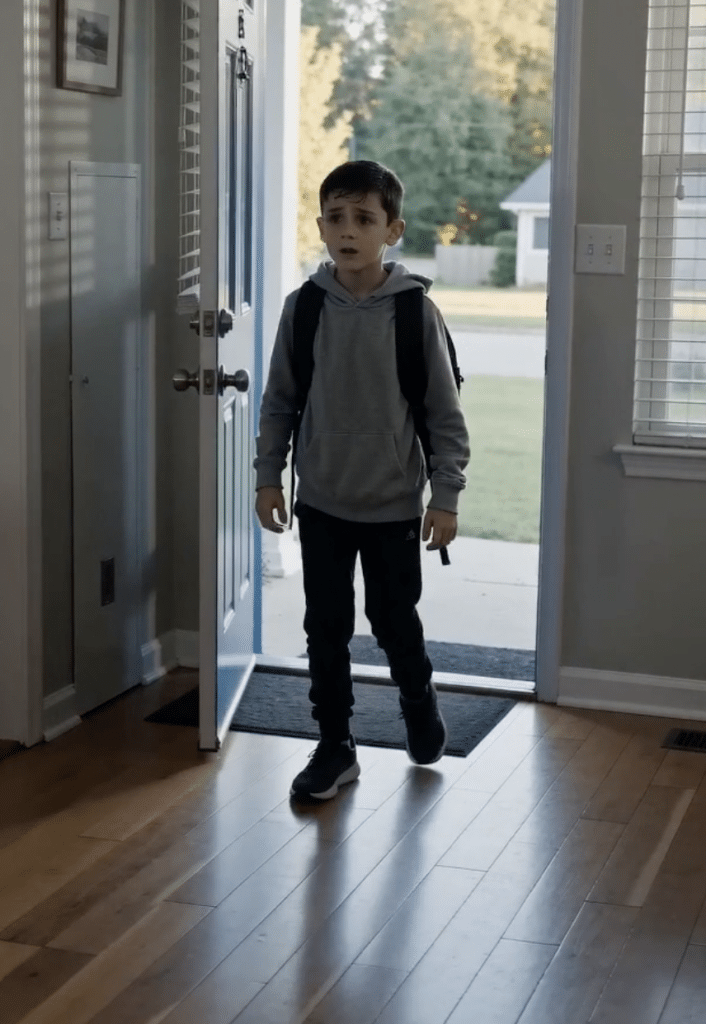
Jordan came through the front door soaked from the rain, clutching one backpack strap like it was the only thing keeping him standing.
The house was warm. Too warm. The kind of suburban warmth that smelled like lemon cleaner, folded laundry, and dinner that had not been made for him.
In the kitchen, Lisa stood by the sink with her phone in one hand. The blinds behind her were half-closed, cutting the late afternoon light into thin lines across the counter.
She turned when she heard the door.
Not with relief.
With annoyance.
Jordan’s wet sneakers squeaked against the wooden floor as he stepped closer. His green shirt clung to his shoulders. His hair was plastered to his forehead, and his lower lip trembled in a way he was trying very hard to control.
“Mom?” he said.
Lisa’s mouth tightened.
He stopped at the edge of the kitchen.
For a few seconds, he only looked at her. His face was pale, his eyes red, his small chest rising too fast beneath his damp shirt.
Then he asked the question that had carried him all the way home.
“They said you don’t love me,” he whispered. “But you do, right?”
Lisa stared at him.
Something passed over her face, something cold and tired and sharper than anger. She glanced toward the front windows as if worried someone might hear, then back at the boy dripping rainwater onto the clean floor.
“Don’t call me that,” she said.
Jordan blinked.
Lisa’s voice dropped, but every word hit harder than a shout.
“I’m not your real mother.”
The air left the room.
Jordan did not cry right away. That was the worst part.
He just stood there, absorbing the sentence like a child trying to understand why the floor had vanished beneath him.
Lisa turned away first.
She set her phone on the counter and reached for a dish towel, as if the conversation was finished. As if she had corrected a mistake. As if the boy in front of her was not breaking in half.
Jordan took one small step backward.
His backpack slipped from his shoulder and hit the floor.
Then his knees buckled.
He collapsed onto the hardwood beside it.
The sound made Lisa spin around.
For one frozen second, she did nothing.
Then the front door burst open.
David Mercer rushed in with two grocery bags in his arms, rain shining on the shoulders of his coat. One bag tore when it hit the floor, oranges rolling across the entryway.
“Jordan!”
He dropped to his knees beside the boy, one hand going to his son’s face, the other pulling the wet backpack away.
Jordan’s eyes fluttered open, unfocused and frightened.
David looked up at Lisa.
“What happened?” he demanded. “Lisa, what happened?”
Lisa opened her mouth.
No answer came.
And somewhere between the oranges rolling across the floor and the rain dripping from Jordan’s hair, David realized this was not the beginning of something terrible.
It was the moment he had finally walked in on it.
Act II
Before Lisa, the house had been loud.
Jordan used to race down the stairs in dinosaur pajamas, dragging a blanket behind him like a royal cape. David would make pancakes shaped like lopsided stars, and Jordan would pretend not to notice when they looked more like broken circles.
There were photos in the hallway from those years.
Jordan at four, missing a front tooth.
Jordan at five, asleep on David’s chest during a snowstorm.
Jordan at six, holding a birthday cupcake with blue frosting on his nose.
In every picture, there was a space where someone else should have been.
Maya.
Jordan’s mother.
David rarely spoke her name in the house after she died because he thought silence would make grief softer. It did not. It only made the grief invisible, which was worse for a child.
Jordan was three when Maya died after a sudden illness that moved faster than anyone expected. He remembered her in flashes: her humming in the car, her red scarf, the way she called him “my brave little moon.”
David remembered everything.
The hospital chair. The final letter. The promise he made beside her bed when Jordan was asleep at home under a blanket covered in rockets.
“Don’t let him feel like a guest in his own life,” Maya had whispered.
David promised.
Then life became impossible.
He worked too much. He smiled too little. He learned how to pack lunches and sign school forms and braid nothing because Jordan’s hair did not need braiding, but he watched videos anyway because Maya had once joked that every parent should know.
When Lisa came along, she seemed like mercy.
She met Jordan at a fall carnival. She knelt to his height, asked him about the cardboard spaceship he had made, and listened as if it mattered. David remembered thinking, foolishly and gratefully, that kindness could be real even when it arrived late.
They married less than a year later.
At first, Jordan called her Lisa.
Then one morning, half-asleep over cereal, he called her Mom.
David froze.
Lisa smiled.
“It’s okay,” she said gently. “Only if he wants to.”
Jordan had beamed for the rest of the day.
David thought healing had found them.
He did not notice how carefully Lisa performed sweetness when he was watching. He did not notice the way Jordan became quieter after school. He did not notice that his son stopped asking for second helpings at dinner unless David offered first.
There were excuses for everything.
Jordan was growing.
Jordan was sensitive.
Jordan was adjusting.
Lisa always had the right words.
“He needs boundaries.”
“He clings because you let him.”
“You can’t raise him on guilt forever.”
David believed some of it because it hurt too much not to. He wanted to be a good father, but he was tired. Lisa made decisions. Lisa handled appointments. Lisa answered emails from the school. Lisa organized the house into labeled bins and color-coded calendars.
By the time David realized Jordan no longer ran to the door when he came home, it had already become normal.
That was how cruelty survived in nice houses.
It did not always announce itself.
Sometimes it wore beige sweaters, answered school emails, and said, “I’m only trying to help.”
Now Jordan lay on the living room couch wrapped in a blanket, his damp clothes changed, his breathing steadier. David sat beside him, one hand resting on his son’s arm as if afraid Jordan might disappear if he let go.
Lisa stood near the kitchen island, arms crossed.
“He was being dramatic,” she said.
David turned slowly.
“He collapsed.”
“He walked home in the rain. He upset himself.”
“Why was he walking home in the rain?”
Lisa looked away.
“I told the school he could.”
David stared at her.
“He’s eight.”
“He’s not helpless.”
Jordan stirred beneath the blanket.
David lowered his voice.
“Jordan asked if you loved him. Why would he ask that?”
Lisa’s jaw tightened.
“Because children repeat things.”
“What things?”
She said nothing.
David looked toward the backpack by the door. It was still wet. A corner of paper stuck out from the front pocket, crumpled and darkened by rain.
He stood and picked it up.
Lisa moved too fast.
“Don’t go through his things.”
David paused.
That was when he knew.
There was something in the bag she did not want him to see.
Act III
The first paper was a school notice.
David unfolded it carefully, smoothing the damp creases with his thumb.
It was a reminder about early dismissal. Jordan’s class had been released at 1:30 because of a faculty training day.
David checked the time.
It was almost five.
His son had been outside for hours.
The second paper was worse.
It was a behavior referral.
Jordan Mercer displayed emotional instability and difficulty integrating into the home environment.
David read the sentence twice before the meaning reached him.
The form was signed by Lisa.
Not as stepmother.
As guardian.
His eyes moved down the page.
Recommended placement: Brookhaven Therapeutic Boarding Program.
David’s hand went cold.
Lisa exhaled sharply.
“You don’t understand what that is.”
“No,” David said. “I think I’m starting to.”
“It’s a good school. Structured. Private. They help children with attachment issues.”
“My son does not have attachment issues because he wanted his mother to love him.”
Lisa flinched at the word mother.
David saw it.
Jordan’s voice came weakly from the couch.
“She told Mrs. Bell I was ruining everything.”
David turned.
Jordan’s eyes were open now, wet but steady.
“At school?” David asked.
Jordan nodded.
“I was in the hallway. Mrs. Bell said maybe I needed a place with people trained for kids like me. Lisa said she couldn’t keep pretending forever.”
Lisa’s face hardened.
“That is not what happened.”
Jordan curled deeper into the blanket.
“The other boys heard,” he whispered. “They said you were sending me away because you didn’t love me. I came home to ask.”
David looked at Lisa.
Something inside him went very still.
Not calm.
Beyond calm.
“Where is Maya’s letter?” he asked.
Lisa frowned.
“What?”
“The letter Maya left for Jordan. The one I kept in the blue box in my office.”
Lisa’s eyes shifted for half a second.
It was enough.
David walked down the hall.
Lisa followed.
“David, stop.”
He opened the office door.
The blue box was not on the shelf.
It had been there for five years, beside the framed photo of Maya holding Jordan in the hospital. David pulled open drawers, moved files, checked the cabinet.
Nothing.
“Where is it?” he asked.
Lisa stood in the doorway.
Her face was pale now, but her voice stayed sharp.
“You were keeping him trapped in the past.”
David turned.
“That was his mother’s voice.”
“She’s dead.”
The words landed in the office like shattered glass.
David did not move.
Lisa seemed to realize too late what she had said out loud.
Then Jordan appeared behind her, still wrapped in the blanket, one hand against the wall for balance.
“My mom wrote me a letter?” he asked.
David’s face crumpled.
He crossed the room and knelt before him.
“Yes,” he said softly. “She wrote you a letter for when you were older. I should have shown you sooner. I’m sorry.”
Jordan looked at Lisa.
“Did you throw it away?”
Lisa said nothing.
David stood.
“Answer him.”
Lisa’s mouth twisted.
“You both worship a ghost in this house,” she said. “Every birthday, every picture, every little story. I have been here for five years, and I am still competing with a dead woman.”
Jordan stepped back as if the words had pushed him.
David moved in front of him.
“You were never competing with Maya,” he said. “You were asked to love a child.”
Lisa laughed, but it broke halfway through.
“Love him? I cooked, cleaned, drove him everywhere, sat through conferences, smiled at teachers while they praised Maya’s sweet little boy. And what did I get? A house full of memories that weren’t mine and a husband who looked through me every time that kid said her name.”
“That kid is my son.”
“He is her son.”
The silence that followed was complete.
David looked at the woman he had married and saw, finally, the truth stripped of every polite disguise.
This was not stress.
This was not adjustment.
This was resentment with a house key.
Then the doorbell rang.
Once.
Twice.
Lisa turned toward the hallway, startled.
David walked past her and opened the front door.
Mrs. Helen Bell, Jordan’s teacher, stood on the porch in the rain holding a plastic folder against her chest. Beside her was an older woman David recognized with a shock that nearly knocked the breath from him.
Marianne Ellis.
Maya’s mother.
Jordan’s grandmother.
The woman Lisa had told him wanted nothing to do with them.
Marianne looked past David and saw Jordan standing in the hallway.
Her hand flew to her mouth.
“Oh, sweetheart,” she whispered.
Jordan stared back, confused and trembling.
David slowly turned to Lisa.
“What did you do?”
Act IV
Marianne stepped into the house as if crossing a battlefield.
She did not rush Jordan. She did not overwhelm him. She simply lowered herself to one knee, tears shining in her eyes.
“You look so much like your mom,” she said.
Jordan gripped David’s sleeve.
“You know my mom?”
Marianne smiled through the pain.
“I raised her.”
David closed his eyes.
For years, he had believed Maya’s parents had pulled away after the funeral because grief had made them bitter. Lisa had said Marianne blamed him for moving on. She had said calls went unanswered. Cards stopped coming. Birthday gifts never arrived.
But Marianne opened the plastic folder with shaking hands.
Inside were copies.
Letters.
Birthday cards.
Certified mail receipts.
Photos from Jordan’s first three birthdays with Maya’s family, pictures David had not seen in years.
“I sent something every month,” Marianne said. “Then they started coming back.”
David took one envelope.
Return to sender.
The handwriting was Lisa’s.
He looked up.
Lisa’s face had gone gray.
Mrs. Bell spoke next, her voice strained.
“I came because Jordan didn’t get picked up today. Lisa told the office he had permission to walk home, but that didn’t sit right with me. Then I checked the file.”
She handed David another document.
A guardianship consultation form.
A financial disclosure.
A request for educational placement funding.
Jordan’s name appeared again and again.
Beside it was another name.
The Maya Ellis Mercer Trust.
David had not touched Maya’s trust in years. It was for Jordan. For college, medical needs, adulthood, anything that would help him build a life with the love his mother could no longer give in person.
Lisa had been trying to access it.
Not with David’s signature.
With a forged version of it.
David’s voice was quiet when he finally spoke.
“You were sending him away to get control of his trust?”
Lisa’s eyes flashed.
“Don’t make me sound like a monster.”
Marianne stood.
“What would you call a woman who steals a child’s family, hides his mother’s letters, and tries to ship him away for money?”
Lisa snapped.
“I gave up my life for this family.”
“No,” David said. “You tried to erase his.”
Jordan began to cry then.
Not loudly.
Just silently, with tears sliding down his cheeks as if his body had no strength left to hold them back.
Marianne reached out gently.
Jordan looked at David.
He nodded.
The boy stepped into his grandmother’s arms.
She held him like someone holding a piece of the world that had been missing for too long.
Lisa watched them, and something ugly flickered across her face.
“He doesn’t even know you,” she said.
Marianne looked at her.
“Whose fault is that?”
No one spoke.
The rain tapped against the windows. The kitchen light hummed. Somewhere on the floor, Jordan’s backpack lay open, spilling the evidence of a day that had started with a boy trying to find out whether he was loved.
David picked up his phone.
Lisa’s expression changed.
“Who are you calling?”
“My attorney.”
“David, don’t be stupid. Think about what this will look like.”
“I am.”
“You’ll destroy our marriage.”
He looked at her, and the sadness in his face was worse than anger.
“You did that when you looked at my son and told him he wasn’t yours.”
Lisa’s lips trembled.
For a second, she looked almost frightened.
Not of what she had done.
Of losing the life she had built on top of it.
David spoke into the phone, then ended the call.
Mrs. Bell stayed with Jordan and Marianne in the living room while David walked upstairs. When he came back down, he carried a suitcase.
Lisa stared at it.
“You can’t throw me out.”
“I can ask you to leave tonight. The rest will go through the courts.”
“This is my home too.”
David looked around the hallway.
At the photos Lisa had moved to less visible shelves.
At the blank spaces where Maya’s memory had been quietly removed.
At the child on the couch, holding the hand of a grandmother he had been taught to believe had abandoned him.
“No,” David said. “This was Jordan’s home before you ever walked into it.”
Lisa’s face hardened one last time.
“You’ll regret this.”
Jordan lifted his head.
His voice was small, but clear.
“No, he won’t.”
That was the first time Lisa looked truly defeated.
Because the boy she had tried to make powerless had finally spoken without asking permission.
Act V
The house changed slowly after Lisa left.
Not in the dramatic way people imagine healing happens. There was no single morning when Jordan woke up fine. No magical apology that repaired the years. No perfect ending wrapped in music and sunlight.
At first, Jordan asked the same question every night.
“Are you still here?”
David would sit on the edge of his bed and answer, “I’m still here.”
Sometimes Jordan asked, “Are you mad at me?”
David would say, “Never because you told the truth.”
Some nights, Jordan cried for Maya, though he did not remember enough to know exactly what he missed. Some nights, he cried because he had called Lisa Mom and felt ashamed of it.
David told him the same thing every time.
“Wanting love was not wrong.”
Marianne became part of their lives carefully, patiently, without forcing herself into the empty spaces Lisa had created. She brought photo albums. She taught Jordan that Maya loved strawberry jam but hated strawberry candy. She showed him a video of Maya singing off-key while painting the nursery yellow.
Jordan watched it three times.
The fourth time, he leaned into David and whispered, “She sounds happy.”
David kissed the top of his head.
“She was.”
A week later, David found the blue box.
Not in the trash.
Not destroyed.
Hidden in the attic behind two plastic bins of Christmas decorations.
Inside was Maya’s letter.
The paper smelled faintly of cedar, and the envelope was still sealed. David sat with Jordan at the kitchen table, the same kitchen where Lisa had turned her back on him, and placed the letter between them.
“You don’t have to read it now,” David said.
Jordan touched the envelope.
“Will you read it with me?”
David nodded.
Together, they opened it.
My brave little moon,
If Daddy is giving you this, it means you are old enough to understand that love does not disappear just because someone has to leave.
Jordan pressed his hand over his mouth.
David kept reading, though his voice broke more than once.
Maya wrote about the day Jordan was born, about how he had wrapped his tiny fingers around hers, about how she wanted him to know that he was not a burden, not an accident, not a shadow in anyone’s life.
You are the brightest thing I ever got to hold.
Jordan cried then.
So did David.
Marianne stood in the doorway, one hand over her heart, giving them the dignity of not interrupting.
The legal process took months.
Lisa denied everything at first. Then the documents spoke louder than she did. The forged forms. The returned letters. The school records. The attempted trust withdrawals. Mrs. Bell testified. Marianne testified. David did too.
Jordan did not have to stand in court.
David made sure of that.
The judge restricted Lisa from contacting him and referred the financial documents for investigation. The trust was secured under new oversight. The school changed its pickup policies after Mrs. Bell threatened to resign if they did not.
David removed Lisa’s name from every emergency form, every account, every corner of Jordan’s life where she had placed herself like a lock.
But the real victory came on a rainy Thursday almost a year later.
Jordan came home from school with damp hair, a green jacket, and mud on his shoes. He stepped through the front door and paused.
For a moment, David saw the old fear pass through him.
The memory of another rainy day.
Another entrance.
Another question.
Then Jordan looked toward the kitchen.
Marianne was at the stove making soup. David was setting the table. Maya’s photo stood on the sideboard, not hidden, not worshiped, just present.
Jordan let his backpack slide onto the bench.
“Dad?”
David turned.
“Yeah, buddy?”
Jordan hesitated.
Then he said, “Can Grandma stay for dinner?”
Marianne froze at the stove.
It was the first time he had called her that.
David smiled, his eyes stinging.
“I think she’d like that.”
Marianne turned away quickly, pretending to stir the soup.
Jordan noticed.
For the first time in a long time, he laughed.
Not loudly.
Not like everything was fixed.
But like something inside him had opened a window.
That night, they ate at the kitchen table while rain ran softly down the glass. Jordan told them about a science project, about a boy in class who talked too much, about how Mrs. Bell had let him feed the class turtle.
Halfway through dinner, he looked at Maya’s photograph.
Then at Marianne.
Then at David.
“I have two moms,” he said carefully. “One who had me. And one who didn’t know how to love me.”
David’s chest tightened.
Jordan looked down at his soup.
“But that doesn’t mean I’m hard to love, right?”
David set his spoon down.
He moved around the table, knelt beside his son’s chair, and took both of Jordan’s hands.
“No,” he said. “It means she failed at something you deserved.”
Jordan’s eyes filled, but he did not look away.
David continued, “You were always easy to love. I’m sorry I didn’t see sooner when someone made you feel otherwise.”
Jordan nodded slowly.
Then he leaned forward and wrapped his arms around David’s neck.
For a long time, neither of them moved.
The house was still imperfect. There were scuff marks on the floor, dishes in the sink, old grief in the walls, and a future they would have to rebuild one ordinary day at a time.
But Jordan was no longer standing in the doorway asking if he was loved.
He was at the table.
He was warm.
He was believed.
And when the rain grew heavier outside, he did not flinch.
He simply reached for another piece of bread, safe in a home that had finally chosen him out loud.