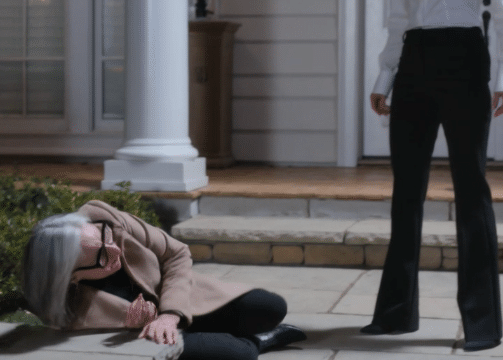
Act I: The Sound of Eggs Breaking
The first thing I heard was the eggs.
Not my wife’s cry.
Not the boy laughing.
Not even the sharp intake of breath from the small crowd gathered near the cart return.
It was the crack of eggs hitting hot asphalt in a grocery store parking lot on a bright Thursday afternoon, followed by the wet, helpless sound of groceries scattering in every direction.
I turned at exactly the wrong moment and saw my wife on her knees.
Ruth was sixty-eight, with bad hips, thin wrists, and the kind of pride that made her carry more than she should because she hated asking for help. One second she had been balancing a brown paper grocery bag against her chest. The next, a young man in a black T-shirt had flipped it upside down in front of her like he was emptying trash.
Bananas rolled under a silver sedan.
A loaf of bread landed near the curb.
A milk carton spun twice and fell on its side.
Ruth reached out on instinct, trying to catch things no one could catch once they were already falling.
“What are you doing?” she cried.
Her voice broke on the last word.
The boy just stood there smiling.
Not furious.
Not panicked.
Smiling.
That was what turned the whole thing from cruelty into something colder.
Around them, four young adults stood off to one side near a red SUV, arms crossed, phones half-raised, caught in that modern paralysis where people know something is wrong but are no longer sure whether to help or record. A cart rattled loose in the wind and bumped the painted yellow line beside Ruth’s shoes.
She dropped lower, one hand on the pavement, the other clutching at a carton of milk and the ruined loaf like they still mattered in the shape they were in. The young man laughed then, head tipped back slightly, as if my wife’s humiliation were the punchline to a joke only he understood.
I started walking before I had decided to.
At my age, walking fast on uneven pavement is really just falling forward in controlled stages. But I reached them before he noticed me.
Ruth looked up once.
Her face was red with shock, not just hurt. That was how I knew this was no accident. Not a collision. Not a misunderstanding. She was humiliated in the specific way people are when someone wants them to feel small.
The boy turned toward me, his laughter already fading into the defensive look of someone assessing whether the old man approaching him might be a problem after all.
He was younger than I expected.
Mid-twenties, maybe.
Athletic build. Dark hair. No beard. The kind of face people trust too quickly.
“I think you need to step back from my wife,” I said.
My voice came out quieter than I meant it to. The heat had been brutal all week, and my chest never handled sudden adrenaline well anymore. But I did not stop moving until I was between him and Ruth.
He smirked.
“Your wife hit my car with her cart,” he said. “Maybe teach her to pay attention.”
Ruth looked up from the pavement, eyes wet.
“That’s not true,” she said. “I didn’t touch your car.”
He shrugged.
“Sure.”
And then he shifted his weight and pushed his hand through his hair in the quick, careless way people do when they think they are still in control of the scene.
That was when I saw his wrist.
A black serpent.
Thin and coiled, its body circling just above the bone, head angled toward the inside of his arm.
Not a common tattoo.
Not to me.
I had seen that exact mark before in a grainy still image I had stared at so many nights it had started appearing in my sleep.
For a second, the parking lot fell away.
The sun.
The cars.
The scattered groceries.
The taste of heat in my mouth.
All of it vanished beneath a single terrible certainty.
I knew that wrist.
I knew it from the last image ever captured of my daughter before the police told us she had probably chosen to disappear.
And in that instant, kneeling beside broken eggs and bruised fruit, my wife stopped being the victim of a random young thug.
She became the reason he had made a mistake.
Because the man laughing over her groceries was standing much too close to the lie that had destroyed our family.
Act II: The Girl They Said Left on Her Own
Our daughter Claire disappeared fourteen months earlier on a Wednesday that had started like any other.
She texted Ruth at 8:12 in the morning to ask whether we still had the lemon cake recipe from Aunt June. She called me at lunch to remind me to check the battery in the hall smoke detector because I kept ignoring the chirping sound. At 5:43 that evening, she left her office.
And then she vanished so thoroughly the police began using the word voluntary before the week was over.
Claire was thirty-four.
She worked for a legal aid nonprofit in downtown Hamilton, mostly helping elderly clients challenge predatory debt actions, fraudulent guardianships, and deed transfers signed under pressure. She was smart in the quiet way that makes foolish people underestimate you. She wore the same silver watch every day and never forgot a birthday.
She did not run away from her life.
But that was the version they handed us.
Adults leave, the detective said.
Stress does strange things, another one told Ruth while standing in our kitchen with sympathy arranged carefully on his face.
When Claire’s car turned up three days later in a long-term parking lot outside the city, they treated it as confirmation. Her purse was inside. So was her old gym bag. Her phone had been powered off. No signs of struggle. No blood. No obvious crime.
She was overwhelmed, they implied.
Maybe depressed.
Maybe she wanted distance.
The ugliest lie is rarely the loudest one. Usually, it is the one spoken with professional calm.
I knew Claire had been afraid in the last few weeks before she disappeared. Not hysterical. Not irrational. Focused. She had started using phrases like emergency petitions and probate capture and paper prisons.
At first I did not understand what she meant.
Then she explained.
There was a company calling itself Harbor Light Advocacy, she said, that presented itself as a service helping elderly people manage debt, housing transitions, and medical paperwork. What it actually did, according to Claire, was much darker. It targeted seniors living alone, seniors with early memory issues, seniors too tired or embarrassed to fight. It steered them toward friendly lawyers, friendly evaluators, and friendly judges.
And once the paperwork moved, they lost everything.
Homes.
Accounts.
Power of attorney.
Sometimes even their names.
The scheme sounded too elaborate when Claire first described it, which was exactly why it worked. Most people hear bureaucracy and stop listening. Predators understand that.
Two weeks before she disappeared, Claire came to our house after dark and stood in the kitchen drinking cold coffee she forgot to finish.
“If anything happens to me,” she said, “don’t go to county probate. And don’t trust the sheriff’s office to care.”
I told her she was being dramatic.
That still wakes me up at night.
After she vanished, I went through everything the police said mattered and all the things they said did not. Receipts. Emails. Her notes. The contents of her glove compartment. Security footage from the office garage. Security footage from the parking lot where her car turned up.
That was where I found the wrist.
A man in a baseball cap and dark T-shirt moving through the edge of the frame near Claire’s car. Not enough face to identify. Not enough posture to prove anything. But when he reached for the driver’s door, the camera caught his right arm in the parking lot glare.
Black serpent.
Thin and coiled.
I printed the image and kept it in a folder the police stopped pretending to read.
Now that same mark was standing three feet from me in a grocery store parking lot, attached to a man who had just dumped my wife’s food onto the pavement and laughed while she cried.
He saw my face change.
Predators notice recognition before they understand it.
“What?” he said.
I didn’t answer him.
I looked down at Ruth instead. “Did he say anything to you before this?”
Her hands were shaking as she gathered oranges into a torn plastic produce bag.
“He asked if I was Claire Bennett’s mother,” she whispered.
The air left my lungs.
I turned back so fast my knee nearly gave way.
The young man saw then that the scene had shifted without his permission. His expression changed from smug to careful.
“That’s enough,” I said.
He took a step backward.
Something slipped from the pocket of his jeans and landed on the pavement between us.
It was a plastic badge.
White card. Blue stripe. Clip snapped off one corner.
The words were visible before he could snatch it up.
Silver Pines Behavioral Center.
I bent first.
He moved too late.
I picked up the badge and turned it over.
The name on the front was Ethan Cole. The logo beneath it belonged to a private psychiatric and recovery facility thirty miles outside Hamilton. Claire had mentioned it once, only once, in a voice so flat I remembered it months later.
If Harbor Light is burying people, she had said, they won’t do it in the ground. They’ll do it in paperwork and locked units no one questions.
When I looked up again, the young man was no longer smirking.
He was scared.
And that frightened me more than if he had tried to hit me.
Act III: The Place Where They Buried People on Paper
Ethan bolted.
Not with the blind panic of a man afraid of an old couple in a parking lot. With the focused urgency of someone who understood he had exposed a layer he was never supposed to expose in public.
One of the young women near the red SUV shouted something as he ran. One of the boys instinctively held up his phone and kept recording. Ethan cut between two parked cars, reached a dark sedan near the pharmacy side of the lot, and tore out fast enough to squeal tires against the painted line.
I memorized the plate anyway.
You do not spend fourteen months looking for your daughter without learning how to treat panic like an assistant instead of a master.
Ruth was still on the ground.
I crouched beside her, gathered what groceries could be salvaged, and tried not to let my hands shake too visibly. Milk gone. Eggs ruined. Bread crushed. Bananas split along one side where they hit the asphalt. It felt obscene that I noticed these details while something much bigger pressed in around us.
But grief trains you to keep moving through ordinary tasks even when the world has split.
One of the bystanders came over then, a girl in a green flannel with mascara half-smudged under one eye. She looked about twenty.
“I got his face,” she said quietly, holding up her phone. “And his plate. I’m sorry I didn’t step in sooner.”
I nodded once because if I opened my mouth, I might not say anything useful.
Back home, Ruth sat at the kitchen table with a damp cloth over her wrists while I spread everything across the surface that had once been Claire’s favorite place to work.
The still image of the serpent tattoo.
Ethan’s Silver Pines badge.
Claire’s old notebook, the one I had almost stopped opening because hope can make a fool out of routine.
And finally, the thin accordion folder Ruth brought from the china cabinet where she had hidden it after Claire disappeared because she could not bear to look at it and could not bear to throw it away.
Inside were copies of Claire’s last case notes.
Harbor Light Advocacy appeared everywhere. So did a probate attorney named Leonard Vale. So did Silver Pines.
At first the references looked incidental. A client moved to temporary stabilization. A competency review expedited. Emergency hold authorized pending guardian appointment. But stacked together, a pattern emerged.
Seniors who contested Harbor Light’s paperwork often ended up referred to Silver Pines for evaluation.
Once there, their objections became symptoms.
Confusion.
Paranoia.
Agitation.
The language was so clean it made me sick.
Ruth found the line before I did.
It was in Claire’s handwriting, circled twice near the bottom of a yellow legal page.
Check Jane Doe admission — female, 30s, no family contact allowed, signed by Vale, same day as Mercer transfer.
I stared at it.
“Mercer?” Ruth asked.
“One of her clients,” I said. “I remember the name.”
But that wasn’t what mattered.
Jane Doe.
Female, 30s.
No family contact allowed.
Something cold moved through me then, not grief exactly, not hope either. Something more dangerous.
Possibility.
I called the number of Claire’s former colleague Marisol Vega, who had stopped answering my messages months ago not because she didn’t care, but because every conversation about Claire ended with both of us more powerless than before. This time she picked up on the second ring.
When I told her Silver Pines, she went silent.
Then she said, “Don’t go to local police. Give me an hour.”
It took forty-three minutes.
Marisol called back using a secure work line and spoke so fast she nearly tripped over her words. She had accessed archived legal aid materials Claire uploaded before she vanished. There were cross-references between Harbor Light, Silver Pines, Leonard Vale, and four emergency guardianship petitions that appeared to have been rushed through the same county court in under forty-eight hours.
And one sealed intake at Silver Pines had been entered the night Claire disappeared.
No legal name.
No family notification.
Temporary alias.
Jane Doe.
Admitting signature: Leonard Vale.
Transport note: E. Cole.
I sat down because my legs would not hold me any longer.
Ruth gripped the edge of the table so hard I thought the wood might crack.
Claire had not run away.
Claire had been filed out of her own life.
And if Ethan Cole had just confronted Ruth in a parking lot, it meant one of two things: either they knew we were close, or Claire had somehow tried to surface again.
Marisol inhaled once, sharply.
“There’s one more thing,” she said. “Someone signed into Silver Pines visitor logs under Ethan’s badge this morning. No patient listed. Just wing C.”
“What’s in wing C?” I asked.
Her voice dropped.
“Restricted holds.”
That was the moment I stopped asking whether we were ready for the truth.
Because if Claire was alive, someone had spent fourteen months making sure we believed the opposite.
Act IV: The Room Behind the Locked Door
Silver Pines sat behind a line of winter-browned trees thirty miles outside Hamilton, all pale brick walls and tasteful landscaping designed to make fear look therapeutic. If you drove past it too quickly, it resembled a private college annex or an expensive rehabilitation retreat.
That was the point.
Places that steal people rarely look like prisons from the road.
Marisol met us there with a state elder abuse investigator she trusted, a compact, sharp-eyed woman named Denise Hanlon who did not waste words on comfort when evidence was moving faster than feelings. By the time we arrived, she had already pushed for an emergency records hold using the badge footage, the visitor log, and Claire’s pre-disappearance case notes.
Silver Pines fought immediately.
Privacy law.
Patient confidentiality.
Administrative delay.
Risk protocols.
All the usual polished barriers corrupt institutions raise when they need ten more minutes to erase something.
Hanlon did not blink.
A judge from outside the county signed the temporary access order just after dusk.
That was when Ethan made his second mistake.
He showed up.
Not through the front entrance.
Through the staff lot behind the east wing, trying to slip in through a keypad door with his hood up and his shoulders hunched. But the bystander’s parking lot video had already done what the police never bothered to do fourteen months earlier. It had given us a full, clear face.
Hanlon’s team stopped him before he reached the handle.
He looked younger in handcuffs.
Smaller.
Mean men often do.
I wanted to ask him where my daughter was. I wanted to grab his shirt and shake the answer loose from him like it was still inside reach. But by then events had moved beyond personal rage into that colder territory where truth either survives procedure or dies in it.
So I waited.
Wing C was quieter than the rest of the building.
Too quiet.
The lights were softer. The doors were heavier. Every few steps there was another smiling sign about recovery, dignity, individualized care. The lies were framed attractively.
A nurse administrator kept saying there had to be some mistake. Her voice had the brittle calm of someone who had practiced plausible deniability in a mirror. Hanlon ignored her and walked straight to the records room.
Marisol touched my arm.
“If Claire is here,” she whispered, “she may not know what day it is.”
I nodded as if I understood what that would mean.
I didn’t.
Not yet.
They found her in room C-14 under the name Janine Ellis.
The door was locked from the outside.
That detail will live in me longer than the rest.
When it opened, I saw first the bed.
Then the narrow window.
Then my daughter, sitting upright in a chair, a blanket around her shoulders despite the room being warm.
For one terrible second I did not know her.
Not because her face was gone. Because so much of her expression had been sanded down into blank self-protection.
Then she looked at Ruth.
And everything broke.
“Mom?” she said.
One word.
Thin, disbelieving, fragile as paper.
Ruth made a sound I had never heard from another human being and crossed the room before anyone could stop her. Claire stood too quickly, staggered once, and then they were holding each other so tightly I had to grip the doorframe to stay upright.
When Claire finally looked at me, her eyes filled in a way I recognized from when she was eight and trying not to cry after falling off her bicycle.
“Dad,” she whispered. “I told them you’d keep looking.”
I do not remember crossing the room.
I only remember reaching her and feeling how light she had become.
No chains.
No visible bruises.
Nothing cinematic.
That was almost worse.
Because the violence done to her had been administrative. Sedation. Isolation. False diagnoses. signatures. Renewals. Locked doors justified by forms. A disappearance built from letterhead instead of rope.
Claire trembled against us as Hanlon read names from files stacked in the adjacent office.
Not just Claire.
Six seniors linked to Harbor Light cases.
Three women whose families had been told they were too unstable for visitors.
Two men whose homes had already been transferred under emergency guardianship while they remained behind secured doors.
A whole quiet graveyard of the legally erased.
Ethan started talking before midnight.
Not out of remorse.
Out of fear.
He admitted Harbor Light used Silver Pines to neutralize anyone who challenged the guardianship pipeline. Seniors. Witnesses. Once, apparently, a journalist. Leonard Vale prepared the paperwork. A court clerk fast-tracked it. Patients were stabilized, which in practice meant medicated, isolated, and documented until nobody credible remained outside asking questions.
“And Claire?” Hanlon asked.
Ethan looked at the table.
“She had files,” he said. “She wouldn’t stop.”
That was all.
But it was enough.
By dawn, Leonard Vale was in custody, along with two evaluators, an intake supervisor, and a county probate clerk whose name I had seen three times in Claire’s notebook. Search warrants were already hitting Harbor Light offices across the county.
I thought that was the end of the nightmare.
Then Claire said something from the hospital bed that made the whole room go cold again.
“Vale wasn’t the top,” she said. “He kept saying the judge would protect them.”
Act V: What the Parking Lot Was Really About
The judge was Alan Mercer.
County probate.
Sixty-two years old.
Clean haircut, church deacon, scholarship donor, quoted regularly in local papers about protecting vulnerable residents. He had presided over more than half the emergency guardianship petitions Claire had flagged before she disappeared.
And according to Ethan, he had approved them because Harbor Light made sure the right people profited.
Homes sold under pressure.
Accounts liquidated.
Fees routed through consulting entities.
Land holdings transferred quietly.
The system worked because it wore the face of procedure.
It took another three weeks to bring Mercer down.
Men in robes fall more carefully than men in parking lots. They resign for health reasons. They deny memory. They describe exploitation as clerical complexity. But eventually the signatures caught up with him. So did the visitor logs. So did the financial trail Claire had almost completed before they buried her inside Silver Pines.
When the arrest finally happened, it was aired live outside the courthouse steps.
Ruth did not cheer.
Neither did I.
There are victories that arrive too contaminated to celebrate cleanly.
Claire came home in phases.
First the hospital.
Then our guest room.
Then the back porch in the mornings with tea gone cold beside her because she kept drifting while the birds moved through the hedges. She was alive, which is a sentence I still say to myself sometimes when the house is quiet.
Alive did not mean untouched.
It meant alive.
That was enough.
Weeks later, after the indictments started spreading beyond the county and the papers began using words like ring and scheme and unlawful confinement, one detail from the grocery store came back to us in a way I had not expected.
The bystander in the green flannel came by the house with flowers.
Her name was Tessa. She had been the one who recorded Ethan’s face clearly enough for Hanlon to get moving fast. She stood in our doorway with the embarrassed look of someone young enough to still believe apologies might sound inadequate beside real suffering.
“I keep thinking,” she said, “if I had stepped in sooner, maybe—”
“No,” Claire interrupted gently from the living room chair.
We both looked at her.
Claire’s voice was steadier than it had been in days.
“He wanted an audience,” she said. “That’s why he did it in public.”
Tessa frowned.
Claire looked down at her hands.
“They were watching your family again,” she said to Ruth. “I tried to tell them if they touched you, they’d make mistakes. Ethan always made mistakes when he wanted to feel powerful.”
That was the final piece.
The grocery store was not random.
He had not dumped Ruth’s groceries because of a shopping cart or a bad mood or some passing cruelty. He had done it because he recognized Ruth from the family photo still kept in Claire’s confiscated wallet. He had wanted to scare her. Humiliate her. Remind her that powerless people stayed powerless.
Instead, he had handed us his wrist, his badge, his face, and the first live thread that led back to Claire.
For months after, I kept thinking about the eggs breaking on the asphalt.
Such a small sound.
Such a stupid, ordinary thing.
And yet that was the sound that cracked open a lie big enough to swallow our daughter whole.
I no longer pretend to understand why truth arrives the way it does. Not after watching institutions fail, paperwork imprison, and strangers with phones succeed where formal investigations refused to begin. But I know this much now:
Cruel people get careless when they believe their victims are already defeated.
Ethan looked at my wife on her knees in a parking lot and saw an elderly woman too humiliated to matter. He looked at me and saw an old man standing in the sun beside spilled groceries. He thought our grief had made us smaller.
He was wrong.
Because grief had made us patient.
And patience, when it finally finds a crack in the wall, is one of the most dangerous things in the world.
The day Claire walked back into our kitchen for the first time, she stopped by the counter and touched the bowl where Ruth kept lemons.
“Do we still have Aunt June’s cake recipe?” she asked.
Ruth started crying before she could answer.
I laughed then, unexpectedly, helplessly, the way people laugh when relief finally reaches a body that has forgotten it was possible. Claire smiled at us both, tired but real, and for one brief second the room felt like ours again.
Outside, the world still held corrupt men, forged orders, and places built to erase people politely.
Inside, our daughter was home.
And every time I think back to that parking lot, I remember the way Ethan laughed over broken groceries and yellow paint and a crowd that did not know what they were seeing.
He thought he was dumping food onto the pavement.
He was really dropping the first piece of evidence that would bring the whole thing down.