Act I: The Laughter Behind Me
The barracks locker room always smelled the same at the end of a long day.
Cold concrete. Damp cotton. Metal lockers that had been opened and slammed shut so many times they seemed to hold the sound inside them. The air was heavy with sweat, boot polish, and the low hum of people trying too hard to look tougher than they felt.
That afternoon, the room was dim except for the hard strip of light above the lockers. It cut across the benches and duffel bags and made everything look harsher than it was.
Or maybe that was just my mood.
I sat on the edge of the wooden bench with my back to the room, changing out of my soaked fatigue shirt after field drills. My shoulders ached. My hands were still unsteady from the last round of live-pressure training. I wanted ten minutes of silence.
Instead, I heard laughter.
Male laughter has a different sound when it is meant for you.
It gets louder on purpose. Sharper. Crueler. It wants you to know it is not accidental.
I didn’t have to turn around to know who it was.
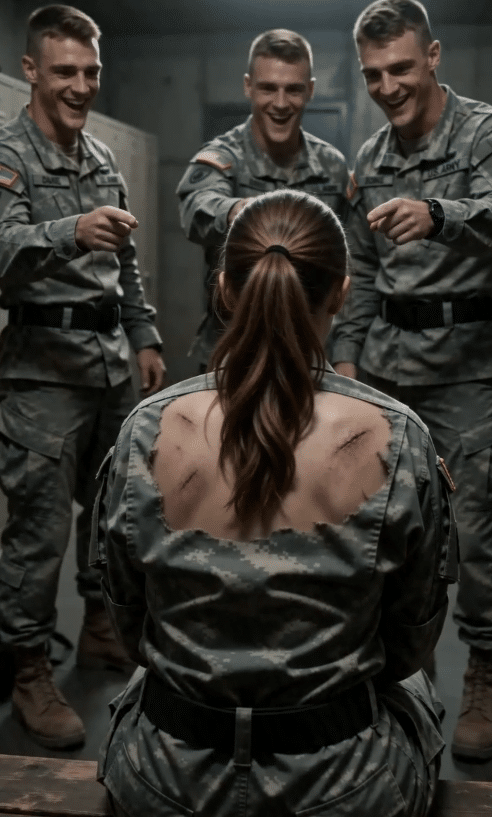
Corporal Brent Walker laughed first. He had one of those clean, camera-ready faces that made people mistake arrogance for charisma. Beside him stood Mason Pike, broad and blond and permanently amused by his own voice. The third was Darryl Keene, quieter than the others, but never quiet enough to stop them.
They had spent the last two weeks circling me like bored dogs.
Too quiet, Brooks.
Too serious, Brooks.
You think you’re better than everybody, Brooks?
What they really meant was simpler.
You don’t fit the version of this place we built in our heads.
I kept my eyes on the floor and reached for the clean shirt in my duffel. That was when Pike leaned forward behind me and let out a low whistle.
“Well,” he said. “Look at that.”
I froze.
Not visibly. I had learned too young how not to give men the satisfaction of seeing a reaction. But inside, every muscle in my back locked.
Walker laughed again.
“Those are real?” he asked. “What happened, Brooks? You get into a fight with a fence?”
Keene chuckled under his breath.
I knew what they were looking at. Anyone behind me would have seen them the second I pulled off my shirt. The marks stretched across my upper back in several jagged, pale lines. Not fresh. Not pretty. Impossible to ignore.
Most people stared and then looked away.
These three stared and decided the scars were an invitation.
Pike stepped closer, his boots scraping the concrete.
“She probably just fell really badly,” he said, loud enough for the others to enjoy it.
That pulled a harder burst of laughter out of Walker.
I slipped my clean shirt halfway over my arms but didn’t finish putting it on. Not yet. My fingers had suddenly gone stiff.
The easiest thing in the world would have been to turn around and explain nothing. Or explain everything. Or say the kind of cruel thing that ends a moment fast but leaves a bigger mess behind.
Instead, I stayed where I was.
That made them bolder.
Men like that always mistake restraint for surrender.
Walker folded his arms and moved into my line of sight when I finally turned my head. He was smiling, but there was something cold under it. The kind of expression that grows in people who have never been forced to examine themselves.
“There’s no place for women here,” he said.
He didn’t shout it.
He didn’t need to.
The sentence dropped into the room like a weight.
The metallic clang of another locker shutting somewhere near the door faded quickly. A couple of soldiers farther down the row looked over, then looked away. No one wanted to step into it. Everyone in uniform learns early which moments can damage you by association.
I lowered my eyes for exactly one second.
That was all they needed.
Walker took that tiny movement as victory. Pike smirked. Keene gave that small, ugly laugh people use when they want cruelty without responsibility.
I lifted one hand and covered my face, just briefly.
Not because I was ashamed of the scars.
Because for one dangerous moment, I was back in another room, another year, another version of myself that still believed being good at the job would be enough to protect me from small men.
It wasn’t.
It never is.
When I dropped my hand, the tears were there. I hated that they saw them.
Pike’s smile widened.
Walker looked pleased with himself, like he had done something clever instead of predictable. “You heard me,” he said. “This isn’t a place for women who need special treatment.”
I stood up slowly.
I was taller than Pike expected. Calmer than Walker wanted. That bought me one full second of silence from all three of them.
I turned to face the far wall instead of them, spine straight, shoulders back, shirt still hanging open at the collar.
I knew the time without checking.
I knew who was due to enter that room.
And I knew those three men had chosen the worst possible minute of their military careers to laugh at my back.
Then the door handle turned.
Act II: The Story in the Scars
People always want scars to come with a simple story.
A fall. A bad accident. A reckless night. Something short enough to fit into a conversation and tidy enough to make them comfortable again.
Mine never had that kind of story.
The marks on my back began three years earlier on a rain-black mountain road outside a village most Americans would never hear about and never care to pronounce correctly. The mission was supposed to be a clean extraction. Go in, pull out an intelligence asset and two wounded civilians, and get airborne before the weather collapsed.
Clean never lasts long in the dark.
I had been twenty-six and stupid enough to think discipline could make me invincible. Back then, I believed pain was something you filed away after the operation. I believed loyalty would be repaid. I believed if you kept your head and saved lives, the institution would remember what mattered.
Then the transport took damage coming down.
Not a fiery movie explosion. Nothing cinematic. Just a hard impact, bent metal, shouted orders, water rushing through places it should never have reached, and the sound of men realizing too late that they were not in control anymore.
One of the civilians was a girl no older than fourteen.
The intelligence officer we had gone in for was already half-conscious. The pilot had blood in one eye and his leg pinned under twisted structure. The fuselage had split, and one section of torn metal was hanging inward like a row of teeth.
I remember the smell more than anything.
Fuel.
Rain.
Hot metal turning cold.
I remember trying to pull the girl free while the aircraft shifted and screamed around us. I remember one of the medics yelling for me to get down just before the loose edge of the torn panel raked across my back when the cabin lurched.
After that, everything became fragments.
The girl crying once, then not again.
My hands slipping.
A flashlight beam swinging wildly through rain.
The voice of Major Daniel Mercer ordering me to leave him and get the others out first.
I did not leave him.
That became the official version they told later, at least in the parts of the story they were allowed to tell. Staff Sergeant Nia Brooks displayed extraordinary courage under catastrophic conditions. She extracted two civilians and an injured officer from a compromised transport under severe environmental hazard.
What the citation never said was that I spent six weeks unable to lie flat without pain and nine months waking up from the same dream.
Or that the officer I dragged through the mud that night was the only son of the man now assigned to take command of the entire installation.
General Stephen Mercer.
Decorated. Feared. Almost impossible to impress.
I had met him only once before, at a private ceremony I did not want and nearly refused to attend. He had shaken my hand, looked at the sealed portions of my file, then looked at me for a little too long.
“You paid dearly for other people to live,” he had said.
It was not pity.
That was why I remembered it.
Three months ago, I received sealed transfer orders to Mercer Ridge Army Post. New assignment. New chain of command. Minimal notice. No explanation that belonged on paper.
When I arrived, I got one private meeting with a colonel who did not smile.
“You are here for two reasons,” he told me. “The first is operational. The second is cultural. You will learn the difference soon enough.”
That was all.
No one in the barracks knew the details. To them, I was just another transfer wearing the wrong kind of silence. A Black woman with a combat file nobody could fully read and a face that did not invite conversation.
Walker and Pike hated that before I ever opened my mouth.
They hated that I could outshoot one of them and outrun the other. They hated that I never flirted, never apologized, never explained my scars. Men like that build themselves out of easy hierarchies. When someone refuses to stand where they place her, the refusal feels like an insult.
So they kept testing me.
A joke in the mess hall.
A comment on the range.
A shoulder hit in a corridor disguised as an accident.
I gave them nothing.
That made them reckless.
And that was why, when I heard the door open behind me in the locker room, I did not turn around right away.
Because I already knew this was no longer their moment.
It was mine.
Act III: The Man in the Blue Uniform
The room went silent before anyone spoke.
You can hear authority before you fully see it. In the speed with which people straighten their backs. In the sudden stillness after careless laughter. In the sound of men trying to rearrange their faces before they are examined too closely.
I buttoned my fatigue shirt all the way to the throat and turned.
General Stephen Mercer stood in the doorway wearing full dark blue dress uniform, gold shoulder boards catching the dull light, ribbons and medals sharp against his chest. He was older than when I had last seen him, but not softer. His face had the kind of stern composure that made even confident men step aside without being told.
Behind him stood two colonels and the post sergeant major.
Walker snapped to attention so quickly he nearly clipped Pike with his elbow. Keene straightened a half-second later. Pike’s smirk died before it had time to fully leave his face.
No one breathed.
Mercer looked first at the three men.
Then at me.
Then, slowly, at the strip of bare bench where I had been sitting, the open duffel on the floor, and the expression that had not entirely left Walker’s face.
He had seen enough.
“At ease,” he said.
No one moved.
It was not disobedience. It was shock.
Mercer stepped into the room with measured, deliberate strides. The polished heels of his shoes clicked once, twice, three times against the concrete. Each sound seemed to strip another layer of certainty from the men in front of him.
He stopped directly in front of me.
For one brief moment, the entire locker room held its breath with the force of a prayer.
Then General Mercer saluted me.
It was not casual.
It was not symbolic.
It was a full, formal salute, given cleanly and without hesitation in front of every witness in that room.
Walker made a sound in the back of his throat. Pike went pale so fast it was almost impressive. Keene looked like someone had reached into his chest and loosened something vital.
Mercer lowered his hand.
“Staff Sergeant Brooks,” he said, his voice flat and carrying. “Thank you for reporting as ordered.”
The ordered part was for the room.
The thank you was not.
“Yes, sir,” I said.
Mercer turned then, not to the colonels, but to Walker.
“What exactly,” he asked, “was so amusing in here when I entered?”
No one answered.
Walker tried first, because men like him always think they can still talk their way through consequences. “Sir, we were just—”
“Stop.”
Mercer did not raise his voice.
He did not have to.
Walker shut his mouth so hard I could hear his teeth click.
The general’s gaze moved from one soldier to the next. “I asked a simple question.”
Pike swallowed visibly. Keene looked at the floor. Walker stared straight ahead, the way people do when they realize eye contact might finish them.
Mercer’s expression did not change.
“I heard laughter from the hall,” he said. “I entered this room and found three enlisted men mocking a decorated combat NCO before a command review. Is there a detail I am missing?”
The command review.
That phrase landed harder than the salute.
Walker blinked.
Pike’s eyes flicked toward me for the first time with something other than contempt.
Mercer took one more step.
“These scars,” he said, and now he was speaking to the room, not just the three men, “are the reason my son came home alive.”
No one moved.
No one even blinked.
I could hear a single drip of water somewhere near the shower drain. I could hear Pike trying not to breathe too loudly through his nose. I could hear my own pulse in the base of my throat.
Mercer did not look away from them.
“And the soldier you just told there is no place for women here,” he continued, “was brought to this installation under direct order to assess whether there is any place left here for men like you.”
That was when the room truly changed.
Act IV: What He Told the Room
People imagine humiliation as noise.
Most of the time, it is silence.
Walker did not speak. Pike did not move. Keene’s face emptied out completely, as if panic had erased every feature at once. The swagger, the casual cruelty, the easy confidence they wore like a second uniform—gone.
General Mercer let the silence sit on them for a few more seconds.
Then he turned slightly toward the two colonels by the door. “Record all names present.”
The post sergeant major pulled a small notebook from his pocket.
Walker found his voice at last. “Sir, with respect, we didn’t know—”
Mercer’s eyes cut back to him.
“No,” he said. “You didn’t know. That is the least damning part of what I just witnessed.”
Walker’s mouth opened, then closed.
Mercer continued. “You did not know who she was. You did not know what those scars meant. You did not know whose life she carried out of a broken transport. And still you chose mockery.”
His voice stayed level.
That made every word heavier.
“You saw pain,” he said, “and treated it like entertainment. You saw a fellow soldier standing alone and decided that was permission.”
No one in that room would forget the way he said permission.
It was not a speech. It was a verdict.
Mercer turned to me then. “Staff Sergeant Brooks, do you wish to make a statement?”
I had imagined that moment more than once in my life, though never in this exact room. The chance to speak when the balance of power had finally shifted. The chance to say everything. The chance to return humiliation in a language these men would understand.
For a second, I was tempted.
Then I looked at Walker.
At Pike.
At Keene.
And I realized something that surprised even me.
They were already finished.
Not broken forever. Not destroyed as human beings. But whatever version of themselves had believed cruelty carried no cost had just died in front of witnesses.
I kept my voice calm.
“Yes, sir.”
Mercer nodded once.
I stepped forward and faced the room.
“The first thing men like this count on,” I said, “is silence. Not mine. Everybody else’s.”
No one moved.
I continued.
“They count on people laughing along. Looking away. Deciding a joke is easier to survive than a confrontation. They count on tradition when tradition is really just fear wearing better language.”
Walker’s jaw tightened.
Not in defiance now.
In shame.
I looked at Pike next. “You said I probably just fell really badly.”
A small pulse moved in his throat.
“I didn’t,” I said. “I stood where other people were running from. That is why I am still here. That is why those scars are there. And that is why I do not need approval from men who mistake cruelty for strength.”
No one spoke after that.
Mercer waited one beat, then faced the three soldiers again.
“Effective immediately,” he said, “Corporal Walker, Specialist Pike, and Private Keene are removed from selection status and placed under formal conduct review pending recommendation for transfer or separation.”
The words hit like clean hammer strikes.
Walker went white.
Pike whispered, “Sir—”
Mercer did not let him finish.
“You will also attend mandatory review before any future promotion consideration,” he said. “Every board that evaluates your names will read today’s report. In detail.”
That was when Keene finally looked up.
Fear is ugly when it arrives late.
“Sir, please,” he said. “We were just messing around.”
Mercer stared at him with an expression so cold it nearly changed the temperature of the room.
“Men who are just messing around do not create hostile units,” he said. “Weak men do.”
He let that sit.
Then he turned to the room at large, because by then others had gathered near the doorway, drawn by the silence and the uniforms and the feeling that something final was taking place.
“This installation will not confuse bullying with toughness,” Mercer said. “It will not confuse sexism with tradition. And it will not confuse survival scars with shame.”
He looked at me once more.
“Staff Sergeant Brooks will begin command assessment of Bravo training cycle effective tomorrow.”
There it was.
The reason for my transfer. The operational part. The cultural part.
All of it.
I had not been sent there to fit in.
I had been sent there to measure what deserved to remain.
Mercer inclined his head toward me, not quite a bow, not merely protocol either. “You have the room, Sergeant.”
Then he turned and walked out.
The colonels followed.
The sergeant major gave the three men one long look that promised no comfort whatsoever.
And just like that, the locker room belonged to me.
Act V: The Silence They Left Behind
The first thing Walker did after the general left was try to speak.
He took one step toward me, then stopped when he realized he no longer knew what position his body was supposed to take in a world where I held the authority and he held the shame.
“Brooks,” he said, his voice thinner than I had ever heard it. “I didn’t know.”
I looked at him for a moment.
Then I said the only honest thing left.
“You didn’t need to know.”
That hurt him more than if I had shouted.
Because it was true.
A person does not need the classified details of your life to decide whether to treat you like a human being. He does not need your medals. He does not need your pain translated into something he respects. He only needs a minimum of character.
Walker looked down.
Pike said nothing at all. He had folded inward somehow, as if his own body had become unfamiliar. Keene moved to the side, giving me space without being asked.
The room was full now, but no one laughed.
That was the strangest part. Not the apology that never fully came. Not the punishment. Not even the general’s salute.
It was the silence.
Not the old silence, the cowardly one. The new one.
The kind that arrives when people see the truth and understand they have been standing too close to something rotten for too long.
I picked up my duffel from the floor and slung it over one shoulder.
At the door, I stopped and turned back.
“Tomorrow at 0500,” I said to the room. “Bravo assessment begins on the north field. Anyone still in this cycle will report ready to work. Not ready to perform.”
No one missed the distinction.
Then I walked out.
The corridor outside the locker room felt colder than before, but cleaner too. Through the high barracks windows, evening light was flattening into steel-blue dusk. Somewhere across the post, a bugle call drifted thinly through the air.
I should have felt triumphant.
Instead, what I felt was tired.
Not weak tired. Not defeated tired. The older kind. The kind that comes after holding yourself upright in rooms that were designed to see whether you crack.
I stood alone for a minute with one hand against the cinder-block wall and let myself breathe.
My back still ached sometimes when the weather changed. Some nights the old operation returned in flashes I could not fully control. Some mornings I looked in the mirror and remembered every person who had ever stared too long and every person who had looked away too fast.
None of that disappeared because a general saluted me in a locker room.
But something had changed.
Not in the scars.
In the witnesses.
The next morning, the north field was dark with pre-dawn mist when I arrived. The air smelled like wet grass and diesel. Fifty-two soldiers stood in rough formation under floodlights that made their faces look pale and tired.
Walker was not among them.
Neither was Pike.
Keene stood at the far end of the line, shoulders stiff, eyes forward, stripped of the easy cruelty I had first seen in him. Whether that change would last was not my job to predict. Only to test.
I stepped in front of the formation and let the silence build.
Some of them knew who I was now.
Others only knew that something had happened the day before and the ground under this post was not as stable as it used to feel.
“My name is Staff Sergeant Nia Brooks,” I said. “You are not here because you deserve to be comfortable. You are here because someone needs to know what kind of people this unit becomes under pressure.”
No one moved.
I continued.
“You can teach speed. You can teach precision. You can teach people how to clear a course, carry weight, and follow command. What you cannot teach, if it is missing entirely, is character.”
A light wind moved across the field.
I thought about the locker room. The laughter. The tears I had hated them seeing. The salute. The look on Walker’s face when he realized the world no longer arranged itself around his assumptions.
Then I looked across the line of soldiers and made myself a private promise.
No one under my watch would ever have to earn dignity with a dramatic reveal.
No one would need medals before being treated like they belonged.
“Assessment starts now,” I said.
The morning exploded into motion.
Hours later, when the sun finally lifted above the training grounds, I caught my reflection for a second in the dark window of a transport vehicle. Close-cropped cornrows. Dust on my cheek. Spine straight. Scars hidden under fabric, exactly where they belonged.
Not erased.
Not explained away.
Carried.
That was enough.
Men like Walker had looked at my back and thought they were seeing damage. They had looked at silence and mistaken it for weakness. They had looked at a woman standing alone and assumed she was easy to diminish.
They were wrong on every count.
Those marks were never proof that I had broken.
They were proof that I had survived the kind of night that would have buried men like them.