Act I
“Trash. Wipe it on your knees.”
The words cut across the manicured fairway just as a golf ball rolled off the green and disappeared into a patch of mud near the cart path.
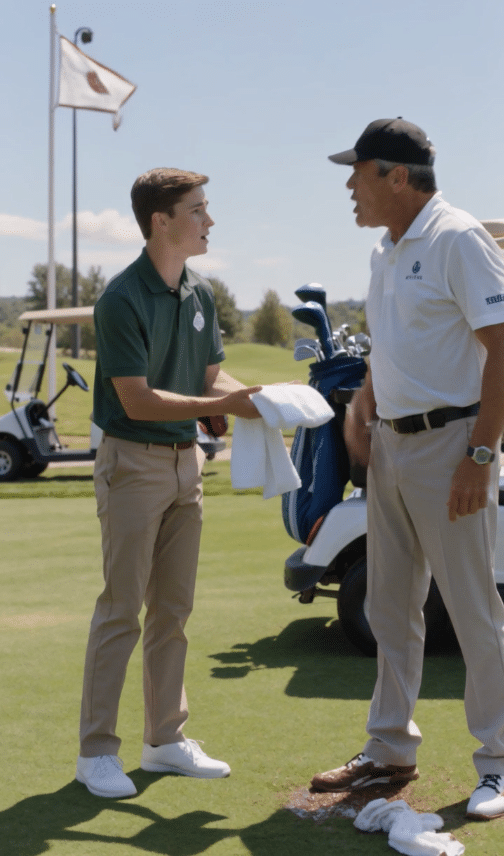
Nineteen-year-old Ethan Brooks stood beside the golf cart, holding a clean white towel. His green polo was damp with sweat, his khaki pants carried a streak of grass near one knee, and his club cap sat slightly crooked after several hours under the afternoon sun.
Across from him stood Richard Caldwell, a fifty-eight-year-old club member who had spent decades making sure everyone around him knew exactly how much money he had.
Richard wore a spotless white golf shirt, an expensive cap, and a leather glove that matched his polished shoes. A gold watch flashed at his wrist as he pointed toward the muddy mark on his footwear.
“Look at this,” he snapped. “Do you have any idea what these shoes cost?”
Ethan glanced down.
“I’m sorry about the mud, sir. The ball rolled off the green, and I was explaining the course’s relief rule. I can hand you a towel.”
“I didn’t ask for a rule.”
Richard lifted his foot slightly, presenting the dirty shoe as though Ethan were a servant summoned to inspect a stain on a palace floor.
“I told you to clean it.”
Ethan kept his voice respectful.
“I can help you clean it, sir. I just can’t kneel on the course like that. Here’s the towel.”
For a second, Richard stared at him as if the young man had spoken in a foreign language.
Then he laughed.
“You can’t?”
Ethan felt several golfers turn toward them. Near the next tee, a woman lowered her sunglasses. Two men beside a parked golf cart stopped talking.
Richard noticed the attention and seemed to enjoy it.
“Do you know how long I’ve been a member here?” he asked.
Ethan shook his head.
“Longer than you’ve been alive, probably. I pay more in annual dues than your family makes in a year.”
“I understand, sir.”
“No, you don’t.”
Richard stepped closer.
“People like you get confused. You carry the bags, fetch the clubs, clean the shoes, and stay out of the way. That’s how this place works.”
Ethan tightened his grip on the towel.
He needed this job.
His mother had been working double shifts at a nursing home since his father left, and Ethan had promised he would find a way to pay for college without adding another burden to the household. The caddie position covered part of his tuition savings, gave him access to a scholarship program, and let him work around his classes.
He had learned to remember club distances, read greens, replace divots, and keep his composure when players became frustrated.
He had also learned that an apology could calm most people.
But some people did not want an apology.
They wanted proof that they could make someone else feel small.
Richard pointed at the muddy shoe again.
“Get down and wipe it.”
Ethan held out the towel.
“Please, sir. You can use this.”
Richard’s expression darkened.
“Caddies stay beneath members.”
Before Ethan could answer, Richard kicked him hard in the chest.
Ethan stumbled backward and fell beside the golf cart. The towel slipped from his hand and landed on the grass. His knee struck the ground, leaving a thin trace of blood against the fabric of his khaki pants.
For a moment, he could not breathe properly.
The sky above him seemed unnaturally bright. He heard the rattle of the golf cart and the faint clink of clubs shifting in their bag.
Someone gasped.
Richard looked down at him.
“You should have listened.”
Then he stepped beside the cart and delivered exactly two more kicks to Ethan’s back and side.
Ethan curled in pain, pulling his injured knee away from the wheel. He tried to protect himself with his arms, struggling to understand how a conversation about a muddy shoe had turned into this.
The golfers nearby froze.
A woman covered her mouth. One man took a step forward, then stopped when Richard turned toward him with a furious glare. A course employee stood near the path, visibly shaken, unsure whether moving closer would make the situation worse.
Richard straightened his shirt and adjusted his glove.
“Caddies stay beneath members,” he repeated.
Ethan lay on the grass, breathing unevenly.
Then the clubhouse doors swung open.
A tall man in a navy blazer descended the stone steps, followed closely by the course manager, who carried a thick membership book under one arm.
The man was Arthur Whitmore, the sixty-two-year-old owner of the country club.
He took one look at Ethan on the ground.
Then he looked at Richard.
And the expression on his face made several members instinctively step away from the golf cart.
Richard had spent years believing there was no one at the club who could tell him no.
He was about to discover that the man walking toward him had been keeping records of far more than membership dues.
Act II
Arthur Whitmore had owned the club for seventeen years.
He had inherited neither its reputation nor its success. When he purchased the struggling property, the clubhouse roof leaked, the grounds crew was understaffed, and longtime members complained that the course had lost the character that once made it special.
Arthur rebuilt it slowly.
He invested in the greens, restored the clubhouse, expanded the scholarship fund for young caddies, and established a management policy that treated the grounds crew as professionals rather than invisible labor.
He believed a great country club was measured not only by the quality of its fairways, but by the way it treated the people who maintained them.
That philosophy had not made him popular with everyone.
Some older members preferred the traditional hierarchy in which a wealthy guest could demand almost anything and expect an employee to comply. They considered Arthur’s emphasis on staff dignity an unnecessary complication.
Richard Caldwell was among the loudest critics.
He had been a member long before Arthur acquired the property. His family had money, his business contacts were valuable, and his name appeared on several local charity committees.
He liked to remind people of all three.
Over the years, staff members had quietly reported his behavior. He had shouted at a groundskeeper for moving a sprinkler, insulted a server who brought the wrong vintage of wine, and once demanded that a young caddie be dismissed for speaking to him without using his title.
Each incident had been handled separately.
A warning here. An apology there. A complaint that somehow disappeared after Richard made a generous donation to a club event.
Arthur had noticed the pattern.
He had also noticed that the same employees rarely complained twice.
Now, as he crossed the fairway toward Ethan, those earlier reports came back to him with uncomfortable clarity.
“Ethan,” Arthur said, lowering himself beside the young man. “Can you hear me?”
Ethan nodded, though his face had gone pale.
“Don’t try to stand. We’re getting you medical attention.”
Arthur looked toward the course manager.
“Call for medical assistance. Have security secure the area and identify everyone who witnessed this. Preserve any available camera footage from the clubhouse and cart paths.”
The manager hurried away.
Arthur then stood and positioned himself between Ethan and Richard.
“What happened here?” he asked.
Richard immediately lifted his hands.
“This is being blown out of proportion. The boy was insolent.”
Arthur’s gaze remained on him.
“Did you kick him?”
“He refused to follow a simple instruction.”
“That wasn’t my question.”
Richard’s jaw tightened.
“He was disrespectful.”
Arthur glanced down at the abandoned towel.
“I see a towel on the ground, a young man who can’t catch his breath, and a group of members who watched you strike him.”
“You weren’t here for the beginning.”
“Then we’ll establish the beginning.”
Richard looked around, expecting someone to defend him.
No one did.
He pointed toward Ethan.
“He was supposed to be helping me. The ball went into the mud, my shoes got dirty, and I told him to clean them. That’s what caddies are for.”
Ethan tried to sit up, then winced.
Arthur turned toward him.
“Don’t move yet.”
The owner waited until the medical team arrived and began assessing Ethan. Only then did he face Richard again.
“You asked an employee to help with your shoe. He offered you a towel. You chose to attack him.”
Richard scoffed.
“You make it sound criminal.”
“I make it sound like what happened.”
“I’m a member of this club.”
“Yes,” Arthur said. “You are.”
Richard’s expression brightened slightly, as if the acknowledgment meant the argument had finally shifted in his favor.
Arthur continued.
“And membership does not give you ownership of another human being.”
The words landed harder than Richard expected.
For years, he had relied on the quiet calculations that governed exclusive spaces. Managers wanted to retain wealthy members. Staff wanted to keep their jobs. Other members preferred not to interfere in disputes that might make their afternoon uncomfortable.
Richard had mistaken their reluctance for permission.
He believed that if he paid enough money, no one would risk challenging him.
“Arthur,” he said, lowering his voice, “let’s handle this privately. I have been bringing business to this club for years. You know what I contribute.”
Arthur’s expression barely changed.
“I know what your membership provides.”
“And you know what it brings to the club.”
“I also know what this club is supposed to stand for.”
Richard glanced toward the course manager, who had returned with the membership book. The thick volume contained more than names and renewal dates. It included formal notices, disciplinary records, and decisions made under the club’s membership rules.
Richard recognized it immediately.
He had seen it brought into committee meetings when members challenged suspensions or disputed conduct decisions.
“What is that for?” he demanded.
The course manager held the book close to his chest.
Arthur did not answer yet.
He was watching Ethan being carefully moved onto a stretcher. The young man looked frightened and embarrassed, as though he were worried about the effect his injury might have on his job.
That expression angered Arthur more than Richard’s shouting.
Ethan had done nothing wrong.
Yet he was the one lying in the grass, wondering whether his future had just been put at risk.
Arthur turned back to Richard.
“You’ve spent a long time believing the rules apply differently to you.”
Richard laughed nervously.
“Don’t be ridiculous.”
Arthur nodded toward the membership book.
“Then perhaps it’s time we read them together.”
Act III
Richard’s confidence faltered when the course manager opened the membership book.
He recognized the tabbed pages immediately.
“Put that away,” he said.
The course manager did not move.
Arthur held out his hand, and the manager passed him the book.
“This club has a written code of conduct,” Arthur said. “It applies to members, guests, and employees. It includes provisions for abusive behavior, threats, and physical misconduct.”
Richard folded his arms.
“I know the rules.”
“Then you know that membership can be suspended or revoked for serious misconduct.”
Richard gave a sharp, humorless laugh.
“You’re going to revoke my membership over a disagreement with a caddie?”
“Over an assault, if the evidence supports what everyone here has reported.”
Richard looked toward the gathering golfers.
“Everyone is exaggerating. He refused to do his job.”
A man near the cart path finally spoke.
“He offered you a towel.”
Richard turned sharply.
“Stay out of this.”
The man flinched but did not withdraw his statement.
A woman standing beside him nodded.
“I heard it, too. The young man offered to help. You told him to kneel.”
Richard stared at them, his face flushing.
“Unbelievable. You people have known me for years.”
The woman lowered her sunglasses.
“And we just watched you kick a teenager who was working.”
That silenced him.
Arthur opened the membership book to the conduct section. He did not theatrically wave it around or pretend that the decision had already been made. He simply showed Richard the relevant provisions and instructed the course manager to begin a formal review.
The club would preserve witness statements, gather any available footage, document Ethan’s injuries, and cooperate with the appropriate authorities. Richard would be given notice of the process and an opportunity to respond.
No amount of money would make the evidence disappear.
Richard looked at the book as though it had betrayed him.
“This is because you never liked me,” he said to Arthur.
“I’ve given you more opportunities to correct your behavior than I should have.”
The words surprised several members.
Arthur continued.
“Three staff complaints were brought to my attention over the past two years. They involved verbal abuse and intimidation. Each time, you were warned that further misconduct could jeopardize your membership.”
Richard’s face changed.
Those complaints had never seemed serious to him. The employees had been young, poorly paid, or too worried about losing their positions to push the matter further. He had assumed that once he apologized—or made a donation that helped smooth things over—the incidents would vanish.
He had not understood that the club’s management had retained the records.
“You can’t use old complaints against me,” he snapped.
“They are part of the documented history of how this matter has been handled,” Arthur replied. “They will be reviewed fairly, along with what happened today.”
Richard looked at the course manager.
“Those complaints were resolved.”
“They were addressed,” the manager said carefully. “That is not the same as erasing them.”
For the first time, Richard seemed to realize that the book was not a prop brought out to frighten him.
It represented a history he could not rewrite simply by raising his voice.
He tried another approach.
“Fine. I’ll pay the boy’s medical expenses. I’ll make a contribution to the scholarship fund. Whatever you want.”
Arthur closed the book.
“Ethan is not a bill you can settle.”
“I’m offering to make things right.”
“You haven’t even apologized to him.”
Richard’s lips pressed into a thin line.
He glanced toward the stretcher, where Ethan was answering questions from the medical team. The young caddie looked exhausted, but he was listening carefully and trying to cooperate.
Richard seemed to be waiting for him to say something that would make the situation easier.
Perhaps Ethan would accept the money. Perhaps he would insist that it had all been a misunderstanding. Perhaps the young man would be so afraid of losing his job that he would help Richard escape the consequences.
But Ethan said nothing.
He did not need to.
Arthur had seen enough, and the witnesses were beginning to give consistent accounts of the assault.
Then Richard made one final mistake.
He stepped toward Ethan’s stretcher.
“Tell them you’re fine,” he demanded. “You don’t want to ruin a man’s life over something this small.”
Arthur immediately moved into his path.
“Step back.”
Richard ignored him.
“You hear me, boy? Tell them this was an accident.”
Arthur blocked him completely.
“Do not approach him again.”
Richard shoved a hand toward Arthur’s shoulder as he tried to get around him.
The owner reacted with a single forceful punch to Richard’s face.
Richard stumbled backward, his expensive cap knocked crooked. He clutched his mouth, stunned, a faint mark appearing at the corner of his lips.
Gasps rippled across the fairway.
Arthur stepped away and signaled for security to intervene. He did not strike Richard again.
The course manager stared at the two men, still holding the membership book.
Arthur had just made a decision of his own that would require scrutiny. His position as owner would not excuse him from the consequences of using force.
He knew that.
But he also knew the immediate priority: Ethan needed to be protected, and Richard needed to be kept away from him.
Arthur positioned himself between Richard and the stretcher.
Then he looked directly at the older man.
“That rule book just ended your last round here.”
Richard’s hand remained pressed against his mouth.
His eyes dropped to the membership book.
For the first time, he looked afraid.
“My last round?”
Act IV
The fairway remained silent as the course manager signaled for security.
Richard seemed unable to decide whether to argue, threaten someone, or pretend the entire scene had been misunderstood.
He chose anger.
“You can’t throw me out,” he shouted. “I’ve been a member here for thirty years!”
Arthur stood several feet away, keeping himself between Richard and Ethan.
“Your membership does not exempt you from the code of conduct.”
“You owe me respect!”
“No,” Arthur replied. “You are entitled to a fair process. Respect is not something you can demand at the end of a threat.”
Richard looked toward the other golfers.
“Are you all going to stand there and let him do this?”
Nobody answered immediately.
Some members looked uncomfortable. Others looked ashamed that they had watched Ethan being attacked without intervening. A few seemed relieved that someone had finally confronted the man whose temper had made the club unpleasant for years.
One of the older members stepped forward.
“Richard, stop. You went too far.”
Richard stared at him in disbelief.
“You’ve played with me every Thursday for twelve years.”
“And I’ve watched you treat staff like they don’t matter,” the man replied. “I should have said something sooner.”
That admission seemed to hit Richard harder than the owner’s words.
He had always relied on people deciding that challenging him would be more trouble than it was worth. Their silence had allowed him to believe his behavior was acceptable.
Now the silence was breaking.
Arthur turned to the course manager.
“Please record the entire incident, including my actions. Preserve all available footage and witness accounts. I want the review to be independent and complete.”
The manager nodded.
“Understood.”
“Also, suspend Mr. Caldwell’s access to the course pending the membership review. Have security escort him from the property once the medical team confirms Ethan is safely on his way for further evaluation.”
Richard stared at Arthur.
“You’re suspending me?”
“Pending review.”
“You can’t do this because of one boy.”
Arthur’s voice hardened.
“This is not about his age, and it is not about your money. It is about whether someone can work here without being assaulted.”
Richard opened his mouth, then closed it.
The security staff approached without grabbing him or escalating the confrontation. They explained that he needed to leave the immediate area while the incident was documented.
He looked at the membership book one last time.
For years, he had treated the club’s rules as a list of conveniences designed to preserve his status. He expected priority tee times, special reservations, and a staff willing to anticipate his wishes.
He had never considered that the same rules could be used to remove those privileges.
Ethan was taken for medical assessment. The staff made sure he was not required to answer any further questions until he was ready, and his supervisor confirmed that his position and scholarship eligibility would not be jeopardized because he had reported what happened.
Before the ambulance departed, Arthur approached the stretcher.
“How are you feeling?”
“Sore,” Ethan admitted. “A little embarrassed.”
“Embarrassed?”
Ethan glanced toward the clubhouse.
“I didn’t want everyone making a scene. I just wanted to finish the round and get back to work.”
Arthur shook his head.
“You didn’t make this happen. You offered a towel. You followed the course rules. You tried to handle a difficult situation professionally.”
Ethan looked down at his hands.
“My mom keeps telling me that if I work hard, people will notice.”
Arthur waited.
“I guess I thought that meant I should just keep my head down, even when someone treats me badly.”
Arthur’s expression softened.
“Working hard does not mean accepting abuse.”
The young man swallowed, fighting the emotion rising in his throat.
Arthur continued.
“You earned your place here. You don’t have to earn the right to be safe.”
The ambulance doors closed a moment later.
Richard watched from a distance as it pulled away.
He had spent the afternoon believing that Ethan’s refusal to kneel was an insult to his status. He had tried to force the young man to demonstrate his place in the club’s hierarchy.
Instead, Richard was the one being escorted away.
And the membership book he had dismissed as a collection of formalities had become the record of every privilege he now risked losing.
The club’s review would take time. The authorities would handle the assault allegations, and Arthur’s punch would be examined as part of the same factual record. The owner could not simply declare himself the hero and close the matter.
But one thing had already changed.
No one on that fairway could pretend they had not seen what Richard was capable of when a young employee refused to humiliate himself for him.
Act V
Ethan spent the next several days recovering.
His injuries required rest and follow-up medical care, and the club arranged for him to take time away from the course without losing his job. His supervisor checked in regularly, and the scholarship coordinator confirmed that the incident would not affect his eligibility.
At home, Ethan initially tried to minimize what had happened.
When his mother asked why he had come back from work in an ambulance, he told her that a member had lost his temper and that the club was handling it.
She listened without interrupting.
Then she sat beside him and took his hand.
“You don’t have to make something terrible sound smaller just because you’re afraid it will cause trouble,” she said.
Ethan looked away.
He had been trying to protect her from worrying. She had already spent years stretching every paycheck, and he hated the thought of becoming another problem she needed to solve.
But as he described the muddy ball, the towel, and Richard’s demand that he kneel, his voice began to shake.
His mother held his hand more tightly.
“You were working,” she told him. “You were doing your job. Nothing about that gives anyone the right to hurt you.”
For the first time since the assault, Ethan allowed himself to cry.
He had not been frightened only by the kicks. He had been frightened by how quickly his future seemed to disappear beneath someone else’s anger.
He had imagined losing the job that paid for school. He had worried that the club would protect its wealthy member and quietly replace him. He had wondered whether speaking up would make him look difficult or ungrateful.
Instead, the people responsible for the club had made it clear that he was not the one who needed to be punished.
While Ethan recovered, the club completed its internal review and cooperated with the appropriate authorities. The witnesses’ accounts and available footage were considered alongside the previous staff complaints.
Richard was given the opportunity to respond to the allegations and the documented history of his conduct.
The outcome was decisive.
The club revoked his membership under its conduct policies, ending his access to the course, clubhouse, and member privileges. The decision was formally documented, and Richard was notified through the club’s established process.
His name disappeared from the active tee-time roster.
His private reservations were canceled.
The membership card he had once displayed as proof of his importance no longer opened the doors he had taken for granted.
The consequences extended beyond the club. Several friends who had regularly played with Richard reconsidered their relationship with him after learning the details of the incident. Business associates who had once accepted his arrogance as the price of working with a successful man began to distance themselves.
Richard tried to argue that he was being punished for one bad afternoon.
But the witnesses remembered the towel.
They remembered Ethan offering help.
They remembered the demand to kneel and the violence that followed.
And the old complaints made it difficult to portray the incident as a moment of uncharacteristic frustration.
For years, Richard had believed that a person’s worth could be measured by the price of their clothes, the size of their bank account, and the number of doors that opened when they arrived.
Now he had lost access to a place where he had once felt untouchable.
The club did not celebrate his downfall. Arthur made it clear that the purpose of the decision was to enforce the rules and protect employees, not to turn a disciplinary matter into entertainment.
He also initiated a review of staff safety procedures, including how caddies could summon help when a member became threatening and how previous complaints were tracked. Managers were reminded that a wealthy member’s spending could not override the club’s obligation to protect its employees.
Arthur understood that his own punch had complicated the situation. He cooperated with the review of his conduct and accepted that ownership did not place him above the standards he expected others to follow.
He could not undo what had happened on the fairway.
But he could make sure the response did not depend on which person involved had the most money.
Several weeks later, Ethan returned to the course.
The grass had been freshly cut, the fairway stretched green beneath a pale blue sky, and the clubhouse flag moved gently in the breeze.
His knee had healed enough for him to walk comfortably again, though he still felt a brief flicker of unease whenever a golfer raised his voice.
On his first morning back, he checked his clubs, adjusted his cap, and reached for the familiar white towel clipped to his bag.
Arthur was waiting near the first tee.
“Good to have you back,” the owner said.
“Thank you, sir.”
Arthur looked across the course.
“The scholarship committee is meeting next month. Your supervisor tells me you’ve been doing excellent work in your classes.”
Ethan nodded cautiously.
“I’ve been trying.”
“I’d like you to apply for the expanded caddie scholarship. It covers more of the cost of tuition and includes a mentoring program for students interested in golf course management.”
Ethan stared at him.
“Are you serious?”
“Completely. You earned the opportunity before that afternoon ever happened. What happened to you is not the reason you deserve it.”
That distinction mattered.
Arthur was not offering Ethan a reward for being injured. He was making sure an incident of abuse did not erase the hard work that had brought the young man there in the first place.
Ethan looked toward the clubhouse, then back at the course.
“My mom is going to cry when I tell her.”
Arthur smiled faintly.
“Then make sure you tell her the good news before she hears it from anyone else.”
For the first time in weeks, Ethan laughed.
It was a small sound, but it carried a relief he had not felt since the afternoon Richard Caldwell ordered him to kneel.
He returned to his work with his head held a little higher.
The towel still hung from his bag. The golf cart still rattled over the path. The wealthy members still arrived in expensive cars and expected their rounds to run smoothly.
But the club’s staff knew that the rules were no longer just words in a book.
They had been enforced.
Richard had once stood on that fairway convinced that his wealth placed him above the young man holding his clubs. He had demanded submission over a muddy shoe, certain that nobody would risk challenging him.
In the end, it was not the mud that cost him his place at the club.
It was the belief that another person’s dignity belonged to him.
And when the membership book closed on his final round, the lesson was unmistakable: money might buy a place at the table, but it never gives anyone the right to put another human being beneath their feet.