Act I
“Trash. Apologize on your knees.”
The words cut through the peaceful white-stone lobby of California’s most exclusive spa resort, sharp enough to silence the soft conversations drifting between the treatment rooms. A woman in a white silk robe stood beside a heated towel cart, her diamond bracelet glittering beneath the warm lights, staring down at a young attendant as though she had discovered something disgusting beneath her shoe.
The attendant, Emily Carter, was twenty-five years old. Her beige uniform was immaculate, her dark hair secured in a neat low bun, and the tray in her hands held a stack of fresh white towels infused with lavender and eucalyptus.
She had been trained to handle demanding guests. She had learned to smile through complaints, to apologize when something went wrong, and to remember that a person’s worst behavior did not always represent their entire character.
But nothing in her training had prepared her for what was happening now.
“I can replace it right now,” Emily said softly.
She glanced at the towel resting across the wealthy guest’s lap. It was still warm, but not as hot as the woman apparently expected. The towel had been prepared minutes earlier, but the guest had arrived late to her appointment, spending nearly fifteen minutes on a phone call in the VIP lounge while the spa staff waited for her.
Emily had offered a replacement immediately.
That should have been the end of it.
Instead, the woman’s expression hardened.
“Did you not hear me?” she demanded. “I said apologize on your knees.”
Emily’s fingers tightened around the tray.
“I’m sorry the towel wasn’t warm enough for you, ma’am. I’ll bring you a fresh one.”
“I don’t want another towel. I want you to understand who you’re speaking to.”
The woman’s name was Victoria Ashford, a forty-seven-year-old real estate investor whose name appeared regularly in society magazines and charity gala photographs. She owned properties along the California coast, traveled with an assistant, and had become accustomed to people rearranging their schedules whenever she entered a room.
At this resort, she had a private treatment suite, access to the members-only pool, and a standing reservation for the most expensive wellness package the property offered.
Victoria had mistaken those privileges for something much larger.
She believed that because she could afford to stay in a place, she could dictate how everyone inside it behaved.
Emily lowered the tray onto the cart with deliberate care.
“I understand you’re disappointed,” she said. “Please let me replace the towel.”
Victoria stared at her for another second, then rose from her spa chair.
“You little nobody.”
Before Emily could step away, Victoria kicked her hard in the chest.
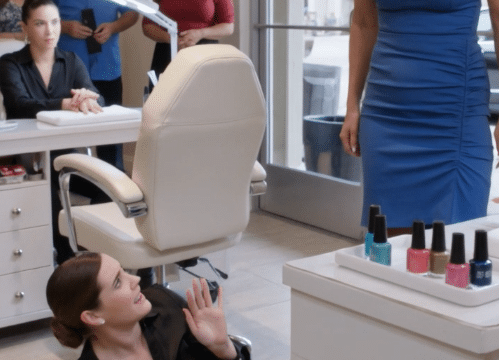
The tray rattled. Emily stumbled backward and fell beside the towel cart, sending folded white towels sliding across the polished stone floor. Pain stole the air from her lungs, and for a moment, she could do nothing but lie there, one hand pressed against her chest.
A faint trace of blood appeared on her hand where she had scraped it against the edge of the cart.
Several guests gasped.
A therapist standing near the entrance covered her mouth. Another guest took a hurried step backward, pulling her robe closer around herself. The peaceful atmosphere of the spa had fractured into something none of them knew how to handle.
Victoria stepped around the fallen towels.
“Spa girls serve quietly,” she said.
Then she delivered exactly two more kicks, striking Emily in the back and side as the young attendant curled protectively on the floor.
Emily reached away from the cart, trying to create distance between herself and the woman standing over her. Her eyes were wet, but she made no attempt to fight back.
She had come to work that morning believing that her hardest task would be helping tired people relax.
Now she was struggling to breathe while a room full of witnesses watched.
And Victoria still seemed convinced that she was the most powerful person in the building.
She was about to discover how wrong she had been.
Act II
For almost a minute, nobody moved.
The silence was not peaceful anymore. It was frightened, uncomfortable, and full of unspoken questions. The guests who had paid thousands of dollars for a weekend of relaxation stood frozen beside the treatment rooms, while the therapists who knew Emily as a gentle, dependable colleague struggled to comprehend what they had just witnessed.
Emily had worked at the resort for eleven months.
She was not the sort of employee who drew attention to herself. She arrived early, remembered returning guests’ preferences, and often stayed a few minutes after her shift to help prepare the next day’s treatment rooms.
When an elderly guest had once become disoriented near the pool, Emily had stayed beside her until her family arrived. When a new employee accidentally mixed up a delivery of essential oils, Emily had quietly helped sort the bottles rather than allowing the mistake to become a public embarrassment.
Her supervisor had recently recommended her for the resort’s internal hospitality management program.
Emily had not told many people about it. She was helping her mother pay medical bills and saving whatever remained of her wages for a small apartment closer to work. A promotion would mean more than a better title. It would mean a little breathing room, the possibility of planning her future without calculating every expense twice.
She had learned to protect that hope by keeping her head down.
Victoria had seen that quietness and mistaken it for weakness.
To her, the beige uniform meant that Emily was interchangeable. The towel tray meant that her job was to obey. The fact that Emily had apologized rather than raised her voice had convinced Victoria that she could demand anything without consequences.
The other guests knew Victoria’s reputation, too.
Earlier that morning, she had complained that the waiting lounge was too cold, ordered a therapist to remake an herbal tea because the cup was facing the wrong direction, and demanded that her appointment begin immediately despite arriving late.
Each complaint had been met with an apology.
Each apology had made her more confident.
Now, standing over Emily, Victoria looked around at the guests who had witnessed the assault.
“What are you all staring at?” she snapped.
Nobody answered.
She adjusted the sleeve of her robe and looked down at the scattered towels as if the mess were another offense committed against her.
“Someone should clean this up.”
A young therapist took one uncertain step forward, then stopped. Victoria’s expression warned her not to interfere.
Emily tried to push herself upright. The movement brought a sharp wave of pain through her torso, and she sank back against the base of the cart.
That was when a door at the far end of the lobby slammed open.
The VIP hallway was reserved for private treatment suites, executive offices, and a discreet entrance used by the resort’s ownership. Ordinary guests rarely saw anyone emerge from it, and staff members knew better than to disturb the people working behind those doors without permission.
A woman in a cream suit came through the doorway at a brisk pace.
Behind her walked the resort’s security manager.
The woman was Eleanor Whitmore, fifty-four, founder and owner of Whitmore House, the luxury wellness resort whose reputation had been built on the promise that every guest would receive extraordinary care.
She was known for her composure, her attention to detail, and her refusal to let the property’s reputation be dictated by the loudest person in the room.
Eleanor had spent twenty years building the resort from a struggling coastal retreat into one of California’s most sought-after wellness destinations. She had personally approved the training standards, the guest conduct policy, and the employee protections that were supposed to make the spa feel safe for everyone who entered it.
She had also been reviewing a private report about a series of complaints involving a VIP guest.
She had not expected to find that guest standing over an injured employee.
Eleanor crossed the lobby, saw Emily on the floor, and stopped.
Her gaze moved from the scattered towels to Victoria’s expensive jewelry, then to the faint blood on Emily’s hand.
For one suspended second, the entire room seemed to hold its breath.
Then Eleanor stepped between them.
And Victoria, who had spent years making other people nervous with a single glance, finally encountered someone who did not move out of her way.
Act III
“Do you have any idea who I am?” Victoria demanded.
It was the first thing she said to Eleanor.
Not an explanation. Not an apology. Not even a question about the woman lying on the floor.
Eleanor looked at her with an expression so controlled that it made Victoria’s indignation seem almost childish.
“I know exactly who you are,” Eleanor replied.
Victoria lifted her chin.
“Then perhaps you can explain to your employee that I expect a certain standard of service. I paid a fortune for this treatment, and that girl brought me a towel that was practically cold.”
Eleanor glanced at the towel lying near her shoe.
Then she looked at Emily.
The young attendant was still struggling to sit upright. One hand rested against her side, and her face had gone pale. The security manager moved toward her, crouching beside the cart and asking whether she could breathe comfortably.
Emily nodded faintly, though she could not hide her pain.
Eleanor turned back to Victoria.
“You kicked her because a towel wasn’t warm enough?”
Victoria gave a short, disbelieving laugh.
“She was rude to me.”
“She offered to replace it.”
“She should have done it properly the first time.”
“That is not an answer.”
Victoria’s expression changed. For the first time, she seemed aware that the usual script was failing. She was accustomed to complaints becoming negotiations, with managers offering complimentary services, discounts, or private apologies to protect a valuable guest relationship.
She reached for that familiar ground.
“Look, Eleanor, I understand you have to defend your staff in front of other customers. But let’s be sensible. I’m a member here. I bring people to this resort. I have recommended your property to investors and executives who spend far more than I do.”
Eleanor listened without interrupting.
Victoria interpreted the silence as an opening.
“If this becomes some sort of formal incident, everyone loses. Your staff member gets a little carried away, I get frustrated, and suddenly we have a scandal. You don’t want that kind of attention attached to your resort.”
There it was.
The threat beneath the complaint.
Victoria believed her money made her valuable enough to be protected from the consequences of her own behavior. She believed the resort would calculate the cost of losing her business and decide that Emily was the cheaper person to sacrifice.
She had made the same calculation in other places.
At a private club, a server had been reassigned after Victoria complained about a spilled drink. At a charity dinner, an event assistant had been removed from the guest floor following a disagreement over seating. In each case, Victoria had insisted she was simply protecting standards.
No one had challenged her long enough for her to consider what those standards meant.
But Eleanor knew something Victoria did not.
For the past three months, the resort’s executive team had been preparing to restructure its VIP membership program. Several high-profile members had complained about aggressive treatment from guests who believed their status exempted them from basic courtesy. Eleanor had personally insisted that the new policy include a clear principle: no guest, regardless of wealth or influence, could threaten or abuse an employee and expect the matter to disappear behind a private apology.
Victoria’s name had already appeared in the confidential review.
Two employees had submitted written complaints about her conduct. A therapist had described being threatened with professional retaliation. Another worker had asked to be transferred rather than continue serving her.
Those complaints had been handled discreetly, but Eleanor had not forgotten them.
Now she had seen the truth with her own eyes.
Victoria followed Eleanor’s glance toward the VIP hallway and tried another approach.
“My attorney can speak with your management team if necessary. I’m sure we can resolve this privately.”
“No,” Eleanor said.
The single word landed harder than a shouted argument.
Victoria blinked.
Eleanor turned toward the security manager.
“Please have the medical team come to the lobby. Preserve the camera footage, secure the incident reports, and make sure every witness has the opportunity to speak privately. No one is to be pressured into changing a statement.”
The security manager nodded and immediately began issuing instructions over his radio.
For the first time, Victoria’s face lost some of its color.
“You’re making a mistake,” she said.
Eleanor looked at Emily again. The young attendant was now being supported by the security manager, who had placed a folded towel beneath her arm to keep her comfortable while they waited for medical assistance.
Then Eleanor faced Victoria.
“You made the mistake when you decided that a person’s uniform made her less human than you.”
Victoria’s mouth tightened.
“You cannot talk to me like that.”
Eleanor stepped closer.
“And you cannot assault someone who works here and expect me to call it customer dissatisfaction.”
The lobby had become so quiet that the faint sound of water moving through the spa’s decorative fountain seemed suddenly loud.
Victoria looked around, searching the faces of the witnesses for someone who would take her side. Nobody did. Even those who had been too frightened to intervene now watched her with unmistakable disbelief.
Still, she could not accept that the room had turned against her.
“You’ll regret this,” she whispered.
Eleanor’s expression hardened.
“No, Victoria. You are about to learn what happens when the people you think you can control stop being afraid of you.”
Then she raised her hand.
Act IV
The slap cracked through the lobby.
It was a single, forceful strike. Victoria’s head turned, and she stumbled half a step before pressing her hand against her cheek. Her expensive earrings swung against her neck, and the perfect composure she had worn like armor finally broke.
For a heartbeat, nobody moved.
Eleanor immediately repositioned herself between Victoria and Emily, shielding the injured attendant from any further confrontation. The security manager remained beside Emily while another employee hurried toward the lobby with a medical kit.
Eleanor did not strike Victoria again.
Instead, she looked at the security manager.
“Take control of the situation. No one touches her unless it is necessary for safety. And make sure Emily receives medical attention immediately.”
The manager nodded.
Victoria stared at Eleanor, one hand still pressed to her cheek.
“You hit me.”
Eleanor did not deny it.
The room had witnessed the strike as clearly as it had witnessed the assault. Whatever happened next would have to be addressed honestly, and Eleanor seemed to understand that there was no value in pretending otherwise.
“You will have the opportunity to make a formal complaint about my actions,” she said. “And I will answer for them. But your complaint will not erase what you did to Emily.”
Victoria opened her mouth, then closed it.
For the first time that morning, she had no immediate answer.
Eleanor turned toward the waiting guests.
“If you witnessed what happened, our security team will speak with you privately. You are not required to confront anyone or make a public statement. We simply need an accurate record of the incident.”
Several guests nodded.
One woman in a pale blue robe stepped forward.
“I saw everything,” she said, her voice trembling slightly. “The attendant offered to replace the towel. This woman ordered her to kneel, kicked her, and then kicked her again when she was already on the floor.”
A man near the treatment-room entrance confirmed her account.
Then another witness spoke.
And another.
The silence that had protected Victoria began to collapse, replaced by a series of calm, precise statements. The security manager recorded names and contact details, while the resort’s operations director arrived to help preserve the relevant camera footage.
Nobody needed to embellish what had happened. The facts were already severe enough.
Emily was transported for medical evaluation, accompanied by a supervisor she trusted. Before she left the lobby, she looked back once and saw Eleanor standing near the towel cart, speaking with the security manager.
Their eyes met.
Eleanor gave her a small nod.
It was not a promise that everything would be easy. It was a signal that Emily would not be left alone to navigate the consequences.
Meanwhile, Victoria demanded her phone.
She called her attorney first, then a friend who sat on the board of a prestigious private club. She spoke rapidly, insisting that she had been attacked by the resort owner and that the entire incident had been provoked by incompetent staff.
But her story had a problem.
Too many people had seen what happened.
Within an hour, the resort had suspended Victoria’s access to the property pending a formal review. Her future appointments were canceled, her membership privileges were placed on hold, and she was escorted to a private area while arrangements were made for her departure.
The resort did not announce a permanent ban in the heat of the moment. Eleanor instructed her team to follow the established review process, document every decision, and ensure that Victoria had a formal channel to respond to the allegations.
But the immediate decision was clear: Victoria would not be allowed to remain in the spa as though nothing had happened.
When the security manager explained that her departure was being arranged, Victoria stared at him in disbelief.
“I have a private suite booked for the entire weekend.”
“Your reservation is under review,” he replied. “We will provide you with the appropriate information in writing.”
“My treatment package costs more than your annual salary.”
He did not answer.
She tried calling the resort’s membership director. The call went unanswered while the director assisted with the incident response. She sent messages to the executive who had originally introduced her to the property, only to receive a brief reply that he would not intervene in an active investigation.
The doors she had expected to open at the sound of her name remained closed.
Then Eleanor returned from the medical corridor.
She stopped several feet away from Victoria, who was standing beside her luggage with her phone clenched in one hand.
Eleanor’s voice was quiet.
“That towel just cost you every door this resort owns.”
Victoria looked up sharply.
“Every door?”
For the first time, the question was not a threat.
It was fear.
Eleanor held her gaze.
“Your membership, your future reservations, your access to our private facilities, and any business relationship that depends on our willingness to trust your conduct. Those decisions will be reviewed and documented. But no one here will pretend that what happened to Emily was acceptable.”
Victoria glanced toward the VIP hallway.
She had entered the resort believing that corridor represented the highest level of privilege she could purchase. Now it seemed to lead to a world from which she could be excluded.
And for the first time in her life, money did not appear to offer an immediate solution.
But the most important consequence of that morning had not yet reached her.
It was waiting in the one place Victoria had never thought to look: the people who had watched her behave as though they were invisible.
Act V
Emily spent the next several hours under medical supervision.
The examination left her shaken and sore, and the resort arranged transportation home once the medical team determined it was appropriate. She was given time away from work, with her pay protected while the incident was investigated.
When she returned a few days later, she expected the lobby to feel different.
She worried that guests would stare at her. She wondered whether colleagues would speak in lowered voices whenever she passed. Most of all, she feared that the incident would become the thing people remembered about her, replacing the months of quiet work she had done before a wealthy stranger decided to humiliate her.
Instead, she found a small envelope waiting in the employee office.
Inside was a handwritten note from Eleanor.
You were doing your job. You offered a solution, remained professional, and did not deserve what happened to you. You will not be expected to carry the burden of someone else’s choices.
Emily read the note twice.
Then she sat down and cried.
Not because the words could erase what had happened, but because someone with real authority had taken the time to say plainly what she had been afraid no one would acknowledge.
The resort’s investigation continued over the following weeks. Witness statements were collected, video footage was preserved, and the incident was referred to the appropriate authorities. Victoria’s conduct and Eleanor’s physical response were assessed separately, rather than being treated as though one excused the other.
Eleanor cooperated with the review of her own actions. She did not ask employees to conceal the slap, and she did not use the resort’s reputation to pressure witnesses into silence.
That decision mattered.
Protecting Emily did not require pretending Eleanor was above scrutiny. It required ensuring that the original assault was documented honestly and that the resort followed through on its responsibility to the person who had been harmed.
Victoria’s relationship with Whitmore House ultimately ended.
After the review, the resort terminated her membership and declined to accept future reservations from her. The decision was communicated formally, with the supporting conduct findings documented. Her attempt to present the incident as a simple disagreement over service failed when multiple witnesses independently confirmed the same sequence of events.
The consequences reached beyond the resort.
Several executives who had previously attended private retreats with Victoria reconsidered their association with her. One charitable organization removed her from an upcoming hospitality committee after reviewing the circumstances. Others simply stopped returning her calls.
There was no dramatic public announcement, no grand press conference, and no single moment when the entire world turned against her.
Instead, the invitations became less frequent.
The private dinners continued without her.
The people who had once laughed at her sharp remarks began to remember the employees she had insulted when she believed no one important was watching.
For a woman who had measured her influence by the number of doors that opened when she arrived, the quiet withdrawal of other people’s trust was devastating.
Yet the story did not end with Victoria’s exclusion.
It ended with Emily.
Six weeks after the incident, Eleanor invited her to the resort’s executive office. Emily arrived in a clean beige uniform, her hair still secured in the same low bun she had worn on the morning everything changed.
She had considered asking to be transferred to another department. She still felt nervous when a guest raised their voice, and the sound of a towel cart rattling across stone occasionally brought back an unwanted memory.
But she had also begun to understand that professionalism did not mean accepting mistreatment.
Eleanor gestured toward a chair.
“How are you feeling?” she asked.
“Better,” Emily replied. “Some days are easier than others.”
“That makes sense.”
Emily looked down at her hands.
“I keep thinking I should have done something differently. Maybe I should have called security sooner. Maybe I should have walked away before she got angry.”
Eleanor waited until Emily looked up again.
“You offered to replace the towel. You tried to de-escalate the situation. You did not cause what happened to you, and you were never responsible for controlling her behavior.”
Emily swallowed.
For months, she had tried to become the sort of employee who could prevent every complaint, anticipate every demand, and make even the most unreasonable guest leave satisfied. She had believed that if she were careful enough, polite enough, and hardworking enough, she could protect herself from being treated badly.
Eleanor’s words did not make that belief disappear overnight.
But they gave Emily permission to question it.
Then Eleanor opened a folder on her desk.
“I’d like you to reconsider the hospitality management program.”
Emily blinked.
“I thought my application was still being reviewed.”
“It was. Your supervisor recommended you before the incident, and the review panel agreed that you have the judgment and temperament we look for in future managers.”
Eleanor slid the folder across the desk.
“The program begins next month. It includes rotations through guest relations, spa operations, and staff development. You would receive additional training, a salary increase, and a path toward a supervisory position.”
Emily stared at the papers.
“You’re offering me this because of what happened?”
“I’m offering it because you earned the opportunity before it happened. What happened afterward reminded all of us why people with your judgment belong in leadership.”
Emily ran a finger along the edge of the folder.
She thought about the towels scattered across the lobby floor. She remembered the guests who had watched without moving, and the moment Eleanor had stepped between her and the woman who had hurt her.
For a long time, Emily had imagined success as a way to escape being overlooked. She had pictured a better title, a more comfortable apartment, and enough savings to stop worrying about the next unexpected bill.
Now she saw something else.
She could become the person who made sure the next frightened employee did not have to wonder whether anyone would stand up for her.
“I’d like to accept,” she said.
Eleanor smiled.
“Good. Then we’ll get started.”
Months later, Emily returned to the spa lobby as part of her management rotation. She wore the same uniform, but she no longer moved through the resort with the anxious determination to make herself as unobtrusive as possible.
She still spoke gently. She still treated guests with patience. She still believed that excellent service could turn an ordinary afternoon into something memorable.
But she had learned the difference between kindness and submission.
One morning, a guest complained that a towel had cooled while she waited for her treatment. Emily apologized, offered a replacement, and arranged for the guest’s appointment to begin as quickly as possible.
The woman accepted the new towel and thanked her.
It was an ordinary interaction, forgotten by lunchtime.
That was how it should have been.
Across the lobby, a new attendant struggled to reposition a loaded cart. Emily stepped forward to help, then showed her how to secure the wheels before turning through the narrow passage.
“You don’t have to do everything alone,” Emily told her.
The young attendant smiled with relief.
Near the VIP hallway, Eleanor watched them for a moment before returning to her office.
The resort had updated its guest conduct procedures, strengthened its reporting process, and made it clear that staff members could call for assistance without fear of retaliation. Managers received additional training on responding to abuse, and employees were reminded that a complaint from a wealthy guest did not automatically outweigh a worker’s account.
The white-stone lobby looked exactly as it had before.
The towels were still folded in neat stacks. The air still carried the scent of lavender and eucalyptus. Guests still arrived in soft robes, expecting a few hours of quiet and comfort.
But something important had changed.
The resort no longer treated silence as proof that everything was fine.
And somewhere far from those polished floors, Victoria Ashford was discovering that influence could not always be purchased back once trust had been lost.
She had entered the spa convinced that a warm towel was something she was owed, that an apology should be delivered on a servant’s knees, and that the people who worked around her existed to absorb whatever anger she chose to unleash.
She had left with her privileges suspended, her reputation damaged, and a question she could no longer dismiss.
Every door?
Yes.
Not because one person had the power to punish her without consequence, but because every door she had relied upon depended on other people choosing to open it.
And the moment she decided that another human being’s dignity was worth less than a towel, she began closing those doors herself.
The most powerful person in the lobby had not been the guest with the diamonds.
It had been the young woman who offered to fix a small mistake, even when the world around her gave her every reason to stop being kind.
And when she finally stepped into a position of authority, she carried that lesson with her.
Respect, Emily learned, was not a luxury reserved for people who could afford the room. It was the one thing everyone deserved before they ever walked through the door.