Act I
“Trash. You’ll pay for the whole set.”
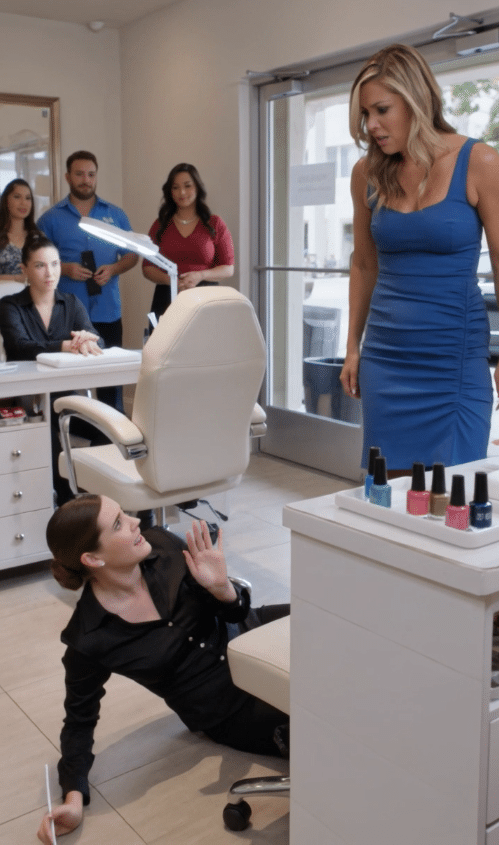
The insult rang through the bright, immaculate nail salon in Miami, where rows of white chairs, glossy manicure tables, and glass shelves of polish usually created an atmosphere of effortless luxury. Every conversation stopped as a wealthy woman in an expensive blue dress rose from her chair, diamond rings flashing beneath the salon lamps, and glared at the young technician standing beside her.
The technician, Emily Bennett, was twenty-seven. Her brown hair was tied neatly at the nape of her neck, and her black blouse was spotless. She held a fine nail brush in one hand and a small bottle of pale pink polish in the other.
“I can fix that for free,” Emily offered.
She pointed gently toward the woman’s ring finger, where a thin line of polish had dried slightly unevenly along the edge of the nail.
It was a tiny imperfection. Almost invisible unless someone held the hand beneath the bright manicure lamp and studied it closely.
Emily knew exactly how it had happened.
Her customer, Victoria Langley, had spent much of the appointment checking her phone. Every few seconds, she jerked her hand away to read a message, answer a call, or type a reply. Emily had asked her twice to keep her fingers still until the polish settled.
Victoria had ignored both requests.
Now she was treating the result as if Emily had deliberately ruined something priceless.
“You think you can fix it?” Victoria asked.
“Yes, ma’am. It will only take a moment.”
Victoria held up her hand, inspecting the nail with exaggerated disgust.
“This is what I get for trusting people who don’t understand quality.”
Emily swallowed her frustration.
“I’m sorry you’re unhappy with it. I’ll correct the line and check the rest of the set.”
Victoria’s eyes narrowed.
“Did I ask you to explain yourself?”
“No, ma’am.”
“Then stop talking.”
At the neighboring stations, other customers lowered their phones. One woman glanced toward the reception desk, expecting a manager to intervene. Two technicians exchanged a worried look, but neither wanted to make the situation worse.
Victoria noticed them watching.
“Trash,” she repeated. “You’ll pay for the whole set.”
Emily placed the polish bottle on the table.
“I’m happy to correct the mistake. There won’t be an additional charge.”
That was the moment Victoria seemed to lose control of herself.
She sprang up from the white manicure chair and kicked Emily hard in the chest.
Emily stumbled backward and fell beside the nail table. The metal legs rattled, and the polish bottle shook dangerously close to the edge without spilling. Her elbow struck the floor, leaving a thin trace of blood on her skin.
For a second, she could barely breathe.
The salon had gone silent.
Victoria stepped around the chair.
Then she kicked Emily twice more, striking her back and side as the technician curled in pain and tried to keep her hands away from the scattered nail tools.
A woman near the front window gasped. Another customer covered her mouth. Someone whispered Emily’s name, but no one moved quickly enough to stop what was happening.
Victoria stood over the fallen technician, adjusting the strap of her designer handbag.
“Paint nails from the floor,” she said coldly.
Emily stared up at her, stunned less by the pain than by the casual cruelty in her voice.
She had spent three years building a reputation as one of the salon’s most careful technicians. She remembered customers’ preferred colors, worked patiently with nervous first-timers, and often stayed late to help colleagues finish their appointments.
She had never imagined that a crooked line could turn an ordinary shift into a nightmare.
Then a black luxury car braked sharply outside the salon’s glass entrance.
The door swung open. The entry bell rang so loudly that several customers turned at once.
A woman in a tailored black suit stepped inside, followed by an assistant carrying a leather portfolio.
She took one look at Emily on the floor.
Her expression changed.
Victoria had no idea who had just walked through that door.
But within seconds, she would discover that the woman she had assaulted was far more important to the future of the salon than she had ever imagined.
Act II
The woman in the black suit was Alexandra Reed, fifty years old, founder of Reed Beauty Collective, and the majority investor behind a growing chain of luxury nail salons across Florida.
She was not a celebrity who appeared on magazine covers every week. She preferred private meetings, careful financial decisions, and knowing exactly how each of her businesses operated. Her name rarely appeared on the storefronts, because she believed a successful brand should be recognized for the quality of its work rather than the fame of its owner.
The Miami salon was one of her original locations.
Alexandra had opened it eight years earlier with a single storefront and a handful of technicians. At the time, the neighborhood had been crowded with inexpensive nail bars, and several investors had told her that a premium salon could never compete without cutting labor costs.
She had refused.
Instead, she built her business around skilled technicians, consistent training, and the belief that luxury should mean care rather than intimidation.
The strategy worked. Her company expanded into multiple locations, attracting professional athletes, executives, socialites, and clients who considered an appointment at Reed Beauty Collective part of their weekly routine.
But Alexandra had learned something else about luxury.
Some customers came looking for excellent service. Others came looking for people they could control.
She had spent the previous six months reviewing reports from several locations after receiving complaints about guests who threatened employees, demanded refunds for invented problems, or used their social connections to pressure managers into firing workers.
One name had appeared more than once.
Victoria Langley.
Alexandra had seen the complaints. She had not yet witnessed Victoria’s behavior herself.
Now, standing in the salon doorway, she saw a technician on the floor, a bottle of polish trembling on the edge of a table, and a wealthy customer who looked irritated rather than frightened.
Alexandra crossed the room.
“Everyone, please step back,” she said.
Her voice was calm, but it carried the unmistakable authority of someone accustomed to making decisions.
She immediately positioned herself between Victoria and Emily.
Behind her, the assistant called for emergency medical assistance while Alexandra’s operations manager, who had arrived with her, instructed the receptionist to contact security and preserve the salon’s camera footage.
Emily tried to sit up.
“Don’t move too quickly,” Alexandra told her. “Help is coming.”
“I’m okay,” Emily whispered automatically.
She was not okay. Her breathing was shallow, her elbow stung, and her side hurt whenever she moved. But she had spent so long trying to make customers comfortable that even now, after being assaulted, her first instinct was to reassure the people around her.
Alexandra noticed.
“You don’t have to take care of anyone else right now,” she said gently. “Just focus on yourself.”
For the first time since the attack, Emily stopped trying to get up.
Victoria, meanwhile, was beginning to understand that the room had changed.
She had expected the owner or manager to appear, apologize for the inconvenience, and ask what could be done to satisfy her. That was how these confrontations usually ended. She complained, the staff became nervous, and someone offered a discount or complimentary service to prevent a negative review.
Instead, the woman in the black suit was kneeling beside the injured technician, asking whether she needed help.
Victoria cleared her throat.
“I assume you’re the owner.”
Alexandra stood.
“I am.”
“Good. Then perhaps you can explain why your employee thought it was acceptable to ruin an appointment I paid a considerable amount of money for.”
Alexandra looked at the unfinished manicure.
Then she looked at Victoria.
“Is that why you kicked her?”
Victoria’s lips parted.
“She was being disrespectful.”
“She offered to fix the polish for free.”
“She should never have made the mistake.”
Alexandra’s expression hardened.
“People make mistakes. That does not give you permission to assault them.”
Victoria let out a disbelieving laugh.
“Assault? Please. I barely touched her.”
Several customers exchanged glances.
One of them, a woman named Natalie Brooks, slowly raised her hand.
“I saw what happened,” Natalie said. Her voice trembled, but she did not look away. “You kicked her. Then you kicked her again when she was already on the floor.”
Victoria turned toward her.
“Stay out of this.”
Natalie flinched but remained standing.
Alexandra stepped closer to Victoria.
“No one here is going to be intimidated into silence.”
Victoria looked around the salon, searching for a familiar face, a sympathetic smile, anyone who might remind Alexandra that wealthy customers were not supposed to be treated this way.
She found none.
Still, she believed the situation could be controlled.
She had no idea that Alexandra had already seen her name in the company’s internal reports—and that the assault had just transformed a collection of troubling complaints into something impossible to ignore.
Act III
“Do you know who I am?” Victoria demanded.
It was a question she had used countless times, usually when a restaurant manager refused to change a reservation or a boutique employee failed to recognize her handbag.
The question was designed to end arguments before they began.
Alexandra did not answer immediately.
Victoria took the silence as an invitation.
“My family has invested in half the businesses in this neighborhood. I know people who can make your life very difficult. One phone call from me, and your little salon could have a reputation problem you wouldn’t recover from.”
Alexandra’s assistant looked up from her phone.
The operations manager remained beside the reception desk, recording the names of witnesses and confirming that the security footage was being secured.
Alexandra, however, did not seem impressed.
“You appear to believe that your money gives you authority over everyone who works here.”
“I pay for a service.”
“You paid for a manicure.”
“I paid for an experience.”
“And Emily was providing it until you decided to attack her.”
Victoria’s cheeks reddened.
“You are making this sound much worse than it was.”
“No,” Alexandra replied. “I am refusing to make it sound smaller.”
The words struck a nerve.
Victoria was accustomed to people softening their language around her. A complaint became a misunderstanding. An insult became an unfortunate exchange. A threat became an expression of frustration.
She had spent years turning accountability into a negotiation.
But Alexandra was not negotiating.
Victoria pointed toward Emily.
“That girl cost me an appointment. I have somewhere important to be this afternoon. Do you understand how valuable my time is?”
Alexandra glanced at the technician, who was now receiving assistance from a medical responder.
“More valuable than her safety?”
Victoria said nothing.
Alexandra continued.
“Your name has come up in reports from other locations. Employees have described being insulted, threatened, and pressured after you complained about routine service issues. Until today, we were still reviewing those reports and determining the appropriate response.”
Victoria’s eyes widened.
“You’ve been investigating me?”
“We investigate complaints involving our employees.”
“Because I expect standards?”
“Because people have the right to work without being abused.”
Victoria took a step back.
She had expected a discussion about one appointment. Instead, Alexandra was connecting her behavior to a pattern Victoria had assumed nobody had noticed.
At a salon in Coral Gables, a technician had reported that Victoria threatened to ruin her career after a disagreement over a color selection. At another location, a manager had documented repeated demands for free services accompanied by threats of negative publicity.
The complaints had not all been identical, and the company had not treated every accusation as proven. Some were still being reviewed. But the pattern was serious enough that Alexandra had ordered a formal assessment of Victoria’s conduct across the chain.
The incident in Miami had now supplied something none of those earlier reports could provide: a group of witnesses who had seen the behavior directly.
Victoria’s gaze moved toward the glass door.
She could leave, she thought. She could get into her car, call her attorney, and explain that an unreasonable salon owner had turned a small disagreement into a public spectacle.
But leaving would not make the cameras disappear.
Nor would it erase the people who had watched her kick Emily to the floor.
“You can’t do this,” Victoria said. “I’m one of your best customers.”
Alexandra’s answer was immediate.
“You are one of our customers. That is not the same thing as being entitled to special protection from the consequences of your actions.”
Victoria’s mouth tightened.
“You’ll regret losing me.”
Alexandra looked at the unfinished manicure once more.
Then she looked at Victoria’s face.
“Your money has never been the problem. Your behavior is.”
Victoria let out a sharp, bitter laugh.
“Fine. Then perhaps you need to be reminded that I have options. I can take my business anywhere.”
“You are free to do that.”
“And you think you can speak to me like I’m nobody?”
“No,” Alexandra said. “I think you should be treated like a person who is responsible for what she does.”
Victoria’s composure finally cracked.
She stepped forward, raising her voice, demanding that Alexandra apologize and order Emily to stand up. The customers moved away from the manicure stations, and the receptionist reached for the phone again.
Alexandra raised one hand, signaling Victoria to stop.
“Enough.”
But Victoria was too angry to listen.
She began another threat, something about lawyers, investors, and the kind of people who could destroy a business without ever setting foot inside it.
Alexandra’s expression shifted.
The anger in her face was unmistakable now.
She had spent years protecting the people who made her company successful. She had listened to workers describe being humiliated by customers who believed the person holding the polish brush was somehow less deserving of respect than the person wearing the diamond rings.
And now one of those workers was receiving medical attention while the person responsible threatened to destroy the business.
Alexandra moved forward.
The slap landed once, sharp and forceful.
Victoria recoiled, pressing her hand against her cheek. Her designer handbag slipped down her arm, and for a moment she stared at Alexandra as if the entire world had violated a rule she had never questioned.
Alexandra immediately moved back between Victoria and Emily.
She did not strike her again.
Then she spoke in a voice that carried across the salon.
“That nail just scratched your name off every appointment we own.”
Victoria blinked.
“What?”
Alexandra held her gaze.
“Every appointment?”
The question seemed to escape Victoria before she could stop it.
For the first time, she understood that the unfinished manicure was no longer the center of the story.
The story was about every door she had assumed would remain open because of her money.
And Alexandra had just made it clear that those doors were no longer guaranteed.
Act IV
Victoria’s hand remained pressed against her cheek.
She looked from Alexandra to the witnesses, then toward the glass entrance where her car was waiting. Her face had lost the confident color it carried when she first walked into the salon.
“You hit me,” she said.
Alexandra did not pretend otherwise.
“Yes. And I will answer for that.”
The admission startled Victoria more than a denial would have.
She had expected Alexandra to invoke her authority, dismiss the incident, or claim that Victoria had imagined the strike. Instead, the owner acknowledged what had happened while refusing to let it become an excuse for the original assault.
“My actions will be reviewed,” Alexandra continued. “Your actions will be reviewed too. Neither one cancels the other.”
The operations manager stepped closer.
“Alexandra, the security footage is secured. We have witness names, and the medical responders are with Emily.”
“Thank you. Please make sure every witness can provide a statement without being approached or pressured by anyone involved.”
The manager nodded and returned to the reception desk.
Victoria stared at Alexandra.
“You’re actually going to let them make statements about me?”
“They witnessed an assault. They have the right to describe what they saw.”
“I can have all of this shut down.”
“No,” Alexandra said. “You cannot.”
The certainty in her voice left Victoria with nowhere to go.
Within minutes, the salon had become a carefully managed incident scene. Customers were moved away from the affected stations, the nail tools near Emily were left undisturbed, and the relevant camera footage was preserved for the formal investigation.
The medical team examined Emily and arranged further evaluation because of her chest and side pain. Alexandra instructed the operations manager to ensure that Emily’s treatment and recovery came first, and that no one asked her to return to work before she was ready.
Natalie, the customer who had spoken up, gave her statement.
So did a man waiting near the front window. Two technicians provided accounts of the confrontation, including Victoria’s demands and the sequence of the assault.
Their stories matched on the central facts.
Victoria had complained about a small imperfection. Emily had offered to fix it without charge. Victoria had attacked her and continued after she fell.
There was no plausible version of events in which a crooked line of polish justified what followed.
Alexandra then turned to the operations manager.
“Effective immediately, place Victoria’s appointments and membership privileges on hold across our locations while the review is completed. Notify the other managers discreetly, and make sure the decision is documented.”
Victoria’s head snapped toward her.
“You can’t cancel my appointments.”
“We can suspend access under our guest conduct policy while we investigate a serious incident.”
“I have appointments booked for months!”
“And they will be reviewed according to the policy.”
Victoria began naming locations. She mentioned her preferred technician, the private room she requested whenever she visited Miami, and the special arrangements she had made for a series of appointments before a major charity gala.
Alexandra listened without interrupting.
When Victoria finished, the owner replied, “Those arrangements do not exempt you from the rules.”
The salon’s receptionist began preparing the formal notice.
Victoria took out her phone and called a lawyer. She spoke in a hurried whisper, insisting that she had been attacked by the owner of a beauty business and that the entire incident was a setup.
But the lawyer asked a question Victoria could not answer.
“Were there witnesses?”
Victoria looked around the salon.
Dozens of eyes had watched her.
“Yes,” she said reluctantly.
“Is there video?”
She glanced at the ceiling-mounted cameras.
Her silence answered for her.
The call became shorter after that.
Victoria tried a second contact, a wealthy friend who had introduced her to several members of Miami’s private social clubs. He listened as she described the incident, then asked whether she had really kicked an employee over a manicure.
Victoria insisted the technician had provoked her.
The friend did not argue. He simply told her that he would not get involved while the matter was under review.
That was the moment the consequences began to feel real.
Not because Alexandra had shouted at her. Not because of the slap. Not even because her appointments had been suspended.
It was the realization that people who had once rushed to help her were suddenly asking what she had done.
A staff member approached with a printed notice explaining that Victoria’s access to the chain’s locations had been temporarily suspended pending review. She was asked to arrange her departure from the salon while the incident was documented.
Victoria stared at the paper.
“This is humiliating.”
Alexandra’s expression remained steady.
“Emily was on the floor while you told her to paint nails from there.”
Victoria’s lips parted, but no response came.
For once, she had no argument that could turn the truth into an inconvenience.
She gathered her designer handbag and walked toward the glass door. Her unfinished nails gleamed beneath the lights, the uneven line still visible on her ring finger.
She looked down at it.
The tiny imperfection that had started everything now seemed almost absurd.
A few millimeters of polish.
A free correction.
A moment of patience that she had refused to offer.
And in exchange, she had placed her reputation, her relationships, and her access to a business she had treated as her personal playground under scrutiny.
At the entrance, she turned back one last time.
“You’re going to regret this,” she told Alexandra.
The owner did not follow her outside.
“I regret that Emily was hurt,” she replied. “I regret that people watched and felt too afraid to intervene. But I will not regret protecting my employees.”
Victoria stepped through the glass door.
For the first time since she had arrived, nobody hurried to hold it open for her.
Act V
The weeks that followed were difficult for Emily.
Her injuries required rest and follow-up care, and the salon arranged paid leave while she recovered. Alexandra personally ensured that Emily’s position remained secure and that her absence would not affect her eligibility for future advancement.
Even so, the experience followed Emily home.
She found herself remembering the sound of the manicure chair shifting, the sudden impact that knocked her backward, and the stunned faces of the people who had watched without helping. Sometimes, she wondered whether she had done something wrong by trying so hard to remain polite.
Her mother told her that she had done nothing to deserve it.
Her closest colleague reminded her that she had offered a free correction before Victoria ever raised her voice.
But understanding something logically was not the same as feeling safe again.
When Emily finally returned to the salon, Alexandra met her in the employee lounge before the first appointment of the day.
“You don’t have to prove anything by coming back before you’re ready,” Alexandra said.
“I know.”
“Do you?”
Emily looked down at her hands.
“I think I’m still learning that.”
Alexandra nodded.
“Then take your time.”
The owner had made changes since the incident. The company strengthened its guest conduct procedures, clarified when employees should call security, and required managers to document threats rather than quietly offering discounts to make difficult customers disappear.
Staff members were given a clearer reporting process. Technicians were reminded that they could stop a service when a customer became abusive, and managers received additional training on responding to aggressive behavior without placing the burden on the employee being targeted.
The company also reviewed Victoria’s previous complaints and the records from other locations.
Some reports required further verification. Others were supported by written communications and consistent accounts from employees. Following the formal review, the company permanently ended Victoria’s membership and declined future bookings across its locations.
The decision was communicated through official channels, with the supporting findings documented. The company did not turn the incident into a public spectacle, and Alexandra instructed her team not to share private employee information or encourage online harassment.
She wanted accountability, not revenge.
Still, Victoria’s social world began to shift.
A friend who had once invited her to every charity luncheon stopped including her in the planning group. An event organizer asked her to step away from a beauty-industry fundraiser while the incident was being addressed. Several acquaintances became noticeably less eager to introduce her to business owners.
No single person announced that Victoria was finished.
Instead, people began making decisions quietly.
They reconsidered whether they wanted their names associated with someone who could attack an employee over a manicure. They questioned the stories they had previously accepted when Victoria complained about incompetent workers. They remembered moments when she had humiliated a server or dismissed a receptionist and wondered whether those moments had been warnings all along.
Victoria tried to explain herself.
She said the technician had ruined her nails. She said the salon owner had overreacted. She said people were exaggerating a private disagreement because they wanted attention.
But each explanation ran into the same obstacle.
The witnesses had seen what happened.
And this time, the person who had been hurt was not being asked to disappear quietly.
Three months after the incident, Emily sat across from Alexandra in a small conference room above the salon.
On the table between them lay a folder containing an offer for a new position.
Emily had been selected for the company’s advanced technician and training program. She would receive additional education in nail artistry, client relations, and salon operations. Once she completed the program, she would help train new technicians and assist managers in maintaining service standards across several locations.
She read the offer carefully, then looked up.
“I don’t know if I’m ready to teach other people.”
“Why not?” Alexandra asked.
“Because I’m still trying to understand how something so small became something so terrible.”
Alexandra considered the question.
“Sometimes, the smallest mistakes reveal the most important things about people. The uneven polish was a mistake. What Victoria chose to do afterward was a decision.”
Emily looked at the folder again.
“I used to think that being good at my job meant keeping everyone happy.”
“That’s an understandable belief,” Alexandra said. “But it isn’t the same as doing your job well.”
“What is the difference?”
“Keeping everyone happy means accepting responsibility for things you cannot control. Doing your job well means providing excellent service, correcting genuine mistakes, and treating people with respect. It also means knowing that you deserve respect in return.”
Emily felt something inside her loosen.
For months, she had been trying to identify the moment when she could have prevented the attack. She had replayed her words, her posture, and the way she held the brush, as though there might be a perfect response that could have transformed Victoria into a reasonable person.
Now, she began to understand that there had never been a perfect sentence capable of controlling another person’s cruelty.
She could be professional without being powerless.
She could be kind without surrendering her dignity.
And she could accept a mistake without accepting abuse.
Emily signed the offer.
Her new role did not make her famous. It did not put her face on a billboard or turn her into a symbol overnight. She simply began teaching other technicians how to perform their work with confidence, communicate with customers, and recognize the difference between a difficult appointment and an unsafe one.
She was good at it.
New employees trusted her because she remembered what it felt like to be nervous. She corrected mistakes without humiliation and encouraged questions instead of treating them as signs of weakness.
Whenever a trainee became flustered over an uneven polish line, Emily would smile and say, “We can fix that. Take a breath.”
It was a simple sentence.
But in her hands, it became a promise.
One afternoon, a customer complained about a manicure that had taken longer than expected. The technician assisting her began to apologize repeatedly, growing more anxious with every word.
Emily stepped over and calmly explained the delay, offered a practical solution, and made sure the customer understood the options available.
The problem was resolved in minutes.
Afterward, the young technician thanked her.
“I thought she was going to get me fired.”
Emily shook her head.
“You made a mistake. That doesn’t mean you’re a bad technician. Let’s just learn from it.”
The young woman smiled, her shoulders relaxing.
Across the salon, Alexandra watched the exchange and understood that the company’s most important investment had never been the polished marble counters or the expensive lighting.
It was the people who made customers feel cared for—and who deserved to feel safe while doing so.
The white chairs remained in neat rows. The glass door continued to chime whenever a customer entered. Hundreds of tiny bottles of polish gleamed beneath the bright lamps, each shade waiting to become part of someone’s ordinary day.
And on one manicure table, a technician carefully corrected a line of pale pink polish.
No one shouted.
No one threatened anyone.
No one demanded that another human being kneel.
The technician finished the nail, turned the client’s hand gently beneath the light, and smiled.
“That’s better.”
The customer smiled back.
Sometimes, Emily thought, the smallest things were exactly what they appeared to be.
A crooked line was just a crooked line.
A mistake was just a mistake.
And a person’s dignity was never something another person had the right to take away.
Victoria had walked into the salon believing her money made every appointment hers to command. She had assumed that the people who served her could be frightened into silence, and that the doors she valued would always open because someone somewhere would be afraid to lose her business.
She had been wrong.
The salon did not collapse without her. The employees did not beg her to return. The customers who had witnessed the assault did not forget what they had seen.
And Emily, the woman Victoria had called trash, rose into a role where she could help shape the culture of the very business Victoria had tried to intimidate.
The final irony was almost painfully simple.
Victoria had been furious over a tiny line of polish that was slightly out of place.
But the real flaw had never been on Emily’s work.
It had been in Victoria’s belief that wealth could make cruelty acceptable.
And once the people around her stopped pretending otherwise, every appointment she thought she owned became a door she could no longer expect to open.