Act I
“Trash. Fix it on your knees.”
The words rang through the luxury boutique as Margaret Ellis stood beside the mirror wall, a handful of silver pins trembling between her fingers. At fifty-five, she had spent nearly three decades learning how to make beautiful things fit perfectly. Yet in front of a room full of elegant shoppers, a wealthy customer was demanding that she crawl across a white carpet to repair a hem that was barely an inch too long.
The customer, Victoria Langford, was thirty-eight, dressed in an exquisite evening gown, with styled blonde hair, diamond earrings, and a gold bracelet that flashed whenever she moved her hands. She had arrived that evening expecting the boutique’s finest treatment. Now, because the hem brushed the floor when she walked, she had decided that someone needed to be humiliated.
Margaret glanced at the gown, then at the narrow fitting-room corridor.
“I can fix it safely in the fitting room,” she said. “It will only take a few minutes, and I don’t want you stepping on any pins.”
Victoria looked at her as if she had been offered an insult.
“Did I ask for your advice?”
“No, ma’am. I only want to make sure—”
“Then do what you’re paid to do.”
Several shoppers stopped examining the dresses. A young sales assistant standing near the jewelry display lowered the garment she was holding. Nobody wanted to become the next target of Victoria’s anger.
Margaret kept her voice steady.
“The adjustment requires you to stand still while I mark the hem. I can do it properly if we move to the fitting room.”
Victoria glanced toward the other customers and noticed their attention. Rather than lower her voice, she raised it.
“You’re making this complicated because you don’t know how to handle an important client.”
Margaret had heard variations of that sentence many times before. She had been called slow, old-fashioned, invisible, and replaceable by people who believed a price tag entitled them to control everyone standing nearby.
She had learned not to answer insults with insults.
“I understand you’re on a schedule,” she said. “But I can’t safely pin the dress while you’re moving around in public.”
Victoria’s lips tightened.
Then she looked down at Margaret’s gray cardigan, her simple black skirt, and the thin glasses resting on her nose.
“People like you always think you know better.”
Margaret’s fingers closed around the measuring tape.
“I only want to fix the gown.”
Victoria stepped closer.
“Then get down here.”
For one stunned second, Margaret thought she had misunderstood.
Victoria pointed at the carpet.
“Kneel down and fix it where everyone can see. I want this finished now.”
“Please,” Margaret said quietly, “there’s no reason to do that.”
Victoria’s face hardened.
“Trash. Fix it on your knees.”
Margaret did not kneel.
She had spent years bending over sewing tables, working through aching shoulders, and staying late to rescue garments that other people had given up on. She had never considered honest work beneath her dignity, but she would not deliberately turn a simple alteration into a public ritual of humiliation.
That refusal was apparently more than Victoria could tolerate.
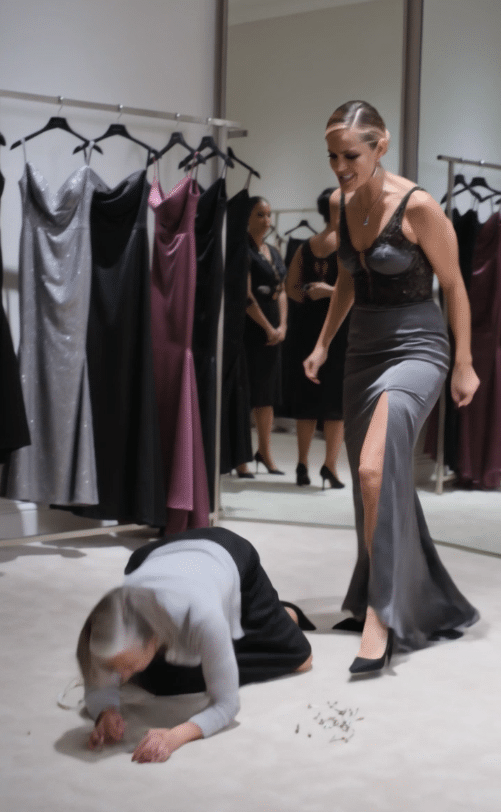
She stepped forward in the gown and kicked Margaret hard in the chest.
Margaret fell beside the mirror wall. Her measuring tape slipped from her hand, and the pins scattered across the white carpet with tiny metallic clicks. She tried to brace herself, scraping her elbow as she landed.
A thin trace of blood appeared against her skin.
The boutique went silent.
Margaret struggled to catch her breath. Her glasses had shifted crookedly, and she stared up at the ceiling lights, trying to understand how a one-inch hem had led to this.
Victoria stood over her.
Instead of stepping away, she delivered two more kicks, striking Margaret’s back and side as the older woman curled instinctively away from the blows.
The shoppers gasped.
One woman covered her mouth. A sales assistant took a frightened step backward. Nobody intervened before the attack ended.
Victoria straightened the fabric of her gown and looked down at Margaret with contempt.
“Seamstresses belong below the dress.”
Then the door to the VIP fitting room burst open.
The hangers along the nearby rail trembled.
A woman in a tailored black suit and a red silk scarf stepped into the boutique, her silver-streaked hair pulled back and her expression so cold that even Victoria stopped moving.
Her name was Eleanor Whitmore.
She was sixty years old, the head designer of the fashion house, and the woman whose name appeared on the label inside Victoria’s gown.
Eleanor looked at Margaret on the floor.
Then she looked at Victoria.
And the entire room seemed to hold its breath.
Victoria had demanded that a seamstress kneel because she believed the woman beneath the gown was nobody important. She was about to discover just how wrong she was.
Act II
Margaret Ellis had never been interested in becoming famous.
When she was young, she had wanted a small house with a garden, a sewing room filled with afternoon light, and enough time to make clothes that would last longer than the occasions for which they were purchased. She loved the quiet satisfaction of transforming fabric into something that made another person stand a little taller.
Her mother had taught her to sew at the kitchen table.
The lessons began with repairing loose buttons and hemming school uniforms. They continued through difficult years when money was scarce and every discarded scrap of fabric became an opportunity to make something useful.
Margaret discovered that she had a particular gift for the work other people found tedious.
She could recognize how a fabric would fall before it was cut. She could look at a gown on a moving woman and understand exactly where the seam needed to shift. She knew that the difference between an ordinary dress and an extraordinary one was often invisible to anyone who did not understand how it had been made.
For years, she worked in small ateliers and alteration rooms, often behind the scenes of grand fashion houses. Designers received the applause, models received the photographs, and wealthy clients received the compliments.
Margaret made sure the clothes deserved them.
She rarely appeared in photographs. Her name was seldom printed on invitations. When a dress fit perfectly, people praised the designer’s vision, never imagining the hours of careful work that had made that vision possible.
She accepted that arrangement because she loved the craft.
Eventually, her skill brought her to Eleanor Whitmore’s fashion house.
Eleanor had built her reputation on elegant eveningwear: gowns that looked effortless but demanded extraordinary precision. She was demanding, sometimes difficult, and famously unwilling to approve a garment simply because it was expensive.
When Margaret first joined the atelier, Eleanor had been struggling with a complicated silk gown whose bodice kept twisting whenever the model walked.
Three specialists had tried to correct it.
Margaret studied the garment for twenty minutes, asked for a different lining, and quietly rebuilt the internal structure. By the next fitting, the gown moved as though it had been designed for the model’s body from the beginning.
Eleanor never forgot it.
Over time, the two women developed a professional relationship rooted in trust. Eleanor could sketch an idea, and Margaret could identify the construction problems before anyone else noticed them. When a deadline became impossible, Margaret found a solution. When an expensive fabric behaved unexpectedly, she found a way to preserve the design without compromising its shape.
They were not merely colleagues.
They understood the same language.
But their lives had taken different paths. Eleanor became the public face of the brand, attending galas and presenting collections to international buyers. Margaret preferred the atelier, where the work spoke for itself.
That was why most customers at the boutique knew Margaret only as the older seamstress who could fix anything.
Victoria Langford had never bothered to learn even that much.
She was a prominent donor on the local charity circuit, married into a family with substantial real estate holdings, and accustomed to receiving invitations to events where photographs mattered almost as much as the cause itself.
She measured success by proximity to power.
The right table at a gala could become a business opportunity. The right photograph could improve a social standing. The right dress could turn an ordinary appearance into an event people discussed the next morning.
For months, Victoria had been trying to secure a place at the annual Whitmore Foundation Gala, an invitation-only event attended by major donors, cultural leaders, and influential figures from the fashion world.
The gala was not simply a party. It was where Eleanor unveiled a small number of exclusive designs, each created for a carefully selected guest or patron. Wearing one of those gowns signaled that the wearer had been personally approved by the house.
Victoria had wanted that distinction desperately.
She had purchased the gown after several fittings and repeated requests for special treatment. She had asked for a private appointment, insisted on changes to the styling, and complained whenever a staff member reminded her that some details could not be altered without affecting the design.
Yet Eleanor had approved the sale because the gown suited the gala’s formal dress code and because Victoria had made a substantial charitable pledge.
Eleanor had not approved Victoria’s behavior.
She had simply never witnessed it.
Until now.
As Eleanor stood in the boutique doorway, the difference between the two women could not have been clearer. Victoria wore the finished product of an extraordinary amount of skilled labor. Margaret, the woman on the floor, wore a plain cardigan and the expression of someone trying not to show how much she hurt.
Eleanor crossed the room.
“Margaret?”
The seamstress tried to sit up.
“I’m all right,” she whispered, though her breathing said otherwise.
Eleanor knelt beside her long enough to check whether she could respond comfortably, then turned toward the staff.
“Call emergency services. Preserve the security footage. Nobody moves those pins until we’ve documented what happened.”
Her voice left no room for argument.
Only then did she stand and face Victoria.
Victoria lifted her chin, trying to recover the authority she had possessed moments earlier.
“This is a misunderstanding,” she said. “Your employee became difficult, and I lost my temper.”
Eleanor looked at the gown.
Then she looked at Margaret.
“No,” she said. “I don’t think that’s what happened.”
Victoria’s confidence faltered.
Because the woman she had attacked was not simply an employee Eleanor happened to like.
She was the person Eleanor trusted with the work that mattered most.
And the gown Victoria had spent months trying to obtain carried a secret that would make the entire boutique understand why.
Eleanor knew exactly who had made the dress. What Victoria didn’t know was that the gown had been created under circumstances she had never bothered to ask about.
Act III
Eleanor had seen the gown before it ever reached the boutique floor.
She had watched Margaret construct its foundation, adjust its seams, and refine the way its skirt moved under changing light. The design had begun as a sketch in Eleanor’s notebook, but the finished piece was the result of months of collaboration.
Its fabric had been sourced through a small European mill that produced limited runs. The embroidery had been completed by hand. The inner structure had been rebuilt twice to achieve the exact movement Eleanor wanted.
Margaret had worked late for weeks, not because she was ordered to, but because she believed the gown could become one of the house’s defining pieces.
When the first fitting failed, she had refused to settle for a quick fix.
When a delicate seam began to pull under the weight of the skirt, she redesigned the support. When the final fabric arrived with a subtle variation in tone, she adjusted the placement of the panels so the difference became part of the garment’s visual rhythm.
Eleanor had given the design a name: The Evelyn Gown, after her late mother, who had taught her that elegance had nothing to do with making other people feel small.
Margaret had understood the significance immediately.
Eleanor’s mother had been a seamstress before she became the inspiration behind the fashion house. She had worked from a cramped apartment, repairing dresses for neighbors and saving every spare dollar to buy fabric for her daughter’s first collection.
When the business began to succeed, Eleanor offered her mother a place on the company’s board.
Her mother refused.
“Keep making beautiful things,” she had told her. “Just remember who helped you make them.”
After her death, Eleanor began supporting the people who worked behind the scenes of the industry. She created paid apprenticeships, established a training program for young craftspeople, and made sure the atelier staff had opportunities to advance rather than remain invisible forever.
Margaret had become one of the program’s most important mentors.
She trained younger seamstresses, reviewed difficult alterations, and helped preserve techniques that were disappearing as fashion houses moved toward faster production. Eleanor had quietly planned to announce a new position for her at the upcoming gala: director of atelier craftsmanship, with authority over training and quality standards across the brand.
Margaret did not know.
Eleanor wanted the announcement to be a surprise.
Now, standing in the boutique, she watched Victoria look at the gown with growing confusion.
“You’re acting as though she’s family,” Victoria said.
“She is a member of my team,” Eleanor replied.
“I paid for this dress.”
“Yes.”
“Then I expect a certain level of service.”
Eleanor’s gaze sharpened.
“You were receiving it.”
Victoria glanced around the room, searching for someone who would agree with her. The sales assistants kept their eyes on Eleanor. The shoppers remained silent, but their expressions had changed.
Victoria had expected the designer to protect the customer.
She had not considered that the designer might protect the person who made the clothes.
“She refused to do a simple alteration,” Victoria insisted. “I had to be somewhere important.”
“Margaret offered to make the alteration safely in the fitting room.”
“She embarrassed me.”
“You ordered her to kneel.”
Victoria’s lips parted.
Eleanor continued, her voice controlled.
“Then you kicked her.”
For a moment, Victoria appeared ready to deny it. But the boutique’s security cameras covered the mirror wall and the fitting area. Several customers had recorded what happened on their phones. The facts were already becoming impossible to reshape.
Victoria lowered her voice.
“I’m sure we can handle this privately.”
Eleanor looked at her with something close to disbelief.
“You assaulted a woman at work, in front of witnesses, because you didn’t like the length of your hem. What part of that do you imagine should remain private?”
Victoria flushed.
“Do you know what my family contributes to this city?”
“I know what Margaret contributes to this house.”
The answer was so direct that Victoria fell silent.
Eleanor glanced toward the injured seamstress. A staff member had placed a folded garment beneath Margaret’s head while they waited for medical assistance. Margaret was conscious, but the pain in her face was unmistakable.
Eleanor’s composure finally cracked.
She turned back to Victoria.
The slap came in one sharp, startling motion.
The sound carried through the boutique.
Victoria staggered half a step, one hand flying to her cheek. A faint mark appeared near the corner of her mouth. For the first time since she had entered the store, she looked less outraged than frightened.
Eleanor immediately moved between Victoria and Margaret, ensuring the customer could not approach the injured woman again.
Then she spoke.
“She stitched the dress you begged to wear.”
Victoria stared at her.
“What?”
“She stitched it,” Eleanor repeated. “Every critical fitting, every adjustment, every detail you praised when you looked in the mirror. You have been wearing Margaret’s work all evening while treating her as if she were beneath you.”
Victoria looked down at the gown.
The fabric suddenly seemed different to her.
She saw the fine stitching along the waist, the delicate way the skirt fell, the flawless line of the bodice. Details she had admired only because they made her look impressive now reminded her of the woman lying on the floor.
“She couldn’t have made all of it,” Victoria whispered.
Eleanor’s expression hardened.
“You don’t know anything about the dress you demanded to wear.”
A sales assistant approached Eleanor and quietly confirmed that emergency services had been contacted and the security recording was being secured. Eleanor nodded, then instructed the staff to keep the fitting area clear and provide the responding personnel with the names of witnesses.
Victoria barely heard the instructions.
Her gaze remained fixed on the gown.
For months, she had imagined arriving at the gala in it, walking beneath the chandeliers, and watching people turn toward her. She had imagined compliments, photographs, and the satisfaction of wearing something that other women could only admire from a distance.
She had never imagined that the woman who made it would become the one person she could not dismiss.
Then Eleanor said something that made the situation even worse.
“The gown was selected for the gala because I believed you understood what it represented.”
Victoria’s eyes lifted.
“What does that mean?”
“It means this was never just a dress.”
Victoria had spent months trying to earn the right to wear a symbol of craftsmanship and grace. In a few brutal seconds, she had revealed that she understood neither.
Act IV
The arrival of emergency responders transformed the boutique from a place of luxury into a scene that required careful documentation.
Margaret was assessed and taken for further medical evaluation. The staff provided the information they had, and the boutique preserved the security footage and relevant records. Witnesses were asked to share what they had seen, while the customer recordings offered additional perspectives on the confrontation.
Eleanor stayed until Margaret had been safely attended to.
She did not leave because Victoria was still demanding answers. She did not leave because a gala was approaching or because the boutique’s reputation might be affected. She remained because Margaret had been hurt, and the person responsible was still trying to make the incident about herself.
Victoria followed Eleanor toward the front of the store.
“You can’t do this to me,” she said. “I have an agreement with your company.”
“You purchased a gown,” Eleanor replied. “You did not purchase the right to assault someone.”
“You slapped me!”
Eleanor held her gaze.
“And that will be addressed separately. I should not have struck you.”
The admission startled Victoria more than another angry retort would have.
Eleanor did not attempt to justify her action or claim that her position exempted her from consequences. Her responsibility for the business did not give her unlimited authority over other people, even when she was protecting someone who had been wronged.
But acknowledging her own mistake did not erase Victoria’s.
“I want my money back,” Victoria said.
“Your purchase will be reviewed according to our policies. Your conduct will be reviewed separately.”
“Do you have any idea who my husband knows?”
Eleanor’s expression was almost weary.
“Victoria, you keep telling me who you know. You still haven’t explained why you thought you could kick a fifty-five-year-old woman on the floor.”
Victoria’s mouth tightened.
She had no answer that would make her look better.
Within an hour, the boutique had begun the formal process of reviewing her customer privileges. Her access to private fittings and invitation-only brand events was suspended pending the outcome. The company also notified the gala’s organizing team that her attendance and the planned presentation of the gown would be reconsidered.
There was no dramatic announcement over a loudspeaker. No employee stood on a chair to denounce her.
The consequences arrived through quiet decisions made by people who had seen enough.
A senior assistant removed Victoria’s name from the private appointment schedule. The gala coordinator requested a meeting with the brand’s representatives. A member of the boutique’s management team documented the incident and began the necessary internal review.
Victoria watched the familiar machinery of privilege stop responding to her.
She called her husband.
He answered after several rings.
“You need to come here,” she said. “There’s been a problem.”
“What kind of problem?”
“Eleanor Whitmore has decided to humiliate me in front of everyone.”
He asked what had happened.
Victoria began with the hem.
She explained that Margaret had refused to accommodate her, that Eleanor had entered the boutique and taken the seamstress’s side, and that the designer had struck her in front of the customers.
Her husband listened without interrupting.
Then he asked one question.
“Did you touch the seamstress?”
Victoria looked toward the mirror wall.
“I was trying to get her to listen.”
“Victoria. Did you hit her?”
“I kicked her because she wouldn’t stop arguing with me.”
The silence on the other end of the call lasted long enough for Victoria to pull the phone away from her ear and check that the connection had not dropped.
When her husband finally spoke, his voice was low.
“Were there cameras?”
Victoria closed her eyes.
“Yes.”
“And witnesses?”
“Yes.”
He exhaled slowly.
“Then stop talking about the hem.”
The call ended shortly afterward.
For years, Victoria had assumed her social position could shield her from consequences. Her husband had helped her navigate that world, introducing her to people who could open doors and teaching her how to avoid public embarrassment.
But he understood something she had never learned: influence was useful only when people trusted you not to abuse it.
By the following morning, the incident had become a serious concern among the people organizing the gala. The brand had no reason to pretend nothing had happened, especially when its own staff had been assaulted in front of witnesses.
Victoria’s invitation was withdrawn after the appropriate review. The exclusive appearance she had imagined was no longer available to her, and the gown would not be presented as part of her gala look.
Her representatives attempted to negotiate a quieter resolution, but the security recording and witness statements made it impossible to dismiss the assault as a disagreement over customer service.
Meanwhile, Eleanor cooperated with the review of her own conduct. The company documented the slap and made clear that protecting an employee did not mean disregarding proper procedure. The incident involving Victoria was referred through the appropriate channels, and the separate questions raised by Eleanor’s response were not ignored.
Eleanor accepted that accountability applied to her, too.
When she finally visited Margaret after the initial medical evaluation, she brought no flowers large enough to turn the visit into a spectacle. She brought a small box containing Margaret’s favorite sewing needles, a new measuring tape, and a handwritten note.
Margaret read it slowly.
“I should have done more to stop her,” Eleanor said.
Margaret looked up.
“You did come out.”
“After she had already hurt you.”
“You can’t be everywhere.”
Eleanor sat beside her.
For several moments, neither woman spoke.
Then Margaret asked the question she had been holding back.
“Was the gown ruined?”
Eleanor stared at her, then gave a short, disbelieving laugh.
“You were attacked, and you’re asking me about the gown?”
Margaret’s mouth curved into a faint smile.
“It’s a very good gown.”
“It is,” Eleanor said. “Because you made it.”
And for the first time since the incident, Margaret allowed herself to cry.
Victoria had lost the gala, the private privileges, and the image she had carefully cultivated. But the most important reversal was happening somewhere she could not see: the woman she had tried to reduce to the floor was about to be recognized in front of the entire fashion world.
Act V
The Whitmore Foundation Gala went ahead several weeks later.
The ballroom was filled with designers, philanthropists, collectors, and guests who had traveled from across the country. Chandeliers cast warm light over the tables, photographers waited near the entrance, and the stage was decorated with a collection of gowns that represented the fashion house’s history.
But the evening’s most important moment was not the unveiling of a new design.
It was the introduction of Margaret Ellis.
She arrived wearing a simple navy dress she had altered herself, with her silver hair neatly arranged and her thin glasses resting comfortably on her nose. Her recovery had taken time, and she still moved with a little more care than before. But she had insisted on attending.
She had spent her life making other people look their best.
She wanted, just once, to see what it felt like to be recognized for her own work.
Eleanor met her backstage.
“You don’t have to say anything if you don’t want to,” the designer told her.
Margaret adjusted the cuff of her dress.
“I’ve spent thirty years avoiding microphones. I think I can survive one evening.”
Eleanor smiled.
Then she offered Margaret her arm.
When the two women stepped onto the stage, the room settled into silence. Eleanor spoke about the people whose skill made fashion possible: the pattern cutters, embroiderers, fitters, and seamstresses whose work often remained invisible behind a famous name.
She described the importance of patience, precision, and the willingness to begin again when a garment failed to meet the standard.
Then she spoke about Margaret.
She told the audience how Margaret had rescued difficult designs, trained younger craftspeople, and preserved techniques that the industry could easily have lost. She described the gown known as The Evelyn, explaining how Margaret’s work had transformed a beautiful concept into a garment that could move naturally with the person wearing it.
Finally, Eleanor announced Margaret’s appointment as director of atelier craftsmanship, responsible for mentoring the next generation of artisans and helping establish the brand’s new training program.
For a second, Margaret stood perfectly still.
She had known that Eleanor wanted to discuss a new role. She had not known it would be announced in front of the very people who had spent decades admiring her work without knowing her name.
Then the audience rose to its feet.
The applause was not polite or brief. It continued as Margaret looked across the ballroom, overwhelmed by the sight of people standing for a woman who had spent most of her career standing quietly behind someone else.
She pressed one hand to her chest.
Eleanor leaned toward her.
“This is yours,” she whispered.
Margaret shook her head, tears gathering behind her glasses.
“No,” she replied. “It’s ours.”
At a table near the back, one of the younger seamstresses from the boutique wiped her eyes. She had once believed that the only way to succeed in fashion was to become visible, fashionable, and connected to the right people.
Watching Margaret stand beneath the lights gave her another possibility.
Maybe skill could matter.
Maybe patience could be rewarded.
Maybe the people who made beautiful things did not have to remain invisible forever.
Victoria Langford was not in the ballroom.
Her gala invitation had been withdrawn, and the gown she had fought so desperately to wear remained in the fashion house’s care. The review of the boutique incident continued through the appropriate channels, and the evidence of what had happened could not be undone by a carefully worded statement.
She had not lost everything in a single night. Life rarely works that way.
But she had lost something she once considered guaranteed: the assumption that her money and social position would make other people accept whatever she chose to do.
In the weeks that followed, she found herself having conversations she had never expected to have. People asked about the incident directly. Some declined invitations. Others kept their distance. Her husband insisted that she take the situation seriously rather than blame the staff, the designer, or the customers who had recorded the attack.
For once, there was no elegant explanation that made her the victim.
The detail that haunted her most was not Eleanor’s slap or the loss of her place at the gala.
It was the sentence the designer had spoken while standing between her and Margaret.
She stitched the dress you begged to wear.
Victoria had spent months admiring the gown in the mirror. She had praised its fit, its movement, its exquisite construction. She had imagined the attention it would bring her.
Yet she had never once considered the hands that had made it.
She had mistaken the person wearing the dress for the person who mattered.
And in doing so, she had revealed the poverty hidden beneath all her expensive things.
At the atelier, Margaret returned to work gradually. She trained new apprentices, refined the construction of future collections, and helped Eleanor build a program that gave talented workers a clearer path into leadership.
One afternoon, a young apprentice approached her with a gown whose hem was slightly uneven.
The apprentice looked nervous.
“I’m sorry,” she said. “I thought I had measured it correctly.”
Margaret examined the fabric, then smiled.
“It’s only an inch.”
The young woman stared at her, unsure whether she was being criticized.
Margaret handed her the measuring tape.
“An inch can change the way a dress moves. That’s why we take our time. Come on. I’ll show you.”
Together, they carried the gown toward the fitting room.
There was no shouting, no audience, and no demand that anyone kneel. Just a woman with decades of experience teaching someone younger how to do the work well.
As Margaret pinned the hem, the apprentice watched her hands with quiet admiration.
“Were you always this good?” she asked.
Margaret laughed softly.
“No. I was terrible at first.”
“Really?”
“Of course. Everyone starts somewhere.”
She placed another pin, checked the length, and stepped back to examine the line of the skirt.
“Being good at something takes practice,” she said. “Being good to people takes a different kind of work.”
The apprentice nodded, though she seemed to understand only half of what Margaret meant.
That was all right.
Some lessons took years to settle.
Margaret returned to the garment, guiding the needle through the fabric with the same steady hands she had possessed before the boutique incident. Her work had always mattered, even when nobody applauded. But now, at last, the people around her knew enough to say so.
And the woman who had once demanded that she kneel had learned a lesson no expensive gown could conceal.
A dress could be purchased.
A seat at a gala could be earned or withdrawn.
A reputation could be damaged by a single moment of cruelty.
But dignity was never something a wealthy customer could buy from the person serving her.
It was something every human being carried into the room.
And no amount of money could make it belong to anyone else.