Act I
“I just need one call.”
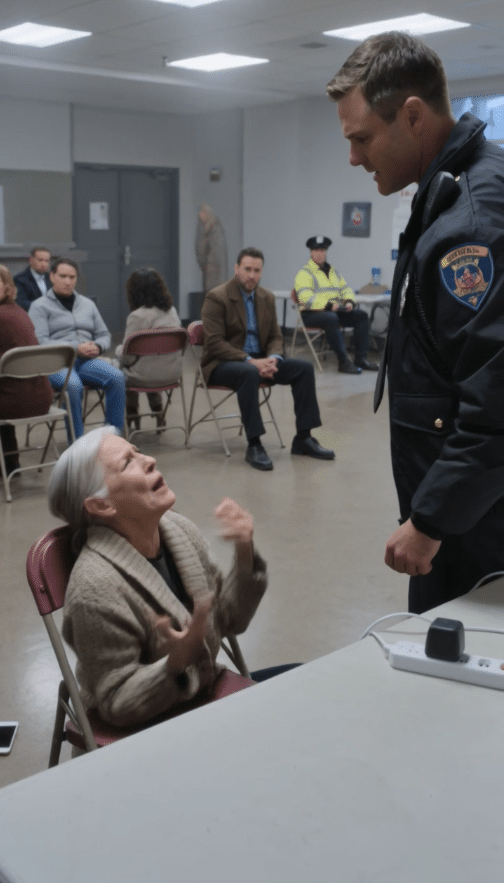
The elderly woman reached for her charger, but the man in the expensive coat yanked it from the outlet and plugged in his own phone.
For a moment, she simply stared at him. Her nearly dead phone rested in her trembling hand, its screen glowing with the last few percent of battery she had left. Beside her, a volunteer stood frozen at the charging table, watching the final available outlet disappear beneath the man’s polished shoe.
“Sir, that outlet was assigned to her,” the volunteer said.
The man didn’t look up.
“Trash. My work matters more.”
His name was Richard Voss, a forty-six-year-old real estate executive who had spent most of his adult life believing that inconvenience was something other people were supposed to absorb for him. He wore a dark designer coat over tailored dress pants, carried two expensive phones, and had the impatient expression of someone who considered every delay a personal insult.
The community center had opened its doors after a violent storm knocked out power across several neighborhoods. Families sat on folding chairs beneath emergency lights. Volunteers distributed bottled water, blankets, and basic supplies while residents called relatives to confirm they were safe.
The charging table was one of the busiest corners of the building.
There were only a handful of working outlets, and every one of them mattered. People were using their phones to contact family, check emergency announcements, arrange transportation, and find out whether their homes had suffered damage.
The last outlet had been assigned to Eleanor Brooks, a seventy-four-year-old widow in an old knitted coat.
She had been waiting patiently for nearly an hour.
Her son, Michael, lived in another state. He had called before the storm reached its worst, telling her to stay away from the windows and promising to check on her again as soon as he could. But the power had failed before she could return his call, and the battery on her phone had been fading ever since.
She wanted to tell him she was safe.
That was all.
She didn’t need to scroll through messages or check the news. She wasn’t trying to work or entertain herself. She wanted to hear her son’s voice and reassure him that his mother was still standing, still breathing, and still waiting for the storm to pass.
When a volunteer finally found an available outlet, Eleanor had thanked him twice before plugging in her charger.
Then Richard arrived.
He had been sitting across the room with a laptop bag beside his chair, growing increasingly irritated that the center’s emergency arrangements were not moving at the speed he expected. His phone had enough battery to remain on, but he wanted it charged before it dropped any further.
He noticed Eleanor’s charger and decided that her turn was over.
“Excuse me,” she said when he pulled the cable free. “I was using that.”
Richard inserted his own charger.
“And now I’m using it.”
“But I was assigned this outlet.”
He glanced at her worn coat, then at the old phone in her hand.
“I’m sure you can wait.”
“I’ve already waited a long time.”
“So have I.”
Eleanor looked at the second phone in his other hand.
“You have two phones, sir.”
Richard’s expression hardened.
“One is for work.”
“I’m only trying to call my son.”
“Then call him when I’m finished.”
She swallowed, fighting the embarrassment rising in her throat.
The volunteer stepped closer.
“Sir, we have a sign-up sheet. Mrs. Brooks was next, and we need to follow the order.”
Richard finally turned toward him.
“Do you know how much time I’m losing standing here?”
The volunteer hesitated.
“We’re dealing with an emergency, sir. Everyone is waiting.”
Richard gave a contemptuous laugh.
“Exactly. Which means the people with something important to do should be prioritized.”
Eleanor lowered her eyes.
She had spent her life trying not to become a burden. After her husband died, she learned to carry groceries in smaller bags, stretch a fixed income, and avoid asking for help unless she had no other choice. Even now, surrounded by people who had come to the community center for assistance, she felt guilty for needing one small thing.
But her son had promised to call.
“I just need one call,” she repeated softly.
Richard looked at her as if she had deliberately challenged him.
“Do you understand English?”
She flinched.
“I understand perfectly.”
“Then stop arguing.”
Eleanor reached for the charger, trying to return it to the outlet that had been assigned to her.
Richard stepped toward her.
His face changed with astonishing speed, as though her refusal to back down had offended him more than any insult could have.
He kicked her forcefully in the chest.
Eleanor fell beside the charging table. Her phone slipped from her hand and skidded across the floor, stopping near the leg of a folding chair. She caught herself with one arm, scraping her forearm as she landed.
A thin trace of blood appeared against her skin.
For a moment, she could not catch her breath.
Residents gasped. A woman near the wall covered her mouth, and two volunteers stepped backward in shock. Everyone seemed to understand what they had witnessed, but no one could quite believe it had happened over an electrical outlet.
Eleanor tried to sit up.
Richard moved closer and kicked her again, striking her side.
She curled instinctively, reaching toward the phone lying just beyond her fingers.
He delivered a second follow-up kick to her back.
“Call people after I’m done,” he said.
The words hung over her like another blow.
Eleanor stared at her phone. The screen had gone dark, and she could no longer tell whether it was still working.
She thought of Michael waiting for her call.
She thought of the promise she had made to him before the storm: I’ll let you know I’m safe.
Now she was lying on the floor of an emergency shelter, frightened and hurt, while a stranger used the last available outlet to check his work email.
Then the community center doors swung open.
A group of emergency support workers entered, followed by a man wearing a black official jacket. He was fifty-nine, broad-shouldered, and moving with the urgency of someone who had spent years responding to crises.
His eyes found Eleanor on the floor.
Then they shifted to Richard’s phone, still plugged into the outlet.
The man’s expression hardened.
He crossed the room so quickly that the people nearest the entrance moved aside without being asked.
Richard had no idea who had just walked in.
And within seconds, his expensive coat, two phones, and carefully cultivated sense of importance would mean very little.
Act II
The man was Daniel Reeves, the city’s emergency response director.
For more than twenty years, Daniel had worked in disaster preparedness and emergency management. He had coordinated evacuations during floods, overseen temporary shelters after apartment fires, and spent sleepless nights arranging food, medicine, and transportation for residents who had nowhere else to go.
He understood that emergencies stripped away the comforts people usually relied on.
A warm house became a dark room. A reliable phone became a dying battery. A familiar street became an obstacle course of fallen branches and flooded intersections.
In those moments, a small resource could become essential.
A charging outlet could keep a phone alive long enough to reach a family member. A bottle of water could prevent someone from becoming dangerously dehydrated. A blanket could help an elderly resident endure a night in a building without heat.
Daniel had helped design the community center’s emergency plan precisely because he knew that supplies would be limited and tempers could rise.
The rules were simple: distribute resources fairly, prioritize urgent needs, document shortages, and make sure no resident was pushed aside by someone louder or wealthier.
He had been visiting another shelter when his team received a report that this center needed additional support. The storm had affected more residents than expected, and several facilities were operating beyond their usual capacity.
Daniel had arrived expecting to review supply levels and coordinate the next delivery.
Instead, he found a seventy-four-year-old woman on the floor.
He rushed toward Richard.
He delivered one forceful punch to the man’s face, knocking him back from the charging table. Richard staggered, clutching his face, while Daniel immediately stepped between him and Eleanor.
“Don’t move toward her again.”
Richard stared at him in disbelief.
“What the hell is wrong with you?”
Daniel ignored the question and turned toward the volunteers.
“Get medical assistance. Check her breathing, and don’t try to pull her up until she’s been assessed.”
A volunteer hurried to call for help.
Another moved the folding chairs to create space around Eleanor. Daniel crouched nearby without grabbing her arm or attempting to lift her.
“Ma’am, can you hear me?”
Eleanor nodded weakly.
“My name is Daniel. Help is coming. Can you tell me your name?”
“Eleanor.”
“Okay, Eleanor. Just stay still for now. We want to make sure you’re all right.”
She glanced past him toward the charging table.
“My phone.”
Daniel followed her gaze.
“We’ll take care of it.”
He asked a volunteer to retrieve the phone carefully and set it somewhere safe. Then he looked at Richard, who was still holding his face, his expression shifting between fury and confusion.
“You attacked an elderly woman.”
“She was trying to take my charger.”
“It was her outlet.”
“She was making a scene.”
Daniel looked at the volunteer who had managed the charging list.
“Was she assigned that outlet?”
“Yes,” the volunteer replied. “She was next. I gave it to her, and Mr. Voss pulled her charger out.”
Richard snapped toward him.
“Watch what you say.”
Daniel rose.
“Do not threaten the staff.”
Richard straightened his coat with his free hand, trying to recover the dignity he felt slipping away.
“You have no idea who I am.”
“I know what you did.”
“You just assaulted me!”
Daniel’s expression remained severe.
“This incident will be documented, and the appropriate authorities will be contacted. Right now, the priority is making sure Mrs. Brooks receives medical care and that you stay away from her.”
Richard laughed bitterly.
“Over an outlet?”
“No. Because you used violence against a woman who was asking to make a phone call.”
The words seemed to confuse Richard more than they angered him.
He looked around the room, expecting someone to explain that he had been misunderstood. He was used to disagreements being settled through status, money, or a carefully worded complaint to someone senior enough to make a problem disappear.
But the residents were staring at him with open disbelief.
One man sat forward in his chair, his hands clenched together. A mother held her child closer. The volunteer who had assigned Eleanor the outlet stood beside the table, pale but determined.
No one was impressed by Richard’s expensive coat.
No one cared that he had work emails to check.
The emergency team moved quickly. One worker began assessing Eleanor while another asked the witnesses to give the staff room to work. Daniel instructed his team to preserve the charging sign-up sheet and record the order in which the outlets had been allocated.
Eleanor’s phone was placed on a nearby table.
Its battery had nearly run out.
She stared at it, her eyes filling with tears.
“Can I call my son?”
Daniel turned toward her.
“We’ll help you do that as soon as the medical team says it’s safe.”
“He’ll be worried.”
“I understand.”
“He lives far away. He can’t come here quickly.”
Daniel’s voice softened.
“Then let’s make sure he knows you’re safe.”
Eleanor closed her eyes.
She had spent decades raising Michael to believe that home was the place where someone would always answer the phone. Even after he moved away, they had kept the habit of checking in whenever a storm arrived or the weather turned dangerous.
She had promised him that she would call.
Now she was frightened that he would imagine the worst because she could not reach him.
Daniel turned back toward Richard.
“What exactly were you trying to do with your phone?”
“Check my email.”
“You had two phones.”
“One is for work.”
“And Mrs. Brooks needed one call to reach her son.”
Richard scoffed.
“She could have waited.”
Daniel looked at the phone on the table, then at the elderly woman who had been knocked to the floor.
“That outlet was for survival,” he said. “Yours just became a liability.”
Richard stared at him.
“A liability?”
For the first time, his anger was edged with uncertainty.
Because he was beginning to understand that the man in the black jacket was not merely another shelter worker who could be intimidated into silence.
And the outlet he had stolen was connected to a much larger responsibility than he had ever considered.
Act III
Richard Voss had spent years building a reputation as a man who understood how the world worked.
He owned a successful property management company and held investments in several commercial buildings across the city. His calendar was filled with meetings, negotiations, and calls from people who wanted his approval. He was accustomed to making decisions quickly and expecting others to adjust.
He rarely thought of himself as cruel.
He preferred words like efficient, practical, and decisive. If a restaurant made him wait, he complained until someone found a table. If a contractor missed a deadline, he threatened to replace them. If a person challenged him, he assumed they were trying to obstruct him.
Over time, he had convinced himself that his impatience was a sign of importance.
The storm had interrupted his schedule, and he resented every minute of it.
He had come to the community center after losing power at his house and finding his office building temporarily inaccessible. His laptop battery was running low, and he had several emails concerning a property transaction that he wanted to review before the following morning.
His second phone was for personal use.
The first was for business.
In Richard’s mind, that distinction made his needs more important than those of everyone else in the room.
He had seen the sign-up sheet. He had heard the volunteer explain the order. He had noticed Eleanor’s trembling hands and the old phone she kept checking.
He had understood everything.
He had simply decided that none of it applied to him.
Daniel Reeves knew nothing about Richard’s personal history when he arrived. He did not know his company, his investments, or his connections. He had acted because he had witnessed a woman being attacked in a place intended to protect residents during an emergency.
But once the immediate danger was addressed, the director’s responsibilities extended beyond the confrontation.
He needed to understand whether the incident revealed a broader problem with how the shelter was operating, whether staff had followed emergency procedures, and whether the center had adequate safeguards for residents who were vulnerable.
The answers began with the charging table.
A volunteer showed Daniel the sign-up sheet. Eleanor’s name appeared beside the final available outlet, with the time she had been assigned. The next entry had not yet been filled in.
The volunteer explained that she had given Eleanor the outlet after learning that the woman needed to contact a family member. She had followed the distribution order and had not offered Richard a place ahead of her.
Daniel thanked her and asked that the original sheet be preserved.
He then asked the emergency team to document the incident, collect witness statements, and retain any available security footage. The center’s standard reporting procedures would determine what happened next.
Richard listened with growing irritation.
“You’re acting as though I’ve sabotaged the entire emergency response.”
“No,” Daniel said. “I’m documenting what happened here.”
“I moved a charger.”
“You removed a charger from an elderly woman who had been assigned the outlet.”
“And she attacked me by trying to take it back.”
The volunteer stared at him.
“She reached for the cable. You kicked her.”
Richard glared.
“Are you calling me a liar?”
“I’m telling you what I saw.”
Daniel stepped between them before the argument could escalate.
“No one needs to argue about this in the room. The incident will be recorded, and the evidence will be reviewed.”
That response frustrated Richard because it gave him no easy target.
He could bully a volunteer. He could threaten a resident. He could complain that the shelter was poorly managed.
But he could not make a sign-up sheet change what it said, and he could not make several witnesses forget what they had seen.
As Daniel continued speaking with the staff, he learned that Richard had arrived with two phones and had been told that the final outlet was already allocated. He had removed Eleanor’s charger despite the explanation.
The assault itself would be handled through the appropriate channels. Daniel would not decide guilt or penalties on the spot, and he made that clear to his team.
But the emergency center also had a duty to ensure that Richard could not interfere with Eleanor’s care or intimidate the witnesses.
A staff member asked Richard to remain away from the charging table while the incident was documented.
He responded with a threat to complain to city officials.
Daniel nodded.
“You may submit a complaint through the normal process.”
“You think I won’t?”
“You can. And the incident report will be submitted through the same process.”
Richard’s expression tightened.
He had expected the director to fear the possibility of a complaint. Instead, Daniel seemed perfectly willing to have the incident examined.
Then one of the emergency workers approached Daniel with a clipboard.
“Director, we have the initial witness accounts. The charging list confirms she was assigned the outlet.”
Daniel reviewed the information and nodded.
“Keep the records together. We need the time stamps and the original statements.”
Richard looked from the clipboard to the official jacket.
Something about the word director finally seemed to register.
“You run this operation?”
“I oversee the city’s emergency response coordination.”
Richard scoffed, though less confidently than before.
“So you’re some kind of government official.”
“I’m the person responsible for making sure this center responds properly during an emergency.”
“Then you should be worried about keeping people calm.”
“I am.”
Daniel glanced toward Eleanor, who was being assessed by the medical team.
“That’s why I’m making sure no one can attack her again.”
Richard fell silent.
He had wanted to turn the argument into a dispute over manners, a disagreement between two adults who could not get along. He had expected to leave the center with his phone charged and his dignity intact.
Instead, the room was filling with records of his actions.
And the more he tried to minimize what he had done, the more obvious it became that he had mistaken his own convenience for an emergency.
Act IV
The medical team recommended that Eleanor receive further evaluation because of the force of the assault and the pain she reported. She remained conscious and able to answer questions, but the staff did not assume that she was unharmed simply because her visible injury was limited to a scrape on her forearm.
Daniel stayed nearby while arrangements were made.
He did not ask Eleanor to recount the incident repeatedly. He asked one staff member to serve as the primary contact for her care and another to make sure her phone was kept safe.
Richard watched the preparations with mounting frustration.
“You’re giving her all this attention because I took an outlet?”
Daniel turned toward him.
“I’m giving her attention because she was injured.”
“I didn’t know she was that fragile.”
“She told you she needed to make a call.”
“She could have waited.”
Daniel’s voice grew colder.
“Waiting was not the problem. You decided that your work email mattered more than her safety, and then you used violence when she disagreed.”
Richard looked toward the residents, several of whom were still watching from their chairs.
“You’re making me look like a monster.”
“No one here needs me to explain what they saw.”
The words landed with uncomfortable precision.
Richard tried another approach.
“I’ve contributed to this city. I’ve paid taxes. My company employs people.”
“Those facts do not give you permission to hurt someone.”
“You’re acting like I have no rights.”
“You have the same rights as anyone else. So does Mrs. Brooks.”
Daniel paused.
“The difference is that you were the one who chose to attack her.”
Richard’s face reddened.
He had expected the emergency director to lecture him, but not to treat him as an ordinary man whose actions would be documented and reviewed. His entire adult life had been shaped by the belief that status could soften any consequence.
Daniel’s refusal to make an exception felt, to Richard, like an insult.
He reached for his phone.
“I want your name and identification number.”
Daniel pointed to his badge.
“My name is Daniel Reeves. My identification is right here.”
“I’ll be speaking to your superiors.”
“You’re entitled to file a complaint.”
Richard looked as though he wanted to throw the phone against the wall.
Instead, he clutched it in one hand and stared at the outlet.
His device was still connected, its screen displaying a notification from his email account. He had finally achieved the thing he had wanted when he entered the center.
His phone was charging.
Yet the accomplishment looked absurd now.
Across the room, Eleanor’s nearly dead phone sat on a table beside the nurse’s bag. It was the device she had been trying to charge so she could reassure her son. It had been dropped during the assault, and the staff were checking whether it still worked.
Daniel noticed Richard looking at it.
“That phone is how she was trying to contact her family,” he said.
Richard’s jaw tightened.
“I’m not responsible for her family situation.”
“You are responsible for what you did to her.”
The emergency director turned toward his team.
“Make sure the footage is preserved. Get the witness statements, and refer the incident through the appropriate channels. We also need to review the charging arrangement so residents with urgent communication needs aren’t left without an option when the outlets are full.”
One of the workers nodded.
“Understood.”
Daniel’s attention returned to Eleanor.
“Has anyone reached her son?”
“Not yet. We’re trying to get the phone working.”
“Find another way. We can use the center’s phone if necessary.”
Eleanor heard him and tried to sit up.
“Please don’t trouble everyone on my account.”
Daniel crouched beside her.
“Mrs. Brooks, you’re not troubling anyone. This is what the center is here for.”
Her eyes filled with tears.
“I promised Michael I’d call.”
“We’ll help you keep that promise.”
Those words broke through the composure she had been trying to maintain. She pressed her lips together, but a tear slipped down her cheek.
Daniel looked away for a moment, giving her the privacy to cry without feeling watched.
When he stood, Richard was still waiting near the charging table.
“Are you finished?” Richard demanded.
Daniel faced him.
“No.”
Richard frowned.
“What does that mean?”
“It means the medical team will complete its assessment, the incident will be documented, and the appropriate authorities will be notified. You will be asked to cooperate with the process.”
“You can’t threaten me with a report.”
“I’m not threatening you. I’m telling you what will happen.”
Richard shook his head in disbelief.
“You’re going to make me a liability over a charging outlet?”
Daniel glanced at the phone plugged into the wall.
“No. Your decision to assault a seventy-four-year-old woman made you a liability in an emergency shelter.”
For a moment, the only sound was the low hum of the generator powering the building.
Richard looked toward his phone, then at the emergency workers moving around Eleanor.
He had wanted to preserve his access to work. Instead, he had created an incident that could affect his reputation, require him to answer formal questions, and expose him to consequences he could not dictate.
Daniel did not promise that Richard would lose his business or face a particular penalty. Those decisions belonged to the relevant authorities and any applicable review process.
But he made it clear that money would not determine whether the incident was taken seriously.
The emergency center existed to protect people during a crisis.
Richard had turned it into the place where his own behavior became the crisis.
And now the records would follow him long after the lights came back on.
Act V
The storm continued into the evening, but the situation inside the community center gradually settled.
The medical team completed its initial assessment of Eleanor and arranged further care. Staff helped her contact her family through an alternative phone, ensuring that she did not have to depend on the damaged device to deliver the message she had been desperate to send.
When Michael answered, Eleanor could barely speak at first.
“Mom?”
His voice sounded frightened.
“I’m here,” she whispered.
“Where are you? I’ve been trying to reach you.”
“I’m at the community center. The power is out, but I’m safe now.”
There was a pause.
“Are you hurt?”
Eleanor closed her eyes.
She had wanted to tell him everything was fine. She had wanted to spare him the fear of knowing that his mother had been attacked while trying to make a simple phone call.
But she could not make herself lie.
“Something happened,” she said. “I’m getting help.”
Michael’s voice changed immediately.
He asked for the center’s address, and a staff member came onto the line to explain where Eleanor was being cared for and what steps were being taken. Michael lived several states away and could not reach her immediately, but he stayed on the phone until she had been transferred to the next stage of care.
For the first time since the storm began, Eleanor no longer felt alone.
She held the phone close to her ear, listening to her son breathe on the other end of the line.
“You don’t have to worry about me every minute,” she told him softly.
“I’ll worry when I need to,” Michael replied. “That’s what sons are for.”
A faint smile appeared on her face.
“I suppose I can’t argue with that.”
When the call ended, Eleanor thanked the staff member who had helped her. Her voice was tired, but the tension in her shoulders had eased.
Daniel heard the update and nodded.
“Good. Make sure she has a direct contact if she needs anything else.”
He then returned to the incident report.
The center preserved the charging list and collected the witness accounts. Staff documented the damage to Eleanor’s phone and recorded the sequence of events as accurately as possible. The assault was referred to the appropriate authorities, and the emergency team followed its procedures for reporting incidents involving residents.
Richard was not permitted to approach Eleanor while the immediate response was underway. He was asked to cooperate with the process and to leave the charging area clear for other residents.
He complained repeatedly.
He said he had been provoked. He said the director had overreacted. He said the entire incident was a ridiculous waste of time.
But no one changed the record to accommodate his version.
The volunteer’s account remained consistent. The charging sheet confirmed that Eleanor had been assigned the final outlet. Multiple witnesses described Richard removing her charger and attacking her when she tried to restore it.
The evidence would be reviewed through the appropriate process, and any consequences would be determined according to the facts and the law.
Daniel made no grand announcement about Richard’s future.
He did not need to.
The most important thing was that Eleanor had received help, the witnesses had been heard, and the emergency center had not allowed a wealthy resident to dictate who deserved access to its limited resources.
Before Richard left, Daniel spoke to him once more.
“Do you understand why the outlet was reserved for Mrs. Brooks?”
Richard looked away.
“I understand that you think I did something wrong.”
“That’s not what I asked.”
Richard’s mouth tightened.
Daniel continued.
“People come here because something has gone wrong in their lives. Some need a place to sit. Some need water or medical help. Some need to contact a family member because they don’t know whether their home is still standing.”
He gestured toward the charging table.
“And sometimes they need a few minutes of electricity to tell someone they love that they’re alive.”
Richard remained silent.
“You had two phones,” Daniel said. “She had one nearly dead phone and a son waiting to hear from her.”
For the first time, Richard seemed unable to find a clever answer.
Daniel did not tell him that he had to become a different person overnight. He did not pretend that one incident explained every part of Richard’s character.
He simply refused to let him reduce the event to a dispute over an outlet.
“Your work may be important to you,” Daniel said. “But it does not make another person’s safety less important.”
Richard lowered his eyes briefly, then looked toward the door.
He left the community center without another argument.
The storm eventually passed. Electricity returned to the affected neighborhoods, and residents went home to inspect their properties, charge their devices, and begin the difficult work of putting their lives back in order.
The community center reviewed its emergency procedures, including how it allocated charging access when demand exceeded the available outlets. Staff considered ways to create additional charging stations during future outages and to provide alternatives for residents who urgently needed to contact family members.
The changes would not prevent every conflict.
But they could make it harder for one person’s arrogance to deprive someone else of an essential resource.
Eleanor spent the following days recovering and staying in touch with Michael. Her phone was damaged, but it could be replaced. The scrape on her arm was minor, though the fear of being attacked lingered longer than the visible injury.
For a while, she hesitated whenever someone moved too quickly near her.
Then, one evening, Michael called again.
This time, Eleanor answered on the first ring.
They talked about ordinary things: his work, the weather, a recipe she had promised to send him, and whether he would visit when the roads were safe. Their conversation lasted long enough that she had to plug her replacement phone into a charger halfway through.
She laughed at the coincidence.
“I suppose I should keep a spare cable now.”
Michael laughed with her.
“Maybe two.”
Eleanor looked toward the window, where the streetlights had returned after days of darkness.
“Two sounds sensible.”
It was a small exchange, almost forgettable.
But it marked the return of something the storm and the assault had briefly taken from her: the freedom to think about tomorrow without first wondering whether she would be safe enough to reach it.
Richard, meanwhile, could no longer pretend that the incident had been invisible. The report and witness accounts existed, and the appropriate authorities would decide what further action was warranted. He could dispute the facts through proper channels, but he could not simply demand that the event be forgotten.
He had entered the center believing that his work was more important than everyone else’s needs.
He left having discovered that, in an emergency, the value of a person could not be measured by the number of phones in his pocket or the importance of the emails on his screen.
The outlet had been a tiny resource.
For Richard, it had meant a few minutes of convenience.
For Eleanor, it had meant the chance to keep a promise to her son.
That difference should never have required an emergency director to explain it. It should never have required an elderly woman to lie on the floor, frightened and hurt, while strangers stood frozen around her.
And it certainly should never have required a punch to make a grown man stop and look at what he had done.
The real lesson was not that someone more powerful had arrived to defeat Richard.
It was that Eleanor’s need had mattered before Daniel entered the room.
Her age did not make her disposable. Her old coat did not make her less deserving. Her trembling voice did not give anyone permission to silence her.
She had asked for one call.
A decent person would have stepped aside.
A decent person would have understood that some things matter far more than a work email.
And a decent person would never have mistaken another human being’s vulnerability for an opportunity to take what they needed.
When the lights finally came back on, the community center’s charging table looked ordinary again. Cables snaked across the surface, residents checked their phones, and volunteers helped people find their way home.
But Eleanor remembered what had happened there.
So did the people who witnessed it.
And Richard Voss learned that the most dangerous liability in an emergency is not a dying phone, a crowded shelter, or a shortage of electrical outlets.
It is the belief that someone else’s survival can wait simply because you have something you would rather do.