Act I
“Please do not move the historic furniture.”
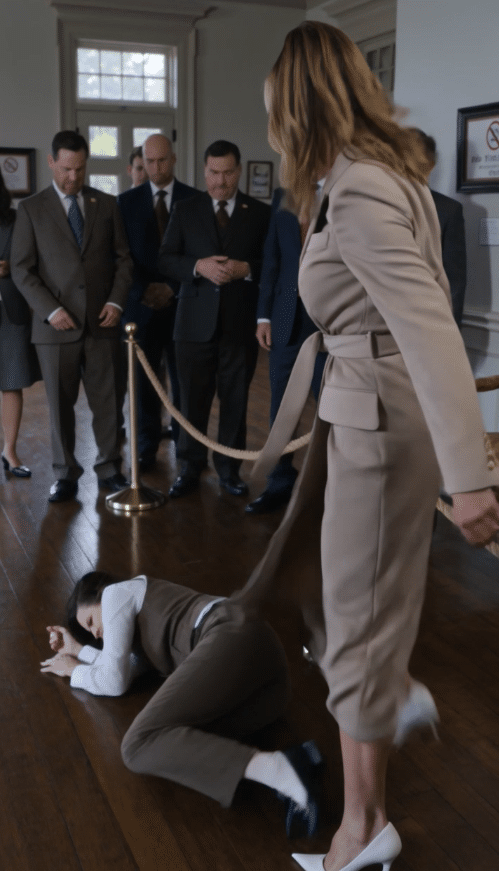
The tour guide’s warning came just as the wealthy woman in the beige coat dragged an antique chair across the wooden floor, pulling it out from behind the low rope barrier so she could pose beside it.
The chair’s legs scraped against the floorboards.
Several visitors turned at the sound. The woman barely noticed them. She adjusted the strap of her designer handbag, glanced at her phone screen, and began angling the chair toward the afternoon light coming through the tall windows.
“Ma’am, please,” the guide repeated. “That chair needs to remain exactly where it is.”
The woman turned slowly.
Her expression suggested that the interruption was more offensive than anything she could possibly have done.
“Trash. It’s just an old chair.”
The guide, a forty-one-year-old woman named Laura Mitchell, stood with her tour booklet tucked against her chest and a small radio clipped to her belt. She had spent twelve years working in historic museums, and she knew that the word just could be dangerous when applied to an object that had survived centuries.
The chair was not an ordinary piece of furniture.
It had belonged to the historic estate’s original household collection and had been carefully preserved through generations of changing ownership. Its wood, joints, upholstery, and finish all required special handling. Even moving it the wrong way could put unnecessary stress on fragile components.
That was why the rope was there.
That was why the signs said not to touch the exhibits.
And that was why Laura had stepped forward before the woman could pull the chair any farther.
“Please put it back behind the barrier,” Laura said. “You can take photographs from the designated viewing area.”
The woman stared at her.
“Do you have any idea how much I paid to visit this place?”
Laura kept her voice level.
“The admission fee doesn’t include permission to move the collection.”
The woman gave a sharp, humorless laugh.
“You people are unbelievable.”
She grabbed the chair again.
Laura stepped closer, trying to prevent the antique from being dragged across the floor a second time.
“Ma’am, stop. You’re putting the chair at risk.”
That was when the woman’s face hardened.
She turned toward Laura and drove a forceful kick into her chest.
Laura was thrown backward onto the old wooden floor beside the rope barrier. Her tour booklet flew open, its pages scattering across the boards, while her radio skidded away beneath the edge of a display table.
Her forearm struck the table leg as she fell, leaving a thin red scrape against her skin.
A sharp gasp passed through the room.
For a second, the woman in the beige coat stood motionless, as though even she had not expected the confrontation to go that far.
Then her expression hardened again.
Laura tried to sit up, but pain stopped her. She struggled to draw a full breath, her face tightening as she looked toward the antique chair.
It was still standing, but one of its legs had shifted awkwardly against the floor.
“Please,” Laura whispered. “Don’t move it.”
The woman looked down at her.
“Trash. It’s just an old chair.”
Then she stepped over Laura and kicked her twice more, striking her back and side as Laura curled instinctively to protect herself.
The visitors recoiled.
An older man covered his mouth. A young couple stepped away from the rope barrier. One woman lifted a hand toward her face, unable to believe what she had just witnessed.
Nobody intervened quickly enough.
The attacker straightened her coat and looked toward the nearest visitor holding a phone.
“History can survive one photo.”
Laura lay on the floor, breathing hard, humiliated and frightened. Yet her eyes kept returning to the chair, as though she were still trying to protect the collection even while she struggled to understand what had happened to her.
Then the sound of a vehicle braking sharply echoed outside.
A black SUV stopped at the entrance.
The museum doors flew open, and three people hurried into the room: the sixty-three-year-old site director, the chief conservation officer, and two members of museum security.
The director saw Laura on the floor and immediately rushed to her side.
She knelt beside the injured guide, checking whether she could respond before turning toward the antique chair.
Her expression changed.
“Seal this room. Conservation damage report.”
Security moved to block the woman in beige while the conservation chief approached the chair to assess its condition.
The attacker stared at the director, suddenly uncertain.
“Damage report?”
For the first time, she seemed to understand that the chair she had dismissed as worthless might matter far more than she had imagined.
And the woman she had kicked to the floor was about to become the most important witness in the room.
Act II
The historic site was called Bellamy House, a plantation museum in the American South that had been transformed into a public heritage center.
Its buildings and grounds preserved a complicated history, including the lives of the people who had lived and labored there under slavery. The museum’s mission was not simply to display beautiful antiques. It was to document the estate’s past, preserve its surviving records, and tell a fuller story than the wealthy families who once owned the property had chosen to tell.
The room where Laura had been attacked was part of the original house.
Its wooden floors creaked beneath visitors’ feet, and tall windows cast long afternoon shadows across the furniture. Portraits hung above carefully maintained display tables. Small signs explained which objects could be approached and which had to remain behind protective barriers.
Every item had a documented history.
Some had been restored extensively. Others had been left with visible signs of age because preserving their original materials mattered more than making them look new.
The antique chair was among the most carefully monitored pieces in the collection.
Its value was not measured solely in dollars. Museum records connected it to the estate’s earliest surviving household inventory, and conservation specialists had spent years documenting its construction, previous repairs, and condition.
The chair had also become part of a larger research project examining how objects moved through the estate over time.
It was a physical link to a history that could not be recovered from photographs alone.
Laura understood that responsibility.
She had started at Bellamy House as a seasonal tour assistant while finishing a degree in public history. She stayed because she discovered that guiding visitors was not merely about memorizing dates and names. It was about helping people understand why the past still mattered.
She had learned to answer difficult questions without becoming defensive and to explain uncomfortable history without reducing it to a convenient story.
Most visitors appreciated her work.
Some arrived expecting the museum to function as an elaborate backdrop for their vacation photographs. They wanted the old furniture, the sweeping staircase, and the portraits behind them, but they rarely wanted to hear about the conservation work required to preserve those things.
Laura had grown accustomed to redirecting them politely.
The woman who attacked her, however, had little patience for anyone who contradicted her.
Her name was Vivian Cross, a forty-four-year-old real estate investor known in her social circle for expensive vacations, exclusive charity galas, and a carefully curated public image.
Vivian had booked a guided tour with several friends. She wanted photographs that would make the afternoon look effortless and exclusive.
When she saw the antique chair, she decided it would make the perfect centerpiece.
The rope barrier spoiled the composition.
She moved it.
Laura stopped her.
And Vivian interpreted that ordinary professional intervention as a personal challenge.
What she could not understand was that the museum’s rules existed to protect more than the appearance of the room. The furniture had been preserved through carefully controlled conditions, and its placement was part of the documented display. Moving it without authorization risked damaging the object and disrupting the conservation team’s work.
Vivian had not asked permission.
She had not read the signs.
And when Laura explained the rules, Vivian had responded as though the guide had deliberately embarrassed her.
By the time the black SUV arrived, the consequences of that attitude were visible throughout the room.
Laura was injured on the floor.
The chair had been moved out of position.
The rope barrier had been displaced, and the visitors who had come to learn about the estate’s history were now witnesses to an assault.
The museum director, Eleanor Whitmore, had spent more than thirty years working in historical preservation. She knew how quickly an apparently minor incident could become a serious conservation problem.
But she also knew that no artifact was more important than the safety of the people entrusted with its care.
Her first priority was Laura.
Her second was securing the room so the conservation team could assess the chair without further interference.
Vivian seemed to expect the director to apologize for the disruption.
Instead, Eleanor asked security to keep her away from the guide and instructed the conservation chief to document the chair’s position and condition before anyone attempted to move it again.
Vivian folded her arms.
“This is completely ridiculous. She was rude to me.”
Eleanor looked up from Laura.
“Then you could have filed a complaint.”
“She tried to stop me from taking a photograph.”
“She was protecting a historic object.”
Vivian scoffed.
“It’s a chair.”
Eleanor’s expression became still.
“No,” she replied. “It’s a piece of the historical record.”
Vivian glanced toward the furniture again, but the significance of those words seemed lost on her.
She still believed the entire problem could be solved by making someone understand how much money she had spent.
She did not yet realize that the museum had records, witnesses, and conservation protocols that could not be negotiated away.
And the chair’s documented history was about to reveal why the director had reacted so quickly.
Act III
“Laura, can you hear me?”
Eleanor remained beside the injured guide while a security officer contacted emergency medical services.
Laura nodded, though her breathing was still strained.
Eleanor asked her not to move unnecessarily and instructed another employee to retrieve the first-aid kit. She kept her voice steady, even as her eyes moved briefly toward the chair.
The conservation chief, Martin Hale, was already examining the display area.
He did not touch the chair immediately. Instead, he photographed its position, checked the surrounding floor, and used a tablet to compare the current scene with the museum’s placement records.
The chair’s front leg appeared to have shifted during Vivian’s attempt to reposition it.
Whether that movement had caused damage was not yet clear.
Martin crouched to examine the lower joints and finish, looking for signs of fresh stress or abrasion. He asked the staff to keep visitors well away from the display until he could complete a preliminary assessment.
Vivian watched him with growing impatience.
“You’re acting like I smashed it with a hammer.”
Martin did not look up.
“I’m documenting the condition of an artifact that was moved without authorization.”
“It didn’t break.”
“You don’t know that.”
Vivian gave an exasperated sigh.
“It’s been sitting here for hundreds of years. I’m sure it can survive someone moving it six inches.”
Martin finally straightened.
“Age is not the same thing as strength.”
He explained that historic furniture could contain weakened joints, fragile finishes, or previous repairs that were not obvious to the casual observer. An object might look perfectly stable while remaining vulnerable to stresses that modern furniture could withstand easily.
That was precisely why the museum restricted handling.
Vivian rolled her eyes.
“Fine. Write your report.”
She seemed to believe the phrase was a harmless formality, something employees used to make a visitor feel guilty before quietly moving on.
But Martin had discovered something in the conservation records that made the situation more complicated.
The chair was scheduled for a detailed condition review as part of a larger archival research project. Its position and physical features had been photographed and documented shortly before the public tour began.
Those baseline records would allow the team to compare its condition before and after the incident.
If the chair had been damaged, the museum would have a way to investigate what changed.
If it had not been damaged, the report would document that conclusion as well.
Either way, Vivian would not be allowed to decide the outcome by insisting that nothing had happened.
Eleanor stood once the medical responders arrived and began assessing Laura.
Then she turned to Vivian.
“You are not permitted to leave until security has recorded the necessary information for the incident report.”
Vivian’s eyes widened.
“You can’t detain me.”
“We are asking you to remain while the incident is documented and the appropriate authorities are contacted. The police will determine what happens next.”
Vivian stared at her.
“You called the police over a chair?”
“No,” Eleanor said. “We contacted them because an employee was assaulted.”
The distinction silenced the room.
A man near the doorway stepped forward.
“I saw the whole thing.”
Vivian turned sharply.
The man had been standing near the display table when Laura first approached her. He had watched Vivian drag the chair out from behind the barrier, heard Laura warn her, and seen the attack unfold.
Another visitor nodded.
“I saw it too.”
A third witness, a woman who had been taking photographs of the room, offered to preserve the images she had captured before the confrontation.
The evidence was beginning to assemble itself.
Vivian’s confidence faltered, but she tried to recover.
“She got in my way. I was trying to move the chair, and she made it into a confrontation.”
The first witness shook his head.
“She told you not to move it. You kicked her.”
Vivian glared at him.
“You don’t know what you’re talking about.”
“I know what I saw.”
Eleanor asked the witnesses to provide their contact information and encouraged them to give their accounts directly to the responding officers.
She did not tell them what to say.
She did not embellish what had happened.
She simply made sure the facts would be preserved.
Meanwhile, Martin continued his examination of the chair.
His preliminary assessment suggested that the movement warranted a closer inspection, particularly around the lower joints and the areas that had shifted against the floor. He could not yet determine whether the incident had caused lasting damage.
He would need to complete the examination before reaching a conclusion.
When Vivian heard that, she laughed bitterly.
“Now you’re going to charge me for imaginary damage?”
Martin’s reply was measured.
“No one has concluded that damage occurred. The report will establish what we can determine from the evidence.”
Eleanor looked toward the open doorway, where the police had begun arriving.
“That is why we document first and speculate later.”
For the first time, Vivian appeared genuinely unsettled.
She could not dismiss the report as a personal grievance. The conservation team had records from before the incident, and witnesses had seen her move the chair.
She could not claim that Laura had invented the confrontation.
And she could no longer convince the room that the entire matter was simply an employee being difficult.
The museum had shifted from an argument about permission to a documented investigation.
Vivian had entered Bellamy House believing that history could be rearranged for a better photograph.
Now the evidence would determine what had actually happened.
And the most damaging part of the story was not yet the chair.
It was the fact that Vivian had attacked someone to get her way.
Act IV
The medical responders helped Laura onto a stretcher and prepared to take her for further evaluation.
Before they carried her from the room, Eleanor leaned close enough for Laura to hear her over the surrounding activity.
“Don’t worry about the exhibit,” she said. “Martin and I will take care of it.”
Laura looked toward the chair.
“I was trying to keep her from moving it.”
“I know.”
The guide’s face tightened.
“I didn’t want the collection to get damaged.”
Eleanor gently touched her shoulder.
“You did your job. Now let us take care of you.”
Laura nodded, though the shock of what had happened was still visible in her expression.
After the medical team left, Eleanor stood and addressed the room.
“Please remain outside the sealed area until security has finished its work.”
The rope barrier was repositioned to establish a clear boundary, and security guided the remaining visitors toward another part of the museum.
The conservation team continued documenting the chair, comparing its current position with the earlier photographs and checking the areas most likely to have been affected by movement.
Martin recorded his observations on the tablet.
No one announced a verdict before the examination was complete.
That discipline irritated Vivian more than anything else.
She wanted the matter settled immediately, preferably with a declaration that the chair was fine and Laura had overreacted.
Instead, she was asked to provide her account to the responding officers.
At first, she tried to make the incident sound trivial.
She said she had wanted a photograph. She said Laura had interfered. She insisted that the chair had not appeared fragile and that she had not intended to damage anything.
Then the officers asked about the assault.
Vivian’s explanation became less coherent.
She claimed that she had been angry, that the guide had embarrassed her, and that the confrontation had happened too quickly.
The witnesses described something more specific.
They had seen Laura issue a calm warning. They had watched Vivian react with contempt. They had witnessed the kick that sent the guide backward and the subsequent blows while she was on the floor.
The accounts were consistent on the central facts.
The officers continued their investigation and handled the incident according to the applicable procedures. Vivian was not allowed to turn the process into a debate about how much she had paid for admission.
When she finally looked toward Eleanor, her expression had shifted from outrage to fear.
“You’re going to ruin my life over this.”
Eleanor stood near the display table, where Martin was reviewing the preliminary condition report.
“No,” she said. “You made a choice. We are documenting what happened.”
Vivian lowered her voice.
“I can make a donation to the museum. A substantial one. If there’s a problem with the chair, I’ll pay to have it fixed.”
Eleanor regarded her quietly.
“Any financial claim will be handled through the appropriate process. A donation would not change the evidence, and it would not excuse the assault.”
Vivian looked stunned.
She had expected money to soften the situation. Perhaps the director would accept a contribution, declare the matter resolved, and allow everyone to return to their afternoon.
But Eleanor had no intention of treating the museum’s mission as a bargaining chip.
The institution depended on accurate records, responsible stewardship, and public trust. If it allowed wealthy visitors to buy exceptions to its rules, the collection would be protected only when protection was convenient.
That was not preservation.
That was favoritism.
Martin approached Eleanor with his tablet.
His preliminary review had identified areas requiring closer examination, but he was careful not to overstate what the evidence showed. He recommended a more detailed inspection before the museum made any final determination about the chair’s condition.
Eleanor approved the recommendation.
“Keep the room sealed until the assessment is complete.”
Vivian stared at the tablet.
“Damage report?”
Martin met her gaze.
“Condition report first. If the examination identifies damage, that will be documented too.”
The precision of his answer left her with nowhere to go.
The report was not a punishment invented for her. It was a standard record of what had happened to an artifact under the museum’s care.
The fact that she had triggered the investigation did not make it optional.
Eleanor turned toward security and confirmed that Vivian’s visit was over. The museum would review her conduct under its visitor policies, while the assault would be handled separately through the appropriate legal process.
Vivian gathered her designer bag and coat with stiff, unsteady movements.
As she approached the doorway, she glanced back at the chair.
It looked almost exactly as it had when she first entered the room.
But now there were photographs, measurements, witness statements, and a formal record of its condition before and after the incident.
There was also the testimony of the woman she had tried to silence.
Vivian had believed that the chair was just an old object, the guide was just an employee, and the rules were just inconveniences.
She was discovering that every one of those assumptions had been wrong.
And as security escorted her from the room, the conservation chief returned to his examination with a seriousness that made it clear the work was far from finished.
Act V
The following morning, Bellamy House remained open to visitors, but the affected room stayed closed while the conservation team completed its inspection.
Martin and his colleagues compared the chair’s current condition with the museum’s existing photographs and documentation. They examined the joints, checked the finish, and recorded any areas that required additional attention.
Their findings would determine whether the chair needed further treatment.
The museum did not announce that the artifact had been destroyed, nor did it claim damage without evidence. Preservation required accuracy, especially when the incident itself had already generated strong emotions.
The conservation report became part of the museum’s internal records, alongside the incident documentation and the accounts gathered from witnesses.
Meanwhile, Laura was recovering from the injuries she had sustained during the assault.
The physical pain was difficult, but the humiliation lingered in unexpected ways. She replayed the confrontation in her mind, wondering whether she could have prevented it by choosing different words or calling security sooner.
When Eleanor visited her, Laura admitted what had been troubling her most.
“I keep thinking I should have just let her take the picture.”
Eleanor sat across from her.
“And then what?”
Laura hesitated.
“Maybe she would have left without making a scene.”
“Maybe,” Eleanor replied. “But the rule would still have mattered. And the next visitor might have moved the chair farther, or damaged it, or hurt themselves trying to handle it.”
Laura looked down at her hands.
“I didn’t want to make things worse.”
“You didn’t make things worse by doing your job.”
Eleanor spoke gently, but there was no uncertainty in her voice.
“You were responsible for protecting the collection. You explained the rule. You gave her an opportunity to follow it. She chose to respond with violence. That choice belongs to her.”
Laura finally looked up.
For the first time since the attack, she seemed willing to believe that she was not responsible for what had happened to her.
The museum continued cooperating with the authorities, preserving the relevant footage and records and making the witnesses available as needed. Vivian’s conduct was handled through the appropriate processes, and the institution reviewed its own procedures to ensure staff knew exactly how to respond when a visitor became threatening.
Eleanor also made one decision that mattered deeply to the employees.
She refused to let the incident be reduced to a story about a damaged chair.
At the next staff meeting, she explained that protecting historical objects was part of the museum’s mission, but the people who cared for those objects deserved protection too.
The ropes and signs were not there to give employees an excuse to control visitors. They existed because the collection was fragile, the history was irreplaceable, and responsible access required boundaries.
The staff were instructed to call security whenever a situation became unsafe rather than attempting to manage a violent visitor alone.
They were also reminded that no employee would be expected to tolerate abuse merely because the person causing it had money, influence, or an expensive complaint to make.
The message spread through the museum quietly.
People returned to their duties knowing that the director had stood behind Laura when it mattered.
Several weeks later, Laura came back to Bellamy House.
Her first day was deliberately uncomplicated. She reviewed her tour materials, checked the day’s schedule, and walked through the rooms she knew so well.
When she reached the historic furniture gallery, she stopped at the rope barrier.
The antique chair had returned to its designated position after the appropriate conservation assessment was completed. Its condition had been documented, and any recommended follow-up work had been incorporated into the museum’s preservation records.
Laura studied it for a moment.
She remembered the scraping sound of its legs against the floor. She remembered the sudden impact, the scattering pages of her tour booklet, and the cold shock of realizing that a visitor had chosen violence over a simple instruction.
But she also remembered Eleanor kneeling beside her.
She remembered Martin refusing to speculate before examining the evidence.
And she remembered the witnesses who had eventually stepped forward to tell the truth.
A family approached the display while Laura stood nearby. A young girl pointed toward the chair and asked her father whether they could move it to get a better picture.
He shook his head gently.
“No, sweetheart. It’s part of the exhibit. We’ll take the picture from here.”
The girl accepted the explanation and stepped back behind the rope.
Laura smiled.
It was an ordinary moment, so small that the family probably forgot it before they reached the next room.
But it reminded her why she had stayed in museum work for so many years.
People could learn to respect history. Children could understand boundaries. Visitors could enjoy beautiful objects without treating them as possessions.
The purpose of the rules was not to keep people away from the past.
It was to make sure the past survived long enough for future generations to encounter it.
Eleanor joined Laura beside the gallery entrance.
“How does it feel to be back?”
Laura considered the question.
“Different,” she admitted. “But good.”
Eleanor nodded toward the chair.
“You helped protect this place.”
Laura shook her head slightly.
“I was only doing my job.”
“Exactly.”
They stood together for a moment, listening to the quiet movement of visitors through the old house.
The chair remained behind its rope, surrounded by the records and safeguards designed to preserve it. Its history was still being studied, its condition still documented, and its place in the collection still protected.
No photograph had been worth the risk Vivian had taken.
No admission fee had given her the right to move an artifact.
And no amount of money had entitled her to attack the person who reminded her of those facts.
Vivian had entered Bellamy House believing history could be rearranged for her convenience.
She had left facing the consequences of treating both a human being and a historical object as things that existed only to serve her wishes.
The museum did not need revenge.
It needed evidence, accountability, and the patience to preserve what mattered.
Laura returned to her tour, welcoming the next group through the gallery.
She explained the chair’s historical context, described the work required to care for fragile objects, and invited visitors to look closely without crossing the barrier.
People listened.
Some asked questions. Others leaned forward to study the craftsmanship.
No one needed to touch the chair to appreciate it.
And as afternoon sunlight settled across the wooden floor, the room returned to what it had always been meant to be: a place where people could encounter history without being allowed to destroy it.
Because Vivian had misunderstood the most important lesson of Bellamy House.
History was not something she had paid to own. It was something everyone shared a responsibility to preserve.