Act I
“Colonel, she closed your lane.”
The aide delivered the complaint beside the military base swimming pool, where families gathered around the children’s area and service members prepared for their scheduled training. A red closure marker stretched across one lane, and an elderly-looking volunteer in a lifeguard polo stood beside it, her silver hair tied neatly at the back of her neck.
The colonel followed the aide’s gesture with an irritated stare.
“Why is my lane closed?”
The woman turned toward him. Her whistle rested against her chest, and her eyes remained fixed on the water beyond the divider.
“A child is still in the water.”
The colonel glanced toward the pool, then at his watch.
“I have a scheduled training session.”
“And the lane will remain closed until the child is accounted for.”
She spoke calmly, as if the matter required no further discussion. There was no challenge in her tone, no attempt to undermine his authority. She was simply doing the job she had agreed to do.
That answer infuriated him.
He was forty-nine, athletic, sharply dressed in military training attire, and accustomed to people moving when he approached. His colonel’s identification was clearly visible, and his aide stood nearby, ready to reinforce whatever order he gave.
The woman had no visible rank. She wore no uniform covered in ribbons, no polished insignia, and no sign that she had ever commanded anyone.
To the colonel, she was just pool staff standing between him and his schedule.
“Do you understand who I am?” he demanded.
The woman didn’t look away from the water.
“I understand that a child is still in it.”
The aide shifted uncomfortably. A few military families nearby had begun to watch, but nobody had yet moved closer. A lifeguard at the far end of the pool glanced toward the children’s area, where a small disturbance beneath the surface had drawn the volunteer’s attention moments earlier.
The colonel stepped toward the lane divider.
“Move it.”
“No.”
The single word landed harder than a shouted explanation might have.
The colonel scooped up water with both hands and threw it directly into her face.
She recoiled, blinking as water streamed down her cheeks and soaked the front of her polo. Before she could finish wiping her eyes, he slapped her hard across the face.
The sound cracked through the swimming facility.
She staggered sideways, catching the edge of the lifeguard chair to keep herself from falling. A faint trace of blood appeared at the corner of her lip, and the struck cheek began to redden.
Several parents gasped.
The colonel wasn’t finished.
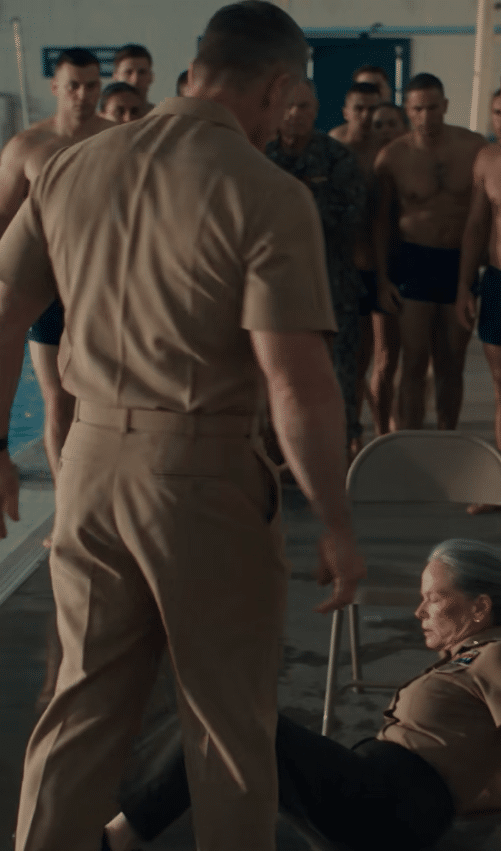
He drove a forceful kick into her torso, knocking her down beside the chair.
For one terrible second, she lay on the wet deck, struggling to draw a full breath. Her whistle swung against her chest, and the sound of splashing water seemed suddenly much louder than the conversations that had filled the facility moments earlier.
Then she turned her head.
Not toward the colonel.
Toward the child’s area.
The child was still in the water.
The woman pushed herself up, one hand pressed against her torso. Pain tightened her face, but her attention never left the pool.
The colonel stood over her.
“Pool attendants don’t close lanes on colonels.”
She said nothing.
She got one foot beneath herself, then the other, and rose beside the lifeguard chair. Her breathing was shallow, and her cheek was swelling, but she moved immediately toward the closure marker.
She did not remove it.
She did not reopen the lane.
And when the colonel reached toward the marker, she raised one hand to stop him.
“Not until the child is safe.”
Her wet polo shifted as she straightened.
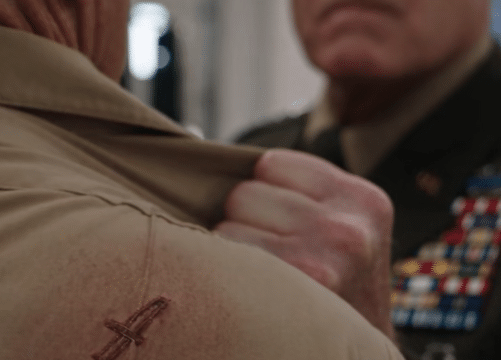
Something small and metallic slipped out from beneath the fabric, swinging briefly against her chest before coming to rest in the open.
An old rescue medallion.
The colonel barely glanced at it.
But an older man sitting near the spectator benches saw the object and went completely still.
He was a retired Navy rescue swimmer, sixty-two years old, with graying hair and a powerful frame shaped by a lifetime of physical work. He had been watching the confrontation with growing disgust.
Now all the color seemed to drain from his face.
He rose so quickly that his chair scraped backward across the floor.
“Colonel… don’t touch that medallion.”
The colonel turned, annoyed by the interruption.
He looked down at the little piece of metal and gave a contemptuous laugh.
“It’s a medal from a pool.”
The woman finally looked at the retired swimmer.
Her expression remained controlled, despite the pain in her face.
“He knows there was no pool where I earned it.”
The retired swimmer did not blink.
The colonel’s smile faltered.
He looked at the medallion again, then at the man who had recognized it. For the first time since arriving at the facility, he seemed unsure of what he was looking at.
“No pool…?”
And the woman turned back toward the water, as if the colonel’s confusion mattered far less than the life that was still at risk.
Because the medallion had not been earned in a swimming pool. It had been earned somewhere the colonel had never imagined—and where survival had come at a terrible price.
Act II
The base swimming facility was supposed to be one of the safest places on the installation.
It had separate training lanes, a shallow children’s area, emergency equipment mounted along the walls, and a staffed lifeguard station overlooking the water. Military families came there to teach their children to swim, while service members used the deeper lanes for fitness assessments and scheduled training.
The woman in the lifeguard polo had volunteered for the facility’s safety program for nearly a year.
Most people knew her only as the quiet volunteer who arrived early, checked the equipment, and insisted that every closure rule be followed. She kept spare whistles in a drawer, tested the rescue poles before opening, and reminded parents that even confident swimmers needed supervision.
She rarely discussed her past.
When asked about her military experience, she offered little more than a polite answer and returned to whatever task was in front of her.
Her name was Margaret Hayes.
She was sixty-four years old, with silver hair, a steady gaze, and the habit of listening more carefully than she spoke. She wore comfortable shoes, dark athletic trousers, and an ordinary polo shirt bearing the facility’s volunteer insignia.
Nothing about her appearance suggested that she had once held a senior command position.
Margaret preferred it that way.
She had spent enough of her life around rank, briefings, ceremonies, and people who mistook authority for importance. Retirement had given her the opportunity to do something simple and necessary without having to explain herself to anyone.
A child near the training area had briefly slipped beyond the normal supervision zone that afternoon. A lifeguard had spotted movement in the water, and Margaret had closed the adjacent lane until the child could be located and the area cleared.
It was a routine safety decision.
The colonel had treated it as a personal insult.
He had arrived with his aide and a printed training schedule, expecting the facility to be ready for his unit. When he saw the closure marker, he hadn’t asked whether someone was in danger. He had asked who had authorized the inconvenience.
The aide had framed the situation in exactly the wrong way.
“She’s holding up your session,” he had said. “The lane was ready before she closed it.”
The statement made Margaret sound careless, perhaps even defiant. The aide had not mentioned the child’s presence in the water until she said it herself.
The colonel accepted the complaint without investigating.
He was a competent officer in many respects. He understood physical training, scheduling, and the importance of keeping personnel prepared. But his career had also taught him that most people eventually yielded when confronted by someone with enough authority.
That assumption had become a reflex.
He rarely noticed how much of his authority depended on other people choosing not to challenge him.
Margaret had no intention of challenging his command. She was not part of his unit, and she had no interest in his schedule. She simply knew that opening a lane before confirming a child was safe could turn a manageable situation into a tragedy.
She had seen what happened when people decided that a procedure was optional because they were in a hurry.
She had watched small mistakes become irreversible.
And she had learned that the person who spoke up was often blamed long before anyone examined whether the warning had been justified.
That was why she had not moved.
Even after the water hit her face, she had kept her eyes on the pool.
Even after the slap, she had resisted the instinct to raise a hand to her cheek and concentrate on the pain.
And even after the kick knocked her to the deck, she had looked toward the water before looking at the man who had hurt her.
The retired rescue swimmer noticed all of it.
His name was Daniel Brooks, and he had spent decades working in naval rescue operations before retiring. He was now a civilian instructor who occasionally visited the base facility to help with water-safety training.
He had seen men and women respond to danger in countless ways. Some shouted. Some froze. Some moved so quickly that the fear came only afterward.
Margaret’s reaction was familiar to him.
She had been hurt, humiliated, and knocked down in front of strangers. Yet the first question in her mind had not been how to defend herself.
It had been whether the child was safe.
That was when Daniel saw the medallion slip free.
He recognized its shape before he could fully process the details. The metal was old, its surface worn smooth in places. It was not the kind of decoration that appeared on a standard dress uniform or in a display case at a public ceremony.
He had seen one before.
Not on a wall.
Not in a photograph.
On a person who had come back from an operation that Daniel still struggled to describe without remembering the names of those who never returned.
He had thought the medallion’s history belonged to a closed chapter of his life.
Now it hung against the wet shirt of a woman he had mistaken for an ordinary volunteer.
Daniel rose, his expression tightening.
He wanted to ask her a dozen questions.
But the colonel was still standing there, and Margaret was still protecting the closed lane.
The moment demanded something more urgent than curiosity.
So Daniel gave the only warning he could manage.
“Colonel… don’t touch that medallion.”
The colonel laughed at him.
Margaret answered for herself.
“He knows there was no pool where I earned it.”
Daniel lowered his head for a moment.
The memory was no longer distant.
It was standing in front of him, breathing through pain, refusing to move a safety marker for a man who believed his schedule mattered more than a child’s life.
And Daniel realized that the colonel had made a mistake far greater than insulting a volunteer.
He had attacked a woman whose understanding of rescue had been forged somewhere no swimming pool could ever prepare him for.
The question was no longer why Daniel recognized the medallion. It was what he remembered about the woman who had earned it.
Act III
Margaret had never worn the medallion to attract attention.
For years, she kept it beneath her clothing, close enough to touch but hidden from casual view. It was not an accessory, and she did not consider it a conversation piece. It was a reminder of a place she rarely discussed and of people whose names she had carried long after official ceremonies ended.
The medal had been presented after a rescue operation in a hostile environment where the sea was not the greatest danger.
There had been no pool.
No lane markers.
No warm building with lifeguard stations and emergency phones.
There had been only dark water, unstable equipment, desperate radio calls, and people waiting for someone to reach them before time ran out.
Margaret had been younger then. She had been stronger, faster, and more willing to believe that determination could overcome almost anything. But she had also learned that rescue work was not about being fearless.
It was about moving despite fear, making decisions when every option carried risk, and accepting that the people who needed help could not wait for someone to feel ready.
The operation that earned her the medallion had changed the course of her life.
Its full details were never part of the stories told at public military functions. Some information remained restricted, while other parts had simply faded from the official record as years passed and the people involved moved on.
Margaret did not correct every incomplete account.
She had no desire to turn a rescue into a legend built around one person. The operation had involved a team, and its outcome had depended on decisions made by people whose names the public would never learn.
Some had survived.
Some had not.
The medallion reminded her of both.
Daniel Brooks had been part of the wider rescue community at the time. He had not been standing beside Margaret when she received the award, but he knew the circumstances surrounding it. He had read the operational account, spoken with people who had been there, and spent years listening to the few survivors willing to discuss what had happened.
He remembered Margaret’s name.
More importantly, he remembered the way people spoke about her.
Not with the usual language of career advancement or ceremonial praise. They spoke about her decisions under pressure, her refusal to abandon those still waiting, and the impossible calculations that rescue personnel sometimes had to make when there was not enough time to save everyone.
Daniel had once heard an experienced rescuer say that Margaret had gone where nobody could reasonably expect a person to go and had returned carrying someone who should never have survived.
He had never forgotten the sentence.
Now, watching her beside the lifeguard chair, he recognized the same determination.
The colonel saw none of that.
He saw an older woman with wet hair, a swollen cheek, and a metal ornament hanging from her shirt. He saw a retired rescue swimmer who had interrupted him in front of his aide and several military families.
And he saw a situation that was slipping beyond his control.
“What’s so special about that thing?” he demanded.
Daniel stared at him.
“You don’t need to know that to understand what you’ve done.”
The colonel’s face hardened.
“I struck a pool attendant who refused a direct instruction.”
“You struck a woman who told you a child was still in the water.”
“She should have explained herself.”
Margaret looked up from the closure marker.
“I did.”
Her voice was quiet, but the answer silenced the colonel for a moment.
She had told him the reason. He had simply decided it was not important enough.
Daniel stepped closer, careful not to crowd her.
“Margaret, are you hurt badly?”
“I’m winded.”
“That isn’t what I asked.”
She met his eyes.
“My cheek hurts. My ribs hurt. But I need to know whether the child has been accounted for.”
Daniel turned toward the pool.
At the far end, a lifeguard was now speaking with another staff member near the children’s area. The earlier disturbance had drawn several adults’ attention, and the child had been brought safely out of the water. A staff member was checking the child’s condition while a parent hurried toward them.
Only when Margaret saw the child standing safely beside the pool did her shoulders relax by the smallest degree.
The lane remained closed.
The colonel followed her gaze and seemed offended that she had not even asked him for permission to continue her work.
“You can stop this now,” he said. “The child is out.”
“The area still needs to be checked.”
“Your job is to assist the facility, not command it.”
Margaret pressed one hand lightly against her torso.
“My job is to keep people safe.”
“Your job,” he repeated, “is not to decide what happens when a colonel gives an order.”
Daniel’s expression changed.
He had heard that argument before, from people who confused procedural authority with the right to ignore consequences. It was an especially dangerous belief around water, where a few seconds could make the difference between a rescue and a recovery.
The colonel looked down at the medallion again.
“It’s a medal from a pool.”
He spoke more loudly this time, as though mockery could restore the control he had lost.
Margaret studied him.
“He knows there was no pool where I earned it.”
There was no boast in her voice. No threat. No effort to make the room admire her.
She was simply telling him that Daniel understood the truth behind the object he had dismissed.
The colonel looked at Daniel.
The retired swimmer’s expression had become almost unreadable, but his eyes held an unmistakable warning.
For the first time, the colonel wondered whether the medallion was connected to a rescue story he had encountered during his own military education. There had been a case study about a dangerous operation, one used to illustrate the consequences of hesitation and the importance of getting people out alive.
The details had been limited.
The names had been fewer.
But he remembered that the operation had involved a rescue under conditions that made conventional training seem almost irrelevant.
He also remembered that a senior instructor had once stopped a discussion when a student tried to turn the story into a simple lesson about heroism.
The instructor had said that anyone who wanted to understand the operation should first understand what it had cost.
The colonel had dismissed the comment as dramatic at the time.
Now he looked at Margaret’s medallion and felt the memory return with uncomfortable clarity.
Daniel had recognized it instantly.
Which meant this was not a sentimental keepsake from a routine exercise.
It was evidence of a past the colonel had never taken the time to understand.
And the more he tried to dismiss it, the more he feared that he already knew enough to recognize the mistake he had made.
Act IV
A facility supervisor arrived with two security personnel shortly after the child had been checked.
The supervisor had heard the commotion from the administrative office and had already been told that a colonel had struck a volunteer. His expression tightened when he saw Margaret standing beside the lifeguard chair with a swollen cheek and wet clothing.
“Ma’am, do you need medical assistance?”
“Yes,” Margaret replied. “But please make sure the children’s area is secure first.”
The supervisor looked toward the lifeguard station, confirmed that staff had the situation under control, and asked a medical responder to examine her.
The colonel interrupted.
“This has been blown out of proportion.”
Nobody answered him.
He turned toward the supervisor.
“I gave a direct instruction. She refused to comply.”
“The lane was closed because a child was in the water,” the supervisor said.
“That was her claim.”
“The lifeguard staff can confirm it.”
The colonel glanced toward the aide, expecting support.
The younger officer stood with his hands at his sides. His expression was tense, and he seemed suddenly fascinated by the wet marks on the floor.
“You reported that she was obstructing my training,” the colonel said.
“I reported that the lane was closed, sir.”
“You made it sound like she was refusing an order.”
The aide swallowed.
“I should have explained the situation more clearly.”
It was a cautious answer, but it was also an admission that the colonel’s version of events had been built on an incomplete report.
The supervisor looked at the colonel.
“Regardless of the lane closure, no one here was authorized to assault a volunteer.”
The colonel’s expression darkened.
“I’m a field-grade commander.”
“And she is a person who was performing a safety function.”
The distinction was so simple that it seemed to leave the colonel without a prepared response.
Daniel remained beside Margaret while the medical responder checked her cheek and asked her to describe the pain in her torso. She answered each question clearly, though the effort of speaking sometimes made her pause to breathe.
When the responder suggested that she sit still, Margaret nodded.
Then she looked toward the closure marker.
“Please leave that where it is until the supervisor clears the lane.”
The colonel stared at her.
Even now, after he had humiliated her and knocked her to the floor, she was still managing the safety of the facility.
He had expected her to become frightened, angry, or desperate to defend herself. He had expected the confrontation to become personal, giving him an excuse to portray her as emotional and difficult.
Instead, she remained focused on the work.
Daniel crouched beside the chair so that he could speak without making her turn toward him.
“You don’t have to keep doing this.”
“I know.”
“Then let someone else handle the lane.”
She looked at the child, now sitting beside a parent with a towel around their shoulders.
“Someone else is handling it.”
It was the closest thing to reassurance she offered.
Daniel’s gaze fell briefly to the medallion, which had slipped back against her shirt. He remembered the day he had first heard about the operation connected to it. The account had been incomplete, but one detail had remained clear: the rescue had required people to act in conditions where conventional procedures offered little protection.
Margaret had not been rewarded for performing a routine task exceptionally well.
She had been recognized for surviving a situation in which the margin between rescue and disaster had almost disappeared.
Daniel looked at the colonel.
“You should stop talking about that medallion.”
The colonel gave a brittle laugh.
“Why? Because it makes her important?”
“No,” Daniel replied. “Because you keep trying to use it to decide whether what you did was wrong.”
The colonel’s face tightened.
Daniel continued.
“If that medallion meant nothing to you, you would still have assaulted a woman who was protecting a child. If it means something to you now, then you’re only discovering the value of a person after you’ve hurt her.”
The words carried farther than Daniel intended. Several people nearby heard them, and no one challenged him.
The colonel glanced at Margaret.
“Who are you?”
She looked back at him.
“Someone who told you there was a child in the water.”
“That isn’t an answer.”
“It was the answer you needed.”
He seemed to shrink under the simplicity of it.
For years, he had relied on rank to establish the terms of every confrontation. He could demand an explanation, question someone’s qualifications, and insist that his own authority be acknowledged before he considered the substance of an objection.
Margaret had refused to follow that pattern.
She had not tried to prove she was his equal. She had not told him what she had commanded or how many people had once answered to her. She had not mentioned that she was a retired major general.
She had simply protected the child.
And when the colonel had used violence to force her to surrender, she had returned to the same responsibility without asking anyone to admire her for it.
The supervisor asked the colonel to step away while security personnel documented the incident. He began to protest, but the request was repeated in a firmer voice.
The aide was asked to provide a statement.
The witnesses were identified.
The facility’s safety records and training schedule were preserved, and the supervisor confirmed that the lane had been closed for a legitimate reason.
The colonel’s own words had been heard by too many people for him to reshape the event into a disagreement about authority.
As the initial investigation began, the supervisor turned toward Margaret.
“Ma’am, do you have a military contact we should notify?”
Margaret considered the question.
“You can contact the retired personnel office. My records should be there.”
The supervisor nodded and asked for her full name.
When she gave it, he paused.
Then he looked again at her face.
“Major General Margaret Hayes?”
The colonel heard the title.
His eyes moved from the supervisor to the woman in the lifeguard polo.
The aide’s head lifted sharply.
Daniel closed his eyes for a brief moment, as though he had hoped the revelation would not be necessary.
Margaret looked mildly uncomfortable.
“I retired several years ago.”
The colonel stared at her.
A retired major general.
A woman who had once commanded people whose careers depended on her decisions.
A veteran whose name had been preserved in records he had never bothered to study.
But even that was not the part that frightened him most.
The medallion still hung against her shirt.
And Daniel was still looking at it with the grave recognition of a man who understood that the title on her record told only a fraction of the story.
The colonel had finally learned her rank. He was only beginning to understand what she had done to earn the medallion—and why Daniel had warned him not to touch it.
Act V
The investigation continued long after the pool had closed for the evening.
The colonel was relieved of his scheduled training responsibilities while the incident was reviewed through the appropriate military channels. Witness statements were collected, security records examined, and the facility supervisor submitted the closure report confirming that a child had been in the water when the lane was secured.
The facts were difficult to dispute.
The colonel had been informed of the safety concern. He had chosen to treat it as an affront to his authority. He had thrown water into Margaret’s face, slapped her, and kicked her to the floor.
His rank did not change any of those facts.
The aide also faced questions about the way he had presented the incident. He admitted that he had emphasized the disruption to the training schedule without establishing why the lane had been closed. He had expected the colonel to resolve an inconvenience, not to assault the person responsible for preventing a potential emergency.
But his incomplete report did not excuse what followed.
Margaret received medical attention for her injuries. Her cheek remained swollen, and her torso was painful for several days, but she was fortunate to avoid a more serious injury. The child was confirmed safe, and the facility reopened the lane only after the supervisor and lifeguard staff completed their checks.
When Daniel visited her later that week, he found her sitting in a small office near the pool, reviewing the facility’s safety procedures.
“You’re supposed to be resting,” he said.
“I am resting.”
“You’re reading an emergency checklist.”
“I’m sitting down while reading an emergency checklist.”
He laughed despite himself.
For the first time since the confrontation, the tension between them eased.
Daniel sat across from her and looked at the medallion, now tucked safely beneath her shirt.
“I’ve wanted to ask you about it for years,” he admitted.
Margaret’s expression grew distant.
“I know.”
“I recognized it immediately. I just never expected to see one again.”
“Most people won’t.”
“Do you ever talk about what happened?”
“Sometimes.”
“Not with me.”
She looked at him for a moment.
“You already know enough to understand why it isn’t a story I tell casually.”
Daniel lowered his eyes.
He did know. He knew that the rescue had involved more than a single brave decision. He knew that some people had done everything right and still had not returned. He knew that the medallion represented a mission whose outcome had been measured in lives saved, lives lost, and decisions that could never be undone.
But he had never heard Margaret describe it in her own words.
“Does wearing it help?” he asked.
She considered the question.
“Not exactly.”
“Then why keep it?”
Margaret reached beneath her shirt and drew the medallion into view. She held it in her palm, turning it slightly so that the light moved across its worn surface.
“Because memory changes,” she said. “People simplify things. They turn difficult events into clean stories with a beginning, a brave decision, and a happy ending.”
Daniel remained silent.
“But there are people who never get to be part of the happy ending. I keep it to remember them.”
She closed her fingers around the metal.
“That is all.”
Daniel nodded slowly.
He had known the operation’s history, but hearing her explain the medallion’s purpose made him understand something he had never fully considered. The object was not a trophy from a glorious moment. It was a burden she had chosen to carry because leaving it behind felt too much like leaving the people behind with it.
The colonel had seen an old medal.
Daniel had seen a history.
Margaret had seen the names of people she could never bring home.
A week later, the colonel requested a meeting with her.
The supervisor offered to have another officer present, and Margaret agreed. She had no interest in a private confrontation that might be misunderstood or turned into another contest of authority.
The colonel arrived without his usual confidence. He wore a plain uniform, and his hands remained still at his sides as he stood before her.
“I’ve reviewed the initial findings,” he said.
Margaret waited.
“I was wrong to close the matter without understanding why the lane was shut.”
“You were told why.”
He accepted the correction with a small nod.
“Yes. I was.”
He looked down briefly, then continued.
“I was also wrong to strike you.”
The apology sounded stiff, but it was not evasive. He did not blame the aide, the schedule, or the pressure of command. He did not claim that he had misunderstood the physical encounter.
Margaret listened without interrupting.
“I didn’t know you were a general,” he added.
Her expression remained unchanged.
“You shouldn’t have needed to know.”
He swallowed.
“I understand that now.”
She studied him for a moment.
“Do you?”
He looked up.
“If I had been a civilian with no military service, would you have treated me differently?”
He hesitated.
The hesitation answered more honestly than a polished apology could have.
Margaret continued.
“You thought my job was unimportant because you didn’t know my history. You thought the lane closure was unimportant because it interfered with your schedule. And you thought you could force me to change my decision because you outranked everyone you could see.”
The colonel’s jaw tightened, but he did not interrupt.
“Those are three separate mistakes,” she said. “Your rank doesn’t repair any of them.”
“I know.”
“No. You know the investigation is serious. That’s not the same thing.”
He lowered his eyes.
For a long moment, the only sound in the office was the distant splash of water from the reopened pool.
Finally, Margaret tucked the medallion beneath her shirt.
“I hope you become a better officer,” she said. “Not because of what happened to me. Because the next person who tells you something is wrong may not have the time to convince you.”
The colonel left without another argument.
The military review continued, and the consequences of his actions followed through the appropriate channels. His conduct was documented, his leadership was scrutinized, and the incident became a lesson in why rank could never replace judgment or excuse violence.
The aide was required to account for his role in the initial report and received formal guidance on verifying safety concerns before escalating them as disciplinary matters.
Neither man was allowed to rewrite the event as a minor misunderstanding.
Margaret returned to the swimming facility when she was medically cleared.
Her first morning back, she checked the rescue equipment, reviewed the emergency procedures, and walked the length of the training lanes. A few families recognized her and offered quiet greetings. One parent thanked her for insisting that the children’s area be checked before the lane reopened.
Margaret simply nodded.
She did not mention the colonel.
She did not discuss her rank.
And she did not take the medallion out to show anyone.
Daniel watched her from the spectator benches, remembering the warning he had given that afternoon.
“Colonel… don’t touch that medallion.”
At the time, the words had been meant to stop a man who had already gone too far. But Daniel now understood that the warning had carried another meaning.
The medallion was not powerful because it could frighten an officer.
It was powerful because it connected the present to a past that deserved to be remembered honestly.
And Margaret had never needed to use it to prove that she mattered.
One afternoon, as she prepared to open the facility, a young service member approached the desk.
“Ma’am, I heard you were involved in a rescue operation a long time ago. Is that true?”
Margaret looked at him.
“Yes.”
“Was it dangerous?”
She considered the question, then glanced toward the children gathering beside the shallow end.
“Yes,” she said. “But the important part wasn’t how dangerous it was.”
“What was the important part?”
“That people needed help, and someone had to go.”
The young service member nodded, absorbing the answer without fully understanding it.
Margaret handed him a stack of clean towels and returned to checking the lane markers.
The medallion remained hidden beneath her shirt, close to her heart.
She had earned it somewhere there had been no pool, no lifeguard chair, and no safe place to stand while someone else took responsibility. She had carried its memory through years of command, retirement, and quiet service.
And now she was back where she belonged: protecting people who might never know how much danger could be prevented by one person refusing to look away.
The colonel had once believed that the woman in the lifeguard polo was beneath his authority.
He had learned that she had commanded at a level he could barely imagine.
But the most important truth was simpler than either of those facts.
Even if she had never worn a uniform, even if the medallion had never existed, even if Daniel Brooks had never recognized her, she would still have been right to close the lane.
A child was still in the water.
That should have been enough.
And in the end, that was the lesson the colonel could not escape: the measure of a leader is not how quickly people obey him, but whether he recognizes the person who is trying to save a life—even when that person has no rank he can see.