Act I
“Colonel, she won’t leave the command-family row.”
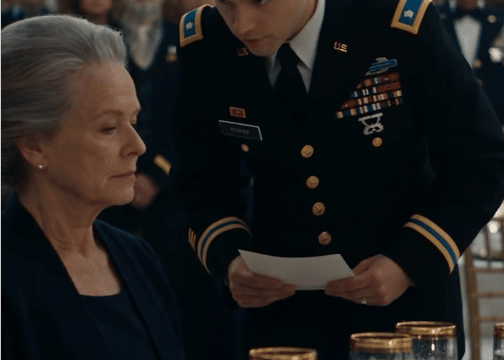
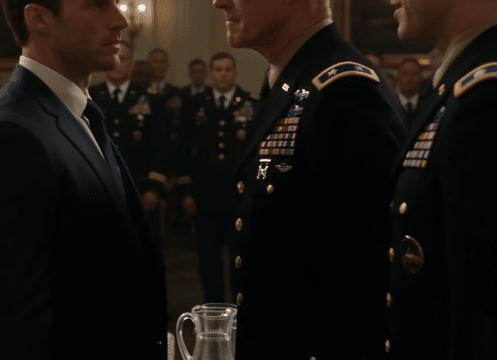
The Lieutenant’s complaint carried across the military academy’s graduation ceremony, where cadets stood in immaculate dress uniforms beneath rows of flags. Senior officers occupied the seats near the stage, proud families filled the bleachers, and a reserved row waited at the front for guests personally invited by the academy’s command leadership.
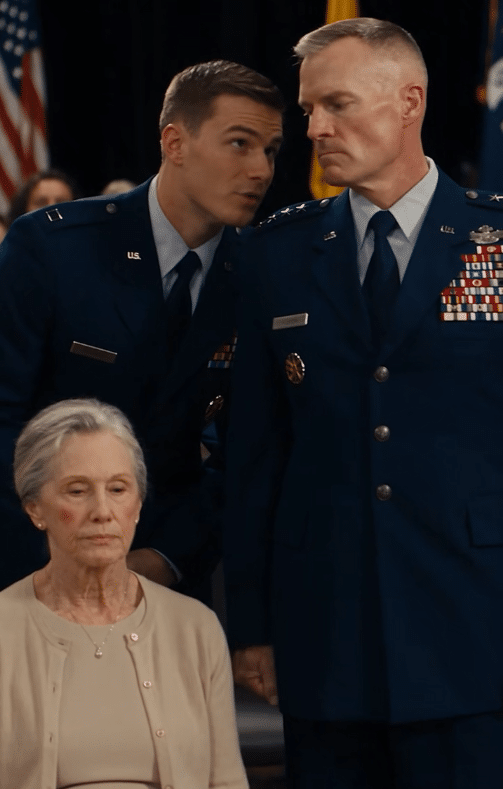
In one of those seats sat a seventy-four-year-old woman wearing a simple dress, a modest cardigan, and low shoes.
She looked nothing like the polished guests surrounding her.
The Colonel overseeing protocol noticed immediately.
“Ma’am, this section is reserved.”
The woman lifted the printed invitation in her hand.
“My invitation says front row.”
Her voice was gentle but certain. She didn’t argue about rank or demand special treatment. She simply held out the document that had given her the seat in the first place.
The Colonel barely glanced at it.
He had spent years enforcing ceremony, appearance, and hierarchy. To him, a person’s clothing revealed whether they belonged in a particular room. The elderly woman looked ordinary, and that was enough to make him suspicious.
“Who issued that invitation?”
“It was sent to me.”
“That isn’t an answer.”
The Lieutenant shifted uncomfortably beside him. Several guests had begun watching, and the ceremony was scheduled to begin soon. The Colonel could have checked the seating list, confirmed the invitation, and resolved the matter in seconds.
Instead, he chose humiliation.
He snatched the invitation from the woman’s hand.
Then he slapped her across the face.
A gasp rose from the front row. The woman staggered, her cheek reddening as she struggled to keep her balance. Before she could recover, the Colonel drove a forceful kick into her torso, knocking her down beside the chair.
For one terrible moment, the graduation ceremony seemed to stop breathing.
Cadets remained in formation. Parents stared in disbelief. A few officers turned sharply toward the commotion, but nobody moved to intervene while the assault was happening.
The Colonel stood over the woman.
“Front-row guests don’t arrive dressed like this.”
The words were colder than the slap.
The woman drew a shallow breath. Her cheek was swelling, and a faint trace of blood appeared at her lip. Still, she kept hold of the invitation, refusing to let the crumpled paper fall from her fingers.
She pushed herself upright.
There were tears in neither her eyes nor her voice. Only pain, and beneath it, a quiet resolve that the Colonel seemed incapable of recognizing.
Then a man in a formal military staff uniform hurried toward them.
He looked at the elderly woman and stopped so abruptly that another guest nearly collided with him.
“Ma’am, I’m so sorry. I was supposed to escort you.”
He carefully helped her steady herself after the assault.
Then he turned toward the Colonel.
“Colonel, do you know who she is?”
The Colonel gave a contemptuous laugh.
“She’s nobody. Just an old woman trying to steal a command-family seat.”
The elderly woman looked directly at him.
“You just found her.”
The staff officer went silent.
And the Colonel’s expression began to change, because the words had pointed toward one name he knew far too well.
General Mercer.
Act II
The woman’s name was Margaret Mercer.
She had arrived at the academy that morning carrying a printed invitation and expecting nothing more than a graduation ceremony. She had chosen her clothes carefully, though not expensively. The cardigan was comfortable, the dress was neat, and the low shoes were practical for someone who preferred to walk rather than be fussed over.
Margaret had never been interested in looking important.
She had spent most of her life watching people confuse appearances with character, and age had only made her less patient with the distinction. She knew that a pressed uniform could conceal arrogance just as easily as an inexpensive cardigan could conceal a lifetime of sacrifice.
The invitation had arrived several weeks earlier.
It had come with a personal note from General Daniel Mercer, one of the academy’s senior leaders and a man whose name carried considerable weight throughout the service. He had asked Margaret to attend the graduation and promised that a member of his protocol staff would meet her at the entrance.
She had accepted without hesitation.
The graduating cadets represented everything she admired about the next generation: young people preparing to shoulder responsibilities they could not yet fully understand. Some would become pilots, others engineers, medics, intelligence officers, or commanders. Many would eventually discover that leadership was less glamorous than the speeches suggested.
Margaret wanted to see them graduate.
She also wanted to see Daniel in his element.
He had worked for years to reach his position, enduring deployments, long absences, difficult decisions, and the quiet strain that accumulated in a military family. Margaret knew the personal cost behind his public achievements, even when he rarely spoke about it.
She had never asked him to make an event revolve around her.
That morning, she had arrived early, presented her invitation, and been directed to the command-family row. The seating attendant checked the document and indicated the reserved chair. Margaret sat down, folded her hands in her lap, and watched the cadets prepare for the ceremony.
Then the Lieutenant approached.
At first, his concern seemed procedural. He had noticed an elderly woman dressed more simply than the guests around her and assumed that someone had placed her in the wrong section. Rather than check the invitation’s issuing authority, he brought the matter to the Colonel.
The Colonel made the same assumption and turned it into a confrontation.
By the time Margaret tried to explain that her invitation specifically named the front row, he had already decided that her presence was an insult to protocol.
He never asked whether she was expected.
He never checked the list.
And he never considered that someone might have invited her for a reason that had nothing to do with appearance.
Now she stood beside the chair, one hand holding the crumpled invitation, while the staff officer remained close enough to steady her if she needed it.
His name was Andrew Cole. At thirty-six, he had spent years assigned to General Mercer’s staff, coordinating arrivals, ceremonial details, and the endless practical demands that surrounded senior command.
He had been delayed by an unexpected issue at the entrance.
He had arrived too late to prevent the assault.
The guilt was written plainly across his face.
“I’m sorry,” he repeated, his voice lower now. “I should have been here.”
Margaret gave him a small nod.
“It’s all right, Andrew.”
It wasn’t an absolution. Her cheek hurt, her breathing was uncomfortable, and the humiliation had been witnessed by families who had come to celebrate their children. But she understood that Andrew hadn’t struck her. He was apologizing because he had failed to fulfill a responsibility he had taken seriously.
The Colonel watched their exchange with growing irritation.
He had expected the staff officer to confirm his authority, not challenge it. He had certainly not expected a man assigned to a senior general to apologize to the woman he had just called nobody.
Yet Andrew’s attention remained on Margaret.
And the way he addressed her made the Lieutenant begin to realize that the seating dispute had never been what it appeared.
Act III
The Colonel had spent years believing that protocol was a form of protection.
A ceremony depended on order. Reserved seating existed for a reason. Guests needed to be guided to the correct places, schedules had to be maintained, and the academy’s reputation depended on the impression it made before senior officers and visiting families.
Those principles were not inherently wrong.
His mistake was believing that enforcing them gave him permission to humiliate anyone who failed to match his expectations.
He looked at Andrew Cole.
“I’m handling a seating violation. If you have a concern, take it up with the protocol office.”
Andrew didn’t move.
“Sir, I am taking it up with you.”
The Colonel’s eyes narrowed.
Margaret remained silent. She could have explained the invitation’s origin, identified the person who had requested her presence, or told the Colonel exactly why she belonged in the command-family row.
Instead, she smoothed the edge of the paper between her fingers.
The gesture was almost painfully ordinary.
It reminded Andrew of the woman he had been assigned to escort: someone who disliked grand entrances and had specifically asked that no announcement be made when she arrived. She had wanted to take her seat quietly, watch the graduation, and leave without turning the day into a personal celebration.
The Colonel had mistaken that modesty for insignificance.
“She’s nobody,” he repeated, as though saying it twice would make the problem disappear. “I won’t have someone exploiting a command-family seating arrangement because she thinks a piece of paper gives her special treatment.”
Andrew stared at him.
“Did you verify the invitation?”
The Colonel hesitated.
“I don’t need to explain every protocol decision to a staff aide.”
“That wasn’t my question.”
The Lieutenant looked from one officer to the other. He had reported the situation believing he was helping the Colonel preserve order. Now he was beginning to understand that neither man was discussing a genuine security concern.
They were discussing an invitation that the Colonel had never bothered to verify.
Andrew drew a controlled breath.
“General Mercer personally requested that she be escorted to this row.”
The Colonel’s expression hardened.
“Then General Mercer should have sent someone who looks like she belongs here.”
The words landed in front of the families, the cadets, and the officers who had already witnessed the assault.
Even Andrew seemed momentarily stunned by the cruelty of the remark.
Margaret, however, showed no surprise.
She had spent enough years around powerful people to recognize the moment when someone had stopped defending a decision and started defending their pride. The Colonel could have admitted he had made a mistake. He could have checked the invitation, apologized, and restored the ceremony to its proper course.
But each challenge made retreat more difficult for him.
He had called Margaret an intruder.
He had struck her.
He had then dismissed the staff officer assigned to escort her.
Now, rather than verify a single fact, he was doubling down.
Margaret looked at Andrew.
“Daniel asked me to be here,” she said softly.
It was the first time she had used the General’s given name.
Andrew lowered his head slightly.
“Yes, ma’am.”
The Colonel noticed.
It was not a dramatic gesture. Andrew hadn’t saluted or announced Margaret’s identity. He had simply answered her with the respect of someone who understood that her words carried a personal significance he would not presume to explain.
The Colonel looked at her again.
“Daniel?”
Margaret didn’t answer.
She didn’t need to.
The ceremony’s opening music began faintly through the academy loudspeakers, but nobody in the immediate seating area seemed to hear it. The Lieutenant was staring at Andrew, whose expression had turned from apology to controlled anger.
Then Andrew spoke again.
“Colonel, I strongly suggest you think about what you’ve just done.”
The Colonel tried to laugh.
But the sound died before it reached his eyes.
Because Margaret Mercer was no longer merely the elderly guest he had decided didn’t belong.
She was someone General Mercer had personally asked his staff to protect.
And the Colonel had just made that fact impossible to ignore.
Act IV
The Colonel glanced toward the stage.
General Daniel Mercer was expected to appear shortly, and the command-family row had been reserved in preparation for his arrival. The Colonel had spent the morning managing the ceremony’s details, ensuring that officers and distinguished guests were seated according to the official plan.
He had been proud of the precision.
Now he could barely look at the woman beside the chair.
Andrew moved a chair into a more comfortable position for Margaret. He did not make a show of helping her, and she accepted the support with a quiet nod before sitting down briefly to catch her breath.
The Colonel watched, his expression caught between disbelief and resentment.
“Are you seriously suggesting I should answer to a civilian guest?”
Andrew turned.
“I’m suggesting you answer for your actions.”
For the first time, the Colonel had no immediate response.
The Lieutenant took a step back. He had followed the Colonel’s lead because he had believed the older woman was in the wrong. He now realized that he had helped create the conditions for a public humiliation by treating an assumption as a fact.
He wanted to apologize, but he couldn’t find the words.
Margaret looked up at him.
“You were doing your job,” she said.
The Lieutenant’s shoulders loosened slightly.
“Ma’am, I—”
“Your job includes checking the invitation.”
Her tone wasn’t cruel. That made the correction more difficult to evade.
He nodded.
“Yes, ma’am.”
The Colonel heard the exchange and seemed to interpret it as another challenge to his authority. He straightened his uniform, pulling himself back into the posture he used whenever he wanted a room to remember his rank.
“I’m not going to be lectured at a graduation ceremony.”
Andrew’s answer was immediate.
“Then you should not have turned a seating question into an assault.”
Several nearby guests looked away, uncomfortable with the bluntness of the accusation. Others continued watching the Colonel, waiting to see whether he would deny what they had all witnessed.
He didn’t.
He couldn’t.
The red mark on Margaret’s cheek was becoming more pronounced. The faint trace at her lip remained visible, and she was still breathing carefully after the kick. Her injuries were not abstract allegations that could be disputed in a meeting.
They were in front of him.
So were the witnesses.
Andrew reached into his uniform pocket and checked the communication device assigned to his staff duties. He sent a brief message to the appropriate command representative, reporting that the planned escort had been delayed and that a serious incident had occurred in the front seating area.
He didn’t threaten the Colonel.
He didn’t promise punishment.
He simply ensured that the incident would not disappear into the confusion of a formal event.
The Colonel watched him do it.
“You’re making a serious mistake.”
Andrew put the device away.
“No, sir. I arrived late. That’s my mistake.”
He paused, then continued.
“Everything that happened after I arrived was your decision.”
The distinction left the Colonel visibly unsettled.
He had expected Andrew to protect the institution’s image, to quietly move Margaret elsewhere, and to let the ceremony proceed without embarrassment. Instead, the staff officer had drawn a line between an administrative failure and an act of deliberate cruelty.
One could be corrected with an apology.
The other demanded accountability.
Then the audience began rising as the first senior officers approached the stage.
A ripple of movement passed through the hall. Cadets adjusted their posture, families lifted phones to take photographs, and the ceremony’s announcer prepared to welcome the academy leadership.
General Mercer was arriving.
The Colonel turned toward the entrance.
He had spent the morning believing he was the person responsible for keeping the ceremony under control. Now he watched the staff officer stand beside Margaret as though her comfort mattered more than the Colonel’s opinion.
Andrew leaned toward her.
“Would you like me to take you somewhere private while we get medical assistance?”
Margaret considered the offer.
Then she looked at the stage, where the graduating cadets were beginning to march into position.
“No,” she said. “I came to see the graduation.”
Andrew nodded.
“Then that’s what you’ll see.”
The Colonel heard her answer.
His face tightened as the meaning of the moment finally reached him. She wasn’t trying to take his place, undermine his rank, or turn the ceremony into a personal spectacle.
She had come to watch a graduation.
He was the one who had made himself the center of it.
And the man whose name she had spoken was about to enter the room.
Act V
General Daniel Mercer stepped onto the platform to a formal announcement and a wave of applause.
He wore his uniform with the composure of someone accustomed to public ceremonies. His career had brought him into rooms filled with senior officials, visiting commanders, and families who wanted a moment to thank the people responsible for their loved ones’ service.
But as he looked across the audience, his eyes moved toward the command-family row.
The chair Margaret had been assigned was occupied.
Andrew stood beside it.
And Margaret was holding a crumpled invitation, her cheek swollen and her expression far too controlled.
Daniel’s smile disappeared.
He stepped away from the platform before the applause had fully faded. An officer beside him began to speak, but Daniel raised one hand, asking him to wait.
He walked directly toward the front row.
“Margaret?”
She looked up.
“Hello, Daniel.”
The quiet familiarity between them answered the question Andrew had carefully avoided answering aloud.
Daniel stopped beside her, his attention moving from her face to the paper in her hand, then to the Colonel standing several feet away. He didn’t need a detailed explanation to recognize that something serious had happened.
“What happened?”
Margaret glanced briefly at the Colonel.
“He thought I didn’t belong here.”
Daniel looked at Andrew.
The staff officer’s face tightened with regret.
“Sir, I was delayed at the entrance. When I arrived, the Colonel had already assaulted her. I apologize for not escorting her as assigned.”
Daniel’s expression changed.
He turned toward the Colonel.
The man who had spent the morning enforcing protocol now seemed unable to stand comfortably beneath the attention of the general whose family member he had attacked. His polished uniform and rigid posture offered no protection from the facts.
“Sir,” the Colonel began, “there was a confusion regarding seating.”
Daniel looked at Margaret’s cheek.
“Is that what you call this?”
The Colonel swallowed.
He tried to explain that the woman had refused to leave the command-family row, that her appearance had raised questions, that he believed the invitation required verification. Each sentence made the situation worse because every explanation returned to the same point.
He had acted before checking.
He had judged her by her clothes.
And he had used violence when she refused to surrender a seat she had been invited to occupy.
Daniel listened without interrupting.
Then he asked the question that ended the Colonel’s excuses.
“Did you verify her invitation before you touched her?”
The Colonel’s lips parted.
No answer came.
Daniel looked toward the Lieutenant.
“Did you?”
The young officer lowered his eyes.
“No, sir.”
The general nodded once, absorbing the answer.
He didn’t need to shout. The witnesses were there. Andrew’s report had been sent. Margaret’s injuries were visible, and the invitation remained in her hand.
Daniel turned back to her.
“I’m taking you to get checked by the medical team.”
Margaret gave a small nod.
“After the cadets are seated.”
For a moment, Daniel looked as though he wanted to argue. Then he glanced toward the stage and understood what she was asking.
She had come for the graduates.
Even now, after being struck and humiliated in front of strangers, she didn’t want the ceremony abandoned on her account.
“Of course,” he said softly.
He offered her his arm.
Margaret accepted it and rose carefully. The Colonel watched as Daniel escorted her toward the command-family row, where the chair had been reserved from the beginning.
No announcement was made about her identity. No one needed to shout that she was the general’s grandmother. The truth was already clear in the way Daniel looked at her, in the personal familiarity of their exchange, and in the care he took to make sure she could sit without worsening her injuries.
The Colonel’s face went pale.
“General Mercer…?”
Daniel turned toward him.
“You will remain here and answer the questions that follow.”
It was not a dramatic threat. It was the beginning of a formal accounting.
The Colonel looked at Margaret, perhaps hoping she would soften the moment by explaining that the incident had been a misunderstanding. She offered no such rescue.
Instead, she unfolded the invitation as carefully as her sore hands allowed and placed it on the chair beside her.
The printed words were still there.
Front row.
She had never needed to steal a place among the command families.
She had been invited.
As the graduation ceremony resumed, Daniel remained beside her long enough to ensure she was comfortable. The cadets marched onto the stage, their faces bright with pride and uncertainty, unaware of the full story unfolding in the front row.
Margaret watched them with quiet attention.
The Colonel stood apart from the celebration, surrounded by the consequences of choices he could no longer blame on a seating chart or a misunderstood rule.
He had believed that dignity could be measured by clothing, that authority could excuse cruelty, and that an elderly woman who didn’t look important must be nobody.
Now he had discovered that the woman he struck was the person General Mercer had personally asked his staff to welcome.
And the worst part was not that she belonged to a powerful family.
It was that she had never used that connection to demand respect.
She had simply expected to be treated like a human being.
By the time the first graduates received their diplomas, the Colonel understood that no amount of ceremony could make the morning look the way it had before he acted.
The woman in the front row had come to honor the next generation of military leaders.
Instead, she had given the people watching a lesson they would remember long after the flags came down.
Rank could command a room. Appearance could deceive it. But neither could turn cruelty into honor.