Act I
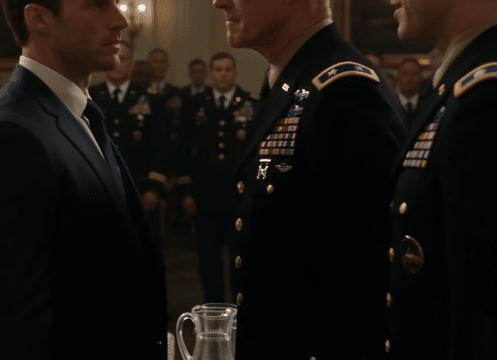
The Brigadier General had struck a seventy-two-year-old man in front of an entire fire station because the old man refused to give him a fire engine.
Now he stood over him, one polished boot inches from the fallen man’s hand, while firefighters watched in stunned silence. The engine behind them remained ready, its lights dark, its fuel checked, its hoses secured. It was exactly where it needed to be.
“Firehouse relics don’t cancel my schedule,” the General sneered.
The old man, whose name was Thomas Hale, pressed one hand against the concrete and slowly pushed himself upright. His cheek was red and swelling. A faint trace of blood marked his lower lip, and every breath seemed to remind him of the two kicks he had taken to the back and side.
Yet his eyes never left the engine.
“It’s staying available,” Thomas said.
The General stared at him as if he had misheard. Behind him, Captain Ryan Whitmore held a demonstration schedule against his chest, suddenly looking less confident than he had moments earlier.
“Sir, he was told this demonstration was a priority,” Whitmore said. “He refused to cooperate.”
Thomas turned his head just enough to look at the Captain.
“I cooperated with every instruction that didn’t put someone else’s life at risk.”
The answer landed harder than an argument. Several firefighters exchanged glances, but nobody moved. They had watched the General snatch Thomas’s helmet, throw it across the floor, and punch him down beside the engine. They had watched him kick a man who was already hurt.
And they had heard Thomas refuse to surrender the one thing he had been trusted to protect.
The General adjusted his uniform as though the confrontation had been an inconvenience rather than an act of violence.
“You have no idea who you’re dealing with,” he said.
Thomas wiped his lip with the back of his hand.
“No,” he replied quietly. “I don’t think you do.”
The General took a step toward him, ready to make the old man regret those words.
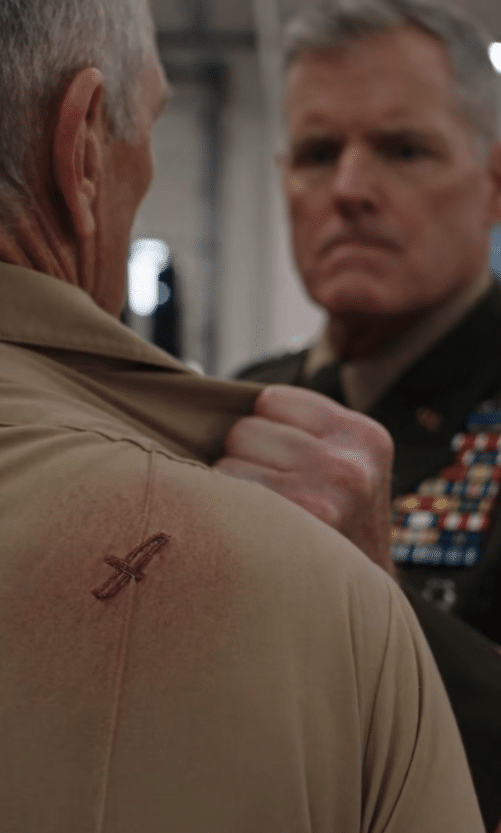
Then Thomas’s work shirt shifted at the shoulder.
A long, pale scar appeared beside a tiny insignia almost hidden in the weathered skin. It was an old injury, the kind that had faded over decades but never disappeared completely. The insignia was so small that most people would have mistaken it for an ordinary mark.
Most people.
Across the station, Fire Chief Daniel Mercer had stopped moving.
His eyes fixed on Thomas’s shoulder. The color drained from his face, and his expression changed so abruptly that the Captain noticed it before the General did.
Mercer had spent years learning how to remain calm around fire, wreckage, and men who thought panic was a weakness.
Now his voice came out low and urgent.
“General… you need to stop.”
The General glanced at him, irritated.
“Why? Because the old man has a scar?”
“That scar means nothing,” he said, turning back toward Thomas.
Thomas finally met his eyes.
“He knows the call sign attached to it.”
For the first time since entering the station, the Brigadier General looked uncertain.
And when he tried to repeat the words, they came out like a question he was afraid to have answered.
“Call sign…?”
But the story behind that scar had begun decades before this fire station, long before the General’s schedule, and long before Thomas Hale became an old man in a work shirt.
Act II
Thomas Hale had not come to the base to impress anyone.
He arrived three mornings a week in a battered pickup truck, parked beside the service entrance, and changed into a dark work shirt that smelled faintly of soap, smoke, and old canvas. He trained young firefighters on equipment checks, reviewed emergency procedures, and corrected small mistakes before they had the chance to become fatal ones.
He never demanded a special parking space. He never asked anyone to call him sir.
Most of the younger personnel assumed he was a retired municipal firefighter who had been invited to volunteer because the station needed experienced hands. A few knew he had served in the military. None could agree on what he had done there.
Thomas never volunteered the answer.
He cared about things that could be checked and measured: the pressure in a hose, the condition of a coupling, the response time between an alarm and a moving vehicle. If a piece of equipment was unreliable, he wanted it fixed. If a procedure was unsafe, he wanted it corrected.
He had little patience for ceremonies that made people feel prepared without actually preparing them.
That was why he had refused to release the engine.
The Brigadier General, whose name was Marcus Voss, had scheduled a public readiness demonstration for visiting officials. The event was supposed to showcase the base’s emergency response capabilities, with the fire engine positioned prominently for photographs and a short staged deployment.
Voss wanted the vehicle available on demand.
Thomas wanted it available for an actual emergency.
The difference seemed obvious to everyone except the man with the stars on his shoulders.
The engine was one of only two vehicles capable of responding immediately to a particular category of emergency on the installation. The second was undergoing a mechanical inspection, leaving the first as the station’s only fully available unit for that response window.
Thomas had checked the board himself. He had spoken with the crew leader, confirmed the maintenance status, and entered the restriction in the station log.
When Captain Whitmore arrived with the demonstration schedule, Thomas explained the situation without raising his voice.
“The other engine isn’t cleared yet,” he said. “This one stays ready.”
Whitmore glanced at his paperwork.
“General Voss has a timetable.”
“So does an emergency.”
The Captain had not liked that answer. He had spent years learning how to anticipate what senior officers wanted before they had to ask twice. In his experience, a schedule signed by a general was not a request. It was an instruction, and the people below him were expected to find a way to make it happen.
Thomas had been part of another generation.
He believed a commander’s responsibility was not measured by how quickly people obeyed, but by whether the people under that command survived the decisions being made.
When Whitmore reported the refusal, Voss did not ask why the engine was unavailable. He did not ask how long the inspection would take or whether another vehicle could be substituted.
He heard only that someone had said no.
To Voss, that was the real problem.
He had built his reputation around control. Meetings began when he entered them. Officers adjusted their language when he spoke. His plans were praised in briefing rooms, and even reasonable objections tended to disappear after he repeated an order in a sharper tone.
He mistook silence for agreement and compliance for respect.
The demonstration mattered to him because senior visitors would be watching. He wanted the base to appear flawless, and an elderly volunteer refusing to follow instructions threatened the image he had carefully arranged.
So he walked into the station expecting to find an apologetic old man.
Instead, he found Thomas beside the engine, inspecting a connection while a young firefighter held a flashlight.
“Release the vehicle,” Voss ordered.
Thomas straightened.
“I can’t do that.”
Voss stared at him.
“You can’t?”
“Not while it’s the only cleared vehicle available for that response.”
The General’s face tightened. He looked toward Whitmore, who remained close enough to hear every word but far enough away to avoid becoming the center of the confrontation.
“Who authorized you to make that decision?”
Thomas’s expression did not change.
“The responsibility was assigned to the station. I’m telling you what the readiness status is.”
“You’re a volunteer.”
“Today, yes.”
The distinction seemed to enrage Voss more than an outright insult would have. In his mind, Thomas had crossed a line by speaking to him as an equal, despite the difference in their uniforms—or, more accurately, despite the fact that Thomas wasn’t wearing one.
The General reached for the old man’s helmet.
Thomas instinctively caught its rim.
“Don’t,” he warned, not loudly, but with a firmness that made the nearest firefighter look up.
Voss yanked the helmet free and threw it aside.
Then he punched Thomas across the cheek.
The old man fell hard against the concrete, and the station seemed to contract around the sound. Voss followed him down with two forceful kicks before anyone had fully processed what was happening.
Thomas curled just enough to protect himself, then turned his head toward the engine.
He did not plead.
He did not promise obedience.
He did not tell the General what he could do with his schedule.
Even hurt and humiliated, he was still checking that the vehicle remained clear, the crew remained ready, and no one had moved the equipment that could be needed at any moment.
That was when Voss made his mistake impossible to excuse.
“Firehouse relics don’t cancel my schedule.”
Thomas looked up at him.
The General believed he had defeated an old volunteer.
He had no idea that the man on the floor had spent years learning the difference between a powerful person and a dangerous one.
And he had no idea why the Fire Chief was suddenly staring at Thomas’s shoulder as if he had seen a ghost.
Act III
Daniel Mercer had retired from the Army as a colonel before taking over the base fire station.
He had seen enough emergencies to know that the most important detail was often the one everyone else overlooked. A warped doorframe could reveal where a vehicle had taken its impact. A missing equipment seal could mean that someone had ignored a safety procedure. A single sentence from a witness could expose a lie that an entire official report had concealed.
Thomas’s scar was that kind of detail.
Mercer had first encountered the insignia years earlier, not on a uniform in a display case, but in a classified after-action briefing he had been required to study during his military career.
The briefing had not been glamorous. It contained maps, redacted names, technical diagrams, and a record of a rescue operation that had nearly failed before it began. Most of the people connected to it had been identified only by position or call sign.
One name, however, had appeared repeatedly in the surviving accounts.
Not a rank.
Not a surname.
A call sign.
Mercer had never forgotten it.
The story had circulated among a small number of military and emergency-response veterans, though the details were rarely discussed in public. It concerned an operation in which a damaged communications link and a fast-changing emergency had left a team without reliable instructions from higher command.
The people involved had been ordered to withdraw.
The situation on the ground had made withdrawal far more dangerous than anyone in the command post understood.
Someone had stayed long enough to coordinate a rescue, keep the remaining team moving, and bring people out who otherwise might never have returned. The mission had cost that person dearly. Its official record had been restricted, its public summary stripped of identifying details, and the call sign associated with the operation had become something older veterans recognized without needing to explain.
Mercer had never met the person behind it.
He had simply learned that the scar and the tiny insignia were associated with the same history.
Now, beside the fire engine, he was looking at both.
Thomas had never mentioned the operation during their time at the station. He had never offered a dramatic account of his service or used the past to demand deference. He showed up, trained the crew, checked the equipment, and went home.
Mercer had assumed the old man preferred privacy.
He had not realized just how much history that silence concealed.
“General… you need to stop,” Mercer said again, his voice low enough that the words seemed intended for Voss alone.
But the station was quiet, and everyone heard him.
Voss turned.
“Stop what?”
Mercer did not answer immediately. His eyes returned to the insignia, then to Thomas’s face. Something in the old man’s expression told him that the recognition was mutual.
Thomas knew what Mercer had seen.
He simply wasn’t going to explain it for the General’s benefit.
Voss followed the Fire Chief’s gaze and looked down at the exposed shoulder. The scar was unimpressive to him. It was old, pale, and surrounded by the ordinary marks of an aging body. The insignia beside it was too small to look official.
He had spent his career around decorations, citations, and uniforms. He knew how to recognize the symbols that brought attention in a room.
This was not one of them.
“That scar means nothing,” Voss said.
He delivered the words with the same contempt he had used when calling Thomas a relic, as if dismissing the evidence could restore the authority he had begun to lose.
Thomas pushed himself into a seated position against the side of the engine. His breathing remained uneven, and he kept one hand near his ribs. But when he spoke, his voice was steady.
“He knows the call sign attached to it.”
Mercer felt a chill pass through him.
The General looked from Thomas to the Fire Chief.
“What call sign?”
Neither man answered.
That silence unsettled Voss more than any direct accusation could have. He was accustomed to people explaining themselves when he demanded it. He was accustomed to forcing an answer by repeating a question, raising his voice, or reminding someone of the consequences of refusing him.
But Thomas was not trying to win an argument.
And Mercer was not trying to protect the General’s pride.
The Fire Chief had recognized something that made the assault look different from the moment it began. Voss had not merely attacked a volunteer who refused a demonstration. He had struck a man whose past was connected to a chapter of military history that still carried weight among those who remembered it.
The name behind that call sign was not something Mercer wanted to say casually.
Not here.
Not with the station crew listening, and certainly not while Thomas was still hurt on the floor.
He stepped closer, careful to keep his attention on the General rather than the scar.
“Sir, I strongly advise you to step away from him.”
Voss straightened his shoulders.
For a moment, he looked as though he might issue another order simply to prove that he could. His jaw worked, and his eyes narrowed at Mercer, searching for the familiar signs of hesitation.
He found none.
Then he looked at Thomas again.
The old man was not glaring at him. He wasn’t smiling. He wasn’t waiting for the General to understand how badly he had miscalculated.
He was watching the engine.
It was the strangest thing about the entire confrontation. Thomas had been assaulted, insulted, and knocked to the floor, yet his attention remained fixed on the job he had come to do.
The vehicle was still ready.
The emergency board still showed the other unit under inspection.
And the man who had attacked him was beginning to understand that there were consequences no schedule could erase.
But understanding was not the same as accepting the truth.
Voss still had one last chance to make matters worse.
Act IV
“I’m not taking instructions from a retired colonel about a volunteer’s attitude,” Voss said.
He delivered the sentence as if the words themselves could put the room back under his control.
Mercer didn’t flinch.
“This isn’t about attitude.”
“Then what is it about?”
“The engine is not available for your demonstration. It was never available. That was explained to you before you came in.”
Voss looked at Whitmore.
The Captain had gone pale. He had been the one who framed Thomas’s refusal as disrespect, the one who presented the schedule as though it outweighed the station’s readiness requirements. He had not thrown the punch, but he had helped create the conditions in which Voss believed violence was an acceptable response.
“Captain,” the General snapped. “Explain this.”
Whitmore swallowed.
“Sir, the board showed the second engine under inspection. Mr. Hale said the first had to remain ready.”
“You told me he was refusing to cooperate.”
“I thought—”
“You thought what?”
Whitmore stopped.
He had no answer that would make the moment look better. The truth was simple: he had assumed the General’s wishes should come first, and he had allowed that assumption to turn a safety decision into a personal challenge.
Mercer spoke before Voss could press him further.
“Captain, secure the readiness log and the maintenance status. Preserve the station’s records exactly as they are.”
Whitmore nodded quickly and moved toward the control desk.
Voss’s face hardened.
“You don’t give my aide orders.”
“I am responsible for this station,” Mercer replied. “And I’m documenting what happened here.”
That was the moment the power in the room began to shift.
Not because Mercer had revealed a secret title or produced an impressive medal. Not because Thomas suddenly stood up and announced that he had once outranked everyone present.
The shift came because the people around them were finally looking at the facts instead of the stars on Voss’s uniform.
The engine had been reserved for a legitimate emergency response. Thomas had stated the reason calmly. Voss had answered with an assault. The station’s personnel had witnessed it, and the records would show that the vehicle had remained on the ready board throughout the confrontation.
No amount of rank could change the order of those events.
Mercer crouched beside Thomas.
“Can you stand?”
“With help,” Thomas admitted.
It was the first time he had acknowledged the extent of his pain. He said it without shame, without pretending he was unhurt, and without offering the General the satisfaction of seeing him beg.
Mercer signaled for the station’s medical kit and asked another firefighter to contact the appropriate medical personnel. Two crew members approached Thomas, moving carefully as they helped him sit more comfortably against the engine.
Voss watched them.
“You’re making this into something it isn’t,” he said.
Thomas looked at him.
“You made it something when you hit me.”
There was no anger in the words. That made them harder to dismiss.
Voss glanced toward the open station doors, where the demonstration team had begun arriving. They had come expecting a polished display of discipline and emergency readiness. Instead, they found firefighters standing in silence, a discarded helmet on the floor, and a General whose expression had lost its certainty.
He turned back toward Thomas, attempting to recover the contempt that had worked so well only minutes earlier.
“Who are you supposed to be?”
Thomas said nothing.
Mercer rose slowly.
“Someone you should have listened to.”
“That’s not an answer.”
“No,” Mercer said. “It isn’t.”
The Fire Chief’s restraint was deliberate. He was not going to turn a painful history into a performance for the General’s benefit. Whatever the scar meant, Thomas had kept it private for decades. Mercer had no intention of using it to humiliate him a second time.
But Voss was no longer looking at the old man with simple contempt.
He was looking at the insignia again.
He had begun to recognize the outline of a story he had heard in fragments during his own career. A call sign mentioned in an old briefing. A name that appeared in the recollections of officers who usually dismissed war stories as exaggerations. A mission whose surviving details had been discussed in careful language, as though even those who knew the facts were reluctant to claim ownership of them.
He could not quite connect the pieces.
That was what frightened him.
If he had known Thomas’s identity from the beginning, he might have treated him differently. He might have shaken his hand, asked for an introduction, or pretended that his concern for readiness had been genuine all along.
But Thomas had been a nobody to him when the General walked through the doors.
An old volunteer.
A man without visible rank.
Someone who could be pushed aside so the schedule would run smoothly.
And now Voss was discovering that his judgment had been wrong in a way that could not be repaired by a polite apology delivered in front of witnesses.
Thomas adjusted his shirt over the scar.
The gesture was small and unceremonious. He wasn’t hiding it out of fear. He was simply finished allowing the General to stare at it as though it were a clue in a puzzle he had the right to solve.
“Get the engine ready for the next shift,” Thomas told the nearest firefighter.
The young man hesitated, glancing toward Mercer.
The Chief nodded.
“Do it.”
The firefighter moved immediately.
Voss watched the crew return to their duties. Nobody waited for his permission. Nobody asked whether the demonstration should continue. The station was going back to what it had been designed to do.
Respond.
Prepare.
Protect lives.
The General’s schedule had become the least important thing in the building.
And still, the name behind Thomas’s call sign remained unspoken.
Voss looked at Mercer one final time.
“Tell me what that insignia means.”
Mercer studied him for a long moment.
“You should be asking why you thought it was acceptable to hit him.”
The answer struck at the one thing Voss had spent his career avoiding: responsibility without excuses.
He looked back at Thomas.
For the first time, the old man seemed less like a mystery and more like a mirror. He had refused an order for a reason. He had taken the blows without abandoning that reason. He had not used his past to protect himself from the consequences of someone else’s temper.
Voss, by contrast, had used his authority to avoid being told no.
Now the entire station knew it.
But the General still did not understand the call sign.
And until he did, the fear in his face would remain only the beginning.
Act V
The immediate consequences came quietly.
The demonstration was postponed. The engine remained on emergency readiness, exactly as Thomas had insisted it should. Medical personnel examined him, documented the injuries to his cheek and torso, and advised further evaluation because of the force of the assault.
Thomas accepted the help without argument.
He had no interest in pretending that pain was a badge of honor. He had simply refused to let pain make the decision for him.
Meanwhile, Mercer ensured that the incident was formally reported. The station’s readiness records were preserved, along with the maintenance status of the second engine and statements from the personnel who had witnessed the confrontation.
Captain Whitmore gave his account.
At first, he described the event as a dispute over the demonstration schedule. But when asked why Thomas had refused to release the vehicle, he had to acknowledge the actual reason: the engine was the only cleared unit available for the specified response during that window.
His report could not make that fact disappear.
Nor could it explain away the moment when Voss had taken the helmet from Thomas and thrown it aside. Several witnesses had seen the punch. Several more had seen the kicks. The discarded helmet was still lying where it had landed when the first responders arrived to assist Thomas.
The evidence was ordinary.
That was what made it powerful.
There was no dramatic recording of the General confessing his motives. No secret document suddenly appeared to reveal a hidden conspiracy. No mysterious superior officer swept into the station to announce that Thomas was untouchable.
There were only the facts, the witnesses, and a man who had believed that his authority would protect him from both.
Voss was relieved of his immediate duties pending a formal investigation. His conduct was referred through the appropriate military channels, and the assault became part of an official record that could not be dismissed as a misunderstanding about a schedule.
The General’s position did not vanish in a single cinematic instant. Real consequences rarely arrive that neatly.
Instead, the privileges he had taken for granted began to fall away one by one. His access to the demonstration was suspended. His account of the incident was compared with the witness statements. Questions were asked about his decision-making, his treatment of subordinates, and the way he had handled a safety restriction that should never have become personal.
The station did not need Thomas to demand punishment.
The record spoke for itself.
Several days later, Mercer visited Thomas at the station after his medical evaluation. The old man was back in his work shirt, though he moved more carefully when he reached for equipment.
Mercer waited until the others had left before speaking.
“I recognized it immediately,” he said.
Thomas checked the strap on a spare helmet.
“I know.”
“I never thought I’d see it here.”
“Neither did I.”
Mercer hesitated. There were questions he had carried since the moment he saw the scar: what exactly had happened during that old operation, how many people had come home because of Thomas, and why the man had spent so many years avoiding any mention of it.
But Thomas had spent a lifetime choosing what to tell people.
Mercer was not going to force him to surrender that choice.
“People still talk about that call sign,” the Chief said at last.
Thomas lowered the helmet.
“People talk about a lot of things.”
“They talk about what happened when the operation went bad. About the team that came out when everyone thought they were lost.”
Thomas’s eyes settled on the floor for a moment.
“They weren’t lost,” he said. “They were waiting for somebody to stop making the wrong decision.”
Mercer felt the meaning of the answer settle between them.
He could have asked for names. He could have asked Thomas to confirm the story he had studied years earlier. Instead, he looked at the scar disappearing beneath the man’s sleeve and understood why the old veteran had never needed to talk about it.
The operation was not a trophy.
It was a responsibility he had carried long after the official reports were closed, long after the medals were put away, and long after the people who had witnessed it moved on to other lives.
Thomas had come to the fire station for a simpler reason.
He wanted the next crew to be ready when someone needed them.
Mercer glanced toward the engine.
“Voss wanted that vehicle for a demonstration,” he said.
“I know.”
“He thought you were challenging his authority.”
Thomas gave a tired, almost imperceptible smile.
“I was challenging his decision.”
The distinction was the whole story.
A person could have rank and still make a dangerous choice. A person could have no visible insignia and still understand exactly what a life depended on. The difference was not in the uniform, the title, or the number of people who stood when someone entered a room.
It was in what that person was willing to protect when protecting it became inconvenient.
Mercer extended his hand.
Thomas took it.
There was no salute. No announcement to the station. No speech about the old mission or the mysterious call sign. The two men simply stood beside the engine, surrounded by equipment that had been checked and maintained for the day someone might need it.
That was enough for Thomas.
For Voss, however, the story was not so easily put aside.
He had heard the call sign before. He was certain of it now. He remembered the tone in which older officers had spoken about it—not with the casual admiration reserved for decorated careers, but with a rare kind of respect that seemed to carry an unspoken warning.
He tried to place the name behind the insignia.
He remembered an old briefing. A restricted account. A mission that had become a reference point among people who understood that a bad order could be more dangerous than no order at all.
Then he remembered Thomas’s face on the floor, the red swelling along his cheek, and the way the old man had looked past him toward the engine.
Voss had mistaken restraint for weakness.
He had mistaken silence for insignificance.
And he had mistaken a refusal to obey an unsafe demand for a personal insult.
The investigation would determine the formal consequences of his actions. The military would decide what his record could bear. The people who had witnessed the assault would decide what kind of man they believed him to be.
But the most important judgment had already happened in that fire station.
Thomas Hale had been given a choice between protecting his pride and protecting the people who might someday depend on that engine.
He had chosen the people.
Voss had been given the same choice.
He had chosen himself.
And when the old scar appeared beside the tiny insignia, the General finally glimpsed the history he had been too arrogant to ask about before throwing the first punch.
The call sign remained unexplained to the wider world. Thomas never offered the full story, and Mercer never broke the confidence of a man who had earned the right to keep his past private.
Some histories do not need to be displayed to be real.
Sometimes, all it takes is one person recognizing what others have overlooked.
A scar.
A small insignia.
A name carried quietly through the years.
And a warning spoken just in time.
Because the engine had never belonged to the General’s schedule.
The station had never existed to protect his image.
And the old man he had knocked to the floor had never needed to announce who he was.
The scar was not what made Thomas Hale worthy of respect. It was the reason the Fire Chief recognized him. What made him worthy of respect was that, even after being struck down, he still refused to gamble with someone else’s life.