Act I
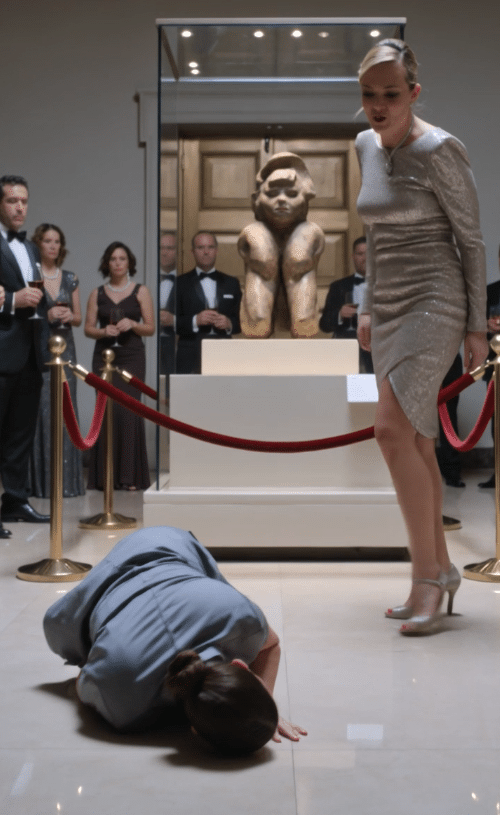
The wealthy woman kicked the janitor so hard that the older woman fell backward onto the polished museum floor, her radio flying from her hand and the velvet barrier trembling behind her.
A sharp gasp swept through the gold-lit gallery.
Guests in tuxedos and evening gowns stood frozen beneath the warm lights, their champagne glasses suspended halfway to their lips. Behind them, priceless artifacts rested inside carefully controlled displays, protected by glass, velvet ropes, and strict rules that applied to everyone who entered.
Everyone, apparently, except the woman in the silver evening dress.
“Please don’t touch the exhibit,” the janitor had said moments earlier.
Her name was Helen Brooks. At fifty-five, she had worked in museums and cultural institutions for nearly two decades, cleaning exhibition halls, polishing floors, and learning how to recognize the difference between ordinary dust and the kind of damage that could ruin an irreplaceable object.
She wore a gray uniform, comfortable shoes, and her silver-gray hair tied neatly at the nape of her neck. A small radio rested in her hand as she moved around the gallery, checking the area near a display containing an ancient ceremonial object.
The woman in silver had been leaning across the barrier to pose for a photograph, one hand reaching toward the artifact.
Helen had approached calmly.
“Ma’am, please keep behind the barrier.”
The woman turned as if a stranger had dared to interrupt a private conversation.
Her name was Vanessa Caldwell, and she was accustomed to being recognized before she had to explain herself. Her family had money, her social calendar was filled with charity events, and she had spent years cultivating the impression that the rules were meant for other people.
She looked Helen up and down.
“Trash. You clean here, not command here.”
Helen swallowed the embarrassment and kept her voice level.
“I’m just trying to protect the exhibit.”
Vanessa’s expression hardened.
She kicked Helen in the chest.
Helen fell backward, striking the floor as her radio clattered away. The barrier cord shook, and her elbow scraped against the polished stone, leaving a thin red trace.
For a moment, Helen struggled to catch her breath.
Then Vanessa stepped over her.
Two more forceful kicks landed against Helen’s back and side. The older woman curled inward, grimacing as she tried to protect herself. Her hand reached instinctively toward the radio, but she could not get her breath under control long enough to crawl toward it.
Around them, the gala guests recoiled.
One woman covered her mouth. A man took a step backward and nearly collided with another guest. Several people stared in disbelief, but nobody immediately moved to help.
Vanessa straightened, looking down at the woman on the floor.
“Stay with the mop.”
Helen’s eyes glistened. Her breathing came in short, trembling bursts, and the pain in her face was unmistakable.
Still, she turned her head toward the artifact.
The barrier had shifted slightly.
“Don’t let anyone touch it,” she whispered.
Even now, she was thinking about the exhibit.
Then the VIP gala doors burst open.
The museum director emerged with several security guards, followed by a distinguished older man whose name appeared on the largest donor plaques in the building. The guards hurried toward Helen while the director knelt beside her and ordered the guests to step back.
He checked that she was conscious and instructed a staff member to call for medical assistance.
Only when Helen was being attended to did he rise and face the gallery.
His voice cut through the silence.
“Seal the exhibit room.”
Security moved immediately. One guard shielded Helen from the crowd while another directed guests away from the display. Museum staff pulled the barrier into position, and the room that had been filled with conversation moments earlier fell completely silent.
Vanessa blinked.
She had expected someone to scold the janitor for interfering with a VIP.
Instead, the entire gallery was being secured.
“Seal it?” she whispered.
She had no idea what the director was protecting—or why he looked more concerned about the exhibit than the gala itself.
And the answer would soon reveal that Helen Brooks was not simply another employee Vanessa believed she could humiliate without consequences.
Act II
Helen Brooks had never considered herself important.
She lived in a modest apartment on the outskirts of the city, drove an aging sedan, and carefully planned her monthly expenses. Her daughter, Rachel, was in college, and Helen had spent years saving whatever she could to help pay for tuition and books.
There had been no inheritance waiting for her.
No wealthy relatives to rescue her when life became difficult.
When her husband died unexpectedly several years earlier, Helen had returned to work as quickly as she could. She had learned to stretch a paycheck, repair small things rather than replace them, and keep going even when exhaustion settled into her bones.
Her job at the museum was physically demanding, but she loved the building.
She loved the way sunlight moved across the gallery floors in the morning. She loved the quiet before visitors arrived and the sense that she was helping preserve something that belonged to generations of people she would never meet.
Most of the visitors saw the artifacts.
Helen saw the responsibility behind them.
She knew which displays required special cleaning procedures, which cases were sensitive to changes in temperature, and which objects could be damaged by something as seemingly harmless as a careless touch.
She had once noticed a small shift in the humidity reading near an ancient wooden artifact. The problem was subtle, and no alarm had sounded, but Helen reported it to the conservation team.
Their inspection revealed a malfunctioning climate-control unit.
The issue was corrected before the artifact suffered serious damage.
Helen received a brief thank-you from the conservation director. She smiled, returned to her duties, and thought little more about it.
That was how she worked.
She did not need an audience to take responsibility.
Over the years, Helen had also learned how different people behaved when they believed nobody important was watching.
Some guests treated the staff with genuine warmth. Others barely acknowledged them. A smaller group seemed to regard any request from an employee as a personal insult.
Vanessa Caldwell belonged to that last group.
She had arrived at the museum’s annual preservation gala as a guest of a prominent corporate sponsor. Her silver dress shimmered beneath the gallery lights, and a diamond necklace rested against her collarbone.
She was not unfamiliar with the museum.
Her family had attended several high-profile events there, and she had made a generous donation to a restoration campaign years earlier. That contribution had earned her invitations to private receptions and a place among the museum’s preferred supporters.
Vanessa had come to believe that this history gave her special standing.
She complained when staff members asked her to follow ordinary procedures. She expected photographers to accommodate her schedule and servers to remember her preferences. If someone corrected her, she rarely considered whether the correction was justified.
Instead, she wondered why the person had dared to challenge her.
At the gala, Vanessa had been eager to photograph herself beside the museum’s newest exhibition. The centerpiece was an ancient ceremonial object recovered decades earlier and painstakingly preserved by generations of specialists.
Its precise history was still being studied, but the object was widely considered one of the museum’s most significant acquisitions.
A protective barrier surrounded the display.
Guests could admire the object from a short distance, but they were prohibited from reaching over the barrier or touching the case.
Vanessa wanted a photograph that looked more intimate.
She leaned forward, extending her hand toward the display as her companion tried to find the right angle.
Helen noticed immediately.
She had been assigned to check the gallery during the event, and she knew that the barrier had been positioned for a reason. A careless movement could knock a fixture out of place or bring a guest into contact with the display.
Her warning was brief and polite.
Vanessa interpreted it as an insult.
What made the confrontation particularly revealing was that Helen had not raised her voice, embarrassed Vanessa deliberately, or attempted to assert authority beyond her role.
She had simply done her job.
For Vanessa, that was intolerable.
She believed status flowed in one direction: from the wealthy toward everyone expected to serve them. The idea that a janitor could correct her in front of other guests challenged the hierarchy she had spent her life protecting.
So she responded with violence.
What Vanessa did not understand was that the museum had been preparing for a very different kind of confrontation.
The director, Dr. Samuel Reed, had spent the previous year overseeing an investigation into a series of concerns involving the exhibition. Nothing had yet established that an artifact had been stolen or deliberately damaged, but irregularities in the display’s documentation had raised questions that demanded careful attention.
The gala was supposed to celebrate the museum’s preservation work and announce a major new commitment from its donors.
Instead, the assault would force Samuel to make a decision that could affect the institution’s future.
Because when he saw Helen lying beside the barrier, he recognized the radio she had been carrying.
It was the same radio she had used to report the first sign that something might be wrong with the exhibition.
And the incident that followed would bring an old mystery into the light.
Act III
The museum’s security team moved the guests into an adjoining gallery while medical personnel examined Helen.
Samuel Reed remained nearby until he was confident that she was receiving appropriate care. He did not ask her to explain herself while she was in pain, and he did not begin by asking whether the artifact had been damaged.
He asked what she needed.
Helen struggled to sit up.
“My radio,” she murmured. “I need to tell conservation the barrier moved.”
Samuel looked toward the display.
A guard retrieved the radio, and the conservation team checked the artifact and its surroundings. The case appeared intact, but the team documented the barrier’s position and began a formal inspection.
Only after Helen had been taken for medical evaluation did Samuel turn to the security supervisor.
“Preserve the footage. All of it. Nobody overwrites anything.”
The supervisor nodded.
The museum had cameras covering the gallery, the entrances, and the corridors leading to the VIP room. Their recordings would establish what happened before, during, and after the assault.
Samuel also instructed the team to record the names of witnesses and preserve the relevant access logs. The investigation would have to distinguish between what people had directly seen and what they had heard from others.
There would be no private arrangement that allowed the evidence to disappear.
Vanessa, meanwhile, was escorted into a separate room.
She protested from the moment security approached her.
“This is absurd. She was interfering with my photograph.”
A guard asked her to remain in the room while the incident was reviewed.
“Do you know who I am?” Vanessa demanded.
“Yes, ma’am. We know your name.”
“Then you know my family supports this museum.”
The guard remained professional.
“Please wait here.”
Vanessa sat down, furious that she was being treated like an ordinary guest.
She expected Samuel to appear, apologize for the embarrassment, and explain that the misunderstanding had been resolved. She was certain that once the director understood her family’s importance, the matter would be handled discreetly.
Instead, Samuel went to the museum’s conservation office.
There, he asked for the records associated with the ceremonial object.
A senior conservator brought him the documentation, including condition reports, environmental readings, photographs, and notes from previous inspections. Samuel reviewed them carefully, then requested the report Helen had filed months earlier.
It concerned the climate-control issue she had noticed.
Her report was unusually detailed for someone whose formal responsibilities centered on cleaning and facility maintenance. Helen had recorded the time, the reading on the nearby monitor, the condition of the room, and the exact location where she had first noticed the discrepancy.
The conservation team had confirmed that the climate-control unit was malfunctioning.
That incident had helped identify a problem before it became serious.
But the report had also prompted a closer look at the exhibition’s documentation. During the follow-up review, staff had noticed inconsistencies between several older photographs and the recorded placement of certain display components.
Those inconsistencies were not proof of wrongdoing. They could have resulted from undocumented maintenance, changes in photography, or mistakes in recordkeeping.
Still, they had led the museum to conduct a broader audit.
Samuel had been waiting for the results.
The audit was not complete, and he was determined not to accuse anyone without evidence. But the records made one thing clear: Helen had repeatedly noticed details that other people overlooked.
She understood the galleries.
She paid attention.
And she took the museum’s rules seriously even when doing so brought her no recognition.
Samuel returned to the sealed exhibit room.
The barrier had been secured, and the conservators were carrying out their inspection. He stood beside the display, studying the space around it.
A museum guard approached with an update.
“The cameras captured the assault clearly,” he said. “They also show the guest reaching over the barrier before Ms. Brooks approached.”
Samuel closed his eyes briefly.
That settled the immediate question of how the confrontation had begun.
Vanessa had not been attacked by an overzealous employee. Helen had been attempting to prevent a guest from violating a safety rule.
Samuel ordered the footage preserved and instructed the museum’s legal team to coordinate with the appropriate authorities regarding the assault. Vanessa’s identity and financial connections would not alter the process.
Then he asked the conservator one question.
“Has the artifact been cleared?”
“Not yet,” she replied. “We need to finish the inspection.”
“Then the room stays sealed until you are satisfied.”
That was the meaning behind his first order.
The room was not being sealed merely to punish Vanessa or create a spectacle for the gala guests. It was being secured to protect the collection, preserve evidence, and ensure that no one disturbed the scene before the investigation was complete.
But the decision had another consequence.
Vanessa had spent years using her family’s donations as proof that she belonged at the center of the museum’s social world.
Now her own conduct had placed her outside the gallery while the institution she claimed to support investigated an incident she had caused.
And when Samuel learned that Vanessa had been attempting to arrange a private introduction to the museum’s acquisition committee, he began to suspect that her interest in the exhibition extended beyond a photograph.
The audit was still incomplete.
But the timing was too important to ignore.
Act IV
By the following morning, the museum had begun two separate reviews.
The first concerned the assault on Helen Brooks. The security footage, witness accounts, and incident records were being preserved for the appropriate investigation.
The second concerned the exhibition’s documentation.
Samuel refused to merge the two into a single accusation. Vanessa’s violence was already serious enough without speculation about her motives, and the museum had a responsibility to distinguish established facts from unanswered questions.
Still, the assault had exposed something the institution could no longer overlook.
Helen had been responsible for enforcing basic rules in a gallery filled with influential guests, yet she had no reason to believe that anyone would protect her if a guest decided to retaliate.
That had to change.
Samuel called the museum’s senior staff into a meeting.
He asked the security director to explain the procedure for responding when a visitor threatened an employee. The answer revealed that the museum had a formal process, but employees had not received consistent guidance on when to activate it or how quickly senior staff should become involved.
The policy existed on paper.
Its practical meaning was less certain.
Samuel instructed the team to review the reporting process, ensure that staff knew how to summon security, and establish clear steps for responding to threats or physical aggression. Serious incidents would be documented and escalated regardless of a visitor’s donor status.
No one would be asked to tolerate violence to protect a fundraising relationship.
Then he addressed the gala.
Several donors had already contacted the museum asking why the exhibit room had been sealed and whether the evening’s program would continue. Samuel instructed the communications team to provide a measured account of the situation without disclosing private medical information or prejudging the investigation.
The gala could continue only in areas that were safe and unaffected by the review.
The collection came first.
The people responsible for caring for it came first, too.
Vanessa was informed that her access to the museum’s private events was suspended while the institution reviewed the incident under its visitor policies. The museum would not accept pressure to restore her privileges simply because her family had made past contributions.
She reacted with disbelief.
“My family has supported this place for years,” she told Samuel during a formal meeting.
“I understand that.”
“Then you should understand what this will do to your fundraising.”
Samuel folded his hands on the table.
“I understand that donations help us preserve the collection. They do not purchase immunity from consequences.”
Vanessa’s expression tightened.
“You’re choosing a janitor over the people who keep this museum running?”
“No,” Samuel replied. “I’m refusing to make that distinction.”
For the first time, Vanessa seemed unable to find a response.
She had expected the museum to weigh her family’s money against Helen’s position and conclude that the employee was expendable. Samuel’s refusal to play that game left her without the advantage she had relied on.
She tried to argue that Helen had embarrassed her publicly.
Samuel asked whether Helen had touched her, threatened her, or prevented her from leaving.
Vanessa said nothing.
He then explained that the footage showed Helen warning her about the barrier before the assault. The museum would cooperate with the appropriate authorities and would not allow the incident to be rewritten as a disagreement between two equally responsible people.
Vanessa’s face grew pale.
She had assumed the guests would remember her status.
Instead, they had witnessed her behavior.
Several had already provided statements describing what they saw. Others had asked the museum how Helen was doing. A few admitted that they had frozen during the attack and regretted not calling for help sooner.
Samuel did not condemn them for failing to intervene physically. He reminded staff that witnesses should summon security immediately and avoid putting themselves in danger, but that silence should never be mistaken for a solution.
Meanwhile, the conservation team completed its initial inspection of the exhibit.
The ceremonial object appeared to have escaped damage from the incident, but the team continued documenting the display and reviewing the surrounding records. The broader audit remained open.
When Samuel received the preliminary report, he felt relief—but not complacency.
The artifact was safe.
Helen was receiving care.
The security footage had been preserved.
And the museum was finally addressing the concerns that had been accumulating behind the scenes.
That evening, Samuel visited Helen.
She was tired and still sore, but she was alert. He sat beside her and explained that the exhibit had been secured and that the investigation was moving forward.
Helen listened, then asked the question that had stayed with her since the moment she fell.
“Did I do the right thing?”
Samuel looked at her in surprise.
“You were protecting the collection.”
“I know. But sometimes people get angry when you tell them no.”
He understood what she meant.
Helen had not asked whether the rules were correct. She had asked whether following them was worth the humiliation and pain that had followed.
“Yes,” Samuel said. “You did the right thing. And it was our responsibility to make sure you weren’t left alone when someone reacted badly.”
Helen looked down at her hands.
For years, she had assumed that responsibility meant doing her job quietly, even when others refused to show her the same respect.
Samuel’s apology did not erase what had happened.
But it acknowledged something that should never have been in doubt: her work mattered, and she deserved protection while doing it.
The museum had sealed the exhibit to preserve evidence and safeguard an irreplaceable object.
Now Samuel intended to make sure it never again treated an employee’s dignity as something less worthy of protection.
Act V
The investigation continued over the following weeks.
The museum cooperated with the authorities, preserved the relevant records, and followed its established procedures for addressing the assault. Vanessa’s family was not permitted to negotiate away the incident, and the museum made no promises about outcomes that belonged to investigators or the legal process.
Her access to private events remained suspended under the museum’s policies.
For Vanessa, the consequences were difficult to accept.
She had spent years believing that money could turn an unpleasant incident into a private misunderstanding. She expected a phone call, an apology, and perhaps a generous donation to smooth over whatever had gone wrong.
But the museum did not restore her privileges in exchange for a contribution.
Samuel made it clear that any future relationship would depend on the resolution of the incident and the institution’s policies, not on the size of a check.
The museum also completed a review of its employee-safety procedures. Security staff received updated guidance, workers were reminded how to request immediate assistance, and supervisors were instructed to document incidents involving threats or aggression.
The new process could not guarantee that every visitor would behave well.
It could ensure that employees would not be expected to face dangerous situations without support.
Helen returned to work when she was ready.
Her first shift back began before the museum opened to the public. Morning light fell across the gallery, illuminating the glass cases and the carefully arranged displays. The rooms were quiet, the floors were clean, and the ceremonial object stood safely behind its barrier.
Helen paused near the exhibit.
For a moment, she remembered the silver dress, the sudden impact, and the cold shock of lying on the floor while strangers watched.
She remembered reaching for the radio.
She remembered worrying that the barrier had shifted.
The memory hurt, but it no longer carried the same uncertainty. The museum had acknowledged what happened, and the staff now understood that asking a visitor to follow a rule was not an act of disrespect.
It was part of protecting the collection.
A young guard approached while Helen checked the area.
“Good morning, Ms. Brooks.”
She smiled faintly.
“Morning.”
He asked whether she needed anything before the gallery opened. The question was simple, but Helen noticed the difference. He was not speaking to her as though she were invisible or assuming that her work required no thought.
He was treating her like a colleague.
Later that morning, a visitor leaned too far toward another display while trying to photograph a sculpture. A guard stepped forward and politely reminded the visitor to remain behind the marked line.
The visitor looked annoyed but stepped back.
Nothing dramatic happened.
No one was humiliated.
No one was hurt.
Helen continued cleaning the floor.
That ordinary moment meant more to her than she could easily explain. The rules were being enforced without making the employee who enforced them a target.
The museum had not become perfect overnight.
The documentation audit still required careful work, and Samuel knew that rebuilding trust would take longer than issuing a new policy. Employees needed to see that the institution would stand behind them consistently, not only when an incident attracted attention.
But a change had begun.
Samuel also made a point of recognizing the work that often went unseen. At a staff meeting, he spoke about the people who maintained the galleries, monitored the building, handled deliveries, and protected the collection during the hours when visitors were absent.
He did not describe them as background support.
He described them as part of the museum’s mission.
“Preservation isn’t only about protecting objects from time,” he told the staff. “It’s about building a place where the people who care for those objects can do their work safely and with dignity.”
Helen stood near the back of the room, listening.
She had never wanted to become the center of a public controversy. She had not asked for recognition, and she would have preferred that the assault had never happened.
But she was grateful that the museum had not allowed the incident to disappear behind a donor’s name.
The most meaningful consequence was not Vanessa’s embarrassment or the suspension of her privileges.
It was that other employees now had a clearer path to help when a visitor crossed the line.
Months later, the museum reopened the exhibit room after completing the necessary inspections and documentation reviews. The ceremonial object remained undamaged, and the display was restored with its protective barrier securely in place.
Visitors gathered to admire it.
Some read the explanatory plaque. Others listened to a guide describe the object’s history and the generations of people who had preserved it.
Most never knew that the room had once been sealed during a gala because a guest had assaulted the woman trying to protect it.
Helen did not mind.
The point was never to turn her pain into a spectacle.
She wanted the collection to remain safe. She wanted to do her job without fearing that a wealthy visitor could hurt her and expect the museum to look away.
And she wanted her daughter to understand that dignity did not depend on a person’s salary, clothing, or place in a room.
One evening, as Helen prepared to leave, she paused beside the display and checked the barrier one last time.
It was secure.
She switched off the cleaning equipment and headed toward the staff entrance.
The museum’s golden lights glowed behind her, illuminating objects that had survived wars, journeys, and centuries of change. Each had a story worth preserving.
So did the people who protected them.
Vanessa Caldwell had entered the gala believing that a janitor had no right to tell her what to do. She had mistaken a uniform for weakness and wealth for authority.
But when she crossed the barrier and attacked Helen, the museum’s response was not to protect its most prestigious guest.
It was to protect the employee who had tried to prevent harm.
The order to seal the exhibit had been about preserving evidence and safeguarding history. Yet its meaning reached beyond the room’s locked doors.
The museum had drawn a line that no donation could erase.
A person’s worth is not measured by the title on their invitation—or by the uniform they wear while doing the work everyone else depends on.