Act I
“Please… I need that money for milk.”
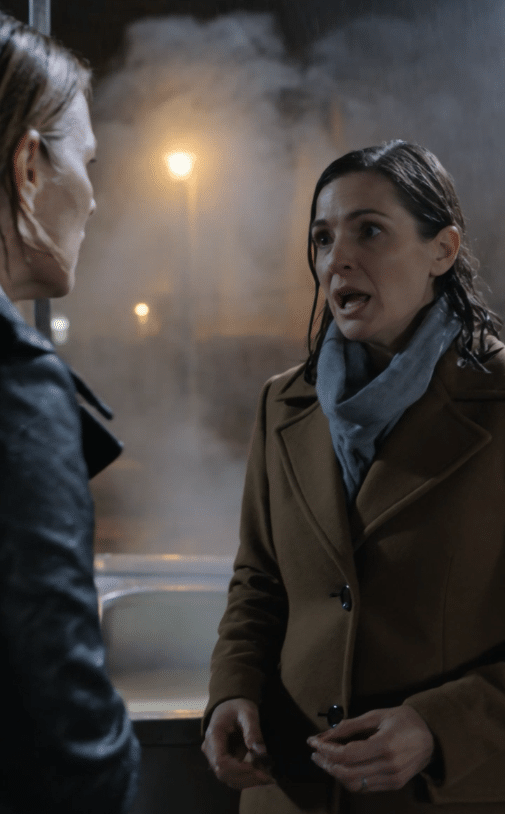
Martha Collins knelt in the rain beneath an overpass, staring at the bowl of soup scattered across the wet pavement. Steam rose briefly from the spilled broth before the freezing rain swallowed it. A few noodles clung to the edge of a storm drain, and the metal bowl rolled against the leg of her battered cart.
The woman standing over her laughed.
“Trash. Your soup tastes like rainwater.”
Martha was forty-three, dressed in an old brown coat with a faded apron tied around her waist. Her gray scarf was soaked through, her hands were red from the cold, and her hair stuck to her cheeks as rainwater ran down her face.
She had spent the entire evening selling soup beneath the bridge near the train station. The little cart was the only thing standing between her and another night of wondering how she would feed her child.
The woman in the black leather coat didn’t care.
She was thirty-six, visibly drunk, and wearing the kind of expensive clothes that looked deliberately out of place among the people huddled beneath the bridge. She had approached Martha’s cart demanding something hot, then complained that the soup was cheap, the bowl was scratched, and the service was too slow.
Martha had served her anyway.
When the woman finished, Martha quietly asked for payment.
That was when the woman threw the bowl into the rain.
Martha had reached for it, hoping to recover what she could, when the woman drove a hard kick into her chest. Martha flew backward into the cart. The metal frame jolted violently, utensils scattered across the pavement, and the little pot of soup rocked dangerously on its burner.
A spoon clattered into a puddle.
Martha struggled to breathe.
Her elbow scraped against the rough ground, leaving a thin red mark along her forearm. She curled onto her side, one hand pressed against her chest while the other instinctively reached toward the cart.
The woman stepped closer.
Two more brutal kicks struck Martha’s back and side.
Martha gasped and folded inward, trying to protect herself. Pain tightened her face, and her breath came in short, trembling bursts. Around them, people under the bridge recoiled in shock.
A man holding a paper cup covered his mouth. A young couple backed toward the train station entrance. Someone whispered that they should call for help, but nobody moved quickly enough to reach her.
The woman in black looked down at Martha as if she had found something unpleasant on the bottom of her shoe.
“Feed your child excuses.”
Martha’s eyes filled with tears.
Not because the woman had insulted her. Martha had endured insults before, from people who thought poverty was a character flaw and a cheap coat was proof of personal failure.
She was crying because she could see the coins from her apron pocket scattered across the wet pavement.
The money for the milk.
She tried to push herself up, but pain forced her back down. Her trembling fingers stretched toward a quarter resting near the drain.
“Please,” she whispered again.
The woman turned away, satisfied that the encounter was over.
Then headlights swept beneath the bridge.
A dark kitchen van came around the corner and stopped so abruptly that water sprayed from its tires. The sliding door slammed open, and several kitchen workers jumped down into the rain.
Behind them stepped a woman in a long black coat, her silver hair pulled neatly back, her expression cold with purpose.
She was Eleanor Whitmore, the owner of one of the largest charitable kitchen networks in the region.
But she did not look at the drunk woman first.
She hurried straight to Martha, knelt beside her, and placed a protective hand near her shoulder while checking whether she was conscious.
Then she looked toward the scattered cart, the spilled soup, and the coins disappearing into the rain.
Her voice was quiet, but everyone beneath the bridge heard it.
“Load her cart into my van.”
The kitchen staff moved immediately.
The woman in the leather coat stared at them, suddenly uncertain.
“Your van?”
For the first time that night, she seemed to understand that the person she had just attacked might not be as powerless as she had assumed.
And Eleanor Whitmore had not come beneath that bridge by accident.
Act II
Martha Collins had never imagined that selling soup would become the defining struggle of her life.
Five years earlier, she had lived in a small rented house with her husband, Daniel, and their young son, Noah. Daniel worked long shifts repairing commercial refrigeration systems, while Martha handled bookkeeping for a local hardware store.
They were not wealthy, but their life had a dependable rhythm.
There was rent to pay, groceries to buy, school mornings to organize, and the occasional weekend when they could afford to drive somewhere beyond the city. Martha had believed that if she worked hard and avoided unnecessary debt, her family would remain secure.
Then Daniel died in a highway accident on his way home from work.
The insurance process dragged on. Medical bills and funeral expenses consumed their savings, and Martha found herself trying to raise Noah while working whatever hours she could find.
She cleaned offices at night, prepared food for a neighborhood café, and took temporary jobs whenever they became available. Some weeks, she worked so many hours that she could barely stay awake on the bus ride home.
Still, the money never seemed to stretch far enough.
When Noah was diagnosed with a condition that required regular follow-up appointments, Martha began turning down shifts that conflicted with his care. She refused to let him feel responsible for the sacrifices she made, but she knew he noticed the little things.
The new shoes she postponed buying.
The dinners she claimed she wasn’t hungry enough to eat.
The way she checked every price before putting anything into a shopping basket.
Noah was twelve when Martha began selling soup.
She had inherited an old metal cart from a neighbor whose brother had used it to sell coffee outside a factory. The wheels were uneven, one handle had been repaired with wire, and the burner needed constant attention.
But it worked.
Martha spent what little she had on a large stockpot, disposable bowls, ingredients, and the permits required to operate at an approved location near the train station. She developed recipes that were inexpensive to prepare but filling enough to help people get through a cold night.
Chicken soup. Vegetable stew. Bean soup with potatoes and herbs.
She cooked at home before dawn, packed everything into insulated containers, and pushed the cart to the covered area beneath the overpass before the evening commuters arrived.
Her customers were mostly people who needed a warm meal without spending much money: night-shift workers, delivery drivers, commuters who had missed their connections, and people living in temporary shelters.
Martha remembered their names whenever she could.
She sometimes let a regular customer pay the next day if their paycheck had been delayed. She kept extra bread for an elderly man who could no longer chew hard food comfortably. If a young person appeared frightened and hungry, she would find a way to make the portion a little larger.
She could not solve everyone’s problems.
But she could offer a bowl of soup.
That evening, however, she had nearly run out of ingredients and had earned less than expected. A delivery had cost more than she planned, and the price of milk had risen again.
Noah was spending the night at home with a neighbor checking on him after school. Martha had promised to bring home milk, bread, and the medicine he needed for a persistent cough.
She had calculated the cost several times.
The money from the last few bowls would cover it.
Then the woman in the leather coat arrived.
Martha had recognized the type immediately: a customer who mistook the right to purchase something for the right to humiliate the person selling it.
At first, the woman complained that the soup was too hot. Then she demanded a different bowl, criticized the cart, and asked why Martha did not operate somewhere cleaner.
Martha answered each complaint patiently.
She had learned that arguing with an angry customer rarely improved anything, particularly when the customer had been drinking. She simply wanted the woman to pay and leave.
When the woman finished eating and refused to pay, Martha made one small request.
“Ma’am, the bowl is three dollars.”
The woman stared at her.
“Three dollars? For this?”
“Yes. I’m sorry if it wasn’t what you expected, but I do need payment.”
That was the moment the woman’s expression changed.
She looked at Martha’s worn coat, the patched cart, and the faded apron. She saw a woman who could not afford to walk away from three dollars and decided that this made her an easy target.
Martha’s request became an insult in the woman’s mind.
The bowl hit the pavement.
Then came the kick.
The woman did not know that the three dollars represented more than the price of soup. It was part of the money Martha had set aside for Noah’s milk. She did not know about the bills stacked on Martha’s kitchen table or the handwritten budget taped inside a cupboard.
She did not know that Martha had spent years learning how to survive without asking anyone for help.
She simply saw someone who looked vulnerable.
And she chose to hurt her.
What the woman could not have known was that Eleanor Whitmore had spent the last six months searching for the very people Martha had been trying to serve.
Eleanor’s charity kitchens had grown from a single community dining room into a network of meal programs, mobile kitchens, and emergency food services. Her organization provided thousands of meals every week, but Eleanor had become increasingly concerned that its reach was not matching the need.
People were falling through the cracks.
Some could not travel to a fixed dining location. Others worked during the hours when traditional food banks were open. Still others avoided asking for help because they were ashamed of being seen in a line for free meals.
Eleanor wanted to understand those gaps firsthand.
She had spent weeks visiting neighborhoods without announcing herself, speaking to outreach workers, and reviewing reports from mobile kitchen teams. She had heard about an independent soup seller beneath the train-station bridge who stayed late to feed people who could not afford a restaurant.
That seller was Martha.
Eleanor had planned to meet her that night.
Instead, she arrived just in time to see the consequences of a stranger’s cruelty.
And once Eleanor understood why Martha had been there, she would make a decision that neither woman expected.
Act III
Eleanor Whitmore had built her charity network on a belief she repeated to every new employee.
“Hunger is an emergency. Dignity is not optional.”
She had not always been wealthy.
At twenty-three, Eleanor had worked double shifts at a hospital cafeteria while caring for her younger brother after their mother died. There had been months when rent and groceries competed for the same dollars, and she remembered the humiliation of standing at a checkout counter while a cashier removed food she could not afford.
Her brother had eventually recovered from a serious illness, but the experience never left her.
Years later, after inheriting a modest family business and selling it, Eleanor used much of her fortune to establish a community kitchen. She expected it to serve a few hundred meals a week.
Within a decade, it had become a regional network.
She could have spent her time attending fundraising dinners and posing beside ceremonial checks. Instead, she insisted on visiting kitchens, speaking with volunteers, and meeting people who used the services.
She understood that a charitable organization could look successful on paper while failing the very people it existed to help.
That was why she had arranged to visit the train-station area that night.
A mobile kitchen team had reported that people were gathering beneath the bridge after the nearby food pantry closed. Eleanor wanted to see whether a later service could provide meaningful help.
When the van arrived, she expected to find a busy soup cart and a few people waiting for dinner.
Instead, she found Martha on the ground.
Eleanor immediately crouched beside her.
“Can you hear me?”
Martha nodded weakly.
“Don’t try to get up yet,” Eleanor said. “We’re going to get you checked out.”
A kitchen worker took off his waterproof jacket and held it over Martha while another called emergency services. Eleanor stayed beside her, shielding her from the woman in black.
Only after Martha was receiving assistance did Eleanor turn toward the attacker.
The woman tried to recover her confidence.
“She started it,” she said. “She was harassing me over a bowl of soup.”
A man near the train-station entrance finally spoke.
“She asked you to pay.”
The woman glared at him.
“You didn’t see anything.”
“I saw you kick her.”
Another witness stepped forward. A delivery driver said he had watched the woman throw the bowl onto the pavement before striking Martha. A commuter offered to show security footage from his phone, which he had begun recording after the first kick.
The woman’s face tightened.
She had assumed the crowd would remain silent. She had assumed that no one would risk becoming involved in a confrontation with a drunk, aggressive stranger.
But Eleanor’s arrival had changed the atmosphere.
The witnesses who had frozen were now beginning to speak.
Eleanor listened without interrupting, then instructed her staff to preserve the scene as best they could without interfering with the emergency response. She asked one worker to collect the cart’s loose utensils and another to keep people away from the hot burner.
The spilled soup could be replaced.
Martha could not.
When the attacker attempted to move closer, Eleanor stepped between them.
“Stay where you are.”
The woman scoffed.
“Who do you think you are?”
“Someone who witnessed enough to know that you need to stop.”
Eleanor did not threaten her or raise her voice. She simply instructed the nearest staff member to contact the police and make sure the available witness information was preserved.
The woman glanced toward the van.
It was a substantial vehicle, professionally maintained, with the organization’s name displayed on its side. Several workers moved with the confidence of people who had responded to emergencies before.
Suddenly, the scene no longer looked like a helpless street vendor being humiliated by a stranger.
It looked like a community surrounded by people who were prepared to protect one of their own.
But the most important revelation had not yet come.
As paramedics arrived, Martha tried to apologize to Eleanor.
“I’m sorry about the cart,” she whispered. “I know it’s a mess. I can clean it up.”
Eleanor looked at the scattered bowls and the broth washing into the gutter.
Then she looked back at Martha.
“Why are you apologizing to me?”
Martha’s lips trembled.
“I just don’t want to cause trouble.”
Something in Eleanor’s expression softened.
“You haven’t caused trouble. Someone hurt you.”
Martha stared at her as if the distinction were difficult to believe.
Eleanor asked whether she had somewhere safe to go and whether anyone was waiting for her at home. When Martha mentioned Noah, the milk, and the money she had been trying to earn, Eleanor finally understood the full weight of the incident.
This woman had been attacked while trying to earn a few dollars to care for her child.
Eleanor glanced toward the soup cart.
Then she turned to her team.
“Load her cart into my van.”
The order was not a dramatic gesture designed for the crowd. Eleanor knew that Martha’s cart represented her livelihood, and leaving it abandoned beneath the bridge would turn one terrible night into a financial disaster.
The staff moved to secure the cart and load it carefully.
The woman in black stared at the van again.
“Your van?”
Eleanor turned toward her.
“Yes,” she replied. “And we’re taking Martha somewhere safe.”
The woman’s confidence faltered.
But the van was only the beginning.
Because Eleanor was about to offer Martha something the woman had never imagined a soup seller could receive: a chance to stop fighting for survival one bowl at a time.
Act IV
The paramedics recommended that Martha receive a medical evaluation before attempting to return home.
She was frightened by the thought of an emergency bill, but Eleanor assured her that she would not be left to navigate the immediate aftermath alone. The organization would help coordinate practical support while Martha received the care she needed.
The police arrived soon afterward.
Witnesses provided statements, and the available video was identified for preservation. The woman in the leather coat was questioned about the incident, and the authorities began handling the matter through the appropriate process.
Eleanor did not attempt to dictate the outcome.
She did not need to.
The facts were already serious: a dispute over an unpaid meal had escalated into a physical assault, witnessed by multiple people.
The attacker tried one final time to make the encounter about her status.
“You have no idea who I am,” she told Eleanor. “I know people. I could make trouble for your organization.”
Eleanor looked at her calmly.
“Then you can explain that to the people handling this case.”
The woman’s mouth fell open.
She had expected fear, negotiation, or at least some acknowledgment that her threats might carry weight. Instead, Eleanor returned her attention to Martha.
That refusal to engage was more devastating than an argument.
The woman had spent the evening trying to prove that Martha was insignificant. Now she was the one being ignored while everyone focused on helping the person she had hurt.
The kitchen team packed the remaining safe supplies from Martha’s cart, secured the equipment, and loaded it into the van. A worker carefully wrapped the stockpot so it would not shift during the drive.
Eleanor rode with Martha to a nearby medical facility while one of her staff members contacted a colleague who could check on Noah.
Martha protested at first.
“I can’t pay for all this.”
“We’ll talk about the arrangements once you’re safe,” Eleanor said. “Right now, you need to be examined.”
“I don’t want charity.”
Eleanor turned to her.
“Then don’t think of it as charity. Think of it as someone making sure you don’t have to face an emergency alone.”
Martha looked away, embarrassed by the tears gathering in her eyes.
She had spent years trying to avoid becoming a burden. She knew how to help other people without making them feel small, but accepting help herself felt like stepping into a room without knowing where to stand.
Eleanor understood that feeling.
She did not overwhelm Martha with promises or insist that she should be grateful. She simply stayed until the immediate arrangements were settled.
Later that night, after Martha had been examined and was able to leave with appropriate guidance, Eleanor brought her to a warm staff room at one of the organization’s kitchens. Noah had been collected by a trusted colleague and was waiting there, frightened but safe.
The moment he saw his mother, he ran to her.
“Mom!”
Martha wrapped her arms around him carefully, wincing as she held him close.
“I’m okay,” she whispered.
Noah pulled back and saw the marks on her face.
“Who did this?”
Martha struggled to answer.
Eleanor crouched to his eye level.
“Someone made a terrible choice tonight,” she said gently. “Your mother did nothing wrong.”
Noah looked at Eleanor, then at the unfamiliar kitchen workers standing quietly nearby. He was old enough to recognize when adults were hiding something from him, but Eleanor did not lie to make the moment easier.
She explained that his mother had been hurt and that people were helping ensure she was safe.
Then a staff member brought him a cup of warm milk and a sandwich.
The sight of the cup nearly broke Martha’s composure.
All evening, she had been terrified that she would return home without enough money to buy it.
Now her son was sitting at a table, warm and safe, eating while the rain continued to fall outside.
Eleanor sat across from Martha.
“I’ve heard about your soup cart,” she said. “Our outreach team has been trying to understand why so many people in this area miss the meals available through traditional services.”
Martha wiped her eyes.
“Some people don’t want to go to a shelter. Some work late. Some don’t have a way to get to the food pantry. And some just want to buy something themselves, even if it’s only soup.”
“That’s what I thought.”
Martha looked uncertain.
“I don’t know much about running a charity.”
“You know how to feed people. You know when someone needs help. And you know what it’s like to count every dollar.”
Eleanor paused.
“Those are things we can’t teach from a spreadsheet.”
She explained that the organization was developing a new evening meal program near transit stations and other places where people gathered after regular services closed. They needed people who understood the community and could help shape a practical, respectful way to reach it.
Eleanor wanted Martha to join the program as a paid coordinator.
Martha stared at her.
“Me?”
“Yes, you.”
“I sell soup under a bridge.”
“You’ve built a small food service from almost nothing, and you’ve learned what the people we serve actually need. That matters.”
Martha shook her head slowly.
“I don’t have a degree. I don’t know the first thing about an office.”
“Then we’ll teach you the parts you don’t know.”
Eleanor slid a folder across the table. It contained an outline of the proposed program, not a contract demanding an immediate decision. Martha could review it, ask questions, and decide whether she wanted to be involved.
There would be a regular wage, training, and support to help her transition into the role.
Her cart could also be repaired and incorporated into the mobile meal program if she wished. It would no longer have to carry the entire weight of her family’s survival.
Martha looked at the folder for a long time.
She was afraid to hope.
Hope had become expensive in her life. Every time she allowed herself to imagine that things might improve, another bill or emergency reminded her how quickly stability could disappear.
Eleanor did not pressure her.
“You don’t have to decide tonight,” she said. “But I want you to know that what happened to you does not get to define what happens next.”
For the first time since the bowl hit the pavement, Martha felt something besides fear.
Possibility.
And when the woman who had attacked her finally realized that Martha was not going to disappear quietly, the consequences of that rainy night would reach far beyond the bridge.
Act V
Three weeks later, the rain returned.
Martha stood beneath the same overpass, watching the evening commuters hurry past with their collars raised against the cold. The train station lights reflected in the puddles, and the familiar sound of wheels on wet pavement echoed between the concrete pillars.
But the soup cart looked different.
Its frame had been repaired, the wheels moved smoothly, and the burner had been checked by a qualified technician. A clean awning protected the cooking area, and a new insulated container kept the soup warm without forcing Martha to struggle with a damaged lid.
The cart still belonged to Martha.
That mattered to her.
Eleanor had offered to replace it entirely, but Martha had asked whether the original could be restored. It had carried her through years of difficult nights, and she wanted to keep it as a reminder that her life had not begun with the assault or ended with it.
Now it stood beside a larger mobile kitchen van operated by Eleanor’s organization.
A sign on the van announced the new evening meal program. People could receive a meal without charge, purchase a modest bowl if they preferred, or ask staff about additional support.
Nobody was required to explain why they were hungry.
Nobody had to prove that they deserved to eat.
Martha had accepted Eleanor’s offer and begun training as a paid community meal coordinator. She still prepared soup, but she also helped choose service locations, plan menus, and identify the hours when people were most likely to need food.
Her knowledge of the neighborhood proved invaluable.
She knew which workers finished after midnight, which bus routes stopped running early, and which people were too embarrassed to ask for help when other customers were watching.
She also understood the difference between feeding someone and making them feel indebted.
That lesson shaped every part of the new program.
Noah was thriving, too. The milk and groceries no longer depended on whether Martha sold enough bowls on a rainy night. Her new income gave her room to plan, and the organization helped her connect with resources that could make their household more stable.
She still watched prices.
She still repaired things rather than replacing them.
But she no longer counted every coin with the same quiet terror.
As the evening service began, an older man approached the cart and studied the menu.
“How much for the vegetable soup?”
Martha smiled.
“You can have a bowl for free tonight, or you can pay the listed price if you’d rather. Either way, there’s bread with it.”
The man hesitated, then nodded.
“I’ll pay.”
“All right,” Martha said, handing him a bowl.
There was no judgment in her voice.
He gave her the money, thanked her, and moved toward a sheltered table where other people were eating.
Martha watched him go.
Three dollars had once represented the difference between having enough milk for Noah and going home ashamed that she had failed to provide something so ordinary.
Now she could offer someone else a choice without making them feel small.
That was the kind of work she wanted to do.
The investigation into the assault continued through the appropriate channels, and the witnesses’ statements helped establish what had happened. Eleanor’s organization cooperated with the authorities but did not turn the case into a public spectacle.
The woman in the black leather coat faced the consequences of her conduct through the relevant process. Her wealth did not erase the evidence, and her threats had not persuaded the organization to withdraw its support for Martha.
Eleanor never claimed that one job offer or one repaired cart could undo the harm.
She knew Martha would carry the memory of that night for a long time. A person could recover physically and still remember the moment when a crowd watched them suffer and no one stepped forward.
That was why Eleanor continued to speak about the importance of intervention, witness support, and protecting people who were vulnerable.
She did not ask the public to admire her for helping Martha.
She asked her staff to build a system in which help did not depend on a powerful person happening to arrive at the right moment.
The van beneath the bridge was part of that commitment.
So were the workers who served meals in the cold, the people who checked on vulnerable residents, and the staff who made sure nobody was left alone after a frightening incident.
One evening, after the last bowls had been served, Martha found Eleanor standing beside the van.
“Thank you,” Martha said.
Eleanor looked at her.
“For what?”
“For seeing me that night.”
Eleanor was quiet for a moment.
“I wish someone had reached you sooner.”
Martha glanced toward the pavement where the bowl had shattered against the wet ground. The memory still hurt, but it no longer felt like the whole story.
“You did come,” she said.
Eleanor nodded.
“And now we’ll make sure the van keeps coming back.”
Martha smiled.
Behind them, the kitchen staff were packing the remaining supplies. The rain had eased, and the yellow lights beneath the bridge no longer looked quite so lonely.
A young woman approached the cart with a child asleep against her shoulder. She looked at the menu, then at the prices, and began to turn away.
Martha noticed.
“Hey,” she called gently. “We’ve got plenty left. Come get something warm.”
The woman hesitated.
“I don’t have any money.”
“You don’t need any tonight.”
Martha filled a bowl, added bread, and handed it over. The woman thanked her in a voice that was barely audible, then moved beneath the awning to eat.
Martha watched as the child stirred and the mother carefully balanced the bowl in one hand.
She remembered how she had felt on the ground: cold, ashamed, frightened that she would return home empty-handed.
She could not change what had happened to her.
But she could help make sure that someone else did not have to face the same kind of night alone.
The soup cart had survived.
Her dignity had survived.
And the money that once seemed impossibly small had led her toward a life she had never dared to imagine.
The woman in the leather coat had looked at Martha and seen someone disposable—a poor mother whose labor could be mocked, whose food could be stolen, and whose pain could be ignored.
Eleanor had looked at the same woman and seen a skilled worker, a devoted mother, and someone who understood hunger in a way no report could fully capture.
The difference was not money.
It was what each woman believed money gave her the right to do.
As the van doors closed and the staff prepared to leave, Martha placed the last clean bowl on the cart and looked toward the passing trains.
She had once believed that surviving meant enduring whatever cruelty came her way, then returning home and trying again the next day.
Now she understood that survival could also mean accepting help, building something better, and refusing to let humiliation become the final word.
That night, a drunk stranger had tried to teach Martha that poverty made her worthless.
Instead, the woman had revealed her own character—and given Martha the chance to build a future that no insult could take away.
The cruelest person beneath that bridge had been the one who believed a hungry mother had no power. The strongest was the woman who kept feeding people, even after the world gave her every reason to stop.