Act I
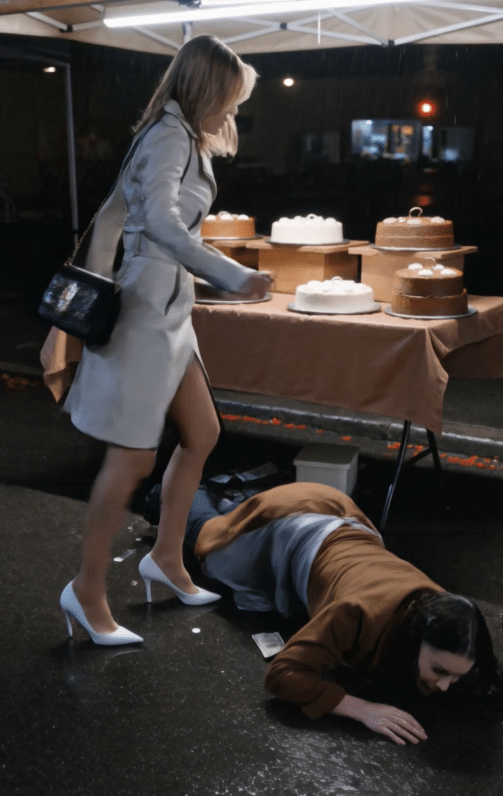
The coins were still rolling across the wet pavement when the woman kicked the mother to the ground.
A small metal cash box lay overturned beside the cake table. Dollar bills clung to puddles, quarters disappeared beneath the wooden stall, and homemade cakes slid from their trays into the rain.
The mother dropped to her knees, scrambling to gather the money before the water ruined it.
“Please,” she whispered, her fingers shaking. “That’s my child’s school money.”
Behind her stood a wealthy woman in a white leather coat, a designer purse hanging from one arm. Her name was Victoria Hale, and she looked down at the scattered coins as if she had just watched someone spill garbage across her driveway.
“Trash,” Victoria said. “Your child can learn poverty.”
The mother froze.
Her name was Rachel Bennett. She was thirty-seven years old, a single mother who had spent the entire day baking cakes in a tiny kitchen, then carrying them to the night market beneath a leaking canvas awning. Her brown coat was worn at the cuffs, her apron was soaked, and the skin across her hands had cracked from cold water and long hours of work.
She had not come to the market to make a fortune.
She had come because her twelve-year-old daughter, Emily, had a tuition payment due on Monday morning.
Rachel had calculated every dollar. The ingredients, the stall fee, the bus fare, even the small amount she needed to keep the electricity running at home had been accounted for. The cash box contained the money she had spent weeks trying to save.
And Victoria had knocked it onto the ground because Rachel had asked her to pay for a cake.
The trouble had started less than a minute earlier.
Victoria had approached the stall beneath the market’s brightest awning, selected a slice of chocolate cake, and taken a bite before asking its price.
“Six dollars,” Rachel had said politely.
Victoria had looked at the cake, then at Rachel.
“Six dollars? For this?”
“It’s made with real butter and dark chocolate,” Rachel explained. “I bake everything myself.”
Victoria took another bite, then placed the cake back on the tray as though she had grown tired of it.
“I’ll give you two.”
Rachel tried to smile.
“I’m sorry, ma’am. The price is marked on the sign.”
Victoria’s expression hardened.
“Do you know how much I spend on lunch?”
Rachel said nothing.
“Probably more than you make in a week.”
“I still have to charge enough to cover the ingredients.”
That was when Victoria noticed the small cash box beside the register.
She reached toward it, tipped it off the table, and sent its contents spilling across the pavement.
The sound of falling coins drew the attention of nearby vendors. Conversations stopped beneath the canvas awnings as customers turned toward the commotion.
Rachel stared at the money.
Then she bent to retrieve it.
Victoria kicked her from behind.
Rachel fell face-first beside the cake table, knocking several trays onto the soaked ground. Her elbow scraped the pavement, leaving a thin red mark. For a moment, she could not seem to understand what had happened.
She tried to push herself up.
Victoria stepped closer and kicked her twice more in the back and side.
A woman near the fruit stand gasped. An elderly vendor covered his mouth. Two men standing beneath a nearby awning exchanged horrified looks but remained where they were.
Rain tapped against the canvas above them.
Rachel curled protectively, trying to shield herself while reaching toward the nearest fallen cake with her fingertips. It was instinctive, almost desperate. Even on the ground, she was thinking about the money she could no longer afford to lose.
“That’s my child’s school money,” she repeated, her voice breaking.
Victoria looked at the soaked bills.
“Bake your way out of it.”
Rachel lifted her face.
She wanted to scream. She wanted to ask why a stranger could look at a struggling mother and see someone who deserved to be hurt. But humiliation had tightened her throat, and the pain in her side made every breath difficult.
All around them, the market had gone silent.
The people who had watched Rachel work through countless rainy evenings knew how carefully she counted every sale. Some had bought her cakes for years. One vendor knew Emily by name. Another had seen Rachel arrive early to set up her stall even after spending the night caring for her sick daughter.
Yet in that terrible moment, nobody moved.
Then headlights swept across the market entrance.
A black SUV braked sharply beside the gate.
Its rear door opened, and a silver-haired woman in a long black coat stepped into the rain. Two security officers hurried ahead of her, parting the stunned crowd as she made her way toward the fallen mother.
The woman was Eleanor Whitmore, the sixty-year-old owner of the entire night market.
She had built it from a struggling row of temporary stalls into one of the city’s most successful independent food markets. Vendors knew her as a demanding but fair businesswoman who remembered the names of people who worked for her.
Eleanor saw Rachel on the pavement.
Her face changed.
She reached the mother before turning toward Victoria, and her security officers formed a protective barrier around the stall.
“Are you hurt?” Eleanor asked Rachel.
Rachel tried to sit up.
“My daughter,” she whispered. “I need to pay her tuition.”
Eleanor crouched beside her, then looked at the ruined cakes and the coins scattered in the rain.
She rose slowly.
“Close this market section.”
The security officers moved at once. One called for medical assistance while another asked the surrounding vendors to step back and preserve the area.
Victoria stared at Eleanor, bewilderment spreading across her face.
“For her?”
She had expected the market owner to complain about the disturbance, perhaps even to blame the poor vendor for making a scene.
Instead, Eleanor Whitmore had arrived like a storm—and the entire market was moving at her command.
Victoria still believed this was a misunderstanding she could talk her way out of.
She had no idea that the woman on the ground was connected to a secret Eleanor had spent years trying to uncover.
And once that secret emerged, the price of Victoria’s cruelty would become far greater than a ruined cake.
Act II
Rachel Bennett had never imagined that a few dollars could become the dividing line between her daughter’s future and another year of uncertainty.
Emily had always been a bright child. She loved science, kept a notebook filled with questions about the stars, and dreamed of becoming a doctor after watching a pediatrician patiently care for her younger cousin.
When Emily earned a place at a respected private scholarship school, Rachel cried in the kitchen after reading the acceptance letter.
The school offered substantial financial assistance, but tuition, transportation, books, and other expenses still required careful planning. Rachel had promised her daughter that she would do everything possible to keep her there.
She had made that promise before understanding how expensive keeping it would be.
Rachel’s husband, Daniel, had died four years earlier after a sudden medical emergency. His death left Rachel with grief, unpaid bills, and a daughter who was too young to understand why her father would never return.
Before he died, Daniel had worked as an electrician. He was the sort of man who repaired neighbors’ broken appliances without charging them and kept a jar of spare change on the kitchen counter for anyone who needed bus fare.
After his funeral, Rachel found a note in his toolbox.
It was only a few lines long.
If things ever get hard, remember that a small honest thing is still worth doing well. Don’t let the world convince you otherwise.
Rachel kept the note in the drawer beside her bed.
Whenever she doubted herself, she read it.
She had once worked as a hotel pastry assistant, preparing desserts for weddings and corporate events. After Daniel’s death, she began baking at home to supplement her income. At first, she sold cakes to neighbors and parents from Emily’s school.
Then a vendor at the night market offered her a small table on weekends.
Rachel accepted.
The market was not glamorous. Rain leaked through the awnings, deliveries arrived late, and the smell of frying food lingered on everyone’s clothes long after closing. But it gave Rachel something she desperately needed: a way to earn money on her own schedule.
She named her stall Daniel’s Kitchen.
She sold lemon loaf, cinnamon cake, chocolate brownies, and small vanilla cakes decorated with seasonal fruit. Nothing was extravagant, but every item was carefully made.
Emily sometimes helped fold paper boxes or write labels after finishing her homework. Rachel never let her daughter work late on school nights, but the girl loved sitting beside her mother at the kitchen counter, dusting flour from her hands and imagining what life might look like when things became easier.
Their goal was simple.
Get Emily through the school year without making her feel that her father’s death had taken away every possibility.
Rachel kept the tuition money in a separate cash box. She deposited most of her earnings into a bank account, but the market’s cash sales went directly into the box until she had enough for the next payment.
It was not the safest system, but it helped her see the money accumulating. Each bill meant another step toward the deadline.
A ten-dollar sale could buy school supplies.
A good Saturday could cover transportation for the month.
A busy weekend might mean that Rachel could pay the tuition installment without borrowing from anyone.
The money scattered in the rain represented weeks of exhaustion.
And Victoria Hale had treated it like litter.
Victoria’s own life had unfolded in the opposite direction.
She was forty years old, married to a successful real-estate investor, and accustomed to moving through expensive restaurants and private events where employees anticipated her needs before she voiced them. Her wardrobe was carefully chosen, her jewelry understated but costly, and her social circle full of people who discussed businesses as though money were simply another language.
She was not accustomed to being told no.
Her husband had recently purchased a luxury condominium near the market district, and Victoria had begun visiting the area on weekends. She liked the atmosphere of the night market when it served as a backdrop for photographs, but she had little patience for the people who made it function.
She complained about the noise, the smell of cooking oil, and the crowds. She once demanded that a vendor move a cart because it obstructed her preferred route to a nearby parking entrance.
When a market employee explained that the walkway had to remain open for safety, Victoria called the man incompetent.
She had learned that anger often worked.
People apologized. Staff members hurried to accommodate her. Others stepped aside rather than risk an argument with someone who seemed wealthy enough to create trouble.
Each time, her behavior became a little more extreme.
At Rachel’s stall, Victoria had expected the same response.
A poor vendor would accept whatever price she offered, clean up the mess, and remain grateful that a customer had stopped by at all.
Rachel’s refusal to surrender her earnings had offended her more than the price of the cake.
To Victoria, the confrontation was about status.
To Rachel, it was about survival.
And to Eleanor Whitmore, who had watched the final moments from the market gate, it was about something even more personal.
Eleanor had not built her business because she inherited a fortune. She had started with a small produce stand decades earlier, working beside her late husband in freezing weather and counting the day’s earnings in their kitchen after midnight.
She remembered what it meant to have a customer walk away with goods and refuse to pay. She remembered the humiliation of being treated as though a small business owner had no right to defend her own labor.
When her husband died, Eleanor expanded the stand into a row of food stalls, then an organized market, then a network of neighborhood markets that supported hundreds of independent vendors.
She had made mistakes along the way, but she had never forgotten where she began.
The night market was not simply property to her.
It was a promise that people willing to work hard could build something of their own.
That was why she had come personally when a manager called to report an incident at the gate.
She had expected an argument over a vendor fee or a safety complaint.
Instead, she found a mother on the ground, her tuition money scattered in the rain, while a wealthy customer stood above her without the slightest sign of remorse.
Eleanor had seen cruelty before.
What she had not expected was the small detail that emerged when she knelt beside Rachel.
Tucked inside the fallen document pouch near the cash box was a faded photograph, its edges softened by years of handling.
Eleanor recognized the man in the photograph immediately.
Her late husband had kept an identical picture in his desk for nearly thirty years.
And the name written on the back would change everything Eleanor believed she knew about the woman lying in front of her.
Act III
The ambulance crew arrived within minutes.
Rachel insisted that the responders check her before worrying about the cakes, but her eyes kept drifting toward the scattered money. She was frightened that the rain would wash bills beneath the stalls or that someone would accidentally step on the coins.
Eleanor noticed.
“Please,” Rachel whispered, “the box. I need to collect the money.”
“We’ll make sure it is collected,” Eleanor said. “Right now, I want you to let the medical team examine you.”
Rachel swallowed and nodded.
The responders assessed her injuries and recommended further evaluation because of the force of the kicks. Eleanor arranged for a trusted market supervisor to accompany Rachel and make sure Emily could be contacted.
Then she turned her attention to the stall.
The ruined cakes were separated from the money. Security officers documented the scene, and market staff began collecting the scattered bills and coins without mixing them with the damaged food.
Eleanor wanted a clear record of what had happened, not a hurried cleanup that might erase evidence.
Victoria stood several feet away, furious at being kept behind the security barrier.
“This is ridiculous,” she said. “I barely touched her.”
A security officer asked her to remain where she was.
Victoria looked toward Eleanor.
“Do you know who my husband is?”
Eleanor did not answer.
“I’m a customer,” Victoria continued. “I had a disagreement with a vendor. Your people are treating me like a criminal.”
“You are being asked to remain here while we document a serious incident,” Eleanor replied. “That is all.”
“She was rude to me.”
“You took something from her stall without paying.”
“It was a piece of cake.”
“And then you knocked over her money and kicked her.”
Victoria’s lips tightened.
“You’re taking her side because she’s poor.”
Eleanor looked at her for a long moment.
“No. I’m taking the side of the person who was attacked.”
The words silenced Victoria briefly.
But when Eleanor returned to Rachel’s table, she was thinking about the photograph.
It showed a young man standing beside a market stall, his arm around a woman who was laughing at something outside the frame. The woman was Eleanor’s younger sister, Margaret, who had died many years earlier.
Eleanor’s husband, Thomas, had taken the photograph during a summer street fair. He had kept it in his office because Margaret and the young man had been close friends before a family dispute separated them.
The young man’s name was Michael Bennett.
Rachel’s father.
Eleanor remembered the name because Thomas had tried for years to reconcile the two families.
Michael had been a talented carpenter who dreamed of opening a small workshop. Margaret had helped him design a line of handmade kitchen furniture, and the two had planned to start a business together.
But when Margaret’s father died, an argument over a family property forced the project to collapse. Michael believed the family had deliberately shut him out. Margaret believed Michael had walked away rather than fight for their partnership.
The truth, Eleanor later learned, was more complicated.
A business intermediary had concealed correspondence from both sides, persuading each that the other had chosen money over loyalty. By the time the misunderstanding came to light, Michael had moved to another state, and Margaret’s health was failing.
The friendship never recovered.
Thomas had kept the photograph as a reminder of a promise he had failed to fulfill: to bring the two families back together.
Eleanor had not seen Michael in decades.
She looked again at the young woman in the photograph.
Then she looked at Rachel.
There was a resemblance in the shape of the eyes, the line of the nose, and the way the woman in the picture held her head when she smiled.
“Rachel,” Eleanor said gently, “may I ask who the people in this photograph are?”
Rachel’s expression changed.
“My father and my mother.”
“What was your father’s name?”
“Michael Bennett.”
Eleanor felt the market noise recede around her.
“Michael was your father?”
Rachel nodded slowly.
“He died two years ago. We weren’t close for a long time. We had some family problems, and I spent most of my adult life trying to keep my distance from things I didn’t understand.”
She glanced at the photograph.
“I found it in his belongings after he died. I keep it with me because it’s one of the few pictures I have of him before everything went wrong.”
Eleanor’s throat tightened.
“Did he ever mention Thomas Whitmore?”
Rachel thought for a moment.
“Yes. He used to say Thomas was the only man who had tried to help him when his business fell apart. But he stopped talking about that time when I was young.”
Eleanor sat down on the edge of an overturned crate.
Thomas had died five years earlier, but she could still hear his voice describing the friendship he had never been able to repair.
He had left behind a locked cabinet containing old letters, contracts, and records from the early years of their business. Eleanor had never fully examined the contents because she had been occupied with the company’s expansion and her husband’s illness.
After Thomas died, she had discovered documents showing that Michael’s workshop proposal had been undermined by a dishonest intermediary. The intermediary had altered correspondence and misrepresented financial terms, causing both families to believe the other had withdrawn.
Eleanor had intended to locate Michael and explain what had happened.
Then she learned that he had died.
She had assumed the opportunity to make amends had disappeared with him.
Now his daughter was sitting in front of her, injured and worried about a tuition payment.
“Rachel,” Eleanor said, “I think your father was wronged. And I believe my husband tried to help him prove it.”
Rachel stared at her.
“I don’t understand.”
“Neither do I. Not completely. But I would like to examine the documents with you, if you’re willing.”
Rachel looked down at the photograph.
For years, she had believed her father’s final years were marked by failure and resentment. He had never explained the details of the dispute, and she had assumed the story would end with him.
Now a stranger was telling her that there might be more to it.
Before Rachel could respond, a market employee approached Eleanor with a small envelope retrieved from the bottom of the document pouch.
Inside was a folded letter, its paper yellowed at the edges.
The handwriting belonged to Michael.
Eleanor recognized it from the old correspondence.
The letter was addressed to Thomas Whitmore and dated nearly twenty-five years earlier.
It contained a sentence that made Eleanor’s hands tremble.
If anything happens to me before we can put this right, please make sure my daughter knows I never abandoned the people I loved.
Eleanor looked at Rachel.
The market owner had come to protect a stranger from a violent customer.
Now she was discovering that the woman she had helped might be the living connection to a promise her own family had failed to keep.
But the letter was only the beginning.
The documents in Thomas’s cabinet would reveal that Michael had left behind something more valuable than an apology—and that the truth had been hidden for decades.
Act IV
The next morning, Eleanor met Rachel at a private office above the market’s main hall.
Rachel arrived wearing a borrowed coat because her own had been soaked through during the assault. Her elbow was bandaged, and she moved carefully, but she insisted on coming herself rather than sending the photograph and letter with someone else.
Eleanor had offered to cover the immediate cost of medical care and replace the money destroyed in the rain. Rachel had accepted the help reluctantly, making it clear that she did not want charity to become a debt she could never repay.
Eleanor understood.
She had asked her legal adviser to arrange the assistance transparently, with no conditions attached. The recovered tuition money would be counted and documented, the damaged cash separated from the usable bills, and the remaining shortfall covered through a market emergency fund available to vendors facing unexpected hardship.
Rachel would not have to trade her story for help.
That distinction mattered to her.
She had spent years protecting Emily from the feeling that their lives were defined by what they lacked. She did not want her daughter to grow up believing that dignity belonged only to people who could afford to refuse assistance.
While Rachel sat across from her, Eleanor opened a box of documents brought from her late husband’s cabinet.
The records were more complete than she expected.
There were early business plans, letters between Thomas and Michael, and a draft agreement concerning a small workshop that would have supplied handcrafted fixtures to the first Whitmore market.
The workshop had never opened.
According to the story Eleanor had heard for years, Michael had withdrawn from the project after demanding a larger share of the profits. The letters suggested something different.
Michael had proposed a fair division of expenses and revenue. Thomas had agreed. But a third party involved in the negotiations had sent altered financial summaries to both men, making it appear that each was attempting to take advantage of the other.
The deception had been deliberate.
The intermediary, a former business consultant, had wanted to take over the workshop contract for his own company. By creating distrust between Michael and Thomas, he had cleared the way for a competing supplier.
The plan had worked.
Michael lost his workshop opportunity. Thomas’s business paid a higher price for supplies, and the relationship between the two men collapsed under the weight of a lie neither fully understood.
Eleanor stared at the old signatures.
“My husband spent years believing Michael had chosen to walk away,” she said. “He regretted that they never spoke again.”
Rachel held one of the letters carefully.
“My father always said he had tried to explain himself. I thought he was remembering things the way people do when they’re hurt.”
“He may have been telling the truth.”
Rachel’s eyes filled.
She had not been close to her father at the end of his life. Their relationship had been strained by years of silence, and she had often wondered whether he had allowed pride to destroy opportunities that might have changed their family’s future.
The documents did not erase those years.
But they gave her a different way to understand them.
Eleanor then revealed another discovery.
Thomas had left a small financial interest in the original workshop proposal untouched in his private records. It had never become a successful business, but the legal papers showed that Michael had contributed money and designs before the project was abandoned.
The amount was modest by the standards of the Whitmore company. Yet it represented something important: Michael had never simply walked away from the agreement, and the family had never properly settled the accounts.
Eleanor’s legal team began reviewing the records to determine what obligations remained and whether any claims could still be resolved.
She made no promises before the review was complete.
Rachel appreciated that.
She had endured enough uncertainty to know that hope could be painful when people offered it too easily.
Meanwhile, the investigation into Victoria’s assault was moving forward.
The market had preserved the security footage, and several witnesses agreed to provide statements. Medical documentation recorded Rachel’s injuries, while the recovered cash and damaged goods were documented as part of the incident report.
Eleanor refused to let the family discovery interfere with the process.
“Those are two separate matters,” she told her legal adviser. “Rachel deserves a fair resolution to both. One cannot be used to distract from the other.”
Victoria, meanwhile, had spent the night telling herself that the market owner had overreacted.
She called her husband, Graham Hale, and demanded that he contact Eleanor.
Graham was a successful real-estate developer who had done business with several property owners in the district. He was accustomed to resolving disputes through private conversations, and Victoria assumed he could make the problem disappear.
But when he watched the security footage, he said nothing for a long time.
“You kicked her?” he finally asked.
“She was being impossible.”
“She was picking up money.”
“She embarrassed me.”
Graham rubbed his forehead.
“Victoria, she was on the ground.”
“She shouldn’t have provoked me.”
He looked at her as though he were seeing a stranger.
For years, he had dismissed her temper as a private inconvenience. He had heard stories about arguments with restaurant staff and rude comments toward service workers, but he had never imagined she would attack someone in public.
Now he could no longer pretend the behavior was harmless.
He refused to pressure Eleanor or contact witnesses.
Victoria accused him of abandoning her.
He replied that he would support her through the legal process, but he would not lie about what the footage showed.
That evening, Eleanor issued a formal notice barring Victoria from the market pending the outcome of the investigation. The decision was not presented as punishment for being wealthy or difficult. It was a safety measure following a documented assault.
Victoria’s face drained of color when she read it.
She had always treated the market as a place she could enter whenever she pleased.
Now she was being told that the rules applied to her, too.
Her attorney advised her to cooperate with the authorities and avoid contacting Rachel.
Victoria did not apologize.
She continued to insist that the incident had been exaggerated and that Eleanor was using the market’s influence against her.
But the footage could not be argued away.
Neither could the witnesses.
And as the documents about Michael Bennett’s past began to surface, Eleanor discovered that the dishonest consultant had later worked with a company linked to one of Victoria’s family’s old real-estate partnerships.
There was no evidence that Victoria had known about the historical deception, and Eleanor made sure nobody treated the connection as proof of wrongdoing.
Still, it raised a troubling question.
Had the same network of people who profited from Michael’s ruined opportunity continued to benefit from the assumption that wealthy families never needed to answer for their actions?
Eleanor ordered a careful review of the historical records.
She would not accuse anyone without evidence.
But she would no longer let old money, polished reputations, or powerful connections decide which truths deserved to be heard.
And for Rachel, the discoveries meant that the night her tuition money scattered through the rain had opened a door into a family history she had never been allowed to understand.
Act V
By the end of the month, Rachel’s immediate crisis had been resolved.
The recovered tuition money was counted and returned where possible. The market’s emergency fund covered the verified shortfall, allowing Rachel to make Emily’s payment before the deadline.
The assistance was documented as a one-time hardship grant, not a loan.
Rachel also received compensation for the damaged cakes through the market’s vendor-support process, separate from any legal proceedings involving Victoria. The money did not make the assault disappear, but it meant Rachel would not have to spend the next several months trying to recover from the financial damage alone.
She returned to her stall on a quiet Friday evening.
The weather was clear, and the canvas awnings barely moved in the breeze. She had baked a fresh batch of chocolate cakes, lemon loaves, and cinnamon rolls. The cash box sat beside the register, secured beneath the table rather than left exposed near the edge.
For a moment, Rachel simply stood there.
The last time she had looked at that spot, her cakes had been scattered across wet pavement and her tuition money had been washing toward the drains.
Now a customer was asking whether the chocolate cake contained walnuts.
Rachel smiled and answered.
The ordinary rhythm of business felt almost sacred.
She was not suddenly wealthy. She still had bills to pay, groceries to buy, and a daughter who seemed to outgrow her school shoes every few months. Her elbow was healing, and some nights she still remembered the shock of the first kick when she bent to retrieve something from the floor.
But she had made it through the deadline.
Emily could remain at her school.
And Rachel could return to the work she loved without feeling that one cruel stranger had the power to define the rest of her life.
Eleanor visited the stall shortly before closing.
She did not arrive with the SUV or a security escort this time. She came in a simple dark sweater, carrying a folder of documents and two cups of coffee.
Rachel looked at the folder.
“Did you find out what happened to my father?”
“I found enough to know that he was telling the truth about the partnership,” Eleanor replied. “The records show that he contributed money and work to a project that was abandoned because someone deliberately misrepresented the agreement.”
Rachel took a breath.
“What happens now?”
“My lawyers are determining whether there are any remaining legal obligations. I won’t promise you a result until we know what the documents support.”
Rachel nodded.
“Thank you for being honest.”
Eleanor set the folder on the table.
“There is something else. My husband always believed he had failed your father. He spent years wishing he had found a way to reach him before it was too late.”
Rachel looked away, blinking quickly.
“My father spent years thinking no one had believed him.”
“I know.”
Neither woman spoke for a moment.
The market hummed around them. A vendor called out the price of fresh peaches. Someone laughed near the noodle stall. A delivery truck rattled over the street beyond the gate.
Finally, Rachel said, “I can’t change what happened to him.”
“No,” Eleanor replied. “But we can stop pretending it didn’t happen.”
That was the beginning of a different kind of relationship.
Eleanor helped Rachel obtain copies of the historical records, and the two families worked through the remaining questions with legal advisers. They did not discover a hidden fortune or an extravagant inheritance waiting to transform Rachel’s life overnight.
What they found was more believable, and in some ways more valuable.
They found the truth.
Michael had not abandoned his friend. Thomas had not deliberately betrayed him. A dishonest intermediary had exploited their trust, and both men had carried the consequences long after the original business opportunity had disappeared.
The records also revealed that Michael’s early designs had influenced several fixtures used in the first Whitmore market. The work had never made him rich, but it had been real, and his contribution had deserved acknowledgment.
Eleanor arranged for his name to be included in the market’s historical archive, alongside the other small-business owners whose labor had helped shape its early years.
Rachel attended the unveiling with Emily.
Her daughter stood beside her in a blue school sweater, holding her mother’s hand while Eleanor spoke about the people who had built the market before it became successful.
She did not describe Michael as a tragic figure or turn his life into a lesson about poverty. She spoke about his skill, his ambition, and the work he had contributed.
Then she invited Rachel and Emily to place a small framed copy of his original workshop design in the archive.
Rachel touched the edge of the frame.
For years, her father had existed in her memory as a complicated man who had loved his family but carried an old hurt he could never fully explain.
Now she could remember him as more than his final years.
She could remember the young man in the photograph, smiling beside a market stall, believing that honest work could build something lasting.
Emily squeezed her mother’s hand.
“Grandpa made things that are still here?”
Rachel smiled through her tears.
“Yes, sweetheart. He did.”
Meanwhile, the legal process involving Victoria continued independently.
The market’s evidence was provided to the appropriate authorities, and Rachel was given the opportunity to pursue the remedies available to her. Eleanor did not interfere with the proceedings or demand a particular outcome.
Victoria remained barred from the market while the matter was reviewed.
Her husband stopped defending the incident as a misunderstanding. Several friends distanced themselves from her, not because Eleanor ordered them to, but because the footage had made it impossible to dismiss the cruelty as a rumor.
Victoria still struggled to accept what she had done.
She continued to speak about the consequences as though they were the real injustice. Losing access to the market embarrassed her. The investigation threatened her reputation. The questions from acquaintances made her angry.
But none of those things had happened because Rachel was poor.
They had happened because Victoria had chosen to hurt someone who was trying to protect her child’s future.
That distinction was the one she had resisted from the beginning.
One evening, weeks after the incident, Victoria passed the market gate in the passenger seat of her husband’s car. Through the window, she saw Rachel standing beneath the awning, handing a cake box to a young customer.
Rachel looked tired, but she was smiling.
No guards surrounded her. No wealthy benefactor stood beside her. She was simply selling cakes, counting change, and doing the work that had carried her family through another difficult month.
Victoria watched until the car turned the corner.
For the first time, she seemed to understand that Rachel had never needed to become powerful to deserve protection.
She had deserved it when she was on the ground.
She had deserved it when her money was scattered in the rain.
She had deserved it before anyone recognized her name, knew her history, or decided that her suffering mattered.
At the market, Eleanor continued making changes to protect vendors. Emergency procedures were clarified, security staff received additional training, and a confidential reporting system gave workers a safer way to raise concerns.
She also introduced a small education-support program for market vendors facing unexpected hardship. It was not named after Rachel, and Rachel did not become its public symbol. Eleanor wanted the program to help people without requiring them to turn their pain into a story for strangers.
Rachel eventually volunteered to advise the program on how it could best serve working parents.
She did so because she understood the difference between help that preserved dignity and help that demanded gratitude.
On the last evening of the season, Emily arrived at the market after school carrying a report card.
Rachel was closing her stall when her daughter slipped the paper across the counter.
“I got an A in science,” Emily announced.
Rachel read the grade, then looked at the handwritten note from the teacher praising Emily’s curiosity and persistence.
For a moment, she could not speak.
Emily laughed.
“Mom, it’s just a grade.”
“No,” Rachel said softly. “It’s your work. You earned it.”
She pulled her daughter into a hug.
Behind them, the market lights glowed beneath the awnings, reflecting on the pavement. The cash box rested safely beside the register, holding the evening’s earnings. There were bills inside it again, along with coins and a receipt for the next week’s ingredients.
Rachel had not escaped hardship forever.
She had simply taken another step forward.
And somewhere above the market entrance, in a small archive room that most customers would never visit, Michael Bennett’s old design rested behind glass—a quiet reminder that the value of a person’s work did not depend on whether the world had rewarded it.
Eleanor had arrived that rainy night believing she was protecting a vendor from a cruel stranger.
She had done that.
But she had also helped restore a piece of history that had been buried beneath decades of misunderstanding.
Victoria had looked at Rachel’s old coat, cracked hands, and modest stall and seen someone she could humiliate without consequence.
She had been wrong about Rachel.
She had been wrong about the market.
And most importantly, she had been wrong about what made a person worthy of respect.
Because the real reversal was never that a powerful woman came to Rachel’s defense.
It was that Rachel had deserved to be defended all along.
And the money Victoria scattered across the rainy pavement had never been just money.
It was the tuition of a little girl who wanted to become a doctor, the labor of a mother who refused to surrender, and the hope of a family that had already lost too much.
No designer coat could make that hope worthless.
No insult could erase it.
And no amount of wealth could turn cruelty into strength.