Act I
“Please… I need that money for my child.”
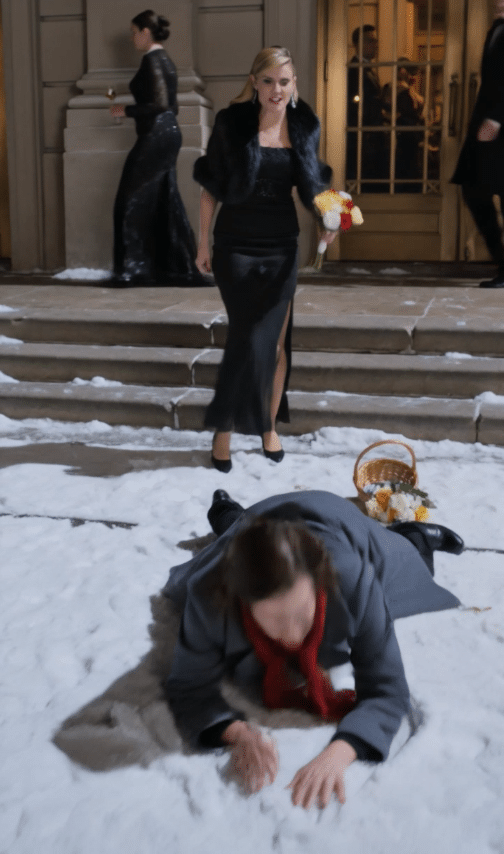
Clara Bennett’s voice trembled as she knelt in the snow outside the grand theater, reaching for the roses scattered across the stone steps.
The woman standing above her barely glanced down.
Vanessa Harrington, thirty-six, wore a black evening gown beneath a white fur wrap. Diamonds glittered at her throat, and a pair of bodyguards waited near the entrance while gala guests moved beneath the warm golden lights. She looked like someone who had never been told no—and who considered every person unable to afford her lifestyle beneath her notice.
Clara, forty-four, wore an old gray coat and a red scarf that had begun to fray at the edges. Her fingers were numb from the cold. Beside her lay a small flower basket, now overturned, its remaining bouquets scattered across the snowy sidewalk.
Vanessa had taken a bouquet of white roses from the basket only moments earlier.
She had examined them, laughed at something her companion said, then plucked several petals and let them fall into the snow. When Clara politely asked her to pay, Vanessa turned away as if the flower seller had interrupted an important conversation.
“Ma’am,” Clara had said, bending to retrieve the ruined flowers. “You took those without paying.”
Vanessa stopped.
The guests nearest the VIP entrance grew quiet.
“What did you say?”
Clara swallowed. She knew she should have been more careful. People in expensive clothes sometimes bought flowers from her out of generosity, but others seemed offended that someone like her existed near their evening of champagne, music, and velvet ropes.
“I just need the payment,” Clara said. “Please. I need that money for my child.”
Vanessa looked at the old coat, the cracked skin around Clara’s fingernails, and the little basket that held the last flowers she had left to sell that night.
Her expression hardened.
“Trash. Your flowers look as poor as you.”
A man near the entrance shifted uncomfortably. One of Vanessa’s companions lowered her eyes, pretending to check her phone.
Clara tried to gather the roses before the snow soaked through the wrapping paper. Each bouquet represented money she could not afford to lose. She had bought the flowers on credit from a neighborhood wholesaler, hoping to sell enough outside the theater to cover the cost of her daughter’s medicine.
Vanessa watched her bend down.
Then, from behind, she drove a hard kick into Clara’s back.
Clara fell face-first onto the snowy steps.
The impact knocked the breath from her lungs. Flowers flew from her hands, white petals scattering across the dark stone like scraps of paper. The basket tipped onto its side, and the thin wrapping around the remaining bouquets tore beneath the rush of boots and startled movement.
A sharp gasp rose from the crowd.
Clara tried to push herself up, but pain forced her back down. Her elbow scraped against the stone, leaving a thin red mark against her pale skin.
She drew a shaky breath.
“Please,” she whispered again.
Vanessa stepped closer.
Instead of walking away, she kicked Clara twice more, striking her back and side as the flower seller curled instinctively to protect herself.
Several guests covered their mouths.
Nobody stepped forward.
The theater’s grand doors stood only a few feet away. Inside, a string quartet was playing for a charity gala attended by business leaders, politicians, and wealthy donors. Servers carried trays of champagne through a ballroom decorated with gold ribbons and white orchids.
Outside, a woman who had spent the day trying to buy medicine for her child lay in the snow while strangers watched.
Vanessa adjusted her fur wrap.
“Sell your sadness somewhere else.”
Clara turned her face toward the basket. One of the small bouquets had rolled beneath the lowest step. She reached toward it, then stopped when another wave of pain crossed her back.
She thought of her daughter, Sophie, waiting at home with a fever that had returned that afternoon.
She thought of the pharmacy receipt folded inside her coat pocket.
And she thought of the money she had promised to bring home.
She had been so close.
Then the VIP doors flew open.
A tall man in a long navy coat strode into the snow, followed by two bodyguards and the theater’s general manager. At sixty-three, billionaire philanthropist Alexander Sterling was one of the most influential donors in the city. His name appeared on hospitals, scholarship funds, and cultural institutions throughout the state.
He had been inside the gala when a security supervisor informed him that a serious assault had occurred on the steps.
He had expected an argument.
Instead, he saw Clara on the ground.
Alexander moved toward her immediately, signaling his bodyguards to shield her from the crowd. One guard knelt nearby and asked whether she could hear him. The other cleared space so the theater manager could call for medical assistance.
Only when Clara was protected did Alexander turn toward Vanessa.
“Stop the gala,” he ordered. “Bring her inside with me.”
The theater manager hurried back toward the entrance, signaling staff to pause the program and keep the doorway clear for the paramedics.
The quartet fell silent behind the glass.
Guests began turning toward the doors. Conversations died, champagne glasses stopped halfway to waiting mouths, and the people who had watched Vanessa attack Clara moved aside as the bodyguards took control of the steps.
Vanessa stared at Alexander.
She recognized him immediately.
She had spent months cultivating his attention because his foundation was considering a major partnership with her family’s luxury hospitality company. She had expected to see him that evening, but she had expected to meet him beneath the chandeliers, where every introduction could be photographed.
Not here.
Not beside a woman she had just kicked into the snow.
“Stop the gala?” Vanessa repeated.
Her voice had lost its certainty.
Alexander did not answer her.
He was watching the paramedic approach Clara, whose trembling hand still clutched one crushed rose.
And the moment Vanessa understood why that small flower mattered to him, the power she had carried so confidently onto those steps began to slip away.
Act II
Clara Bennett had never imagined that selling flowers would become the way she measured the distance between hope and fear.
Before her husband’s death, she had worked as a receptionist at a small dental clinic. Her life had been ordinary and busy, filled with school lunches, laundry, grocery lists, and the constant negotiations of raising a child while keeping a household running.
Her husband, Daniel, had been a mechanic who loved terrible jokes and strong coffee. He had a habit of bringing home flowers whenever he found them discounted at a roadside stand.
“They don’t have to be expensive,” he used to tell Sophie. “They just have to make someone smile.”
When Daniel died in a workplace accident four years earlier, the family’s modest savings disappeared quickly. Clara struggled to keep the apartment and maintain the routine Sophie depended on. She picked up extra shifts, sold household items, and learned how to stretch every dollar.
Then Sophie became seriously ill.
The doctors had identified a chronic condition that required regular treatment and medication. With insurance covering some expenses but not all, Clara found herself choosing between necessities she had once taken for granted.
She never told Sophie how frightened she was.
Instead, she began selling flowers outside restaurants, hotels, and theaters. She bought small batches from a wholesaler who allowed her to pay after the day’s sales. On good nights, she returned home with enough money for groceries and medicine. On bad nights, she sat at the kitchen table calculating what could wait another day.
Sophie hated seeing her mother work in the cold.
“You shouldn’t have to stand outside all night,” the girl had said once.
Clara brushed a strand of hair from her daughter’s forehead.
“It’s only temporary.”
She had said those words so often that they had become a promise she was afraid to examine.
The night of the gala was supposed to be a good one.
The theater had rented its grand hall to the Sterling Foundation for an annual charity event supporting pediatric care. The guests were expected to arrive in formal clothes, and Clara had hoped to sell the last of her flowers to people buying gifts for their partners or hosts.
She had arranged the bouquets carefully, wrapping the stems in paper and tying them with inexpensive ribbons. She had even saved three white roses for Sophie, because her daughter loved them.
The cold was brutal, but the theater’s golden lights made the entrance look welcoming from the sidewalk.
Clara watched couples arrive in polished cars. Men in dark suits held doors for women in evening gowns. Drivers unloaded guests beneath the awning, and attendants hurried to keep the steps clear.
Nobody paid much attention to Clara until Vanessa emerged from a car.
Vanessa Harrington was the public face of Harrington Collection, a luxury hospitality group that operated boutique hotels, private dining clubs, and exclusive event venues. Her family had built its fortune over three generations, and she had spent the last decade turning that inheritance into a personal brand.
She was beautiful, impeccably dressed, and accustomed to being accommodated.
In her world, staff existed to anticipate her wishes. If a table was too close to a doorway, someone moved it. If a reservation was unavailable, a manager found a way. If a person disappointed her, she could often make sure that person never served her again.
Vanessa had learned to confuse influence with permission.
She had also learned that public charity was good for business.
Her company sponsored hospital events, arts programs, and holiday drives. Photographs of Vanessa presenting oversized checks appeared in magazines and on social media. She spoke frequently about compassion and community, especially when a camera was nearby.
The Sterling Foundation partnership was supposed to be her biggest philanthropic achievement yet.
Alexander Sterling’s organization had been expanding its pediatric assistance program, helping families cover urgent medical costs that could not wait for lengthy funding reviews. Vanessa’s company had proposed contributing money and event space, and negotiations were nearing completion.
The agreement would have given her access to a respected network of donors and a powerful new association with Alexander’s foundation.
She had spent weeks telling friends that the partnership was practically guaranteed.
Then she stepped out of her car and noticed Clara’s flowers.
Vanessa picked up the white roses without asking.
When Clara requested payment, Vanessa reacted as if a stranger had publicly questioned her status. She could have paid the asking price without noticing the amount missing from her bank account.
Instead, she chose to humiliate the woman who needed that money.
Clara had no way of knowing that Alexander Sterling had spent years thinking about families like hers.
His own life had changed when his younger sister, Rebecca, died after a long illness. She had been a single mother, and Alexander had helped raise her son during the final years of her life. He remembered the unpaid bills, the pharmacy calls, and the way Rebecca tried to hide her fear whenever the cost of treatment became too much.
After her death, Alexander established a foundation dedicated to helping families facing extraordinary medical expenses.
He had never believed that charity could solve every problem. But he had seen how a relatively small amount of money, delivered at the right time, could keep a family from falling into crisis.
His foundation’s staff reviewed applications carefully, and the organization avoided publicizing recipients without their permission. Alexander wanted assistance to preserve dignity, not turn suffering into a marketing campaign.
That philosophy was why he had been uneasy about Vanessa’s proposed partnership.
Her company had offered generous publicity commitments, but the negotiations had become increasingly focused on branding opportunities, exclusive invitations, and prominent placement of her logo.
Alexander had asked for clearer guarantees that the proposed funds would reach families directly.
Vanessa had interpreted his caution as a challenge to her credibility.
She wanted the agreement because of what it would say about her.
Alexander wanted it because of what it could do for people.
They had not yet resolved that difference when he stepped through the VIP doors and found Clara in the snow.
As the paramedics assessed the flower seller, Alexander noticed the crushed rose in her hand.
“Is there someone we can call for you?” he asked gently.
“My daughter,” Clara whispered. “She’s at home.”
“Is she safe?”
Clara hesitated.
“She needs her medicine. I was trying to earn enough tonight.”
Alexander glanced toward the scattered flowers.
He did not promise her money on the spot. He did not ask for her daughter’s name in front of the crowd or turn the moment into an emotional performance.
Instead, he asked the paramedic to make sure Clara was stable and told his assistant to arrange for a family support coordinator to contact her once she was ready.
Then he stepped aside to give the medical team room.
Behind him, Vanessa was arguing with the theater manager.
“This is a private gala,” she insisted. “You cannot stop the entire event because of a street vendor.”
The manager stared at her.
“She was assaulted on our property.”
“She was making a scene.”
Alexander turned.
For the first time, Vanessa saw something in his expression that she had never encountered in their business meetings.
Not irritation.
Disappointment.
“You are right about one thing,” he said. “This is a private event. And I am ending it until we understand what happened outside.”
Vanessa’s lips parted.
“You can’t be serious.”
Alexander looked toward the medical team.
“I am.”
The gala was paused, guests were asked to remain inside, and the immediate area was secured for the investigation.
Vanessa had spent the evening believing she was one of the most important people in the building.
Now the man whose partnership she wanted had stopped his own event because of the woman she had tried to erase.
But the reason Alexander had reacted so decisively went deeper than the assault itself.
And the truth was about to reach the one place Vanessa had always believed was beyond criticism: her own carefully managed reputation.
Act III
By midnight, the theater’s management team had preserved the available security footage and contacted the appropriate authorities.
The recordings showed Vanessa taking the bouquet, dropping the petals, and turning away without paying. They showed Clara bending to retrieve the flowers and asking for payment. They showed the attack from behind and the moments that followed.
There was no evidence that Clara had threatened Vanessa.
The witnesses’ accounts were consistent with the footage. Several guests had seen the assault directly, and the theater staff confirmed that Clara had been selling flowers peacefully near the entrance before the confrontation.
Alexander instructed his team to cooperate fully with the investigation.
He did not tell the police what decision to make. He did not demand a particular charge or promise that Vanessa would be punished in a specific way. He made sure the evidence was preserved and that Clara received medical attention.
The gala remained paused while the theater manager coordinated with security.
Inside the ballroom, guests spoke in hushed voices. Some were shocked that the event had been stopped. Others were more troubled by the reason it had stopped.
A prominent donor approached Alexander’s assistant and asked whether the program would resume.
“Not tonight,” she replied. “Mr. Sterling is addressing an incident involving an injured person.”
The donor frowned.
“Can’t they handle it outside?”
The assistant looked at him.
“They are handling it outside.”
That ended the conversation.
Vanessa, meanwhile, had retreated beneath the awning with her attorney on the phone. She insisted that the situation had been exaggerated and demanded to know who had authorized the security footage to be reviewed.
Her attorney advised her to remain calm and cooperate.
“Do you understand what this means?” Vanessa asked. “The Sterling partnership is supposed to be announced next month.”
“I understand,” he replied. “But the immediate issue is the incident itself.”
“She was a flower seller!”
There was a pause.
“Vanessa, that doesn’t change what happened.”
She lowered her voice.
“I barely touched her.”
The words sounded less convincing when spoken aloud.
She had seen Clara fall. She had watched the flowers scatter. She had seen the woman struggle to breathe while the guests around them recoiled.
The security footage would show the same thing.
Vanessa ended the call and stared through the glass doors at the ballroom.
For years, she had treated public embarrassment as a problem that could be solved by controlling the narrative. A harsh comment could be reframed as humor. A broken promise could be called a misunderstanding. An employee’s complaint could be dismissed as resentment.
But a recording could not be persuaded to forget.
Neither could the people who had witnessed the assault.
One of Vanessa’s friends approached cautiously.
“Maybe you should apologize.”
Vanessa turned sharply.
“Apologize for what?”
Her friend stared at her.
“For kicking her.”
Vanessa’s face hardened.
“You weren’t the one being disrespected.”
“I saw what happened.”
“Then you saw her trying to embarrass me.”
The friend looked at her for several seconds.
“No,” she said quietly. “I saw you hurt someone who asked you to pay for flowers.”
She walked away before Vanessa could respond.
That was the first time Vanessa realized the evening might cost her more than a business deal.
Her social circle had been built around shared invitations, exclusive tables, and the unspoken understanding that everyone would protect one another’s reputations. People laughed when she mocked a waiter. They made excuses when she complained about staff. They praised her generosity whenever she donated money in public.
But now the evidence was too clear, and defending her meant defending something no one wanted to say aloud.
Vanessa had attacked a woman who could not afford to lose the money from a single bouquet.
And she had done it because the woman asked her to pay.
The following morning, Alexander convened a meeting with his foundation’s legal and program directors. The proposed partnership with Harrington Collection was reviewed under the organization’s established procedures.
The agreement had not yet been signed. Its final approval depended on several conditions, including due diligence and a review of the proposed partner’s conduct standards.
The foundation had legitimate reasons to pause negotiations while a serious incident involving Vanessa was investigated.
Alexander was careful not to confuse suspicion with a final judgment. He wanted the facts established, and he wanted the organization to follow its own rules.
But he also wanted to understand whether the proposed partnership reflected the values it claimed to support.
The meeting lasted two hours.
At its conclusion, the foundation formally suspended negotiations pending the outcome of its review. The organization would continue providing assistance through its existing programs and would not allow one proposed corporate partnership to delay help for families already receiving support.
Alexander then asked his staff to locate the appropriate support services for Clara.
Not because she had become famous.
Not because she could help him prove a point.
Because a person had been injured on the steps of his theater, and she had told him her child needed medicine.
The foundation’s family support coordinator contacted Clara after she had been discharged from medical care. The coordinator explained what assistance might be available, what documentation would be required, and which local programs could help while the application was reviewed.
Clara was wary at first.
She had encountered people who offered help enthusiastically, then disappeared when paperwork became difficult.
“I don’t want anyone making promises they can’t keep,” she said.
The coordinator answered honestly.
“I can’t promise every expense will be covered. But I can help you understand the options and make sure your application is reviewed.”
Clara agreed to speak with her.
Over the following days, the coordinator helped Clara gather the necessary medical information and connect with a local assistance program. The process was separate from the investigation and did not require Clara to appear in public, give an interview, or agree to tell her story at the next gala.
For the first time in weeks, Clara could focus on her daughter’s health without trying to sell flowers every night in the snow.
Sophie was relieved when her mother returned home.
She noticed the bruising, the careful way Clara moved, and the way her mother kept glancing at the small pile of flowers she had managed to bring back.
“What happened?” Sophie asked.
Clara sat beside her on the bed.
“Someone was unkind to me.”
Sophie frowned.
“Why?”
“Because she thought she could be.”
The girl reached for her mother’s hand.
“Did you do something wrong?”
Clara’s eyes filled.
“No, sweetheart.”
She pulled Sophie into a careful embrace.
“No. I didn’t.”
That simple answer mattered more than any statement Alexander could make.
Clara had spent years teaching her daughter that people should be judged by how they treated others. Now she had to reassure Sophie that the cruelty they had experienced did not mean the world was entirely cruel.
There were still people who would help.
There were still rules that could be enforced.
And there were still ways to rebuild after someone tried to make you feel worthless.
Yet while Clara began to recover, Vanessa’s own world was beginning to close around her.
The Sterling Foundation had suspended negotiations. Her attorney was handling inquiries from the authorities. Her company’s board had requested an internal review, and her public-relations team was struggling to explain why a woman who had spent years promoting charity had attacked a struggling flower seller outside a charitable event.
Then an email arrived from the board.
It requested a special meeting to review Vanessa’s conduct and determine whether her actions had violated the company’s standards.
For the first time, she realized that the people asking questions were not strangers on a sidewalk.
They were the people who had trusted her with the company she had built her identity around.
And they were no longer willing to accept her word as the only version of the truth.
Act IV
The board meeting took place four days later.
Vanessa entered the conference room wearing a tailored black suit and a carefully composed expression. She had chosen not to wear the white fur wrap that had become associated with the incident, but she could not escape the memory of it.
A printed copy of the incident summary lay in front of each board member.
Beside it was a record of the proposed Sterling Foundation partnership, including the public statements Vanessa had made about compassion, community support, and helping vulnerable families.
The board chair, Martin Shaw, began with a simple question.
“Do you dispute the footage?”
Vanessa folded her hands.
“I dispute the way it is being presented.”
“Did you take the bouquet?”
“Yes.”
“Did you pay for it?”
“No.”
“Did you kick Clara Bennett?”
Vanessa looked around the table.
“I was angry.”
“That was not the question.”
She swallowed.
“Yes.”
The room remained silent.
Martin continued.
“Did she threaten you?”
Vanessa looked down.
“No.”
“Did she ask you to pay for the flowers?”
“Yes.”
Martin closed the file.
“Then we need to discuss why you believed that situation justified what you did.”
Vanessa felt heat rise into her face.
“I didn’t think it would go this far.”
“That doesn’t explain why you did it.”
She looked toward the other board members, searching for someone who would intervene. One had worked with her for years. Another had attended dozens of the same charity events. A third had once described Vanessa as the most decisive leader in the company.
None of them rescued her.
For years, Vanessa had believed that her public generosity gave her a kind of moral credit. She had donated money to hospitals, funded scholarships, and appeared at events where people thanked her for her support.
She had told herself those actions proved she was a good person.
Now she was being asked to account for what she did when generosity brought her no applause.
The board did not make a theatrical declaration of guilt. It reviewed the company’s conduct policies, considered the documented incident, and discussed the responsibilities attached to Vanessa’s leadership position.
The result was a formal review of her role and restrictions on her authority while the company assessed the matter. The board also required changes to its internal procedures for handling complaints involving senior executives and customers.
The consequences were serious, but they followed the company’s governance process rather than a public demand for revenge.
Vanessa left the meeting shaken.
Outside, her public-relations consultant was waiting.
“What happened?” he asked.
She walked past him without answering.
Her phone was full of messages. Some were from colleagues asking for clarification. Others were from acquaintances who had suddenly remembered that they had been planning to meet her for lunch. Several were invitations she had expected to receive that had quietly disappeared.
The Sterling partnership remained on hold.
The board was reviewing her position.
And for the first time in her life, Vanessa could not solve a crisis by deciding which version of the story other people were allowed to hear.
She went home and watched the footage again.
At first, she looked away when Clara fell.
Then she forced herself to watch.
She saw the bouquet in her hand. She saw the petals falling into the snow. She saw Clara bend to gather them, and she saw herself kick the woman from behind.
The guests’ reactions were unmistakable.
They had not been watching two equally angry people argue.
They had been watching someone use her strength against a woman who was trying to recover the cost of a few flowers.
Vanessa paused the video.
She had spent years believing that respect meant never allowing another person to challenge her. If a worker corrected her, she felt insulted. If a stranger asked her to wait, she treated it as a personal affront. If someone refused to accommodate her, she assumed they were deliberately trying to diminish her.
She had called that confidence.
Now she had to consider whether it was simply entitlement.
The thought frightened her because it threatened the story she had told herself about her entire life.
She had not set out that evening intending to become a public example of cruelty. She had expected to attend a gala, greet influential people, and leave with a promising business partnership.
But a person’s character was not revealed only by what they planned to do.
It was revealed by what they chose when a moment of frustration offered them the chance to hurt someone weaker.
Vanessa had made that choice.
No explanation could undo it.
Several weeks later, her attorney informed her that the investigation was continuing through the appropriate legal channels. He advised her to cooperate fully and avoid contacting Clara directly unless the contact was appropriate and welcome.
Her company continued its internal review. The Sterling Foundation ultimately decided not to proceed with the proposed partnership under its existing terms, documenting the decision through its normal governance process.
Alexander did not announce that Vanessa had been defeated.
He did not arrange for her to be publicly shamed at another gala.
He simply made it clear that the foundation’s work would continue with partners whose conduct and commitments could withstand scrutiny.
The next event on the foundation’s calendar was a smaller fundraising dinner supporting emergency medical assistance for children. Alexander chose to proceed, but he changed the program.
There would be no extravagant presentation about the generosity of wealthy donors.
Instead, the evening focused on the practical work of helping families navigate medical costs, insurance delays, and emergency expenses.
Alexander told the guests that a charitable organization should be measured by what happened after the applause ended.
“It’s easy to talk about compassion in a ballroom,” he said. “The harder question is whether we show it when no one important is watching.”
Several people in the room glanced toward the empty place where Vanessa’s company had been expected to sit.
Alexander did not mention her name.
He did not need to.
The gala had been stopped because one person had treated another human being as disposable.
The work continued because one person’s cruelty could not be allowed to define the purpose of the entire evening.
And Clara, who had once stood outside that theater hoping to sell her last flowers, was about to receive an invitation that had nothing to do with public attention or proving anyone wrong.
It was an invitation to come inside, sit down, and be treated like a guest.
Act V
Clara returned to the theater on a quiet afternoon in early spring.
The snow had melted, leaving the stone steps dark with rain. The golden lights still framed the entrance, but there were no limousines waiting beneath the awning and no crowds of guests moving toward the VIP doors.
Clara wore a clean gray coat and the same red scarf she had worn on the night of the assault.
Her injuries had healed, though she still felt a tightening in her back whenever she remembered the fall. The memory had become less immediate with time, but it had not vanished.
Sophie walked beside her.
The girl’s health had stabilized after Clara connected with assistance programs that helped cover part of her treatment and medication costs. The support had not solved every problem, and the family still had bills to manage, but the immediate crisis had eased.
For the first time in months, Clara could plan a week without wondering whether every prescription would force her to skip another necessity.
Alexander Sterling met them inside the lobby.
He had asked Clara whether she would be comfortable visiting, and she had agreed on the condition that there would be no press and no public ceremony.
He honored that request.
“I’m glad you came,” he said.
Clara looked around the lobby.
“I wasn’t sure I would.”
“You didn’t owe us a visit.”
“I know.”
She paused.
“But I wanted to see the place again without being afraid of it.”
Alexander nodded.
“That makes sense.”
He showed them into a small reception room where a family support coordinator had prepared information about the foundation’s medical assistance programs. Clara could ask questions without being rushed, and Sophie could sit beside her mother while they discussed the next steps.
No one asked Clara to tell the story of the assault.
No one asked her to pose for a photograph holding a bouquet.
No one described her as an inspiration for surviving a difficult night.
She was simply a mother trying to care for her child.
After the meeting, Alexander walked with them toward the lobby.
Clara stopped near the entrance and looked out at the steps.
“I kept thinking about the flowers,” she said.
Alexander waited.
“I knew I should have walked away. I knew the woman was angry, and I didn’t want trouble. But I kept thinking about the money. I had promised Sophie I’d bring enough home for her medicine.”
Her voice grew quieter.
“Sometimes I wonder whether I should have just let her take them.”
Alexander looked at her.
“You were asking to be paid for something you had worked to provide. You were not responsible for what she chose to do.”
Clara blinked back tears.
“I know that now. Most of the time.”
“That’s enough for today.”
She gave a small, grateful laugh.
“You make it sound simple.”
“It isn’t simple,” Alexander replied. “But it is true.”
Sophie slipped her hand into her mother’s.
Clara looked at her daughter, then back at the man standing beside them.
“Thank you for helping us.”
Alexander shook his head gently.
“You did the hard work of getting through it. We helped you find support.”
He did not offer her a dramatic reward.
He did not promise to make her wealthy.
He did not claim that the assault had happened for some greater purpose.
He understood that Clara had not needed a life-changing tragedy to become deserving of kindness. She had deserved it before the first rose fell into the snow.
That afternoon, Clara left the theater with Sophie beside her and a folder of practical information tucked into her bag.
She did not return to selling flowers outside the VIP entrance.
Instead, she began working with a neighborhood cooperative that helped small vendors obtain affordable stock and sell at approved local markets. The schedule was more predictable, and she could spend more evenings at home with Sophie.
She still sold flowers.
She still tied ribbons around the stems and arranged the colors carefully.
But she no longer had to stand in the snow outside a gala, hoping that a stranger’s generosity would cover the cost of medicine.
The change came gradually.
Some weeks were still difficult. There were bills, appointments, and moments when the future felt uncertain. Sophie still had medical needs, and Clara still worried about money.
But their lives were no longer balanced on the price of a single bouquet.
As for Vanessa, the consequences of the assault continued through the legal and professional processes that followed. Her company’s board completed its review, and her role was changed as the organization addressed the incident and its standards of conduct.
She eventually sent Clara a letter through an appropriate intermediary.
It contained no request for publicity and no demand for forgiveness.
Vanessa acknowledged that she had taken the flowers without paying, insulted Clara, and assaulted her when she asked for payment. She admitted that Clara had done nothing to justify the violence.
She apologized for frightening Sophie and for treating a woman trying to support her child as though she were beneath consideration.
Clara read the letter at the kitchen table after Sophie had gone to bed.
She folded it carefully.
She did not feel a sudden rush of forgiveness. She did not feel compelled to answer.
For a long time, she had believed that moving on meant pretending something no longer hurt.
Now she understood that she could move forward without giving Vanessa anything in return.
She could accept that the apology had been made and still keep her distance.
She could refuse to hate someone without inviting that person back into her life.
And she could remember what happened without allowing it to define every day that followed.
Clara placed the letter in a drawer beside an old photograph of Daniel holding a bunch of flowers outside their first apartment.
She remembered his familiar joke.
They don’t have to be expensive. They just have to make someone smile.
The memory made her smile through her tears.
A few days later, Sophie brought home a small bunch of white roses from the neighborhood market. She had saved a little money from helping at a school fundraiser and wanted to surprise her mother.
Clara stared at the flowers.
“Where did you get these?”
“I bought them.”
“With your own money?”
Sophie nodded proudly.
Clara laughed and hugged her.
“You didn’t have to do that.”
“I know,” Sophie said. “I wanted to.”
They placed the roses in a glass jar on the kitchen table.
The petals were not perfect. One stem bent slightly to the side, and the wrapping paper had a crease where Sophie had carried it home. But the flowers filled the room with a quiet beauty that had nothing to do with wealth or status.
That night, Clara sat beside her daughter while they drank tea.
She thought about the theater steps, the falling snow, and the people who had watched without moving. She thought about Alexander stopping the gala, but she also thought about the paramedics, the family support coordinator, and the ordinary people who had helped her rebuild afterward.
She did not want the story of her life to end with the woman who kicked her.
She wanted it to continue with the daughter she loved, the flowers on the table, and the chance to wake up the next morning without being afraid of how she would pay for the medicine.
The gala had stopped that night because Alexander Sterling recognized that something more important than a celebration was happening outside his doors.
But the real victory was not that a billionaire had interrupted an evening of champagne and speeches.
It was that Clara had been seen as a person before anyone knew what she needed, whom she knew, or whether she could ever repay the kindness.
Vanessa had looked at Clara’s old coat and small flower basket and decided that poverty made the woman insignificant.
Alexander had looked at the same woman lying in the snow and understood that her dignity had never been his to grant.
The flowers had been crushed.
The night had been cruel.
But Clara’s worth had survived both.
And when she placed fresh roses on the kitchen table, she did so without thinking about the woman who had tried to make her feel ashamed.
She thought instead about the person her husband had been, the daughter she was raising, and the simple truth she wanted Sophie to remember for the rest of her life:
A person’s value is never measured by the price of what they can afford. It is revealed by how they treat someone who has nothing to offer them in return.