Act I
“Pick it up with your face.”
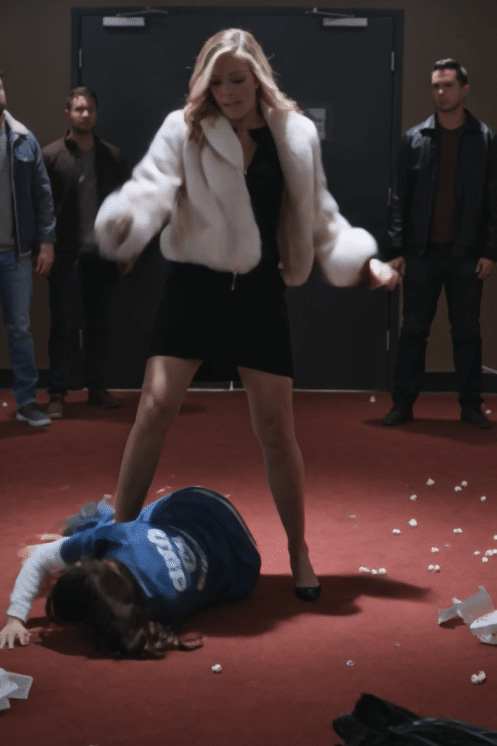
The words echoed through the emptying movie theater lobby just as Margaret Ellis fell onto the red carpet, her cleaning picker clattering beneath a row of velvet stanchions.
Thirty-five-year-old Vanessa Blake stood over her in a white fur coat, black dress, and impossibly high heels. Her friends watched from behind her, their expensive handbags hanging from their wrists, their laughter dying as the scene became something none of them could pretend was harmless.
Margaret, forty-six, tried to push herself up. Her dark blue uniform had twisted at the waist, and a thin red scrape marked her forearm. She sucked in a trembling breath, fighting the pain while popcorn, crushed cups, and napkins lay scattered around her.
Only moments earlier, she had asked Vanessa to throw away her empty drink cup.
“Please,” Margaret had said gently. “The bin is right there.”
It was the end of the final showing. The lobby was nearly empty, the lights had dimmed to their late-night setting, and Margaret still had two theaters to clean before she could clock out. She had spent the last hour collecting popcorn from beneath seats, wiping sticky drink spills from armrests, and gathering the trash people left behind when they hurried out to beat the parking-garage traffic.
Vanessa had finished watching a private screening with three friends. They had come through the VIP door laughing, carrying drinks and shopping bags, still talking about the film as if the rest of the building existed only to serve them.
When Margaret approached with her trash bag, she did not demand an apology or lecture anyone about manners.
She simply held the bag open.
Vanessa looked at the cup in her hand, then at Margaret.
“You want me to throw this away?”
“Yes, ma’am. Thank you.”
Vanessa’s smile was small and cold.
Instead of dropping the cup into the bag, she grabbed the open edge and flipped the entire thing onto the carpet.
Popcorn, napkins, empty containers, and crumpled wrappers spilled across the floor.
One of Vanessa’s friends gasped. Another gave an uncertain laugh, the kind people make when they hope a cruel joke will somehow remain a joke.
Margaret stared at the mess.
She had been cleaning public spaces for nearly twenty years. She knew how to handle spilled drinks, broken glass, impatient customers, and people who acted as though the person holding a mop had no feelings worth considering.
She also knew when a situation was turning dangerous.
Still, she bent down to collect the rubbish.
She could not afford to lose this job.
Her rent was due in nine days. Her daughter’s community college tuition payment was coming up, and the small emergency fund Margaret had built over several years had been drained by her mother’s recent medical expenses.
She needed the hours.
She needed the insurance.
And she needed to get home before midnight because her mother, Eleanor, was recovering from surgery and could not be left alone for long.
Margaret reached for a crushed popcorn box.
Vanessa seized her hair and yanked her downward.
The sudden movement forced Margaret off balance. Before she could steady herself, Vanessa drove a hard kick into her back.
Margaret fell face-first onto the carpet.
The sound of the impact silenced the lobby.
Her cleaning picker skidded across the floor. A plastic drink lid spun in a circle near the ticket counter. Margaret tried to draw her knees beneath herself, but pain made her movements falter.
“Please,” she whispered.
Vanessa looked down at her.
“Trash. Cleaning is your whole purpose.”
Margaret raised one trembling hand, instinctively shielding her head as she tried to move away.
Vanessa kicked her again.
Then once more.
A man standing near the concession counter covered his mouth. A teenage employee froze with a stack of paper cups in his hands. Vanessa’s friends backed toward the VIP screening door, suddenly fascinated by anything other than the woman on the floor.
Margaret’s breathing grew ragged.
She had not insulted Vanessa.
She had not touched her.
She had asked her to put a cup in the trash.
Now she lay on the red carpet beneath the glowing movie posters, trying to protect herself while strangers watched.
“Pick it up with your face,” Vanessa repeated.
Margaret closed her eyes for a moment.
She thought of her mother waiting at home.
She thought of the little note her daughter had left on the kitchen counter that morning, reminding her not to forget her medication.
She thought of how badly she needed to finish her shift.
And she wondered how a request so small could have become something so terrible.
Then the VIP screening door burst open.
A man in a black suit stepped into the lobby, followed by the theater’s location manager and several security guards. He was Richard Bennett, the fifty-eight-year-old founder and owner of one of the country’s most successful independent theater chains.
He had been attending a private industry screening upstairs.
He had heard the shouting through the corridor and come out expecting an argument.
Instead, he saw Margaret on the floor.
His expression changed instantly.
“Get medical assistance,” he ordered. “Protect her. Keep everyone back.”
Two guards moved between Vanessa and Margaret while another knelt beside the injured janitor, asking whether she could hear him.
Richard waited until Margaret was being protected before turning toward the security manager.
“Lock every exit in this lobby.”
The guards moved quickly. Staff secured the immediate area, and the location manager began clearing a path for medical personnel.
Vanessa’s face went pale.
She looked from the guards to Richard, then toward the doors that had suddenly become guarded checkpoints.
“Every exit?” she asked.
She had spent the evening believing the theater belonged to people like her.
Now she was discovering that the man who owned it had seen exactly what she had done.
And Richard Bennett was not about to let her walk away pretending it had never happened.
Act II
Margaret Ellis had never believed that honest work made someone less important.
Her father had been a mechanic, and her mother had worked as a school cafeteria assistant for nearly thirty years. Neither had been wealthy, but both had taught Margaret that a person’s character showed in how they treated people who could do nothing for them.
Her father used to say that a clean floor was not beneath anyone.
“Every job keeps something running,” he would tell her. “The trick is to do yours well and never let somebody else’s pride convince you that you should be ashamed of it.”
Margaret had carried those words into adulthood.
She had worked in office buildings, hospitals, hotels, and eventually the Regal Crown Cinema, a flagship location in Richard Bennett’s theater chain. The pay was not extraordinary, but the schedule was reliable, and her supervisor generally treated the cleaning crew with respect.
Margaret liked the quiet work after the crowds left.
She liked seeing the lobby return to order, the rows of seats emerge from beneath discarded wrappers, and the polished floors reflect the soft lights again. There was satisfaction in making a place ready for the next day, even if few people noticed who had done it.
At home, her life was less quiet.
Her daughter, Olivia, was twenty and studying nursing at a community college. Margaret had raised her alone after Olivia’s father left when she was a child. There had been no dramatic court battle or bitter public feud, just years of missed calls, broken promises, and financial responsibilities Margaret learned to handle without waiting for help.
Olivia had inherited her mother’s stubbornness.
She worked part-time at a pharmacy and insisted on paying for her textbooks, even when Margaret offered to cover them. They argued about money often, but beneath the arguments was a fierce love neither of them doubted.
Then Margaret’s mother, Eleanor, suffered a serious heart condition that required surgery and months of recovery.
Margaret moved her into the small house she shared with Olivia, rearranged the living room to accommodate a medical recliner, and adjusted her work schedule around appointments.
Some nights, Margaret returned home so exhausted that she sat in the car for five minutes before opening the door.
She never told Olivia how frightening the bills were becoming.
She never complained about the extra cleaning shifts.
And she never told her mother that she sometimes cried in the laundry room after everyone else had gone to bed.
She had responsibilities, and those responsibilities did not disappear simply because life became unfair.
That was why she had tried to avoid provoking Vanessa.
She recognized the woman’s type immediately: someone accustomed to having her wishes treated as commands. Vanessa had the sort of polished confidence that came from spending years in rooms where assistants carried her bags, staff anticipated her needs, and people laughed at her jokes because they wanted something from her.
Margaret had encountered similar people in luxury hotels.
They rarely shouted at the beginning.
They started by ignoring a greeting, snapping their fingers, or leaving a mess while staring directly at the employee who would clean it. They tested boundaries in small ways, then became offended when someone reminded them that other people existed.
Vanessa had crossed that line the moment she emptied the trash bag.
The assault was not an accident. It was a choice.
Yet as Margaret lay on the carpet, she worried less about Vanessa than about the consequences of what had happened.
Would she be able to return to work?
Would the theater consider the incident bad publicity?
Would she be blamed for provoking a customer?
These fears were not irrational. Margaret had seen coworkers lose shifts after complaints from powerful guests. She had watched managers apologize to people who were clearly wrong because the company wanted to protect a sale.
She knew how easily an employee could become the problem simply because speaking up was inconvenient.
But Richard Bennett had built his theater chain around a different principle.
Years earlier, his younger brother, James, had worked as a projectionist at a small cinema in Ohio. James was the kind of man who remembered every employee’s birthday and knew which customers needed help with the stairs. When the cinema was struggling, he took extra shifts rather than see the staff lose their jobs.
One winter night, James was injured while helping evacuate a theater during an electrical emergency. His recovery took months, and the experience changed the way Richard thought about the business.
He had already owned several theaters by then, but he began paying closer attention to the people who kept them running. Cleaners, ushers, ticket sellers, projectionists, concession workers—these were not interchangeable figures moving around the edges of the customer experience.
They were the reason the doors could open every morning.
Richard introduced better safety procedures, created an employee emergency fund, and established a policy that serious threats or assaults against staff would be documented and referred to the appropriate authorities.
He had learned that company values meant nothing if they disappeared whenever a wealthy customer complained.
That policy was now being tested in the lobby.
As the guards secured the area, Richard knelt beside Margaret, careful not to crowd the medical worker who had begun assessing her.
“I’m Richard Bennett,” he said. “You are safe here. The paramedics are on their way.”
Margaret looked up at him, struggling to focus.
“I’m sorry about the floor.”
For a moment, Richard thought he had misunderstood.
“What?”
“The trash,” she whispered. “I was trying to clean it up.”
Richard’s jaw tightened.
“You do not need to apologize for the mess.”
Margaret swallowed, fighting back tears.
“I was only asking her to use the bin.”
“I know.”
“You saw?”
“I saw enough. And the cameras will show the rest.”
The reassurance seemed to release something in her. Her eyes filled, and she turned her face slightly away, embarrassed by the tears.
Richard did not ask her to be brave.
He did not tell her everything would be fine.
He simply remained beside her until the paramedics arrived.
Meanwhile, Vanessa was discovering that her friends were not going to help her.
At first, she had expected them to explain that she was upset, that the janitor had been disrespectful, that the incident was not as bad as it looked. She had spent years surrounded by people who smoothed over her behavior before it became a problem.
But none of them spoke.
One friend stared at the floor.
Another quietly moved away when a guard asked the group to remain in place for statements.
The third had gone pale.
Vanessa looked at them in disbelief.
“Are you seriously just going to stand there?”
No one answered.
Her anger sharpened into fear.
She turned toward Richard.
“This is outrageous. She was rude to me.”
Richard rose slowly.
“You asked a worker to clean up a mess you deliberately made. When she bent down, you attacked her.”
“She was giving me orders!”
“She asked you to use a trash bin.”
Vanessa’s lips tightened.
“You don’t know the whole story.”
Richard glanced at the security camera mounted above the concession counter.
“We are going to find out exactly what happened.”
He gestured to the security manager.
“Preserve every recording. Get witness statements separately. Contact the police and provide them with the evidence they request. No one is to delete, edit, or circulate footage outside the proper process.”
Vanessa’s expression hardened at the word police.
Then Richard’s location manager approached with a tablet.
“Sir, there’s another issue,” he said quietly. “Ms. Blake was listed as a special guest for tonight’s private screening.”
Richard looked at him.
“Who invited her?”
The manager hesitated.
“Corporate partnerships. Her company has been negotiating a major sponsorship agreement with us.”
Richard took the tablet.
On the screen was a photograph of Vanessa smiling beneath a banner announcing her company’s proposed partnership with the theater chain.
The headline read: A New Standard of Elegance, Service, and Community.
Richard stared at it for a long moment.
Then he handed the tablet back.
“Put the agreement on hold. Have legal review the relevant terms, and make sure we follow the same process we would for anyone else.”
Vanessa heard enough to understand.
“You can’t do that,” she snapped.
Richard turned toward her.
“I can review a proposed partnership when serious questions arise about whether the conduct involved is compatible with its terms.”
“It has nothing to do with my business!”
“That is what the review will determine.”
For the first time, Vanessa realized that the theater owner was not simply angry.
He was treating the incident as something that would have consequences beyond the lobby.
And he had no intention of allowing her social standing to decide what those consequences should be.
Act III
The partnership had been worth millions.
Vanessa’s company, Blake Luxe Hospitality, operated a portfolio of upscale lounges, boutique hotels, and private entertainment clubs. She had spent years cultivating a reputation for exclusivity, turning her personal brand into a symbol of expensive taste.
Her proposed agreement with Richard Bennett’s theater chain was meant to expand that image.
The company planned to sponsor premium screening rooms, private event packages, and a new series of luxury movie experiences. Vanessa had already told business associates that the agreement would position her company as a leader in the future of entertainment hospitality.
The contract was not finalized, but the announcement was close.
Richard’s legal department had been reviewing the proposed terms for weeks. Among the provisions were requirements relating to employee safety, guest conduct, and the parties’ obligations when serious misconduct occurred at a sponsored venue.
No contract could determine the outcome of a criminal investigation.
But it could determine whether the parties were willing to enter a business relationship.
Richard was careful to keep those questions separate.
He did not want his anger to replace due process. He wanted the footage preserved, the witnesses heard, and the facts documented before anyone made decisions about the agreement.
The security recordings soon provided a clear account.
They showed Margaret approaching with her trash bag and speaking calmly. They showed Vanessa tipping the bag onto the carpet. They showed Margaret bending down to collect the debris, followed by Vanessa grabbing her hair and kicking her.
The recordings captured the subsequent blows, the reactions of the people nearby, and the moment Richard entered the lobby.
There was no evidence that Margaret had threatened Vanessa.
No hidden argument explained the assault.
No missing piece of footage transformed the incident into an accident.
Witness statements supported the same sequence of events.
A concession worker said Margaret had been polite throughout the interaction. A couple waiting near the exit described hearing Vanessa insult her before the attack. One of Vanessa’s own friends admitted that the janitor had done nothing to provoke the violence.
The evidence was documented and provided to the authorities through the appropriate channels.
Richard did not release the recordings to the public.
He did not need to turn Margaret’s pain into a spectacle to demonstrate that he took it seriously.
He issued a brief internal directive instead: all employees involved in the incident were to be protected from retaliation, and no manager was to pressure Margaret into changing her account or returning to work before she was medically cleared.
Her wages and available leave would be handled under company policy.
The theater would cooperate with the investigation.
And the partnership review would proceed independently.
When Vanessa learned that the footage contradicted her version of events, she changed tactics.
Her attorney advised her not to discuss the incident publicly while the investigation was active. Her public-relations consultant drafted a statement expressing regret that a “distressing interaction” had occurred.
Vanessa rejected it.
“It makes me sound guilty.”
Her consultant chose his words carefully.
“The footage is difficult to explain.”
“Then don’t explain the footage. Explain me.”
He looked at her.
“What does that mean?”
“It means people know who I am. They know the work I’ve done. They know the charities I’ve supported. This is one moment.”
He hesitated.
“One moment can still be serious.”
Vanessa’s eyes narrowed.
“You work for me.”
He fell silent.
It was the answer she expected from everyone around her: submission disguised as professionalism.
But when she left the meeting, she noticed that he did not follow her.
For the first time, the people who had helped maintain her image seemed uncertain whether they wanted to keep protecting it.
That uncertainty frightened her more than the police investigation.
She could imagine a fine, a court date, or a settlement. Those were problems with a price and a procedure. She had spent most of her adult life believing that money could make difficult situations manageable.
But the footage had captured something she could not buy back.
It had shown her enjoying another person’s helplessness.
And it had shown witnesses watching her do it.
The next day, Richard met with his executive team.
His chief operating officer, Daniel Price, argued that the company should avoid making any announcement about the partnership until the investigation was complete. A public confrontation, he warned, could create unnecessary legal complications.
Richard agreed that they needed to be careful.
“We are not going to announce a verdict,” he said. “We are going to suspend negotiations while the matter is reviewed under the contract. That is a business decision, not a criminal judgment.”
The legal team confirmed that the agreement permitted a pause under the circumstances, subject to the required procedures. The proposed sponsorship was formally placed on hold.
The company also began reviewing its late-night security response.
Why had the first employee who noticed the attack hesitated?
Why had several witnesses frozen instead of calling for assistance?
Had staff received enough training to respond safely when a customer became violent?
The answers were uncomfortable.
The guards had responded once alerted, but the company recognized that its procedures could be clearer. Employees needed a direct reporting channel, managers needed to know when to call emergency services, and no worker should feel that protecting a customer relationship mattered more than protecting a colleague.
Richard ordered those improvements to be documented and implemented.
Then he asked for Margaret’s supervisor to contact her—not to discuss the investigation, but to make sure she had everything she needed during her recovery.
Margaret was still at home.
The paramedics had taken her to the hospital, where doctors examined her injuries and monitored her condition. She was fortunate to have avoided a more serious outcome, but the pain in her back and side made even simple movements difficult.
Her mother sat beside her bed when she returned home.
Olivia had taken time off from the pharmacy to help, and the three women tried to maintain their usual routine. They ate soup at the kitchen table. Olivia handled the grocery shopping. Eleanor insisted that she could fold the laundry herself, even when Margaret told her to rest.
For a few days, they avoided discussing the theater.
Then Margaret’s phone rang.
It was her supervisor.
She answered carefully, expecting questions about the shift, the police report, or the incident itself.
Instead, he told her that her job was secure, that the company would follow its leave and compensation policies, and that she should focus on her recovery.
Margaret closed her eyes.
“Thank you,” she whispered.
After the call, Olivia sat beside her.
“Mom, you don’t have to go back there if you’re scared.”
Margaret looked at her daughter.
“I know.”
“Then why are you crying?”
Margaret wiped her cheek.
“Because for once, I didn’t have to beg someone to believe me.”
She had spent years making herself small around difficult people, hoping that politeness would protect her from their anger.
Now she was beginning to understand that being polite had never made Vanessa’s behavior her fault.
And as Margaret slowly recovered, a second story was taking shape inside the theater chain—one about the people who had watched, the employees who had hesitated, and the rules that needed to change.
Richard intended to make sure that story did not disappear when the headlines faded.
Act IV
Vanessa’s world began to narrow.
The theater partnership remained suspended. Her company’s board requested a formal review of the incident, and several business partners asked whether the conduct captured on the recordings was consistent with the public image Blake Luxe Hospitality had built around premium service and professional standards.
Vanessa responded with anger.
She accused Richard of overreacting, insisted that the incident had been exaggerated, and demanded to know why a janitor’s complaint was being treated as a threat to her business.
Her lawyers advised her to stop sending messages to the theater’s management team.
She ignored them long enough to send one final email.
I expect this matter to be resolved privately. There is no reason to damage a partnership over an employee dispute.
Richard’s general counsel forwarded the message to him.
He read it once, then set it aside.
“Reply through counsel,” he said. “Confirm the review is continuing. Nothing more.”
He refused to trade insults with Vanessa.
He refused to discuss Margaret’s medical details with anyone who did not need them.
And he refused to use the incident as an opportunity to advertise himself as a heroic employer.
Instead, he visited the theater during a late-night shift.
The lobby was quiet. A cleaning crew was finishing the last auditorium, collecting cups and folding the red carpet barriers for storage. The smell of popcorn lingered beneath the ventilation system.
Richard watched an employee wipe down the concession counter.
Then he asked the location manager to bring the overnight team together for a short meeting.
He thanked them for their work and acknowledged that the incident had been frightening. He reminded them that they were entitled to a safe workplace and that no customer’s spending, social position, or personal connections gave them permission to assault staff.
“If something like this happens again,” he said, “you do not have to solve it alone. Call for help. Follow the safety procedure. Preserve what you can safely preserve. Your responsibility is to protect people, not to protect someone’s ego.”
Several employees nodded.
One young usher raised her hand.
“What if the customer threatens to get us fired?”
Richard looked at her.
“Then you report that threat, too. No employee should be punished for following a safety procedure in good faith.”
The meeting lasted less than fifteen minutes.
It did not solve every problem in the company. But the employees left knowing that management had heard what happened and was prepared to make its expectations clear.
The theater also introduced a more direct incident-reporting process, reviewed its camera coverage, and expanded training for supervisors working late shifts.
The changes were practical rather than dramatic.
No grand speech could guarantee that every employee would act perfectly under pressure. But clearer procedures gave people a better chance of doing the right thing when a situation became frightening.
Meanwhile, Vanessa faced a decision of her own.
Her public-relations consultant had prepared a revised statement. It did not claim the incident was a misunderstanding. It acknowledged that the available evidence showed unacceptable behavior and said the company would cooperate with the appropriate authorities.
Vanessa read it in silence.
“You want me to admit everything?”
“I want you to stop saying things the footage contradicts.”
She threw the pages onto the table.
“If I apologize, everyone will think they can walk all over me.”
Her consultant looked exhausted.
“Someone asked you to throw away a cup.”
Vanessa stared at him.
“You weren’t there.”
“I saw the recording.”
“Then you saw how she looked at me.”
He did not answer immediately.
Finally, he said, “I saw a woman asking you to use a trash bin.”
Vanessa stood so abruptly that her chair scraped the floor.
“Get out.”
He gathered his papers and left.
For the rest of the afternoon, Vanessa sat alone in her office, surrounded by photographs from charity galas and ribbon-cutting ceremonies. In one, she was smiling beside a group of hospital volunteers. In another, she was handing a check to a community organization.
She had always believed those images told the story of who she was.
Now they looked like evidence of how carefully she had chosen the moments when kindness was convenient.
She remembered Margaret’s face on the carpet.
She remembered the way the woman had apologized for the mess, even after being attacked.
And she remembered Richard kneeling beside her.
That image irritated Vanessa most of all.
He had not looked at Margaret as though she were a cleaner who had become a problem. He had spoken to her as though she were a person whose safety deserved immediate attention.
Vanessa could not understand why that simple act had made her feel so powerless.
Then her attorney called.
The authorities were continuing their investigation, and she needed to cooperate with the process. Her company would also be reviewing the incident under its internal conduct standards. No one could promise her a particular outcome.
Vanessa asked whether the theater could be forced to restore the partnership.
Her attorney explained that the answer depended on the contract and the relevant facts, not on how strongly she wanted the agreement back.
She ended the call without saying goodbye.
For years, Vanessa had treated consequences as negotiations that began once someone challenged her. She had assumed that enough money, enough pressure, or the right phone call could make an inconvenient situation go away.
But this time, the people involved were not arguing about whether she had been embarrassed.
They were asking what she had done.
The difference was impossible to ignore.
Several weeks later, the partnership review concluded that the proposed agreement would not proceed under its original terms. The company documented its reasons and followed the contractual process. The theater chain continued its plans with other partners.
The decision was not announced as a victory over Vanessa.
It was a business decision grounded in the review, separate from the investigation into the assault.
Richard did not celebrate it.
He had never wanted Margaret to become the center of a corporate spectacle. He wanted her to recover, and he wanted his employees to understand that they did not have to accept violence as part of their jobs.
When a reporter asked whether he was pleased that Vanessa had lost the deal, he answered simply.
“This was never about humiliating anyone. It was about making sure our staff were safe and that our decisions reflected the standards we expect.”
The reporter asked whether he would meet with Margaret again.
“If she wants to,” Richard replied. “She owes us nothing.”
That answer reached Margaret through Olivia, who had seen the interview online.
Margaret sat quietly for a while after her daughter showed it to her.
Then she asked for the television to be turned off.
She was tired of watching strangers discuss her life.
She wanted to return to ordinary things: making breakfast, walking around the house without wincing, helping Olivia prepare for her nursing exams, and sitting beside her mother while they watched their favorite old sitcom.
She did not want to be famous.
She wanted to feel safe.
And when she was finally ready to return to work, she wanted it to be because she had chosen to—not because anyone expected her to prove she was strong enough to endure what happened.
Richard understood that.
He sent a brief note through the company’s employee-support office, offering a private meeting if Margaret wanted one. He made clear that there was no obligation to attend and no expectation that she discuss the incident publicly.
Margaret considered it for several days.
Then she agreed.
What she told Richard during that meeting would change the way he understood the entire incident.
Act V
Margaret arrived at the theater on a quiet weekday afternoon, several weeks after the attack.
She wore her dark blue uniform beneath a light jacket, her hair gathered in the same low bun she had worn on the night Vanessa assaulted her. Her movements were still cautious, but she could walk without the sharp discomfort that had followed her home from the hospital.
Richard met her in a small conference room away from the lobby.
There were no photographers, no public-relations staff, and no prepared statement on the table. Her supervisor had arranged for her to meet during paid time, and a representative from the employee-support office was available if she needed anything.
Richard stood when she entered.
“Thank you for coming,” he said.
Margaret sat down.
“I wanted to see what was going to happen here.”
“That is fair.”
She glanced toward the window, which overlooked the empty ticketing area.
“I’ve worked in places where the customer is always right. Even when the customer is cruel. Even when they lie. Even when they make you feel like you’re lucky to be allowed in the same room.”
Richard listened without interrupting.
“You start thinking that if you keep your head down, nothing bad will happen,” Margaret continued. “You learn to apologize before anyone has even accused you of something. You do it because you need the job.”
She looked down at her hands.
“After what happened, I kept thinking about the floor. Not the pain. Not even the woman. I kept thinking that I was supposed to clean it, and I was afraid someone would say I hadn’t finished my shift.”
Richard felt the words settle heavily in the room.
He had been focused on the attack, the evidence, and the company’s response. Margaret was describing something quieter: the fear that an employee could be hurt and still feel responsible for leaving a mess behind.
“I am sorry,” he said. “You should never have had to worry about that.”
Margaret nodded, but she did not rush to reassure him.
“I don’t want special treatment,” she said. “I don’t want people whispering when I walk through the lobby. I don’t want everyone thinking of me as the woman who got kicked.”
“You won’t be asked to tell your story to anyone,” Richard replied. “And you will not be required to return to a shift before you are ready. We’ll handle your return according to your needs and the company’s policies.”
She took a slow breath.
“Good.”
Then she looked directly at him.
“But I do want one thing.”
“Tell me.”
“I want the next person who works here to know they can ask for help without wondering if they’re going to lose their job.”
Richard nodded.
“That is something we can work on.”
Margaret leaned back slightly.
“Then work on it.”
It was not a grand speech.
It was not forgiveness.
It was a straightforward request from a woman who had spent too many years learning how to survive unfairness quietly.
Richard accepted it as the responsibility it was.
Over the following months, the theater chain completed its review of late-night safety procedures. Managers received clearer instructions on how to respond to threats and assaults. Employees were reminded that they could report misconduct without first obtaining approval from a customer-facing supervisor. The company also reviewed how incident reports were handled to ensure that complaints from cleaning and maintenance staff received the same attention as complaints from executives or guests.
Margaret returned gradually, with adjustments made to her schedule while she finished recovering.
Her coworkers welcomed her without making a ceremony of it.
One left a cup of coffee in the staff room with a note that read, Glad you’re back.
Another quietly took over the heaviest cleaning tasks during her first few shifts.
Her supervisor checked in regularly, but he did not ask her to recount what happened.
The ordinary kindness of those small gestures helped Margaret feel like herself again.
She was still a mother who worried about tuition bills. She was still a daughter who reminded Eleanor to take her medication. She was still the woman who liked to finish a job properly, even if nobody noticed.
The attack had hurt her.
It had frightened her.
For a while, it had made the sound of high heels behind her enough to tighten her shoulders.
But it had not erased the rest of her life.
Vanessa, meanwhile, continued to face the consequences of her actions through the appropriate legal and professional processes. Her company reviewed its conduct standards and the claims made in its public-facing campaigns. The theater partnership was no longer available as the centerpiece of her expansion plans, and some business relationships changed as partners reconsidered their association with her.
There was no magical moment when she suddenly became humble.
People rarely change that neatly.
For a long time, Vanessa focused on what she had lost. She complained about the damage to her reputation, the cost of legal advice, and the way former friends had distanced themselves. She resented Richard for refusing to help her control the story.
Eventually, however, she stopped watching the footage only to search for a way to defend herself.
She watched it because she could no longer deny what it showed.
The moment she tipped the trash bag.
The moment she grabbed Margaret’s hair.
The moment Margaret fell.
The moment the people around them froze.
And the moment Richard entered the lobby and went to the injured worker before addressing anyone else.
Vanessa had once believed power meant never having to accept correction from someone she considered beneath her.
Now she had to confront the possibility that her real weakness had been her inability to hear a simple request without treating it as an insult.
She wrote Margaret a letter of apology.
It did not ask for forgiveness or request that Margaret speak publicly on her behalf. It acknowledged the assault, the humiliation, and the fear she had caused. It also acknowledged that Margaret had been doing her job when Vanessa chose to attack her.
Margaret read the letter at home.
Olivia asked whether she wanted to reply.
“Not right now,” Margaret said.
“Are you going to forgive her?”
Margaret folded the paper and placed it in an envelope.
“That’s not something I have to decide for anyone else.”
Olivia nodded.
Margaret was not interested in revenge. She did not need Vanessa to suffer in order to know that what had happened was wrong. She did not need a public apology to validate her memory of the night.
What she wanted was to move forward without pretending the assault had been a small misunderstanding.
So she kept the letter but did not respond.
The choice belonged to her.
One evening, months after the incident, Margaret finished a late shift and walked through the lobby toward the staff exit. The red carpet had been cleaned, the concession counters were polished, and the movie posters glowed beneath the dim lights.
An empty drink cup sat on the ledge beside the doors.
A young couple walked past it without noticing.
Margaret paused, then picked it up and dropped it into the bin.
The motion was so ordinary that it almost made her smile.
For a moment, she remembered the night Vanessa had emptied the trash bag onto the floor. She remembered the sting in her back, the fear that she would lose her job, and the awful silence of people who watched a person being hurt without knowing whether they should intervene.
Then she remembered Richard’s voice.
You do not need to apologize for the mess.
She had carried those words with her.
Not because the owner of a theater chain had defended her, but because someone had finally said aloud what she had always known and had sometimes been afraid to believe.
Her work mattered.
Her safety mattered.
She mattered.
Richard had ordered every exit secured that night, but the real point had never been to trap Vanessa or frighten her into submission. It had been to stop the immediate situation from getting worse, protect Margaret, and ensure that the evidence could not simply disappear.
The doors had been secured because an employee had been attacked.
The partnership had been reviewed because serious conduct deserved scrutiny.
The procedures had changed because safety could not depend on whether a victim happened to be standing near a powerful witness.
And Margaret had returned to her job because she had chosen to reclaim that part of her life.
She walked through the staff door and stepped into the cool night air.
Her phone buzzed with a message from Olivia.
Grandma made tea. We’re waiting for you.
Margaret smiled.
She had a home to return to, a daughter building her future, and a mother who still wanted to hear every detail of her day. There were bills waiting on the kitchen table and laundry that would need folding in the morning.
There was life beyond the red carpet.
And for the first time in weeks, Margaret realized that when she remembered the theater, she was no longer seeing only the woman who had hurt her.
She was seeing the people who had learned from what happened, the colleagues who had welcomed her back, and the small, ordinary future she had been afraid of losing.
Vanessa had called her trash.
But a person’s worth had never been measured by the uniform they wore, the mess they cleaned, or the money they earned.
It was measured in something far less glamorous and far more important: the dignity they carried when others tried to take it away.
And the night Margaret Ellis was humiliated in front of a theater full of witnesses, the person who finally lost control was not the woman holding the trash bag.
It was the woman who believed that everyone else existed to clean up after her.