Act I
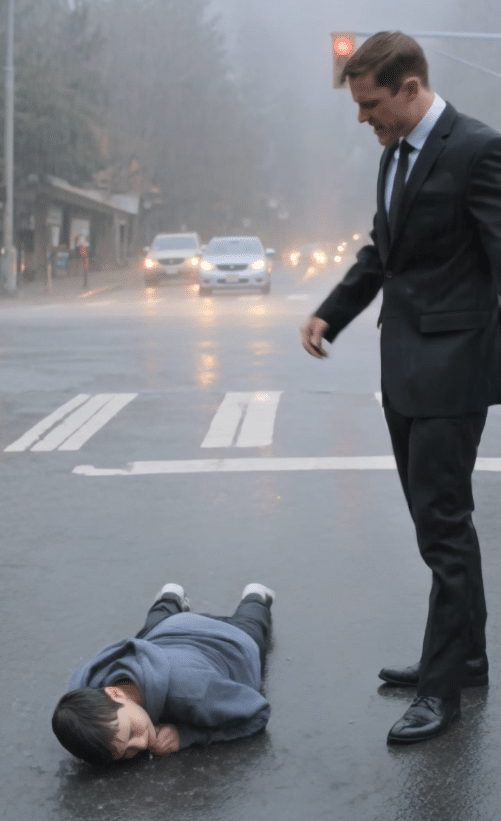
The dollar bill landed in a puddle beside the luxury SUV’s front tire, and fourteen-year-old Daniel Brooks dropped to his knees to retrieve it.
“Please, sir. That’s all I have.”
The man standing over him adjusted the cuffs of his black suit. Rain slid from the shoulders of his expensive coat, but he seemed far more offended by the boy’s presence than by the storm soaking them both.
“Trash. You scratched my glass.”
Daniel looked up in disbelief.
“I didn’t scratch it. I was just cleaning the windshield.”
“Don’t lie to me.”
The traffic light above the intersection remained red. Cars idled behind the SUV, their headlights glowing through the rain, while windshield wipers swept back and forth in restless rhythm.
Daniel had been working at the intersection since late afternoon, offering to clean windshields for spare change. He wore a gray hoodie beneath a thin raincoat, and his old sneakers squelched whenever he moved.
He had earned six dollars that evening.
Five were already gone, spent on bread and a small carton of milk for his eight-year-old brother, Ethan. Their mother had left home before sunrise for a cleaning shift and had not returned yet. Daniel had promised Ethan that he would bring something warm for dinner.
The last dollar was supposed to buy a hot meal from the corner store.
It was not much.
But to Daniel, it was the difference between walking through the apartment door with a promise kept and having to watch his little brother pretend he wasn’t hungry.
The driver of the SUV had stopped at the red light just minutes earlier. Daniel had approached cautiously, holding up his small squeegee and asking whether the man wanted his windshield cleaned.
The driver had waved him away.
Daniel had stepped back immediately.
Then the man noticed a faint mark on the glass.
He blamed Daniel without checking whether the mark had been there before. When the boy tried to explain, the driver reached through the open window, snatched the dollar from his hand, and tossed it onto the road.
“Pay me for the damage.”
Daniel stared at the bill floating in the muddy water.
“It’s for my little brother’s dinner.”
The man laughed.
“Then maybe you should have been more careful.”
Daniel bent down to retrieve the money.
That was when the man kicked him hard in the back.
Daniel fell face-first onto the wet asphalt. Water splashed around his hands as his chest struck the road, and his forearm scraped against the rough surface, leaving a thin trace of blood.
For several seconds, he could do nothing but gasp.
The dollar lay inches from his fingers.
He reached for it anyway.
The man stepped closer and delivered two more forceful kicks into the boy’s back and side. Daniel curled instinctively, his face twisting with pain as rainwater ran into his eyes.
A woman in the car beside them covered her mouth.
Someone shouted from behind a closed window, but no one stepped forward. Drivers watched through their windshields, frozen between disbelief and the fear of becoming involved.
Daniel tried to push himself up.
His arms trembled.
“Please,” he whispered. “I didn’t do anything.”
The man stood over him, his polished shoes planted in the rain.
“Pay me with your last dollar.”
Daniel looked at the bill again.
It was soaked now, flattened against the asphalt, its edges trembling beneath the runoff.
He thought of Ethan sitting at their kitchen table, pretending to read an old comic book while waiting for dinner. He imagined his little brother looking up when the door opened, asking the question he always asked.
Did you bring something?
Daniel swallowed the pain in his throat.
Then a black sedan stopped sharply behind the SUV.
Its driver opened the rear door.
A tall man in a long black coat stepped into the rain, his eyes fixed on the boy lying beside the tire.
He crossed the distance quickly, placed himself between Daniel and the SUV’s driver, and signaled to his own driver to call for emergency assistance.
Only after he had made sure the boy was no longer within the man’s reach did he turn around.
“I saw everything.”
The SUV driver stiffened.
He looked at the newcomer, then at the black sedan, then at the chauffeur standing beside the open door.
For the first time, the confidence drained from his face.
But he still tried to smile.
“Saw what?”
The lawyer did not answer immediately.
He looked down at the soaked dollar beside Daniel’s hand.
Then he looked back at the man who had kicked a child over it.
And the silence that followed was more frightening than anything the rain could have carried away.
Act II
The lawyer’s name was Thomas Harrington.
At fifty-eight, he was one of the most formidable trial attorneys in the state. He had spent more than thirty years representing clients in high-stakes civil litigation, corporate fraud cases, and disputes involving powerful executives who believed their money could shield them from accountability.
His name rarely appeared in the news unless a case was already serious.
He preferred it that way.
Thomas was not the sort of man who needed to raise his voice to make a room listen. He understood that real authority often arrived quietly, carrying facts that could not be argued away.
That evening, he had been returning from a meeting with a client when his driver stopped behind the black SUV at the intersection.
At first, Thomas had noticed only the boy approaching the vehicles.
Then he saw the SUV driver snatch something from Daniel’s hand.
He had watched the dollar fall.
And he had watched the man kick the boy while he was bent over trying to retrieve it.
Thomas had seen enough.
Now he knelt beside Daniel, keeping his voice calm.
“Can you hear me, son?”
Daniel nodded, though his breathing remained uneven.
“What’s your name?”
“Daniel.”
“I’m Thomas. Help is coming. Don’t rush to stand up.”
Daniel glanced toward the dollar.
Thomas followed his gaze.
“I see it,” he said. “We’ll take care of that.”
It was a small promise, but Daniel seemed to need it. He kept staring at the bill as though losing it would somehow be worse than the pain in his back.
Thomas asked his driver to keep traffic from moving too close while emergency services were contacted. He did not attempt to diagnose the boy’s injuries. He simply stayed beside him, shielding him from the man who had caused them.
The SUV driver shifted impatiently.
“This is ridiculous. The kid damaged my vehicle.”
Thomas looked up.
“Did you see him damage it?”
“He was cleaning it.”
“That wasn’t my question.”
The man frowned.
Thomas continued, “Did you personally see him scratch your windshield?”
The driver hesitated.
“I saw a mark.”
“A mark is not proof that this boy caused it.”
“You don’t know what happened.”
“I know what I saw.”
The driver’s face tightened.
He was forty-three-year-old Victor Sloane, a property developer who had built a reputation for being aggressive in business and unforgiving when challenged. He owned several commercial buildings, had recently invested in a luxury residential project, and regularly appeared at charity events where photographers captured him shaking hands with politicians and business leaders.
Victor liked being seen as a man who had earned everything he possessed.
He disliked being reminded that some of his success depended on other people choosing not to challenge him.
He looked at Thomas’s black sedan and expensive coat.
“Who are you supposed to be?”
Thomas reached into his pocket and removed a card, but he did not hand it over.
“Thomas Harrington.”
The name meant nothing to Victor at first.
Then he remembered it.
A few months earlier, Victor’s company had become embroiled in a dispute involving a former business partner who claimed that financial records had been altered before a major property sale. The matter had attracted the attention of several attorneys, and one name had come up repeatedly in conversations about who might eventually take the case to court.
Harrington.
Victor studied the older man more carefully.
“You’re that lawyer?”
“I’m a lawyer, yes.”
Victor gave a short laugh.
“Then you should know better than to make accusations without all the facts.”
Thomas glanced toward Daniel, who was still lying on the wet road.
“I am not making an accusation about what I haven’t seen. I’m telling you what I witnessed.”
A horn sounded from farther back in the traffic line, but another driver immediately stopped it with an angry wave. The intersection had become unnaturally quiet.
Victor looked around and realized that several people were watching.
He straightened his coat.
“This boy was trying to hustle money from drivers. I had a legitimate complaint.”
“Then you could have reported it or driven away.”
“He damaged my property.”
“You have yet to establish that.”
Victor’s jaw clenched.
Thomas turned away from him and focused on Daniel again.
“Is there someone we can call for you?”
Daniel hesitated.
“My little brother is at home.”
“How old is he?”
“Eight.”
“Is there an adult with him?”
“Our mom is working. She should be home soon.”
Thomas’s expression changed slightly.
“Does your brother know where you are?”
Daniel shook his head.
“He thinks I’m getting dinner.”
The words landed heavily between them.
Thomas looked toward the dollar, still lying in the puddle. It had become so wet that it clung to the road whenever the runoff moved around it.
He understood then why Daniel had kept reaching for it despite being hurt.
The boy was not fighting for a dollar.
He was fighting to keep a promise to someone who depended on him.
Thomas removed his coat and placed it over Daniel’s shoulders without moving him unnecessarily.
“Your brother is going to hear from you,” he said. “And you’re not going to have to figure out tonight by yourself.”
Victor scoffed.
“Are you planning to adopt him now?”
Thomas slowly rose to his feet.
“No. I’m planning to make sure a child who was assaulted receives help, and that the person responsible does not intimidate him into silence.”
Victor’s smile disappeared.
“You’re making this bigger than it is.”
Thomas looked directly at him.
“You kicked a fourteen-year-old boy on a public road over an unproven scratch. You took his last dollar and told him to use it to pay you.”
He paused.
“Tell me which part you think is small.”
Victor had no answer.
Then the first siren sounded in the distance.
And as the emergency lights approached through the rain, Thomas noticed something about the SUV that made him look twice.
A small emblem on the windshield identified the vehicle as part of a corporate fleet.
It belonged to a company whose legal troubles Thomas already knew very well.
Victor Sloane had no idea that the man standing in the rain had been investigating a case connected to his business for months.
And the dollar in the puddle was about to become the least of his problems.
Act III
The paramedics arrived within minutes.
They assessed Daniel at the roadside, asked him questions, and arranged to take him for further examination because of the pain in his back and side. Thomas stayed nearby while the emergency crew worked, answering questions about what he had witnessed.
Daniel was frightened when the paramedics prepared to move him.
“Can I just go home?” he asked. “My brother’s waiting.”
One of the paramedics crouched beside him.
“We need to make sure you’re okay first. We’ll help you contact your family.”
Thomas asked his driver to retrieve the wet dollar only after the paramedics confirmed that it was safe to do so. The bill was barely recognizable, but it had not vanished into the storm.
Thomas placed it inside a small paper envelope and handed it to Daniel.
“You shouldn’t have to lose what you earned tonight.”
Daniel stared at the envelope.
“It’s only a dollar.”
“I know.”
Thomas paused.
“But it was yours.”
For the first time since the assault, Daniel’s expression softened. He held the envelope carefully, as if it were something more valuable than paper.
Across the intersection, Victor was speaking to a police officer.
He had already begun constructing his version of events.
He said Daniel had approached his vehicle without permission. He claimed the boy had scratched the windshield, refused to leave, and become aggressive when confronted.
He did not mention the dollar.
He did not mention the kicks.
And he certainly did not mention that he had continued striking the boy after Daniel fell.
But the officer had spoken to several witnesses, and Thomas had given a clear account of what he had seen. At least two drivers had captured portions of the confrontation on their phones.
Victor’s explanation was already beginning to unravel.
When an officer approached Thomas for a formal statement, the lawyer provided his contact information and described the incident in precise detail. He was careful to distinguish what he had directly witnessed from what others had told him.
He did not threaten Victor.
He did not announce that he would destroy the man’s career.
He simply made it clear that he would cooperate fully with the investigation.
That calmness unsettled Victor more than shouting would have.
“Are you trying to ruin me?” Victor demanded when Thomas finished speaking.
Thomas looked at him.
“You seem to believe your reputation is the most important thing that happened here.”
Victor stepped closer, then stopped when the officer intervened.
“You don’t know anything about my life.”
“I know what I saw tonight.”
“You’re using your position to threaten me.”
“No,” Thomas replied. “I’m using my eyes to describe what happened.”
Victor’s hands curled at his sides.
The officer instructed him to step back and continued gathering statements. The incident would be documented, and the available footage would be reviewed as part of the investigation.
Victor glanced at the black sedan.
He had assumed Thomas was simply a wealthy lawyer who happened to witness the assault. He still believed he could contain the problem with the right phone calls, the right explanation, and perhaps a generous offer to the boy’s family.
He did not understand why Thomas seemed so uninterested in bargaining.
Then Thomas’s driver approached and quietly reminded him about a meeting scheduled for the following morning.
Victor overheard the name of the firm involved.
His expression changed.
Harrington’s firm had been reviewing documents connected to a dispute involving Sloane Urban Holdings, one of Victor’s principal companies.
Months earlier, a former financial controller named Michael Reeves had alleged that the company concealed significant maintenance liabilities during negotiations to sell a portfolio of commercial properties. Reeves claimed that internal reports had been altered and that investors had been given incomplete information.
Victor denied the allegations.
The dispute had been moving toward formal proceedings, and his attorneys had been working to limit the damage. He had spent considerable money attempting to keep the matter contained.
Thomas had been retained by parties examining the transaction.
Victor now realized that the man who had witnessed the assault was not an incidental stranger.
He was a lawyer familiar with the business dispute that had been haunting Victor’s company.
“You’re involved in the Reeves matter,” Victor said.
Thomas did not react to the name.
“I represent clients in several disputes.”
“That’s not an answer.”
“It is the answer you’re getting while we’re standing in the street.”
Victor stared at him.
For the first time, he began to understand why Thomas had not been impressed by his car, his suit, or his threats.
The lawyer had no need to compete with Victor’s wealth. His work depended on evidence, and the confrontation at the intersection had produced something Victor could not easily dismiss: a group of witnesses, a potential video record, and an account from a professional who understood the importance of documenting what he had seen.
Still, Thomas did not suggest that the assault proved anything about Victor’s business dealings.
He knew better than to confuse suspicion with evidence.
The cases were separate.
But Victor’s behavior that night had exposed a pattern of entitlement that made the lawyer even more determined to examine every claim carefully.
A person who believed he could rewrite the truth in public might also be tempted to rewrite it on paper.
The difference was that documents could be compared, witnesses could be questioned, and false statements could carry consequences.
Victor watched as Daniel was placed into the ambulance.
“Where are they taking him?” he asked abruptly.
Thomas looked at him with disbelief.
“Why do you want to know?”
“I need to resolve this.”
“You can cooperate with the authorities.”
“I can pay for whatever happened.”
Thomas’s expression hardened.
“You cannot buy a different version of what happened.”
The ambulance doors closed.
As it pulled away, Daniel looked through the window at the intersection. He could see the traffic lights reflected in the wet road, the black SUV, and the man who had stepped out of the car behind him.
He did not know Thomas’s reputation.
He did not know about the corporate dispute or the documents being reviewed.
He knew only that someone had finally stood between him and the person hurting him.
And for the first time that night, he allowed himself to stop fighting.
Act IV
Daniel’s mother, Angela Brooks, arrived at the hospital shortly before midnight.
She had come straight from her cleaning job after receiving a call from a social worker who had helped coordinate the family’s emergency contact. Her uniform was still damp from the rain, and her hands shook as she hurried through the hospital doors.
When she saw Daniel sitting on the examination bed, exhausted and wrapped in a blanket, she rushed to his side.
“Oh, sweetheart.”
Daniel tried to smile.
“I’m okay, Mom.”
Angela held him carefully, avoiding the areas that hurt. She listened as the medical staff explained that he was being evaluated and would need to follow their advice while recovering.
Then she looked at Thomas.
“You were there?”
“Yes.”
“You helped him?”
“I stayed with him until help arrived.”
Angela pressed a hand to her mouth.
She had been working double shifts because her regular hours were not enough to cover rent, food, utilities, and school expenses. She knew Daniel sometimes tried to earn money at the intersection, despite her repeated requests that he stay away from traffic.
She had not realized how much responsibility he had quietly taken upon himself.
“He was only supposed to bring dinner home,” she whispered.
Thomas let her speak without interruption.
Angela looked at her son.
“You don’t have to take care of everything, Daniel.”
He lowered his eyes.
“I didn’t want Ethan to go hungry.”
“I know.”
Her voice broke.
“But you’re my child. You’re not supposed to be hurt trying to make sure everyone else is okay.”
Daniel began to cry then—not loudly, not dramatically, but with the exhausted relief of someone who had spent too long trying to be brave.
Angela held him until his breathing steadied.
Thomas stepped into the hallway to give them privacy.
His driver was waiting nearby with a folder from the office. Thomas had intended to review it that evening, but the events at the intersection had changed his priorities.
Inside were documents related to the corporate dispute involving Victor’s company. Some had been submitted by the former financial controller; others had been obtained through formal legal procedures.
Thomas did not open the folder in the hospital corridor.
He called his associate and instructed the team to continue following the established process. Every document needed to be authenticated. Every allegation needed to be tested. Any new information had to be handled lawfully and independently of the assault investigation.
He would not use Daniel’s suffering as a shortcut to win a business case.
But he would not allow Victor’s wealth to discourage witnesses or interfere with legitimate proceedings, either.
The next morning, Victor’s attorneys contacted Thomas’s firm.
They wanted to discuss the intersection incident before it became a larger public issue. Their initial approach was cautious, suggesting that their client might be willing to cover Daniel’s expenses and compensate the family for the inconvenience.
Thomas declined to negotiate the facts.
“The family can decide what assistance, if any, they wish to accept,” he said. “The police will investigate the incident, and the evidence should speak for itself.”
The attorney paused.
“Our client believes there has been a misunderstanding.”
“Then your client should cooperate with the investigation.”
“We’re hoping to avoid unnecessary publicity.”
“Publicity is not the issue. Accountability is.”
The conversation ended politely, but the message was unmistakable.
Victor had spent years assuming that every problem had a price. He had learned to regard apologies as negotiations and generosity as a way to control the story.
This time, there were boundaries he could not dictate.
The police continued reviewing the witness accounts and any available footage. Thomas provided his statement, and the other drivers were contacted for information. Victor was given the opportunity to respond through the proper channels.
Meanwhile, the separate business dispute moved forward.
During the following weeks, the parties exchanged records and prepared for formal proceedings. Investigators and attorneys examined the disputed transaction documents, comparing versions and asking questions about who had approved particular changes.
No conclusion rested on Thomas’s presence at the intersection.
The evidence had to stand on its own.
But Victor was no longer able to dismiss every challenge as the work of jealous competitors or disloyal employees. The people reviewing the records were asking specific questions, and the answers mattered.
For the first time in years, he faced scrutiny he could not end by raising his voice.
At home, the consequences were quieter but no less painful.
His teenage daughter, Sophie, learned about the intersection from a classmate who had seen a video circulating among local residents. She confronted him in the kitchen.
“Dad, did you really kick a kid who was trying to get a dollar back?”
Victor stared at her.
“You don’t know the full story.”
“Then tell me.”
He began to explain the alleged scratch, the boy’s presence at the traffic light, and the damage he believed had occurred.
Sophie listened until he finished.
“Did you see him scratch the windshield?”
Victor looked away.
“No.”
“Then why did you do it?”
The question echoed the one Thomas had asked.
Victor felt anger rise, but it had nowhere to go. He could not threaten his daughter with legal action or demand that she respect him because of his position.
“He was disrespectful,” he said weakly.
Sophie shook her head.
“He was fourteen.”
She left the kitchen.
Victor remained standing beside the counter, staring at the glass of water he had not touched.
He had spent years teaching his daughter that success meant being strong, decisive, and unwilling to let anyone take advantage of you.
He had never taught her that strength without restraint could become cruelty.
Now she was learning the lesson from his worst moment.
A week after the assault, Victor received formal notice that the investigation was proceeding and that the available evidence would be considered by the relevant authorities. His lawyers advised him to preserve all related records and avoid contacting Daniel or his family except through appropriate channels.
He sat alone in his office after reading the notice.
The luxury SUV was parked below his window.
Its windshield had been inspected. The mark he had blamed on Daniel was consistent with an old surface blemish, and there was no reliable evidence establishing that the boy had caused it.
The accusation that had started everything had no solid foundation.
Victor leaned back in his chair.
He had taken a child’s last dollar to punish him for damage he could not prove.
Then he had kicked him in the rain.
The truth was no longer a matter of pride or persuasion.
It was a record of choices he had made.
And there was nothing left to blame but himself.
Act V
Three weeks later, Daniel returned to the intersection.
Not to work.
His mother had insisted that he take time to recover, and a school counselor had helped the family arrange temporary support while Angela adjusted her work schedule. A local community organization provided grocery assistance, making it easier for Daniel to focus on school and spend time with Ethan.
That afternoon, Daniel stood beneath the awning of the corner store with his brother beside him.
Ethan held a paper bag containing sandwiches and a small container of soup. He had insisted on carrying it himself, even though it was almost too large for his hands.
“Are we going straight home?” Ethan asked.
“Yeah.”
“Can we eat the soup before Mom gets back?”
Daniel smiled.
“Only if we save some for her.”
Ethan nodded solemnly, as though he had just accepted an important mission.
The sight made Daniel laugh.
For the first time in weeks, the sound came easily.
Thomas Harrington had kept in touch through the community organization, making sure the family knew how to contact the people assisting them. He had not turned their experience into a public campaign or asked them to appear in the media.
He understood that Daniel deserved privacy, not a lifetime of being remembered as the boy who had been hurt on a rainy road.
The legal process continued separately.
Victor faced the consequences of the assault through the appropriate channels, while the corporate dispute involving his company proceeded according to its own evidence and procedures. Neither matter disappeared simply because he regretted what had happened.
His lawyers advised him to stop trying to control the public narrative and focus on cooperating with the relevant authorities.
For once, he listened.
He also began meeting with a counselor after Margaret, his sister, and eventually his daughter told him that his anger had become impossible to excuse. He did not transform overnight into a different man. He still struggled with defensiveness, and he sometimes caught himself searching for explanations that made his actions sound less terrible.
But he had begun to recognize the difference between explaining his behavior and taking responsibility for it.
Several months later, Victor wrote Daniel’s family a letter.
He did not ask them to meet him. He did not request forgiveness or suggest that a donation could make the incident disappear.
He acknowledged that he had falsely blamed Daniel for damage he could not prove, taken the boy’s money, and assaulted him when he tried to retrieve it.
He wrote that he was sorry for the pain he had caused and for the fear he had brought into a family already working hard to get by.
Angela read the letter first.
She asked Daniel whether he wanted to read it, and he agreed.
He finished the final paragraph, then folded the pages and set them on the table.
“Do you forgive him?” Angela asked gently.
Daniel thought for a while.
“I don’t know.”
“That’s okay.”
“I don’t want to think about him anymore.”
Angela put an arm around his shoulders.
“Then you don’t have to.”
They did not respond to the letter.
They did not owe Victor a conversation, a second chance, or the comfort of knowing he had been forgiven.
Their lives were finally moving forward, and they chose to keep their attention there.
For Daniel, that meant returning to school, helping Ethan with homework, and learning that he could ask adults for help without feeling he had failed his family.
For Angela, it meant accepting that her son could not carry every burden simply because he loved his brother.
And for Ethan, it meant discovering that dinner could be waiting at home without Daniel having to stand in traffic to earn it.
One evening, Thomas visited the community center where the family had been receiving assistance. He found Daniel helping a volunteer arrange grocery bags for families who had come to collect food.
“Looks like you’ve been busy,” Thomas said.
Daniel smiled.
“They needed help carrying things.”
Thomas glanced at the bags.
“That’s a good reason to help.”
Daniel hesitated before asking the question that had been on his mind.
“Why did you stop that night?”
Thomas looked at him.
“What do you mean?”
“You were in the car. You could’ve just kept going.”
Thomas was quiet for a moment.
He could have given a polished answer about civic duty or the responsibilities of a lawyer. He could have told Daniel that he had simply done what anyone should do.
But the truth was more personal.
“When I was young, my father worked long hours, and my mother sometimes had to ask strangers for help,” he said. “Some people treated her with kindness. Others made her feel ashamed for needing anything.”
Daniel listened.
“I learned that the moment someone is struggling is often the moment they have the least power to defend themselves. That’s when it matters most whether other people choose to look away.”
Daniel lowered his eyes.
“I thought nobody would help me.”
Thomas nodded.
“I know.”
“But you did.”
“Yes.”
Daniel looked up again.
“Thank you.”
Thomas placed a hand on the boy’s shoulder, then stepped aside as the volunteers continued their work.
Outside, the rain had stopped.
Cars moved through the intersection where Daniel had fallen, their headlights reflected in the dark pavement. The traffic light changed from red to green, and the line of vehicles rolled forward.
The city looked ordinary again.
But Daniel was no longer the boy who believed that one cruel man could determine how his night would end. He had learned that help could come from unexpected places, that asking for it was not weakness, and that he did not have to sacrifice his own safety to prove he loved his family.
Victor Sloane had believed the dollar made Daniel insignificant.
He had believed a luxury car made his accusation credible, an expensive suit made his anger respectable, and money made him powerful enough to decide who deserved dignity.
Thomas Harrington had not needed to threaten him or promise revenge.
He had simply witnessed the truth, protected a child, and refused to let wealth rewrite what happened.
In the end, the dollar was returned.
But the lesson was worth far more.
A person reveals his character not when everyone is watching him succeed, but when he believes the person in front of him is too powerless to matter.
And on that rainy night, the man in the luxury SUV had revealed exactly who he was.
The boy he tried to humiliate had revealed something else entirely: even with almost nothing in his pocket, Daniel had been trying to make sure someone he loved would not go hungry.
That was the difference between them.
One man had used his power to take.
The other had spent his last dollar trying to give.