Act I
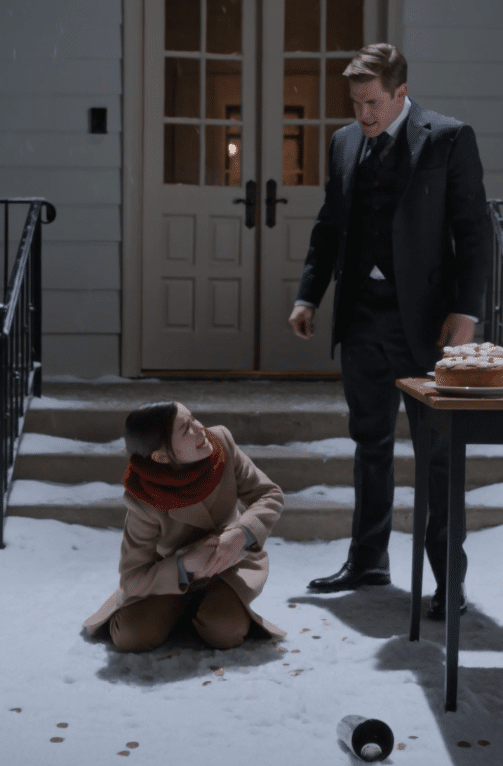
The coins scattered across the snow just as fourteen-year-old Lily Bennett dropped to her knees to collect them.
“Please, sir. That’s my money.”
The man in the expensive black coat barely glanced at her. He had already taken two homemade cakes from her table without paying, and when Lily had asked him to leave the money, he had knocked her small metal cash box onto the church steps.
Now the coins were disappearing beneath the falling snow.
Lily clutched the remaining cake box against her chest with one arm and reached for the money with the other. Her old beige coat was too thin for the weather, and the red scarf around her neck had begun to unravel at one end.
“I’m not asking you for anything,” she said, struggling to keep her voice steady. “I just need what you owe me.”
The man looked down at her with open contempt.
“You’re standing outside a church selling cakes in a snowstorm. Don’t lecture me about what I owe you.”
Lily swallowed hard.
The cakes had taken her most of the previous evening to make. She had measured the flour carefully, stretched the last of the butter, and decorated each one with the little sugar flowers her mother had taught her to make when Lily was younger.
They weren’t perfect.
But people liked them, and every dollar brought Lily closer to buying the medicine her mother needed.
Her mother, Rebecca, had been ill for months. Medical bills had swallowed their savings, and the hours Rebecca could work had become fewer and fewer. Some days, she could barely stand long enough to make tea.
Lily had begun baking after school because she couldn’t bear watching her mother pretend she wasn’t in pain.
She sold cakes at neighborhood events, outside local shops, and occasionally near the church, where people gathered for evening services. The churchgoers had been kind to her before. Some bought two cakes and paid for three. Others left small tips without asking questions.
Tonight, she had almost sold everything.
Then this man had appeared.
He had taken the cakes as though the table were his personal buffet. When Lily asked for payment, he had laughed and told her that a little girl should be grateful anyone was willing to take her food.
She had tried to explain that she needed the money for medicine.
He had knocked over the cash box.
And when she bent to retrieve it, he kicked her hard in the back.
Lily fell face-first beside the table.
The cake box slipped from her arms. Several cakes tumbled into the snow, their carefully decorated tops disappearing beneath white flakes. Her coins scattered around her hands, and her forearm scraped against the rough edge of the stone step.
A thin trace of blood appeared on her skin.
For a moment, she couldn’t breathe properly. She curled onto her side, her face tightening with pain and shock as she tried to pull her knees beneath herself.
The man stepped closer.
Before Lily could get up, he delivered two more forceful kicks into her back and side.
A woman standing near the church doors gasped.
An elderly man covered his mouth. Several churchgoers froze, staring at the scene with expressions of disbelief, but nobody reached down to help her.
Lily fought to keep the remaining cakes from sliding into the snow.
Her hands trembled.
“Please,” she whispered. “My mom needs medicine.”
The man looked at the ruined cakes and then at the scattered coins.
“Trash. Bake yourself out of poverty.”
Lily’s eyes filled with tears.
She tried to gather the coins, but her fingers were clumsy with cold and pain. A few had already disappeared beneath the snow along the edge of the steps.
The man leaned over her.
“Snow will keep your money safe.”
A bitter laugh escaped him.
Lily lowered her head, humiliated. She was fourteen years old, standing outside a church with a bleeding arm and a ruined box of cakes, listening to a grown man mock her because she was poor.
Then the church door swung open.
A tall, silver-haired man in a long black coat stepped down onto the snowy steps, followed by a medical assistant carrying a tablet.
The older man’s gaze moved from the scattered cakes to Lily on the ground.
He immediately crossed the distance between them.
“Don’t try to stand yet,” he told her gently. “Let someone check your injuries.”
He signaled to his assistant, who hurried to summon help, then positioned himself between Lily and the man who had attacked her.
Only after making sure the girl was being protected did he turn toward the bully.
His expression was controlled, but his voice carried across the steps.
“Cancel tomorrow’s surgery. I won’t operate for his family.”
The man in the expensive coat went completely still.
His face drained of color.
For the first time that night, he seemed unable to find a single cruel thing to say.
He stared at the surgeon as if he were looking at a ghost.
“Dr… Whitman?”
And suddenly, the little girl he had treated as worthless was no longer the person with the least power on those steps.
Act II
Dr. Alexander Whitman was one of the most respected surgeons in the region.
At sixty-one, he had spent decades performing complex operations that other doctors sometimes considered too risky. His work had earned him an international reputation, and his hospital had become known for handling difficult cases that required extraordinary skill.
But the people who knew him personally understood that his reputation was not built on technical ability alone.
He was demanding. He could be blunt. He had little patience for arrogance, particularly when it came from people who believed money entitled them to special treatment.
Years earlier, Alexander had grown up in a family that struggled to pay medical bills. His father had died after a long illness, and his mother had worked multiple jobs to keep the family afloat.
He remembered waiting outside hospital rooms while adults discussed whether his father could afford another treatment.
He remembered the shame of overhearing conversations about his family’s finances.
And he remembered the physician who had once taken the time to explain everything to his mother without making her feel foolish for asking questions.
That doctor had changed the way Alexander understood medicine.
He had learned that expertise was a responsibility, not a license to feel superior.
Over the years, Alexander had volunteered at community clinics, supported medical assistance programs, and donated to organizations that helped families facing overwhelming healthcare costs.
He was also deeply involved with the small church where Lily had been selling cakes.
The congregation had helped fund a local medical assistance program, and Alexander occasionally attended its winter events when his schedule allowed.
That evening, he had arrived after a hospital meeting with his medical assistant, Natalie Brooks.
They had been discussing the next morning’s surgical schedule when the church door opened and the sound of a commotion reached them.
Alexander had seen Lily on the ground before he understood what had happened.
Now he knelt beside her while Natalie contacted emergency assistance.
“What’s your name?” he asked.
“Lily.”
“I’m Dr. Whitman. Can you tell me where you’re hurt?”
“My back. My arm.”
“Are you dizzy?”
“A little.”
“Okay. Stay still for now. Help is coming.”
Lily glanced at the scattered coins.
“I need to get those.”
Alexander followed her gaze.
“We’ll make sure they’re collected.”
“My mom needs the medicine.”
“I understand.”
He didn’t tell her that the money didn’t matter. He didn’t promise that everything would magically be fine. He simply made sure she knew that someone was taking her seriously.
Natalie brought a clean cloth and helped keep Lily warm while they waited for medical personnel to assess her. Alexander asked a church volunteer to secure the remaining cakes and collect the coins from the snow.
Then he stood and faced the man in the black coat.
His name was Richard Coleman.
Richard was a wealthy real estate investor whose family had known Alexander’s hospital for years. His wife, Margaret, had been diagnosed with a serious heart condition, and after consultations with several specialists, Alexander had agreed to perform a complex operation scheduled for the following morning.
The procedure carried significant risks, but it also offered Margaret a meaningful chance of improvement.
Richard had spent weeks preparing for it.
He had spoken to hospital administrators, arranged private transportation, and made sure his family would have access to everything money could provide.
He believed the operation was the final piece of a problem he could solve by paying the right people.
When he recognized Alexander, his first instinct was to regain control.
“Doctor, I can explain.”
Alexander did not respond immediately.
He looked toward Lily, who was still being assessed.
Then he turned back to Richard.
“You attacked a child.”
“She was making a scene.”
“She was collecting money you knocked into the snow.”
Richard’s jaw tightened.
“She was selling food on the church steps. It was getting in the way.”
Alexander stared at him.
“You took her cakes without paying.”
“They were small cakes. It’s not as though she lost a fortune.”
Natalie looked up from her tablet.
The churchgoers had fallen silent.
Alexander’s voice grew colder.
“You don’t get to decide that someone else’s hardship is insignificant because the amount of money involved seems small to you.”
Richard glanced toward the crowd.
He was accustomed to people stepping aside when he spoke. He donated to charities, sponsored hospital events, and knew how to make a room respond to his presence.
He expected the same deference here.
Instead, the witnesses were looking at him as if they had finally seen him clearly.
“Doctor, my wife is scheduled for surgery tomorrow,” he said. “This is not the time to make a personal issue out of something that can be settled.”
Alexander held his gaze.
“Your wife’s condition is serious. I know that better than anyone here.”
“Then you understand why this is important.”
“I do.”
Richard exhaled, believing he had found an opening.
But Alexander continued.
“And that is precisely why I need to decide whether I can proceed with the care of your family while maintaining my professional judgment and responsibilities.”
Richard frowned.
“What does that mean?”
“It means your wife’s treatment cannot be used as leverage to excuse what happened tonight.”
Alexander had not made his decision lightly.
He knew Margaret had not been involved in the assault. He knew she was vulnerable, frightened, and relying on a team of professionals to help her through a difficult medical crisis.
He also knew that a surgeon could not simply treat medical care as a reward for good behavior or a punishment for cruelty.
The question was whether the operation could proceed safely and ethically under the circumstances, whether the clinical team could continue to work effectively, and what immediate steps were necessary to protect the patient.
Alexander would have to consider those obligations carefully.
But Richard had just demonstrated something that made the situation much more complicated: he believed the surgeon’s professional commitment to his wife gave him the right to demand silence about his own behavior.
Alexander turned to Natalie.
“Contact the hospital’s surgical leadership and ethics team. Tell them I need an urgent review of tomorrow’s case and the arrangements for continuity of care.”
Natalie nodded and began making calls.
Richard stared at her.
“You’re actually doing this?”
Alexander looked back at him.
“I’m making sure the patient is protected and that the decision is handled properly.”
Richard’s mouth opened, but he had no answer.
He had arrived at the church believing he could take whatever he wanted from a girl with no money or influence.
Now he was facing a physician who refused to confuse wealth with moral authority.
And the next conversation would determine whether Richard’s family could still trust the man scheduled to operate on Margaret’s heart.
Act III
The snow grew heavier while the church volunteers gathered Lily’s coins.
Alexander remained beside the girl until the medical team arrived. They assessed her injuries, asked her questions, and arranged for further evaluation because of the pain in her back.
Lily was frightened, but she kept looking toward the table.
Only a few cakes remained intact.
She had spent hours preparing them, and the money she had earned was supposed to cover the prescription her mother needed the following morning.
Alexander noticed her counting the recovered coins.
“What are you trying to work out?” he asked.
“How much I lost.”
“You don’t have to figure that out right now.”
“I do,” Lily replied. “The pharmacy won’t give Mom the medicine for free.”
The answer silenced him.
Alexander had spent much of his career treating people who had delayed medical care because they were afraid of the cost. He knew that financial stress could turn an ordinary illness into a crisis, particularly for families with no savings.
“What medicine does your mother need?” he asked.
Lily named the prescription and explained that her mother, Rebecca, had been treated for a chronic condition that required regular medication. Their latest bill had left them short, and Lily had hoped to make up the difference by selling cakes.
Alexander listened carefully.
He did not attempt to diagnose Rebecca from a brief conversation. Instead, he asked Natalie to contact the church’s medical assistance coordinator and determine what legitimate support might be available for the family.
The church already had a small emergency fund for prescriptions and transportation. It had been established to help residents who faced temporary financial hardship, but few people knew how to apply for it.
The coordinator agreed to review Rebecca’s situation and contact the pharmacy about appropriate assistance options.
For Lily, the possibility of help felt almost unreal.
“Does that mean my mom can get her medicine?”
“It means we’re going to find out what assistance is available and help you through the process,” Alexander said. “You shouldn’t have to handle all of this alone.”
Lily nodded, still clutching the edge of her coat.
Across the steps, Richard was speaking urgently with Natalie.
“Tell the doctor I want to speak privately.”
Natalie glanced toward Alexander.
“He’s with the patient right now.”
“Then tell him to come here.”
“I’ll let him know you requested a conversation.”
Richard looked as though he wanted to argue, but the sight of the gathered churchgoers made him lower his voice.
His concern was not entirely fabricated.
Margaret’s operation was scheduled for the next morning, and the stakes were enormous. She had been struggling with her condition for months. They had spent weeks meeting specialists, reviewing risks, and preparing for the possibility that recovery would be difficult.
Richard loved his wife.
But he had spent so long trying to control every problem through money and influence that he had begun to treat even serious medical decisions as transactions.
If he paid enough, he expected certainty.
If he donated enough, he expected loyalty.
If he was important enough, he expected other people to accommodate him.
That mindset had followed him into the church courtyard.
He had seen a girl selling cakes and assumed she was too insignificant to challenge him. When she asked him to pay, he had treated her request as an insult.
He had not considered that she might be working to buy essential medicine for someone she loved.
And now the consequences of that arrogance were spreading beyond the snowy steps.
Alexander eventually approached him.
“Your wife needs continuity of care,” the surgeon said. “The hospital’s clinical leadership is reviewing the situation now. I will not make a decision about her operation in anger, and I will not abandon her care because of your actions. But I also won’t pretend that what happened tonight is irrelevant to the professional circumstances.”
Richard’s expression shifted.
“So you’re not canceling the surgery?”
“I have not made a final decision. The hospital must determine the safest and most appropriate plan for Margaret, including whether I can proceed or another qualified surgeon should take over. That decision will be based on clinical judgment, professional obligations, and the circumstances of the case—not on revenge.”
Richard looked toward Lily.
The girl sat quietly beneath a blanket, her face pale, while a medical professional examined her arm.
For the first time, he seemed to understand that the situation had become larger than the money he had thrown into the snow.
“I didn’t know she was selling cakes for medicine,” he muttered.
Alexander’s expression did not soften.
“You didn’t ask.”
Richard looked away.
He could have apologized. He could have admitted that he had acted cruelly and offered to pay for the damaged cakes.
Instead, he tried to explain.
“I’ve had a difficult year. My wife’s illness—”
“I’m sorry your family is going through that,” Alexander said. “But suffering doesn’t give you permission to create suffering for someone else.”
Richard fell silent.
The words were simple, but they left him with nowhere to hide.
He had spent months afraid of losing his wife. He had watched her grow weaker, sat through consultations, and listened to specialists explain risks that money could not eliminate.
He knew what helplessness felt like.
Yet when he encountered a child who was frightened and desperate, he had chosen to make her feel even more helpless.
Alexander turned toward the church coordinator.
He asked that the incident be documented, that the witnesses be given an opportunity to provide statements, and that Lily’s family receive assistance through the established program without being pressured to accept anything from Richard.
He also made sure that the hospital team understood the distinction between Richard’s behavior and Margaret’s needs.
Margaret had done nothing wrong.
Her care could not become a weapon in a confrontation between two adults.
But neither could Richard expect the entire world to behave as though his actions had no consequences.
When Natalie returned, she carried an update from the hospital.
The clinical leadership team had begun reviewing the next morning’s schedule. They would assess whether the operation could safely proceed with Alexander, whether another surgeon should assume responsibility, and what communication with Margaret and her family would be required.
No decision would be made on the church steps.
Richard listened, his hands trembling inside his expensive gloves.
He had arrived expecting the surgeon to obey his request for privacy and move on.
Instead, the hospital was treating the matter seriously, and the surgeon was insisting that both patient safety and professional integrity come first.
Richard looked at Alexander.
“Please,” he said. “Don’t let my wife pay for what I did.”
For the first time that evening, his voice sounded less like a demand.
Alexander regarded him for a long moment.
“Then stop making her illness an excuse for your behavior.”
Richard lowered his head.
The snow continued to fall around them.
And for the first time, the man who had believed himself untouchable had to face a truth he could not purchase his way out of.
Act IV
The hospital called Richard shortly after midnight.
Margaret had already been admitted for preoperative preparation, and the clinical team needed to speak with both of them before finalizing the plan for the morning.
Richard sat in the back of his car with his phone pressed to his ear, listening as a hospital administrator explained the review process.
The operation had not been canceled outright.
Instead, the team was evaluating whether Alexander should proceed, whether another appropriately qualified surgeon should take over, and how to ensure that Margaret received uninterrupted care.
The administrator emphasized that the decision would be based on medical judgment and patient safety.
Richard understood every word.
He still felt panic rising in his chest.
He had spent months believing that Alexander was the one person who could make Margaret’s operation succeed. The surgeon’s experience was extraordinary, and Richard had come to depend on his calm certainty.
Now he was afraid that his own actions had damaged that relationship beyond repair.
“What can I do?” he asked.
“Your wife needs accurate information, cooperation with her medical team, and time to make any decisions required of her. We need you to remain calm and avoid pressuring staff.”
Richard ended the call without answering.
For years, people had told him that he was a difficult man. He had dismissed the criticism as envy or incompetence. He believed that his high standards were the reason he had succeeded in business.
Now he was being told that his behavior had become a concern in a setting where people could not simply walk away from him.
He looked through the car window at the falling snow.
On the church steps, Lily had been trying to collect coins from the ground.
He had looked at her and seen a nuisance.
He had never imagined that she might be frightened for her mother’s life, just as he was frightened for Margaret’s.
When he reached the hospital, Margaret was awake in her room.
She was fifty-eight, with dark hair streaked silver at the temples and a quiet manner that often made people underestimate how much she noticed. She had been married to Richard for thirty-one years.
She knew his temper. She knew how he could turn a small inconvenience into a battle. She had spent years persuading him to be more patient with service workers and less dismissive of people who couldn’t afford the things he took for granted.
When Richard entered the room, she studied his face.
“What happened?”
He sat beside her bed.
“There was an incident at the church.”
“What kind of incident?”
Richard hesitated.
He considered minimizing it. He could describe an argument, a misunderstanding, a girl who had become upset after he objected to her selling cakes outside the church.
But Margaret had known him too long to accept a story designed to protect his pride.
“There’s a girl who was selling cakes,” he admitted. “I took some without paying. I knocked her money box into the snow. Then I hurt her.”
Margaret stared at him.
“You hurt a child?”
Richard looked down.
“Yes.”
“Why?”
He had no answer that did not make him sound as cruel as he had been.
“She was in the way,” he finally said.
Margaret closed her eyes.
For a moment, the only sound in the room was the steady rhythm of the medical equipment.
“Richard,” she whispered, “what is wrong with you?”
He flinched.
She had criticized him before, but rarely with such disappointment.
“I was angry.”
“That doesn’t answer the question.”
He rubbed his hands together.
“I thought I could make her move.”
“And when she didn’t?”
He said nothing.
Margaret turned her face toward the window.
“I have spent months worrying about whether I’ll survive this operation. I’ve been frightened every day, and I’ve tried not to let it consume me. But I never thought that my illness gave me the right to make someone else’s life worse.”
Richard’s eyes filled.
“I didn’t think.”
“No,” she said. “You didn’t.”
The words hurt more than any public accusation.
Margaret had never been impressed by his wealth. She had loved him when he was building his first company, when they lived in a small house and counted every dollar. She remembered the man who used to bring home groceries for an elderly neighbor and quietly fix broken steps without asking for payment.
She did not understand when he had decided that success made him more important than everyone around him.
“Did you apologize?” she asked.
Richard shook his head.
“Then that’s where you start.”
He looked at her.
“What if he won’t let me?”
“Then you accept that. An apology isn’t a way to demand forgiveness.”
Richard sat quietly.
For the first time since the incident, he stopped thinking about how to restore his own position and began considering what Lily had actually experienced.
He remembered the way she had held the cake box against her chest, even after he knocked her down. He remembered her voice when she said her mother needed medicine.
He had mocked her poverty because he assumed she had no power to answer him.
Now he understood that the most important person in the room had never been him.
The next morning, the hospital’s clinical team completed its review.
Alexander would not be the sole decision-maker about the arrangements for Margaret’s care. The hospital ensured that an appropriate surgical plan was in place, with qualified clinicians available and Margaret fully informed about her options.
After careful review, the team determined that the operation could proceed under a revised care arrangement with another senior surgeon taking the lead and Alexander available for consultation if needed.
Margaret agreed to the plan after discussing the risks and benefits with her doctors.
The operation went ahead.
It was long and difficult, but the surgical team completed it successfully. Margaret was transferred to recovery, where her condition was monitored closely.
Richard waited outside the operating area, unable to do anything but sit and listen for updates.
For once, he could not buy certainty or command an outcome.
He had to trust the professionals caring for his wife.
When the surgeon finally came out to speak with him, Richard stood so quickly that his chair scraped against the floor.
“She made it through the operation,” the doctor said. “The next stage is recovery, and we’ll be watching her closely.”
Richard covered his face with both hands.
Relief washed through him, followed by shame.
Margaret had received the care she needed. The hospital had not allowed his behavior to put her at risk, and the clinical team had made its decision according to its responsibilities.
He could no longer tell himself that cruelty was justified by fear.
But there was still one person he needed to face.
A fourteen-year-old girl who had been trying to buy medicine for her mother.
Act V
Three days later, Richard returned to the church.
He did not arrive in his car with an entourage. He came alone, carrying an envelope containing payment for the cakes that had been destroyed and a letter he had rewritten several times.
The church courtyard was quiet. Snow remained along the edges of the steps, but volunteers had cleared a path to the entrance.
A church coordinator met him at the door.
“Lily is here with her mother,” she said. “They know you’d like to speak with them, but the decision is theirs.”
Richard nodded.
“Of course.”
He waited outside the small community room until Rebecca agreed to see him.
Lily sat beside her mother, wearing the same beige coat and red scarf. Her arm was bandaged, and she looked tired, but she was sitting upright.
When Richard entered, she immediately became still.
Rebecca moved closer to her daughter.
Richard stopped several feet away.
He did not approach them without permission.
“My name is Richard Coleman,” he began, though Lily already knew it. “I came to apologize for what I did.”
Lily looked down at her hands.
Richard placed the envelope on a table rather than pushing it toward her.
“I took your cakes without paying. I knocked your money box into the snow, and I hurt you when you were trying to collect it. I humiliated you in front of people who should have been able to feel safe outside their own church.”
His voice shook.
“There is no excuse for what I did. Not my stress, not my wife’s illness, not the weather, and not anything you said or did. I was wrong.”
Lily said nothing.
Richard continued.
“I brought payment for the cakes and the money you lost. You don’t owe me forgiveness because I brought it. I just wanted to make sure you weren’t left paying for what I destroyed.”
Rebecca looked at the envelope but did not touch it.
“Why did you do it?” she asked.
Richard could have said that he had been upset. He could have blamed the weather, his fear, or the pressure of the operation.
Instead, he answered honestly.
“Because I thought I could treat her that way and nothing would happen to me.”
Rebecca’s expression hardened.
“And now something has happened to you.”
“Yes.”
“Your wife was never responsible for what you did.”
“I know.”
“Then don’t make her illness an excuse again.”
Richard lowered his head.
“I won’t.”
Lily finally looked up.
“Did your wife get her surgery?”
Richard nodded.
“She did. The doctors said the operation went as planned. She’s recovering now.”
Lily’s shoulders loosened slightly.
“I’m glad.”
The simplicity of her response nearly broke him.
She had every reason to hate him. He had injured her, destroyed the money she had worked for, and mocked the very reason she had been standing in the snow.
Yet when she heard that Margaret had survived the operation, Lily had responded with genuine relief.
Richard understood then that the girl he had dismissed as worthless possessed something he had failed to show in that courtyard.
Compassion.
He thanked her, though he knew gratitude was not what she needed from him.
Then he stepped back and let Rebecca decide whether the conversation was over.
She did not offer forgiveness.
She did not tell him that everything was all right.
She simply said, “We need time.”
Richard nodded.
“You deserve it.”
He left the room without asking for anything else.
Outside, the church had resumed its usual rhythm. Volunteers were arranging tables for a community meal, and someone was carrying fresh bread through the doorway.
Richard stopped near the steps where the money box had fallen.
The snow had melted, leaving only damp stone and a few dark marks where the cakes had been crushed.
He could still picture Lily kneeling there, trying to save the coins.
He had thought her smallness made her powerless.
He had thought his money made him untouchable.
Neither belief had survived the truth.
In the weeks that followed, Margaret continued her recovery under medical supervision. Richard spent more time at her bedside and less time treating every disagreement as a contest he had to win.
He also made a private donation to the church’s medical assistance fund, but he did not attach his name to it or ask the congregation to publicize the gift. The church accepted the contribution under its normal procedures and used the funds to support families struggling to pay for essential care.
Lily and Rebecca applied for assistance through the same program, receiving help with the prescription costs and referrals to local services that could support Rebecca’s ongoing treatment.
Lily eventually returned to baking.
At first, she made only a few cakes at a time, and she sold them with her mother’s help. She was still nervous when strangers approached the table, especially men wearing expensive coats.
But the churchgoers who had witnessed the assault began stopping by to buy from her.
Some purchased cakes for their families. Others paid for a box and asked Lily to keep the change. One retired teacher offered to help her calculate ingredient costs so that she could make a little more from each batch.
Nobody treated her like a charity display.
They treated her like a girl with a skill, a family to care for, and a future worth protecting.
One afternoon, several weeks after the incident, Alexander Whitman stopped by the church after finishing his clinic appointments.
He found Lily arranging small lemon cakes beneath a clear cover.
“How’s business?” he asked.
She smiled cautiously.
“Better than before.”
“And your mother?”
“She’s doing better too.”
Alexander nodded.
“I’m glad to hear it.”
Lily glanced toward the church steps.
“Dr. Whitman?”
“Yes?”
“Did you really mean it when you said the surgery might be canceled?”
Alexander took a moment before answering.
“I meant that what happened was serious and needed to be addressed. But a patient’s care should never be used as a weapon. The hospital’s responsibility was to make sure your family was protected and that Margaret received safe, appropriate treatment.”
Lily considered that.
“So you didn’t punish her because of him.”
“No,” Alexander said. “I didn’t make her responsible for his choices.”
Lily nodded slowly.
She had been thinking about that distinction since the night in the snow. She had watched an adult use power to hurt someone smaller, and then watched another adult use his authority to protect her without asking for anything in return.
It had shown her that power itself was not the difference between cruelty and kindness.
The difference was what a person chose to do with it.
Alexander bought two lemon cakes and placed more money on the table than they cost.
Lily started to return the extra.
He smiled.
“That’s for the next batch.”
She laughed softly and accepted it.
As he walked away, the church bell rang above them, its sound carrying into the cold afternoon.
Lily watched the snow drifting beyond the steps.
She still remembered the night her money box had been knocked into the snow. She remembered the pain, the humiliation, and the awful feeling that nobody would help because nobody thought she mattered.
But she also remembered the moment the church door opened.
The moment someone saw her—not as a nuisance, not as a poor child, and not as an obstacle to an important man’s evening—but as a human being who deserved to be safe.
Richard Coleman had feared losing control of his wife’s medical future.
What he had needed to lose was the belief that money placed him above everyone else.
And Lily Bennett, the girl he had mocked for baking her way out of poverty, had reminded him of something no fortune could purchase.
A person’s worth is not measured by what they can afford.
It is measured by how they treat someone who has nothing to offer them in return.